

The easiest way to spot a fake Rolex comes down to three things: its weight, the flawless sweep of its second hand, and the 2.5x magnification of the Cyclops lens. These are the details counterfeiters consistently get wrong, and they can often expose a fake within seconds of you picking it up.
The First Glance Signs of a Genuine Rolex
Your first 30 seconds with a watch can tell you almost everything you need to know. Before you even think about serial numbers or hidden engravings, trust your senses. A genuine Rolex feels different, moves differently, and looks different up close. It's all about recognizing the signature of true luxury craftsmanship, which starts the moment the watch is in your hand.
Quick Rolex Authenticity Checklist: Real vs. Fake
Here's a quick comparison of what to look for when you first handle a watch. These are the most common and immediate tells that separate a genuine piece from a replica.
| Feature | Genuine Rolex Characteristic | Common Fake Characteristic |
|---|---|---|
| Weight & Feel | Substantial, dense, and well-balanced due to 904L steel. | Surprisingly light, flimsy, or unbalanced. Hollow links. |
| Second Hand | Smooth, continuous sweep (around 8 ticks per second). | Obvious, jarring "tick-tock" motion (one tick per second). |
| Cyclops Lens | Precise 2.5x magnification. Date pops and fills the window. | Weak magnification (often 1.5x), date looks small and flat. |
| Dial Text | Crisp, perfectly spaced lettering with clean, sharp edges. | Blurry, smudged, or uneven text. Spacing is often wrong. |
| Crown & Engravings | Finely detailed engravings on crown, caseback, and rehaut. | Sloppy, shallow, or acid-etched engravings. Poor detail. |
Mastering these initial checks will sharpen your eye and build your confidence in spotting fakes right away.
Feel the Weight and Substance
The first thing you should always do is simply pick it up. A real Rolex has a satisfying heft to it, a dense feeling that speaks to the quality of its materials. This isn't just a perception; it's a direct result of Rolex using superior metals.
Genuine models are crafted from a solid block of 904L Oystersteel, a high-grade alloy that's heavier and more corrosion-resistant than the 316L steel found in nearly all fakes. An authentic Oyster Perpetual, for example, can weigh between 150-200 grams. Solid gold models are significantly heavier.
This substantial feeling comes from the solid metal links, a dense case, and the precision-engineered movement inside. A counterfeit, even a "super clone," will almost always feel lighter or poorly balanced in your hand—a dead giveaway that cheaper materials were used.
Observe the Second Hand Sweep
Next, just watch the second hand. This is one of the most classic tells. A real Rolex is powered by a high-end automatic movement, which means the second hand doesn't "tick" once per second like a cheap quartz watch. Instead, it glides in a smooth, nearly silent sweep around the dial.
Expert Tip: While it looks like one fluid motion, the second hand on a genuine Rolex actually moves at about 8 tiny ticks per second. This rapid movement is what creates that signature illusion of a perfect sweep. A quartz fake will have a jarring, start-stop tick that is immediately obvious.
While some higher-end fakes now use automatic movements to mimic this effect, they rarely achieve the same flawless grace of a true Rolex Calibre. If you notice any stuttering, choppiness, or hear an audible ticking sound, it’s a major red flag.
Check the Cyclops Magnification
If the watch has a date window, your eyes should go straight to the Cyclops lens—that little magnifying bubble on the crystal. Rolex invented this feature for one reason: to make the date perfectly legible.
A genuine Rolex Cyclops provides a precise 2.5x magnification, no more, no less. The date should appear large and crisp, completely filling the window. It should literally "pop" out at you. Counterfeits almost never get this right.
- Fake Rolex: The magnification is usually weak, closer to 1.5x, making the date look small, flat, and sometimes blurry or off-center.
- Genuine Rolex: The date is magnified perfectly by 2.5x, appearing sharp and centered directly over the aperture.
This quick three-step process is a great first line of defense. The infographic below visualizes these crucial initial checks.
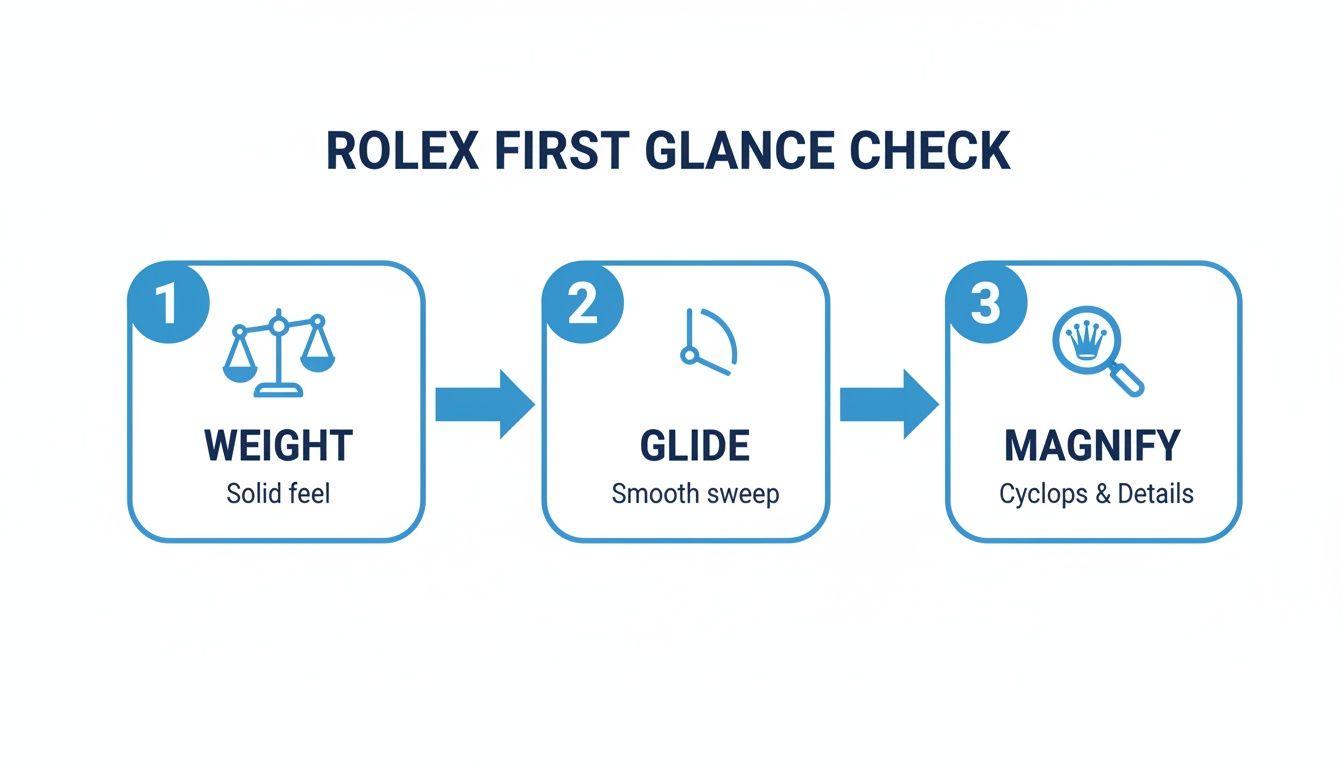
These three pillars—weight, movement, and magnification—form the foundation of any quick authenticity check. For a deeper dive into what to look for next, this expert authentication guide is an excellent resource. By mastering these first few observations, you'll be well on your way to spotting fakes with confidence.
Diving Deep Into the Dial: Where Fakes Fall Short
Alright, you've given the watch a quick once-over. Now it's time to zoom in on the dial. This is where Rolex’s obsession with perfection truly comes to life, and it’s almost always where counterfeiters, even the really good ones, slip up. A genuine Rolex dial is a marvel of micro-engineering, and a close look will tell you everything you need to know.
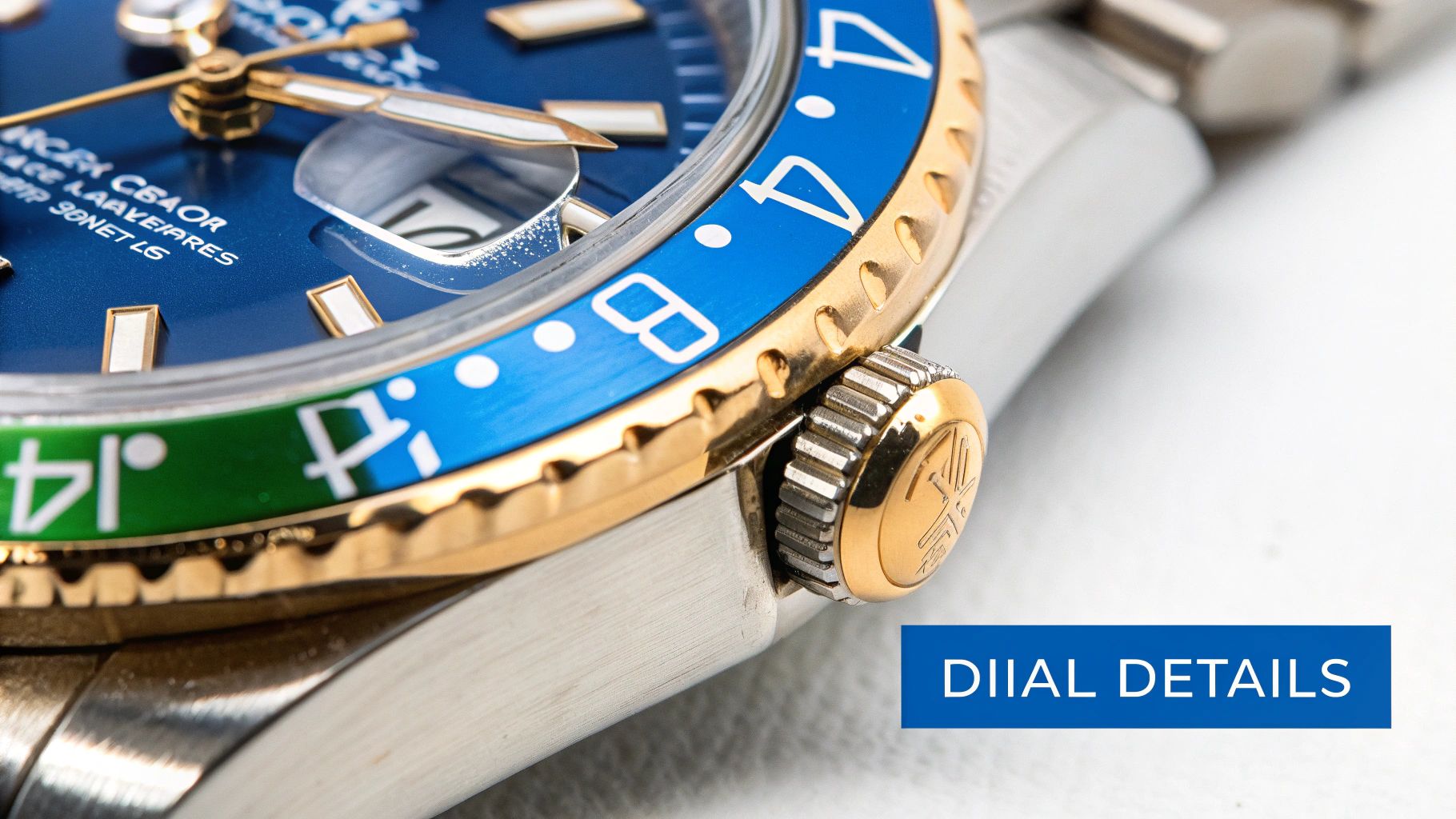
The Cyclops Lens Is Your Best Friend
Remember the Cyclops lens over the date? It’s one of the most powerful authentication tools you have. In fact, checking the date magnification is one of the fastest ways to expose a fake. A real Rolex has a Cyclops that provides a very specific 2.5x magnification. The result is a date that looks big, bold, and perfectly fills the window with zero distortion.
Fakes almost never get this right. They often use cheap magnifiers that only hit 1.5x (or even less), making the date look small, weak, and sometimes blurry. Think of it like looking through a high-end camera lens versus a disposable one—the difference in clarity is night and day. On a genuine Rolex, the date pops. On a fake, it just sits there.
A Quick Cyclops Test: Look at the watch straight on, then slowly tilt it from side to side. A genuine Cyclops lens holds its magnification and clarity across different angles. A fake one will often distort or lose its magnifying power as you move the watch. This is a dead giveaway.
This one feature is incredibly difficult and expensive to replicate, which is why it's such a reliable tell. If that date looks anything less than perfect, you should be suspicious.
Examine Every Letter and Marker
Next, grab a magnifying glass—a jeweler's loupe is even better—and get up close with the text on the dial. Every single letter and number on a genuine Rolex dial is applied with absolute precision. The edges are razor-sharp, the spacing is perfect, and the alignment is flawless.
This is where counterfeiters cut corners with cheaper printing methods. Under magnification, you'll start to see imperfections.
- Blurry or Smudged Edges: The text for "Submariner" or "Oyster Perpetual" might look fuzzy around the edges.
- Uneven Spacing: You might notice inconsistent gaps between letters, a tiny mistake that would never pass Rolex's quality control.
- Slightly Off Fonts: Fakes often use a font that's close but not an exact match to the official Rolex typeface.
The same rules apply to the hour markers. Whether they're batons, dots, or Roman numerals, they should be perfectly set and finished. If you see any trace of glue, poor alignment, or rough finishing, you're looking at a major red flag.
The Lume Glow and Application
The luminous material, or "lume," on the hands and markers is another detail fakes struggle with. Rolex uses its own proprietary Chromalight lume, which casts a bright, long-lasting blue glow in the dark. On older models, you might see the green glow of Super-LumiNova.
The key here isn't just the color, but how it's applied and how it performs.
- Charge the Lume: Hold the watch under a bright light for 15-30 seconds.
- Move to a Dark Room: Check out the glow. It should be incredibly bright and perfectly even across all the hands and markers.
- Look for Consistency: A fake often has a splotchy or uneven glow. Some markers might be dimmer than others, and the light often fades much faster than on a genuine model.
Even in daylight, the lume should look perfect—neatly applied within the borders of the hands and markers with no spillover.
The Winding Crown and Its Markings
Go ahead and unscrew the winding crown. On a real Rolex, the action is buttery smooth and precise, whether you're winding the watch or screwing the crown back down. Fakes often feel gritty, loose, or just plain cheap.
With the crown unscrewed, take a close look at the engraved Rolex coronet on the end. The logo should be sharp and finely detailed. Right below it, you'll find tiny markings that tell you about the waterproof system:
- A single line or two dots: This indicates a Twinlock crown, commonly found on watches like the Datejust.
- Three dots: This signifies a Triplock crown, which provides superior water resistance for professional models like the Submariner and Sea-Dweller.
Counterfeiters frequently use generic crowns with poorly stamped logos, or they miss these critical markings altogether.
The Simplicity of the Caseback
Finally, flip the watch over. With only a few rare vintage exceptions (like some early Sea-Dweller models), a genuine Rolex has a completely plain, smooth, and polished steel caseback. It's famous for being unadorned.
This is a classic mistake counterfeiters make—they overdo it. They assume a luxury watch should have engravings and logos everywhere. If you see a Rolex with a transparent exhibition caseback showing the movement, or a caseback engraved with a logo, model name, or serial number, you can be almost certain it's a fake. Rolex puts its artistry on the inside, keeping the exterior clean, classic, and functional.
Analyzing the Bracelet and Clasp Construction
A Rolex bracelet is so much more than a strap; it's a piece of precision engineering. The way it feels, sounds, and moves in your hands is one of the quickest ways to sniff out a fake. Counterfeiters just can't match the quality of the materials or the level of finishing that goes into a genuine Rolex bracelet.
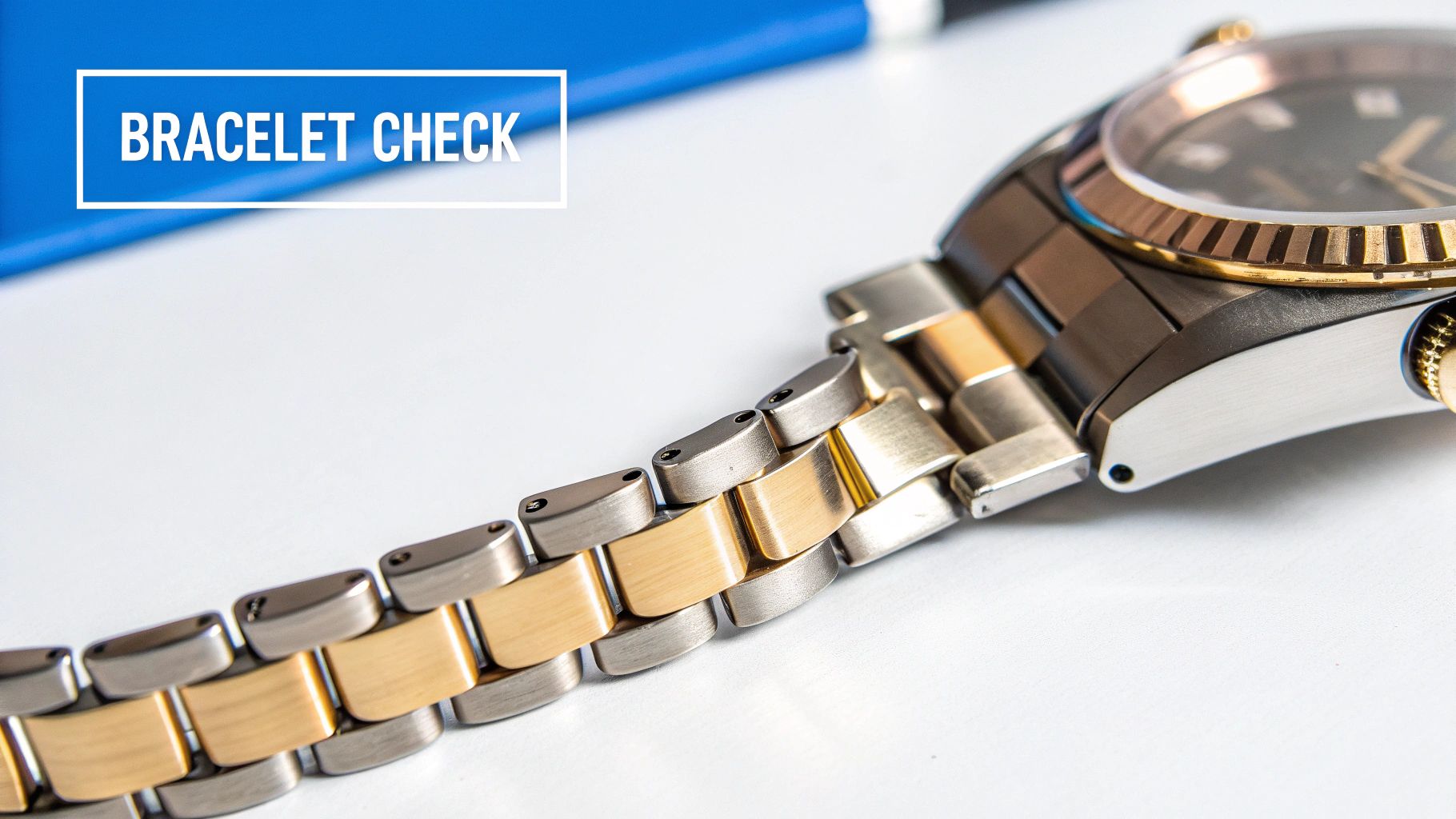
Whether it’s the iconic three-link Oyster, the elegant five-link Jubilee, or the prestigious President, each style has a distinct character. A real Rolex bracelet feels solid and substantial, but also incredibly fluid. Run your fingers over it—the links should articulate smoothly with zero sharp edges.
A fake, on the other hand, often feels flimsy and surprisingly light. Give it a gentle shake. If you hear a cheap, tinny rattle, that's a massive red flag. That sound comes from poorly fitted, hollow links made from cheap metal—a world away from the solid steel or gold of a genuine model.
The Clasp: A Masterclass in Security and Detail
The clasp is where function meets branding, making it a prime spot to catch fakes. A genuine Rolex clasp closes with a smooth, secure, and deeply satisfying click. It feels like a high-end mechanism because that's exactly what it is.
Take a close look at the engravings on the clasp. On a real Rolex, the coronet (crown logo) and other markings are engraved deeply and crisply. The lines are sharp and the logo is perfectly formed. Fakes usually have shallow, fuzzy-looking logos that are laser-etched or poorly stamped.
Expert Insight: The tolerances on a real Rolex clasp are incredibly tight. There should be absolutely no wiggle or play when it's closed. Counterfeit clasps often feel loose and insecure, a detail that becomes obvious once you’ve handled the real deal.
This obsession with detail is a hallmark of Rolex. Every single part of the clasp, from the folding arms to the safety latch, is built for security and a lifetime of use. If any part feels cheap or poorly made, you're almost certainly looking at a fake.
Examining the Links and Screws
Another subtle but critical tell is how the bracelet links are held together. Modern Rolex bracelets use proprietary screws to secure the removable links, not cheap friction pins.
Grab a small screwdriver or a jeweler's loupe and inspect these screws.
- Genuine Rolex: The screws are perfectly machined with a clean slot and sit completely flush with the side of the link. The threading is precise and smooth.
- Fake Rolex: Counterfeiters often use simple friction pins that you can see from the side. If they try to mimic screws, they are often just decorative caps on a pin, or the screw head is poorly finished and doesn't sit flush.
This is a small detail that reveals a lot about the overall manufacturing quality. To get even deeper into the specifics of each bracelet style, check out this comprehensive guide to Rolex bracelets. Understanding these differences will sharpen your ability to tell if a Rolex is real.
Finding the Hidden Marks of Authenticity
Beyond the obvious external features, Rolex integrates subtle security marks that are incredibly difficult for even the best counterfeiters to replicate. These hidden details are Rolex’s silent signature—the little things that separate a genuine timepiece from a convincing fake.
Finding them just requires a keen eye and knowing exactly where to look.
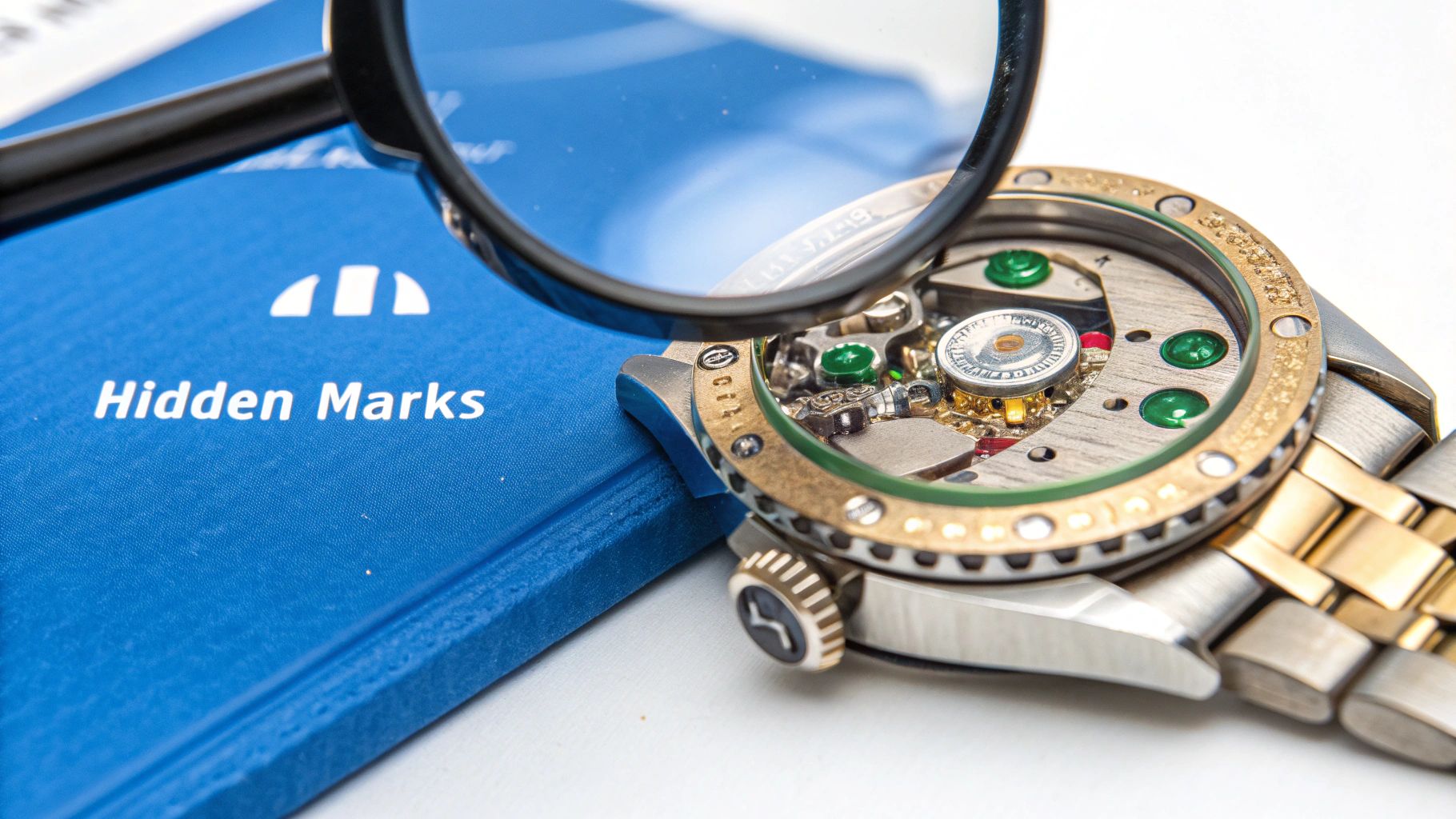
From nearly invisible engravings to unique serial numbers, these marks provide a definitive layer of authentication. They prove the watch's identity and history, and spotting them is a crucial skill.
Locating the Serial and Model Numbers
Every single Rolex has a unique serial number and a model (or reference) number. Think of them as the watch's fingerprints. Their location, however, depends on the watch's age.
For Rolex models produced before 2005, you'll have to remove the bracelet to find these engravings. It's the only way.
- The serial number is engraved deeply and precisely between the lugs at the 6 o'clock position.
- The model/reference number is in the same spot, but on the 12 o'clock side.
On a real Rolex, these engravings are cut into the metal with diamond-tipped tools. This creates sharp, clean lines that catch the light beautifully. Fakes often use a shallow acid-etching process that leaves a sandy, dotted, or fuzzy appearance.
Around 2005, Rolex started engraving the serial number on the inner bezel ring, known as the rehaut, right at the 6 o'clock position. By 2008, this became the standard. You'll also see the word "ROLEX" engraved repeatedly around the rehaut—a feature counterfeiters almost always fail to align perfectly with the minute markers.
Key Takeaway: The quality of the engraving matters just as much as its location. Look for deep, flawless lines that shine when you tilt the watch. Any shallow, poorly spaced, or fuzzy-looking numbers are an immediate red flag.
The Elusive Laser-Etched Coronet
This is one of my favorite security features—the laser-etched coronet (LEC). Introduced around 2002, it's a tiny, almost invisible Rolex crown logo etched directly onto the sapphire crystal at the 6 o'clock position. It’s so small you'll need a jeweler's loupe and just the right angle of light to spot it.
Finding it can be tricky, but here’s a method that works for me:
- Grab a bright, focused light source, like an LED penlight.
- Shine it at an angle across the crystal, aiming from the 12 o'clock side down toward the 6.
- Look through a magnifying glass at the 6 o'clock marker. The tiny crown, made of microscopic dots, should pop into view.
Fakes that try to replicate the LEC almost always get it wrong. Their version is often too big, too easy to see, or just poorly formed. The real deal is subtle and perfect. If you can spot it with your naked eye, you're probably looking at a fake.
Scrutinizing the Paperwork
While a watch can be 100% authentic without its original box and papers, having them adds another strong layer of verification. But be warned: paperwork can be counterfeited, too. You have to inspect the documents with the same critical eye you use on the watch itself.
Look for high-quality printing on premium paper. The fonts should be crisp, and the Rolex branding must be perfect. The warranty card, in particular, must have the correct serial and model numbers that match the engravings on the watch.
An authentic warranty card feels substantial, almost like a credit card, and will have zero spelling errors or printing flaws. For anyone learning how to know if your Rolex is real, a complete, matching set of paperwork is a very strong sign you're on the right track. For a deeper dive into these crucial identifiers, check out our detailed guide to Rolex serial and reference numbers.
Why Professional Authentication Is Essential
You’ve checked the weight, scrutinized the dial, and examined every hidden mark. While the tips in this guide are incredibly powerful for weeding out most fakes, the reality is that the world of counterfeit watches is always evolving. The rise of so-called "superfakes" has created replicas so convincing they can fool even a seasoned enthusiast.
This is where visual inspection hits its limit. It’s the point where professional expertise becomes absolutely non-negotiable. It’s the difference between feeling confident and being completely certain. For an investment as significant as a Rolex, certainty is the only thing that matters.
The Movement: The Unmistakable Heartbeat of a Rolex
The single most definitive way to know if a Rolex is real is to inspect the movement. This is the intricate mechanical engine that powers the watch—a work of art that counterfeiters simply cannot replicate with the same level of precision, finishing, or materials.
This is one step you should never attempt yourself. Opening a Rolex caseback without the proper tools and training can instantly compromise its water resistance, damage the delicate movement, and void any warranty. This is a job for a certified watchmaker, period.
Inside a genuine Rolex, an expert will be looking for:
- Signature Finishing: Rolex movements have a distinct and beautiful finish, with specific patterns and polished components that are instantly recognizable to a trained eye.
- Caliber Markings: Each movement is engraved with its specific caliber number. An expert can verify these markings are correct for the model and its production year.
- Proprietary Components: Things like the iconic red reversing wheels or the unique balance wheel are proprietary to Rolex. In fakes, they're either absent or just poorly copied.
A counterfeit movement might look complex to an untrained eye, but to a professional, it’s full of obvious shortcuts. They’ll spot the wrong color metals, cheaper jewels, and a general lack of the refined finishing that defines every authentic Rolex Calibre.
This internal inspection is the final word in authentication. It moves past what the watch looks like on the outside and verifies the very soul of the timepiece.
The High Cost of a Mistake
Let's be blunt: the main reason to get a professional authentication is to protect your investment. A high-end fake can cost thousands of dollars, tricking buyers into paying a premium for a worthless watch. The financial loss is crushing, but so is the disappointment of discovering your prized possession isn't what you thought it was.
An expert verification provides the peace of mind that your hard-earned money was spent on a genuine, valuable asset. It’s a small cost upfront that prevents a potentially massive loss down the line.
A professional can also spot issues that go beyond authenticity. They might find signs of water damage, non-genuine replacement parts from a sloppy repair, or a movement that is in desperate need of a service. This is critical information for any buyer or owner.
Once authenticated, getting a professional jewelry appraisal for insurance is often the next essential step. This ensures your investment is covered against theft, loss, or damage at its true market value.
Trusting the Experts at ECI Jewelers
When it comes to something as valuable as a Rolex, you need an authority you can trust without question. For over 25 years, ECI Jewelers has been a trusted name in luxury watch authentication and sales. Our specialists have inspected thousands of timepieces, developing an unmatched eye for the subtle tells of both genuine and counterfeit watches.
We provide a 100% authenticity guarantee on every watch we sell. That promise is backed by rigorous, multi-point inspections performed by our in-house experts. This process is about more than just checking boxes; it’s about upholding the integrity of the brands we carry and ensuring our clients get nothing but the best.
Professional authentication isn’t just another step—it's the ultimate safeguard. Whether you are buying, selling, or just want to confirm the history of a family heirloom, turning to a trusted authority is the only way to be absolutely certain.
If you're looking for that definitive answer, our experts can provide the clarity and confidence you need. Learn more about our personalized watch concierge and authentication services and let us help you protect your investment.
A Few Common Rolex Authentication Questions
Even with a checklist in hand, certain questions always seem to pop up. These are the little details that can make you second-guess what you're seeing. Let's tackle some of the most frequent ones I hear to give you more confidence in your assessment.
Does a Sweeping Second Hand Mean My Rolex Is Real?
This used to be the gold standard for spotting a fake, but times have changed. While that iconic, smooth glide of the second hand is a Rolex signature, it's no longer a foolproof sign of authenticity.
A genuine Rolex movement makes about 8 tiny ticks per second, which creates that flawless, almost silent sweep. A cheap quartz fake is an easy giveaway with its loud, clunky, once-per-second tick. The problem is, the counterfeiters have gotten much better. High-end replicas, or "superfakes," now use automatic movements that do a surprisingly good job of mimicking the sweep. It’s rarely as perfect as a true Rolex Calibre, but it’s close enough to fool an untrained eye.
So, think of the sweeping hand as a starting point—a good first check, but not the final word. You have to pair it with other clues, like the feel of the watch's weight, the magnification on the Cyclops, and the sharpness of the dial printing.
Can a Fake Rolex Be Made with Real Gold?
It’s almost unheard of for a counterfeit Rolex to be made of solid gold. The cost of the raw material alone would destroy the counterfeiter's profit margin. What they do instead is take a cheap base metal, usually stainless steel, and plate it with a thin layer of gold to get the look without the cost.
Here are a few ways to spot the difference:
- The Weight Test: Solid gold is much, much heavier than steel. A plated watch will feel noticeably lighter than a genuine solid gold Rolex of the same model.
- Look for Wear: Gold plating eventually wears off, especially around the clasp, the crown, and the sharp edges of the bracelet links. If you see a different colored metal peeking through, that's a dead giveaway.
- Check the Color: Rolex has its own foundry and creates proprietary gold alloys, like its famous 18k Everose gold. Fakes often get the color wrong, looking too brassy, overly yellow, or having a cheap coppery shine that just doesn't match the rich hue of a real Rolex.
Of course, the only 100% certain way to know is to have a jeweler perform a precious metal test, which can confirm the material without damaging the watch.
Key Takeaway: If you see a "solid gold" Rolex being offered at a price that seems too good to be true, it is. The market price of gold creates a floor for a genuine model's value that fakes simply can't compete with.
Is It Safe to Buy a Rolex Without Its Original Box and Papers?
Absolutely—if you're buying from the right seller. It's very common to find a legitimate, pre-owned Rolex being sold "naked," meaning without its original box and paperwork. Over decades, these items get lost, damaged, or simply thrown away.
The watch's authenticity is what truly matters, and an expert can verify that with or without the original papers. In fact, counterfeiters have gotten so good that even the box and warranty cards can be faked. This is why the seller's reputation is everything.
A trusted dealer will stand behind the watch with their own airtight guarantee of authenticity. That guarantee is far more valuable than a questionable set of original papers from an unknown seller. While a full set is a nice bonus for collectors and can add value, its absence doesn't mean the watch is fake.
When you're navigating the pre-owned market, nothing beats the peace of mind that comes from trusting an expert. At ECI Jewelers, every single watch we sell is meticulously inspected and backed by our 100% authenticity guarantee, so you know your investment is safe.
Explore our curated collection of certified pre-owned luxury watches at https://www.ecijewelers.com.


