


You're probably looking at two Rolex sport watches that seem close enough at first glance that the choice feels harder than it should. One says classic dive watch. The other says nautical luxury. For a serious first-time buyer, that's exactly where the confusion starts, because the Yacht-Master and Submariner share Rolex DNA but serve different kinds of owners.
The Submariner sits near the center of the luxury sports watch category as Rolex's foundational dive instrument, while the Yacht-Master is the more refined nautical sibling for buyers who want sport-watch credibility with a dressier edge. This guide is for the collector weighing history, wrist feel, modern references, and secondary market pricing before making a meaningful purchase. By the end, you'll have the context to buy with confidence.
- Technical split: Current Submariner models publish 300 metres / 1,000 feet of water resistance, while current Yacht-Master models publish 100 metres / 330 feet, reflecting different hardware priorities and use cases according to Rolex's Yacht-Master specifications.
- Easiest entry point: On the market side, a steel Submariner is the easiest starting point for many buyers, with retail at about $10,050 and trading around $11,500 to $14,500 according to Majestix Collection's Yacht-Master vs Submariner market review.
- Value position: The Yacht-Master usually asks more upfront for luxury finishing and broader material choice, while the Submariner tends to offer stronger liquidity and resale momentum in the same market review from Majestix Collection.
There are a few different eras and variants to understand before either watch makes sense on paper. Once you know what changed, the decision becomes much clearer.
Introduction to the Yacht-Master and Submariner
A lot of buyers arrive at this comparison after narrowing the field to “one Rolex sports watch I can wear everywhere.” Then they hit a wall. The Yacht-Master looks close enough to the Submariner that it seems like a style choice, but the ownership experience is different once you wear them, time with them, and eventually think about resale.
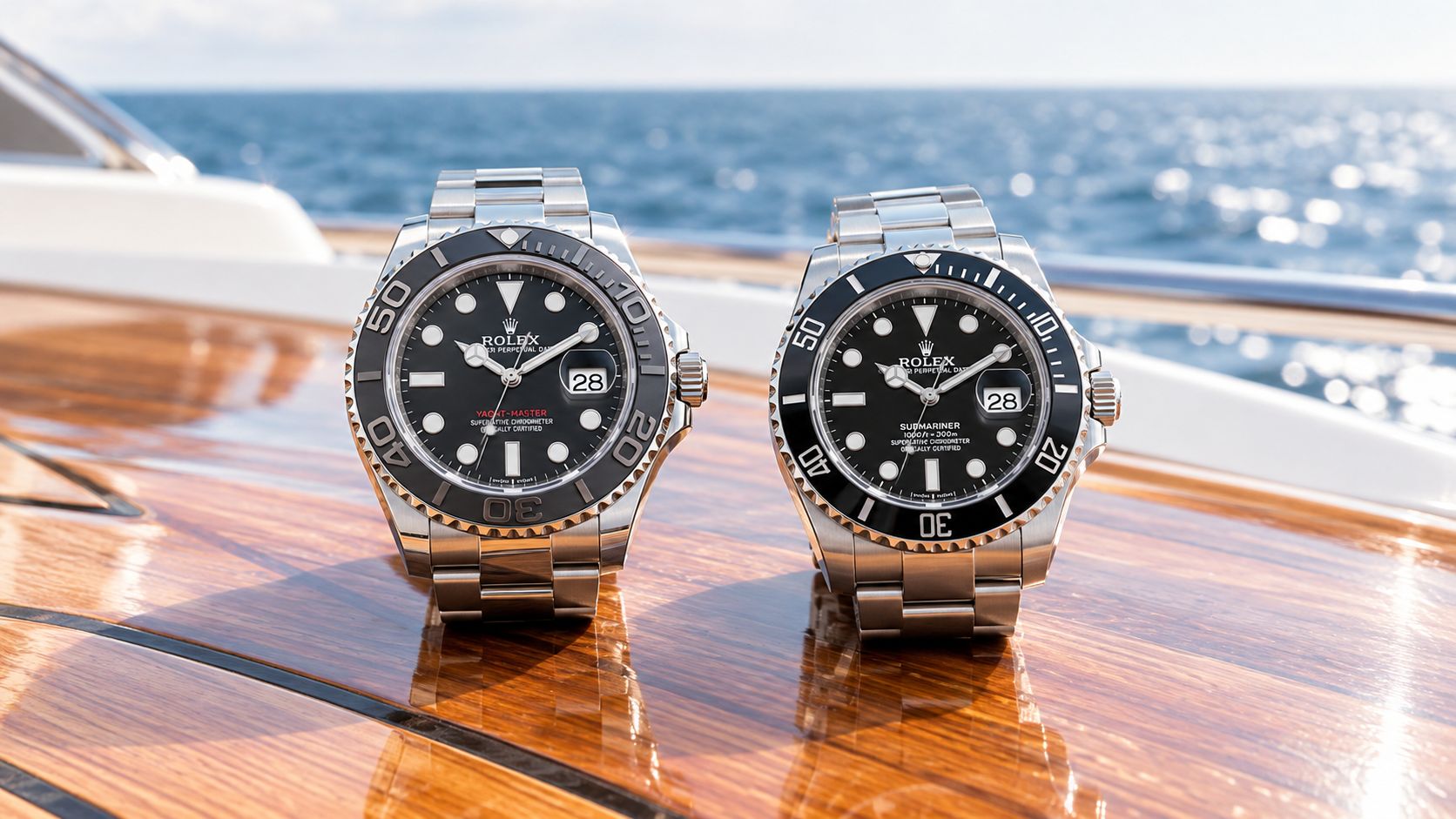
The simplest way to understand how Yacht-Master and Submariner compare is this. The Submariner is the original-purpose tool watch in the pair. The Yacht-Master is the later, more luxurious nautical interpretation. They aren't just two sizes of the same idea, and they aren't aimed at the exact same buyer.
Who usually gets stuck between them
Most serious first-time Rolex buyers fall into one of three groups:
- The one-watch buyer: wants one Rolex that can travel, swim, and handle daily wear without second-guessing it.
- The style-conscious buyer: wants a sport watch, but doesn't want the most obvious sport watch in the room.
- The value-focused buyer: cares not just about purchase price, but what the extra cost of a Yacht-Master buys over a Submariner.
Practical rule: If your first question is “Which one is tougher?”, you'll usually lean Submariner. If your first question is “Which one feels more refined on the wrist?”, you'll usually lean Yacht-Master.
That trade-off matters more after the recent price environment shifted. The gap between them isn't always as dramatic as buyers assume, especially once you compare retail against pre-owned prices and factor in materials, wearability, and resale behavior. That's where this decision gets interesting.
What ownership really comes down to
Most articles stop at surface-level specs. A better way to compare them is by asking four things:
- Why was each watch created?
- What does the bezel and case design do for you?
- Which current size and movement fits your wrist and routine?
- Does the Yacht-Master premium change your real ownership experience enough to justify it?
Those are the questions that separate a smart purchase from a watch that only looked right in photos.
The History Behind Each Icon
History matters here because Rolex did not create these two watches for the same job. A first-time buyer can miss that point if both models are viewed only as luxury sports watches with rotating bezels.
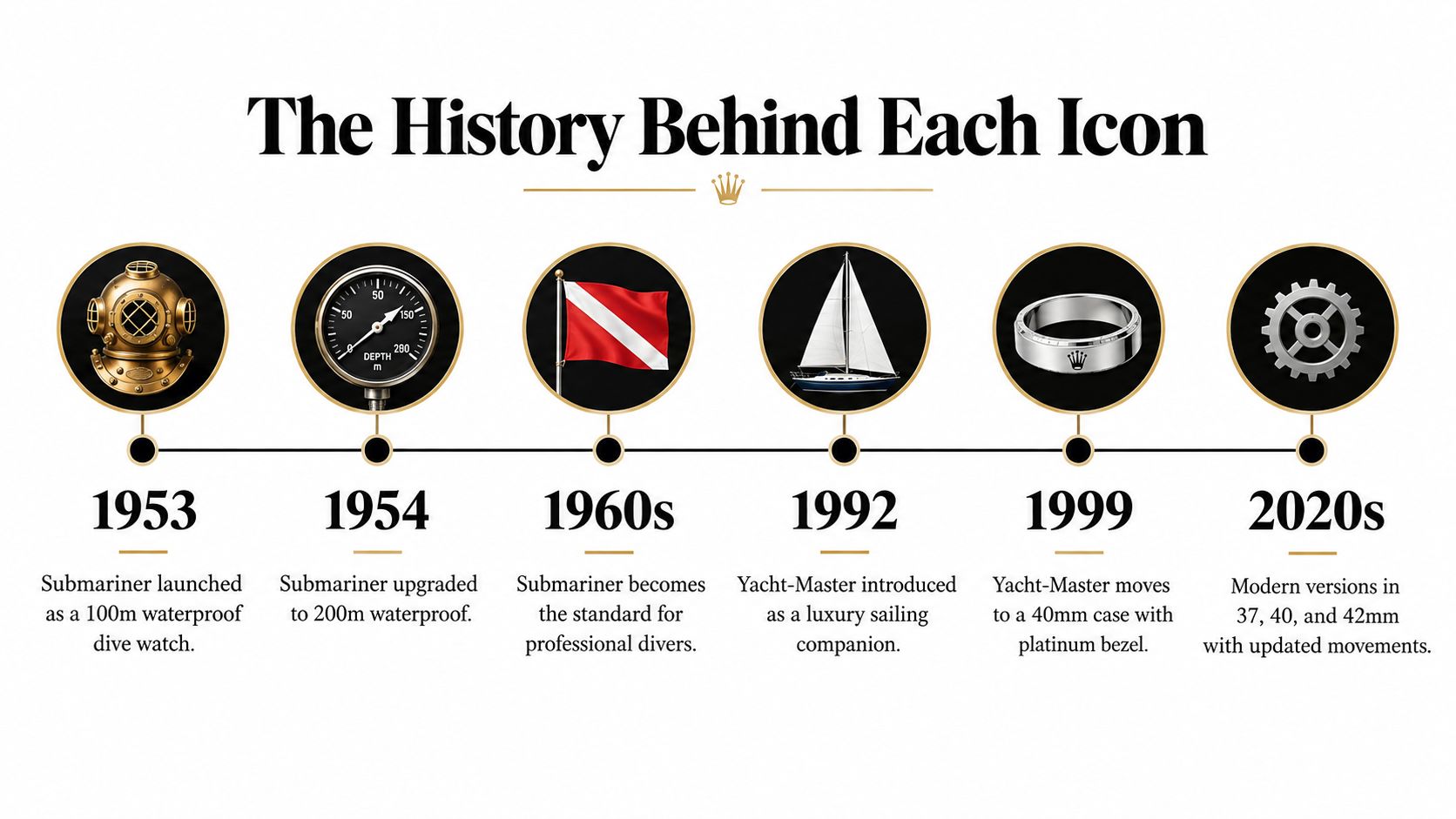
The Submariner established the template first. The Yacht-Master arrived later and used some of that familiar Rolex sports-watch language for a different purpose. That sequence still affects ownership today, because buyers generally pay a premium for the Yacht-Master's materials and finishing while the Submariner usually holds the simpler resale story and the clearer tool-watch identity after the 2026 price increase.
Why the Submariner set the baseline
The Rolex Submariner debuted in 1953 and started life as a watch built around underwater utility, according to Watch Chest's historical comparison of the Rolex Yacht-Master and Submariner. Over time, Rolex increased the model's depth rating and refined the case, bezel, and bracelet, but the original idea stayed consistent. The Submariner was meant to function like equipment first.
That origin explains why the Submariner often feels so straightforward in the market. Buyers understand what it is immediately. Even someone who knows very little about Rolex usually recognizes it as the brand's core dive watch.
Why Rolex added the Yacht-Master
The Yacht-Master entered the collection in 1992, and Rolex describes it as a watch created for navigators and skippers in the Rolex Newsroom overview of the Yacht-Master. That wording matters. Rolex was not trying to replace the Submariner. It was building a watch for life around the water rather than under it.
A useful way to frame it is this. The Submariner came from the logic of a dive instrument. The Yacht-Master came from the logic of a luxury deck watch. The family resemblance is real, but the mission is different.
That difference also helps explain the price gap many buyers notice. With a Yacht-Master, part of the premium goes toward metal choices, bezel execution, and a more refined visual finish. With a Submariner, more of the value case rests on the model's long-standing recognition, stronger liquidity, and broader buyer pool on the secondary market.
How the Yacht-Master built its own identity
Early Yacht-Master models gave Rolex a way to offer nautical character without the harder-edged feel of the Submariner. The line gradually became known for precious-metal use, polished surfaces, and a softer wrist presence than the classic dive-watch formula.
That is why calling it a dressier Submariner usually leads buyers in the wrong direction. The better comparison is that the Yacht-Master shares some architecture with the Submariner while expressing a different brief from the start.
If you want more family context before comparing references, ECI's guide to top facts about the Rolex Yacht-Master and Yacht-Master II helps place the Yacht-Master within Rolex's broader nautical line.
Key milestones that still shape buyer perception
- 1953: Submariner launches and establishes Rolex's dive-watch foundation, which still anchors its reputation.
- Late 20th century: The Submariner develops into the modern high-depth professional format buyers now associate with the line.
- 1992: Yacht-Master launches as a nautical luxury sports watch aimed at navigators and skippers, giving Rolex a water-oriented model with a more refined brief.
- Following years: The Yacht-Master expands into the platinum-accented and precious-metal executions that define its modern character.
- Current era: The two lines sit close enough in size and format to invite comparison, but their histories still point buyers toward different ownership outcomes.
The shortest historical summary is also the most useful. The Submariner began as a dive tool. The Yacht-Master began as a luxury sports watch for time spent around the water.
Core Differences That Matter on the Wrist
Set a Submariner Date 126610LN and a Yacht-Master 40 126622 on the same tray, and the choice gets more practical than many buyers expect. Both are Oyster sports Rolex models with familiar proportions, but they solve different ownership problems. One is built around underwater timing and long-term market liquidity. The other asks you to pay more for finishing, material mix, and a softer, more luxurious wrist presence.
Tool-watch logic versus deck-watch logic
The clearest dividing line is functional intent. The Submariner gives you professional dive-watch architecture, including 300 meters of water resistance and a unidirectional timing bezel. The Yacht-Master uses a bidirectional 60-minute bezel and a lower water-resistance rating that suits swimming, boating, and daily wear rather than dive-duty use.
That bezel difference matters in real life. A unidirectional bezel works like a ratchet with a safety stop. If it gets bumped, it can only shorten the measured time, which protects a diver from reading extra remaining time by mistake. A bidirectional bezel is faster to adjust and easier to use on the surface, where convenience matters more than fail-safe underwater timing.
So the ownership trade-off is not abstract. After the 2026 price increase, the Yacht-Master premium buys refinement first. The Submariner's advantage stays functional first, with stronger resale liquidity as a second benefit.
How the case and dial feel different
On the wrist, the Submariner usually feels more squared-off and purpose-led. Its ceramic bezel, broader visual contrast, and dive-watch handset give it the character of an instrument you happen to wear daily.
The Yacht-Master feels more sculpted. On references such as the 126622, the raised platinum bezel numerals and more reflective surfaces create a lighter, more fluid look than a Submariner. Buyers often notice this before they can name it. The watch catches light in more places, so it reads closer to luxury sports wear than pure tool watch.
Clothing makes that difference easier to understand. The Submariner is like a pair of field boots that still works with jeans every day. The Yacht-Master is closer to a performance loafer. It still belongs near the water, but it was designed to look more finished while doing it.
If you are still unsure whether a millimeter or two will change the feel, this guide to 36 mm vs 39 mm vs 41 mm watch case sizes gives a useful frame of reference before you compare references in person.
Yacht-Master vs Submariner Design and Function
| Design Element | Submariner | Yacht-Master |
|---|---|---|
| Case Dimensions | More angular, dive-focused case profile | Broader size and material variety, with a more relaxed visual shape |
| Bezel/Crown Detail | Unidirectional bezel built for elapsed dive timing | Bidirectional 60-minute bezel with raised numerals for surface timing |
| Dial Pattern | More instrument-like, high-contrast presentation | More reflective, more jewelry-adjacent finish choices |
| Crown and Pushers | Dive-watch hardware logic, no pushers | Nautical luxury sports setup, no pushers |
| Water Resistance | Professional dive-watch level | Suited to swimming and boating, not positioned as a dive tool |
Which one feels more versatile
Versatility depends on the life the watch is entering.
- For hard use and maximum role clarity: the Submariner is stronger.
- For office, dinner, and weekend wear in one watch: the Yacht-Master often adapts more naturally.
- For the buyer who wants the easiest Rolex sports model to resell later: the Submariner usually holds the simpler path.
- For the buyer who wants to see exactly where the extra money went on the wrist: the Yacht-Master makes that case through materials, finishing, and feel.
At ECI Jewelers, this is often the point where a first serious Rolex buyer decides. If you want the cleaner financial story, the Submariner usually wins. If you want a more luxurious wearing experience and accept that the premium does not buy the same level of liquidity, the Yacht-Master starts to make more sense.
Choosing Your Modern Configuration and Size
You are at the case trying on two Rolex sports watches for the first time. One feels like a single, established answer. The other asks a second question first: which size and material fit your wrist and your life?
That is the practical split here. The modern Submariner is a narrower lane. The Yacht-Master gives you more ways to tune the watch before you ever get to price.
Start with fit before reference numbers
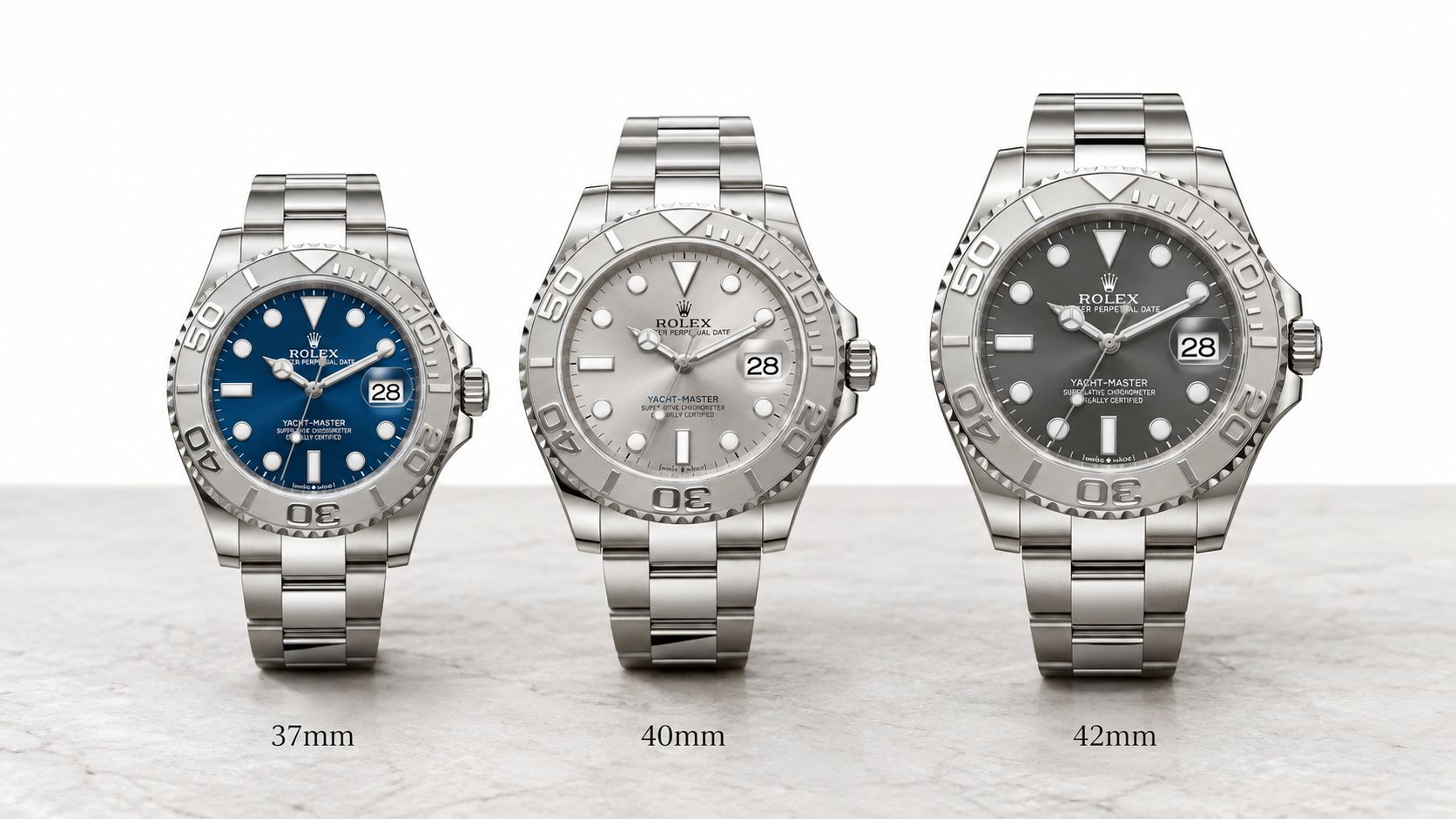
Rolex currently offers the Yacht-Master in 37, 40, and 42 mm, according to its official Yacht-Master overview. That range matters more than it may sound on paper. A 37 mm Yacht-Master can wear like a balanced everyday sports watch on a smaller wrist, while a 42 mm version has the broader stance many buyers expect from a modern Rolex.
The Submariner asks less from you at this stage. Its identity is already defined, so your decision usually narrows to date or no-date, then specific reference, condition, and price. For a first-time buyer, that often makes the Submariner simpler to buy correctly.
A useful way to frame it is this: the Yacht-Master is chosen from the outside in, meaning size, material, then movement. The Submariner is usually chosen from the inside out, meaning purpose, then reference details.
The movement split inside the Yacht-Master line
Modern Yacht-Master sizing also changes the movement you get.
- Yacht-Master 40 and 42: Calibre 3235, with about 70 hours of power reserve and Rolex's stated -2/+2 seconds per day precision after casing
- Yacht-Master 37: Calibre 2236, with a Syloxi silicon hairspring and about 55 hours of power reserve
That difference confuses some buyers because they expect one collection to use one movement. Rolex did not build the Yacht-Master that way. The 40 and 42 mm models suit buyers who want the larger case sizes most often cross-shopped against a Submariner. The 37 mm model serves a different goal: proportion first, without dropping into an older or entry-level feeling watch.
Here's a useful visual overview before you compare specific references:
Material is where the Yacht-Master premium starts to show
If size is the first Yacht-Master question, material is the second. This is also where the ownership trade-off starts to become concrete.
A Submariner buyer is usually paying for a highly recognizable dive-watch format with strong resale liquidity. A Yacht-Master buyer is often paying extra for what can be seen and felt immediately on the wrist: more varied metal combinations, more expressive finishing, and a softer overall presentation. After the 2026 price increase, that distinction matters even more because the premium is easier to notice at purchase, while the Submariner still tends to offer the simpler exit path later.
Yacht-Master 37
This size works well for buyers who care about balance more than sheer presence. It often fits slimmer wrists naturally and gives the collection's design language without excess visual weight.
Yacht-Master 40 and 42
These are the configurations that serious first-time buyers compare most directly with the Submariner. The 40 mm usually lands in the middle ground. The 42 mm brings more wrist presence and can make the Yacht-Master feel closer in scale to the modern large-sports-watch expectation.
Material-forward references
Here the Yacht-Master separates itself fastest. A change in bezel metal or case material can shift the watch from quiet luxury to noticeably more expressive. That is part of what the premium buys.
If your priority is to compare that choice against Rolex's more straightforward professional sports watch formula, our Rolex Submariner buying guide gives a clearer baseline.
At ECI Jewelers, the most successful first purchase usually starts with one honest question: do you want to pay more for fit, finish, and material expression, or would you rather keep the configuration simple and preserve the stronger liquidity that often comes with the Submariner?
Retail Versus Secondary Market Pricing Explained
A first-time buyer often reaches this point with two tabs open. One shows Rolex retail pricing. The other shows pre-owned listings that do not line up as neatly as expected. That gap is where the Yacht-Master versus Submariner decision becomes practical, because you are not only choosing a design. You are choosing how much money is tied to materials, how much is tied to demand, and how easy the watch may be to sell later.
What the Yacht-Master premium actually buys
After the 2026 Rolex price increase, the steel Submariner sits at a lower retail entry point than the Yacht-Master, while the Yacht-Master asks for more money before you even begin comparing precious metal, titanium, or two-tone variations, according to Majestix Collection's market-focused comparison.
That extra spend usually does not buy a sharper tool watch in the way a Submariner buyer might expect. It buys refinement. On the wrist, the difference is similar to choosing between two well-made jackets where one is built for hard weather and the other uses richer fabric, softer lines, and more expressive trim. The Yacht-Master premium tends to go toward material interest, a more polished visual character, and a sport-luxury identity that feels less strictly utilitarian.
For a buyer comparing current references, that distinction matters more than a simple price gap.
Approximate Retail and Secondary Values
| Reference Type | Core Material | Approx Retail | Approx Secondary Value |
|---|---|---|---|
| Steel Submariner | Steel | Lower entry point in the current lineup | Commonly stronger and more consistent than comparable entry Yacht-Master references |
| Entry Yacht-Master | Steel-based starting point | Higher than steel Submariner entry | Can overlap with or trail some Submariner references depending on condition and set |
| Mid-tier Yacht-Master | Mixed or upgraded material configurations | Higher than entry Yacht-Master | Moves more by exact reference, bracelet, and buyer taste |
| Premium Yacht-Master | Titanium or precious-metal leaning variants | Higher still | Can exceed Submariner pricing, but resale depends heavily on configuration |
| Collector-leaning discontinued references | Discontinued | Discontinued | Condition, originality, and completeness drive value |
Use that table as a map, not a fixed quote.
Condition, year, bracelet type, dial variation, service history, and whether the watch includes box and papers all affect the final number. Buyers who are still deciding which route makes more sense should compare the trade-offs in this guide to pre-owned versus new luxury watches in 2026, because pricing efficiency is often better understood that way than through retail alone.
Liquidity is usually stronger with the Submariner
The easier way to understand resale is to separate value from liquidity. They are related, but they are not the same.
A Yacht-Master can be expensive, desirable, and beautifully finished, yet still take more explanation in the secondary market because buyers tend to shop it by exact metal, size, and personality. A Submariner, especially a steel no-date or date reference, is simpler. More buyers recognize it immediately, more buyers understand its purpose, and that usually supports a cleaner resale path.
That is the ownership trade-off serious first-time buyers should quantify. The Yacht-Master premium often buys nuance. The Submariner usually buys broader demand.
If you expect to keep the watch for many years, the Yacht-Master's added cost can be reasonable if its comfort, materials, and quieter profile are the exact qualities you want. If you want the stronger exit option after the 2026 increase made entry prices easier to feel, the Submariner still holds the clearer advantage.
Where Each Watch Stands in Today's Luxury Market
A first-time Rolex buyer often reaches this point after narrowing the choice to two watches that seem close on paper but behave differently in ownership. One is the watch nearly everyone recognizes across a room. The other asks for a little more explanation, then rewards the right buyer with better materials, a dressier finish, or a less expected presence on the wrist.
The Submariner as the category reference point
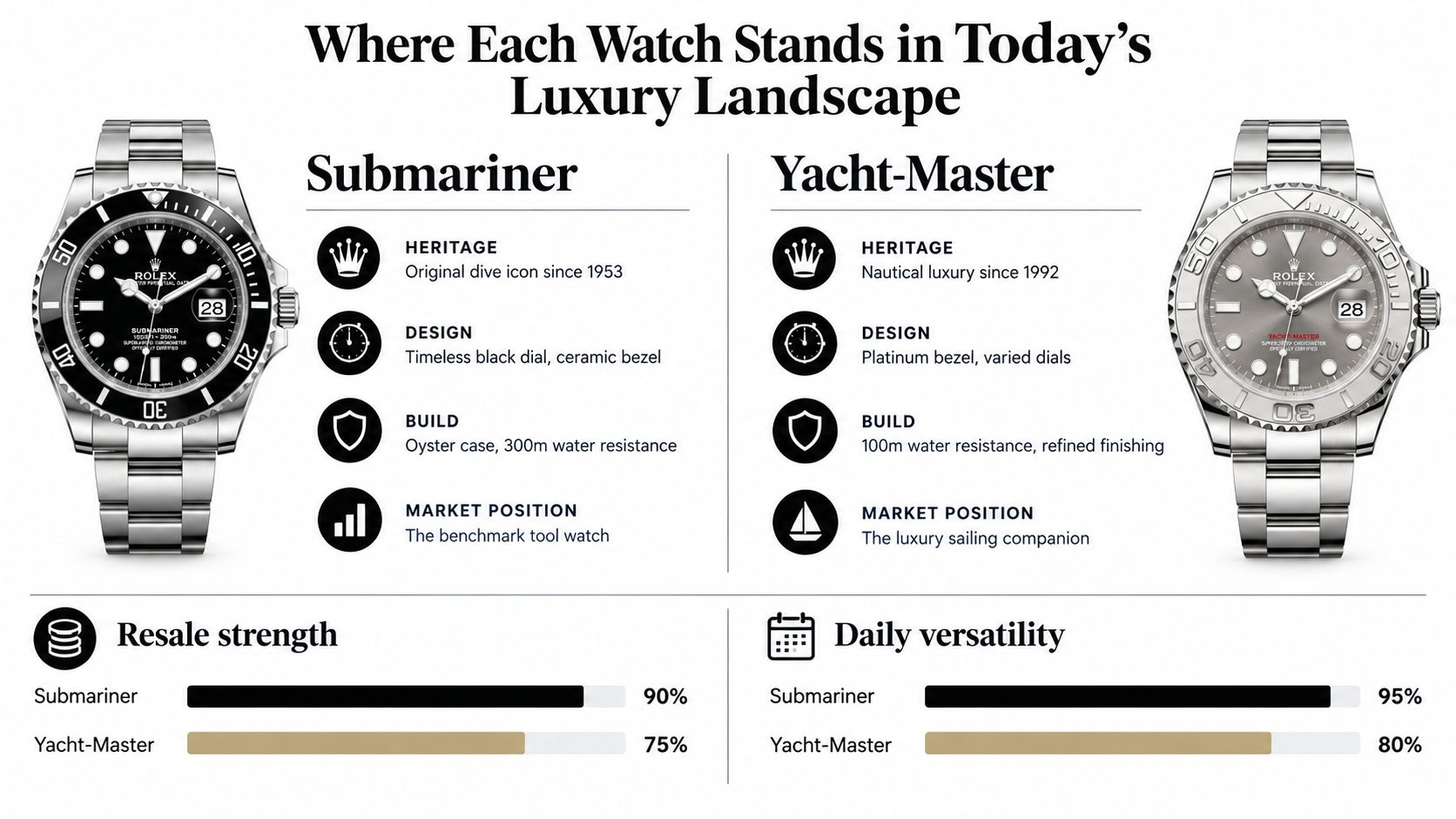
The Submariner still sits closest to the center of the modern luxury sports-watch field because its purpose is instantly legible. Buyers know what a Submariner does, what it should look like, and why references such as the 124060 or 126610LN remain easy to compare across listings, dealers, and private sales.
That clarity matters after the 2026 price increase. If you pay more at entry, the easier exit usually becomes more valuable. In practical terms, the Submariner often gives you broader buyer demand, faster resale conversations, and less dependence on finding someone who wants your exact configuration.
The Yacht-Master as a premium for nuance
The Yacht-Master asks a different question. What are you getting for the premium?
In many cases, you are paying for refinement rather than for a stronger resale lane. A Yacht-Master 40 such as the 126622 gives you a more sculpted case, a platinum bezel, and a softer, more polished visual profile than a Submariner. A Yacht-Master 42 in titanium, reference 226627, changes the equation again by offering a lighter feel and a more specialized character that no standard steel Submariner matches.
That is the ownership trade-off many comparisons skip. The Yacht-Master premium often buys material interest, wrist comfort, and lower visual predictability. The Submariner usually buys simpler liquidity, a more direct tool-watch identity, and the comfort of owning one of the easiest Rolex sports models to explain and resell. As noted in The Watchology's 2026 Yacht-Master buying guide, the Yacht-Master is generally positioned as the more lifestyle-oriented watch beside the Submariner's diving role.
How They Compare to Other Luxury Sports Watches
| Brand and Collection | Key Defining Model | Market Stance and Value Driver |
|---|---|---|
| Audemars Piguet Royal Oak | Royal Oak | Integrated-bracelet prestige driven by design recognition |
| Rolex Submariner | Submariner | Clear dive-watch identity, broad buyer familiarity, and strong liquidity |
| Rolex Yacht-Master | Yacht-Master 40 | More luxurious sports-watch execution with differentiated materials and a quieter profile |
| Omega Seamaster | Seamaster Diver | Established dive alternative with strong enthusiast support |
| Patek Philippe Nautilus | Nautilus | High-status sports watch led by scarcity and design heritage |
The simplest way to separate the two is to ask what kind of confidence you want your money to buy. If you want the safer all-around answer, the Submariner remains the cleaner choice. If you want Rolex sports-watch quality with more texture, more variation in metals and feel, and less of the obvious pick, the Yacht-Master earns its place.
Essential Checklist for Buying Pre-Owned With Confidence
A first-time buyer often notices the same surprise at this stage. Two watches can look similar in photos, carry the same Rolex name on the dial, and still behave very differently as pre-owned purchases. With a Submariner, small flaws are often easier for the market to forgive. With a Yacht-Master, the extra money usually pays for finish, materials, and wrist presence, so condition has to support that premium.
That is the ownership trade-off many buyers miss. After the recent price increases, the Yacht-Master premium only makes sense if the watch still shows the details you are paying for. The Submariner usually gives you a wider resale audience and a more obvious use case, which helps liquidity later. The Yacht-Master asks for a closer inspection up front.
Four checks worth doing every time
- Check the case edges and lug shape. Clean, defined edges usually suggest the watch has been preserved well. Rounded lugs or softened transitions can mean repeated polishing. On a Submariner, that changes the crisp tool-watch geometry. On a Yacht-Master, it can flatten the softer, more sculpted case lines that give references like the 126622 or 126621 much of their appeal.
- Inspect the bezel and crystal under direct light. This is one of the fastest ways to separate honest wear from costly cosmetic issues. A Submariner bezel insert can show scratches and still read like a used sports watch. A Yacht-Master bezel is less forgiving because the raised numerals and blasted background are part of the watch's character. If those surfaces are heavily worn, the watch can lose the visual quality that justified the higher buy-in.
- Confirm paperwork, serial details, and seller inspection standards. Box and papers help, but they are not the whole story. You also want matching reference information, a clear description of replaced parts, and a seller who explains how the watch was authenticated and tested. Buyers who want that framework often start with certified pre-owned Rolex and luxury watches, where condition screening is already part of the process.
- Test the parts you will use every day. Rotate the bezel. Unscrew and screw down the crown. Check clasp action, bracelet stretch, and the date change around midnight. The watch should feel precise and settled, like a well-fitted door latch, not loose, gritty, or uncertain.
One rule helps avoid expensive mistakes. Buy the watch in the best honest condition you can verify, not the one with the most flattering listing story.
ECI Jewelers inspects authenticated luxury watches, documents condition carefully, and often offers examples with original box and papers. That is especially useful when you are comparing nuanced references rather than shopping by model name alone. If you are deciding between a Yacht-Master and a Submariner, ask a simple question before you buy: does this specific watch still show the qualities that make its price make sense?


