


Before you can adjust the time on your Rolex, the first step is always the same: unscrew the winding crown. You'll do this by turning it counter-clockwise (that’s toward you) until you feel a gentle pop. Once it springs free, you can then pull it out to the correct position to set the time or date. This single component is your gateway to every adjustment.
Getting to Know Your Rolex Crown
Before you even think about changing the time, you need to get familiar with your Rolex's winding crown. It's not just a simple knob; it's a precision-engineered piece of hardware that's absolutely critical to your watch's integrity. The screw-down crown is a Rolex hallmark, creating a hermetic seal that protects the delicate movement inside from both water and dust.
Honestly, mishandling the crown is one of the easiest ways to cause expensive damage. So, your pre-flight check starts right here. After you've unscrewed it, the crown is in its first position, ready for manual winding.
From that point, gently pulling it out further will click it into distinct positions, each one controlling a different function. This visual guide gives you a great macro view of the crown, which is the central point of interaction for any adjustment you'll make.
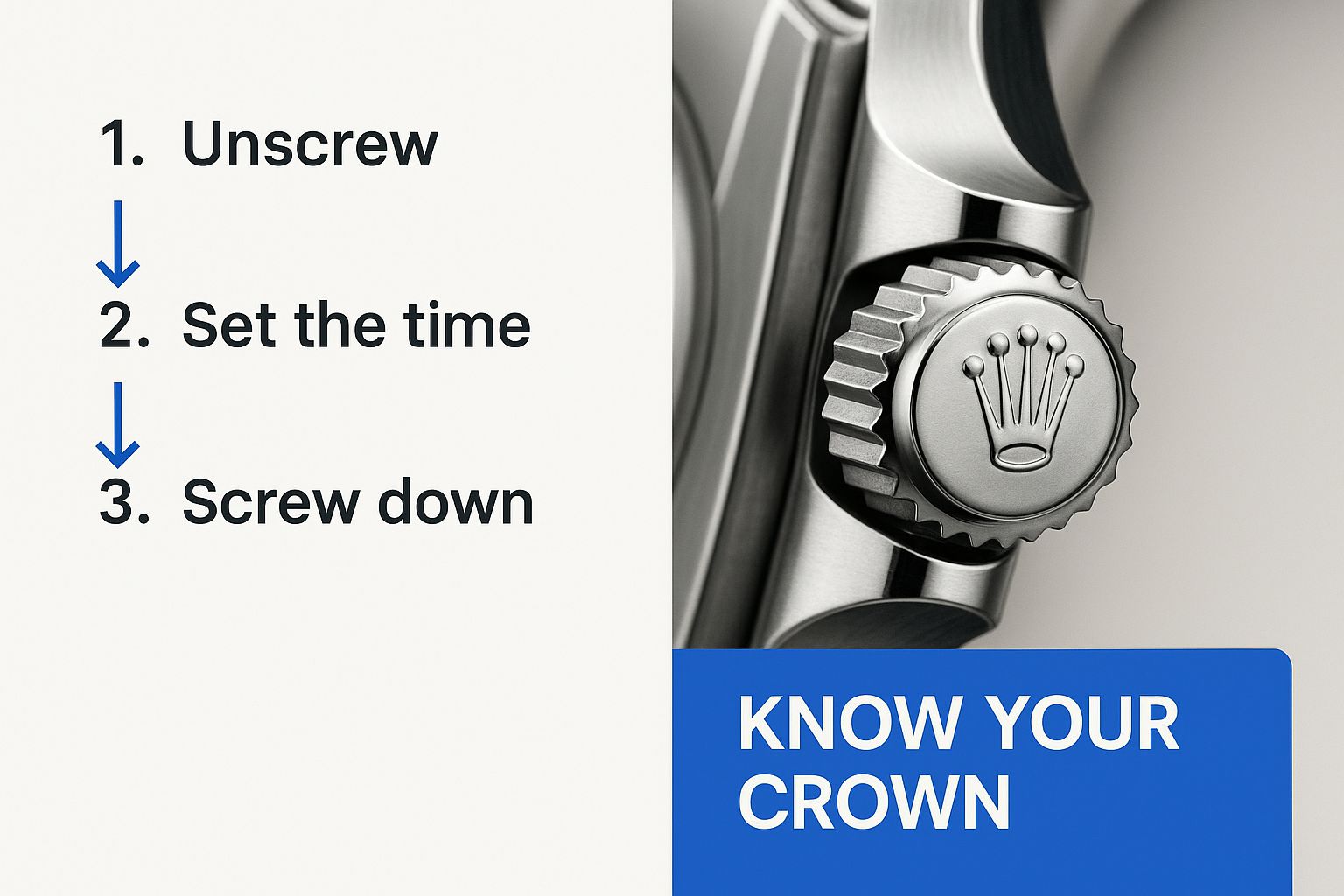
This close-up really drives home why it's so important to master this component before you move on to adjusting the time on your Rolex.
The Crown Positions Explained
The number of positions your crown has depends entirely on your watch’s complications. A simple, time-only model like an Oyster Perpetual might only have two, whereas a Datejust or Day-Date will have three.
The introduction of the Rolex Datejust way back in 1945 was a game-changer, marking the arrival of the first automatic date-changing function—a feature that made these distinct crown positions necessary. For a deeper dive, you can explore more about Rolex's technical history and how it shaped modern watch adjustments.
To help you get your bearings, here’s a quick-reference table that breaks down what each crown position typically does.
Rolex Crown Positions and Their Functions
| Position | Description | Primary Use |
|---|---|---|
| Position 1 | The crown is unscrewed but not pulled out. | Manually winding the mainspring to power the watch. |
| Position 2 | The crown is pulled out to the first "click." | Setting the date (on models with a date complication). |
| Position 3 | The crown is pulled out to the final "click." | Setting the precise time. The seconds hand usually stops. |
This table should make it easy to remember the basics. Once you're finished making your adjustments, always remember to push the crown back in and screw it down firmly to maintain that crucial water resistance.
Crucial Tip: Always be gentle when pulling and pushing the crown. Never force it. You can damage the stem, which is a delicate part connecting the crown to the internal movement, and that's a repair you want to avoid.
Setting the Time and Date on Modern Rolex Models

So you've got a modern Rolex, like a Datejust or a Submariner, that's stopped after a few days off the wrist. No problem. The first thing you'll always do, after unscrewing the crown, is give it a full manual wind.
You're looking for about 30-40 clockwise turns in Position 1. This gets the mainspring nice and tight, giving the movement all the power it needs to run accurately once you're done.
With the watch wound, it's time to deal with the date. Gently pull the crown out one click to Position 2. Turning it clockwise will jump the date forward one day at a time. Here’s a pro tip: always set the date to yesterday's date, not today's. This little trick is crucial for the next step and helps you avoid the common mistake of mixing up AM and PM.
Avoiding the Danger Zone
Before you pull the crown out any further, you need to know about the "danger zone." On most mechanical watches with a date, the changing mechanism starts engaging around 9 PM and doesn't fully clear until after 3 AM.
Expert Warning: Never use the quickset date function (Position 2) when the watch hands are between 9 PM and 3 AM. Forcing the date change during this period can damage the delicate gears of the movement, leading to a costly and avoidable repair.
If your watch happened to stop within this window, just pull the crown all the way out to Position 3 first. Move the hands forward past 3 AM, and then you can safely adjust the date.
Finalizing the Time and Date
Alright, you've set the date to yesterday. Now pull the crown out to its final stop, Position 3. You’ll notice the second hand has stopped, which allows for perfect, to-the-second time-setting.
Start advancing the hands clockwise. As they pass the 12 o'clock mark, you’ll see the date disc click over to today’s date. That’s your confirmation that you've just passed midnight and are now in the AM.
From there, just keep turning the hands to the correct time, paying attention to whether it's AM or PM. If you're setting it for 2 PM, for instance, you'll need to circle past the 12 o'clock marker one more time.
To recap the whole process:
- First, fully wind the watch in Position 1.
- Next, pull the crown to Position 2 and set the date to yesterday.
- Then, pull to Position 3 and move the hands past midnight until the date flips to today.
- Finally, set the correct time, then push and screw the crown securely back down.
Following these steps ensures you're adjusting your Rolex safely and accurately every single time. For more answers to common questions about ownership, our Rolex FAQ guide from ECI Jewelers is an excellent resource.
How to Adjust Vintage and Non-Quickset Rolex Watches
There's something special about owning a vintage Rolex. It connects you to a different era of watchmaking, one that often calls for a bit more hands-on patience, especially when setting the date.
If your watch was made before the mid-1970s, it most likely lacks the "quickset" date function we're all used to today. This simply means you can't isolate the date wheel and click through the days with a quick turn of the crown.
Instead, adjusting the date on these older pieces means you have to manually advance the hands through a full 24-hour cycle for each day you need to change. It's a more deliberate process, one that really makes you appreciate the intricate mechanics ticking away on your wrist. To get started, just unscrew the crown and pull it all the way out to the final time-setting position.
From there, turn the crown to move the minute and hour hands clockwise. You'll need to watch the date window closely as you sweep past the 12 o'clock marker. When the date clicks over, you’ve just gone past midnight. To advance to the next day, you have to circle the entire dial one more time.
The Semi-Quickset Shortcut
Luckily, some transitional models from that period came with a handy little trick known as the "semi-quickset" function. This can save you a good bit of time and wrist-work.
Here's how it works:
- First, advance the hands clockwise past midnight until the date changes.
- Now, turn the hands backward to around the 9 PM position.
- Finally, move the hands forward past midnight again. You'll see the date click over once more.
This simple back-and-forth motion lets you cycle through dates much faster than making full 24-hour rotations. It's a small but significant convenience for owners of these specific models.
This hands-on approach was the standard for decades. A major development came with the Rolex GMT-Master in 1955, where pilots adjusted a second time zone by rotating the bezel, an early solution for travelers that bypassed complex hand-setting. Discover more insights about the historic value of Rolex models on Goldammer.me.
Getting to know these older mechanisms is a key part of owning and caring for a vintage watch. If you're not sure about your watch's production year or its specific features, our guide to Rolex serial and reference numbers is a great resource to help you pinpoint its era and capabilities.
Adjusting Complex Models Like the GMT and Sky-Dweller

Once you move past the standard time and date functions, you get into the really interesting stuff. Models like the GMT-Master II and Sky-Dweller are in a different league, built from the ground up for people who cross time zones for a living. Learning to set these pieces correctly is what unlocks their full, incredible potential.
The GMT-Master II, for instance, is all about tracking multiple time zones at once. Its secret weapon is the independent hour hand, which you can adjust without stopping the watch—a total game-changer when you touch down in a new city.
To set your new local time, just unscrew the crown and pull it out to the second position. From there, you can jump the main hour hand forward or back in one-hour clicks to match your new location. All the while, the minute hand and the 24-hour GMT hand keep running perfectly, so your home time (or "reference" time) is never disturbed.
Mastering the GMT and Sky-Dweller Functions
The GMT-Master II’s party trick doesn’t stop there. You can actually track a third time zone by using the rotatable 24-hour bezel. All you have to do is turn the bezel to align the hour you want to track with the tip of the 24-hour GMT hand. It's a brilliantly practical feature and exactly why pilots and international business pros have sworn by this model for decades.
The Sky-Dweller, on the other hand, is a whole different animal. It operates on an entirely different system centered around its innovative Ring Command bezel. This isn't just a decorative element; it's the control hub for the entire watch, interacting directly with the movement inside.
The Ring Command bezel is easily one of Rolex's most complex yet user-friendly innovations. By rotating the bezel into one of three positions, you choose which function to adjust—date, local time, or reference time—all using the single winding crown.
You start by rotating the fluted bezel counter-clockwise. You'll feel it click into distinct positions, and each click selects a different setting to adjust.
A Quick Guide to the Sky-Dweller Adjustment
Adjusting a Sky-Dweller feels incredibly mechanical and satisfying once you get the hang of it. It’s a unique experience that showcases the genius of Rolex engineering.
- Select Your Function: First, rotate that Ring Command bezel to the left. The first click is for the date, the second click is for the local time, and the third click selects the reference time (that off-center 24-hour disc).
- Make Your Adjustment: With your function selected, pull the winding crown to the second position and turn it. This will advance the date, jump the local hour hand, or set your 24-hour reference time, depending on what you selected.
- Lock It Down: When you're done, simply rotate the bezel back to its original neutral position and screw the crown back down tight.
This system is pure brilliance. It gets rid of the need for extra pushers or correctors, keeping the watch's lines clean while packing in a ton of functionality.
Common Mistakes to Avoid When Setting Your Rolex
Adjusting your Rolex should be an act of finesse, never force. It’s a precision instrument, and one of the most common—and costly—mistakes I see is trying to muscle a crown that feels stiff or resistant. If it doesn’t turn smoothly, just stop. Applying extra pressure can easily damage the delicate winding stem, and that’s a direct ticket to an expensive service visit.
Another critical mistake is changing the date while the hands are in the "danger zone," which is typically between 9 PM and 3 AM. During these hours, the watch's internal date-changing gears are already engaged. Forcing the date to change manually can strip those gears, causing a problem that could have been easily avoided.
Preserving Your Investment
It's easy to forget, but your watch is a significant asset. With Rolex prices surging by over 550% between 2010 and 2025, even minor damage can have a real impact on its value. Taking proper care during a simple time adjustment is a huge part of protecting that investment. You can find more great insights on Rolex market trends at Bob's Watches.
A Critical Final Check: The single most overlooked mistake is forgetting to screw the crown back down. Leaving it even slightly unscrewed completely compromises the waterproof Oyster seal. This exposes the intricate movement to moisture and dust, which can cause irreversible damage.
Always, always double-check that the crown is screwed in firmly. Making this a habit ensures your Rolex remains sealed and protected, safeguarding its performance and longevity for years to come. It's the simplest preventative step you can take.
A Few Common Questions About Rolex Adjustments
Even after you've mastered the basics, a few questions always come up in the day-to-day ownership of a fine timepiece. Here are some of the most common ones we get about keeping your Rolex running smoothly.
How Often Should I Wind My Rolex If I Don't Wear It Daily?
If you don't wear your automatic Rolex every day, it's a good idea to give it a manual wind—about 30-40 turns of the crown—every two or three days. This simple routine keeps the mainspring topped up with power.
If the watch has stopped completely, don't worry. A full wind before you set the time is all it needs to get ticking again.
Is It Bad to Let My Rolex Stop Running?
Not at all. It's perfectly safe to let your automatic Rolex run down and stop. Modern Rolex movements use incredibly stable synthetic lubricants that won't gum up or dry out like older oils.
In fact, letting the watch rest can actually reduce a tiny bit of mechanical wear over the long haul. When you're ready to put it back on, just give it a full manual wind and set the time and date.
You might notice your Rolex's date flips a few minutes before or after midnight—this is perfectly normal. It's just a quirk of mechanical movements. If, however, the date changes hours away from midnight, that's a sign your watch needs a professional look.
Whether you're looking to buy, sell, or service your timepiece, the experts at ECI Jewelers provide trusted, five-star service and a 100% authenticity guarantee on every watch. Explore our curated collection of luxury timepieces at https://www.ecijewelers.com.


