

Choosing between Audemars Piguet and Rolex really boils down to a fundamental question: are you drawn to artistry or engineering? Rolex is the undisputed benchmark for tough, reliable luxury. Its timeless designs have made it a globally recognized symbol of success. Audemars Piguet, on the other hand, represents the very peak of haute horlogerie and avant-garde craftsmanship, speaking more to the dedicated connoisseur.
Choosing Between Two Titans: Audemars Piguet vs Rolex
The Audemars Piguet vs. Rolex debate is a fascinating clash of watchmaking philosophies. One is an industrial titan, revered for its perfectionism and steady, incremental evolution. The other is a family-owned artisan, celebrated for constantly pushing creative and mechanical boundaries. This guide is designed to dissect these differences, going far beyond surface-level comparisons to give you the clarity needed to pick the right brand for your wrist and your collection.
We'll explore the nuances that define each brand, from their distinct histories to their current standing in the market. Understanding their core identities is the first step in making a choice you'll be happy with for years to come.
Key Brand Differentiators
To set the stage, it's critical to see how each brand positions itself in the world of luxury watches. Rolex built its empire creating exceptionally durable and precise tool watches that grew into universal status symbols. Audemars Piguet has carefully cultivated an image of elite exclusivity, focusing on incredibly complex movements and groundbreaking designs.
The table below gives a high-level overview of their core identities and where they sit in the market.
Audemars Piguet vs Rolex Key Differences
| Attribute | Rolex | Audemars Piguet |
|---|---|---|
| Brand Identity | The benchmark for versatile luxury and reliability | A member of the "Holy Trinity" of watchmaking |
| Core Philosophy | Gradual, perfective evolution and durability | Avant-garde design and mechanical artistry |
| Production Volume | High (over 1 million watches annually) | Low (around 50,000 watches annually) |
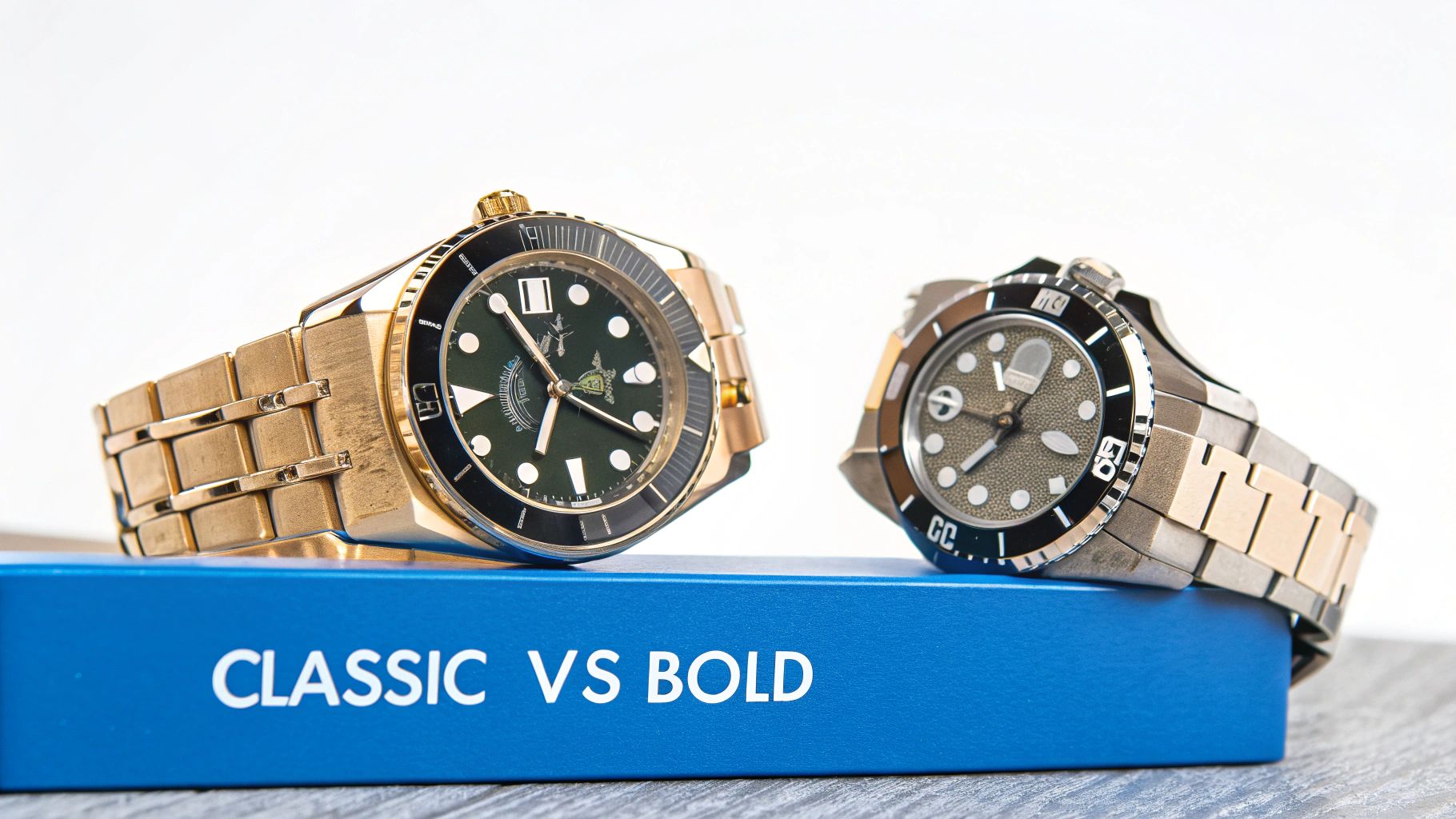
| Design Language | Classic, functional, and timeless forms | Bold, angular, and architecturally complex |
| Target Audience | Broad luxury market seeking success and status | Discerning collectors valuing craft and exclusivity |
| Entry Price | More accessible, starting around $6,000 | Higher, generally starting above $25,000 |
This summary offers a quick visual breakdown of the key traits that define each brand.
As you can see, Rolex's focus is on widespread recognition and practical excellence, while Audemars Piguet's identity is firmly rooted in artistic expression and limited production. This core contrast influences every single aspect of owning a watch from either of these legendary makers.
Comparing Brand Heritage and Philosophy
To really get to the heart of the Audemars Piguet vs. Rolex debate, you have to look past the movements and metals and go back to their beginnings. The history of each brand is the key to its modern identity, explaining why one is a titan of industrial perfection and the other a champion of artistic disruption. These aren't just stories; they're the soul of the watches they make today.
Rolex didn't start in Switzerland, but in London back in 1905. Its founder, Hans Wilsdorf, had a simple but powerful goal: create wristwatches that were elegant but, above all, reliable. That obsessive focus on practical innovation became the brand’s DNA.
This philosophy of performance-first design led to one breakthrough after another. After moving to Geneva in 1919, Rolex dropped a bombshell in 1926 with the world's first waterproof wristwatch, the legendary Oyster. This wasn’t just a new feature; it completely changed the game, turning the watch from a delicate accessory into a tough, everyday tool.
Rolex: The Path of Perfective Evolution
Rolex’s legacy is built on slow, deliberate improvement. This is not a brand that chases fads; it refines perfection. From the first self-winding "Perpetual" rotor in 1931 to the Submariner in 1953, every step was about making their watches tougher, more accurate, and more dependable.
This dedication to functional excellence is why Rolex became the standard-issue timepiece for professionals and adventurers, from deep-sea divers to pioneering pilots. The brand’s mission is clear: build the most reliable and versatile luxury tool watch on earth, then make it just a little bit better every year.
This approach is why a Rolex feels both timeless and completely modern. You can put a Submariner from decades ago right next to a new one, and it's instantly recognizable. This consistency is a huge part of its appeal, offering a sense of permanence that very few brands can touch. To dig deeper into this history, you can learn more about why Rolex is the epitome of luxury watches and how it earned that title through decades of focused innovation.
Audemars Piguet: A Legacy of Artistic Rebellion
Audemars Piguet's story, on the other hand, starts in 1875 deep in the Swiss Jura Mountains, in the Vallée de Joux. Founded by Jules-Louis Audemars and Edward-Auguste Piguet, the company has stayed in the hands of the founding families ever since. This is a massive differentiator, as it allows AP to stick to a singular, artist-driven vision.
From day one, Audemars Piguet was all about mastering complex, intricate watch movements. While others were scaling up production, AP went all-in on haute horlogerie—the high art of watchmaking. They proved their chops by creating the world's first minute-repeating wristwatch movement in 1892, cementing their reputation for mechanical genius.
This history of artistry and independence created a culture of bold, creative risk-taking. While Rolex was busy perfecting the tool watch, Audemars Piguet was gearing up to break every rule in the book.
- Family Ownership: Staying in the family has allowed AP to prioritize a long-term artistic vision over short-term profits. This is the source of its creative freedom.
- Artisanal Focus: The brand has always worked with local artisans, preserving traditional hand-finishing techniques like perlage and Côtes de Genève.
- Mechanical Complexity: AP's history is defined by its quest for grand complications, treating the movement not just as an engine but as a canvas for incredible art.
This all came to a head in 1972 with the Royal Oak. At a time when luxury watches were small, round, and made of gold, AP dropped a huge, angular sports watch made of steel and priced it like it was solid gold. It was an audacious, rebellious move that completely changed the luxury watch world and perfectly sums up the brand’s defiant spirit.
A Deep Dive into Design and Iconic Models
When you put an Audemars Piguet next to a Rolex, you're looking at two completely different languages of design. It’s where their core philosophies really come to life. Rolex is all about that timeless, functional elegance—they refine, they don't revolutionize. Audemars Piguet, on the other hand, swings for the fences with bold, architectural shapes that demand attention.
Rolex has spent decades building its legacy on designs that are instantly recognizable. Their whole game is evolution. A Rolex from today will look just as classic in thirty years, and that's by design. This approach is perfectly showcased in their most famous models.
Rolex: Versatile and Timeless Icons
The Rolex lineup is built around legends that perfectly blend form and function. Each watch was born with a purpose, but they’ve all grown into symbols of go-anywhere, do-anything luxury.
- The Submariner: First hitting the scene in 1953 as a serious diver's tool, its design is the very definition of functional beauty. That rotating ceramic bezel, the glowing hour markers, the tough-as-nails Oyster bracelet—every piece is there for a reason. Yet, it all comes together in a look that’s just as at home with a wetsuit as it is with a business suit.
- The Daytona: A chronograph made for the racetrack. The Daytona's design is laser-focused on telling you everything you need to know, fast. Its dial is a masterclass in balance, with three sub-dials and a tachymetric scale that creates a look that's both sporty and seriously sophisticated.
- The Datejust: This might just be the most classic Rolex of them all. It pairs the waterproof Oyster case with that iconic fluted bezel and the Cyclops lens magnifier over the date. It's the quintessential luxury watch for every day, famous for its understated class and countless configurations.
All these icons share the same DNA: smooth lines and rounded shapes built around the legendary Oyster case. This piece of engineering is the foundation of Rolex's durability, creating a silhouette that feels both powerful and graceful on the wrist.
Audemars Piguet: The Royal Oak Revolution
While Rolex was busy perfecting classic watch design, Audemars Piguet decided to tear up the rulebook. The brand is almost entirely defined by one of the most radical watch designs of the 20th century: the Royal Oak.
When the Royal Oak landed in 1972, it was like nothing anyone had ever seen. Luxury watches were supposed to be small, round, and made of gold. This thing was a huge steel beast with sharp angles and an industrial vibe. It single-handedly created the luxury sports watch category.
The Royal Oak’s design is aggressive and architectural. Its key features are a middle finger to tradition:
- The Octagonal Bezel: Gérald Genta got the idea from an old-school diver's helmet. The eight-sided bezel is held down by eight hexagonal screws that are completely visible—something unheard of in high-end watchmaking at the time.
- The Integrated Bracelet: The bracelet isn't just attached to the watch; it is the watch. It flows seamlessly from the case, tapering perfectly with a stunning mix of brushed and polished finishes.
- The 'Tapisserie' Dial: That intricate, grid-like pattern on the dial isn’t just for show. It adds incredible texture and depth, catching the light in a way that is unmistakably AP.
This watch was a massive gamble. When it launched in 1972, this steel sports watch cost around 3,500 CHF. To put that in perspective, that was about 15 times more than a steel Rolex Submariner from the same era. AP was making a bold statement: steel could be just as precious as gold.
The difference between Audemars Piguet and Rolex couldn't be clearer. Rolex gives you enduring class with its soft curves and functional, quiet confidence. Audemars Piguet delivers a knockout punch with sharp angles and an industrial-chic swagger. It really comes down to whether you want a watch that whispers success or one that announces its arrival.
If you want to get a better handle on the AP family, check out our guide on the top three Audemars Piguet watch series to buy.
Analyzing Movement Craftsmanship and Innovation
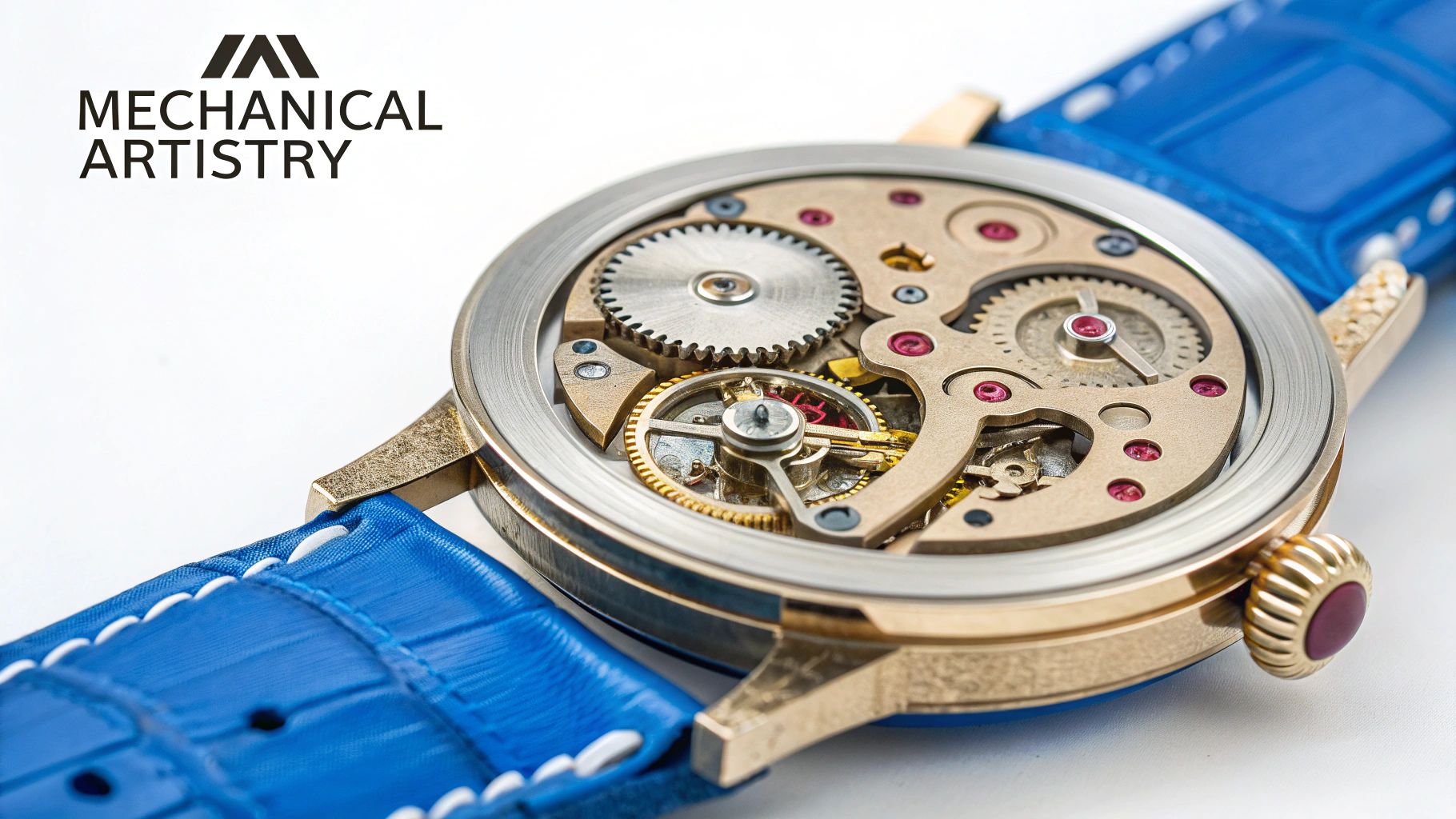
The real story in the Audemars Piguet vs Rolex debate isn’t just what you see on the outside; it’s about the mechanical heart beating inside. This is where the core philosophies of engineering and artistry truly collide.
Simply put, each brand has a completely different idea of what makes a movement great. Rolex pursues absolute functional perfection, creating powerhouse movements built for relentless precision. Audemars Piguet, on the other hand, treats the movement as a canvas for mechanical art, focusing on mind-bending complications and breathtaking hand-finishing.
Rolex Calibers: The Pursuit of Industrial Perfection
Rolex movements are engineered to be indestructible workhorses. Their entire philosophy is built around creating calibers that are supremely accurate, easy to service, and able to withstand just about anything you throw at them. This is why you’ll almost always find a solid steel caseback on a Rolex—the beauty is in the performance, not the presentation.
The modern Calibre 32xx series is a perfect example of this mindset. It's packed with innovations designed for real-world use.
- Parachrom Hairspring: This proprietary alloy is highly resistant to magnetic fields and temperature swings, two of the biggest enemies of mechanical accuracy.
- Chronergy Escapement: An optimized version of the classic Swiss lever escapement, it seriously boosts the movement's efficiency, contributing to an impressive 70-hour power reserve.
- Superlative Chronometer: This in-house standard goes well beyond the typical COSC certification, guaranteeing an accuracy of -2/+2 seconds per day.
This engineering-first approach means Rolex movements are built for a lifetime of dependable service. They choose reliability over elaborate decoration every time, creating what many consider the most robust mechanical movements in the world.
Audemars Piguet Calibers: A Showcase of Haute Horlogerie
Audemars Piguet’s approach couldn't be more different. As a pillar of haute horlogerie (high watchmaking), AP creates calibers that are as stunning to look at as they are mechanically complex. It’s why most of their watches feature sapphire exhibition casebacks, inviting you to admire the artistry inside.
AP movements are famous for their intricate hand-finishing, a level of detail Rolex's industrial process just isn't designed for.
| Finishing Technique | Description |
|---|---|
| Anglage | The edges of movement bridges are hand-chamfered and polished, creating brilliant, light-catching angles. |
| Côtes de Genève | Decorative "Geneva stripes" are meticulously applied to the flat surfaces, creating a beautiful wave-like pattern. |
| Perlage | Small, overlapping circular grains are applied to the mainplate, creating a rich, detailed texture. |
Beyond looks, Audemars Piguet is a master of grand complications—highly complex mechanical features that showcase incredible skill. While Rolex perfects core functions like the date and GMT, AP is busy creating movements with perpetual calendars, minute repeaters, and tourbillons.
This is the central difference in the Audemars Piguet vs Rolex comparison: Rolex builds a high-performance engine designed to run forever, while Audemars Piguet crafts a mechanical sculpture that also happens to tell time flawlessly.
Ultimately, choosing between them comes down to what you value more in a watch's soul. Do you want the unwavering confidence of a perfectly engineered tool, or do you prefer the artistic expression of a hand-finished masterpiece? One represents the pinnacle of industrial precision; the other embodies the zenith of horological art.
Evaluating Investment Potential and Market Value
For a lot of collectors, the Audemars Piguet vs. Rolex debate goes way beyond how a watch looks or works; it’s a serious financial decision. A luxury watch is often a tangible asset, and both brands offer compelling—though very different—investment profiles. Getting a handle on their market dynamics is crucial for picking the right piece for your portfolio.
Rolex is what you’d call the blue-chip stock of the watch world. Its massive brand power, combined with high demand and tightly controlled supply, creates a market where many of its steel sports models don’t just hold their value—they often trade for well above retail. Models like the Submariner, GMT-Master II, and Daytona are famously tough to get from authorized dealers, which fuels a very active and liquid secondary market.
This stability makes Rolex a relatively safe bet for anyone new to watch investing. Its universal appeal means there's almost always a buyer ready to go, giving it a level of liquidity that's hard to beat. If you're looking to understand the basics of this asset class, you can find out why luxury watches are a good investment in our in-depth guide.
Rolex: The Stable Blue-Chip Asset
The investment case for Rolex is built on a foundation of unmatched brand recognition and market dominance. It's a strategy that has proven itself over and over for decades.
The numbers really tell the story. Rolex is the most recognized Swiss watch brand, and because of that, it commands the strongest resale value out there. It holds over 30% of the retail market share and leads the secondary market with 34.2% of global transaction volume. That's a level of market control no other brand can touch.
This translates into real-world benefits for owners:
- High Liquidity: Popular Rolex models are incredibly easy to sell quickly because the global demand never stops.
- Strong Value Retention: Even the less sought-after models tend to hold their value remarkably well compared to other luxury goods.
- Proven Appreciation: Key sports models have a track record of providing returns that outperform many traditional investments.
The investment profile of a Rolex is all about steady, reliable growth. This makes it an ideal choice for a first-time investor or anyone looking for a stable asset.
Owning a Rolex is like holding a highly liquid, universally accepted currency. Its value is understood globally, providing a sense of financial security that few other luxury items can offer.
Audemars Piguet: The High-Reward Connoisseur's Choice
Audemars Piguet is a different kind of investment entirely—it's more like buying a piece of fine art. The price of admission is significantly higher, and the market is more specialized, but the potential for huge returns on certain models is massive.
The brand's low production numbers and the iconic status of the Royal Oak create genuine scarcity. While not every AP is going to appreciate like a Rolex, key references, particularly in steel, have seen their values skyrocket. The Royal Oak "Jumbo" Extra-Thin, for example, is a collector's holy grail that trades for many times its original retail price.
But investing in AP isn't as straightforward. You need more specialized knowledge to navigate its market.
- Higher Entry Cost: The initial investment is much larger, creating a significant barrier to entry.
- Niche Market: The pool of potential buyers is smaller and more discerning, which can impact liquidity compared to a Rolex.
- Model-Specific Returns: Value is heavily concentrated in specific Royal Oak and Royal Oak Offshore references. With Rolex, the value is more evenly spread across its professional line.
Investing in Audemars Piguet is a play for exclusivity and rarity. It’s a higher-risk, higher-reward game best suited for the seasoned collector who understands the market's nuances and values the watchmaking artistry as much as the financial return.
Understanding Production Volume and Brand Exclusivity
When you get right down to it, the single biggest difference between the Audemars Piguet and Rolex experience is availability. It’s that simple. These two brands sit on opposite ends of the production spectrum, a deliberate choice that shapes everything from how the world sees them to how you actually go about buying one.
Getting a handle on this contrast is the first step in figuring out which brand’s journey is the right one for you.
Rolex operates at a scale that no other luxury watchmaker can even touch. This industrial powerhouse status is what keeps it positioned as a global symbol of success. Audemars Piguet, on the other hand, purposely keeps its numbers low, creating an air of genuine scarcity. This approach elevates a watch from a luxury item to a piece of rare art, meant for a select few.
The Rolex Approach: Mass Production Meets Insane Demand
Rolex has perfected the art of balancing massive volume with even more massive desirability. The brand pumps out a staggering number of watches every year, yet demand always seems to be one step ahead of supply. This is what creates those famous waitlists, which have become a signature part of the Rolex buying experience.
In 2023, Rolex hit a major milestone, becoming the first Swiss watch brand to blow past $10 billion in sales by producing an estimated 1.24 million watches. This insane volume, led by icons like the Submariner and Daytona, gives it a stranglehold on over 30% of the global luxury watch market. You can dive deeper into this record-shattering year by reading the full 2023 market report on Wristcheck.com.
What this scale means for you is that while getting a hot model will test your patience, the brand itself is everywhere. You can find dealers all over the world. The challenge isn't finding Rolex; it's getting them to allocate one of their most sought-after watches to you.
The Audemars Piguet Method: Crafting True Exclusivity
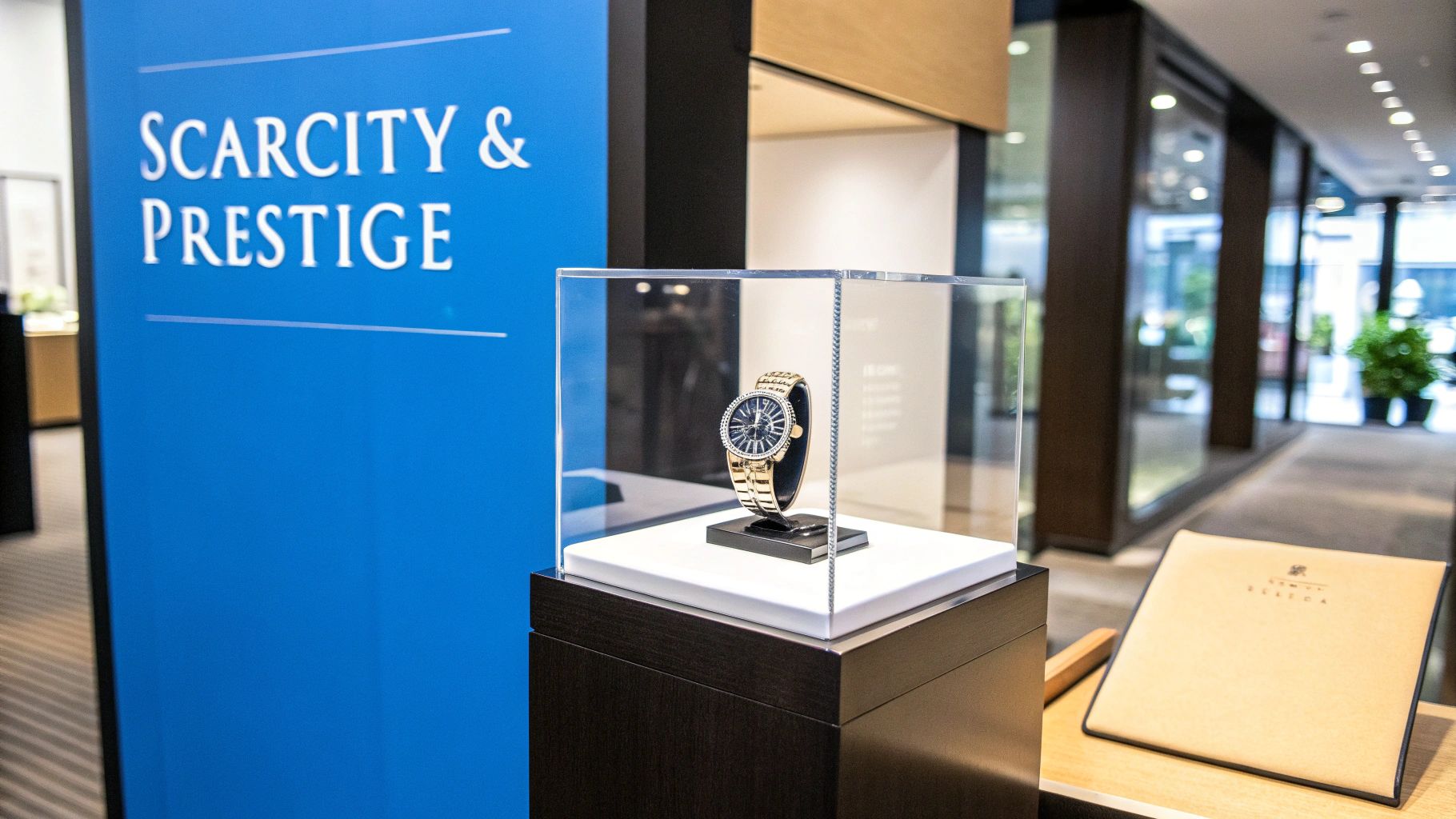
Audemars Piguet plays a completely different game. The brand makes only about 50,000 watches annually—a tiny fraction of Rolex's output. This isn't because they can't make more; it's a calculated decision to protect the brand's elite status and ensure every single watch receives the highest level of hand-finishing.
This extreme limitation means that getting a desirable AP, especially a Royal Oak, is less about getting on a waitlist and more about building a real relationship with the brand. This happens through their exclusive AP Houses and boutiques. It’s a system built for loyal clients who have a proven passion for watchmaking.
This creates a very clear choice for a potential buyer:
- Rolex gives you worldwide recognition. Its watches are universally known symbols of success, built with industrial perfection.
- Audemars Piguet offers elite exclusivity. Its watches are for the connoisseur who cares more about rarity and artistry than mass appeal.
Ultimately, your choice in the Audemars Piguet vs Rolex debate comes down to what you truly value. Do you want the king of accessible luxury, a watch respected in every corner of the globe? Or are you looking for a ticket into an exclusive club, where ownership itself is a statement about your status as a serious collector?
Frequently Asked Questions
Even after comparing the details, a few key questions usually come up when deciding between these two horological powerhouses. Let's tackle the most common ones to help you make your final choice.
Understanding these final nuances, from investment safety to the owner's experience, is what separates a good purchase from a great one.
Which Brand Is a Better First Luxury Watch Investment?
For a first-time buyer prioritizing a secure investment, Rolex is almost always the smarter place to start. You just can't beat the liquidity and value retention of iconic models like the Submariner or GMT-Master II. Their global brand recognition is immense, which keeps the secondary market consistently strong.
While it's true that certain Audemars Piguet Royal Oak references can yield higher percentage returns, they come with a much steeper entry price and appeal to a more niche group of collectors. Think of Rolex as the blue-chip stock of the watch world—a stable, reliable foundation for any new collection.
Is Audemars Piguet More Prestigious Than Rolex?
This is a classic debate, and the answer really depends on who you ask.
Among seasoned collectors and watchmaking experts, Audemars Piguet often takes the edge in prestige. It's a member of the "Holy Trinity" of Swiss watchmaking, a title earned through its incredibly complex movements and painstaking hand-finishing.
In terms of sheer global recognition and brand power, however, Rolex is unmatched. AP holds its prestige within the circles of connoisseurs who appreciate its deep artistry. Rolex, on the other hand, commands prestige with the entire world as a universal symbol of success.
How Does the Ownership Experience and Servicing Compare?
The day-to-day ownership journey is night and day between these two, largely because of their production scales.
The Rolex experience is built on a massive global network. With authorized dealers and service centers everywhere, maintenance is accessible, reliable, and relatively straightforward. Their movements are workhorses, engineered for durability and ease of service.
Living with an Audemars Piguet is a much more exclusive, personal affair. The experience is centered around building a relationship at their dedicated AP Houses and boutiques. Because of the intricate, hand-finished movements, servicing an AP can be more expensive and take longer, as it requires highly specialized expertise.
Whether you are drawn to the timeless investment appeal of a Rolex or the artistic exclusivity of an Audemars Piguet, ECI Jewelers offers a curated selection of authenticated timepieces from the world's finest brands. Explore our collection and find your next masterpiece at https://www.ecijewelers.com.


