


So, you're ready to buy an engagement ring. This is a huge moment, a blend of excitement, emotion, and maybe a little bit of anxiety. Don't worry—that's completely normal. Think of this not as a stressful task, but as the first step in a really cool adventure to find the perfect symbol of your commitment.
This guide is here to walk you through it all, from understanding the famous 4Cs of diamond quality to picking a style that truly tells your story.
Your Journey to the Perfect Ring Starts Here
Buying an engagement ring is one of those life purchases that really means something. It's not just about the transaction; it's about creating a lasting emblem of your love story. The whole process can feel like a lot to take in, but once you know what you're looking for, it turns into a confident and genuinely rewarding experience.
We've designed this guide to be your roadmap. Our goal is to demystify every part of the process, making sure you feel totally empowered to make a choice you’ll both cherish forever. We'll cover everything from timeless traditions to modern must-knows like ethical sourcing and how to safely shop online. You're not alone in this—millions of people are on this exact same journey.
What This Guide Will Cover
The engagement ring market is a massive, multi-billion dollar industry, pulling in around $79 billion a year. That number is only expected to grow, which just goes to show how many people are out there looking for that perfect ring every single year. If you want to dive deeper into the numbers, you can explore the full research about engagement ring industry growth.
To help you cut through the noise and make a great choice, we're going to focus on a few key areas:
- Mastering the 4Cs: We'll break down Cut, Color, Clarity, and Carat in simple, practical terms that actually make sense.
- Finding the Perfect Style: You’ll get to explore the most popular settings and metals to find the one that perfectly matches your partner’s personality.
- Setting a Realistic Budget: We'll look at modern ways to think about budgeting that put value and your comfort first.
- Choosing a Trusted Jeweler: Get the inside scoop on how to pick a reputable retailer, so your purchase is totally secure.
By the time you're done with this guide, you won't just be buying a ring. You'll be making an informed, heartfelt decision that celebrates your unique relationship and kicks off your future together.
Decoding the 4Cs of Diamond Quality
Jumping into the world of diamonds can feel like learning a new language. But really, it all boils down to four key factors: Cut, Color, Clarity, and Carat. These are the 4Cs, the universal standards that jewelers use to grade a diamond's quality and, ultimately, its value.
Don't think of them as a rigid checklist. Instead, see them as ingredients in a recipe. You can adjust each one to create the perfect ring for your taste and budget. Getting a handle on the 4Cs is easily the most important part of buying an engagement ring. It gives you the power to compare diamonds like a pro, put your money where it matters most, and walk away feeling confident about your choice.
This concept map helps visualize how the 4Cs fit into the bigger picture—from traditions and trends to the actual buying process.
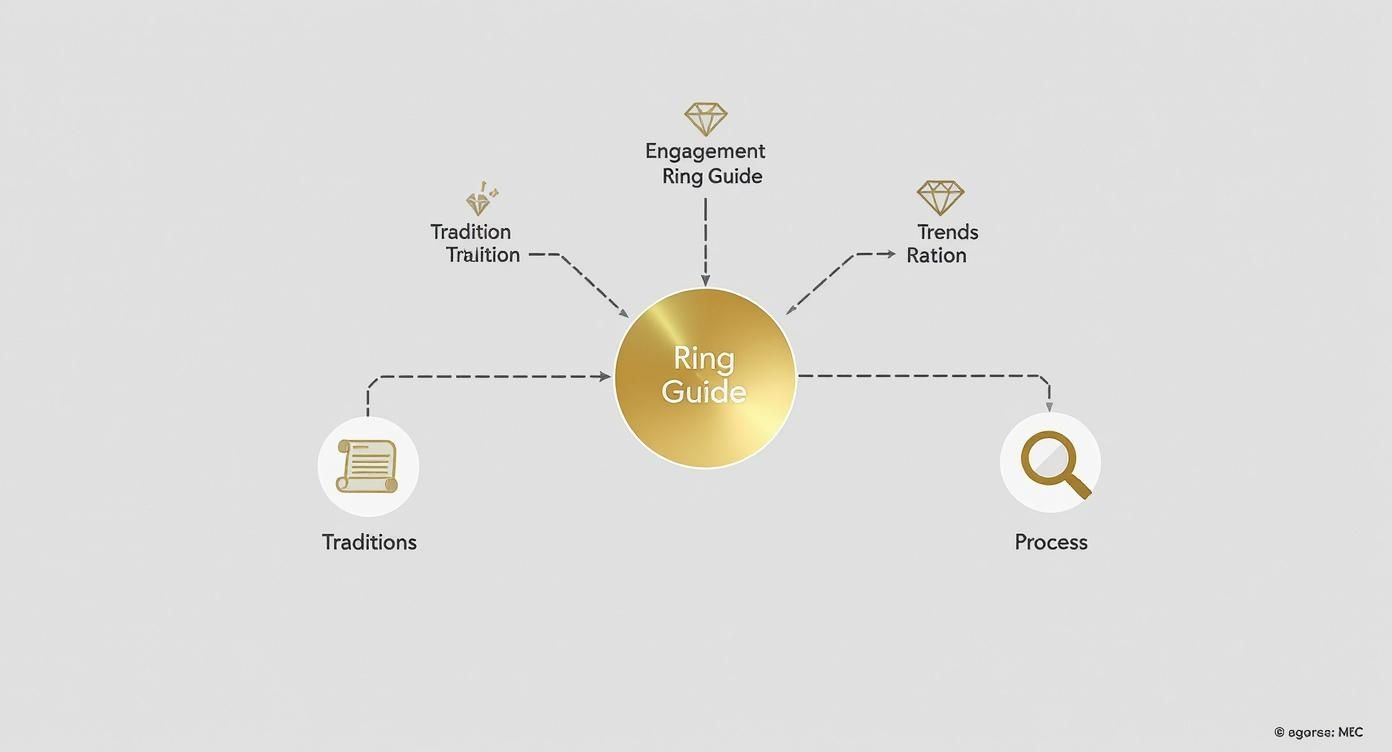
As you can see, understanding these fundamentals is central to finding a ring that feels both timeless and perfectly modern.
Cut: The Source of Sparkle
Most people think "cut" refers to the diamond's shape—round, oval, princess, etc. That's a common mistake. A diamond's cut grade is all about how well its facets, the tiny mirrors on its surface, play with light. It’s the only one of the 4Cs that’s all about human craftsmanship, and it has the biggest impact on a diamond's sparkle.
Think of a perfectly designed hall of mirrors. When light enters, it bounces from surface to surface before shooting right back out, creating a brilliant light show. A well-cut diamond does exactly that. A poorly cut one? It's like a hall of mirrors with wonky angles. Light leaks out the bottom and sides, leaving the stone looking dull and lifeless.
This is why so many experts will tell you to prioritize the cut above everything else. An "Excellent" cut diamond can look more brilliant and even bigger than a poorly cut stone with a higher carat weight or better color.
Color: The Absence of Hue
When gemologists talk about diamond color, they're actually talking about the lack of it. The industry standard, set by the Gemological Institute of America (GIA), is a D-to-Z grading scale, where D is the best.
- D, E, F grades: These are "colorless." Think of pure, clear water. They're the rarest and carry the highest price tag.
- G, H, I, J grades: Graded as "near-colorless." To most people, the subtle warmth is completely unnoticeable, making this range a fantastic value.
- K-Z grades: These diamonds have a visible yellow or brownish tint.
The ring's metal can make a big difference here. A warmer diamond, like a J grade, can look absolutely beautiful in a yellow or rose gold setting that complements its tone. On the other hand, an icy-white D-grade diamond really pops in platinum or white gold.
A Quick Guide to Prioritizing the 4Cs
Figuring out where to focus your budget can be tricky. This table breaks down what each 'C' really means for the look of your diamond and where you can find the best value.
| The 'C' | What It Measures | Impact on Sparkle | Budget-Saving Tip |
|---|---|---|---|
| Cut | The quality of a diamond's angles, facets, and finish. | Maximum. This is the #1 factor for brilliance and fire. | Don't skimp here. An "Excellent" or "Very Good" cut is the best investment for a beautiful, sparkling diamond. |
| Color | The absence of color (from D, colorless, to Z, light). | Moderate. A slight tint is often invisible to the naked eye, especially in a setting. | Go for a G-J grade ("near-colorless"). It looks white to most people but costs much less than a D-F grade. |
| Clarity | The number and size of internal and external flaws. | Minimal, as long as the diamond is "eye-clean." | Choose a VS2 or SI1 grade. Inclusions are usually microscopic and don't affect beauty, saving you a bundle. |
| Carat | The physical weight of the diamond (not its size). | None. Carat is about weight, not sparkle. Cut determines how big a diamond looks. | Buy just shy of the full carat marks (e.g., a 0.90 ct instead of a 1.00 ct). The size difference is tiny, but the price drop can be huge. |
In the end, it's about finding a smart balance. A well-cut, eye-clean diamond with a near-colorless grade will almost always look more stunning than a larger, flawed diamond with a poor cut.
Clarity: A Diamond's Unique Fingerprint
Clarity is all about the tiny, natural imperfections found in almost every diamond. Flaws on the surface are called blemishes, and internal ones are known as inclusions. Don't think of them as defects—they're more like natural birthmarks that make every single diamond one-of-a-kind.
The clarity scale runs from Flawless (FL), where nothing is visible even under 10x magnification, down to Included (I1, I2, I3), where flaws are easy to spot.
For most people, the sweet spot is in the VS (Very Slightly Included) or SI (Slightly Included) ranges. Diamonds in these grades are usually "eye-clean," meaning you can't see the inclusions without a jeweler's loupe. This lets you get a gorgeous diamond without paying the hefty premium for technical perfection.
Carat: The Measure of Weight
And finally, we have carat—the C everyone asks about first. Carat is simply a measure of a diamond's weight, not its size. One carat equals 200 milligrams. While it's true that a higher carat weight usually means a bigger diamond, that’s not the whole story.
A diamond's visual size is also massively influenced by its cut and shape. A beautifully cut oval or marquise diamond can look much larger than a round diamond of the exact same carat weight. Likewise, a deeply cut diamond hides its weight at the bottom, making it appear smaller from the top than a better-proportioned stone that weighs less.
Want to maximize your budget? Consider looking for diamonds just below the popular weight markers, like a 0.90-carat stone instead of a full 1.00-carat. The visual difference is almost impossible to spot, but the savings can be significant. For a deeper dive, our comprehensive diamond education resources have all the details you need.
Choosing a Ring Style and Setting
If the diamond is the heart of the ring, the setting is what gives it a personality. This is the part that turns a beautiful stone into a piece of art that tells a story about your partner. Choosing the right style is less about chasing trends and more about finding a design that truly reflects who they are and fits into their everyday life.
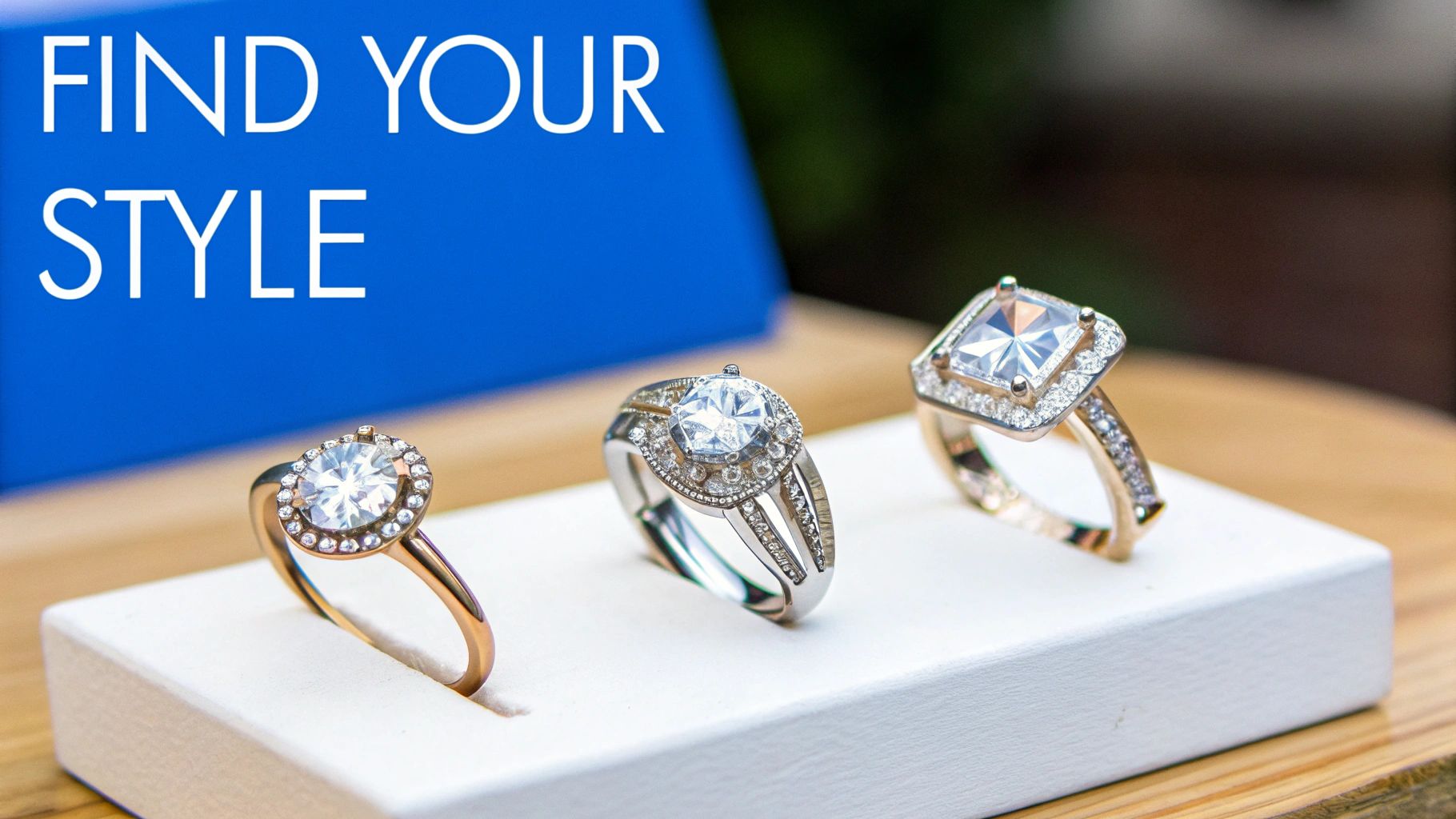
This part of the journey is all about the architecture of the ring itself. We’ll walk through the most beloved designs—from the timeless classics to more modern looks—and break down the pros and cons of each one.
Exploring Timeless Engagement Ring Styles
Some designs never go out of style. There's a reason they've been popular for decades: they're beautiful, versatile, and often carry a deeper symbolic meaning.
-
The Solitaire: This is the quintessential engagement ring, hands down. It features a single, incredible diamond held up by simple prongs, making that stone the absolute star of the show. Its magic is in its elegant simplicity, perfect for someone with a classic, understated taste.
-
The Halo: If you want to maximize sparkle, the halo is your best friend. A circle of smaller diamonds surrounds the center stone, creating a brilliant "halo" of light that also has the clever effect of making the main diamond look much bigger.
-
The Three-Stone Ring: This style is packed with symbolism. The three stones are meant to represent a couple's past, present, and future. It’s a really meaningful choice that also gives a substantial, balanced look on the finger.
Choosing a style is really about matching the ring's personality to your partner's. Are they more about the clean, elegant lines of a solitaire or the dazzling brilliance of a halo? Take a look at the jewelry they already wear; it will give you some great clues.
Considering Modern and Intricate Designs
Beyond the classics, you'll find plenty of settings that offer unique details for extra character. These styles are perfect for someone who really appreciates fine craftsmanship and wants a ring that stands out from the crowd.
A pavé setting, for example, embeds tiny diamonds closely together along the band, creating what looks like a continuous, shimmering surface of sparkle. It’s a technique that adds a delicate, glamorous feel without taking away from the main diamond.
Vintage-inspired settings are also a huge favorite, often featuring intricate details like milgrain (tiny metal beads along the edges) and filigree (delicate, lacy metalwork). These rings have all the romance of a bygone era and are perfect for someone with a bit of an old-soul vibe. As you start to picture these different looks, you can explore a curated collection of beautiful engagement rings to see them all in action.
Selecting the Perfect Precious Metal
The metal you choose for the band does more than just hold the diamond in place—it sets the whole tone for the ring. Each option has a unique color, feel, and durability to think about.
-
Platinum: Known for being both rare and incredibly durable, platinum is a naturally white metal that won’t fade or change color over time. It’s also hypoallergenic, which is a huge plus for sensitive skin. You can feel its quality in its density; it has a substantial, luxurious weight to it.
-
White Gold: This is a very popular and more affordable alternative to platinum. It’s made by mixing yellow gold with white metals and then plating it with rhodium for that bright, silvery shine. It looks nearly identical to platinum but will need to be re-plated every few years to maintain its crisp white color.
-
Yellow Gold: A true classic. This metal has a warm, rich glow that looks especially beautiful with diamonds that have a little warmth to them (think G-J color grades). Its traditional appeal is timeless, and it’s seeing a major comeback.
-
Rose Gold: With its romantic, pinkish hue, rose gold is a stylish and unique choice. It's made by alloying gold with copper, which also makes it quite durable. This metal has a wonderful way of complementing all skin tones, giving off a soft, warm glow.
At the end of the day, the right setting and metal is the one that feels authentic to your partner. It should be a design they will be excited to wear every single day, for the rest of their lives.
How to Set a Realistic Engagement Ring Budget
Alright, let's talk about the budget. This can be the most nerve-wracking part of buying an engagement ring, but it really doesn't have to be. First things first, throw out that old rule about spending two or three months' salary. That was a clever marketing line from decades ago, not a practical piece of advice for today.
Setting a real-world budget is all about figuring out what feels right for you and your financial situation. The whole point is to start your life together on a high note, not buried in unnecessary debt. A thoughtful budget makes the ring a symbol of your love, not a source of financial stress.
This isn't a small purchase for most people. The engagement ring industry in the United States is a massive $12.5 billion market, and the average couple spends around $5,800. While that shows people are willing to invest in this milestone, your number should be about what works for you. You can find more jewelry industry trends on carattrade.com if you're curious.
Understanding What Drives the Cost
So, what are you actually paying for? The final price tag on a ring is a mix of a few key ingredients. Once you understand them, you can decide where you want to put your money.
- The Diamond (or Center Stone): No surprise here—this is usually the biggest chunk of the cost. It's driven entirely by the 4Cs you just learned about. Even tiny tweaks in Color or Clarity can make a big difference in price.
- The Setting and Metal: Platinum is naturally more expensive than white gold. A simple solitaire band will cost less than an intricate pavé setting loaded with tiny diamonds.
- Craftsmanship and Brand: The skill involved in making the ring and the jeweler's reputation are also part of the equation.
It’s a bit like building a custom car. You have to decide if you want to invest in the engine (a diamond with a superior cut), the plush leather interior (a high clarity grade), or the fancy paint job (a detailed, unique setting).
Smart Strategies for Maximizing Your Budget
Once you have a spending range that feels comfortable, it's time to get clever. This is where you can make some smart trade-offs to get the most sparkle for your dollar.
A couple of simple moves can have a huge impact:
-
Prioritize the Cut: As we've mentioned, the cut is the single biggest factor in a diamond's brilliance. A beautifully cut diamond reflects more light, looks livelier, and can even appear larger than a poorly cut stone of the same carat weight. Always set aside enough of your budget for an "Excellent" or "Very Good" cut grade.
-
Buy Shy of the Carat: Diamond prices take a big leap at those "magic" numbers—1.0, 1.5, and 2.0 carats. If you choose a diamond just under that mark, like a 0.95 carat instead of a full 1.0 carat, you can save a significant amount. And guess what? The size difference is impossible to spot with the naked eye.
The secret to a great purchase is knowing where to compromise. Sacrificing a little on a quality you can't see (like flawless clarity) to invest in a quality you can (like a brilliant cut) is the smartest move you can make.
Choosing a diamond with a VS2 or SI1 clarity grade is another fantastic way to stretch your budget. These diamonds are almost always "eye-clean," meaning you'd need a jeweler's loupe to see any tiny inclusions. You get a stone that looks perfect to the world without paying the premium for true flawlessness. It’s the perfect balance of beauty and practical value.
Finding a Trusted Jeweler Online or In-Store
Where you buy the engagement ring is just as important as the ring itself. A great jeweler isn't just a salesperson; they become your guide, your educator, and a trusted partner in one of life's biggest purchases. Their job is to make sure your experience is as brilliant as the diamond you choose.
Whether you love the hands-on service of a local showroom or the endless selection of an online retailer, doing your homework on the seller is the key to buying with total confidence.
This final step connects all the dots. Finding someone reputable protects your investment and gives you the peace of mind that your ring’s quality and value are solid for years to come.
Evaluating In-Store Jewelers
There's something special about walking into a physical jewelry store. It’s a tactile experience that online shopping just can't match. You can see how different diamonds catch the light and feel the true weight of a platinum band versus a gold one.
When you visit a store, pay attention to the professionalism and expertise. Are the staff GIA-trained gemologists? A truly knowledgeable team can answer your questions with confidence and offer genuine insights, not just a sales pitch. Don't ever hesitate to ask about their credentials and experience.
A reputable jeweler encourages questions and prioritizes education. Their goal should be to help you find the best possible ring for your budget and preferences, not just to sell you the most expensive one.
Look for a jeweler with a solid reputation in the community. Check out online reviews on independent sites to see what other locals are saying about their service, the quality of their pieces, and their support after the sale.
Navigating Online Retailers
Shopping for an engagement ring online has exploded in popularity, offering incredible convenience and a massive selection. This shift is a huge force in the industry, and it's projected to keep growing at a rate of around 6.65% annually in the coming years.
When you're browsing online, transparency is everything. A trustworthy online jeweler will always provide:
- High-Resolution Imagery: Look for 360-degree videos and crystal-clear photos of the actual diamond you're looking at, not just generic stock images.
- Detailed Specifications: All the 4Cs, plus exact measurements and certification info, should be listed plainly for every single stone.
- Transparent Policies: Make sure you can easily find and understand their return policy, warranty details, and shipping procedures.
A secure checkout and customer service that's easy to reach by phone, chat, or email are also absolute must-haves.
The Power of Diamond Certification
No matter where you shop—online or in-person—the single most important piece of paper is the diamond's grading report. Think of it as the diamond's birth certificate and vehicle history report, all rolled into one. It's your unbiased, third-party proof of quality.
Always, always insist on a certificate from a respected and independent gemological lab. The Gemological Institute of America (GIA) is widely known as the industry's gold standard because of its incredibly strict and consistent grading. A ring with a GIA report is your guarantee that the Cut, Color, Clarity, and Carat weight have been verified by an impartial authority.
This little document protects you from paying for an inflated grade and ensures you get exactly what you paid for. To get comfortable with these reports, check out our in-depth guide to understanding diamond certification. A great jeweler will be more than happy to walk you through the report line by line, explaining every last detail.
Common Questions About Buying an Engagement Ring
As you get closer to making one of life's biggest purchases, it’s only natural for a few last-minute questions to pop up. Think of this as your final checklist—a chance to clear up any lingering uncertainties so you can move forward with total confidence.
We'll run through some of the most common questions we hear from people in the final stages of their search. From the practicalities of sizing to the big-picture decision on diamond origin, getting these answers will help solidify your choice.
What Is the Difference Between a Lab Grown and a Natural Diamond?
This is easily one of the most common questions in today's market. The simplest answer? Their origin story. Physically, chemically, and to the naked eye, they are identical materials.
A natural diamond formed deep within the Earth billions of years ago under unimaginable heat and pressure. A lab-grown diamond, on the other hand, is created inside a highly controlled environment using advanced tech that perfectly mimics those natural conditions.
It's a bit like the difference between ice that forms on a frozen lake and the ice from an ice maker in your freezer. It’s the same H2O, just made in a different environment. Both are real ice, just like both lab-grown and natural diamonds are real diamonds.
The decision really boils down to what you value most:
- Cost: Lab-grown diamonds usually cost significantly less than natural diamonds of the same size and quality. This means you can often get a larger or higher-quality stone for your budget.
- Ethical and Environmental Considerations: For some, the controlled environment of a lab is a huge plus. It guarantees a conflict-free origin and a smaller environmental footprint.
- Perceived Value: Others place a high value on the incredible rarity and the billions-of-years-old story behind a natural diamond, seeing it as a timeless piece of Earth's history.
There’s no "right" answer here. It’s all about which origin story and set of values feels right for you and your partner.
How Do I Find Out My Partner's Ring Size Secretly?
Ah, the classic challenge! With a little creativity, you can definitely solve this without ruining the surprise. The goal is to get as accurate as you can, but don't sweat it too much—most rings can be easily resized later if they aren't a perfect fit.
Here are a few clever, low-risk methods that work wonders:
- Borrow an Existing Ring: This is the gold standard. Sneak a ring they already wear on their ring finger and bring it to a jeweler. If they wear it on another finger, just let the jeweler know; they can usually make a very educated guess on the size adjustment.
- Enlist a Friend or Family Member: A trusted friend, sibling, or parent can be your secret agent. They can casually bring up jewelry during a shopping trip or ask to try on your partner’s rings just for fun, gathering that crucial intel for you.
- Use a Bar of Soap: If you can only borrow a ring for a moment, press it firmly into a bar of soap. The impression it leaves creates a perfect mold of the inner circumference that a jeweler can use to figure out the size.
A little bit of planning here makes the big moment that much smoother.
What Is a Diamond Certificate and Why Is It Important?
A diamond certificate, often called a grading report, is the single most important piece of paper that will accompany your diamond. Think of it as the diamond's official ID card, issued by an independent, third-party gemological lab.
This report gives you an unbiased, expert breakdown of the diamond's 4Cs: Cut, Color, Clarity, and Carat weight. It details the stone’s exact measurements, proportions, and notes any identifying characteristics. The most respected lab in the business is the Gemological Institute of America (GIA), famous for its strict and consistent standards.
Without this certificate, you're just taking the seller's word for the diamond's quality. This report is your guarantee that you are getting exactly what you paid for. It protects your investment from being misrepresented and ensures its value is based on verified facts. For any significant diamond purchase, it's completely non-negotiable.
Should I Purchase Ring Insurance?
The short answer is: absolutely. An engagement ring is a huge emotional and financial investment, and protecting it is just plain smart. Insurance gives you peace of mind by covering you in case of loss, theft, or significant damage.
You generally have two straightforward options for insuring the ring:
- Add a "Rider" to an Existing Policy: You can often add a personal property rider (or "floater") to your current homeowners or renters insurance policy. This is usually an easy and affordable route.
- Use a Specialized Jewelry Insurer: Companies that focus exclusively on jewelry insurance are also a great option. They often provide more comprehensive coverage, sometimes including preventative maintenance like prong checks and repairs.
Whichever way you go, getting insurance is a small step that provides massive protection for a truly priceless symbol.
Ready to begin your journey with a team you can trust? At ECI Jewelers, we combine decades of expertise with a passion for helping you find the perfect symbol of your love. Explore our curated collection of engagement rings or schedule a consultation with our GIA-trained experts today. Your perfect ring is waiting. https://www.ecijewelers.com


