

Ever wondered what makes a mechanical watch tick without a battery? It's a tiny, intricate engine powered entirely by stored mechanical energy. A mechanical watch works by using a wound spring to power a series of gears, which are precisely controlled by a regulating mechanism called an escapement.
The Miniature Engine Inside Your Watch
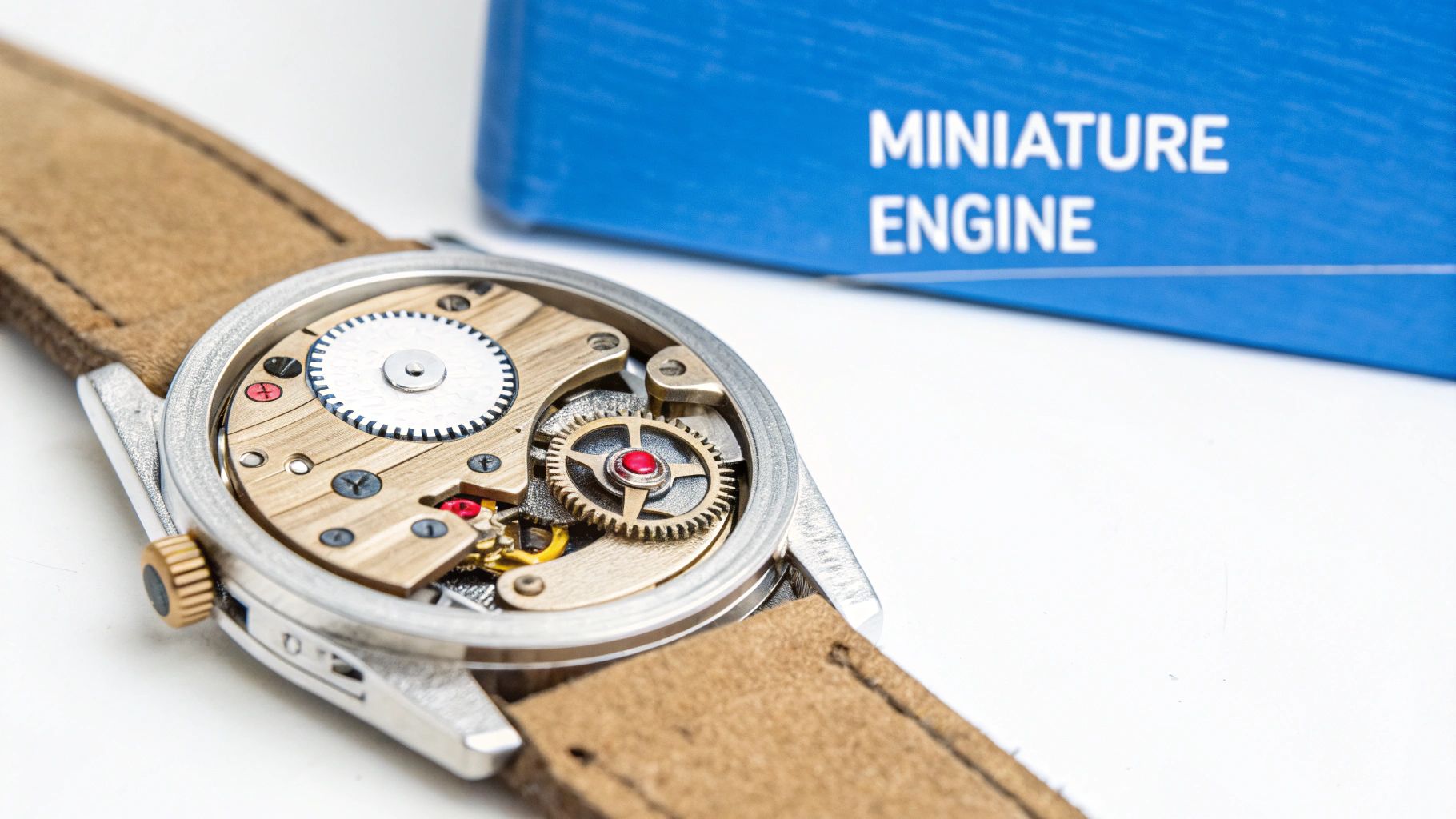
Think of a mechanical watch not as an electronic device, but as a miniature engine with a soul, humming with controlled power. Instead of fuel, it runs on the potential energy stored within a tightly wound spring. This energy is released in a slow, deliberate manner, almost like how a water wheel turns at a steady, predictable pace.
This process transforms raw power into the precise measurement of time, all without a single circuit or battery. At its heart is the mainspring, a tightly coiled piece of metal that stores energy when it's wound—either by hand or through the motion of your wrist in an automatic watch. You can see this incredible craftsmanship on full display in automatic skeleton watches, which leave the inner workings completely visible.
To truly get how a mechanical watch works, we need to look at its core systems and how they work in perfect harmony.
This infographic breaks down the essential engine components into three core concepts: the spring, the gears, and the escapement.
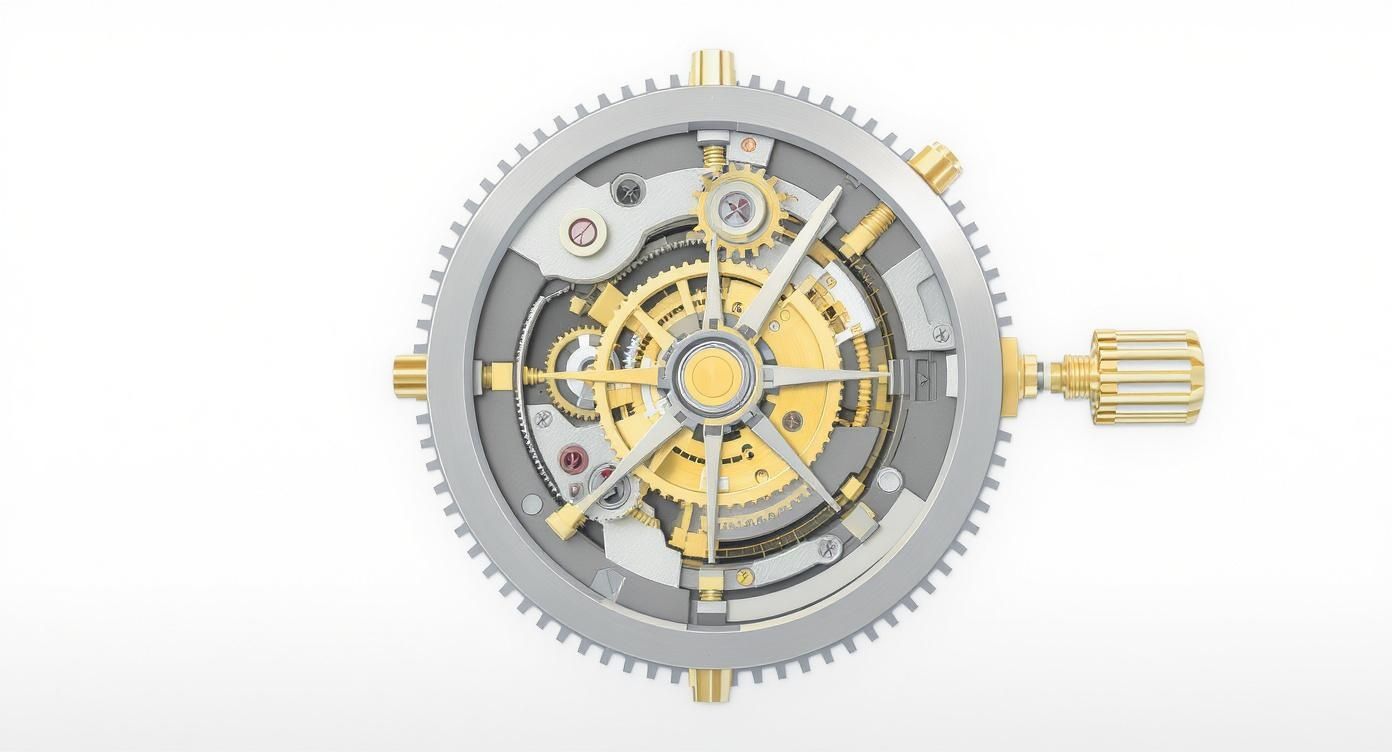
As you can see, stored energy flows from the mainspring, gets transferred and divided by the gears, and is ultimately regulated by the escapement. It’s a beautiful, self-contained system.
The Five Core Systems of a Mechanical Watch
Before we dive deep, it helps to have a quick roadmap of the essential components and what they do. Think of these five systems as the key players in the mechanical symphony happening on your wrist.
Here’s a quick summary of what each system is responsible for.
| Component System | Primary Function |
|---|---|
| The Power Source | Stores and delivers energy (the mainspring) |
| The Gear Train | Transmits and divides power into units of time |
| The Escapement | Regulates the release of power in precise bursts |
| The Winding System | Winds the mainspring to add energy (manual or automatic) |
| The Display | Shows the time using hands, dials, and other indicators |
Each part plays a crucial role, and understanding them provides a much deeper appreciation for the art of watchmaking. Let’s break them down one by one.
Storing Power: The Mainspring and Winding System
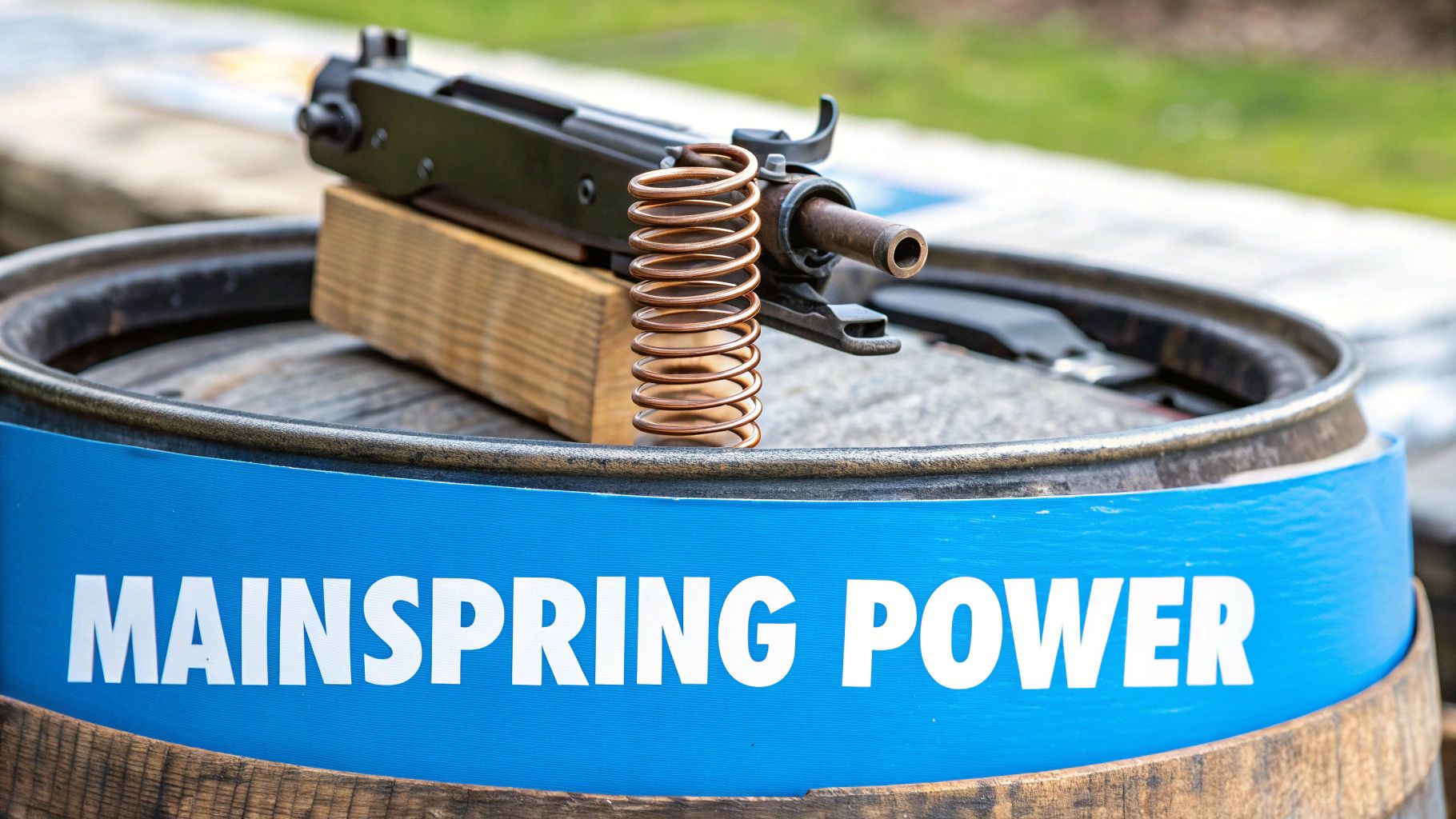
At the absolute heart of any mechanical watch is its power source: the mainspring. The best way to picture it is as a long, tightly coiled ribbon of special metal alloy, not unlike the spring inside an old wind-up toy. When you turn the crown, you're essentially tightening this ribbon, packing it with potential energy.
This stored power is the lifeblood of the watch. Without it, the beautiful, intricate dance of gears and wheels would simply never start.
This powerful spring doesn't just sit loose inside the watch; it’s housed within a small, toothed cylinder called the barrel. As the mainspring gradually and consistently unwinds, it forces the barrel to turn, delivering a smooth, controlled flow of power to the rest of the movement.
How long a watch can run on a full wind is called its power reserve. This can be anywhere from 38 hours in a standard movement to several days—or even weeks—in more advanced, high-end timepieces.
So, how does that spring get wound in the first place? That’s where the winding system comes in, and there are two main ways it's done.
Manual vs. Automatic Winding
Understanding the difference between manual and automatic winding is crucial, as it’s one of the most fundamental distinctions in the watch world. Each method has its own history and appeals to different kinds of watch lovers.
- Manual Winding: This is the old-school, original method. The wearer has to physically turn the crown by hand to tighten the mainspring. For many collectors, this daily ritual is a cherished part of owning a mechanical watch, creating a tangible connection to the machine.
- Automatic (Self-Winding): An automatic watch has a far more clever way of powering itself. It uses a weighted, semi-circular piece of metal called a rotor that’s attached to the movement. As you go about your day and your arm moves, the rotor swings back and forth, using that motion to automatically wind the mainspring for you.
The real genius of the automatic system is how it captures the kinetic energy from your body’s natural movements and converts it into stored, potential energy for the watch. If you wear an automatic watch regularly, it could theoretically run forever without ever needing to be manually wound.
This distinction is fundamental to some of the most iconic timepieces ever made. For a fantastic deep dive, exploring the different Rolex movements offers a fascinating look at how a top-tier brand has perfected both systems over the decades.
Ultimately, whether manual or automatic, the goal is the same: to efficiently store energy in the mainspring, ready to be released with impeccable precision.
Translating Power Into Time: The Gear Train
So, the mainspring holds all this raw, coiled-up energy. But how does that brute force become the steady, elegant march of the hands around the dial? That critical job falls to the gear train—the intricate transmission system of the watch.
Think of it like the gearbox in a car. It’s responsible for taming the engine’s raw power and converting it into controlled, useful motion.
This series of interlocking wheels takes the slow, powerful unwinding of the mainspring and systematically steps it up into precise increments of time. Each gear, or "wheel," has a specific number of teeth designed to rotate at a particular speed, transferring energy to the next wheel in a perfectly calculated sequence. At its heart, this is how a mechanical watch works: by dividing and multiplying motion.
The whole process kicks off as the mainspring’s barrel turns, feeding power into the first and largest gear. From there, the energy flows through a series of progressively smaller and faster-moving wheels.
The Journey of Power
The gear train isn’t just a random jumble of cogs; it's a meticulously engineered cascade. Each wheel and its corresponding pinion (that’s the tiny gear it meshes with) has a specific name and a critical job, all working in concert to drive the hands on the dial at just the right speeds.
- Center Wheel: This is typically the first wheel to get power from the mainspring barrel. It usually rotates once an hour, making it the perfect driver for the minute hand.
- Third Wheel: Think of this as the intermediary. It transfers power from the slower center wheel to the much faster fourth wheel.
- Fourth Wheel: This one is crucial for the display. It almost always rotates once every 60 seconds, which is why it’s the gear that drives the seconds hand.
- Escape Wheel: This is the final and fastest-moving wheel in the train. Its job is to deliver power in tiny, precise kicks directly to the escapement, which we'll get into next.
The real magic of the gear train lies in its ratios. For instance, if the center wheel has 60 teeth and it drives a pinion with only 10 teeth, that pinion (and the wheel it's attached to) will spin six times for every single rotation of the center wheel. By carefully calculating these ratios, watchmakers convert the mainspring's slow, hours-long unwinding into the exact rotations needed for seconds, minutes, and hours.
This mechanical ballet is a true marvel of micro-engineering. The slow, heavy torque from the mainspring gets refined into a quick, light impulse that the escapement can actually regulate. Without the gear train, the mainspring would just spin out uncontrollably in a matter of seconds. Instead, this beautiful system creates a controlled, predictable flow of power, turning the abstract idea of time into something you can see and hear ticking away on your wrist.
The Beating Heart and Brain: The Escapement
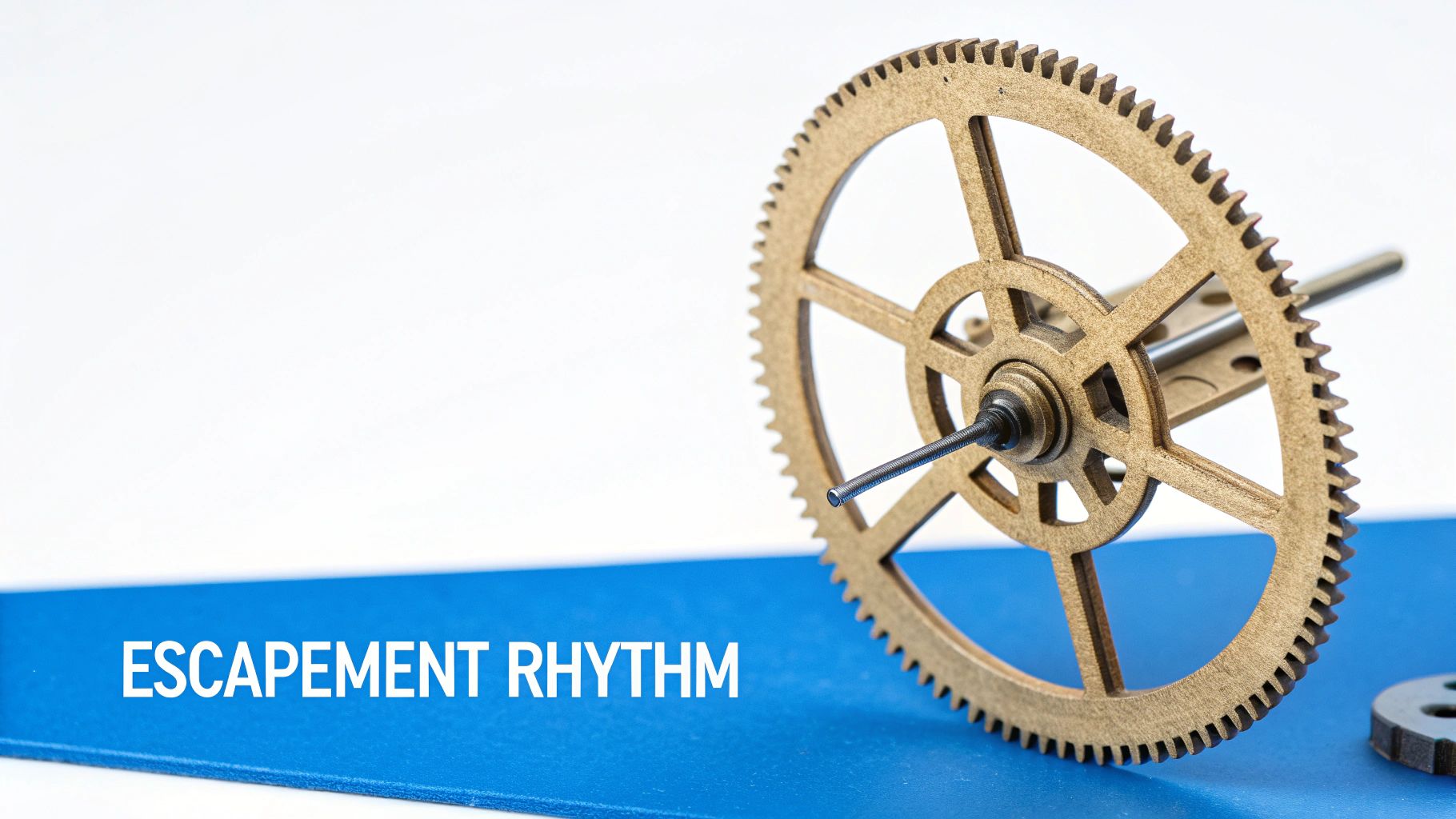
So, we've got the power from the mainspring and the transmission with the gear train. Now we get to the real magic: the escapement. This tiny, brilliant mechanism is both the beating heart and the brain of the whole operation. It’s what creates that iconic and deeply satisfying 'tick-tock' sound you only get from a mechanical watch.
The escapement’s job is all about extreme precision. It has to take the raw, continuous power flowing from the gear train and chop it into perfectly measured, identical little parcels of energy. Without this critical piece, the mainspring would just unwind in a chaotic mess in a few seconds.
Imagine it as a perfectly timed swinging gate. This gate (the pallet fork) swings open and shut at an exact rhythm, letting just a tiny pulse of power through before locking again. This keeps the full force of the gear train from just rushing through all at once.
The Dance of Regulation
The genius of the escapement comes from the interplay between three key parts, all moving in a delicate, high-speed dance. How well they work together is what makes a watch accurate.
- Escape Wheel: This is the last wheel in the gear train. It has these funny, club-shaped teeth and is always trying to spin forward, pushed by the mainspring's power.
- Pallet Fork: Shaped like a little anchor, this part has two tiny jewels (called pallets) on its tips. It rocks back and forth, and its jewels take turns locking and then unlocking the teeth of the escape wheel.
- Balance Wheel: This is the true timekeeper. It's a weighted wheel that swings back and forth at a very precise, constant speed, driven by a hair-thin coiled spring called a hairspring.
It's all a beautiful, self-regulating loop. The balance wheel’s swing tells the pallet fork when to move. The pallet fork then unlocks the escape wheel for a split second, and the escape wheel gives a tiny "kick" back to the pallet fork. That little kick of energy is what keeps the balance wheel swinging.
This constant locking and unlocking is what breaks up the raw power into distinct beats, pushing the watch's hands forward with incredible precision.
Setting the Beat of Time
The speed of this whole system determines how accurate the watch is and how smoothly the second hand sweeps across the dial. The balance wheel oscillates at a set frequency, usually somewhere between 18,000 to 36,000 beats per hour (BPH).
For example, a ton of classic Swiss mechanical watches run at 28,800 BPH. That translates to eight ticks every single second, which is what gives the second hand that famously fluid motion instead of a jerky tick. You can get a better sense of these industry standards by checking out Grand View Research's analysis of the mechanical watch market.
Ultimately, the escapement's ability to perform this high-frequency dance millions of times without missing a beat is the essence of a mechanical watch. It’s the single most important assembly for accuracy, turning stored energy into the steady, reliable passage of time.
Decoding Watch Terms and Specifications
You can understand how a mechanical watch works, but learning its language is where a true appreciation begins. When you scan a watch's spec sheet, you’re reading the very blueprint of its performance and personality. This is what separates one timepiece from another and helps you understand exactly what you're buying.
One of the first terms you'll probably run into is jewels. No, these aren't for decoration. They're tiny, synthetic rubies strategically placed at high-friction points inside the movement. Their ultra-smooth surface is a lifesaver for the gears, slashing wear and tear and keeping the watch running like a dream for years to come. A solid, quality movement will typically have 17 jewels or more.
Another big one is power reserve. This simply tells you how long a fully wound watch will keep ticking before it runs out of juice. It can be anywhere from about 38 hours on a standard movement to several days, or even a week, on higher-end models.
Understanding Performance Metrics
Beyond the basics, a few key numbers define the timekeeping soul of a watch. These specs are tied directly to the escapement and gear train systems we’ve already covered.
- Beats Per Hour (BPH): Also called frequency, this number tells you how many times the balance wheel swings back and forth in one hour. A higher BPH, like 28,800, creates that beautifully smooth, sweeping motion of the second hand and often leads to better accuracy.
- Complications: This is just a fancy word for any function a watch performs besides just telling you the time. Common complications include a simple date window, a day-date display, or a chronograph for stopwatch timing. Each complication adds another fascinating layer of mechanical ingenuity to the movement.
The world of horology is a fascinating blend of art and engineering. While quartz watches offer superior accuracy and affordability, the appeal of mechanical timepieces continues to grow, driving a significant portion of the global market.
This enduring appeal isn't just a feeling; it's backed by the numbers. The total global wristwatch market was valued at around $72.9 billion, with mechanical watches carving out a major premium slice of that pie. For more on this, you can check out some fascinating insights into the global watch market on Marketgrowthreports.com.
Getting familiar with these terms does more than just make you sound smart—it empowers you to truly appreciate the incredible craftsmanship packed into these tiny machines.
Mechanical vs. Quartz Watch: A Quick Comparison
To put things in perspective, it helps to see how the traditional mechanical watch stacks up against its modern battery-powered cousin, the quartz watch. While both tell time, they get there in completely different ways.
| Feature | Mechanical Watch | Quartz Watch |
|---|---|---|
| Technology | Powered by a wound mainspring and intricate gears. | Powered by a battery and a vibrating quartz crystal. |
| Maintenance | Requires regular servicing (every 3-5 years) to maintain accuracy. | Minimal maintenance; just a battery change every few years. |
| Price | Generally more expensive due to complex craftsmanship. | Typically more affordable and accessible. |
| Accuracy | Can lose or gain a few seconds per day. | Extremely accurate, often losing only a few seconds per month. |
Ultimately, the choice between mechanical and quartz comes down to what you value more: the soul and artistry of traditional watchmaking or the convenience and precision of modern technology.
Why Mechanical Watches Endure in a Digital Age
So after diving into the incredible engine ticking away inside a watch, you might be asking a simple question: why do these things even exist anymore? In a world of hyper-accurate smartwatches, why do these tiny mechanical marvels still capture our imaginations?
The answer has very little to do with just telling time. It’s about a deep, almost primal appreciation for human craftsmanship.
A mechanical watch is a real, tangible connection to centuries of history and skill. Every single component is the result of relentless innovation—a tradition that stretches all the way back to the very first timepieces. It’s a testament to what we can achieve with nothing more than springs and gears, without a single line of code or a microchip in sight.
This connection to the past is a huge part of its appeal. While the first portable timepieces emerged in the 16th century, the real breakthrough came much later with the invention of the balance spring around 1675. This single development dramatically improved accuracy and laid the foundation for the movements we still see today. You can get a deeper look at the evolution of mechanical timepieces on gminsights.com.
More Than a Timekeeper
Owning a mechanical watch isn’t just about having a tool; it’s about wearing a piece of art that also happens to perform a function. Think of it as a miniature, living sculpture on your wrist, driven by a heartbeat you can often see and hear. That creates a relationship between the owner and the object that’s incredibly unique and personal.
The real magic lies in its permanence. A mechanical watch isn’t a disposable piece of tech designed to be obsolete in a year. It’s a potential heirloom—an object built to last for generations, carrying stories and memories right along with it.
It stands for something different in our fast-paced, disposable world. While a smartwatch gives you connectivity, a mechanical watch offers a connection to something more lasting: tradition, artistry, and the quiet power of meticulous engineering. It doesn’t need updates or chargers; all it needs is the energy you give it.
This timeless quality is why these tiny engines don't just survive—they thrive. They offer an analog anchor in a digital sea, reminding us of the lasting beauty found in purely mechanical solutions.
Frequently Asked Questions About Mechanical Watches
Even after you get a feel for the mechanics, a few practical questions always pop up. Here are some clear, straightforward answers to the most common queries we hear from new and seasoned owners alike.
How Accurate Are Mechanical Watches?
A mechanical watch’s accuracy is measured in seconds gained or lost per day, not per month like a quartz watch. Your typical movement will run somewhere in the range of -10 to +20 seconds daily.
For something truly top-tier, a movement certified as a chronometer has to meet the much tighter standard of -4 to +6 seconds per day. The magic of a mechanical watch isn’t about being flawless; it’s about the incredible human craftsmanship required to get that close to perfect.
Do I Need to Wind an Automatic Watch Daily?
Usually, no. If you wear your automatic watch for about 8-10 hours a day with normal activity, the rotor inside will do all the work for you, keeping the mainspring wound through the simple motion of your wrist.
However, if you have a desk-heavy day or let it sit for a couple of days, the power reserve will eventually run out. When that happens, just give the crown a few dozen turns to get it ticking again. It's no surprise that approximately 60% of mechanical watches on the market today are automatic, a convenient self-winding technology that has been refined for centuries. You can learn more about these innovations in watchmaking on gminsights.com.
What Is a Watch Service and How Often Is It Needed?
Think of a watch service like a complete engine overhaul for your car. A certified watchmaker will completely disassemble the movement, give every single part an ultrasonic cleaning, and replace any components showing wear and tear.
Afterward, they reassemble it with fresh, high-grade lubricants and regulate it to make sure it’s keeping the best possible time.
Most brands recommend a full service every 5 to 7 years. This isn't just a suggestion; it's vital preventative maintenance that addresses dried-out oils and stops friction from damaging the delicate parts inside, ensuring your timepiece runs reliably for decades.
Proper care is a must for any luxury item. For some tips on day-to-day upkeep, you might find our comprehensive guide to cleaning your Rolex watch helpful.
Is It Harmful to Let My Watch Stop Running?
Not at all. It’s perfectly fine to let a mechanical watch's power reserve run down if you aren't wearing it.
The modern synthetic oils used in movements today are incredibly stable and won't gum up or degrade like older lubricants. When you’re ready to wear it again, just give it a wind, set the time, and it will start right back up as if it never stopped.
At ECI Jewelers, we believe that understanding the art of watchmaking deepens the joy of ownership. Explore our curated collection of authenticated luxury timepieces and find the mechanical marvel that speaks to you at https://www.ecijewelers.com.


