


Before you even think about checking serial numbers or cracking open the case back, your first few seconds with a watch can tell you almost everything you need to know. This initial "gut check" is all about spotting the obvious fakes, saving you from wasting time on a watch that isn't worth a second glance.
Authenticating a Rolex starts with the basics: its weight, the smooth sweep of the second hand, and the 2.5x magnification of the Cyclops lens. A real Rolex feels dense and valuable, operates almost silently, and boasts a level of craftsmanship that cheap knock-offs just can't touch. These are your first lines of defense.
Your First Look: A Quick Rolex Authenticity Checklist
The very first thing you'll notice when you pick up a Rolex is its weight. Genuine Rolex watches are built from premium materials like Oystersteel (a specific 904L steel alloy), solid gold, or platinum. This gives the watch a substantial, reassuring heft in your hand.
Most fakes are made with cheaper, lighter metals. If the watch feels suspiciously light, hollow, or flimsy, that’s a massive red flag right there. Trust your instincts on this one.
Feel and Sound Tell the Real Story
Next, bring the watch up to your ear and listen. A real Rolex movement is a masterpiece of micro-engineering, with gears that move multiple times per second. The result is a sound so smooth it’s almost silent—more of a faint, high-speed purr than anything else.
What you don’t want to hear is a loud, distinct "tick-tock." That classic ticking sound is the signature of a quartz movement, which is a dead giveaway for a low-quality fake.
Now, watch the second hand. Its journey around the dial should be a fluid, graceful sweep. It’s not a perfectly continuous glide—it actually moves 6-8 times per second—but to the naked eye, it looks almost seamless. If you see a jerky, once-per-second ticking motion, you’re looking at a counterfeit. No question.
Expert Tip: Don't just look, feel the watch. Run your fingers along the edges of the case, the crown, and the bracelet links. A genuine Rolex is finished flawlessly, with perfectly smooth, rounded edges. Counterfeiters almost always cut corners here, leaving behind sharp edges, rough patches, or poor polishing.
To make things even simpler, here’s a quick rundown of what to look for during that initial inspection. This table breaks down the key differences you can spot in seconds.
Authentic Rolex vs Counterfeit At a Glance
| Feature | Authentic Rolex | Common Counterfeit Trait |
|---|---|---|
| Weight | Substantial and solid in hand | Feels light, hollow, or flimsy |
| Second Hand | Smooth, sweeping motion | Jerky, ticking motion (like a quartz watch) |
| Sound | Nearly silent, a faint purr | Loud, audible "tick-tock" |
| Overall Finish | Flawless, smooth edges | Sharp edges, poor polishing |
This initial checklist is an incredibly powerful tool. If a watch fails any of these simple tests, you can walk away with confidence. If it passes, then you're ready to move on to a more detailed examination of the dial, crystal, engravings, and other fine details.
Decoding Serial and Model Numbers
Every single Rolex that leaves the factory has its own unique fingerprint: its serial and model numbers. Think of them as the watch's DNA. Getting comfortable with finding and reading these engravings is one of the most solid ways to tell a real Rolex from a fake one. These numbers don't just identify the watch; they tell you its story—when it was made, its exact model, and even the materials used.
On older and vintage models, you'll need to pop the bracelet off to find these crucial identifiers. The model number (also called the reference number) is tucked away between the lugs at the 12 o'clock position. Spin the watch around, and you'll find the unique serial number in the same spot, but at the 6 o'clock position.
Locating the Engravings
Knowing where to look is the first step. Rolex made things a whole lot easier on modern watches, specifically those made after 2005. They started engraving the serial number on the inner bezel ring, which we call the rehaut. It's that metal flange sitting between the crystal and the dial. You can see it plain as day at the 6 o'clock position without taking anything apart.
- Vintage Models (Pre-2005): You have to remove the bracelet. The model number is at 12 o'clock and the serial is at 6 o'clock, right between the lugs.
- Modern Models (Post-2005): The serial number is visible on the rehaut at the 6 o'clock mark. The model number is usually still found between the lugs at 12 o'clock.
This wasn't just a design change; it was a clever move by Rolex to stay one step ahead of counterfeiters. Engraving the rehaut with that level of precision is extremely difficult, making it a nightmare for replica makers to copy convincingly.
Before you even get to the numbers, though, there are some quick checks you can do. This infographic gives a great rundown of the "feel, listen, and look" basics.
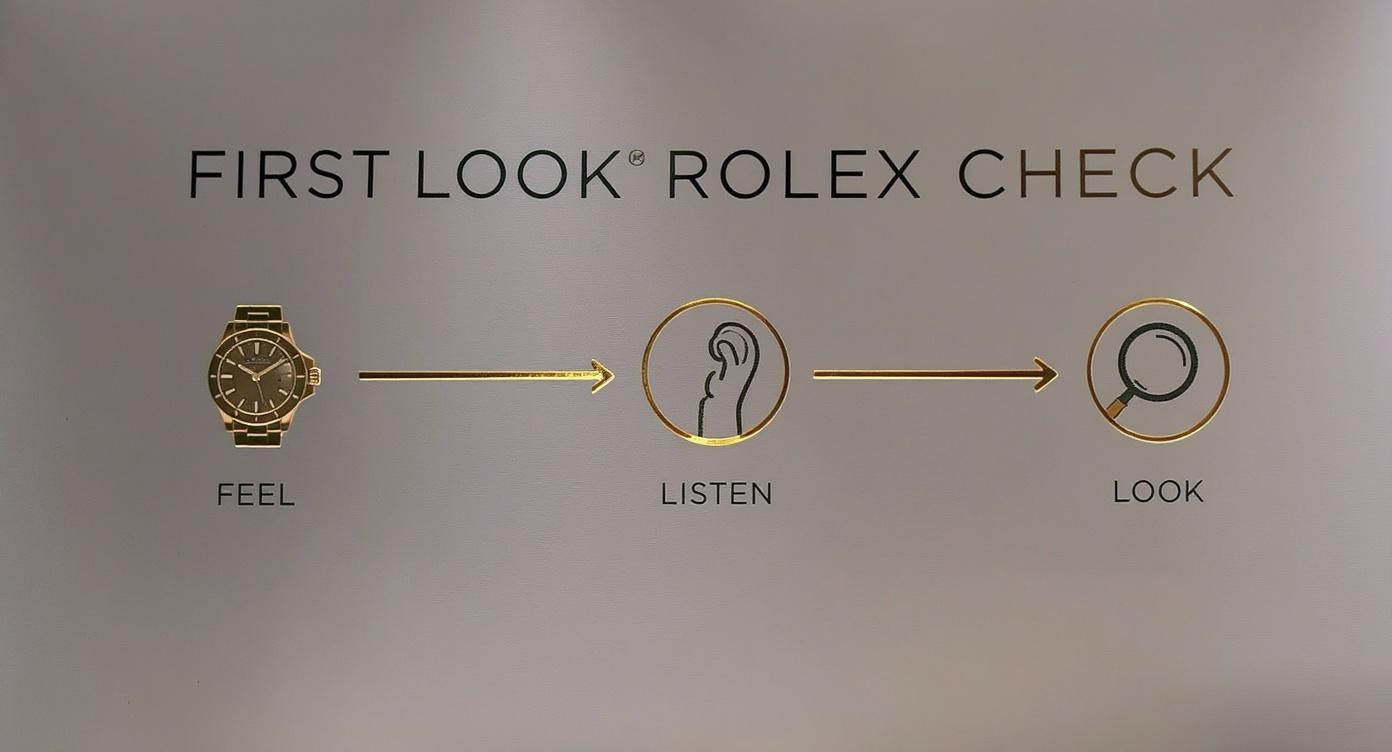
Think of these initial sensory checks as your first line of defense. They can help you spot the really bad fakes right away, long before you start squinting at tiny numbers.
The Quality of the Engraving Matters
It's not enough to just find the numbers; you have to look at how they're engraved. On a genuine Rolex, the serial and model numbers are cut into the metal with incredible precision. They use a diamond-tipped tool, creating lines that are sharp, deep, and clean. When the light hits them, they sparkle, almost like the facets of a gem.
A dead giveaway on many fakes is a sort of sandy, acid-etched look. Counterfeit numbers often appear shallow, faint, or have a weird dotted texture from a cheap engraving job. The lines will be uneven and lack that perfect, crisp finish you see on the real deal.
When you inspect the engravings, they should look absolutely flawless. Any hint of sloppy alignment, uneven depth, or a rough finish is a massive red flag. This obsession with detail is what Rolex is all about. It’s a lot like authenticating other fine collectibles, where the markings tell the whole story, as seen in this guide to antique silver pocket watches and their hallmarks.
Evolution of Rolex Serial Numbers
The numbering system itself has a history that gives us even more clues. Rolex started with 5-digit sequential numbers back in the 1920s and expanded to 8 digits by the early 2000s to keep up with production. Then, in 2010, they switched things up completely and moved to a randomized alphanumeric system. This was a direct shot at counterfeiters who had gotten pretty good at faking the old sequential patterns.
You can dive deeper into this history and get all the specifics in our comprehensive guide to Rolex serial and reference numbers.
This evolution is a powerful tool for authentication. For instance, if you're looking at a watch with a modern ceramic bezel, it absolutely must have a randomized serial number, not a 7-digit one from the 1990s. The serial number always has to match the known features for that model's production year. Understanding this timeline is non-negotiable for anyone serious about authenticating a Rolex. Cross-referencing the numbers against reliable databases is the final step to confirm everything lines up.
Examining the Dial, Case, and Crystal
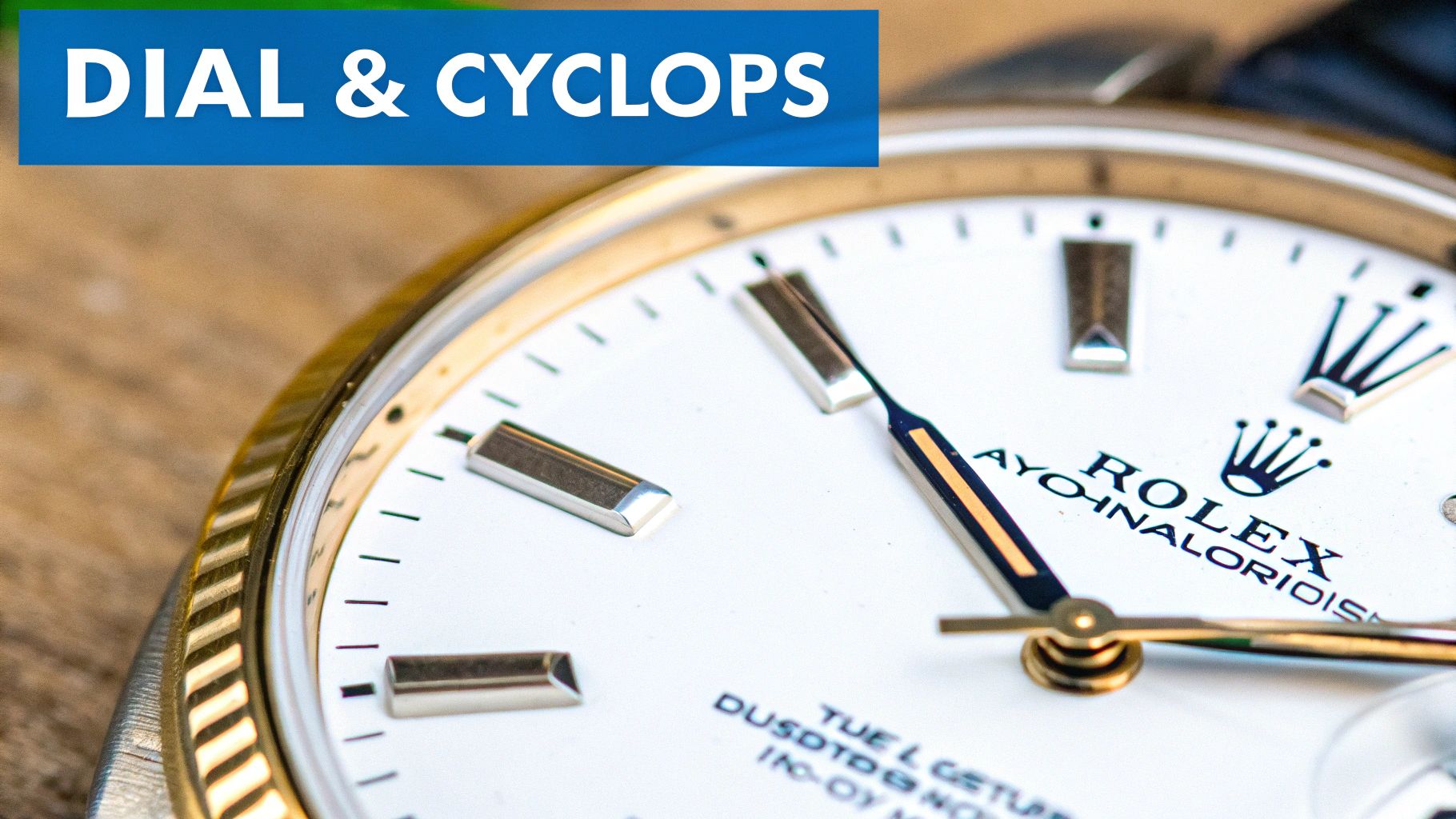
After you've felt the watch and listened to it, your next move is to get up close and personal with its face. This is where Rolex's fanatical attention to detail really shines—and where counterfeiters almost always slip up. They can get the general look right, but they can't replicate the microscopic precision that defines a genuine Rolex.
The dial is your primary canvas for this inspection. Every single piece of text, from the Rolex name to designations like "Submariner" or "Oyster Perpetual," has to be perfect. The letters should be sharp with clean, crisp edges, applied with flawless uniformity. If you can, run a finger over the text; on a real Rolex, it should feel slightly raised due to the high-quality printing process.
On a fake, you’ll often spot smudged lettering, weird spacing, or a totally flat appearance. Even the font might be just a little off—a bit too thick, a tad too thin. These are the tells that a magnifying glass will expose in seconds.
The Cyclops Lens: A Magnified Truth
One of the most famous—and most frequently botched—features on a counterfeit is the Cyclops lens. That little magnifying bubble over the date window isn't just for show; it's engineered to make the date pop. A genuine Rolex Cyclops provides a very specific and powerful 2.5x magnification.
It turns out that hitting this exact magnification is incredibly difficult for forgers. When you look through a real Cyclops, the date should jump out and fill the entire lens. It needs to be perfectly centered and razor-sharp.
Most knock-offs fail this test spectacularly.
- Weak Magnification: Fakes often have a wimpy 1.5x magnification, making the date look small and underwhelming.
- Poor Alignment: The lens might be crooked or just slightly off-center from the date window.
- Distortion: The date digits might look blurry or warped, especially around the edges of the lens.
A real Cyclops lens feels like a distinct, smooth bump on the crystal. On fakes, it often feels less pronounced or even flush with the surface, a dead giveaway that it's just a cheap piece of glass glued on, not an integrated component.
If the date doesn't completely fill that bubble, you've got a major red flag. For someone just learning how to spot fakes, this single component is one of your most reliable tells.
Uncovering the Crystal's Hidden Secret
Beyond the Cyclops, the crystal itself holds a subtle but powerful security feature. Since around 2002, Rolex has been laser-etching a tiny, nearly invisible coronet (the crown logo) onto the sapphire crystal, right at the 6 o’clock position.
Finding this is a bit of a treasure hunt. You won’t see it looking straight on. You have to tilt the watch and catch the light just right. It's made of minuscule dots and is incredibly hard to copy well.
When forgers try to replicate it, the crown is usually too big, too obvious, or looks crudely scratched into the surface. A genuine laser-etched crown is faint, delicate, and a true mark of Rolex craftsmanship. It's a secret designed to be found, not announced.
Analyzing the Hands and Lume
The hands of a Rolex are finished with the same obsessive precision as everything else. They should be perfectly flat with sharp, clean edges and a brilliant polish. Look closely for any specks of dust, fingerprints, or tiny flaws under the crystal—Rolex’s cleanroom assembly process makes things like that exceptionally rare.
The glow-in-the-dark material, or "lume," on the hands and hour markers is another critical checkpoint. Rolex uses its own proprietary Chromalight compound, which glows a distinct, long-lasting blue. Older models used Super-LumiNova, which glows green.
No matter the color, the application must be perfect.
- Uniformity: The lume should be applied evenly inside the markers, with no splotches or bleeding over the edges.
- Brightness: After a quick charge from a light source (your phone's flashlight works great), a real Rolex will glow brightly and consistently.
- Longevity: The glow should last for hours, fading slowly and gracefully.
Fakes typically use cheap lume paint that’s applied unevenly, glows faintly, and dies out within minutes. It's a simple test, but a very effective one.
Finally, flip the watch over. With very few rare exceptions (like some vintage exhibition models), a genuine Rolex case back is completely smooth, solid metal. No engravings, no logos, and definitely no clear "exhibition" windows. Counterfeiters love adding flashy glass case backs to show off a crudely decorated fake movement. If you can see the gears through the back, you’re almost certainly looking at a fake.
Inspecting the Bracelet and Clasp
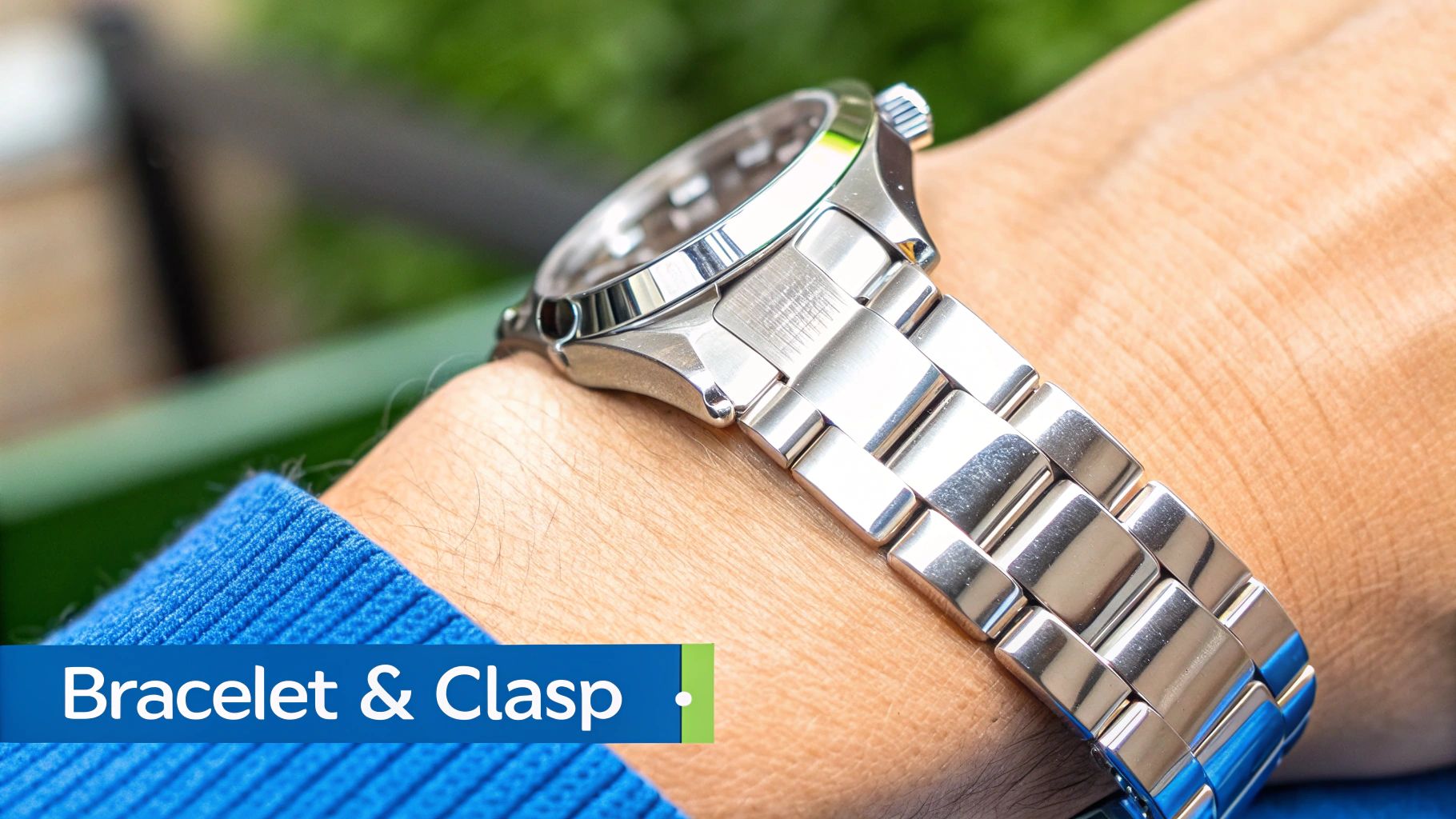
Don't just focus on the watch head; the bracelet and clasp tell a story all on their own. Rolex pours just as much engineering into its bracelets as it does the movements, creating a very specific feel that counterfeiters almost never get right. Honestly, your hands can often spot a fake before your eyes even register the details.
A genuine Rolex bracelet feels solid. It’s substantial and incredibly well-articulated. Whether you’re handling the tough three-link Oyster, the elegant five-link Jubilee, or the iconic three-link President, each link is milled from a solid block of metal. There's a smooth, almost liquid quality to how the links move together—no rattling, no cheap-sounding jingles.
Fake bracelets, on the other hand, often use hollow or folded links. This makes them feel light, cheap, and noisy. A quick trick is to run your fingers along the edges of the links. A real Rolex will be perfectly finished with no sharp or rough spots.
The Feel of Quality Materials
The metal itself is a huge giveaway. Rolex uses its own 904L Oystersteel, which has a unique luster and better corrosion resistance than the standard 316L steel you’ll find in most fakes. If it's a gold or platinum model, the bracelet will have a dense, unmistakable weight that’s hard to imitate.
Take a moment to flex the bracelet and look closely at the end links where they connect to the case. A real Rolex will have a perfect, flush fit with no awkward gaps. Getting this precision right is one of the biggest hurdles for counterfeit operations.
Tactile Test: Try this—close your eyes and just handle the bracelet. Does it feel like a single, cohesive piece of fine machinery? Or does it feel like a bunch of loosely connected parts? A genuine bracelet is a masterclass in seamless integration, while a fake often feels flimsy and disjointed.
This hands-on approach is one of the most powerful tools you have. It cuts right through the visual tricks and gets to the core of manufacturing quality.
Scrutinizing the Clasp Mechanism
The clasp is another area where Rolex’s obsession with detail shines. A genuine clasp closes with a secure, satisfying "click." It should feel like a precision machine engaging, not just a thin piece of stamped metal snapping shut.
The engravings inside the clasp are just as important. Here’s what to look for:
- Crisp Engravings: The Rolex logo, name, and any other markings should be deeply and cleanly engraved. The lines will be sharp and precise, not lightly etched or printed on the surface.
- The Coronet: The five-pointed Rolex crown on the clasp's exterior needs to be perfectly formed. On modern clasps, it’s often an applied, separate piece of metal that’s seamlessly integrated.
- Fit and Finish: The brushed and polished surfaces on the clasp should be flawless and match the finish on the rest of the bracelet perfectly.
A common red flag is a clasp that feels loose or is a pain to operate. The safety latch on a real Rolex sports watch, for instance, is engineered for security and should work smoothly and confidently every single time.
Identifying Bracelet Styles
Knowing which bracelet is supposed to be on a particular model is also crucial. While bracelets can be swapped out over time, the original factory configuration is a key piece of the puzzle.
| Bracelet Style | Common Models | Key Characteristics |
|---|---|---|
| Oyster | Submariner, Daytona, GMT-Master II | A robust three-piece link design known for its durability and sporty look. |
| Jubilee | Datejust, GMT-Master II | An elegant five-piece link design, offering a more refined and comfortable fit. |
| President | Day-Date, Lady-Datejust | The iconic three-piece semi-circular link design, exclusively made in precious metals. |
When you know that a Day-Date should only come on a President bracelet, seeing one for sale on a steel Oyster bracelet is an immediate reason to be suspicious. It’s these small details that, when added up, paint a clear picture of whether you're holding a Swiss masterpiece or a clever imitation.
Verifying the Rolex Movement
While looking at the outside of a watch can tell you a lot, the ultimate test for anyone learning how to spot a fake Rolex is what’s inside. The movement, or caliber, is the mechanical heart of the timepiece. It's the engine that powers everything, and it’s where Rolex's legendary engineering really shines.
This is why inspecting the movement is often the final, definitive step in verification. Counterfeiters might get close with the look of a dial or the feel of a bracelet, but replicating the complex, finely finished mechanics of a Rolex caliber is another challenge entirely. This is where the fakes almost always fall short.
A crucial word of caution here: opening a Rolex case back requires specialized tools and expertise. Don't try this at home. Attempting it without the proper equipment can easily lead to deep scratches on the case, damage to the waterproof seals, or worse, harm to the delicate movement inside. This is a job best left to a trusted, professional watchmaker.
What a Watchmaker Looks For
Even if you don't open the case yourself, understanding what an expert is looking for is empowering. A genuine Rolex movement is a work of art, defined by meticulous finishing and specific design cues that are instantly recognizable to a trained eye. They aren't just functional; they're built to be beautiful.
When a watchmaker opens up the case, they are searching for several key signatures:
- Flawless Finishing: Every plate and bridge inside a Rolex movement is finished with precision. You'll see clean, consistent patterns and perfectly polished screw heads. There are no rough edges, dust, or machining marks to be found.
- Distinctive Engravings: The movement will have "Rolex" engraved on it, along with the caliber number. These engravings are always sharp, clean, and perfectly executed—just like the serial numbers on the case.
- The Iconic Reversing Wheels: On many modern automatic Rolex movements, you’ll find two distinctive red or maroon-colored gears. These are the reversing wheels for the self-winding mechanism, and their specific color and anodized finish are very difficult for fakes to get right.
Expert Insight: Fakes often use generic, undecorated movements, sometimes made of cheap plastic parts or low-grade metal. They might have a sticker or a crude engraving that says "Rolex," but the overall quality will be messy, utilitarian, and completely lacking the fine finishing of a genuine caliber.
The Tell-Tale Sweep of the Second Hand
Fortunately, there is one way to judge the quality of the movement without ever opening the watch: by observing the second hand. As mentioned before, a genuine Rolex has a smooth, sweeping motion because its mechanical movement beats at a high frequency, typically 8 times per second.
This fluid movement is a hallmark of a high-quality mechanical watch. The most common and cheapest fakes use quartz movements, which results in a very obvious, jerky "tick-tock" motion once per second. It's a dead giveaway.
More sophisticated fakes may use a lower-quality mechanical movement to imitate the sweep, but it often won't be as smooth. If you watch it closely, you might notice a slight stutter or a less consistent glide. A genuine Rolex sweep is hypnotic in its consistency. To get a better sense of these mechanical hearts, you can explore our overview of the different Rolex movements and their unique characteristics.
This entire process, from the crystal to the caliber, is why professional authentication services exist. A detailed inspection that includes opening the watch can confirm its legitimacy beyond any doubt. Professional Rolex authentication services typically charge around $100, a small price for the peace of mind that comes with knowing you have a genuine timepiece. This fee covers the technical examination of the movement, verification of serial numbers, and a full assessment of the watch's condition—vital given how convincing some counterfeits have become.
Common Questions About Rolex Authentication
Even with a detailed checklist in hand, jumping into the world of pre-owned Rolex watches can feel a little daunting. The market has its own quirks, and with counterfeiters getting smarter every year, you have to be one step ahead. Let's tackle some of the most common questions we hear during the Rolex authentication process to help you feel more confident in your search.
One of the biggest worries for any buyer is the rise of so-called "super fakes." These aren't your typical knock-offs; they're high-end replicas designed to mimic the look, feel, and even the weight of a genuine Rolex with scary accuracy. So, are they really impossible to spot?
Are Super Fakes Really Undetectable?
While "super fakes" are impressively made, they are not undetectable to a trained eye. They might fool a casual glance, but they almost always have subtle tells that give them away under expert scrutiny. It's one thing to copy the look of a watch; it's another thing entirely to duplicate Rolex's proprietary manufacturing processes and its obsessive level of quality control.
An expert with the right tools can spot tiny inconsistencies that betray a fake. Things like:
- Minor Font Discrepancies: The spacing or thickness of the text on the dial might be off by just a fraction of a millimeter, but it's enough.
- Imperfect Rehaut Engraving: The "ROLEXROLEXROLEX" engraving on the inner bezel ring might have slight alignment or depth issues. A real Rolex is flawless.
- Movement Finishing: This is the big one. Once you open the case back, the finishing on a fake movement’s components will never match the refined polish and detail of a genuine Rolex caliber.
Replicating these microscopic details is just too expensive for counterfeiters, which is why a professional can almost always identify even the most sophisticated fakes.
What Should I Do If I Suspect My Rolex Is Fake?
That sinking feeling you get when you start doubting your watch is a tough one. If you have any reason to believe your timepiece might not be genuine, the first thing to do is stop wearing it and take it to a reputable, independent watchmaker or an authorized dealer. Whatever you do, don't try to open the case back yourself.
When you bring it in, expect to pay a service fee for their time and expertise. They'll perform a thorough inspection, which includes examining the movement, and give you a definitive answer. If it's confirmed to be a counterfeit, your options really depend on where and how you bought it. This is exactly why buying from a trusted source that provides a solid authenticity guarantee is so critical. Our guide on the benefits of purchasing certified pre-owned watches dives deeper into making a secure investment.
Does Having the Box and Papers Guarantee Authenticity?
Having the original box, warranty card, and manuals is a great sign, but let me be clear: it is not a standalone guarantee of authenticity. As replicas have gotten better, so have counterfeit documents and packaging. It's a classic rookie mistake to trust the papers without meticulously authenticating the watch itself.
Think of the box and papers as strong supporting evidence, not the final verdict. The watch is always the main event. Once you've confirmed the timepiece is real, then you verify the documentation. Make sure the serial numbers on the papers perfectly match the engravings on the watch. Also, check that the dealer stamp and date of purchase look legitimate for the watch's era.
The fight against fakes is a massive, ongoing battle. The global luxury market is flooded with counterfeits, and Rolex is always the number one target. Industry experts estimate that a staggering 40 million counterfeit Rolex watches are produced every single year. This is why Rolex has rolled out so many security features over the years, from the tiny laser-etched crown on the crystal to their more recent exploration of blockchain-based "Watch Certificates" to create a tamper-proof digital history for each piece.
Once you’re confident your Rolex is the real deal, protecting its value is the next crucial step. Getting a proper jewelry appraisal for insurance is a smart move to safeguard your investment against loss or theft.
At ECI Jewelers, every single timepiece we sell is rigorously inspected and backed by our 100% authenticity guarantee. You can browse our curated collection of certified pre-owned Rolex watches with the peace of mind that comes from working with trusted experts. Visit us at https://www.ecijewelers.com to find your next masterpiece.


