

To authenticate a Rolex watch, you need more than one clue. The reliable approach is layered: inspect the exterior without opening the case, compare serial and reference details to the correct production era, and use a qualified watchmaker for movement confirmation when the money or risk is meaningful. That sequence matters because a fake can pass one check and still fail three others.
Why Rolex Authentication Is More Critical Than Ever
The pre-owned Rolex market is active, liquid, and full of buyer demand. It is also one of the easiest places for counterfeiters to hide because the most copied models are the same ones buyers know best. Industry reporting has noted that Rolex accounts for the vast majority of fake luxury watches, and estimates cited by the South China Morning Post put annual fake-watch production in the tens of millions, with a portion convincing enough to require expert inspection to catch them according to this report. Watch-market data points in the same direction: high-volume resale platforms continue to reject large numbers of submitted watches, with Rolex overrepresented among the failures as WatchPro reported.
That market reality changes how authentication should be done. Packaging, paperwork, and a quick serial check are not enough by themselves, especially now that counterfeit presentation has improved alongside product copying. Even outside watches, anti-counterfeit strategy has shifted toward layered verification rather than single markers, a point explained well in this practical overview via Packaging Panda.
What we prioritize first is simple: non-invasive checks before invasive ones. We start with the watch as a buyer receives it, dial, case, bracelet, crystal, Cyclops, engravings, and overall construction. Next, we cross-reference the serial and reference details against the claimed era and configuration. Only after those line up do we consider the movement, and that should be done by a qualified watchmaker, not by opening the case on a kitchen table. We also treat box, warranty card, and hang tags as supporting evidence rather than proof. A convincing set can travel with the wrong watch.
The disqualifiers that make us stop early are usually inconsistencies, not one dramatic flaw: a reference number that does not fit the dial or bezel style, weak Cyclops magnification, engraving that looks sandy or shallow under magnification, bracelet construction that feels hollow or poorly finished, or documentation that does not match the watch in front of us. A real authentication framework is built to catch those mismatches before anyone talks themselves into a bad purchase.
The Growing Problem of Counterfeits
The counterfeit problem is not just a headline issue; it directly affects anyone buying in the secondary market. Reporting cited above shows Rolex remains the most concentrated target among fake luxury watches, which is exactly why rolex authentication now has to be treated as a process rather than a quick visual check.
That matters most in high-demand references. Popular Submariner, Daytona, and Datejust variants move fast, and counterfeiters exploit that speed by building watches that can survive casual inspection. For buyers authenticating Rolex watches in 2026, the practical takeaway is simple: the more desirable the reference, the less you should rely on one clue.
How We Authenticate a Rolex Step by Step
The safest order is outside in.
Start with a seller-screening pass using photos and video. Confirm that the reference appears consistent with the bezel, dial layout, handset, bracelet style, clasp generation, and claimed year. If obvious mismatches appear here, there is no reason to move forward.
Next, inspect the exterior in hand. Check weight, bracelet feel, clasp action, dial printing, luminous marker alignment, date presentation, Cyclops magnification, crystal quality, and the precision of all visible engravings. We often find that a watch that looks persuasive in listing photos begins to fall apart once the bracelet, crown action, and date window are examined up close.
Then cross-check the serial and reference numbers. The goal is not to "prove" the watch from the numbers alone. The goal is to confirm whether the numbers are located where they should be for that era, engraved with the expected depth and cleanliness, and consistent with the watch's physical configuration. On newer pieces, that means understanding that a random serial is not a shortcut to an exact production year.
Only after those layers make sense should the movement be part of the decision. Buyers should not open the case themselves. A watchmaker can verify the caliber family, inspect for swapped or aftermarket parts, confirm whether the movement belongs in that reference, and pressure-test the watch after resealing if water resistance matters.
Finally, evaluate the paperwork in context. Box and papers can strengthen a package, but they should match the watch exactly and never override physical evidence. When we review pre-owned Rolex pieces, the document set is one of the last things we trust, not one of the first.
Your Authentication Workflow at a Glance
Before we dive deep into the nitty-gritty details, it helps to understand the overall process. The best approach is a layered one, moving from the most obvious external clues to the more hidden, technical aspects. This summary table gives you a quick-reference guide to the key checkpoints we'll be covering.
Key Rolex Authentication Checkpoints at a Glance
| Checkpoint | What to Look For (Authentic) | Common Fake Watch Flaw |
|---|---|---|
| Serial & Model Numbers | Deep, precise laser engravings between the lugs or on the rehaut. | Shallow, acid-etched, or sloppy-looking numbers. |
| Weight & Feel | Substantial, solid feel due to high-quality 904L steel and precious metals. | Noticeably lighter, feels flimsy or hollow. |
| Movement | Smooth, sweeping second hand (no ticking); intricate, well-finished internal components. | "Ticking" quartz movement or a poorly decorated, generic automatic movement. |
| Cyclops Lens | 2.5x magnification, creating a distinct, large date window. | Weak magnification (1.5x) or a flat-looking date. |
| Micro-Etched Crown | Tiny, perfectly formed laser-etched crown in the sapphire crystal at 6 o'clock. | Missing, poorly etched, or easily visible to the naked eye. |
| Caseback & Hallmarks | Smooth, unadorned caseback (on most models); crisp, clear hallmarks on precious metals. | Engraved casebacks, logos, or blurry, poorly stamped hallmarks. |
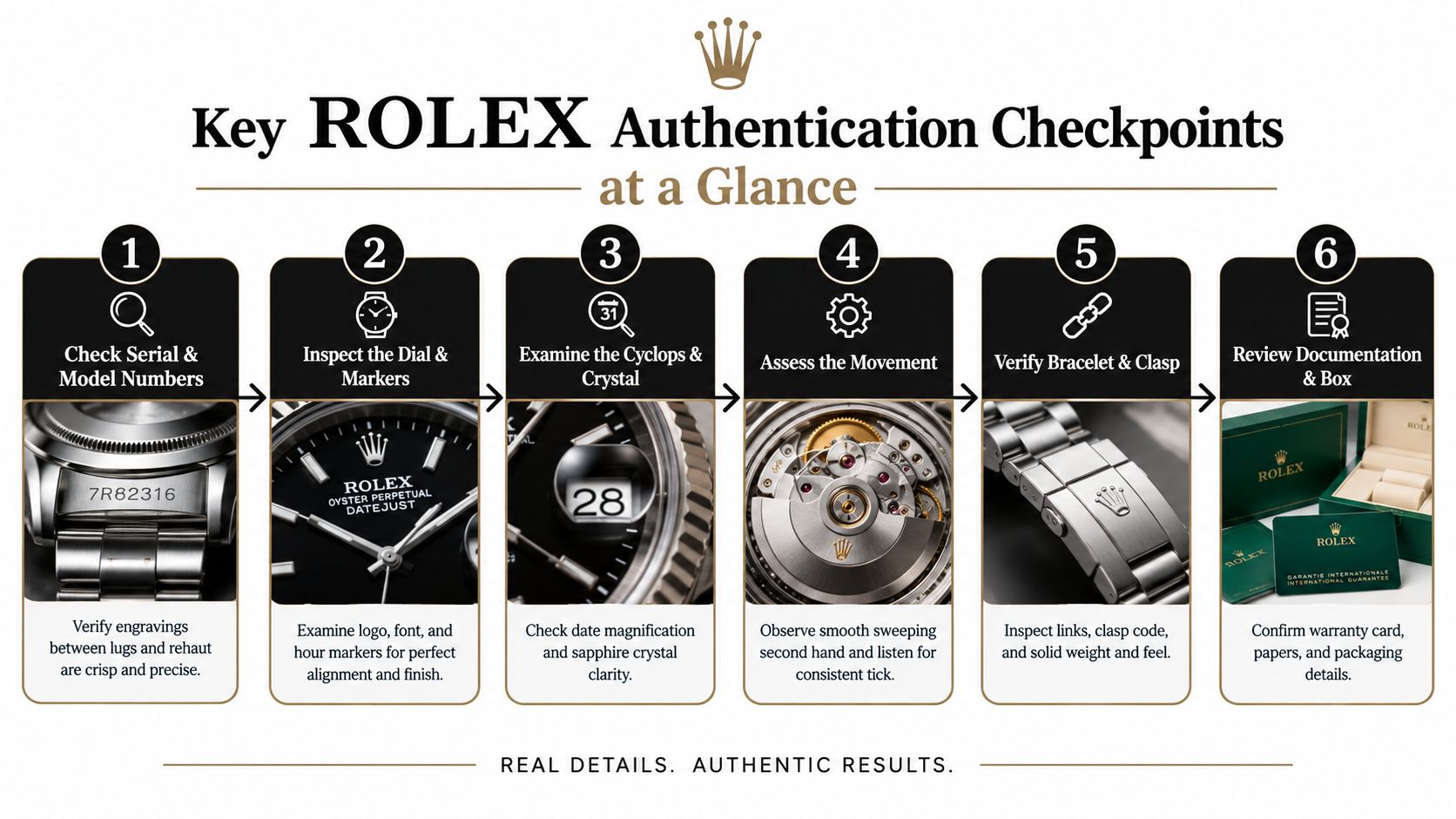
This table acts as your mental checklist. As you get more familiar with these points, the process becomes second nature.
Now, let's look at a more visual breakdown of the workflow.
This workflow hammers home the point: a proper check always moves from the outside in. You start with the external examination, verify the data, and if there are any doubts, finish with professional confirmation for total peace of mind.
A genuine Rolex is more than the sum of its parts; it’s a testament to precision engineering and timeless design. Counterfeits may mimic the look, but they can never replicate the soul of the craftsmanship.
This distinction is what makes the brand so revered. Getting a better sense of why Rolex is the epitome of luxury watches helps you understand the meticulous details you're about to inspect. Your goal isn't just to dodge a fake—it's to appreciate the artistry that makes a real Rolex a true, lasting asset.
Decoding Serial Numbers and Engravings
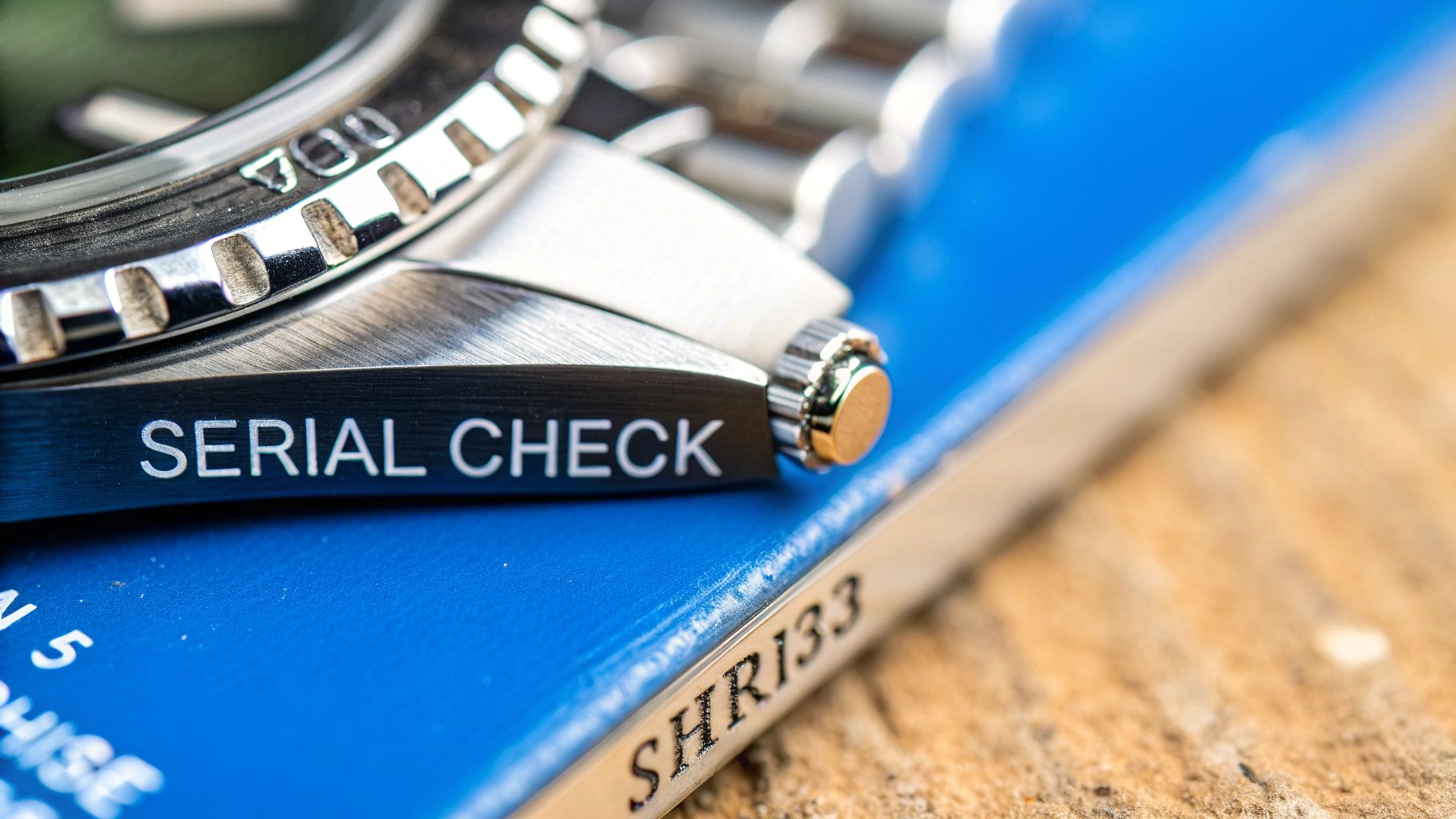
A Rolex's true identity is etched into its steel. If you want to authenticate a watch, learning to read these markings is your first and most important step. Think of the serial and model numbers as the watch's unique fingerprints, but only fingerprints, not a full DNA test.
On older, vintage models, you have to get a little hands-on. You'll need to carefully remove the bracelet to find the engravings between the lugs. The model number, or reference number, sits at the 12 o'clock side, while the unique serial number is at the 6 o'clock position. On later production, Rolex moved the serial to the rehaut, the inner bezel ring visible beneath the crystal. Rolex's own service and buying materials make clear that model-specific details and condition must be evaluated as a whole, not from one isolated stamp through Rolex service resources.
What Serial and Reference Numbers Can Verify
Serial and reference numbers are useful for screening. They can help you confirm whether the engraving is in the right place for the watch's era, whether the reference exists, and whether the broad configuration makes sense for that model family. They can also expose obvious problems fast: a serial placement that does not fit the claimed production period, a reference that conflicts with the dial or bezel style, or engraving quality that looks inconsistent with Rolex manufacturing.
What they cannot do is prove authenticity on their own. Rolex does not provide a public serial verification database, and modern counterfeiters routinely copy valid numbers from real watches. On newer Rolex pieces, the issue is even more pronounced because Rolex shifted to random 8-character serials around 2009-2010, so the serial no longer gives the simple year clue that older lookup charts provided as explained in this serial-number guide. We regularly see buyers give too much weight to a serial search result when the physical watch still shows clear inconsistencies.
A Practical Serial Cross-Check Workflow
Use the numbers as one layer in a chain of checks:
- Confirm where the serial and reference should appear for that production era.
- Inspect the engraving under magnification for depth, crisp edges, and uniform spacing.
- Verify that the reference matches the case, dial, bezel, bracelet style, and complication set.
- Compare the claimed production year to visible features such as rehaut engraving, clasp generation, and dial details.
- Flag any mismatch between the watch's features and the seller's story, even if the serial itself looks plausible.
That last step matters most. A copied genuine serial on the wrong watch is still a fake watch.
Examining the Quality of Engravings
The look and feel of these engravings are your biggest tell. A genuine Rolex has markings that are precise, deep, and clean. They are cut with sharp, consistent edges, and when you angle the watch just right, the light catches those cuts in a way that looks crisp rather than frosted.
Fakes, on the other hand, usually miss the depth and discipline of the original. Counterfeit engravings often look etched rather than cut, with uneven line weight, rough interiors, or a soft, grainy texture under a loupe.
The main thing to remember is that genuine Rolex engravings have a three-dimensional quality you can almost feel. If it looks flat or 'printed' on the surface, that's a massive red flag.
Finding the Hidden Crown on the Crystal
The micro-etched crown at 6 o’clock can be helpful, but it is not a standalone verdict. Starting in the early 2000s, Rolex added a tiny laser-etched coronet to many sapphire crystals. On a genuine crystal, it is subtle and difficult to see without the right light and magnification.
Buyers can overcorrect. A missing or hard-to-find etched crown does not automatically mean the watch is fake, especially if the crystal has been replaced during service. But a crown that is too obvious, crudely shaped, or inconsistent with the rest of the watch is still worth concern.
Here’s what to look for when you find it:
- Visibility: On a fake, the crown is often too big, too obvious, or just looks crudely scratched into the surface.
- Composition: A real etched crown is fine and controlled. Fakes often look like a solid, blurry imitation.
For a deep dive into the specific production years and timelines, our in-depth guide to Rolex serial and reference numbers is an essential resource. It'll help you match a watch’s features to the correct era, letting you spot inconsistencies like a pro.
Evaluating the Dial, Case, and Bracelet
Engravings and serial numbers matter, but a real Rolex tells its story the moment you pick it up. The first thing you should notice is its weight. It feels substantial and perfectly balanced in your hand. This is not just a subjective feeling; it is a direct result of the materials Rolex insists on using.
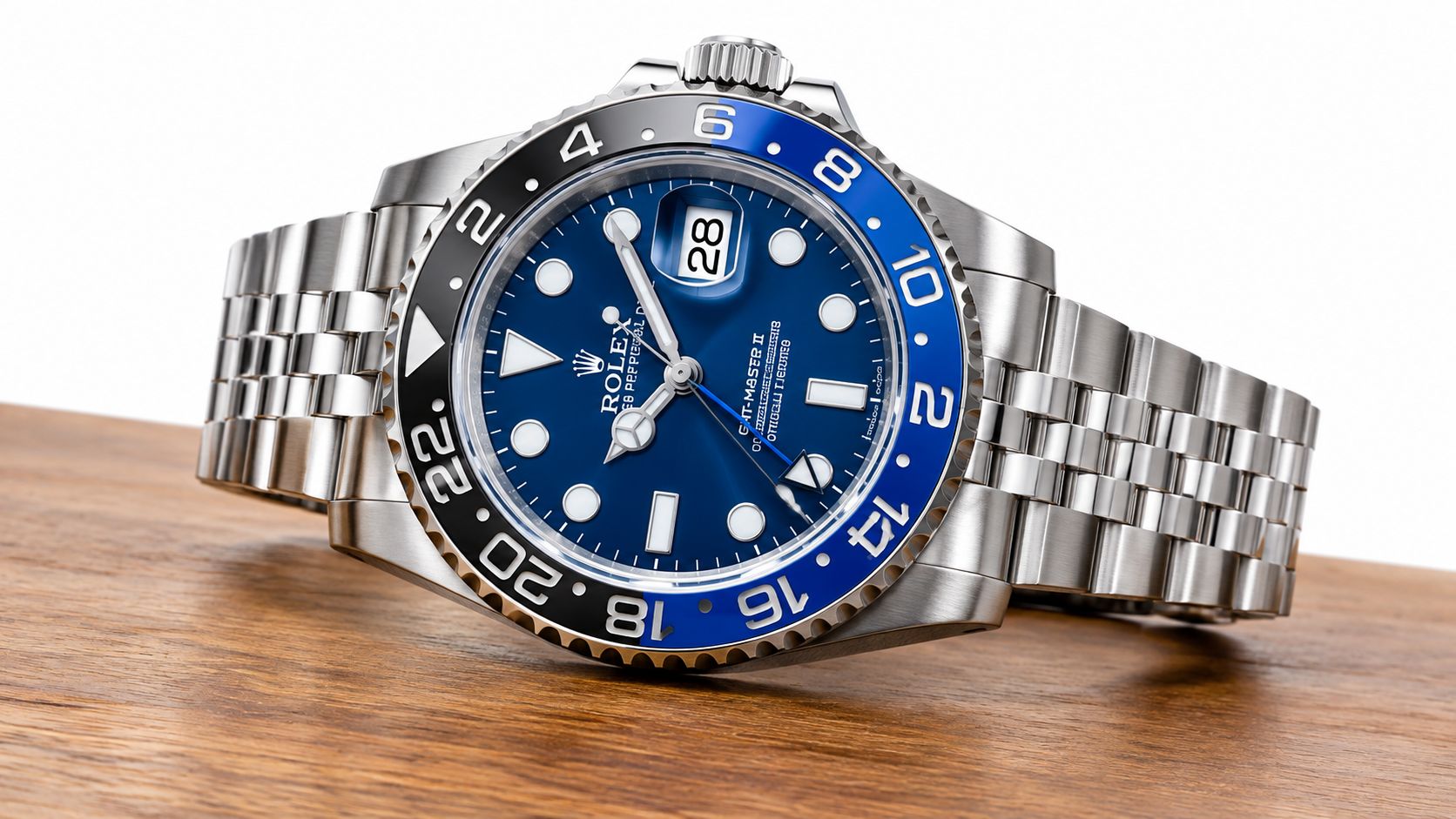
Rolex is famous for using 904L stainless steel, a superior alloy that’s far more corrosion-resistant and capable of holding a brilliant polish compared to the 316L steel found in most other watches, including almost every replica out there. This premium steel is also denser, giving a genuine Rolex a solid heft that fakes just can't match without feeling clunky or unbalanced.
If the watch feels oddly light or the weight seems off, trust your gut. Counterfeiters have to cut corners somewhere, and they often do it by using cheaper, lighter metals or even hollow links in the bracelet. The result is a watch that feels flimsy and cheap.
Zooming In on the Dial Details
The dial is where counterfeiters almost always get caught. To the naked eye, it might look close, but under magnification, the flaws become obvious. On a real Rolex, every single detail is flawless. The text for the brand name and model should be perfectly crisp with clean, sharp edges—no exceptions.
Replicas, on the other hand, often have slightly blurry, smudged, or uneven printing. You might see inconsistent spacing between letters or a font that’s just a hair off. Pay close attention to the luminous markers, too. On a genuine piece, they are applied with surgical precision, filled evenly, and glow brightly and consistently in the dark.
A genuine Rolex dial is defined by its perfection. Any sign of sloppy printing, uneven markers, or dust under the crystal is an immediate red flag that you're likely dealing with a fake.
Analyzing the Cyclops Lens
The Cyclops lens over the date window is one of Rolex's most iconic features, and it’s notoriously difficult to replicate correctly. This little bubble on the crystal isn't just for show; it should provide powerful and clear magnification of the date.
Here's what to check:
- Magnification Power: A genuine Cyclops lens provides a very distinct 2.5x magnification. This makes the date jump out at you, filling the entire bubble.
- Alignment and Clarity: The lens must be perfectly centered over the date window. The view through it should be crystal clear, with zero distortion.
- Common Fake Flaws: This is a huge tell. Most fakes only manage about 1.5x magnification, making the date look small and underwhelming. The lens might also be slightly off-center or have a cloudy, cheap look.
Testing the Bracelet and Clasp
Don't forget the bracelet and clasp. A real Rolex bracelet, whether it's an Oyster, Jubilee, or President, feels solid and impeccably engineered. The links move smoothly without any rattling or excessive gaps between them.
The clasp is another critical checkpoint. It should snap shut with a secure, satisfying click. Run your finger over the Rolex coronet on the clasp—it should be a raised, well-defined emblem, not a shallow etching or a cheap-looking stamp. Flimsy clasps that feel loose or are tricky to close are a dead giveaway of a counterfeit watch. Every single part of the watch has to be right, and the bracelet provides some of the most tangible clues.
Get a Look Inside at the Movement
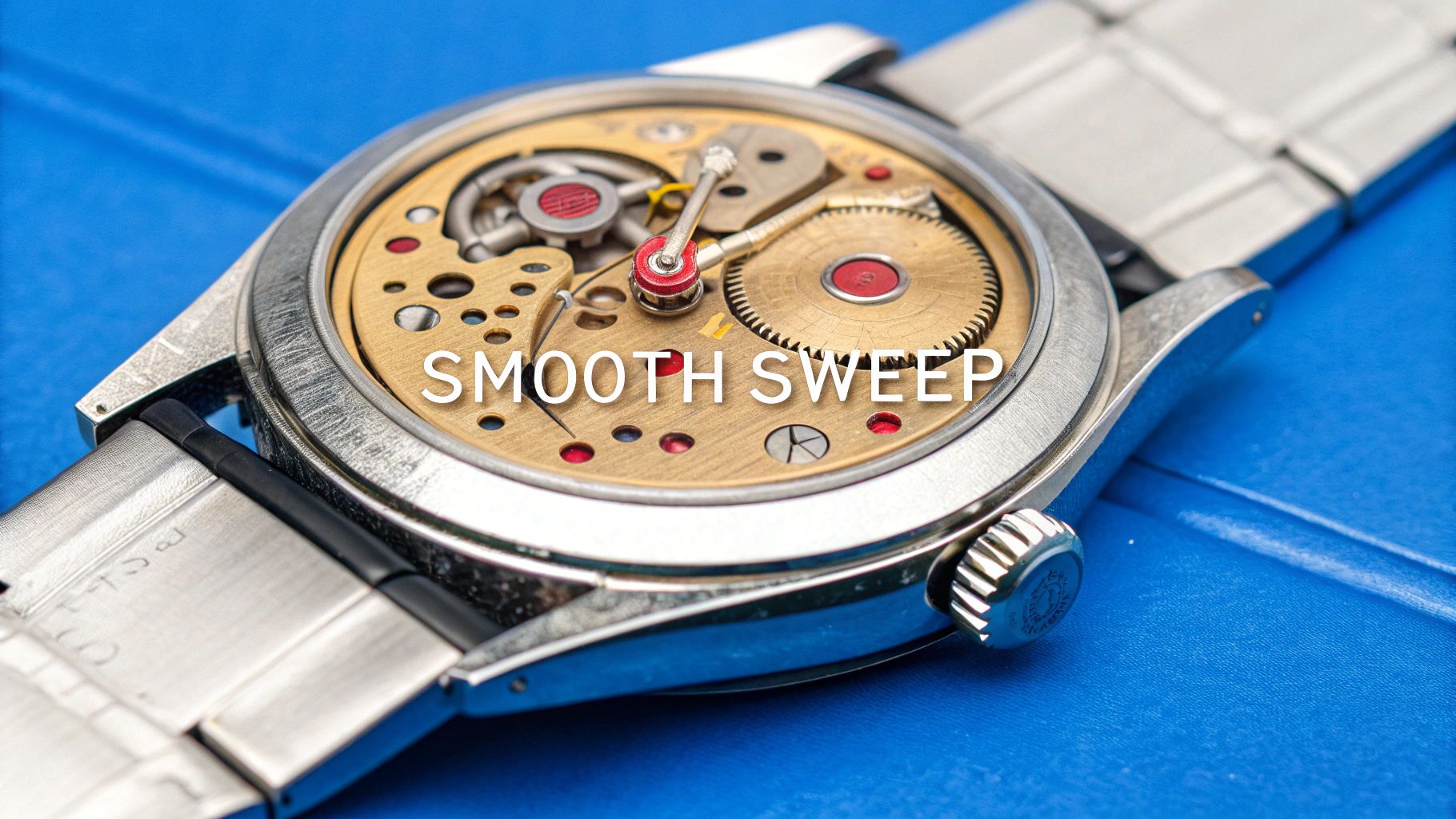
The movement is where screening turns into verification. Exterior checks can eliminate many bad watches, but they cannot fully rule out a Frankenwatch or a high-end replica with copied case components. Modern superfakes are specifically designed to pass quick visual tests, which is why movement inspection remains the point where many questionable pieces finally fail as discussed in watch-market reporting on counterfeit risk.
Now, let's be clear: opening a Rolex caseback is a delicate job best left to a professional watchmaker. You need the correct tools and the ability to reseal and test the case afterward. For most buyers, the practical question is not "Should I open it?" but "What can I observe safely, and what should an expert confirm?"
What You Can Check Without Opening the Watch
Before the caseback comes off, a buyer can still learn quite a lot. The seconds hand should move with a mechanical sweep rather than a one-second quartz tick. The crown operation should feel precise, the date should change correctly, and the watch should show the level of fit and finish expected from the reference.
But this is only a screening layer.
- What this check proves: A hard quartz tick can rule out many cheap counterfeits immediately.
- What this check does not prove: A smooth sweep does not confirm authenticity. Higher-end fakes can use automatic movements that imitate that behavior well enough to fool buyers.
We often tell clients that the sweep test is useful because it can fail a watch, not because it can clear one.
What a Watchmaker Should Verify Inside
Once opened by a qualified professional, the movement can answer much more specific questions. The watchmaker should confirm that the caliber family matches the reference, that the engraving quality is consistent with Rolex standards, and that the finishing and architecture make sense for that generation of movement. This is also where swapped service parts, aftermarket components, and cloned bridges or rotors are easier to spot.
A proper movement review is broader than one famous visual cue. Instead of relying on a single detail, an expert should check:
- Caliber-family match: The movement should belong in that reference and era.
- Engraving quality: Interior markings should be sharp, correctly placed, and consistent with Rolex production.
- Finishing consistency: Bridges, screws, and surfaces should look coherent, not assembled from mixed sources.
- Service-part legitimacy: Replaced parts may be genuine service components or low-quality substitutes; the distinction matters.
- Signs of aftermarket or cloned components: Rotors, bridges, balance assemblies, and other parts may be altered to mimic a genuine caliber.
This is why it helps to understand the different Rolex movements that power various models. The more specific the expected caliber, the easier it is to spot a mismatch.
What Movement Inspection Can and Cannot Settle
Movement inspection is the strongest single check in the process, but even here the output should be described accurately.
- What it can prove: Whether the caliber is appropriate, whether obvious clone or non-Rolex parts are present, and whether the watch has signs of being a Frankenwatch.
- What it may not fully settle without context: Whether every visible and non-visible component is original to first sale, whether replacement parts were installed during authorized service, and whether the watch remains in original collector condition.
That distinction matters for value. A watch can be authentic Rolex and still contain later service parts, aftermarket additions, or replaced components that affect collectibility and price.
Knowing When to Seek Professional Verification
Some watches can be rejected from photos alone. Others need a bench inspection. The key is knowing which situation you are in before money changes hands.
If the seller's photos already show poor engraving, a misaligned date, weak Cyclops magnification, inconsistent bracelet construction, or a reference/dial combination that does not make sense, that is enough to walk away. A professional inspection is not there to rescue a watch with obvious red flags.
Where expert help becomes necessary is the gray zone: a watch that looks mostly right, carries meaningful value, or may contain mixed-era or aftermarket components that are difficult to identify externally. We see this most often with pieces that have some genuine Rolex parts but not the right complete specification. That is also why third-party authentication data matters. Marketplace reporting has shown that large numbers of submitted watches still fail inspection, and Bezel has publicly discussed rejecting a significant share of the watches it examines, mostly Rolex through this report on Bezel.
Authentication vs. Appraisal vs. Service Inspection
These terms are often used interchangeably, but they are not the same.
Authentication is an opinion on whether the watch and its major components are genuine and properly identified. The focus is legitimacy.
Appraisal is a value document, usually prepared for insurance, estate planning, or resale support. The focus is replacement or market value, not just whether the watch is real.
Service inspection is a mechanical and condition review. The focus is performance: timing, water resistance, wear, needed maintenance, and whether the watch is ready to use.
A buyer often needs more than one of these. An authentic watch can still need service, and a serviced watch is not automatically appraised.
Where to Go and What to Ask For
If you are still in the shopping phase and only have seller photos, use them as a filter. If the watch passes that stage but the purchase is significant, an independent watchmaker with Rolex experience is often the best next step before purchase because the goal is not sales support but a neutral inspection.
If you already own the watch and want manufacturer-level review, a Rolex Service Center is the appropriate place for service evaluation and documentation related to factory servicing. If your goal is market-facing authentication for resale or insurance, a respected third-party authenticator or appraiser may be more practical, provided they clearly state whether they are offering an authentication opinion, an appraisal, or both.
After the inspection, ask for specific outputs, not a vague thumbs-up. You want condition notes, movement confirmation, parts assessment, and pressure-test results where relevant. You also want clarity on whether any non-genuine, aftermarket, or later replacement parts were found. In our view, this documentation is what turns "I think it's right" into something useful for ownership, insurance, or resale.
When Professional Verification Is Worth the Cost
Professional verification is worth paying for when any of the following are true: the seller is unknown to you, the watch value is high enough that a mistake would be painful, the piece may be vintage or heavily serviced, or the watch is being represented as all-original. Those are exactly the cases where a visual once-over is least reliable.
Seeking a professional opinion isn't a sign of failure; it's the smartest move you can make. It separates a promising watch from a verified one.
Frequently Asked Questions
Can you verify a Rolex serial number online?
Only as a screening step. An online serial lookup can help you see whether a number format or production-era claim seems plausible, but it cannot prove the watch is genuine because counterfeiters can copy valid serials from real watches, and Rolex does not offer a public serial verification database.
How can I tell if my Rolex watch is authentic?
Start with a layered check: inspect the dial printing, Cyclops magnification, bracelet quality, clasp action, serial/reference engravings, and whether the visible features match the claimed model and era. If the watch is valuable or any details conflict, have a qualified watchmaker confirm the movement and parts inside the case.
How to check if a Rolex watch is original or fake?
Look for consistency rather than one magic tell. A fake may copy the serial, box, or even the sweep of the seconds hand, but it often slips on engraving depth, date magnification, bracelet construction, dial precision, or movement correctness. Originality is a higher bar than authenticity, so if you care about factory-correct parts, ask for a professional parts assessment, not just a quick authenticity opinion.
Where can I authenticate a Rolex?
For a pre-purchase inspection, an independent watchmaker experienced with Rolex is often the most practical option because they can inspect the movement and report on parts without sales pressure. For brand service and factory handling, use a Rolex Service Center. If you need insurance paperwork or resale support, confirm whether the provider offers authentication, appraisal, or both.
At ECI Jewelers, we take all the guesswork and anxiety out of buying a pre-owned luxury watch. Every single timepiece in our collection goes through a rigorous multi-point inspection by our in-house experts to evaluate authenticity, condition, and overall performance before it is offered for sale. Whether you're a seasoned collector or buying your first Rolex, you can shop with confidence rooted in process, not assumption.
Explore our curated selection of authenticated luxury watches at ECI Jewelers.
Read more:


