


When you first get your hands on a potential Rolex, there are a few tell-tale signs that can instantly give away a fake, long before you need a magnifying glass or special tools. Think of it as the first handshake—it tells you a lot. A real Rolex has a presence, a certain feel and fluid operation that counterfeiters find incredibly difficult to get right.
Your First Look: The Rolex Authenticity Checklist
Before you start hunting for serial numbers or trying to peek at the movement, your own senses are your best tool. Counterfeiters are great at mimicking the look of a Rolex, but they almost always fall short on the feel. This initial once-over is designed to catch the most obvious red flags, saving you from wasting time on a cheap knock-off.
A genuine Rolex is a piece of superb engineering, crafted from premium materials, and it feels that way from the moment you pick it up.
Feel the Weight and Quality
The very first thing you'll notice is its heft. A real Rolex feels substantial in your hand. This isn't by accident; Rolex uses a proprietary 904L stainless steel, which is a cut above the 316L steel used in most other watches and nearly all replicas. It's not just heavier, it's also more resistant to corrosion and holds a polish like nothing else.
If you pick up a watch and it feels surprisingly light or the bracelet links feel hollow and flimsy, that’s a massive red flag. Fakes cut corners with cheaper, lighter metals. Trust your gut—if it feels cheap, it probably is.
Observe the Second Hand Sweep
Here’s one of the most classic tells. A genuine Rolex movement is a beautiful piece of mechanical art, and its quality is visible in the effortless glide of the second hand.
- Authentic Rolex: The second hand moves with an almost perfectly smooth sweep, ticking at around 8 tiny movements per second. It looks like it’s floating, not jumping.
- Common Counterfeit: Most fakes use cheap quartz movements, which means the second hand will have a very distinct, jerky "tick... tick... tick" motion once per second. Some better fakes might use a mechanical movement, but it's usually a low-beat one, resulting in a stuttering or jittery sweep. It just won't have that signature Rolex grace.
This fluid motion is the calling card of a high-caliber automatic movement. A ticking second hand is almost always a dead giveaway for a fake.
Scrutinize the Cyclops Lens
For any Rolex with a date window, the cyclops lens is a counterfeiter's nightmare. This little magnifying bubble at the 3 o'clock position is surprisingly hard to replicate correctly.
A real Rolex cyclops magnifies the date by a very specific 2.5 times. The date should jump out at you, looking crisp, clear, and perfectly filling the lens. Forgers consistently get this wrong. Their cyclops lenses often have weak magnification, maybe 1.5x at best, making the date look small, sometimes blurry, or off-center. It's a tiny detail, but it’s one of the most reliable quick checks you can do.
To make things even clearer, here’s a quick breakdown of what to look for when you have a watch in hand. This table covers the immediate, physical tells that often separate the real deal from a convincing copy at a glance.
Authentic Rolex vs Counterfeit: Key Differences at a Glance
| Feature | Authentic Rolex | Common Counterfeit |
|---|---|---|
| Weight & Feel | Substantial, solid, and dense due to 904L steel or precious metals. Balanced feel. | Often feels light, flimsy, or hollow. May have sharp edges on the case or bracelet. |
| Second Hand | Smooth, sweeping motion (~8 ticks per second). Appears to glide continuously. | Jerky, "ticking" motion (one tick per second) on quartz fakes. Stuttering on cheap mechanicals. |
| Cyclops Lens | Precise 2.5x magnification. Date is crisp, large, and fills the entire lens. | Weak magnification (~1.5x). Date appears small, distorted, or is not centered properly. |
| Crystal | Made of scratch-resistant sapphire crystal. Water drops will bead up on the surface. | Often made of mineral glass, which scratches easily. The cyclops may be poorly glued on. |
| Crown | Finely detailed engravings (coronet logo). Smooth winding and setting functions. | Logo may be poorly defined or shallow. Winding can feel gritty or rough. |
Getting familiar with these key differences is your first line of defense. If a watch fails these simple physical tests, you can be pretty confident it's not authentic, and you've just saved yourself a lot of trouble.
Decoding Serial and Model Numbers
Beyond the initial feel and look, every single Rolex carries a unique identity stamped right onto its case. These serial and model numbers are like the watch's DNA, telling you its story—when it was made, what model it is, and more. For anyone learning to spot a fake, these engravings are an absolute must-check. Fakers try their best, but they almost never get the precision right.
The real secret isn't just in the numbers themselves, but in how they're engraved. A genuine Rolex has numbers etched with a diamond-tipped tool, creating incredibly sharp, clean lines that catch the light. If you can run a finger over them, you'll feel the crispness. Fakes, on the other hand, often use a cheap acid-etching process that leaves the numbers looking shallow, sandy, or just plain dull.
Where to Find These Crucial Numbers
Historically, Rolex tucked these numbers away in a spot that required removing the bracelet—a smart move to keep them protected. Here’s where to look on older models:
- The Model Number: You'll find this between the lugs at the 12 o'clock position. It's also called the reference number.
- The Serial Number: This is located between the lugs at the 6 o'clock position. This number is unique to that specific watch.
Sensing a need for easier verification, Rolex started adding the serial number to a more visible spot around 2005. On modern watches, you'll also find it engraved on the rehaut—that's the inner metal ring between the dial and the crystal. This was a direct shot at counterfeiters. A real rehaut engraving is perfectly aligned, with the characters lining up precisely with the minute markers.
This infographic breaks down the first-glance authenticity check into three core areas: the watch's weight, the date magnification, and the sweep of the second hand.
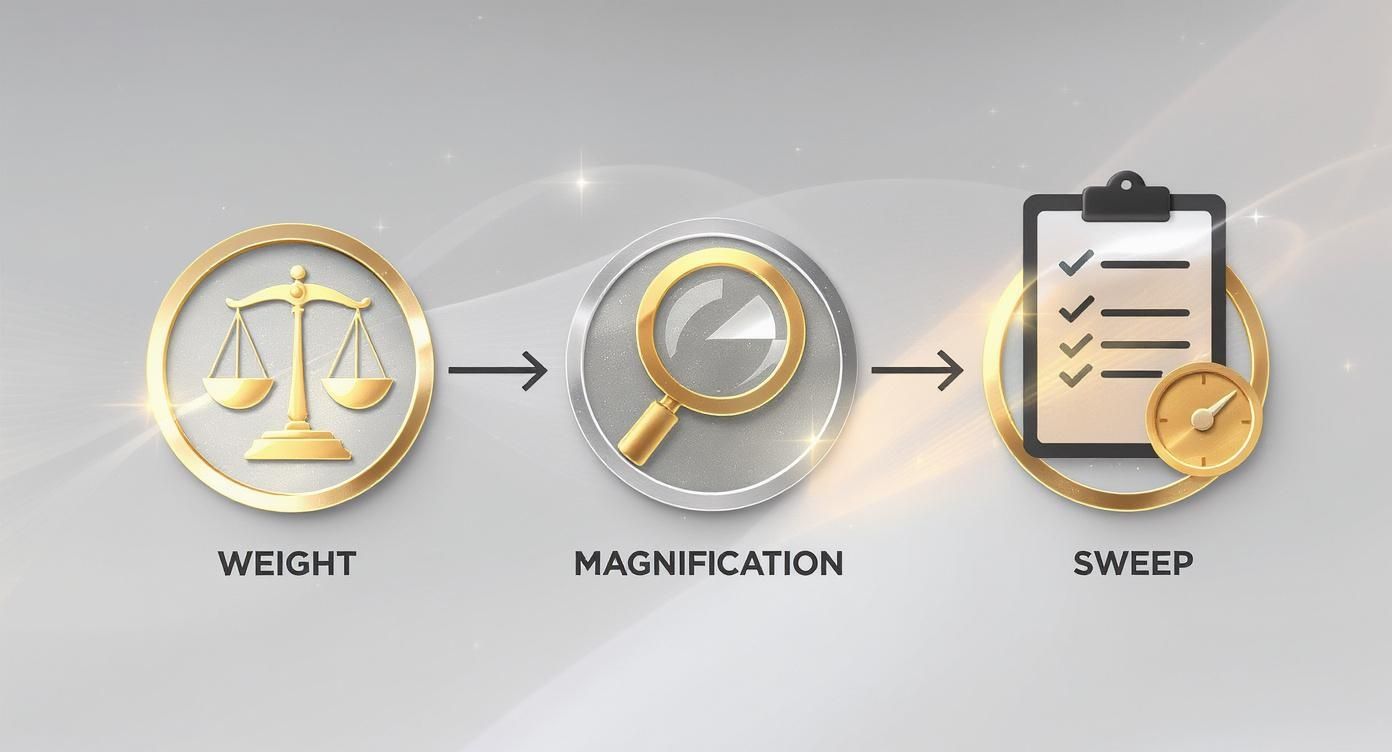
As it highlights, a proper Rolex assessment is a combination of tactile feel, visual precision, and mechanical performance.
Understanding the Serial Number Timeline
Finding the numbers is only half the job; you have to know what they mean. Rolex's serial number system has changed quite a bit over the years, which is a huge help when authenticating a watch. From 1987 until 2010, Rolex used serial numbers that started with a letter followed by numbers (like R123456), with the letter corresponding to the production year.
Then, in mid-2010, they switched to a randomized alphanumeric system. Why? To make it nearly impossible for counterfeiters who had gotten good at predicting and faking the sequential numbers. For a deeper dive into this topic, you can discover more insights about Rolex serial numbers and their history.
This timeline is a powerful tool for catching fakes. Let’s say someone is selling a watch they claim is from the 1990s, but it has a modern, randomized serial number. That's a massive red flag. Counterfeiters love to mix and match details, banking on the buyer not knowing the production history.
A mismatch between the serial number format and the claimed production year is one of the most definitive signs of a counterfeit. Always cross-reference the serial number with the model’s known production era.
Getting a handle on this system is essential. Authenticating a Rolex is all about connecting these dots—the model, the serial number, and its place in history must all line up perfectly.
Examining the Dial, Case, and Bracelet
Sure, the weight and serial number can give you a quick first impression, but the real story of a Rolex’s authenticity is told in the details. Rolex built its entire reputation on near-perfect finishing, and this is where you can catch a fake almost every time. Counterfeiters have gotten pretty good at mimicking the overall look, but it's the microscopic precision they just can't replicate.
The dial is the face of the watch, so it’s the first place my eye goes. Every single element, from the tiniest letter of text to the hour markers, has to be flawless. On a genuine Rolex, the text—like "Oyster Perpetual" or "Submariner"—is printed with incredible sharpness. Get a loupe and look closely; the edges of each letter are crisp and clean, with a slightly raised, almost three-dimensional quality.
Fakes, on the other hand, almost always have fuzzy, flat, or slightly blurry printing. You might spot inconsistent spacing between letters or a font that just feels a bit… off. Pay attention to the little things, like the serifs on the letters.
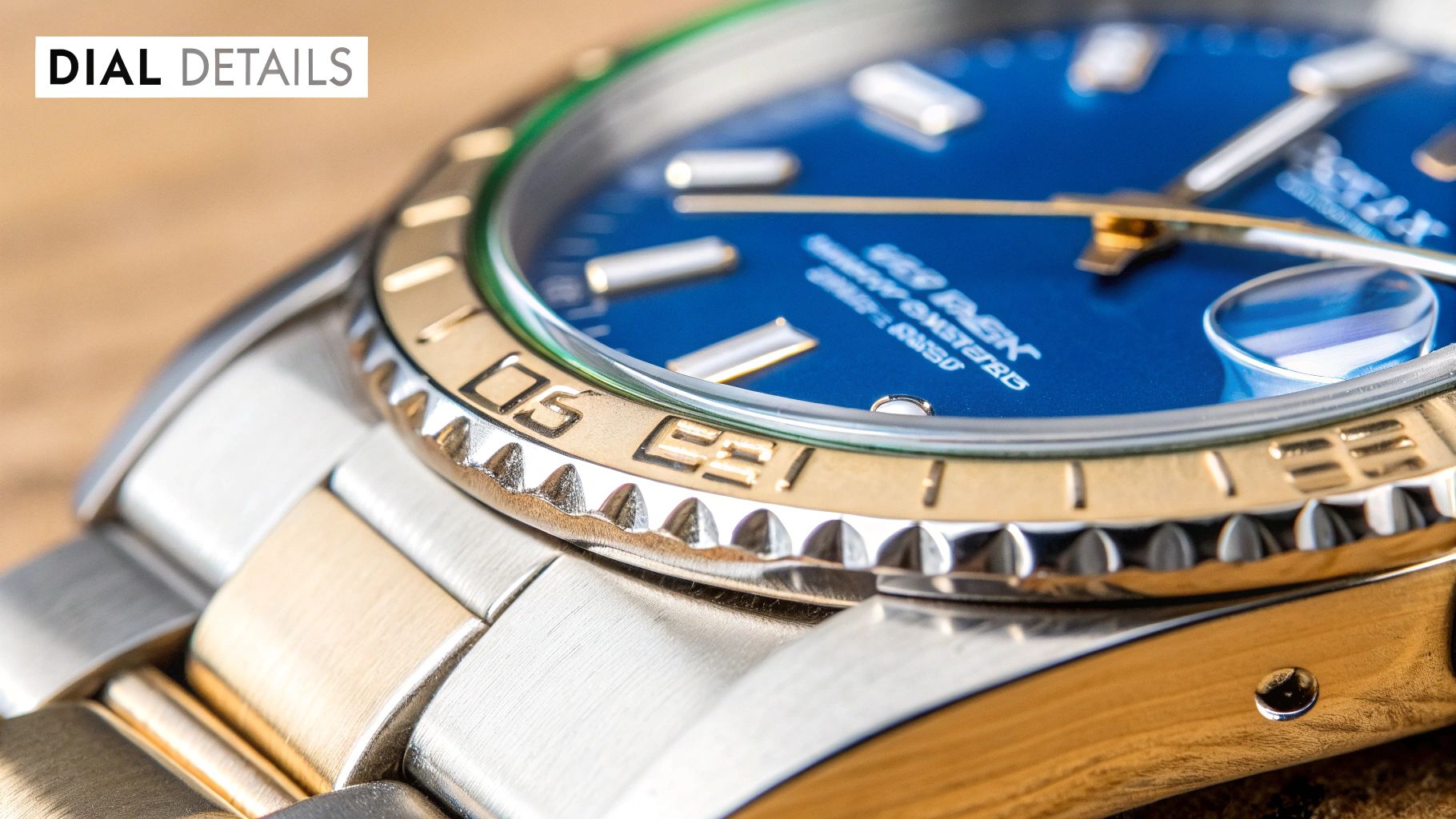
The Telltale Signs on the Dial
Beyond the text, the hour markers are another critical checkpoint. Whether they're simple batons, dots, or numerals, they must be applied perfectly. On a real Rolex, they are flawlessly aligned and finished—and they’re often made from precious metals like white gold to make sure they never tarnish.
The luminescent material, or "lume," applied to the hands and markers tells a similar story. Rolex uses its own special formula called Chromalight, which glows a very distinct blue in the dark.
- Authentic Lume: The application is perfectly even and stays within the borders of the markers. After a quick charge from a light source, it glows brightly and consistently.
- Counterfeit Lume: Often looks sloppy. You’ll see uneven application that might spill over the edges. The glow is frequently weak, patchy, and tends to have a greenish tint instead of that signature Rolex blue.
Now for one of the most famous—and hardest to spot—details: the laser-etched coronet (LEC). Rolex started adding this tiny crown logo to the sapphire crystal around the early 2000s, right at the 6 o'clock position. It's incredibly small and faint. You'll almost certainly need a jeweler's loupe and just the right angle of light to see it. Fakes that try to copy this are usually way too obvious or just look crudely etched.
Assessing the Case and Crown
The watch case itself is a masterclass in finishing. A genuine Rolex case often features a mix of brushed and polished surfaces, and the transition between these two finishes should be absolutely razor-sharp. Counterfeit cases, however, often have blurry, soft lines where the polished and brushed sections meet. The polishing itself might even look wavy and imperfect.
The winding crown is another spot loaded with detail. The Rolex coronet logo on the crown should be finely detailed and stand out proudly.
A key test of a Rolex's craftsmanship is the transition between finishes. A blurry or soft edge where a brushed lug meets a polished case side is a significant red flag.
When you unscrew the crown, the action should feel smooth and precise. Winding the watch should feel like you're operating a fine piece of machinery—buttery smooth, with no grittiness or resistance at all.
The Bracelet and Clasp Inspection
Finally, don’t ever overlook the bracelet and clasp. A real Rolex bracelet feels solid, secure, and impeccably engineered. The links are held together by high-quality screws, not cheap little friction pins. The heads of these screws should be perfectly finished and sit flush with the link.
The clasp is just as telling. A genuine Rolex clasp closes with a satisfying and secure "click." The engravings on the inside, including the Rolex logo, should be deep, clean, and precise. Counterfeit clasps often use shallow, stamped-on engravings that look thin and cheap. The metal might feel flimsy, and the whole mechanism probably won't close as securely as it should. Every detail matters when learning how to authenticate Rolex watches—it’s the sum of all these small perfections that defines the genuine article.
Inspecting the Heart of the Watch: The Rolex Movement
While analyzing the dial, case, and bracelet can reveal dozens of clues, the ultimate test of authenticity lies deep within the watch itself. The movement, or caliber, is the mechanical heart of a Rolex. It's the one area where counterfeiters simply cannot match the brand’s century of engineering and artistry.
This step absolutely requires a professional with the right tools to safely open the caseback, but understanding what they're looking for is essential for any serious buyer.
A genuine Rolex movement is a work of art. The bridges and plates are meticulously finished with intricate patterns, and you'll find beautiful, crisp engravings detailing the caliber number and "Rolex Geneva." One of the most iconic visual tells is the vibrant color of specific components.
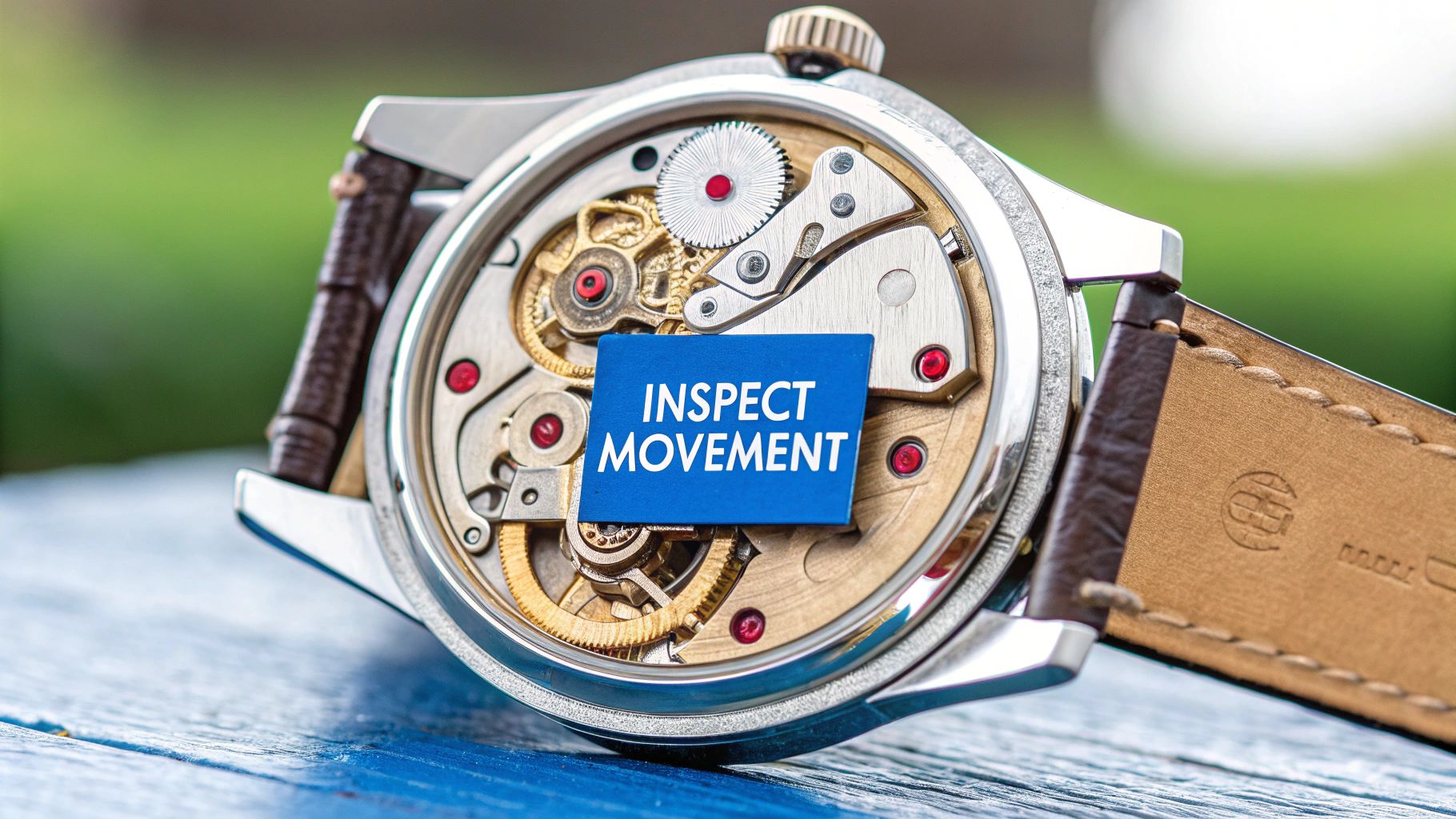
Many Rolex automatic movements feature distinct red anodized reversing wheels as part of their winding mechanism. This pop of color, combined with the overall pristine finishing, is a signature of the brand's in-house manufacturing that fakes struggle to replicate.
Recognizing Genuine Rolex Calibers
Each Rolex family has its own unique caliber, and while they evolve over time, they share common traits of excellence. The finishing is immaculate, with perfectly beveled edges and consistent patterns. You won't find a single rough surface or stray tool mark on a genuine movement.
Additionally, Rolex has developed proprietary technology that is incredibly difficult to replicate. These are key features a watchmaker will look for:
- The Blue Parachrom Hairspring: Introduced in the early 2000s, this hairspring is made from a special alloy that is highly resistant to magnetic fields and shocks. Its distinct blue color is a clear indicator of a modern, authentic Rolex movement.
- The Chronergy Escapement: Found in newer calibers like the 32xx series, this redesigned escapement significantly improves the movement's efficiency and power reserve. Its skeletonized geometry is unique and not found in clone movements.
These innovations are protected by patents, making it nearly impossible for counterfeit operations to legally or accurately copy them. You can learn more about the specific characteristics of different Rolex movements and how they have evolved over the decades in our detailed guide.
When a watchmaker opens a Rolex, they are looking for more than just a clean machine. They are looking for specific, patented technologies and a level of finishing that reflects an obsessive attention to detail. The absence of these is the final, undeniable proof of a fake.
Spotting a Clone Movement
The rise of "super fakes" has brought a new challenge: clone movements. These aren't just generic quartz or cheap mechanical movements; they are specifically designed to mimic the appearance of a real Rolex caliber. The most common ones are based on reliable Swiss ETA movements (like the ETA 2824 or 2836) or are Asian-made copies of Rolex calibers.
At a quick glance, they can be deceiving. They often have fake engravings and might even attempt to copy the look of the rotor. However, a trained eye can spot the differences almost immediately.
Here’s what gives a clone away:
- Mediocre Finishing: The finishing on the bridges will be much cruder. Instead of fine perlage or Geneva stripes, you might see rough, machine-stamped patterns that lack depth and precision.
- Incorrect Regulator: Clone movements often use a standard ETA-style regulator to adjust the timing. This looks very different from Rolex's proprietary Microstella system with its distinctive regulating nuts on the balance wheel.
- Missing Proprietary Parts: A clone movement will not have a real blue Parachrom hairspring or a Chronergy escapement. They might try to paint a part blue, but it won’t have the same metallic sheen or material properties.
Understanding these technical details empowers you to have a more informed conversation with your watchmaker. When they tell you "the movement is wrong," you'll know they're not just looking at a name—they're seeing the absence of true Rolex engineering.
The Modern Challenge of Super Fakes
Let's be clear: the world of counterfeit watches has gotten scarily good. We're not talking about those flimsy fakes with ticking quartz movements you could spot from a mile away. Today, we’re up against "super fakes."
These are high-end replicas so meticulously crafted they can fool even seasoned collectors at first glance. This new reality completely changes the game for anyone learning how to authenticate Rolex watches. It's no longer about just checking the obvious stuff.
These top-tier counterfeits aren't just rare finds; they're a huge part of the secondary market. The risk of running into one in a private sale or from an unverified dealer is higher than most people think. Understanding this threat is the first step to protecting yourself from a very expensive mistake.
The Scale of the Problem
The numbers don't lie. Data from authentication platforms shows just how widespread this issue is. Take Bezel, an online watch trading platform. They reported rejecting 27% of inspected watches in the first half of a recent year because of authenticity issues, and Rolex models made up the bulk of them.
The year before that, the rejection rate was even higher at 29%. Think about that—nearly a third of watches in some transactions might not be the real deal. You can read the full report about these findings to get a sense of the market's scale.
This data is a serious reality check. High-quality fakes aren't a niche problem; they're a rampant issue in a multi-million dollar industry built on deception. It really drives home why professional verification is so critical today.
Where Even the Best Fakes Fail
Despite their uncanny accuracy, super fakes still have weak spots. Counterfeiters can replicate the look, but they can't replicate Rolex’s patented technology and decades of refinement. It’s just not possible.
The most common point of failure is the movement. Fakers use "clone" movements designed to look like a Rolex caliber, but they’re missing key proprietary components that Rolex has spent years perfecting.
- Patented Technology: A fake will never have a genuine blue Parachrom hairspring or a Chronergy escapement. They might try to fool you with blue-painted parts, but they lack the advanced material science behind the real components.
- Finishing Quality: If you look closely at the finishing on the clone movement's bridges and plates, it's often cruder. It's missing the perfect beveled edges and intricate patterns you'd find on a true Rolex caliber.
Another giveaway is the subtle quality of the materials. A super fake might use good steel, but it won't be Rolex's proprietary 904L alloy. This special steel has a distinct luster and corrosion resistance that becomes obvious over time, especially when compared side-by-side with a genuine piece.
These finer points are often where a fake's facade begins to crumble under an expert's eye. For more practical advice on spotting these differences, you can check out our guide on how to spot a fake Rolex in 5 easy steps.
Don’t Forget the Paperwork (and New Tech)
The watch itself is always the star of the show, but the box and papers that come with it are incredibly important supporting characters. A "full set"—meaning the original box, warranty card, booklets, and even the little hang tags—doesn't just add value. It adds confidence.
But here’s the catch: these items can be faked just as skillfully as the watch.
Genuine Rolex paperwork just feels right. The print quality on the manuals and booklets is always razor-sharp, with no bleeding or fuzziness. The paper is high-grade, and the binding is perfect. Modern Rolex warranty cards are a big tell; they’re solid plastic, like a premium credit card, not some flimsy piece of paper or cardboard. The text is perfectly crisp and aligned. Many newer cards even have a subtle UV hologram you can only spot with a blacklight.
Pay Close Attention to the Warranty Card
All the details on that little card have to match the watch, period. That means the serial number, model number, and usually the name of the authorized dealer who first sold it. Any discrepancy here is a massive red flag.
- Feel and Font: A real card has a specific, clean font and a professional, smooth finish. Fakes often get the typography wrong or just feel cheap and flimsy to the touch.
- Hidden Security: For any modern Rolex, look for those UV-reactive features on the card. If it’s a recent model and that security feature is missing, you should be very suspicious.
- The Numbers Must Match: Cross-reference the serial number on the card with the one engraved on the watch’s rehaut (the inner bezel ring) or between the lugs. It has to be an exact match, down to the last digit.
Never, ever rely on the papers alone. I’ve seen genuine watches paired with fake papers to pump up the price, and I’ve seen fake watches come with expertly forged documents. The watch itself is always the final authority.
How Rolex Is Fighting Back with Tech
Counterfeiters are getting scarily good, so Rolex is stepping up its game with modern technology. This is a pretty big shift in how luxury watches are authenticated.
Since the 2020s, Rolex has started rolling out blockchain-based systems to verify a watch’s authenticity in real-time. Often, this involves an NFT chip embedded right into the warranty card, which links to a secure digital certificate that can't be altered.
This digital ledger creates a complete, unbroken history of the watch’s ownership and service records, making a forger's job a whole lot harder. If you want to dive deeper, you can find some great insights about blockchain's role in the luxury watch market on sellusyourjewelry.com. This kind of tech offers a level of security and peace of mind that traditional paper documents just can't compete with.
Common Questions We Hear About Rolex Authentication
Diving into the world of Rolex authentication can feel like a minefield, and it's natural to have questions. To help you get your bearings, we've pulled together some of the most common queries we get from buyers trying to tell the real deal from a convincing fake.
Think of this as your quick-start guide. Getting these fundamentals down is a huge step toward authenticating a Rolex with real confidence.
Can You Tell If a Rolex Is Real by the Serial Number Alone?
In a word, no. A serial number is a crucial part of the puzzle, but on its own, it's not enough to confirm a watch is genuine. The reality is, counterfeiters have gotten incredibly good at copying real serial numbers—or even just lifting them from photos of real watches—and slapping them on their fakes.
A serial number is only meaningful if it lines up perfectly with the watch's specific model and the known production years for that reference. More importantly, look at the engraving quality. A real Rolex has deep, sharp, and laser-precise engravings. A legitimate serial number that looks shallow or sloppy is an immediate red flag.
Does a Real Rolex Tick?
This is a classic. A genuine Rolex doesn't make that loud "tick-tock" sound you'd hear from a standard quartz watch. Instead, its mechanical movement is a masterpiece of engineering, producing a series of super-fast, almost silent micro-ticks. We're talking about eight tiny movements per second. This is what gives the second hand that signature smooth, sweeping glide across the dial.
So, if you hold a watch up to your ear and hear a distinct, slow tick once per second, you can be almost certain it's a fake running on a cheap quartz movement.
The nearly silent, fluid sweep of the second hand is a hallmark of Rolex's high-frequency mechanical calibers. A loud, individual tick is one of the most immediate and reliable signs of a counterfeit.
What Is the Single Easiest Way to Spot a Fake Rolex?
If you need a quick check without pulling out any tools, your best bet is to look at the cyclops lens—that little magnifying bubble over the date. On a genuine Rolex, the cyclops provides a very specific 2.5x magnification. It makes the date pop, appearing large, crisp, and filling the entire window.
This is something counterfeiters consistently get wrong. Replicating that exact magnification is surprisingly difficult and expensive. On fakes, you’ll almost always see weak magnification, usually around 1.5x. The date will look small, maybe a bit blurry or off-center. It's a small detail, but it's one of the most common failure points on even the best "superfakes."
At ECI Jewelers, our team of experts meticulously inspects every timepiece to guarantee its authenticity, so you can buy, sell, or trade with absolute confidence. Explore our curated collection of authenticated luxury watches today.


