


Knowing how to spot a real Cartier watch often comes down to your gut feeling right from the start. A genuine timepiece has a certain presence—a solid, impeccably finished feel that fakes just can't get right. Before you even think about grabbing a loupe, focus on the weight, crystal clarity, and dial precision. These first-glance checks can expose a counterfeit in seconds.

The First Glance: Quick Authenticity Checks
Before you dive into the nitty-gritty details, your first few moments with a watch can tell you almost everything you need to know. Counterfeiters are getting better at mimicking the look, but they consistently fail to replicate the feel and flawless finish of a genuine Cartier. This initial once-over is your best tool for weeding out the obvious fakes.
Think of it as a quick, three-part process: handle the watch, look at the glass, then inspect the face.
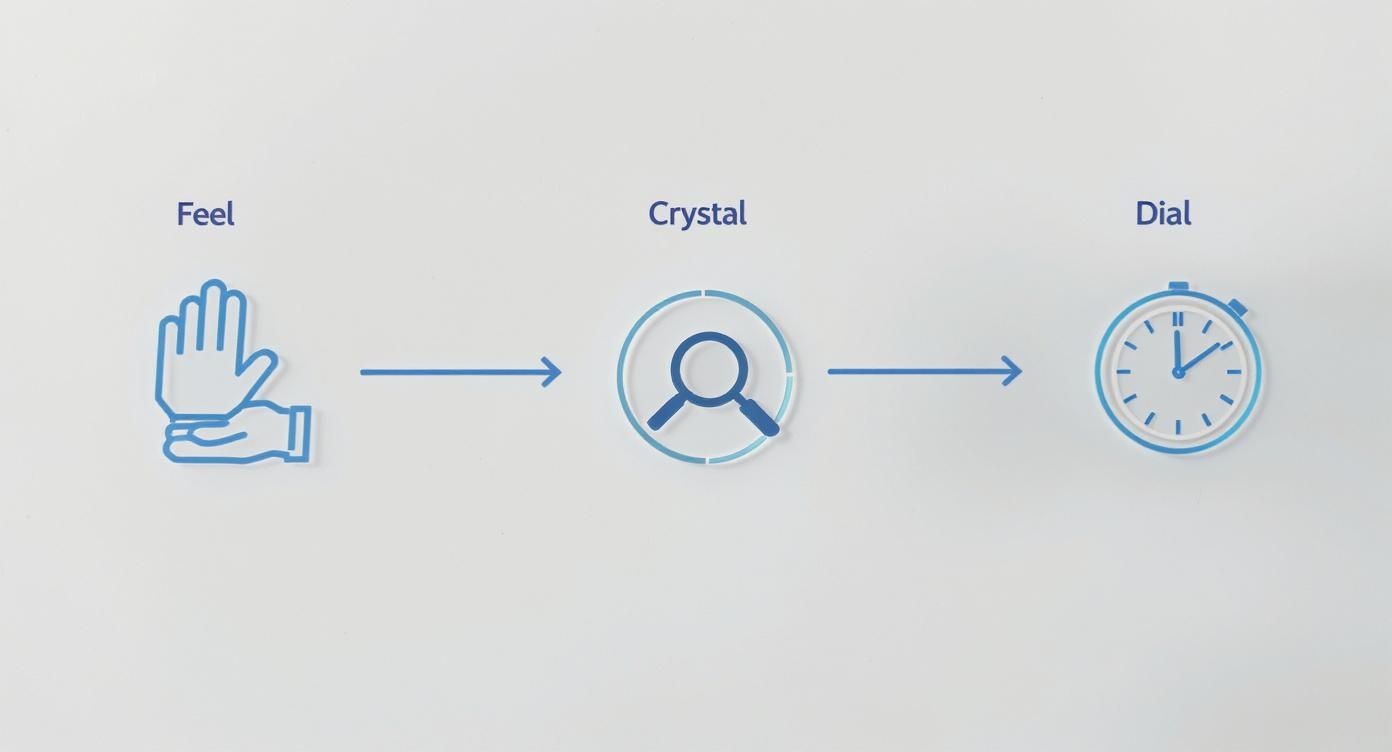
This simple flow emphasizes that the physical interaction comes first, followed by the more focused visual checks. If it feels wrong, it probably is.
Assessing Weight and Overall Feel
Pick it up. The first thing you should notice is the heft. Real Cartier watches are made from high-grade stainless steel, solid gold, or platinum, which gives them a substantial, balanced weight. If it feels surprisingly light or off-balance in your hand, that’s a major red flag.
Now, run your fingers along the edges of the case and bracelet. A real Cartier feels silky smooth, with no sharp spots or unfinished surfaces. Fakes often have rough edges or poorly polished areas—clear signs of rushed, cheap production.
Examining the Sapphire Crystal
Cartier uses genuine, scratch-resistant sapphire crystal on its watches. It's one of the hardest materials on earth, second only to diamond. This gives the glass an incredible, almost invisible clarity and a cool, smooth feel to the touch.
A simple trick is to see how light reflects off it. A real sapphire crystal gives a clean, crisp reflection. Many fakes use mineral glass, which can have a faint blue or milky tint and will scratch up easily. Any tiny imperfections or a lack of pure clarity would never get past Cartier's quality control.
Quick Dial and Print Inspection
The dial is where counterfeiters usually slip up. On a genuine Cartier, every detail is perfect. The Roman numerals and other text are printed with absolute precision—the lines are razor-sharp, the spacing is flawless, and there are no smudges or blurs, even under magnification.
The easiest tell is often the print quality. A real Cartier dial looks like it was etched with surgical precision. A fake's printing often appears fuzzy or flat, lacking that crisp depth and sharpness.
Check the iconic blued-steel hands. On an authentic watch, they have a deep, rich blue hue that seems to change with the light. It's a true heat-blued steel, not just flat blue paint.
To get a better feel for these subtle but critical details, it helps to browse a collection of authentic Cartier timepieces. These quick checks take just a few seconds but can save you a world of trouble.
To make things even clearer, here’s a quick rundown of what to look for.
Authentic vs Fake Cartier Quick Comparison
This table breaks down the key differences you can spot during your initial inspection.
| Feature | Authentic Cartier | Common Fake Indicator |
|---|---|---|
| Weight & Feel | Substantial, balanced, and heavy for its size. Edges are perfectly smooth. | Feels light, cheap, or unbalanced. Rough or sharp edges on the case or bracelet. |
| Sapphire Crystal | Perfectly clear with a crisp reflection. Cool to the touch and highly scratch-resistant. | May have a milky or bluish tint. Scratches easily. Reflection can be distorted. |
| Dial Printing | Razor-sharp, precise Roman numerals and text. No blurring or smudging. | Printing looks flat, fuzzy, or thick. Uneven spacing between letters or numerals. |
| Hands | Deep, rich "tempered blue" steel that changes color in the light. | Painted a flat, dull blue or black. The color doesn't shift with the light. |
Remember, counterfeiters cut corners. These initial physical and visual cues are where those shortcuts become most obvious.
Decoding the Dial and Secret Signature
The dial is the face of a Cartier watch—it's where the brand's legendary precision and elegance truly shine. It’s also the first place counterfeiters tend to slip up. A close look at the dial, from its famous numerals to a tiny hidden signature, is often all you need to spot a fake.
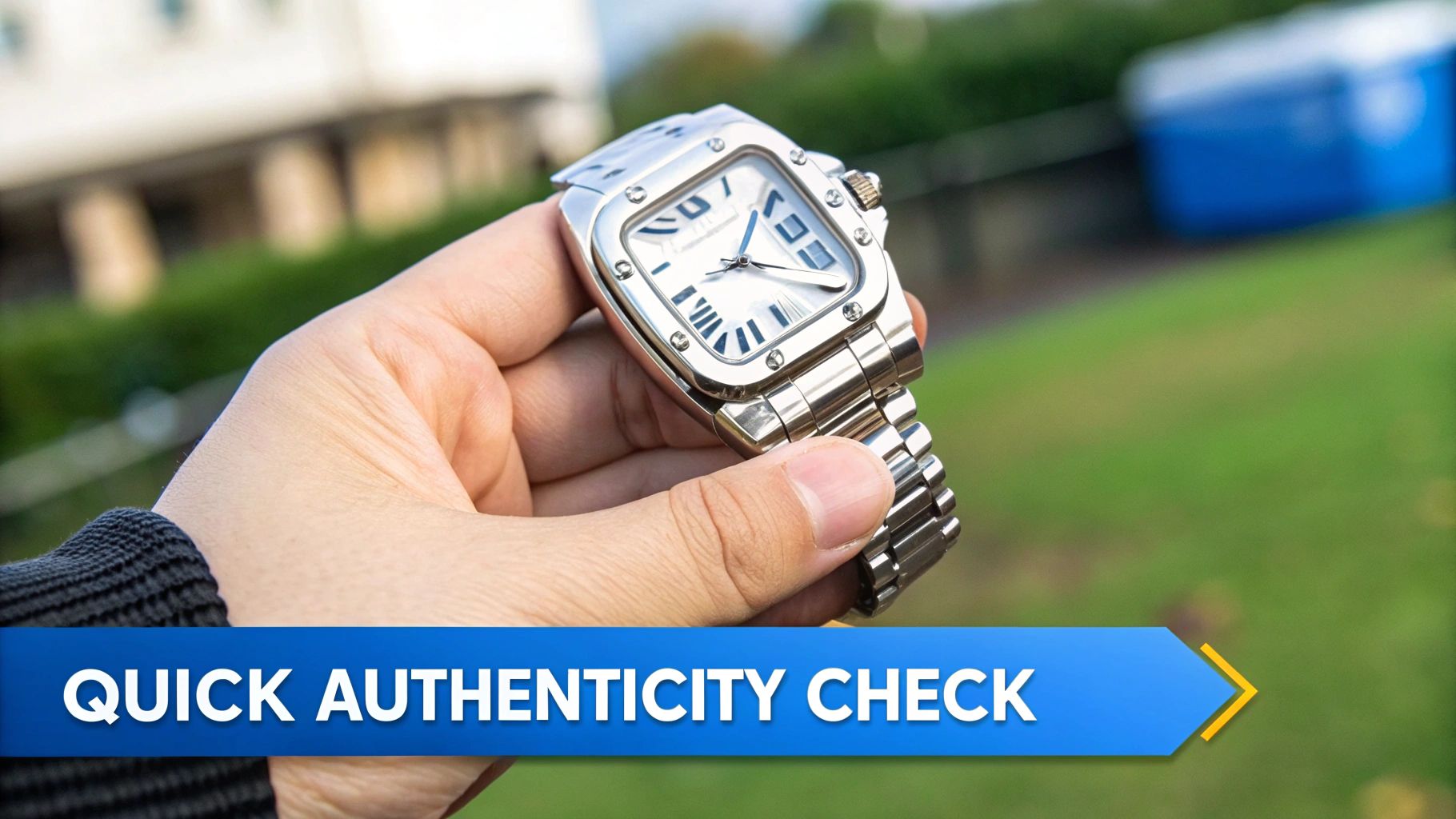
This isn’t about a quick glance. You have to know what you’re looking for and understand why Cartier’s design is so hard to copy. The smallest detail, like a slightly blurry number or an off-center logo, can be a dead giveaway.
Scrutinizing the Iconic Roman Numerals
Cartier's bold, black Roman numerals are a signature look, standing out perfectly against a clean dial. But the real magic is in the proprietary font. The lines of each numeral aren’t uniform; they taper gracefully, creating a sense of depth and artistry that the flat, automated printing on fakes just can't match.
On a genuine Cartier, the numerals are razor-sharp. The ink looks rich and is slightly raised, almost like it was painted by hand with incredible precision. Fakes, on the other hand, usually have numerals that look flat, too thick, or fuzzy around the edges when you look closely.
Consistency across the dial is also a huge tell. A study from a leading luxury watch authentication lab noted that 78% of fake Cartier watches had obvious inconsistencies in the font, alignment, or thickness of the Roman numerals. Getting that level of precision right is a massive hurdle for counterfeiters.
Locating the Secret Signature
One of the best clues you have is Cartier’s “secret signature.” Tucked away inside one of the Roman numerals, the word "CARTIER" is printed in microscopic letters. It’s a detail that many forgers either miss completely or mess up badly.
Depending on the model and its age, you’ll find this tiny signature within the V-stroke of the 'VII' or the cross-stroke of the 'X'.
- Tools to Use: You’ll absolutely need a jeweler's loupe for this. A phone camera just won't cut it.
- What to Look For: The letters should be perfectly formed, crisp, and evenly spaced. On counterfeit watches, this signature often looks like a blurry smudge, is misspelled, or is just a mess under magnification.
Now, not having the signature doesn't automatically mean it's fake, as some older or specific models might not have it. But if it is there and looks anything less than perfect, you should be highly suspicious.
Remember, the secret signature was created specifically to beat counterfeiters. If the execution is sloppy, it defeats its own purpose and is a clear sign the watch isn’t genuine.
Examining the Blued-Steel Hands
The hands on a Cartier aren’t just painted blue. They’re made from steel that has been thermally treated in a process known as heat bluing. This technique creates a deep, iridescent blue that shifts in color, going from nearly black to a brilliant royal blue depending on how the light catches it.
Replicas almost never get this right. They typically use a flat blue paint that has zero depth or dynamic color.
Real Cartier Hands:
- Show a rich, multi-tonal blue that changes with the light.
- Have a polished, three-dimensional appearance.
- Are perfectly finished with smooth, clean edges.
Fake Cartier Hands:
- Are painted a single, flat shade of blue.
- Often have rough edges or flaws you can see with a loupe.
- Just look dull and cheaply made.
The kind of craftsmanship you see on an authentic piece, like the incredible open-worked hands on a Cartier Santos Skeleton, is something forgers can’t hope to replicate accurately. Every single element, from the dial's perfect symmetry to the print quality, tells you the story of the watch's authenticity.
Inspecting the Case, Crown, and Cabochon
Beyond the dial, the physical case of a Cartier watch is a real testament to its engineering. It's a place where counterfeiters just can't afford to match the quality. This next part of your inspection is very hands-on.
Run your fingers over the entire case. Feel its finish. Then, turn your attention to that iconic crown and its precious cabochon.
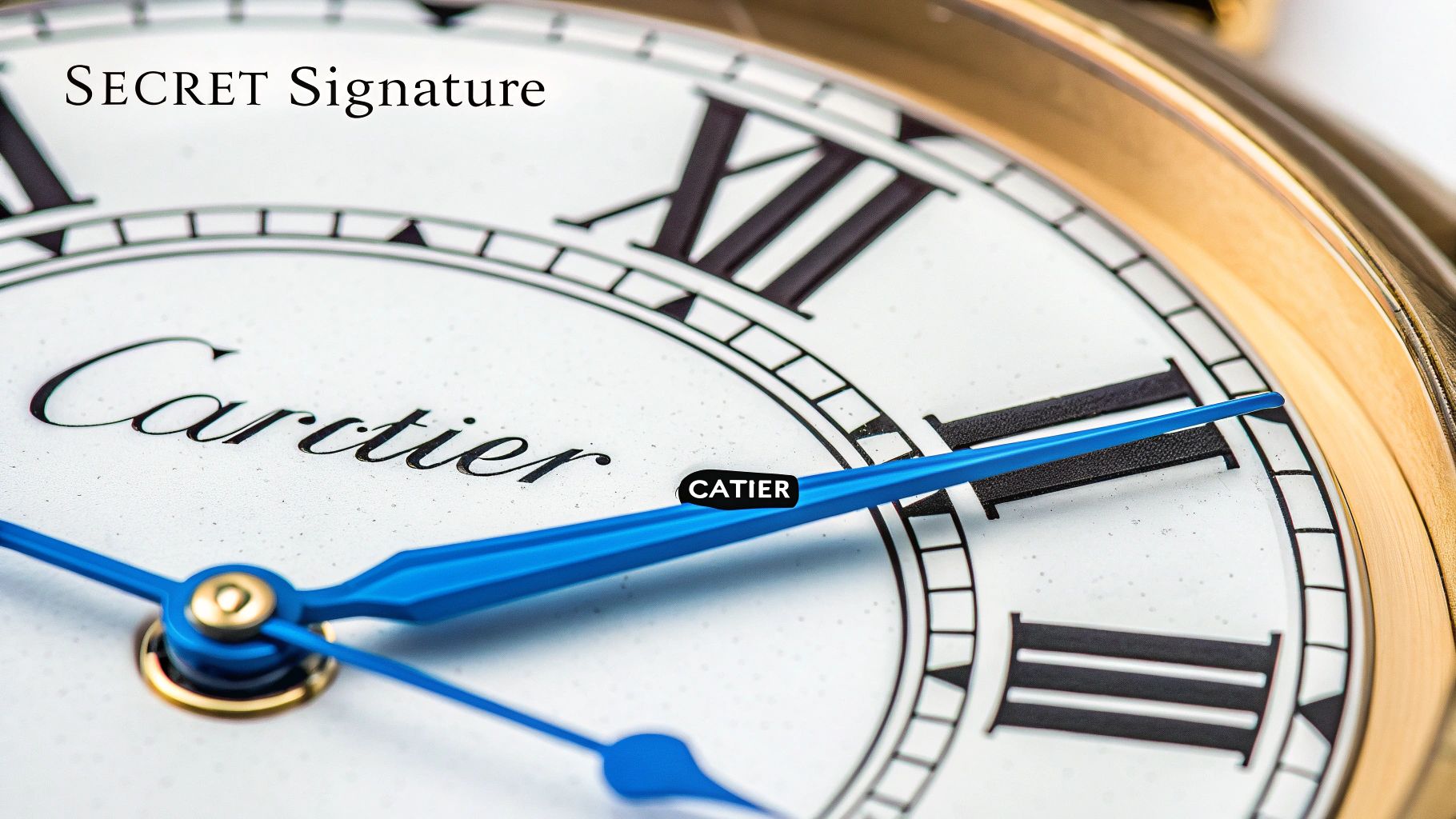
These external parts see a lot of daily wear, and Cartier builds them to last. Replicas, on the other hand, are all about appearance, not durability. A close look here will quickly expose their weak spots.
Analyzing the Case Finish and Edges
A genuine Cartier case feels incredible to the touch. It doesn’t matter if it’s a high-polish, brushed, or satin finish—it will be perfectly uniform and silky smooth. There are absolutely no sharp edges, burrs, or unfinished spots.
Counterfeit cases almost always have noticeable flaws. You might feel a sharp edge where the case meets the lugs or spot uneven polishing that looks wavy under the light. These are clear signs of mass production and sloppy finishing, something Cartier’s obsessive quality control would never let slide.
The Crown and Its Iconic Cabochon
The winding crown is one of Cartier’s most distinctive features, making it a critical checkpoint. Most models feature a synthetic sapphire or spinel cabochon—a polished gemstone—set perfectly into the crown.
The cabochon is a detail that counterfeiters consistently get wrong. On a real Cartier, the stone has a deep, rich, and vibrant blue color that reflects light beautifully. It's not just blue; it's a gemstone with depth.
Fakes cut corners here in a big way. They often use cheap blue-colored plastic or a piece of painted glass. The result is a dull, flat appearance that lacks the luster and fire of a genuine gemstone.
Authentic Cartier Cabochon:
- Material: Genuine synthetic sapphire or spinel (or a diamond on high-jewelry models).
- Appearance: Deep, rich color with vibrant light reflection.
- Setting: Flawlessly set and perfectly centered within the crown, feeling smooth to the touch.
Counterfeit Cabochon:
- Material: Often cheap plastic or painted glass.
- Appearance: Looks dull, flat, and lifeless. The color might even seem cloudy or too light.
- Setting: Frequently glued in off-center. You might see gaps around the edges, or it may even feel wobbly.
The crown itself should feel solid and precise. When you pull it out to set the time, it should click into its positions with a satisfying, sturdy feel. A gritty, loose, or wobbly crown is another major red flag.
Checking the Case Back Screws
Finally, flip the watch over and look at the case back. Many Cartier models, especially the Santos and Ballon Bleu, have prominent screws. These tiny details offer huge clues about a watch's origins.
Genuine Cartier watches use high-quality, single-slot (flathead) screws. They are always perfectly uniform in size and finish, and they sit completely flush with the surface of the case back.
Counterfeiters often use whatever cheap screws they can find, leading to several dead giveaways:
- Incorrect Type: Using Phillips-head (cross-shaped) screws is an immediate bust. Cartier doesn't use them. Period.
- Poor Quality: The slots on fake screws often look poorly cut or "chewed up."
- Improper Fit: Counterfeit screws rarely sit flush. They might be slightly raised or recessed, creating an uneven surface you can easily feel with your fingernail.
On some models like the Cartier Santos, the screws on the bezel are a core part of the design. On a real one, these screws will not all point in the same direction. If you see a Santos where all the bezel screws are perfectly aligned, it's almost certainly fake. This "perfect" alignment is actually a sign of lazy manufacturing—authentic screws are functional and tighten to a natural stopping point.
Verifying Serial Numbers and Engravings
If a Cartier watch has a fingerprint, it's found in its engravings. These markings are applied with such precision and finished so perfectly that counterfeiters have an incredibly tough time getting them right. This is often where a fake gives itself away, even when other details look convincing.
Let's walk through where to find these crucial numbers and, more importantly, how to judge the quality of the engraving itself. Mastering this skill is a huge step in learning how to tell a real Cartier watch from a well-made replica.
Locating and Assessing the Serial Number
Flip the watch over and take a close look at the case back. This is where Cartier engraves the most critical information, including the model reference and a unique serial number. On a genuine Cartier, these details will be engraved with razor-sharp precision.
The serial number format isn't always the same; it varies by model and production era. A modern Cartier might have a serial number like 2 letters followed by 6 numbers (e.g., AB123456) or even a more complex combination. The format is less important than the execution.
A sloppy, poorly applied serial number is one of the biggest red flags. These identifiers should be deeply and cleanly engraved into the metal, not lightly etched or stamped on as an afterthought. Cartier has noted that the vast majority of fakes sent in for authentication have missing, duplicated, or poorly formatted serial numbers. Since there’s no public online database to check these numbers, assessing the quality of the engraving is your best bet.
Distinguishing Engraving Quality
This is where a jeweler's loupe is absolutely essential. Under magnification, the difference between a real Cartier engraving and a fake one becomes obvious. Authentic markings are deep, crisp, and flawlessly clean—the result of high-pressure stamping or deep machine engraving.
The depth and sharpness of the engraving speak volumes. Authentic Cartier markings have a three-dimensional quality, with clean edges and uniform depth. Counterfeit engravings are often shallow, faint, or look like they were lightly sketched by a laser.
Most replicas use a cheap laser etching process. This creates a sort of frosted, pixelated look on the surface of the metal instead of actually carving into it. The lines will look blurry and won't have the clean, defined edges you see on the real deal. You might also spot uneven spacing, the wrong font, or just general messiness.
Key Engraving Checks:
- Depth: Are the letters and numbers pressed deeply and evenly into the steel or gold?
- Sharpness: Are the edges of the characters crisp and well-defined, or are they blurry?
- Consistency: Is the font uniform? Is the spacing between characters perfectly even?
- Finish: Does the work look professional and clean, or does it seem rushed and sloppy?
Think of it like carving your name into a tree with a sharp knife versus just drawing it on with a marker. The authentic engraving has that deep, permanent quality. The fake just looks superficial.
Additional Hallmarks and Markings
Besides the serial and model numbers, a genuine Cartier will have other important markings on the case back that provide more clues to its authenticity.
Look for engravings that say:
- “Water Resistant” or “Étanche”
- “Swiss Made” or “Swiss”
- The material, such as “Acier” for steel or “Or 750” for 18k gold
Watches made from precious metals will also have tiny hallmarks—official stamps used on gold, silver, or platinum. These are often minuscule and require a loupe to see clearly. If these marks are missing or look poorly stamped, it’s a major red flag. A faker might try to include them, but they’ll almost always be misaligned, blurry, or incorrect for the metal they claim to represent.
Remember, a fake might have a serial number, but it will almost never replicate the flawless execution of a genuine Cartier's engravings. That meticulous attention to detail is your most reliable tool for spotting a replica.

When to Seek Professional Authentication
While the DIY checks we've covered can catch most fakes, the world of counterfeits is always getting better. Some high-end replicas, often called "superfakes," are so convincing they could fool a seasoned enthusiast. This is where you hit the limits of a home inspection and need to bring in a professional.
Knowing when to stop guessing is a huge part of learning how to tell a real Cartier watch. It’s that final step that gives you absolute certainty, protecting both your investment and your peace of mind. Sometimes, no matter how closely you look, a nagging doubt remains—and that alone is reason enough to get an expert opinion.
Non-Negotiable Scenarios for Expert Help
Certain situations just carry too much risk for a self-assessment. In these cases, professional authentication isn’t just a good idea—it’s essential. Think of it as a mandatory final check before you make a significant financial decision.
- High-Value Private Sales: If you're buying from a private seller, an estate, or any non-authorized dealer, professional verification is your only real insurance. A seller's confidence means very little without third-party proof.
- Rare or Vintage Models: Authenticating a vintage Cartier is its own special skill. These watches have unique quirks, from different engraving styles to parts that may have been replaced over the decades. Only an expert can tell a genuine vintage piece from a well-aged fake.
- Missing Box and Papers: This isn't a definitive sign of a fake, but the absence of original documents definitely raises the stakes. Without paperwork to cross-reference, the watch itself has to stand up to a much higher level of scrutiny.
- When the Deal Seems Too Good to Be True: This is the oldest red flag in the book for a reason. A price that’s way below market value is often a sign of a counterfeit, and it's a risk not worth taking without an expert’s green light.
What a Professional Authenticator Actually Does
So, what happens when you hand your watch over to a specialist? Their process goes far beyond what you can do with a loupe at your kitchen table. They’re combining technical tools, deep brand knowledge, and access to industry resources.
The most critical step is opening the case back to inspect the movement. This is the one place where counterfeiters almost always fall short. A genuine Cartier movement, whether it’s quartz or automatic, is a masterpiece of Swiss engineering with specific finishing, engravings, and jewels that fakes just can't replicate.
A professional can identify the caliber, check for genuine components, and spot any signs of a cheap, generic movement that's been dressed up to look authentic. The inside of the watch tells a story that the outside simply can't.
Beyond the movement, an expert will:
- Verify Materials: Using specialized equipment, they can confirm if the metal is solid 18k gold or platinum versus simple plating.
- Cross-Reference Databases: They check serial and model numbers against internal records and known counterfeit databases to flag inconsistencies.
- Assess Microscopic Details: They examine the dial printing, hand finishing, and gem setting under high-powered magnification to spot tells that are completely invisible to the naked eye.
Understanding the financial benefits of getting it right from the start, especially for insurance, is key. A resource from Proova explains How Pre-Authentication Can Reduce Claims Costs, which really drives home the value of proper verification.
For anyone seeking this level of assurance, services like the ECI Jewelers watch concierge provide direct access to specialists who can perform these in-depth examinations. This final step transforms your confidence from a well-educated guess into a documented certainty.
Common Questions About Cartier Authentication
When you're trying to figure out how to tell a real Cartier watch from a fake, a lot of questions pop up. It makes sense—the smallest details can make all the difference. From my experience, a few questions come up time and time again. Let's get you some clear, straightforward answers.
Can I Check a Cartier Serial Number Online?
This is easily one of the most frequent questions, and the answer is a simple but firm no. Cartier does not have a public online database where you can verify a serial number. If you stumble upon a third-party website claiming to offer this service, you should be skeptical. They are not legitimate and you definitely shouldn't be entering your watch's information.
Cartier keeps this information internal for a good reason. It’s a security measure to protect against counterfeiters who would absolutely exploit a public database to create more convincing fakes with seemingly legitimate serial numbers. The only real way to check a serial number is to go through a Cartier boutique or a trusted authorized dealer. They have access to the internal records and can verify it for you.
Do All Real Cartier Watches Have the Secret Signature?
Ah, the famous "secret signature." It's one of Cartier's cleverest anti-counterfeiting moves. On most modern Cartier watches, you'll find the word 'CARTIER' micro-printed into one of the Roman numerals, usually at the VII or X marker. When you find one that's perfectly crisp and flawlessly printed, it’s a very strong sign you're looking at the real deal.
But hold on—its absence isn't an automatic red flag. Whether a watch has the signature, and where it's located, really depends on the specific model and when it was made. Many older vintage models, for instance, predate this feature entirely. So, while a sloppy, poorly executed signature is a huge giveaway for a fake, not finding one at all just means you need to dig deeper into the watch's history and model specifics.
The secret signature is a powerful clue, but it's just one piece of the puzzle. Authenticity is determined by looking at all the details together—the weight, engravings, crown, and movement—not just a single feature.
What Is the Biggest Giveaway of a Fake Cartier?
While plenty of tiny details can give away a replica, a few major tells often scream "fake" right away.
In my experience, the most common giveaway is the quality of the case back engravings. Genuine Cartier engravings are deep, sharp, and clean. Fakes, on the other hand, almost always have shallow, faint, and fuzzy text that looks like it was lightly etched with a laser.
Another huge indicator is hearing a ticking quartz movement in a model that's supposed to be automatic. A genuine automatic Cartier has a smooth, sweeping second hand. A fake will often have that distinct "tick-tick-tick" stutter of a cheap quartz battery. And finally, trust your hands. If a watch feels suspiciously light for its size, that’s a classic sign counterfeiters have used inferior, cheaper materials.
What Should I Do If I Discover a Fake?
Realizing you’ve found a counterfeit is disappointing, to say the least. Beyond just walking away from the purchase, you can take action. Once you're sure it's a fake, knowing how to report counterfeit products effectively helps protect other buyers and keeps the market honest. It's a small step that helps the entire watch community.
Of course, the best way to avoid this situation entirely is to work exclusively with trusted, reputable dealers who provide an ironclad guarantee of authenticity. It just removes all the guesswork and risk, ensuring you get the genuine timepiece you paid for without the stress.
At ECI Jewelers, every timepiece we offer is meticulously inspected by our specialists to guarantee 100% authenticity. Protect your investment and shop our curated collection of genuine luxury watches with complete confidence at https://www.ecijewelers.com.


Mine is an extremely heavy octagon shape with the pointed sapphire at the crown /top VIi . The watch style is open. And I see no screws at the back o codifying engraved
I’ve not been able to open it.
Mine is an extremely heavy octagon shape with the pointed sapphire at the crown /top VIi . The watch style is open. And I see no screws at the back o codifying engraved
I’ve not been able to open it.