


Before you even think about grabbing a loupe, the first few seconds of handling a watch can tell you almost everything you need to know. A real Rolex has an unmistakable presence. It's a feeling, a sensory experience that counterfeiters just can't replicate.
This first impression is your gut check, your immediate line of defense against a fake. You don't need any special tools for this part—just your hands and your eyes.
Your First Impression: The Immediate Signs of Authenticity
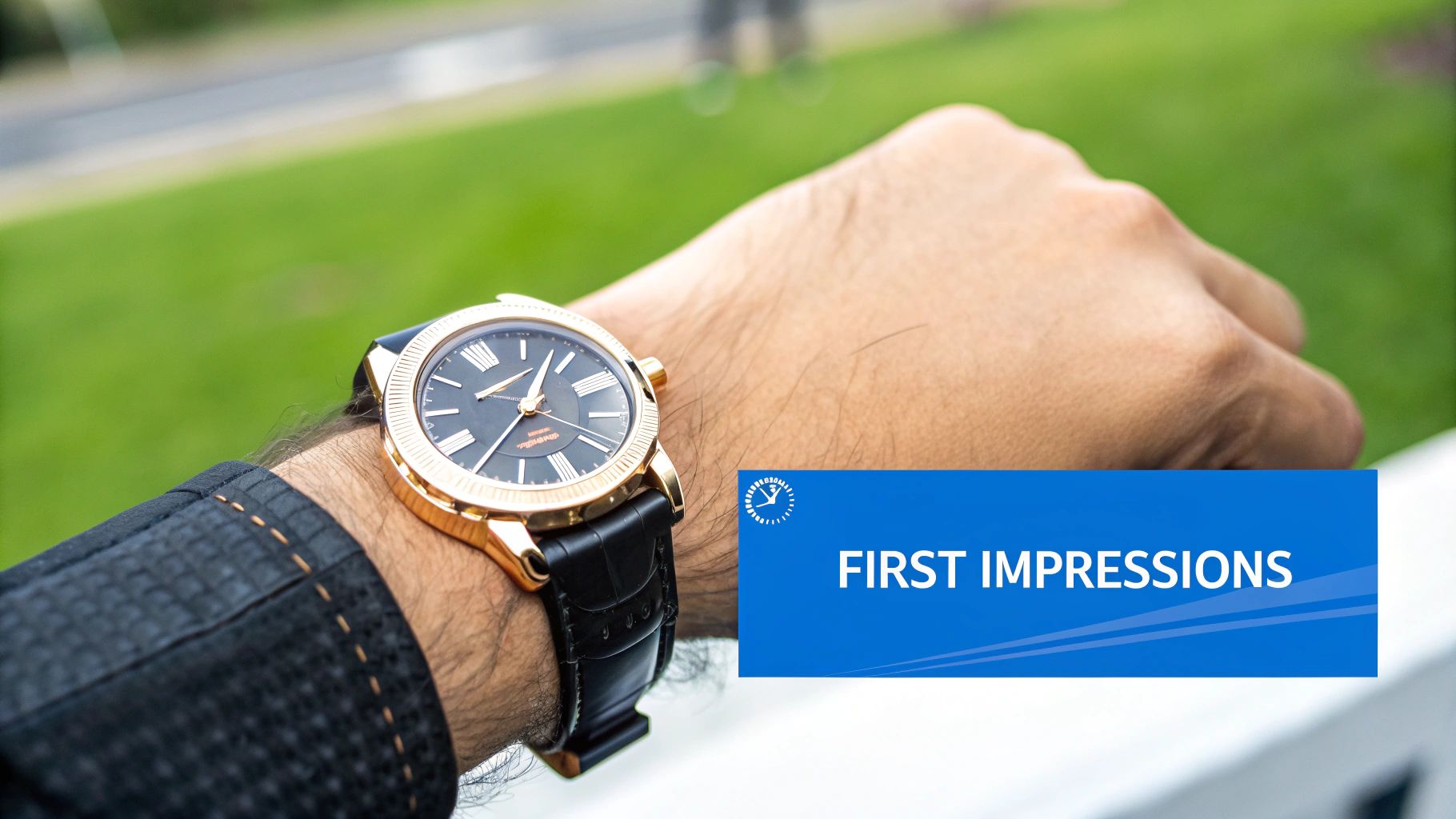
Forget the tiny details for a moment. We're looking at the big picture here: the weight, the movement, and the overall feel. A well-made fake might get some of the visual cues right, but they almost always fail on these fundamental points.
The Weight and Balance Test
First things first: pick it up. Does it feel substantial? An authentic Rolex is milled from a solid block of 904L Oystersteel, 18k gold, or platinum. That means it has a dense, balanced heft that feels reassuring in your hand.
Fakes, on the other hand, often use cheaper materials like 316L steel or, worse, plated base metals. The result is a watch that feels light, flimsy, or even hollow. If you pick it up and your first thought is, "Huh, this feels lighter than I expected," that's a massive red flag.
I've handled countless watches over the years, and a genuine Submariner has a solid, commanding presence on the wrist. A fake just feels… wrong. They cut corners on materials to save money, and it’s something you can feel instantly.
The Second Hand Sweep
Now, look at the second hand. This is probably the most famous "tell" for a reason. A genuine Rolex movement is a high-frequency marvel, beating at 28,800 beats per hour. That translates to eight tiny movements per second, creating a smooth, fluid sweep that’s almost hypnotic to watch.
The vast majority of fakes use cheap quartz or low-grade mechanical movements. You'll see a distinct tick...tick...tick as the hand jumps from one second marker to the next. It’s a jerky, stuttering motion that screams "fake" from a mile away.
This quick guide highlights the three most immediate things to look for when you first get your hands on a Rolex.
As you can see, it all comes down to the fundamentals: how it feels, how it moves, and how it’s finished.
To help you spot the differences at a glance, here’s a quick breakdown of what separates the real deal from a typical knockoff.
Quick Comparison: Real Rolex vs. Typical Fake
| Feature | Authentic Rolex | Typical Fake |
|---|---|---|
| Weight | Substantial, dense, and balanced due to 904L steel or precious metals. | Often feels light, hollow, or imbalanced due to cheaper materials. |
| Second Hand | Smooth, sweeping motion (8 beats per second). | Jerky, ticking motion (1 tick per second). |
| Materials | Solid 904L Oystersteel, 18k gold, or platinum. | 316L steel, plated base metals, or other inferior alloys. |
| Finish | Flawless transitions between brushed and polished surfaces. | Poor polishing, rough edges, and visible imperfections. |
This table covers the most obvious tells, but the final physical check is just as important.
Evaluating the Overall Fit and Finish
Lastly, just run your fingers over the entire watch—the case, the lugs, the bracelet. On a real Rolex, the finishing is impeccable. The lines are crisp and sharp. The transition between a brushed and polished surface is clean and deliberate. It feels like a single, perfectly machined piece of art.
Counterfeits are a different story. You’ll often find rounded edges where they should be sharp, imperfections in the brushing, and a general feeling that the parts don't quite fit together seamlessly. An authentic Rolex feels like a piece of fine jewelry; a fake often feels like a cheap accessory. These initial checks will weed out most common fakes right away and prepare you for a closer look.
Examining the Dial and Case with an Expert Eye
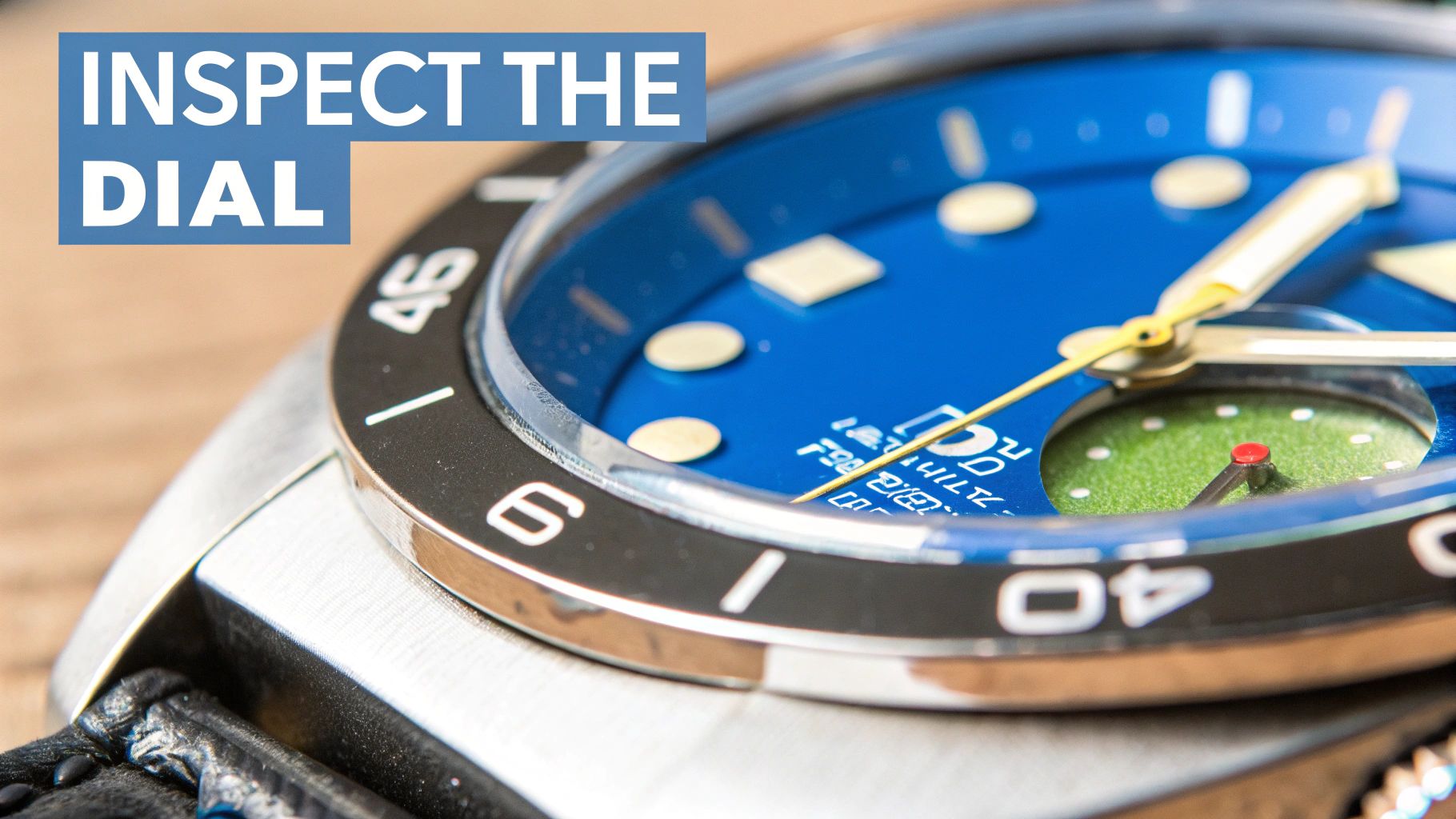
While the weight and overall feel of a watch can weed out the most obvious fakes, the real story is written on the dial and carved into the case. Counterfeiters have gotten much better at mimicking the general look, but their work falls apart under close inspection. This is where you need to stop being a casual observer and start acting like a detailed inspector.
The dial is the first place a trained eye should look. A real Rolex dial is perfect—not just good, but absolutely flawless. The printing, the markers, and the hands are all made with a level of precision that is incredibly expensive to replicate.
A genuine Rolex dial has a certain depth and life to it that a flat, printed fake can never capture. It’s the difference between a high-resolution photograph and a cheap photocopy. Once you’ve seen the real thing up close, the imitation becomes painfully obvious.
Let's start with the text itself. Every single word on a Rolex dial, from the brand name to the "Superlative Chronometer Officially Certified" script, is a tiny work of art.
Scrutinizing the Dial Text and Markers
On an authentic Rolex, the letters look slightly raised, giving them an almost three-dimensional quality. The edges are impossibly crisp and clean, with perfect spacing and alignment. Grab a loupe or use your phone's magnifier—you should see a metallic sheen and the perfect form of each character.
This is where fakes almost always show their flaws. The text often looks flat, as if it were simply printed on. You might notice fuzzy edges, uneven paint, or a slight bleed in the color. These are all dead giveaways of a shortcut.
The hour markers are another huge checkpoint. Rolex uses 18k gold for its hour markers (yes, even on steel models) to prevent any tarnishing over time. These markers are flawlessly finished and expertly applied.
- Check for Precision: Every marker should be perfectly aligned and set. Any marker that looks even slightly crooked or off-center is an immediate red flag.
- Examine the Lume: The luminous material, what Rolex calls Chromalight, should be applied evenly and neatly within the borders of the markers. If it looks sloppy, lumpy, or is overflowing, you're looking at a fake.
Now, let's move on to one of the most famous—and most frequently botched—Rolex features: the Cyclops lens.
The Cyclops Lens Magnification Test
That little magnifying bubble over the date window, the Cyclops, is one of the most reliable ways to spot a fake. Rolex designed it to magnify the date by a very specific 2.5x, making the numbers pop and fill the entire window for easy reading. Getting that precise magnification just right is surprisingly difficult.
Fakes almost always fail here. Their lenses usually offer weak magnification, maybe 1.5x at best, which makes the date look small and lost in the window. You might also see weird distortions around the bubble's edge. A dead giveaway on modern fakes is a bluish anti-reflective coating on the Cyclops itself; real Rolexes don't have this. Hold the watch level and look straight down—if the date doesn't jump out at you, large and clear, be suspicious.
Assessing the Case Finishing and Edges
Finally, take a close look at the case itself. Rolex’s mastery of metalwork really shows in the finishing. The transition between a brushed and a polished surface is where you should focus. On a real Rolex, the line separating these two textures is razor-sharp and perfectly defined. There’s no blurring or softness at all.
Run your finger along the lugs and the crown guards. An authentic case has sharp, crisp lines and perfectly beveled edges that feel precise to the touch. Counterfeit cases, on the other hand, often have softer, more rounded edges because of cheaper machining. They almost feel a bit "melted" in comparison, lacking the sharp geometry that defines a genuine Rolex case. These subtle differences are what separate true Swiss luxury from a clever imitation.
Decoding Serial Numbers and Engravings
If the dial is the face of a watch, then its serial and model numbers are its unique fingerprint. No other detail tells you more about a Rolex’s identity and history. Counterfeiters can get surprisingly close on looks, but faking the precision of Rolex engravings is one of their biggest hurdles.
These numbers tell you everything from the model family to its approximate production year. Knowing where to look—and what you're looking at—is one of the most powerful skills in your authentication toolkit.
Locating the Key Identifiers
The location of these crucial numbers has evolved, and that evolution is a key tell. The first thing you need to know is whether the watch in your hand lines up with its supposed era.
For many years, Rolex engraved these numbers directly on the case, tucked away where you couldn't see them without removing the bracelet. This kept the design clean and uncluttered.
- Model Number (Reference Number): Found between the lugs at the 12 o'clock position.
- Serial Number: Located between the lugs at the 6 o'clock position.
Things started to change around 2005. Rolex began engraving the serial number on the inner bezel ring, what collectors call the "rehaut," right at the 6 o'clock position. By 2008, this was standard practice. If you’re looking at a modern Rolex that only has engravings between the lugs and not on the rehaut, that’s a massive red flag.
The quality of a genuine Rolex engraving is unmistakable. It’s deep, clean, and catches the light with a diamond-like shimmer. A fake often has a shallow, sandy look, like it was acid-etched instead of precision-carved.
Diamond Drag vs. Acid Etching
This difference in engraving quality is where most fakes fall apart under scrutiny. Rolex uses a high-precision, diamond-tipped tool that literally carves into the metal. It creates sharp, brilliant lines that shine when you view them at an angle. The numbers look solid and permanent because they are physically cut into the steel.
Counterfeiters, on the other hand, are all about cutting costs. They typically use a much cruder acid-etching process that simply burns the numbers onto the surface. This lazy method leaves behind several obvious flaws:
- Shallow Depth: The numbers look faint and lack the deep-cut presence of real engravings.
- Pixelated or "Dotty" Look: Up close, the lines aren't solid. They often look like they're made of tiny dots, giving them a sandy or fuzzy texture.
- Poor Spacing: The characters might be unevenly spaced or poorly aligned.
A real Rolex engraving is like fine calligraphy; a fake looks like it was made with a stencil and spray paint. The difference is night and day under a loupe.
Understanding the Serial Number System
The serial number system itself is a huge part of the authentication puzzle. Since 1926, Rolex has used these numbers to track production. For decades, they were issued sequentially, which allowed enthusiasts to date a watch fairly accurately. You can learn more by checking out our complete ECI Jewelers guide to Rolex serial and reference numbers.
This all changed in 2010, when Rolex switched to a randomized system of letters and numbers, making it impossible to date a modern watch by its serial number alone.
This is a critical detail. Verifying the number against known production records is crucial, as fakes often use repeated serials or codes that don't match any known data. Industry experts estimate that about 50% of fake Rolex watches have incorrect or mismatched serial numbers. It's one of the easiest ways for an experienced eye to spot a counterfeit from a mile away.
The Heartbeat of the Watch: Its Movement and Sound
Forget the loupe for a second. The real soul of a Rolex is its mechanical movement, and it’s one of the best ways to spot a fake. This is where counterfeiters almost always fall short because replicating that level of Swiss micro-engineering is incredibly difficult and expensive.
Just watch the seconds hand. A genuine Rolex automatic movement beats at 28,800 vibrations per hour. That translates to eight tiny movements every second, creating that iconic, buttery-smooth sweep Rolex is famous for. It doesn't stutter or jump; it glides.
Most fakes, on the other hand, use cheap quartz or clunky, low-beat mechanical movements. A quartz movement gives you that jerky tick-tick-tick motion where the hand jumps once per second. That's an immediate red flag for virtually any Rolex, except for a few rare vintage Oysterquartz models.
A genuine Rolex is engineered for silent, seamless performance. The smooth sweep of the seconds hand is the visual proof of a high-beat movement, while the near-total silence is the audible confirmation of precision craftsmanship. If you can hear it ticking from your wrist, it’s not real.
The Sound of Silence
This brings us to the next crucial test: what you can (or can't) hear. In a quiet room, hold the watch right up to your ear. An authentic Rolex is almost completely silent. You might—might—hear a faint, high-speed whirring if you press it against your ear. That’s the sound of hundreds of perfectly engineered parts working together.
A fake, however, will often make a loud and obvious "tick-tock" sound. This is the tell-tale sign of a cheap, low-quality movement that doesn’t have the tight tolerances or sound dampening of a genuine Rolex caliber. If you can hear the watch ticking from a foot away, you can be pretty sure it's not the real deal.
- Authentic Rolex: Nearly silent. You might hear a very faint, fast whirring only when it’s held directly against your ear.
- Counterfeit Rolex: Often produces a noticeable and loud "tick-tock" that’s audible from a distance.
A Look Inside the Engine
While we never recommend cracking open a watch case yourself, a professional watchmaker can give you the final word just by looking at the movement. This is where even the best "super-clones" get exposed. Rolex movements aren't just workhorses; they're beautifully finished and meticulously marked.
When a professional opens it up, they’re looking for a few key things:
- Signature Engravings: A real movement will have "Rolex," the caliber number, and other details beautifully engraved right onto its components.
- Colored Reversing Wheels: Many Rolex calibers have signature red or purple reversing wheels in the automatic winding module. Fakes often miss this detail or do a poor job replicating it.
- Overall Finish: The bridges and plates on a genuine movement have a flawless, pristine finish that counterfeiters just can't afford to copy.
Every caliber has its own unique design. To get a better feel for what makes these little engines so special, you can learn more about the different Rolex movements that define their models. Knowing what’s inside helps you understand why fakes can never truly capture the heart of the watch.
Inspecting the Bracelet and Clasp for Quality
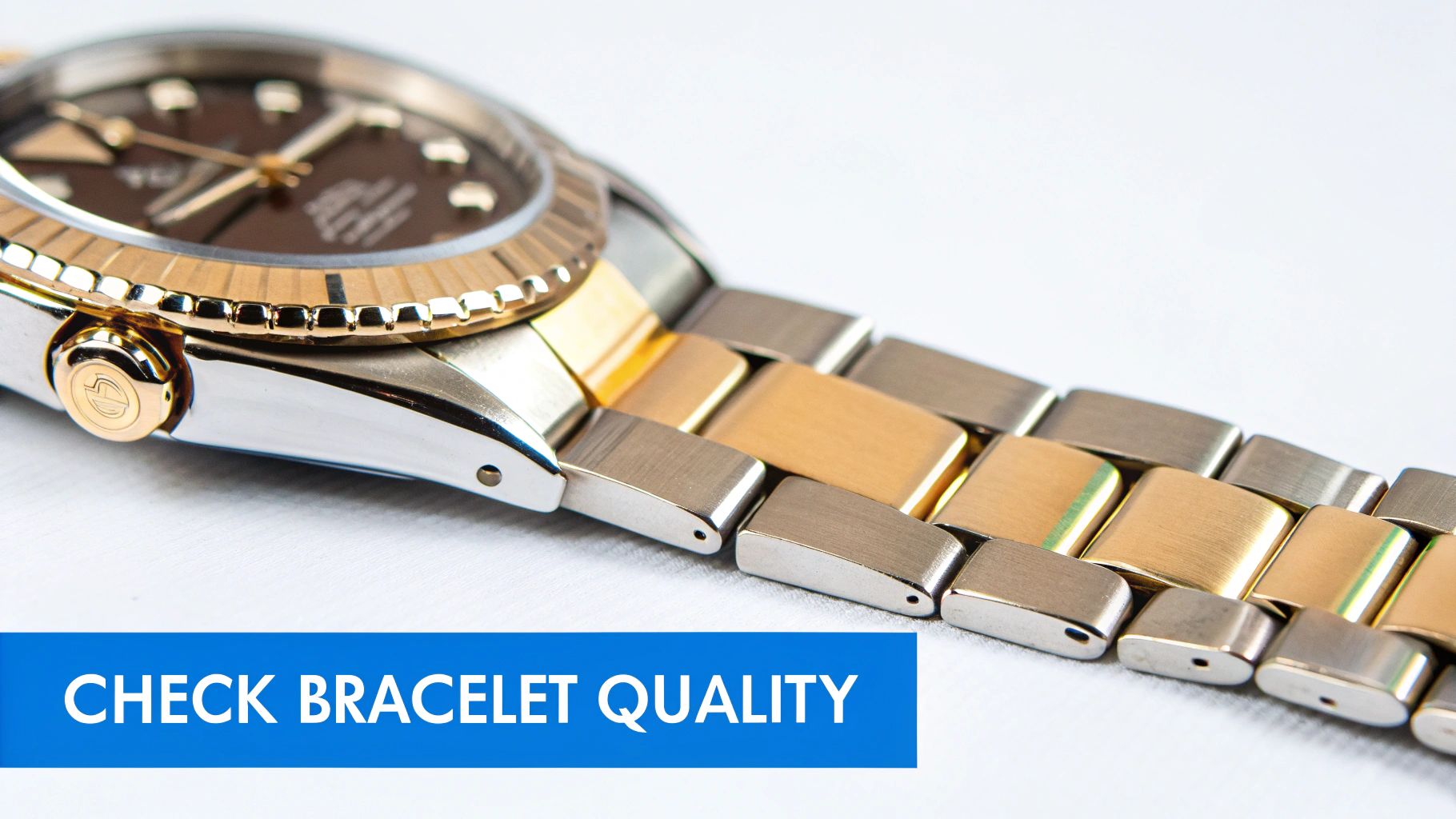
A Rolex bracelet is so much more than a strap—it’s a finely tuned piece of engineering. Counterfeiters often pour all their effort into mimicking the watch head and completely drop the ball on the bracelet. This is great news for you, because it's an area where fakes give themselves away pretty quickly.
A genuine Rolex bracelet feels substantial and solid, like it’s carved from a single piece of metal. Give it a gentle shake. You shouldn't hear much rattling or feel any excessive looseness between the links. Fakes, on the other hand, often feel flimsy, light, and make a cheap, jangly noise that just screams poor quality.
Assessing the Fit and Finish of the Links
Run your fingers along the surface of the bracelet. Whether it's the classic Oyster, the intricate Jubilee, or the prestigious President style, a real Rolex has a perfect finish. The brushed satin areas are uniform and smooth, while the polished sections are flawless and mirror-like.
This meticulous detail carries over to how the links are connected. A real Rolex uses solid, high-quality screws for its removable links, which allows for precise sizing. You'll notice the screw heads are perfectly finished and sit flush with the link.
This is a huge tell. Many fakes cheap out by using simple friction pins instead of screws. If you see tiny pins holding the links together, sometimes with little split ends, you're almost certainly holding a counterfeit. It's one of the easiest red flags to spot.
The feel of a genuine Rolex clasp is something you don't forget. It snaps shut with a crisp, secure 'click'—think of the sound a luxury car door makes. Fakes often feel gritty, weak, or require too much force, completely missing that satisfying, high-precision feel.
Learning to trust your sense of touch is a big part of knowing how to tell if your Rolex is real.
Examining the Clasp and Coronet
The clasp is another hotspot for Rolex's famous quality control. Open and close it a few times. The mechanism on a genuine clasp is buttery smooth and locks down with absolute security. It should feel robust and engineered, not wobbly or loose.
Now, take a close look at the Rolex coronet (the crown logo) on the clasp. On an authentic watch, this crown is usually an applied piece of metal or a very sharp, deeply cut engraving.
- Applied Coronet: The five points of the crown will be well-defined, each with a slightly rounded, ball-like tip.
- Engraved Coronet: The lines should be clean, deep, and precise—not shallow, fuzzy, or blurry.
Counterfeit clasps often have a sloppy, stamped-on crown that looks flat and lacks any real detail. The little circles at the tips of the crown might just be flat dots instead of properly formed spheres.
Finally, check for any markings inside the clasp. Genuine Rolex clasps feature sharp, clear engravings, including the brand name and sometimes material codes. Fake engravings are often shallow, almost sandy in texture, and might use the wrong font or have sloppy spacing. When you add up all these little details, they paint a very clear picture of authenticity—or expose a forgery.
Why Professional Authentication Is Your Safest Bet
While the inspection tips in this guide are fantastic for weeding out most fakes, the world of counterfeits moves fast. Today’s most sophisticated replicas—often called "super-clones"—are frighteningly accurate. They can sometimes even fool a seasoned collector at first glance.
This is where the line between a smart DIY check and the absolute need for professional verification becomes crystal clear. Trusting an expert isn't giving up; it’s the single smartest thing you can do to protect what is a serious investment. A certified watchmaker has the tools and, more importantly, the experience that goes miles beyond what our eyes can see. They offer definitive proof you can bank on.
The Limits of Just Looking
Even with a trained eye and a good loupe, you're still mostly judging the book by its cover. The people making these high-end fakes know exactly what we look for—that perfect 2.5x Cyclops magnification, the buttery-smooth sweep of the second hand, the crisp rehaut engraving—and they pour their energy into perfecting those details.
Some counterfeiters even get their hands on genuine Rolex parts from other watches to fool you on a quick inspection. This is exactly why a professional’s diagnostic tools are non-negotiable for true verification. They don’t just look at the watch; they analyze its performance on a scientific level.
Definitive Tests Only a Pro Can Do
When you hand your watch over to an expert, they run a series of tests that fakes simply can't pass. These diagnostics give you hard data, not just an opinion.
- Timegrapher Analysis: Think of this machine as an EKG for your watch. It listens to the movement's "heartbeat," measuring its rate, amplitude, and beat error. A genuine Rolex caliber has a signature performance that's almost impossible for a modified, off-the-shelf fake movement to replicate.
- Pressure Testing: Rolex is famous for its waterproof Oyster case. A professional pressure test submerges the watch in a controlled chamber to see if it holds up to its depth rating. Fakes almost always fail this test because achieving true water resistance requires precision engineering that counterfeiters just don't bother with.
- Movement Inspection: A watchmaker will safely open the caseback for the final word. They can instantly spot the subtle finishing, the specific engravings, and signature parts like the red reversing wheels that scream authentic Rolex caliber.
Peace of mind is the ultimate luxury. A professional authentication provides a certificate of proof, transforming a watch from a source of anxiety into a source of pride and a secure asset for the future.
When to Absolutely Call in a Professional
Getting an expert opinion isn't just a good idea—it's mandatory in certain situations. If you're thinking about a private sale, buying from an online auction, or any deal without a clear, verifiable history, an expert appraisal is your only real insurance policy. It removes every last bit of doubt and protects you from a very expensive mistake.
For anyone ready to buy, sell, or trade with 100% confidence, the team at ECI Jewelers provides expert services to make sure every transaction is safe and secure. To get started with a more personal approach, you can contact the ECI Jewelers watch concierge.
Once you know your timepiece is fully verified, you might feel ready to explore new corners of the watch world. For instance, learning how to master online watch auctions can open up some incredible opportunities for growing your collection.
Answering Your Top Rolex Authenticity Questions
As you get more familiar with how to spot a real Rolex, you’ll notice a few questions pop up over and over again. Getting straight answers to these common sticking points is often the last hurdle before you feel ready to bring a watch in for a professional opinion.
Do Real Rolexes Tick?
No, a genuine Rolex movement doesn't produce that classic, loud "tick-tock" you might expect from a watch. The magic is in the automatic movement's second hand, which glides with a smooth, sweeping motion powered by eight tiny beats per second.
If you press the watch right up to your ear in a completely quiet room, you might catch a very faint, super-fast whirring sound. But a distinct, audible ticking is a dead giveaway for a cheap, counterfeit quartz movement.
One of the most telling signs for a beginner is the Cyclops lens over the date. A real Rolex has a powerful, perfectly centered lens that magnifies the date precisely 2.5 times. It’s a small detail, but it’s one that counterfeiters almost never get right.
Can I Just Look Up a Rolex Serial Number Online?
There’s no official, public Rolex database where you can plug in a serial number for verification. You might find some third-party websites claiming to offer this, but their data is often spotty or just plain wrong, which can easily lead you to a false conclusion.
The only truly reliable way to verify a serial number is by taking the watch to an authorized dealer or a trusted watchmaker. They have access to the right tools and internal databases needed to confirm its legitimacy.
What's the Single Easiest Way to Spot a Fake?
While no single check is a guarantee, the Cyclops lens over the date is often the fastest way to expose a fake. On an authentic Rolex, that lens magnifies the date by exactly 2.5x, making the numbers look bold, crisp, and perfectly framed in the window.
Fakes, on the other hand, almost always mess this up. They'll use weak magnification, maybe 1.5x at best, or the lens will be crooked and poorly aligned. This makes the date look small, blurry, or just off. This one detail can often tell you all you need to know in a matter of seconds.
When you're ready for an expert opinion, ECI Jewelers provides professional authentication services to give you complete peace of mind. Explore our collection of 100% authenticated luxury timepieces today.


