

When you get down to it, the choice between an Omega Seamaster vs. Speedmaster really comes down to what you need your watch to do. Seamasters are tough, purpose-built dive watches designed to take a beating, while Speedmasters are legendary chronographs with a rich history tied to precision timing. Your decision hinges on whether you value everyday resilience and water resistance or iconic design and mechanical heritage.
A Tale of Two Legendary Omega Timepieces
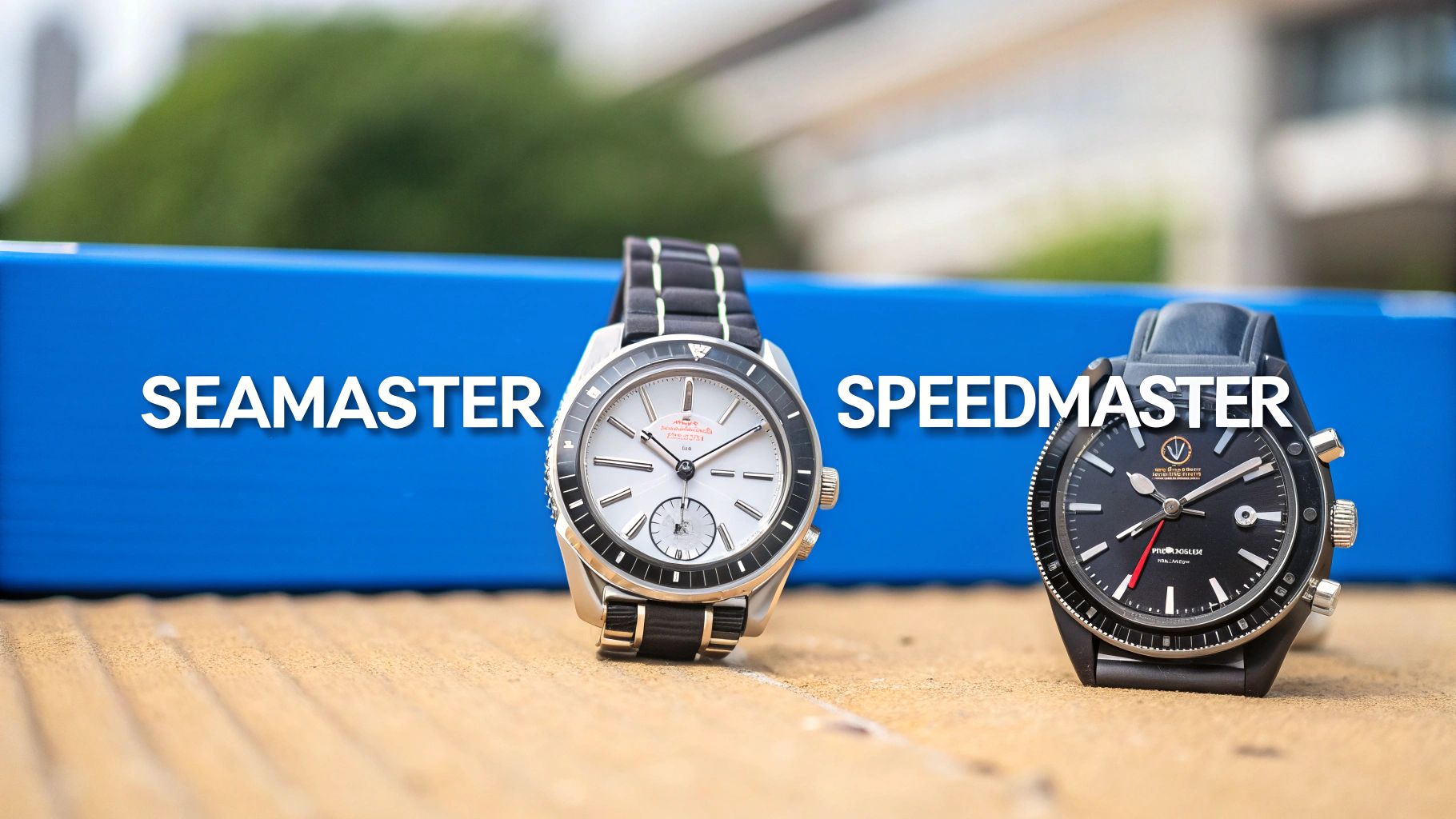
For just about any watch lover, picking between an Omega Seamaster and a Speedmaster is a classic dilemma. On one hand, you have the pinnacle of dive watch engineering. On the other, an icon of space exploration. This guide is here to cut through the noise and give you a clear, practical comparison of these two horological giants.
We’re going to go beyond the basic specs to look at the history, design philosophy, and real-world performance that makes each collection unique. The goal is simple: to help you figure out whether the Seamaster or the Speedmaster is the right fit for your wrist.
Quick Comparison Seamaster vs Speedmaster
To set the stage, let's start with a high-level look at what separates these two iconic Omega collections. This table gives you a quick snapshot of their core functions and key traits, making it easy to see where they differ at a glance.
| Feature | Omega Seamaster | Omega Speedmaster |
|---|---|---|
| Primary Function | Dive Watch | Chronograph (Racing/Aviation) |
| Defining Feature | High Water Resistance & Rotating Bezel | Tachymeter Bezel & Sub-Dials |
| Movement Type | Primarily Automatic Co-Axial | Primarily Manual-Wind Chronograph |
| Historical Milestone | Official Watch of James Bond | First Watch Worn on the Moon |
| Ideal User Profile | The Daily Wearer, Aquatic Adventurer | The Horology Enthusiast, History Buff |
This quick rundown already shows the very different paths these two watches have traveled. The Seamaster started with military-grade waterproof tech and evolved into a luxurious tool watch—perfect for anyone who wants modern mechanics and a go-anywhere, do-anything attitude.
The Speedmaster, however, took a journey from the racetrack to the lunar surface, cementing its status as an absolute legend. Its signature manual-wind movement and chronograph function appeal to those who appreciate mechanical interaction and a direct connection to one of history’s greatest achievements.
A Tale of Two Legacies: From Sea to Space
To really get a feel for the Omega Seamaster vs. Speedmaster debate, you have to look past the specs and into their stories. These watches weren’t just designed in a lab; they were forged by history, each telling a completely different tale of human ambition. One was built to conquer the ocean depths, while the other was destined for the stars.
The Seamaster's story kicks off in 1948. It grew out of Omega's experience building tough, waterproof watches for the British military during World War II. It wasn't a dive watch just yet—more of a refined timepiece for "town, sea, and country" that happened to be incredibly water-resistant, thanks to a game-changing O-ring gasket system.
This military-grade DNA laid the groundwork for what was to come. By 1957, the Seamaster 300 had transformed the collection into a true professional dive watch, and it didn't take long for pioneers like Jacques Cousteau to adopt it. Its legacy was later sealed in pop culture as James Bond's official watch, starting with Goldeneye in 1995.
The Seamaster is all about maritime adventure and rugged elegance. Its journey from a military-spec gentleman's watch to the iconic sidearm of a cinematic spy proves just how versatile and durable it really is.
Today, the entire Seamaster collection, from the Diver 300M to the Planet Ocean, carries this heritage of aquatic exploration. You can explore a wide variety of models in our dedicated Omega Seamaster collection.
From Racetracks to Rocket Ships
The Speedmaster, on the other hand, started its life in a totally different arena. It launched in 1957 alongside the Seamaster 300, but it was designed as a high-precision chronograph for motorsport fans and race car drivers. Its defining feature—a tachymeter scale printed right on the bezel—was a world-first for a wristwatch.
This obsession with precise timing caught the attention of a very different kind of professional. In the mid-1960s, NASA was on the hunt for a watch tough enough for its astronauts. After a series of brutal tests, the Speedmaster was the only one left standing, earning the title "flight-qualified for all manned space missions."
That moment changed everything. The Speedmaster's identity shifted from the racetrack to the final frontier, securing its place in history on July 21, 1969, when it became the first watch worn on the moon. This is how it earned its legendary nickname, the "Moonwatch."
At their core, the Speedmaster is a symbol of precision under pressure, while the Seamaster represents resilient maritime heritage. Their unique histories define not just their functions but their very characters, making them two of Omega's most important and sought-after collections. You can find more details about their investment potential in this analysis of top Omega watches.
Comparing Design Language and Aesthetics
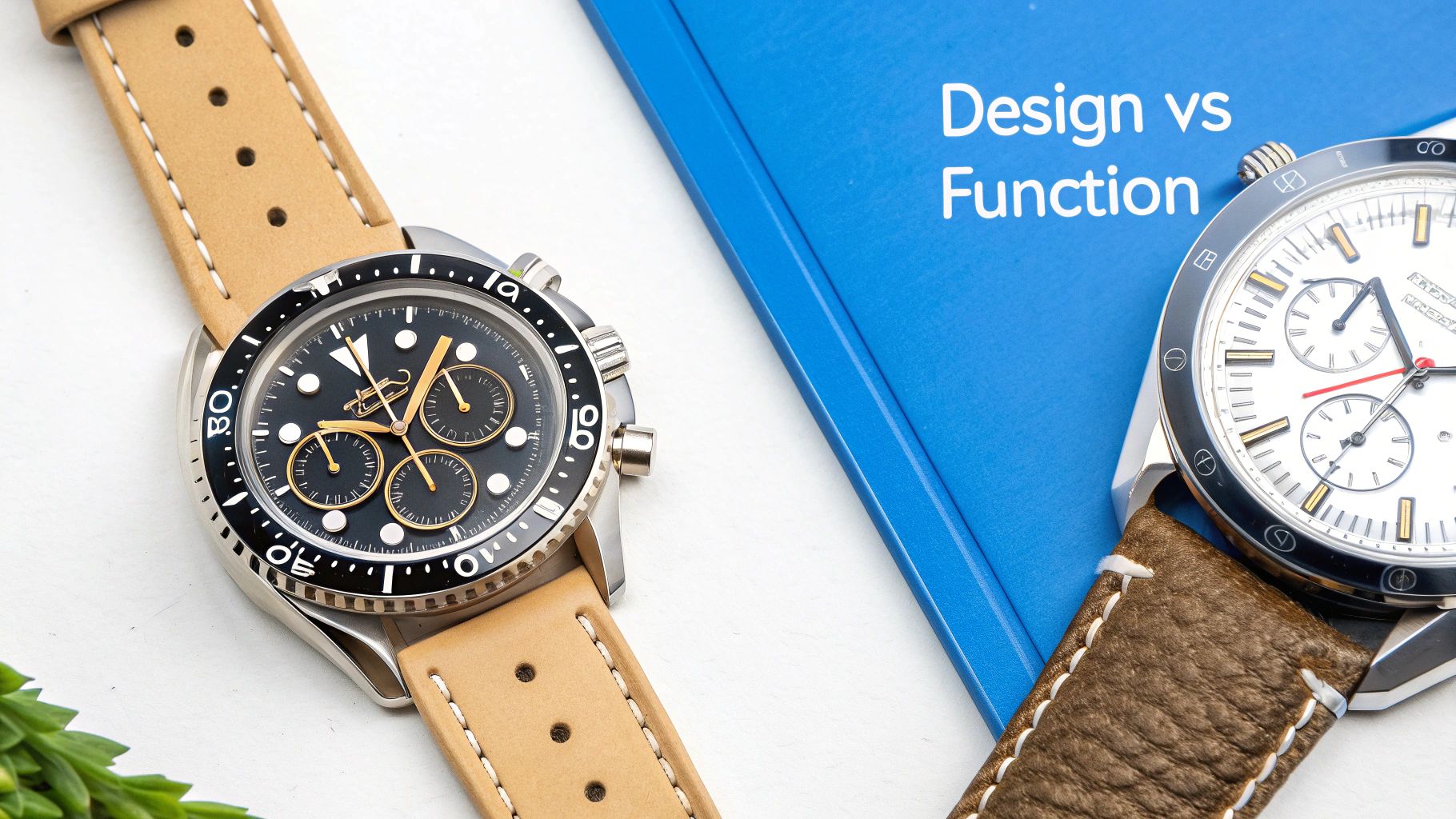
This is where the Omega Seamaster vs Speedmaster debate really comes alive. You can immediately see what each watch was built for just by looking at it. One was engineered for the crushing pressures of the deep sea, the other for the precise timing of a race track.
The Seamaster, especially the fan-favorite Diver 300M, screams "dive watch" from a mile away. Its design is bold, functional, and purpose-built for working below the waves. The first thing you'll notice is that unidirectional rotating bezel, usually a gleaming piece of polished ceramic with a 60-minute dive scale. For a diver, that’s not just for looks—it’s a critical tool for timing your oxygen.
Legibility is everything underwater, so the Seamaster's dial is designed to be read in a flash, even in murky conditions. It has massive applied hour markers and broad, skeletonized hands packed with Super-LumiNova. One quick glance is all you need, whether you're 100 meters deep or just in a dark movie theater.
The Diver's Functional Form
The Seamaster's case is just as rugged as its dial. It features Omega's classic twisted "lyre" lugs and a beefy crown guard, all designed to take a beating. Then there’s the helium escape valve at the 10 o'clock position—a feature that divides opinions but gives the Seamaster its unmistakable tool-watch vibe. While most wearers will never need it, it’s a nod to its professional saturation-diving credentials.
The end result is a watch that feels modern, capable, and strong. The mix of polished and brushed finishes, that colorful ceramic bezel, and the signature wave-pattern dial make it sporty, yet surprisingly refined.
The Seamaster is designed from the outside in. Every external feature—from the grippy bezel to the helium escape valve—is a direct response to the demands of a harsh aquatic environment, shaping its bold, tool-watch appearance.
On the other side of the coin, the Speedmaster Professional "Moonwatch" is a study in pure, functional design. It was born as a racing chronograph, and its look is all about one thing: measuring elapsed time with absolute clarity.
The Chronograph's Timeless Layout
The Speedmaster’s calling card is its fixed tachymeter bezel. Instead of timing dives like the Seamaster, this scale is for calculating speed over a known distance—a direct callback to its motorsport roots. That bezel frames a dial that is the definition of legibility, with a clean, matte black finish to cut down on glare.
The dial layout is perfectly balanced with its three recessed subdials: a 30-minute counter, a 12-hour counter, and a small running seconds hand. Matched with simple white baton hands and stick markers, the whole setup lets you read the time and the chronograph instantly. It’s a design so perfect that it’s barely changed in over 50 years. You can see this iconic layout up close on the Speedmaster Professional Moonwatch listing.
Its case is more utilitarian, featuring an asymmetrical design with crown guards that protect the start/stop pushers from accidental knocks. The Speedmaster's appeal is in its no-nonsense simplicity. It's a tool stripped down to its essential purpose, giving it a versatile look that’s just as at home with a t-shirt as it is with a flight suit.
Analyzing Movements and Technical Capabilities

At the heart of the Omega Seamaster vs Speedmaster comparison is a deep split in engineering philosophy. One is a high-tech, self-winding machine built for modern life and extreme conditions. The other is a manually wound icon that celebrates the purity of mechanical interaction and its own incredible history.
The modern Seamaster Diver 300M is where you see Omega’s forward-thinking watchmaking on full display. It runs on a Co-Axial Master Chronometer movement, like the Caliber 8800. This isn't just a standard automatic movement; it's a technical powerhouse designed to shrug off pretty much anything you can throw at it.
Its biggest party trick is its incredible resistance to magnetism. Certified by METAS, it can handle magnetic fields up to 15,000 gauss—a level that would bring most other mechanical watches to a dead stop. For you, this means your watch stays dead-on accurate even when surrounded by laptops, speakers, and all the other magnetic fields we live with today.
The Seamaster's Set-and-Forget Reliability
The Seamaster movement is all about "set-it-and-forget-it" ease. Its automatic winding mechanism means that as long as you're wearing it, the watch keeps running, backed by a solid 55-hour power reserve. It’s a practical, low-maintenance approach for someone who wants a dependable luxury watch without the daily ritual of winding.
The Seamaster is the epitome of a modern, robust tool watch. Its automatic Co-Axial Master Chronometer movement is engineered for precision, anti-magnetic performance, and everyday convenience, making it a hassle-free companion.
This technical muscle is matched by its physical toughness. The Diver 300M absolutely lives up to its name with 300 meters of water resistance, making it a genuine piece of professional dive gear. This blend of an advanced automatic movement and serious water resistance defines the Seamaster as the go-anywhere, do-anything luxury sports watch.
The Speedmaster's Interactive Legacy
The classic Speedmaster Professional "Moonwatch," on the other hand, embraces a more traditional spirit. It’s famously powered by a manual-wind chronograph movement—today’s version is the Caliber 3861. This is a direct descendant of the movement NASA flight-qualified for all manned space missions, and that legacy is a massive part of its appeal.
Winding the Speedmaster by hand every morning creates a real, tangible connection between you and the intricate machine on your wrist. It's a daily ritual that watch lovers cherish, a nod to the watch's storied past. If you're curious about what's happening inside, our guide explains in detail how a mechanical watch works.
The Caliber 3861 is also a Master Chronometer, so it shares the Seamaster’s impressive anti-magnetic shield. Its core purpose, however, is the chronograph, built for precision timing.
Functionally, this creates a very clear trade-off:
- Seamaster: Superior water resistance (300m vs. 50m).
- Speedmaster: Sophisticated chronograph complication for timing events.
The Speedmaster's modest 50-meter water resistance means it's fine with splashes and rain but isn't meant for a swim. This single spec perfectly illustrates their distinct jobs: one was built to explore the depths of the ocean, while the other was engineered to measure moments in time with historical precision.
Understanding Price and Investment Potential
Let’s talk money. Beyond the sheer joy of strapping a luxury watch to your wrist, both the Omega Seamaster and Speedmaster are serious financial commitments. Whether you’re looking for a lifelong companion or a potential future asset, you need to understand where they sit in the market.
Generally, the Seamaster collection offers a more approachable entry point. You can often pick up a classic Seamaster Diver 300M in steel for less than the iconic Speedmaster Professional "Moonwatch." This makes the Seamaster a fantastic first luxury watch, giving you a ton of value with its advanced Co-Axial Master Chronometer movement and tough-as-nails build.
When it comes to holding its value long-term, however, the Speedmaster usually has a slight edge. This is especially true for the classic Moonwatch references. Its history is so unique that it’s created a stable, passionate collector base that helps protect it from the ups and downs of the market.
Factors Influencing Cost and Value
The price tag on any Seamaster or Speedmaster can swing wildly based on a few key things. It’s not as simple as one line being cheaper than the other.
- Materials: This is a big one. Models in precious metals like gold or platinum, or those with ceramic or titanium cases, are going to cost significantly more than the standard stainless steel versions.
- Complications: The Speedmaster’s chronograph is its signature, but when you add other features like a moonphase or a GMT function, the complexity—and the cost—goes up. The same goes for Seamaster models with more advanced mechanics.
- Special and Limited Editions: Both families are packed with special editions. Think James Bond 007 Seamasters or the "Snoopy" award Speedmasters. They’re made in smaller batches and often go up in value because they’re rare and have a great story behind them.
If you're looking at these watches as an investment, the Speedmaster Professional is often considered the blue-chip stock of the two. Its design has barely changed, and its direct link to space exploration creates a steady demand that keeps secondary market prices strong.
Looking back, you can really see how these Omega models have grown into collectibles. A Seamaster from the early 2000s might have retailed for around $2,500, but a similar model today will set you back $4,000 to $6,000 or more. Both the Seamaster and Speedmaster tend to hold 60% to 80% of their retail value over several years, and some vintage or special editions do much better, even appreciating. You can dig into historical pricing trends from collectors to see just how much they’ve climbed.
So, in the Omega Seamaster vs Speedmaster debate for investment, the Speedy’s path is usually more stable and predictable. The Seamaster is still an excellent store of value, but its huge variety of styles means resale performance can differ a lot between sub-collections. No matter which you choose, the key is to go for iconic references and find a piece that’s been well taken care of.
Which Omega Belongs on Your Wrist
When you’ve boiled down the history, design, and technical specs, it all comes down to a single question: what do you really want this watch for? The final decision in the omega seamaster vs speedmaster debate is deeply personal. It’s about what fits your daily life, your style, and what you truly value in a fine timepiece.
Are you looking for a tough, versatile companion that can go from a client meeting to a weekend on the boat without skipping a beat? If that’s you, the Seamaster is your answer. Its automatic movement is pure convenience—just set it and forget it—while that serious water resistance gives you genuine peace of mind.
Or maybe you’re someone who appreciates a physical connection to watchmaking history, who enjoys the daily ritual of interacting with a mechanical masterpiece. The Speedmaster was made for you. Its manual-wind movement and iconic chronograph are for the purist, the enthusiast who puts legacy and precision above simple practicality.
Your Lifestyle, Your Omega
To make the choice even clearer, think about these two owner profiles. Each one prioritizes something different, which should point you toward the watch that’s truly the right fit.
- The Everyday Professional: This person needs a watch that is durable, reliable, and sharp enough to work in both professional and casual environments. The Seamaster Diver 300M is the perfect match here, offering the ease of an automatic movement with a modern, confident look.
- The Horology Enthusiast: This buyer is fascinated by the inner workings of mechanical movements, the stories behind them, and truly iconic designs. For them, the classic Speedmaster Professional "Moonwatch" is the ultimate grail—it’s a direct link to one of humanity's greatest achievements.
This decision tree helps visualize whether your main goal is adding an icon to your collection or finding a reliable daily partner.

As the infographic lays out, the path really splits depending on whether you prioritize collectible heritage or versatile daily function.
Ultimately, the Seamaster answers the question, "What can this watch do for me?" while the Speedmaster answers, "What story does this watch tell?"
Choosing between them isn't about which one is better, but which one is better for you. One represents the peak of modern performance and versatility; the other embodies a timeless design and a legendary narrative. Your wrist, your story.
Answering Your Key Questions
When you're weighing the Omega Seamaster vs. Speedmaster, a few practical questions almost always come up. These are the details that often tip the scales, moving you from admiring two icons to choosing one for your wrist.
Can You Swim With an Omega Speedmaster?
This is a big one. The classic Speedmaster Professional "Moonwatch" is rated for 50 meters of water resistance. That might sound deep, but in the watch world, it really just means it can handle splashes, getting caught in the rain, or a quick, accidental dip. You absolutely should not swim or dive with it.
If water is part of your life, the Seamaster Diver 300M is the only answer here. With a serious 300-meter water resistance rating, a screw-down crown, and a helium escape valve, it's built for the ocean. If you need a watch that can get wet, the choice is already made for you.
Is a Manual-Wind Watch Practical for Daily Wear?
Many people new to the Speedmaster get hung up on the idea of winding their watch every day. Honestly, it comes down to personal preference. For a lot of watch lovers, that daily ritual of winding the Caliber 3861 is a cherished moment—a two-minute connection with a piece of mechanical history.
But if you’re a "set-it-and-forget-it" kind of person, the Seamaster’s automatic movement is undeniably more convenient for a hectic lifestyle. It’s designed for modern ease of use, whereas the Speedmaster is a nod to a more traditional, hands-on era of watchmaking.
Which Model Holds Its Value Better?
Both the Seamaster and Speedmaster are fantastic investments that hold their value well, but the iconic Speedmaster Professional typically has a slight advantage on the pre-owned market. Why? Its design has remained largely unchanged for decades, and its singular history creates a steady, predictable demand from collectors. That consistency helps keep its resale price strong.
The Seamaster line is amazing, but its sheer variety can sometimes dilute collector focus. The Speedmaster Moonwatch, on the other hand, is a single, legendary reference point. This gives it a more stable and often stronger performance as a long-term asset.
Is the Seamaster Too Sporty for Formal Occasions?
Not in the slightest. While the Seamaster Diver 300M is a true tool watch at heart, it cleans up incredibly well. The mix of polished and brushed finishes on the case, the glossy ceramic bezel, and the refined wave dial give it a sophisticated edge. On its steel bracelet, it slides under a shirt cuff with ease and looks perfectly sharp with a business suit, making it a master of both sport and style.
At ECI Jewelers, we appreciate the unique stories behind every Omega. Whether you're drawn to the legendary heritage of a Speedmaster or the go-anywhere capability of a Seamaster, our curated collection has some of the finest authenticated examples available. Come explore our inventory and find the watch that speaks to you at https://www.ecijewelers.com.


