


The Rolex 16800 for sale is a transitional Submariner Date made roughly from 1979 to 1988, and the big upgrades are sapphire crystal, 300-meter water resistance, and a quick-set date. Two examples can look and price very differently because early watches usually have matte dials, while later ones switch to glossy dials with applied markers. If you're looking at one now, you need to judge the dial, serial, service history, and originality, not just the reference number.
That's the difference between a smart buy and an overpaid one. We're going to break down why the 16800 matters, what the dial change means, what the market is doing, and what to verify before you hand over cash.
Why the Rolex 16800 Is Worth a Closer Look
The Rolex Submariner Date 16800 sits right between the older 1680 and the later five-digit Submariner family, which is why collectors keep circling back to it. It has the old-school 40 mm Submariner stance, but it adds the practical improvements that made later Submariners easier to live with. If you want vintage character without giving up modern usability, this is one of the cleanest places to land.
What makes it a transition reference
The 16800 isn't just another old Rolex. It marks a real change in how the Submariner was built and worn, and that's why listings can vary so much from one watch to the next. Early examples still feel very close to the 1680 era, while later ones start looking like the Submariner most buyers recognize today.
Practical rule: judge a 16800 by its actual build, not by the reference alone.
That matters because buyers shopping a Rolex 16800 for sale often assume all examples are interchangeable. They're not. One may be a more vintage-looking matte-dial watch, while another may be a later glossy-dial example with a far different feel on the wrist.
We also like this internal primer on older Rolex buying habits, because the same caution applies here: vintage Rolex watches.
What this guide focuses on
We're going to look at the reference's place in Submariner history, the matte-versus-glossy split, and why serial ranges matter. We'll also talk about pricing, red flags, and why box and papers are helpful but not enough on their own. If you're comparing listings, that's the right order to do it in.
The Reference 16800's Place in Submariner History
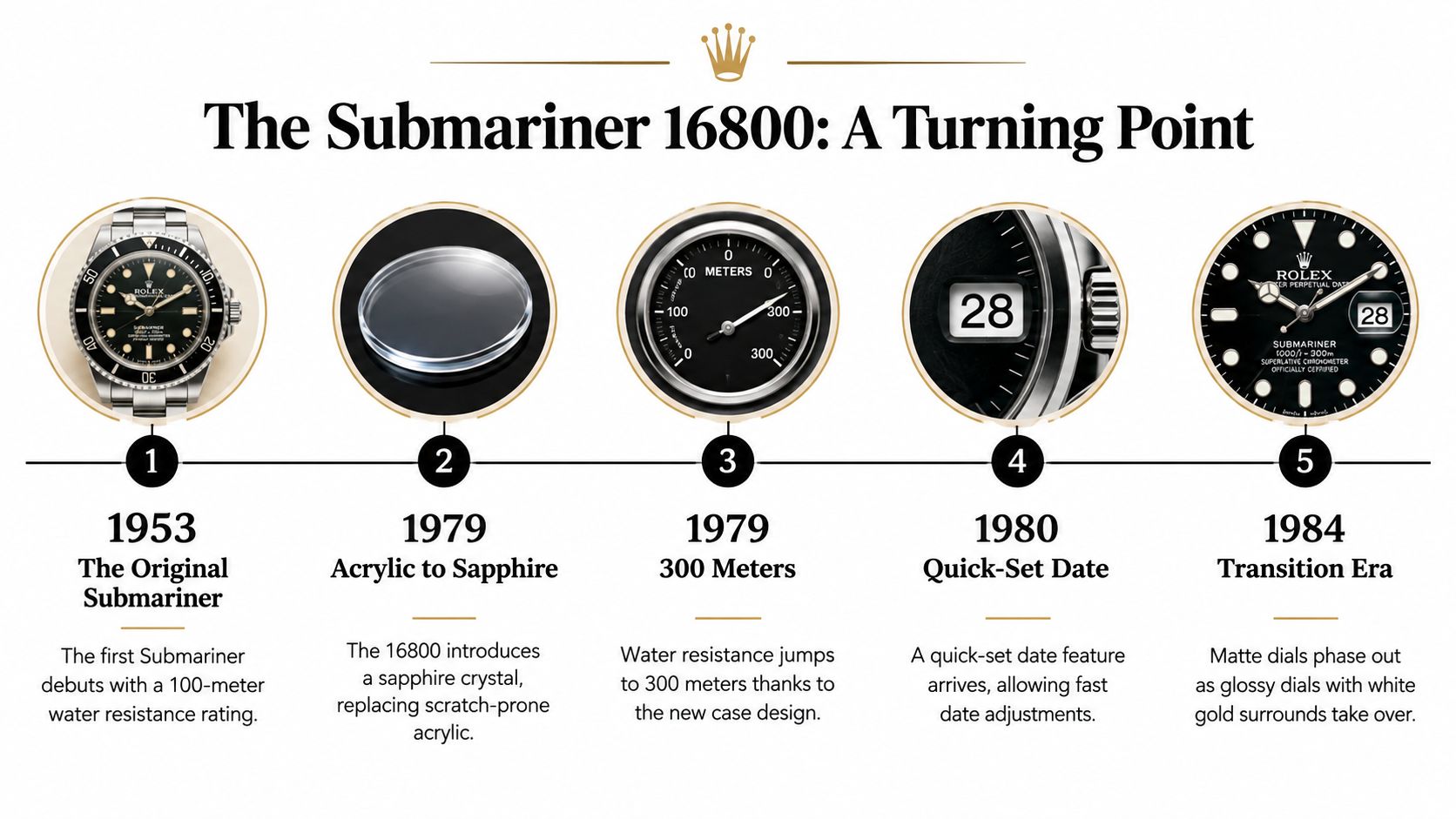
The 16800 brought three changes that still matter to buyers today, sapphire crystal, 300-meter water resistance, and Rolex caliber 3035 with a quick-set date. In plain English, that means a tougher crystal, deeper-rated construction, and faster date-setting than the older generation. It also uses a unidirectional bezel, which is safer for diving because it won't rotate the wrong way and make remaining bottom time look longer than it is.
Why those upgrades matter now
A lot of people look at the 16800 as “just” a vintage Submariner with a date. That undersells it. The sapphire crystal and water-resistance upgrade make it more practical for regular wear, while the quick-set date is one of those features you appreciate immediately once you've used it.
The 16800 is also historically important because it bridges two eras. The reference still belongs to the tritium and 40 mm Submariner world, but it starts moving toward the more modern construction that came after it. For buyers, that means you're not shopping a fully vintage watch or a fully modern one. You're shopping a crossover piece.
A transitional Rolex only makes sense if you understand what changed mid-run. The 16800 is exactly that kind of watch.
What to verify on any example
Check that the watch shows the era it claims to be from. Look at the crystal, the bezel action, the date function, and the dial style. Then compare those details with the stated production period, because this reference doesn't wear one uniform look for the whole run.
For more context on the broader Submariner story, this brand overview is useful: the Rolex Submariner as a dive watch legacy piece.
Matte Versus Glossy Dials and What Serial Numbers Reveal
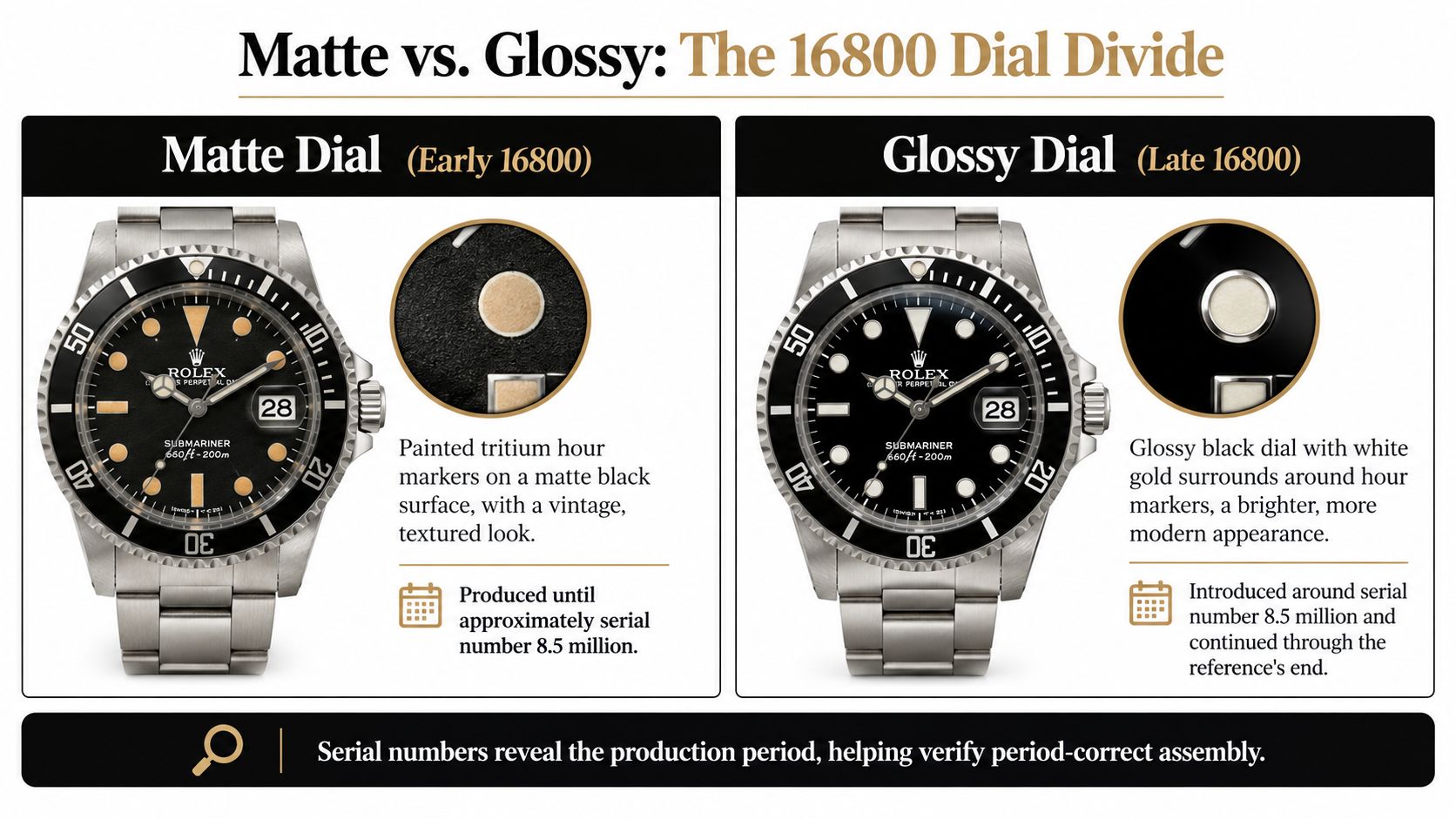
This is the part buyers miss most often. The 16800 changed from matte black dials with painted tritium markers to glossy dials with applied markers surrounded by white gold, and that swap changes both the look and the collector feel. Early watches are more clearly vintage in character. Later watches lean more polished and modern.
How serial ranges help you sort listings
Collector references place early production predominantly below about serial 8.4 million and later production predominantly above about 8.6 million, with both dial styles appearing in the middle range. That means a seller can't always rely on the serial alone to tell the whole story. You still have to inspect the dial finish, marker style, and hands together.
A useful reference point is the production-year guide here: Rolex serial numbers and production year.
What each version tells a buyer
- Matte dial examples: These usually feel closest to the older 1680 family and appeal to buyers who want the tool-watch look.
- Glossy dial examples: These are the later aesthetic and have more visual shine, which some buyers prefer for daily wear.
- Middle-range serials: These need the closest inspection, because both dial styles can appear there.
| Dial type | What you see | Typical collector appeal |
|---|---|---|
| Matte | Flat black surface, painted tritium markers | More vintage, more utilitarian |
| Glossy | Reflective black surface, applied markers with white gold surrounds | More polished, more modern |
The key point is simple. Two watches can both be correct 16800s and still feel like different references in the hand. If you care about collecting, don't shop by reference alone. Shop by serial, dial, and originality together.
What a Rolex 16800 Actually Costs in Today's Market
Pricing on the 16800 is uneven because the watch is not one fixed spec. One market tracker reports a median hammer price near $10,562 for comparable examples, with results from about $8,300 to $26,701 The Chrono Edit. That spread tells you exactly what matters here, provenance, originality, rarity, and condition.
Why one listing can be thousands apart from another
A clean dial, matching hands, honest case lines, and correct bracelet details can push a watch much higher than a tired example. A replacement dial or heavy polishing can pull it down fast. Box and papers can help, but they don't rescue a watch with weak components or a rough service history.
For a wider market lens, this price-trend overview is worth reading: Rolex price trends and what's hot or cooling.
What drives value most
| Factor | What it means | Price impact |
|---|---|---|
| Dial type | Matte or glossy, original or replaced | Can shift buyer demand sharply |
| Service history | Documented work versus unknown maintenance | Strong records support confidence |
| Bracelet condition | Stretch, reference, and originality | Better condition usually commands more |
| Case condition | Sharp lines versus heavy polishing | Better shape usually brings a premium |
| Box and papers | Matching paperwork and accessories | Helpful, but not enough by itself |
A cheaper watch can become the more expensive one after you pay for missing parts, service, or correction work. That's why we don't advise chasing the lowest tag. We advise chasing the cleanest example you can verify.
Authentication, Red Flags, and Why Box and Papers Aren't Enough
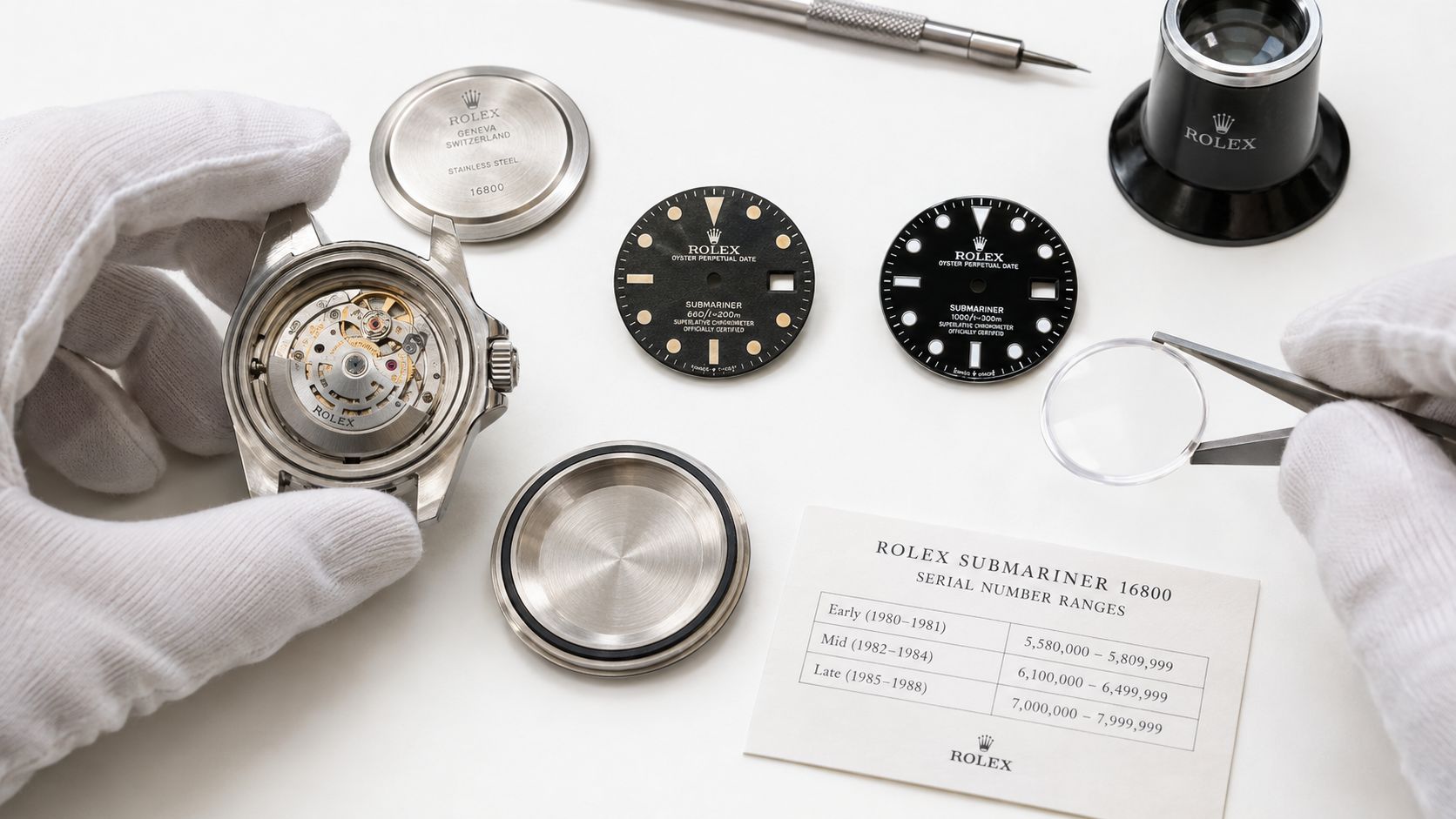
A genuine 16800 can still be a bad buy. That's the hard truth. Replacement parts, relumed dials, refinished cases, swapped bezels, and undocumented service work can all change what you're getting, even if the watch is authentic at the brand level.
What you should verify before paying
- Reference and serial match: The case details should line up with the watch in front of you.
- Component originality: Ask which parts are original, which are service replacements, and which are unknown.
- Pressure-testing status: You want a clear answer, not a vague claim.
- Last overhaul date: A recent service record matters more than a sales pitch.
- Bracelet reference and stretch: Bracelet wear affects both comfort and value.
- Dial and hands history: These parts can be the difference between collectible and merely usable.
- Box and papers: Make sure they belong to the watch, not just the same reference.
If you want a smart explanation of why third-party watch sales need extra caution, this is a useful read: what a third-party sale really means.
Buy the watch, not the paperwork. Papers can support value, but they can't tell you whether the case was polished hard or the dial was changed later.
The best buying question is not “Is it real?” It's “Is this a historically correct collectible, or a genuine Rolex assembled with later components?” That distinction decides whether you're paying collector money or just pre-owned Rolex money. For box-and-papers context, this note is worth a look: what box and papers really mean.
Red flags that should stop the deal
- Inconsistent dial and serial: The look doesn't fit the claimed period.
- Vague service answers: The seller can't say who serviced it or when.
- Overly polished case: The shape looks soft, not sharp.
- Loose bracelet: Heavy stretch often means heavy wear.
- Paperwork mismatch: The documents don't clearly correspond to the watch.
If any of those show up, pause. A clean, honest example is better than a glossy listing with weak answers.
Where and How to Buy a Rolex 16800 With Confidence
Your best path depends on how much certainty you want. A strong pre-owned specialist gives you the most efficient route if you want a watch that has already been inspected closely. Auctions can surface better examples, but you need discipline and a hard ceiling. Private sellers can be fine, but the risk sits with you.
Comparing the common buying paths
- Pre-owned specialist: Usually the best balance of selection and verification.
- Auction: Good for finding unusual examples, but condition can vary widely.
- Private seller: Can offer value, but it demands the most caution and the clearest documentation.
If you're buying in person in New York City, seeing the watch on the wrist beats staring at a few photos. Ask for sharp shots of the dial, case sides, caseback, clasp, serial area, and any paperwork. If you're buying remotely, ask for a written description that covers condition, service history, and included accessories.
We're a New York City Diamond District jeweler with more than 25 years in pre-owned luxury watches, and we know how much easier this process gets when the answers are clear. That said, the watch still has to speak for itself. No dealer can make a rough 16800 into a collectible one.
Questions to send any seller
- Can you confirm the dial type and whether it's original to the watch?
- What service records do you have, and when was the last overhaul?
- Has the case been polished?
- What is the bracelet reference, and how much stretch is there?
- Do the box and papers match this exact watch?
Those questions cut through the noise fast. The seller who answers them cleanly is usually the one worth dealing with.
Financing, Trade-Ins, and Your Next Steps
If you find the right 16800, don't rush the structure around the deal. Financing can help, and so can a trade-in if you already own another luxury watch. ECI Jewelers offers financing through Affirm, Synchrony, Acima, and Snap Finance, with approval and terms set by each provider, through flexible financing and leasing options.
How to think about the next move
A good purchase starts with the watch, then the paperwork, then the payment plan. If the watch checks out, you can decide whether to finance part of it or offset the purchase with a trade-in. That keeps the focus where it belongs, on the example itself.
Watch customers can also trade in a luxury watch through sell your luxury watch. That's useful if you're moving from a modern piece into a transitional Submariner like the 16800.
Practical next steps
- Compare dial type and serial range first.
- Ask for service records and bracelet details.
- Verify what's original and what's been replaced.
- Decide whether financing or a trade-in makes sense.
- Review the current listing carefully before committing.
If you want a Submariner that sits between vintage charm and daily-wear practicality, the 16800 is a serious target. The right one is worth the work.
If you're ready to compare a Rolex 16800 against other pre-owned luxury watches, visit ECI Jewelers and speak with us about current inventory, service history, and trade-in options. We'll help you sort out whether a watch is collectible, modified, or somewhere in between, so you can buy with clear eyes.


