


A vintage Rolex is so much more than just an old watch. Think of it as a historical artifact, a snapshot from a completely different era of watchmaking. Generally, a true vintage piece is one made before the mid-1980s, defined by tell-tale features like the warm glow of an acrylic crystal or lume that has aged into a beautiful, creamy patina.
What Defines a True Vintage Rolex
When collectors get excited about a "vintage" Rolex, they're not just talking about its age. It’s like the difference between an old, used car and a genuine classic car. The classic is prized for its original design, the specific materials used, and the unique feeling it gives you—all things that were engineered out of later models. The same idea applies perfectly to watches.
A genuine vintage Rolex is a time capsule. It was made with materials and techniques that simply don't exist anymore. These aren't seen as flaws or outdated quirks; they're the fingerprints of history that tell the watch's story.
The Key Markers of a Vintage Rolex
There are a few clear physical traits that draw the line between vintage and modern. These are the details that serious enthusiasts hunt for as signs of originality and authenticity.
- Acrylic Crystal: Long before Rolex switched over to scratch-resistant sapphire, their watches were fitted with domed acrylic (Plexiglas) crystals. This material gives the dial a visual warmth and a cool distortion around the edges that you just don't get with modern sapphire.
- Tritium Lume: The glowing material on the hands and hour markers before the mid-1990s was tritium. Over many decades, this radioactive compound ages gracefully, developing a creamy, yellow, or even deep pumpkin-colored patina that collectors go crazy for.
- Matte Dials: Many of the most iconic vintage sports models had matte black dials with printed text, which gave them a rugged, no-nonsense tool-watch vibe. This is a world away from the glossy dials with applied markers that became the standard later on.
- Lug Holes: If you look at the side of an older Rolex case, you'll see holes drilled all the way through the lugs. This was a practical feature for holding the bracelet's spring bars in place, but it was phased out in the early 2000s for a sleeker look.
A vintage watch isn't just about its age; it’s about the soul captured in its original components. Each scratch on an acrylic crystal or faded tone on a dial is a chapter in its unique history, making it irreplaceable.
Getting to know these features is the first step in appreciating what makes vintage Rolex collecting so special. These little details do more than just help date a watch; they determine its originality and how desirable it is on the market.
To get even deeper, our guide to Rolex serial and reference numbers can help you connect these features to specific production years. Every single element adds to the watch's character, turning it from a simple time-teller into a real piece of history on your wrist.
Exploring the Most Iconic Vintage Rolex Models
Jumping into the world of vintage Rolex is a bit like walking through a horological hall of fame. Some watches were built as tools, sure, but they’ve since become cultural icons, recognized on wrists from boardrooms to movie sets. These aren't just gears and steel; they're time capsules, each one carrying the story of the era it represents.
To really get into collecting, you have to know the legends. Each one has a story, whether it's tied to deep-sea adventures, the golden age of air travel, or the high-octane world of motorsports. Let's break down the icons that built the Rolex legacy.
The Submariner: The Original Dive Watch Legend
You can't talk vintage Rolex without starting with the Submariner. Born in the 1950s as a no-nonsense tool for professional divers, it literally set the standard for every dive watch that came after. For collectors, a couple of references really stand out.
- Reference 5513: Made for an incredibly long run (from 1962 to 1989), the 5513 is the quintessential "no-date" Sub. Its clean, balanced dial is a masterclass in function-first design. The earliest versions with glossy gilt dials? Those are the real grails.
- Reference 1680: This was the first Submariner to add a date window, introduced in the late 1960s. The ones everyone chases are the "Red Subs," named for the single line of red text on the dial. It's a tiny detail that makes a massive difference in what they're worth today.
This chart breaks down some of the physical tells that define these classic tool watches.
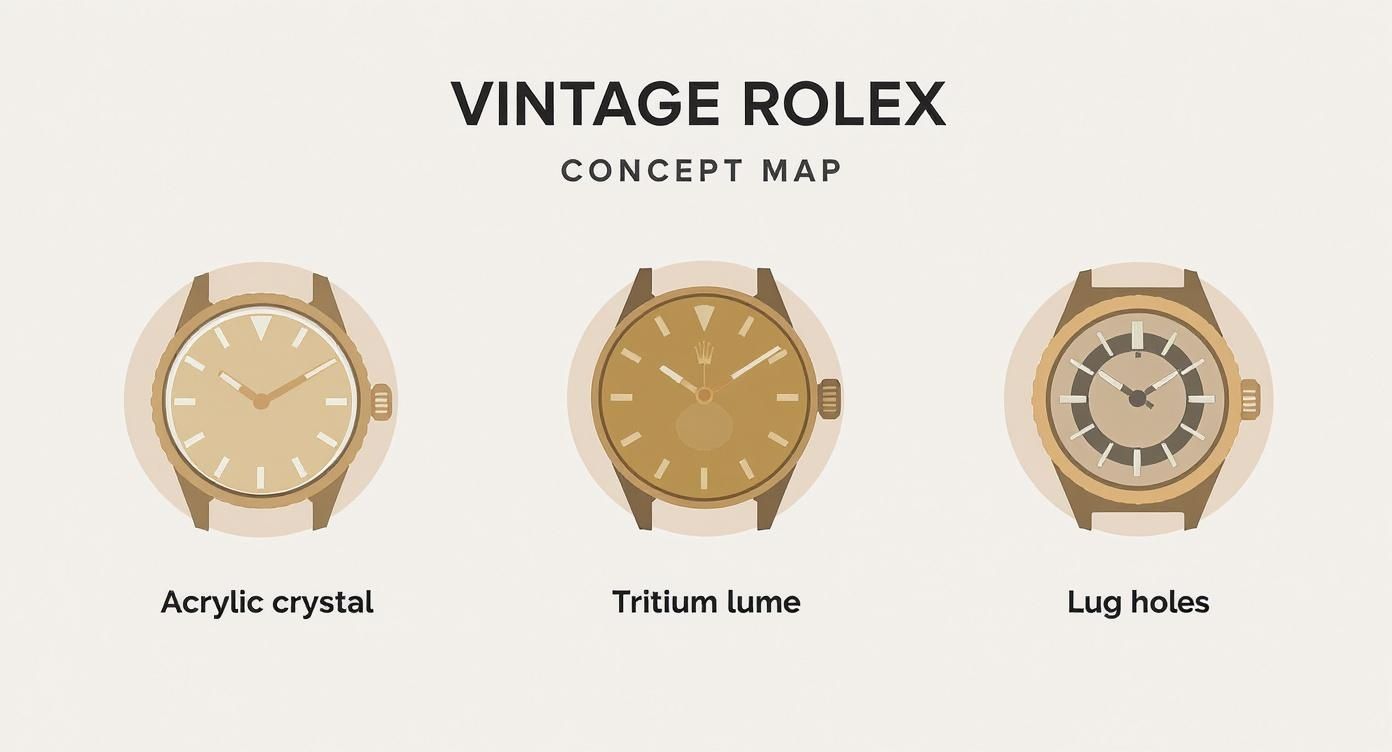
Those little things—the warm glow of an acrylic crystal, lume that has faded to a creamy patina, and the practicality of drilled lug holes—are the fingerprints of history that collectors are hunting for.
To give you a clearer picture, here’s a quick-glance table comparing some of the most sought-after vintage Rolex references.
Key Vintage Rolex Models and Their Defining Features
| Model | Iconic Reference(s) | Key Vintage Feature(s) | Approximate Era |
|---|---|---|---|
| Submariner | 5513, 1680 ("Red Sub") | No-date symmetry, early gilt dials, first date complication with red text | 1960s–1980s |
| GMT-Master | 1675 | "Pepsi" bezel, small GMT hand, pointed crown guards (early models) | 1959–1980 |
| Daytona | 6239, 6263 ("Paul Newman") | Manually-wound movement, exotic "Paul Newman" dial with block markers | 1960s–1980s |
| Datejust | 1601, 16013 | Pie-pan dial, acrylic crystal, classic fluted bezel in gold | 1960s–1980s |
This table is just a starting point, but it helps show what makes each of these models special in their own right. Each reference number tells a story and points to specific details that drive collectors wild.
The GMT-Master: The Jet-Setter’s Timepiece
Back when intercontinental travel was becoming a glamorous reality in the 1950s, Pan American Airways asked Rolex for a watch their pilots could use to track multiple time zones. Rolex delivered the GMT-Master, and it's been the unofficial watch of adventure and travel ever since.
The undisputed king of vintage GMTs is the Reference 1675. Produced from 1959 all the way to 1980, its claim to fame is that vibrant blue and red "Pepsi" bezel. That simple, functional bezel became a design icon. Over its two-decade run, the 1675 saw countless small tweaks to its dial, hands, and case, creating a playground of variations for collectors to obsess over.
The Daytona: The Ultimate Racing Chronograph
While the Submariner owned the ocean and the GMT-Master ruled the skies, the Cosmograph Daytona was built for the racetrack. Interestingly, the early, manually-wound Daytonas weren't a big hit at first. Their fortunes turned around completely, thanks in large part to a certain blue-eyed actor.
The "Paul Newman" Daytona isn't a separate model, but a nickname for specific exotic dials found on references like the 6239 and 6263. These dials had a cool, Art Deco-style font in the sub-dials. Once Paul Newman was famously spotted wearing one, its cool-factor shot through the roof, transforming it into one of the most valuable and sought-after vintage Rolex watches on the planet.
The "Paul Newman" Daytona is a perfect example of how provenance and pop culture can elevate a watch from a simple timepiece to a legendary artifact. Its story is as important as its mechanics.
The Datejust: The Timeless Classic
While the sports models get all the hype, the Datejust is the true backbone of Rolex. It's also a fantastic way to get into vintage ownership. When it launched in 1945, it was the first automatic watch to show the date in a little window on the dial. Its versatility is legendary; it looks just as right with a t-shirt as it does under a suit cuff.
The Datejust’s staying power is clearly reflected in its value. The model has seen an incredible 639% jump in average resale value, climbing from around $1,150 in 2010 to an estimated $8,500 by mid-2025. This growth, powered by classic two-tone references like the 16013 and 16233, proves its unwavering appeal. You can dig into more data on Rolex investment trends over at Business Insider.
Decoding the Value of a Vintage Rolex
So, why can one vintage Rolex Submariner command the price of a small house, while another one that looks almost identical sells for a fraction of that? The answer goes way beyond just the model name or how old it is. It's a fascinating mix of history, how well it's been preserved, and the story it tells.
To really get what makes a vintage Rolex valuable, you have to look past the shiny surface. Collectors and seasoned enthusiasts focus on three key pillars: rarity, condition, and provenance. Think of it like a classic car. Any 1960s Ferrari is a prize, but one with a rare factory engine, all its original paint, and a documented racing history? That's in another universe of value. The same exact logic applies here.
The Power of Rarity and Originality
Rarity is probably the easiest factor to understand. Some reference numbers were simply made in smaller batches. Others had quirky, experimental dials for a very short time, or even a manufacturing slip-up that's now a celebrated feature. A classic example is the "Red Submariner" Ref. 1680. That single line of red text on the dial can easily add tens of thousands to its value compared to the later all-white text versions.
But rarity isn’t just about how few were made. It's about originality. A true collector wants a watch that's as close as possible to the day it left the factory decades ago.
- Original Dial: A dial that has never been repainted, retouched, or "restored" is absolutely critical. The way its tritium lume has aged naturally is part of its soul.
- Unpolished Case: This one surprises people. While a perfectly shiny watch looks nice, serious collectors hunt for an unpolished case. Polishing literally grinds away metal, softening the sharp, crisp edges and chamfers that defined the watch's original design.
- Correct Parts: Everything has to match the period. The bezel insert, the crown, the bracelet, and the hands should all be correct for that specific reference number and production run.
The most valuable vintage Rolex is often not the one that looks newest, but the one that wears its age most honestly. An unpolished case with its original sharp edges tells a story of survival, a quality that can never be replicated once it's gone.
Condition Is King
Once you've established originality, the physical condition of those original parts becomes the next big hurdle. A watch's condition is a direct window into the life it's lived. Was it a trusty tool worn on a wrist for 40 years of hard work, or was it tucked away in a safe deposit box?
This is where tiny details make a huge difference. A flawless dial with zero moisture spots, scratches, or degradation is a massive value booster. Likewise, a bracelet with minimal "stretch"—the natural loosening between links over time—shows it was treated with care. A watch with a perfect, original dial but a heavily polished case and the wrong hands will always be worth far less than an honest, untouched example, even if that one shows a bit more wear and tear.
Provenance: The Story Behind the Watch
Provenance is the watch’s paper trail, its documented history. This is the magic ingredient that can turn a valuable watch into a legendary artifact. It’s the proof of where it’s been and who owned it.
The ultimate provenance package includes:
- Original Box and Papers: The warranty papers, stamped by the authorized dealer with the date of sale, are like the watch's birth certificate. Having the complete "box and papers" set can boost a watch's value by 20-30% or even more.
- Service Records: A stack of receipts from reputable watchmakers shows the watch was properly cared for and adds a layer of trust.
- Celebrity or Historical Connection: This is the jackpot. If a watch was owned by a famous actor, an astronaut, or a decorated military hero, its value can shoot into the stratosphere. The story becomes just as valuable as the timepiece itself.
Understanding these forces helps explain why these watches have seen such incredible growth. Looking at the data, you see a clear pattern of steady, long-term appreciation. Overall, average Rolex prices soared by over 550% from around $2,000 in 2010 to more than $13,400 in 2025, and models like the Explorer have seen a 357% jump. This is a powerful reminder of how heritage and hard assets work together. You can explore more detailed Rolex market data to see these trends for yourself.
How to Inspect a Vintage Watch Like a Pro
Jumping into the world of vintage Rolex without a trained eye can feel like walking through a minefield. It's an exciting hobby, but the market has its share of fakes, "frankenwatches" (watches cobbled together from non-original parts), and pieces that just haven't been cared for. Think of this as your practical checklist to inspect a watch with confidence and spot the red flags before making a costly mistake.
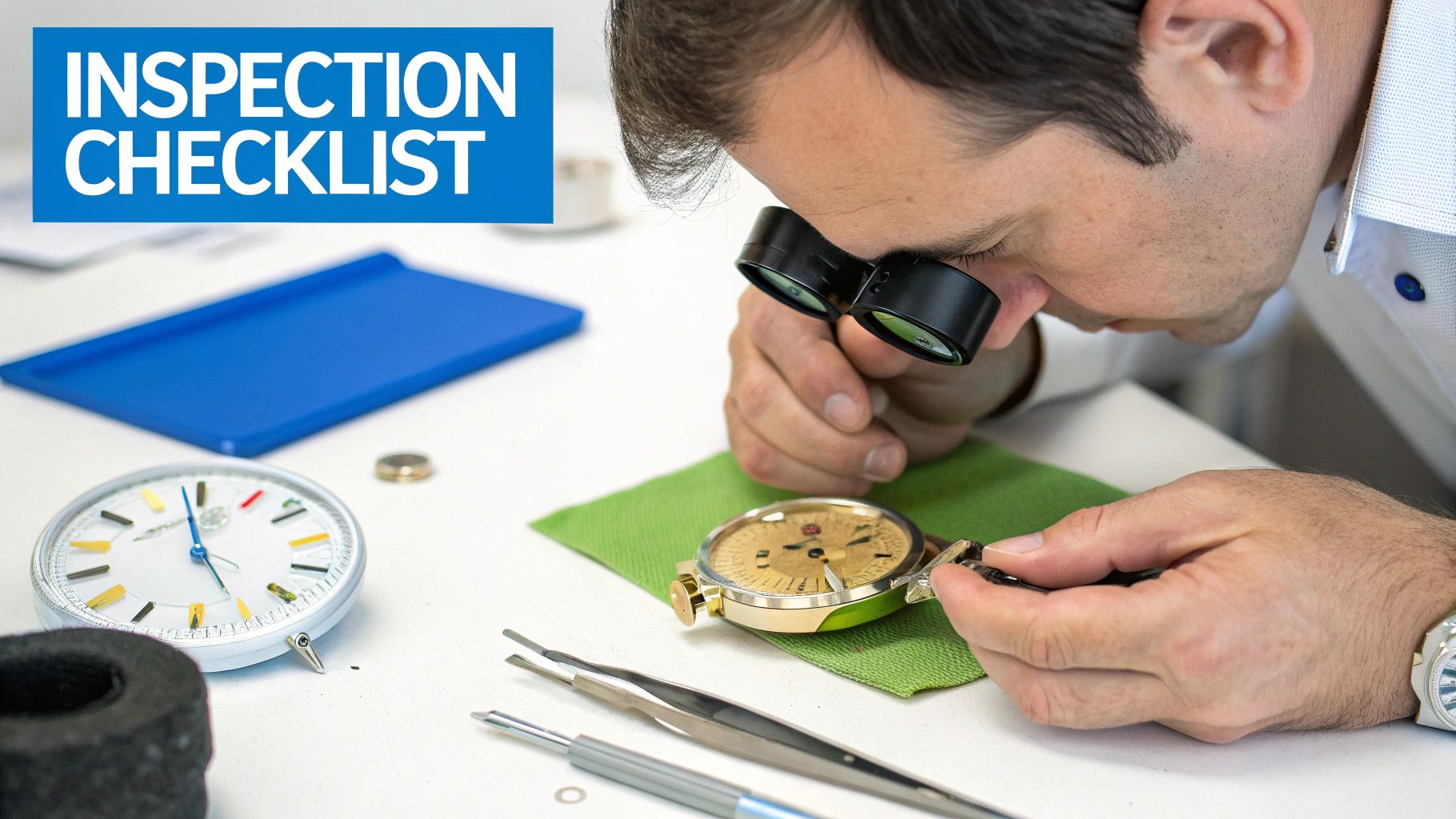
You have to become a detective examining a tiny, historical artifact. Every single detail, from the font on the dial to the sharpness of the case edges, tells a piece of the watch’s story. Your job is to make sure all those details are telling the same story.
Start with the Dial and Hands
The dial is the face of the watch, and it’s usually the first place you'll spot something fishy. You'll need a loupe (a small magnifying glass) to get a proper look.
- Check the Text: Rolex printing is famously perfect. You're looking for crisp, clean letters with zero smudging or weird spacing. Any fuzziness, especially around the coronet (the Rolex crown logo), is a huge red flag that the dial has been repainted.
- Examine the Lume: On a genuine vintage piece, the tritium lume on the dial plots and hands should have aged together, turning a matching creamy, yellow, or even pumpkin color. If the hands are bright white while the dial markers are yellowed, it’s a good bet the hands were replaced during a service.
- Look for Damage: Scan for any signs of moisture damage, like little spots or discoloration. This could point to a much deeper problem with the watch’s seals and overall integrity.
A pristine, original dial is the heart and soul of a vintage Rolex’s value. A bad repaint can slash its worth by more than 50%, so this first check is absolutely critical.
Evaluate the Case and Bezel
Next, turn your attention to the case. This is where you can see signs of over-polishing, a common sin that literally erases a watch’s original character—and its value.
An unpolished case still has its sharp, factory-finished lines and distinct chamfers (the angled edges on the lugs). Imagine the sharp fender lines on a classic car; polishing rounds them off, destroying the original design. A heavily polished watch will look soft and almost melted, losing the crisp shape it was meant to have.
There's a common saying among collectors: "You can always polish a watch, but you can never un-polish it." Preserving that original case geometry is everything when it comes to a vintage Rolex's desirability and price.
The bezel insert should also be correct for the period. For instance, a vintage Submariner bezel might have a beautiful, naturally faded "ghost" look to it. You need to make sure the fading looks even and doesn't show signs of being faked with chemicals.
Inspect the Bracelet and Engravings
The bracelet tells you a lot about the watch's life. A vintage Rolex bracelet will naturally have some "stretch," which is just the loosening of the links over many years. A little bit of stretch is totally expected and fine, but if it's sagging excessively, that's a sign of heavy, hard wear.
Most importantly, you have to check the numbers. A real Rolex has two crucial sets of engravings tucked away between the lugs (where the bracelet connects to the case):
- Reference Number (at 12 o'clock): This tells you the model (e.g., 5513 for a Submariner).
- Serial Number (at 6 o'clock): This is a unique number that helps you date the watch's production year.
These engravings should be sharp, deep, and precise, cut into the metal. Fakes often have shallow, acid-etched numbers that look sandy or faint under a loupe. Make sure the serial number lines up with the watch's supposed era—a quick online search can help you cross-reference it. A thorough authentication process is key, and for a deeper dive, you can learn more about how to authenticate a Rolex watch with our detailed guide. This step is absolutely non-negotiable for confirming a piece is legitimate.
Navigating the Market to Buy and Sell Safely
The vintage Rolex market is an exciting world, but let's be honest—it can also be a minefield. Knowing where to look and what questions to ask is the single most important skill you can develop. It’s what separates a dream purchase from a costly mistake, whether you’re hunting for your first grail watch or parting with a family heirloom.
Every buying channel comes with its own set of pros and cons. Your personal comfort level with risk, your budget, and how much you already know will guide you to the right place. Let's break down the landscape so you can start your search with confidence.
Where to Buy Vintage Rolex Watches
There’s no single "best" place to buy a vintage Rolex. It really depends on what you're looking for.
- Specialist Dealers: A reputable dealer is your safest bet, especially if you're new to the game. They offer curated collections, deep expertise, and stand behind what they sell with a guarantee of authenticity. Yes, you might pay a premium, but what you’re really buying is peace of mind.
- Auction Houses: Big names like Christie’s or Phillips are where you’ll find the rarest and most historically important pieces. It’s a thrilling environment, but it’s not for the faint of heart. The process can be intense, and the "buyer's premium" can easily add 20-25% on top of the final hammer price. This is typically territory for seasoned collectors.
- Online Marketplaces and Forums: Sites like Chrono24 and dedicated communities like The Rolex Forums connect you to a massive global inventory. You can find incredible deals, but the risk is dialed way up. Vetting the seller becomes your full-time job.
No matter where you're shopping, remember this golden rule: buy the seller, not just the watch. A seller with a long, verifiable history of happy customers is the best insurance policy you can have.
If you do decide to venture online, you have to be extra diligent. Think like a pro to protect yourself.
Vetting a Seller Like a Professional
When you can't meet the seller or hold the watch in your hands, you need a checklist. Never, ever skip these steps, no matter how tempting the deal looks.
- Request Specific Photos: Don't accept a few pretty glamour shots. Ask for clear, high-resolution pictures of everything: the engravings between the lugs, the movement (if they can safely open it), the clasp codes, and the dial from multiple angles. A legitimate seller won't hesitate.
- Verify Their Reputation: Take their username or business name and search for it on forums like The Rolex Forums. Look for years of transaction feedback. Positive reviews from other experienced collectors are worth their weight in gold.
- Understand the Return Policy: Ask this question directly: "What is your return policy if the watch isn't as described or my watchmaker finds an issue?" Any seller who doesn’t offer a reasonable inspection period (a few days at least) is waving a giant red flag.
Selling Your Vintage Timepiece
When it's time to sell, your goal is simple: get a fair price without the headache. The very first thing you should do is get a professional appraisal to find out what your watch is actually worth in the current market. Don't just guess based on online listings.
Once you have a solid valuation, you can decide where to sell. For a quick, safe, and efficient sale, going to a trusted dealer like ECI Jewelers is often the best route. You might get a little less than you would in a private sale, but you get paid immediately and completely avoid the risks of dealing with strangers, scammers, and shipping nightmares. It's a transparent and secure way to turn your prized watch into cash.
Keeping Your Vintage Timepiece Ticking
Owning one of these historical timepieces means you've become its custodian. A vintage Rolex requires a special kind of care, one that's focused more on preservation than restoration. Think of it less like a daily tool and more like conserving a piece of art.
The first rule is a big one: assume it's not waterproof. Even a legendary Submariner, after 50 years, has gaskets and seals that have aged and can no longer be trusted. Taking it for a swim is a risk you just don't want to take. Moisture can completely destroy an original dial and hands, erasing its value in an instant.
Preserving Originality During Service
When your watch needs service—usually every 5 to 7 years—finding the right watchmaker is everything. You need someone who gets the collector mindset, not just a technician looking to make it shiny and new.
A standard service might involve swapping out aged parts for modern replacements. On a vintage Rolex, that’s a disaster. The goal is always to keep as many original components as you possibly can.
The big debate in vintage watch care almost always comes down to polishing. A watchmaker's instinct might be to buff out every scratch, but doing so strips away precious metal and softens the case's sharp, original lines. It permanently diminishes its character and value, so always request that the case remains unpolished.
You should also insist on keeping the original dial, hands, and bezel, even if they show a little wear. That "flaw" is its story. A new, sterile service part can slash a watch’s value by thousands.
The Gentle Approach to Cleaning
Routine care is just as important for keeping your timepiece in good shape between services. For the most part, a soft, dry microfiber cloth is your best friend for gently wiping away fingerprints and dust.
If you’ve got more stubborn grime, especially on the bracelet, you have to be careful. Our comprehensive guide to cleaning your Rolex watch breaks down specific techniques that are safe for older models. Knowing how to do it right ensures you can maintain its beauty without compromising its delicate, vintage integrity.
Common Questions About Vintage Rolex Collecting
As you start exploring the incredible world of vintage Rolex, you'll naturally have questions. It’s a landscape filled with nuance—from telling different eras apart to understanding value and proper care. Getting these answers right is what builds the confidence to make a great buy.
Let's tackle some of the most common questions that come up for collectors, both new and seasoned. Think of this as your quick-start guide to clearing up those crucial details.
Is a 25 Year Old Rolex Considered Vintage?
This is a fantastic question and one that gets to the heart of how collectors categorize watches. Generally, a Rolex that’s around 25 to 30 years old is considered "neo-vintage." This popular category covers watches from the late 1980s through the early 2000s. They have a cool, slightly aged vibe but with more modern, durable components like sapphire crystals and glossy dials.
True vintage is usually reserved for watches made before the mid-1980s. These are the pieces that really tell a story, defined by features that have their own unique charm:
- Acrylic Crystals: These give the dial a certain warmth and distortion that collectors love.
- Matte Dials: They offer a rugged, no-nonsense tool-watch look.
- Tritium Lume: Over decades, the luminous material on the dial and hands ages to a beautiful, creamy patina.
Neo-vintage watches are a fantastic middle ground, offering a taste of vintage character with everyday usability. But for that truly classic, old-school feel, you have to go back to the earlier references.
Are Vintage Rolex Watches a Good Investment?
Many vintage Rolex models have certainly seen incredible growth in value over the years. That said, it’s always best to approach them as a passion first and an investment second. Unlike stocks or bonds, the vintage watch market isn't always liquid, and prices are heavily swayed by collector trends, rarity, and—most importantly—condition.
While historical performance has been strong for iconic references, future returns are never guaranteed. The most rewarding approach is to buy a watch you genuinely love to wear. Any appreciation in value should be considered a welcome bonus, not the primary goal.
Put it this way: your enjoyment of the watch is the guaranteed return on your investment. The financial side is subject to a complex market, so your best bet for acquiring a piece that holds its value is to do your homework and prioritize originality and condition above all else.
How Often Should I Service My Vintage Rolex?
A good rule of thumb for servicing a vintage Rolex is every 5 to 7 years. Of course, if you notice it’s losing time, or if the winding feels rough, don't wait—get it checked out sooner.
The single most important part of this is who you trust with the job. You absolutely must find a watchmaker who specializes in vintage watches and respects the collector’s mindset. A standard service center might be tempted to swap out original hands, dials, or bezels with modern service parts, which can absolutely crush the watch’s value and historical integrity.
Always be crystal clear with your watchmaker: do not polish the case, and save every single original part.
At ECI Jewelers, we understand the passion and precision required for collecting vintage timepieces. Whether you are looking to buy your first piece, sell a treasured heirloom, or find an expert to service your watch with the care it deserves, our team is here to help. Explore our curated collection of authenticated luxury watches at https://www.ecijewelers.com.


