


Most couples no longer choose identical wedding bands. In one 2023 survey, only 38% selected identical bands, while another report found that 62% of newly married U.S. couples wear non-matching bands, so the strongest his-and-hers sets usually share a motif, finish, or engraving rather than duplicate every detail. Mixed metals, different widths, and different comfort requirements can still create a coordinated pair. The right choice starts with daily wear, future sizing, and how each ring will sit on the hand, not with a photograph of two identical bands.
Do Wedding Bands Have to Match
His-and-hers wedding bands don't have to be identical. In fact, matching is increasingly a design language rather than a demand for uniformity. A trend summary reports 38% year-over-year growth in mixed-metal searches, while its survey data says only 38% of couples selected identical bands and another report states that 62% of newly married U.S. couples wear non-matching wedding bands (Love Wedding Bands).
That shift makes practical sense. One partner may prefer a slim polished gold band, while the other needs a wider, low-maintenance ring for hands-on work. One ring may need to sit beside an engagement ring, while the other must work alone beside a watch. Forcing both into the same width and metal can make the set look coordinated in a display case but uncomfortable in daily life.
Practical rule: Match one design element, then let each ring solve its wearer's needs.
Useful shared details include:
- Engraving: Use the same date, initials, phrase, or symbol inside both rings.
- Finish: Pair a polished women's band with a brushed men's band in the same metal family.
- Motif: Repeat a milgrain edge, beveled shoulder, hammered texture, or geometric groove.
- Color: Combine yellow gold and white gold while keeping the same stone detail or profile.
- Proportion: Choose different widths that look intentional together, rather than making both rings the same size.
Couples can also shop together without making the same choice. The ancient ring-exchange tradition eventually developed into coordinated couple sets, but paired bands as a common matching concept became widespread only in the late 20th century (Diamonds by UK). If you're weighing a traditional pair against separate choices, compare the practical differences between a bridal set and an engagement ring before deciding.
Choosing Metals and Finishes for Long-Term Wear
Metal choice affects more than color. It determines whether a jeweler can resize the ring later, how the surface will age, and what kind of maintenance the pair may need. A metal that resists scratches can still be the wrong choice if the wearer is likely to need a future size adjustment.
Platinum, 14K gold, and palladium are generally resizable. Titanium and tungsten are typically not resizable, so the initial fit needs to be highly certain (RingReel). Before buying, confirm the expected sizing window with the jeweler. That small step matters if finger size changes over the years.
Comparing common metals
| Metal | Resizable | Durability | Best For |
|---|---|---|---|
| Platinum | Yes | Excellent durability | Couples who want a dense, premium metal with future sizing flexibility |
| 14K gold | Yes | Durable for daily wear, with finish maintenance over time | Couples who want color choice, repairability, and broad design options |
| Palladium | Yes | Excellent durability | Wearers who want a durable, lighter-colored precious metal |
| Titanium | Typically no | High wear resistance | Wearers who are confident in their long-term size and want a lightweight alternative |
| Tungsten | No | High wear resistance | Wearers prioritizing hardness and a fixed fit over resizing flexibility |
Gold gives couples the widest design range. Yellow gold creates a warm traditional look, white gold offers a cooler appearance, and rose gold adds a distinct pink tone. The bands can use different gold colors while sharing a profile or engraving. Remember that white gold may need finish maintenance as its surface changes with wear.
Platinum and palladium suit couples who place a high value on durability and future serviceability. Titanium and tungsten can work well for a wearer who wants strong resistance to everyday wear, but their lack of resizing makes accurate measurement especially important. A common mistake is choosing a hard alternative metal because it seems practical, then discovering that a later fit change requires replacement rather than adjustment.
Finish is part of the maintenance plan
A high-polish surface reflects light and gives a clean formal appearance, but scratches can show clearly. Brushed and matte finishes soften the appearance of everyday marks, which can make them sensible for active wearers. Hammered finishes add texture and make each ring look less uniform, though the surface may require a more specialized refinish.
For a deeper comparison of trade-offs, use our guide to the best metals for wedding bands. The best coordinated pair may use the same metal family but different finishes, especially when one wearer prefers visible shine and the other wants a quieter surface.
Width and Comfort Fit Decisions
Width changes how a ring feels more than most couples expect. A band that looks balanced in a product photograph can feel tight, heavy, or intrusive once it covers more of the finger. Treat width as an ergonomic decision, then use style to refine the final choice.
A large retail analysis found that 2.5 mm was the most purchased width at 29.3% of sales. Women's bands clustered between 1.8 mm and 3.0 mm in 62% of purchases, while men's bands clustered between 4.0 mm and 5.5 mm in 57% of purchases, with 4.5 mm as the median men's width (JewelTrendPro). Those figures are useful starting points, not rules. Finger shape, engagement-ring pairing, work, and personal preference should decide the final width.
How to test a band properly
- Measure the exact finger. A ring finger on one hand may differ from the other, so don't rely on a measurement taken elsewhere.
- Try the final width. A narrow sample won't predict how an 8 mm band feels. Test the actual target width or a close sample.
- Check the knuckle. The ring should pass over the knuckle with gentle pressure, then rest at the base without pinching.
- Test it later in the day. Fingers can swell with heat and activity, so day-end sizing often gives a more useful fit check (Bonnie Jewelry).
- Move your hand normally. Make a fist, grip a handle, and place the hand flat. Spinning, pressure, and interference become obvious during movement.
Comfort-fit bands have an interior curve that reduces contact with the finger. They often feel about half a size larger than flat-fit bands, while a very wide band around 8 mm can feel tighter because it covers more of the finger (RingReel). Don't automatically size down a wide band. Test it instead.
The right pair may have different widths, but neither ring should need to be tolerated.
A slimmer band may suit a smaller hand or an engagement-ring stack. A wider band can provide visual weight and stability on a larger hand. Couples who want a matching look can repeat the same edge, finish, or center groove while choosing widths that respect each hand. Our wedding band width guide can help narrow the options before an in-person fitting.
Personalization With Engraving and Diamonds
Personalization works best after the fit and metal have been settled. Engraving should happen after final sizing, because resizing can stretch or compress the metal and distort the lettering. One guide warns that even a 0.25 size adjustment can shear fine lines (JewelTrendPro).
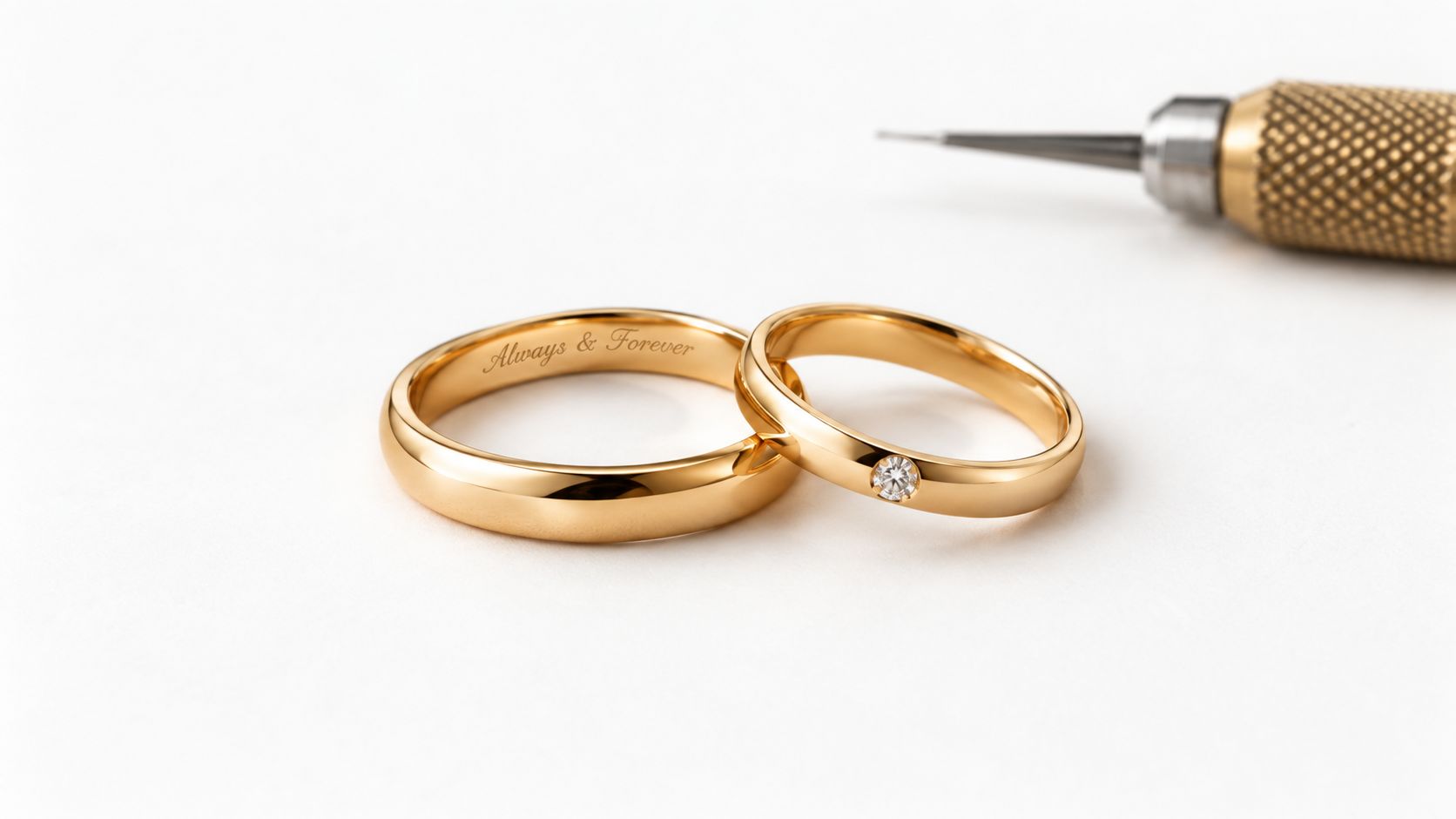
Choose the engraving once both partners have worn the rings and approved the final size. Short inscriptions usually remain more legible than long messages, especially inside narrow bands. Matching engraving can create a clear connection even when the rings use different metals or widths.
Metal also affects the engraving process. Platinum requires slower, more controlled tooling, while harder alternatives such as tungsten and cobalt are difficult to engrave because mistakes can't be polished out (JewelTrendPro). Ask about the metal's engraving limits before ordering, not after the rings arrive.
Diamond details for different lifestyles
A diamond accent can coordinate two rings without making them identical. The setting affects both appearance and maintenance:
- Channel setting: Stones sit between metal walls, giving a smooth profile that can suit active wear.
- Pavé: Small stones are set closely across the surface for more sparkle, but the detailed setting deserves careful inspection and maintenance.
- Eternity style: Stones continue around the full band, creating uninterrupted coverage. That can make later resizing more limited, so confirm fit before adding the detail.
A shared diamond shape, border, or small accent may be enough to connect the pair. For a closer look at stone security and surface design, see our guide to what a pavé diamond setting is.
The practical order is simple: choose the width, confirm the fit, select the metal, approve any stones, complete final sizing, then engrave. That sequence protects the details you're paying for.
Budgeting for Luxury Wedding Band Sets
Wedding band pricing reflects the physical ring, not just the label. Metal weight, metal type, diamond quality, setting complexity, width, finish, and workmanship all affect the total. Two bands with the same apparent width can differ substantially if one uses heavier precious metal or detailed stone setting.
The category is broad. One industry estimate values the global wedding ring market at USD 101.7 billion in 2025 and projects USD 194.1 billion by 2035, with a projected 6.6% CAGR (Global Market Insights). That scale supports a wide range of designs, from straightforward gold bands to diamond-accented luxury pieces. Couples don't need to buy the most elaborate pair to create a considered set.
A practical spending sequence
- Set the total ceiling. Decide what both bands can cost together before choosing stones or custom details.
- Protect the fit budget. Leave room for professional sizing, especially if the chosen metal or setting makes future adjustment difficult.
- Spend on daily-wear priorities. Put money toward a comfortable profile, suitable width, and a metal that fits the expected lifestyle.
- Add diamonds deliberately. Choose a setting that suits the wearer's work and maintenance habits rather than paying for maximum coverage by default.
- Review the written quote. Confirm metal, width, stone details, engraving, sizing, and service terms before approving the order.
A coordinated pair can also have one simpler band and one diamond band. That isn't a compromise if both rings share a finish, engraving, or design line. For ceremony styling, couples may also find inspiration in arrangements such as white and gold wedding roses, especially when warm and cool jewelry tones appear together.
Before setting a jewelry budget, our guide on how much to spend on an engagement ring offers a useful way to separate emotional priorities from practical costs. ECI Jewelers offers wedding bands and fine diamond jewelry through its online store and New York City showroom, giving couples another place to compare coordinated bands, individual widths, and personalization options.
ECI Jewelers can help you compare men's and women's wedding bands by metal, width, finish, and diamond detail, without forcing both rings into the same design. Visit ECI Jewelers to review available wedding jewelry and discuss a pair that fits both your hands and your daily lives.


