

Does Polishing a Luxury Watch Reduce Its Value?
If you own a high-end timepiece, at some point you’ll ask the question:
Does polishing reduce watch value?
It’s a fair question — and the answer isn’t emotional. It’s structural.
Polishing removes metal.
Value in the luxury watch market is heavily tied to originality.
Those two facts are directly connected.
In this article, we’ll break down how polishing impacts resale, why collectors care so much about case geometry, and when refinishing may — or may not — make sense.
Why Polishing Is More Than Just Cosmetic
Luxury watches from brands like Rolex, Patek Philippe, and Audemars Piguet are engineered with precise case proportions.
Lugs are cut to specific thickness.
Chamfers are defined at deliberate angles.
Brushed and polished surfaces transition with intention.
When a watch is polished, a thin layer of metal is removed to eliminate scratches. Done correctly and sparingly, this can refresh the appearance without dramatically altering structure.
Done poorly — or repeatedly — it permanently changes the case.
That’s where value comes into play.
How Polishing Affects Watch Value
Let’s separate this into realistic scenarios.
1. Light, Professional Refinishing
A proper polish involves:
-
Full disassembly (movement removed)
-
Separate treatment of case and bracelet
-
Preservation of factory lines
-
Correct brushing direction
-
Minimal metal removal
Impact on resale:
Often neutral on modern watches, especially if documented.
For newer models, careful refinishing during routine servicing may not significantly reduce value — provided geometry remains intact.
2. Heavy or Repeated Polishing
This is where problems begin.
Over time, excessive polishing can cause:
-
Thinning lugs
-
Rounded edges
-
Loss of bevels
-
Soft crown guards
-
Flattened case profiles
Collectors notice immediately.
And they price accordingly.
The “Over Polished Rolex” Problem
An over polished Rolex is one of the most common value killers in the secondary market.
When examining a pre-owned Rolex, experienced buyers look for:
-
Crisp lug edges
-
Defined chamfers
-
Symmetrical case proportions
-
Strong crown guards
Once those features soften, the watch may still function perfectly — but its collectibility drops.
Here’s what that difference looks like.
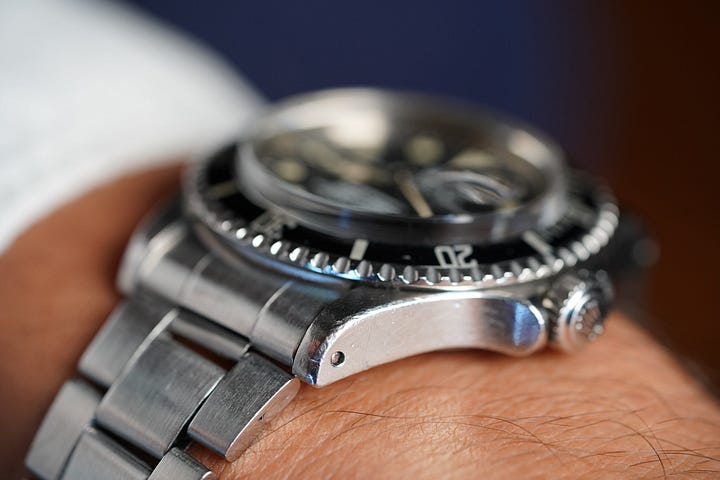
Original, Sharp Case Geometry


Notice:
-
Thick, even lugs
-
Clear bevels
-
Strong transitions between finishes
Collectors describe this as “full” or “crisp.”
This commands a premium.
Over-Polished Case Example

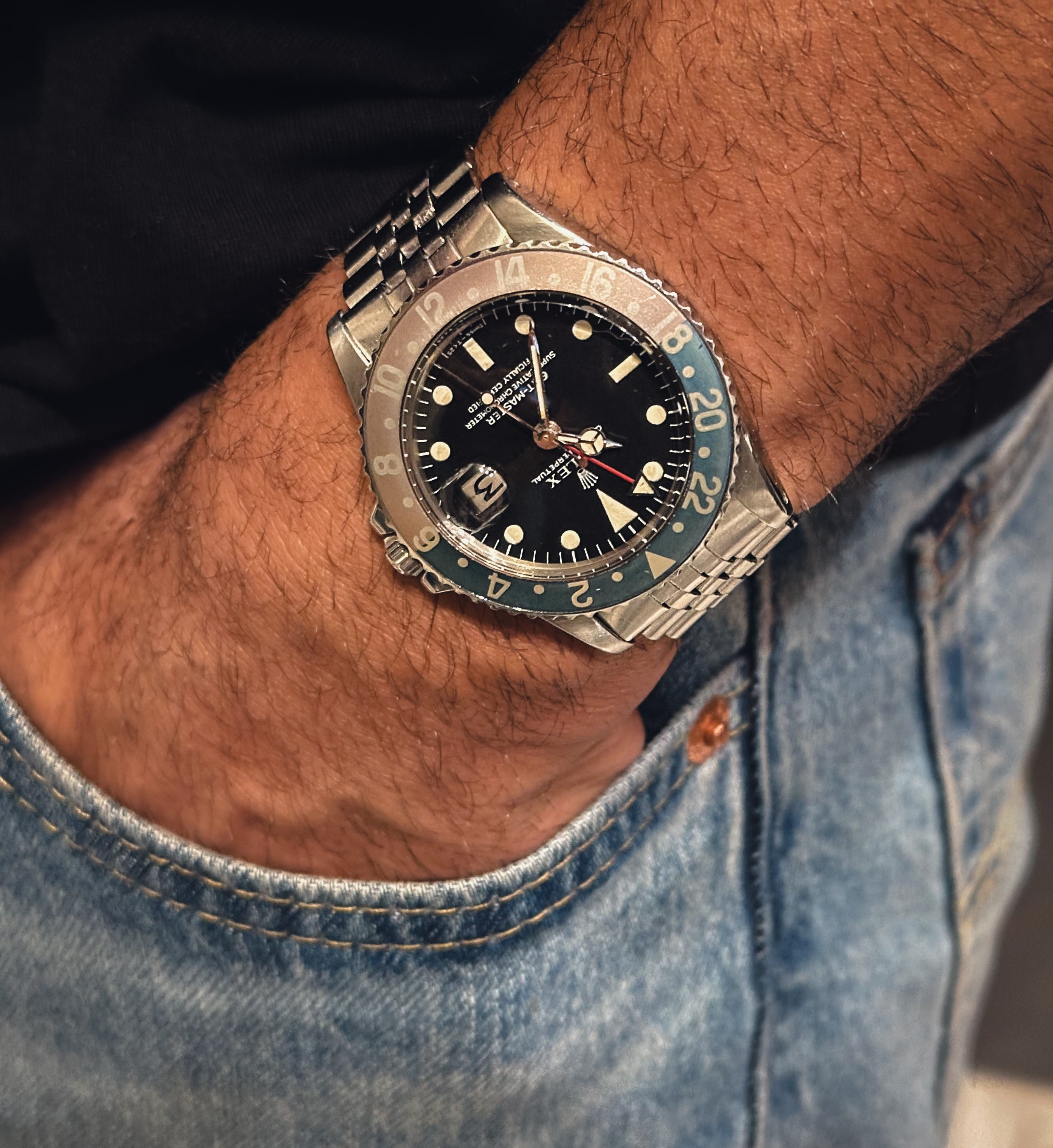
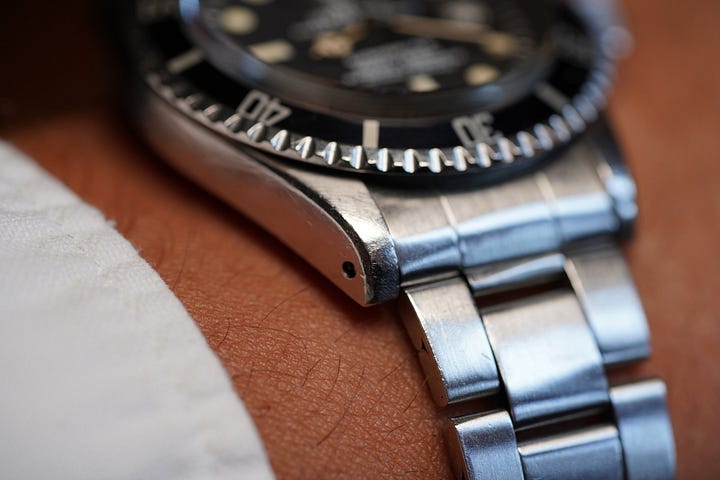
Now look closely:
-
Rounded edges
-
Washed-out crown guards
-
Loss of sharp finishing lines
This is where watch polishing value drops.
The watch may shine — but the structure is compromised.
And structure is what collectors pay for.
Collector Psychology: Why Originality Matters
Luxury watch buyers in the resale market aren’t just buying a timepiece.
They’re buying:
-
Original metal
-
Factory geometry
-
Long-term resale stability
-
Historical integrity
When metal is removed, originality decreases.
In vintage markets especially, unpolished examples often command significantly higher prices than refinished ones — even if they show honest wear.
Because wear tells a story.
Over-polishing erases it.
When Polishing May Make Sense
Polishing isn’t inherently bad.
It may be appropriate when:
-
Scratches are deep and distracting
-
The owner plans long-term wear
-
The watch has not been previously overworked
-
Refinishing is done conservatively
For modern pieces, controlled refinishing can improve marketability — especially if the watch looks excessively worn.
The key is moderation and expertise.
Factory Service vs Independent Polishing
Brands like Omega and Rolex often include refinishing during official servicing.
However, many experienced collectors request:
“No polish.”
Why?
Because preserving original case dimensions matters more than cosmetic perfection.
Every polish — factory or independent — removes metal.
That’s unavoidable.
How Often Should a Luxury Watch Be Polished?
There is no fixed schedule.
Unlike servicing (which is mechanical), polishing is cosmetic.
As a general rule:
-
Avoid polishing every service cycle
-
Avoid polishing unless visually necessary
-
Avoid polishing vintage pieces unless absolutely required
Repeated refinishing compounds material loss over time.
And once case proportions are altered, they cannot be restored.
So, Does Polishing Reduce Watch Value?
Let’s answer it directly.
Does polishing reduce watch value?
It can.
Light, careful refinishing on modern watches may have minimal impact.
Heavy, repeated, or poorly executed polishing — especially on collectible models — will reduce value.
The difference lies in:
-
Craftsmanship
-
Frequency
-
Model type
-
Buyer expectations
In the secondary market, originality consistently commands stronger prices.
Before You Decide
If you’re considering polishing your luxury watch, ask yourself:
-
Do I plan to sell this in the future?
-
Is the watch vintage or collectible?
-
Has it already been polished before?
-
Is the geometry still sharp?
These questions matter more than whether the watch “looks new.”
Shine fades.
Metal doesn’t grow back.
Professional Evaluation Matters
Every watch is different.
Every case has its own history.
Every owner has different goals.
Before any refinishing decision is made, condition should be evaluated carefully.
At ECI Jewelers, we take a preservation-first approach. We understand how polishing affects watch value — especially in the resale market — and we prioritize maintaining original geometry whenever possible.
If you’re unsure whether polishing is appropriate for your timepiece, we invite you to have it assessed professionally.
Visit us at:
Or contact our team directly to discuss your watch’s condition and long-term value.
We evaluate condition before any refinishing.
Because in luxury watches, originality isn’t cosmetic — it’s financial.


