

Any Audemars Piguet Royal Oak review has to start with one simple fact: this isn't just a watch. It's the watch that created the luxury steel sports category out of thin air back in 1972. Bold, exquisitely finished, and always in demand, the Royal Oak is still the benchmark for an entire genre of watchmaking.
Why The Royal Oak Remains A Cultural Icon
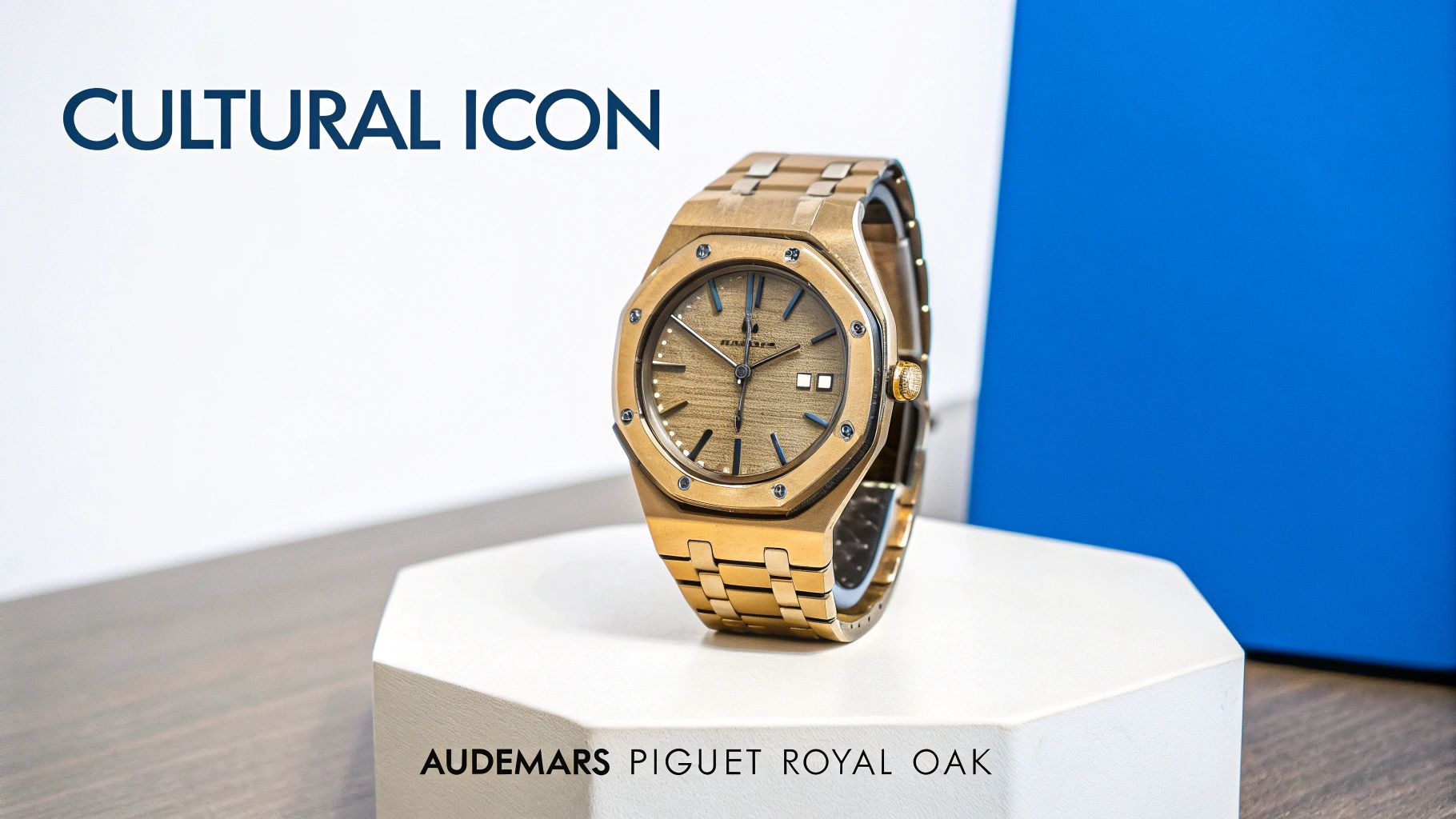
This guide is more than a review; it's a deep dive into a legend that has held collectors captive for over five decades. Sketched overnight by the legendary Gérald Genta, the Audemars Piguet Royal Oak was a gutsy answer to the quartz crisis threatening to upend Swiss watchmaking. Its launch was a gamble—a stainless steel watch that cost as much as a gold one, a move that forever changed how we think about luxury.
At its heart, the Royal Oak’s identity is built on a handful of signature design cues that just work. These aren't just random aesthetic choices; they are the pillars of its iconic status. To truly appreciate the watch, you have to understand its DNA.
The Anatomy of an Icon
You can spot a Royal Oak from across a room. That instant recognition comes from a few key elements that have stayed remarkably consistent since day one, cementing its place in design history.
- The Octagonal Bezel: Genta was inspired by a vintage diver's helmet, and the result is the watch's most famous feature. The eight-sided bezel, secured by eight exposed hexagonal screws, gives it an industrial-chic vibe that perfectly blends ruggedness with refinement.
- The Integrated Bracelet: The bracelet isn't just attached to the watch; it's an extension of the case itself. Its fluid, tapering links are so masterfully finished that it wraps around the wrist with a comfort that completely defies its sharp, angular look.
- The ‘Tapisserie’ Dial: This isn't a simple flat dial. The intricate, engine-turned grid pattern creates a stunning play of light and shadow, giving the watch a depth and artistry you just don't see elsewhere.
The Royal Oak's original ads didn't shy away from its price, famously calling it “the costliest stainless steel watch in the world.” It was more than a marketing slogan; it was a defiant statement that elevated a humble material to the level of a precious metal through sheer design and craftsmanship.
In this guide, we’ll explore every angle of the Royal Oak experience, from its game-changing design and key models to how it actually feels on the wrist and performs in the market. Our goal is to give you a complete Audemars Piguet Royal Oak review so you understand why this watch isn't just owned, but collected, cherished, and passed down for generations.
The Story Behind Its Radical Design
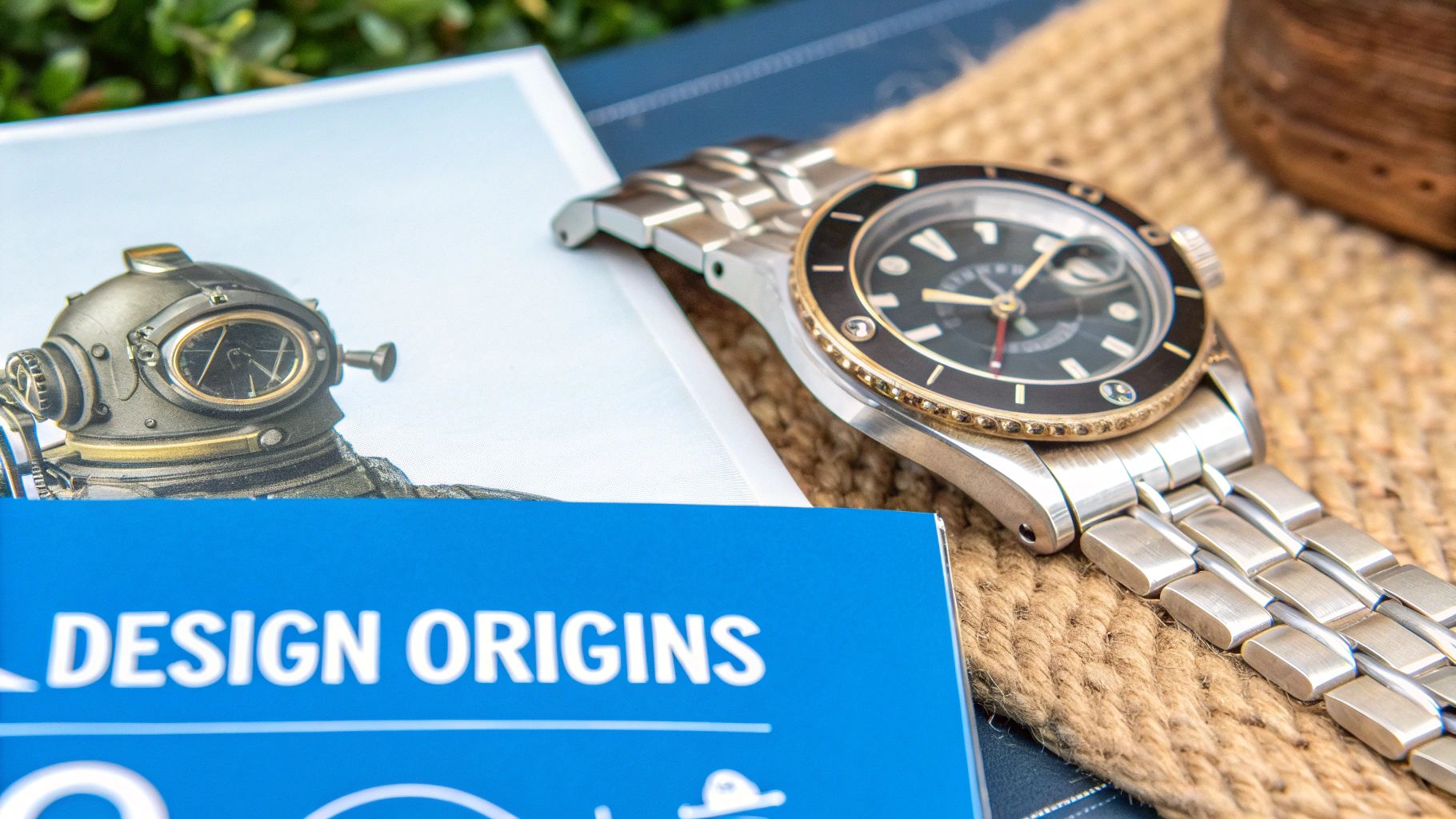
To really get the Royal Oak, you have to rewind to the watch world of the early 1970s. Swiss watchmaking was getting pummeled by cheap, dead-accurate quartz watches pouring out of Japan. Amid this "Quartz Crisis," Audemars Piguet did something that looked like pure madness: they decided to invent a whole new category of timepiece.
The brand needed a Hail Mary, and they needed it yesterday. As the story goes, on the eve of the 1971 Swiss Watch Show, AP’s managing director gave legendary designer Gérald Genta a late-night call. The request? Design a steel sports watch that was completely "unprecedented." Genta sketched it out overnight, and by the next morning, the DNA of the Royal Oak was on paper.
It was an insane gamble. Back then, luxury meant gold. AP, however, launched a stainless steel watch priced at 3,300 Swiss Francs—more than most gold dress watches of the day. This one move completely redefined steel, elevating it from a simple tool material to a canvas for world-class design and finishing.
A Design Pulled From The Depths
Genta found his muse in a pretty unusual place: an old-school brass diver's helmet. He was fascinated by how the faceplate was bolted onto the helmet with big, exposed screws to create a perfect seal. That raw, function-first look became the soul of the Royal Oak.
Its most famous feature—the octagonal bezel with eight exposed hexagonal screws—is a direct callback to that helmet. And those screws aren't just for decoration. They run straight through the case to the caseback, clamping the whole assembly together around a rubber gasket. The result was a watertight construction that was as tough as it was beautiful.
This was a radical idea. It put the nuts and bolts of the watch front and center, turning structural parts into the main event. It sent a clear message: true luxury is in the design and execution, not just the metal it’s made from.
The Magic Is In The Bracelet And Dial
The watch's fully integrated bracelet is another piece of the puzzle. This wasn't a case with some lugs and a strap slapped on. The bracelet flows directly out of the case, forming a single, fluid sculpture for the wrist. Every link tapers just so, finished with the same obsessive satin brushing and polished bevels as the case. It’s what gives the Royal Oak its iconic look and surprisingly comfortable feel.
The dial, however, brought a touch of delicate craft to an otherwise industrial design. Its signature is the "Tapisserie" pattern, a mesmerizing grid of tiny raised squares.
This pattern isn't just stamped on. It's carved into the dial using a centuries-old engine-turning machine called a pantograph. It’s an incredibly skillful process that creates a texture that plays with light like nothing else.
Put it all together, and you have a masterclass in contrasts:
- Industrial vs. Refined: Those tough, exposed screws sit right next to hand-polished, mirror-like chamfers.
- Angular vs. Fluid: The sharp, geometric lines of the octagon are balanced by the almost liquid flow of the integrated bracelet.
- Rugged vs. Artistic: The watch feels like a piece of high-end machinery, yet it’s graced with the intricate, decorative Tapisserie dial.
This blend of raw power and delicate finishing is why any good Audemars Piguet Royal Oak review has to obsess over its design. It wasn’t just a new watch; it was a whole new way of thinking that proved steel, in the right hands, could be more precious than gold.
Navigating The Most Important Royal Oak Models
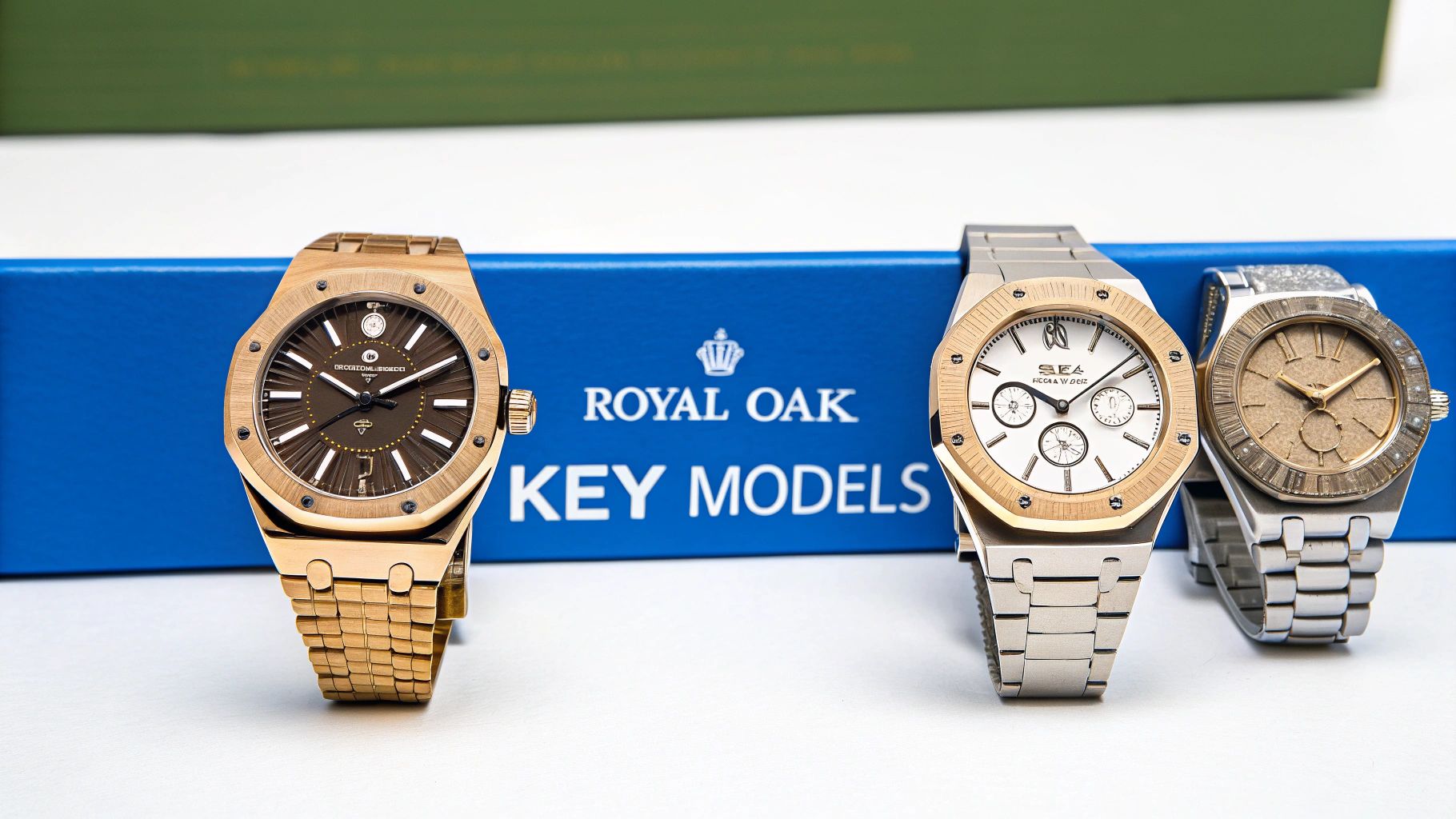
The world of Audemars Piguet Royal Oak references can feel like a maze of numbers and letters. With over five decades of history, just knowing where to start is half the battle. Each model tells a piece of the brand's story, from the groundbreaking original to the modern powerhouses collectors chase today.
To give a proper Audemars Piguet Royal Oak review, you have to start at the source. Getting to know these core models clarifies what makes each one special and helps you zero in on the perfect reference for your own collection.
The Original Game Changer: 5402ST 'Jumbo'
Every legend has an origin story. For the Royal Oak, it’s the reference 5402ST, affectionately nicknamed the 'Jumbo'. Launched in 1972 with its then-massive 39mm case, this is the watch that started it all. For many purists, it is the definitive Royal Oak.
What makes it so revered is how perfectly it captures Gérald Genta’s radical vision. Its surprisingly slim profile was made possible by the legendary Calibre 2121, an ultra-thin automatic movement that let the watch be both a rugged sports piece and a dressy statement. That movement is a work of art in itself and a huge reason for the 5402ST's lasting appeal.
The earliest examples, marked with an "A-series" serial number on the caseback, are the holy grail. They represent the purest form of the design that broke every rule in the book.
Modern Mainstays: The 15510 and 15450
Fast forward to today, and the spirit of the original is alive and well. The cornerstone of the current lineup is the Ref. 15510ST. At 41mm, this self-winding model is the contemporary standard-bearer, offering a more robust wrist presence while keeping all the classic design cues intact. Inside, it runs on the updated Calibre 4302, which delivers a beefier 70-hour power reserve.
For those with smaller wrists or who simply prefer more classic proportions, the Ref. 15450ST is a fantastic choice. Its versatile 37mm case strikes a perfect balance, making it comfortable for a much wider range of collectors without sacrificing an ounce of the iconic Royal Oak look.
Both models represent the smart evolution of the Royal Oak, blending historical DNA with modern engineering. They are the quintessential experience for today's buyer, and exploring the full collection of Audemars Piguet watches reveals the subtle differences that make each reference unique.
Expanding The Family With Complications
The Royal Oak platform has proven to be an incredibly flexible canvas, serving as the foundation for some of Audemars Piguet’s most impressive and complicated watches. Two of the most sought-after are the Chronograph and the Perpetual Calendar.
- Royal Oak Chronograph: This model adds a sporty, functional edge to the design. The sub-dials are so cleanly integrated into the ‘Tapisserie’ pattern that they feel like a natural extension of the original aesthetic. It’s the perfect blend of high-end finishing and practical utility.
- Royal Oak Perpetual Calendar: This is a true pinnacle of watchmaking skill. It houses one of the most prestigious complications, flawlessly tracking the day, date, month, and leap years, all within that iconic octagonal case. These models are highly coveted and showcase the brand's absolute technical mastery.
Understanding production numbers is crucial for collectors. AP’s serial and reference practices created clear tiers of rarity from the very beginning. For instance, the original A-series run was limited to just under 2,000 pieces, while some perpetual calendar models were produced in the low hundreds, making them exceptionally scarce. This documented scarcity is a major driver of value on the secondary market.
To help you see the differences at a glance, this table breaks down how these key models stack up against one another.
Comparison Of Key Royal Oak References
| Reference | Case Size | Movement | Key Feature | Collector Focus |
|---|---|---|---|---|
| 5402ST | 39mm | Calibre 2121 | The original "Jumbo" design | Vintage purists and historical significance |
| 15510ST | 41mm | Calibre 4302 | Modern, robust, 70-hour power reserve | Buyers seeking a contemporary flagship |
| 15450ST | 37mm | Calibre 3120 | Versatile mid-size for universal appeal | Those preferring classic proportions |
| Chronograph | 41mm | Calibre 4401 | Sporty complication, integrated design | Collectors wanting function with luxury |
| Perp. Cal. | 41mm | Calibre 5134 | Grand complication, technical mastery | Aficionados of high horology and rarity |
From the historic 5402ST to the complex Perpetual Calendar, each reference offers a distinct personality. By understanding these pillars of the collection, you can better appreciate the watch's incredible legacy and find the model that truly speaks to you.
What The Royal Oak Feels Like On The Wrist
Specs and movement details are one thing, but they don't capture the real magic of a Royal Oak. That happens when you actually fasten the clasp. It's an experience that goes way beyond a spec sheet, turning all that world-class engineering into a feeling of pure quality on your wrist.
The first thing you’ll notice is the way it plays with light. A Royal Oak doesn't just sit there; it performs. Its surfaces are this incredible mix of brushed steel and mirror-polished edges. The satin finish gives the watch a soft, almost matte glow, while those sharp, hand-polished chamfers catch the light and throw it back at you like a diamond. It makes the watch feel alive, changing its whole personality with every turn of your wrist.
People often compare it to a finely cut gem, and they're not wrong. The way the different facets and finishes interact with light creates a visual energy that photos just can't do justice. This watch was made to be seen in motion.
The Surprising Comfort Of The Bracelet
For first-time owners, the bracelet is a total revelation. Looking at its sharp, angular design, you'd think it would feel stiff or dig into your skin. But the reality is the complete opposite. It drapes over your wrist with an almost liquid-like flow, conforming to your arm with a silky smoothness that you just don't see coming.
Every single link is perfectly articulated and finished, so there are no rough edges or weird pressure points. The bracelet also tapers down from the case to the clasp, which helps balance the watch perfectly. The result is a watch that feels solid and secure, but never heavy or clunky—a true testament to Gérald Genta's genius.
Finding Your Perfect Fit
Of course, how a Royal Oak feels depends a lot on the case size, and AP offers a few options to get that perfect fit. Picking the right one is key to hitting that sweet spot between presence and comfort. Any good Audemars Piguet Royal Oak review has to talk about how these different sizes actually wear.
-
The 34mm: This is the most discreet and elegant size. It’s a fantastic choice for smaller wrists or for anyone who wants a more classic, understated watch that’s incredibly comfortable for everyday wear.
-
The 37mm: Many collectors call this the "sweet spot," and for good reason. The 37mm has that iconic Royal Oak look and enough presence to get noticed, but it’s still slim enough to slide under a shirt cuff. It just works, no matter the situation.
-
The 39mm 'Jumbo': This is the original proportion, and for the purists, it's still the best. Its thin profile and 39mm diameter give it a wide, flat stance on the wrist that is unmistakable. It pulls off being both sporty and incredibly elegant at the same time.
-
The 41mm: This is the modern, more commanding option. It has the most wrist presence by far and feels seriously robust. It’s better suited for larger wrists and makes a bold statement while still being surprisingly ergonomic.
At the end of the day, wearing a Royal Oak isn't just about telling time. It’s about feeling master-level finishing on your skin, appreciating the unexpected comfort of an iconic design, and just watching the light dance across its surfaces. That's what really makes it a legend.
Understanding The Royal Oak As An Asset
There’s the watch itself—the iconic design, the incredible mechanics, the feel on your wrist. But for a growing number of collectors, there’s another equally important side to the Royal Oak: its power as a tangible asset.
Let's be honest, the financial part of owning one of these is a huge piece of the puzzle. Understanding what makes its value tick is just as crucial as appreciating the finishing on the case. It’s a key part of any real Audemars Piguet Royal Oak review.
The Royal Oak's strength as an investment isn’t just one thing. It’s a perfect storm of brand prestige, carefully managed scarcity, and a global demand that just won't quit. Audemars Piguet has absolutely mastered the art of production, creating a market where there are always more buyers than watches. This strategy is why boutique waitlists are years long and why the secondary market is so incredibly robust.
The Economics of Scarcity
Unlike brands pumping out hundreds of thousands of watches a year, Audemars Piguet plays a different game entirely. This tightly controlled production is the bedrock of the Royal Oak’s incredible value retention. AP intentionally keeps the numbers low to maintain an air of exclusivity, ensuring each watch is a coveted treasure, not a common sight.
Think about it: even in its 50th anniversary year of 2022, AP only produced around 50,000 watches in total. That's a tiny figure in the grand scheme of the industry. When you consider that Royal Oak models drive an estimated 80-90% of the brand's entire revenue, you can see how concentrated the demand becomes. It’s this focused desire that keeps prices on the pre-owned market exceptionally strong.
This guide gives you a quick visual on how Royal Oak case sizes actually wear on different wrists.
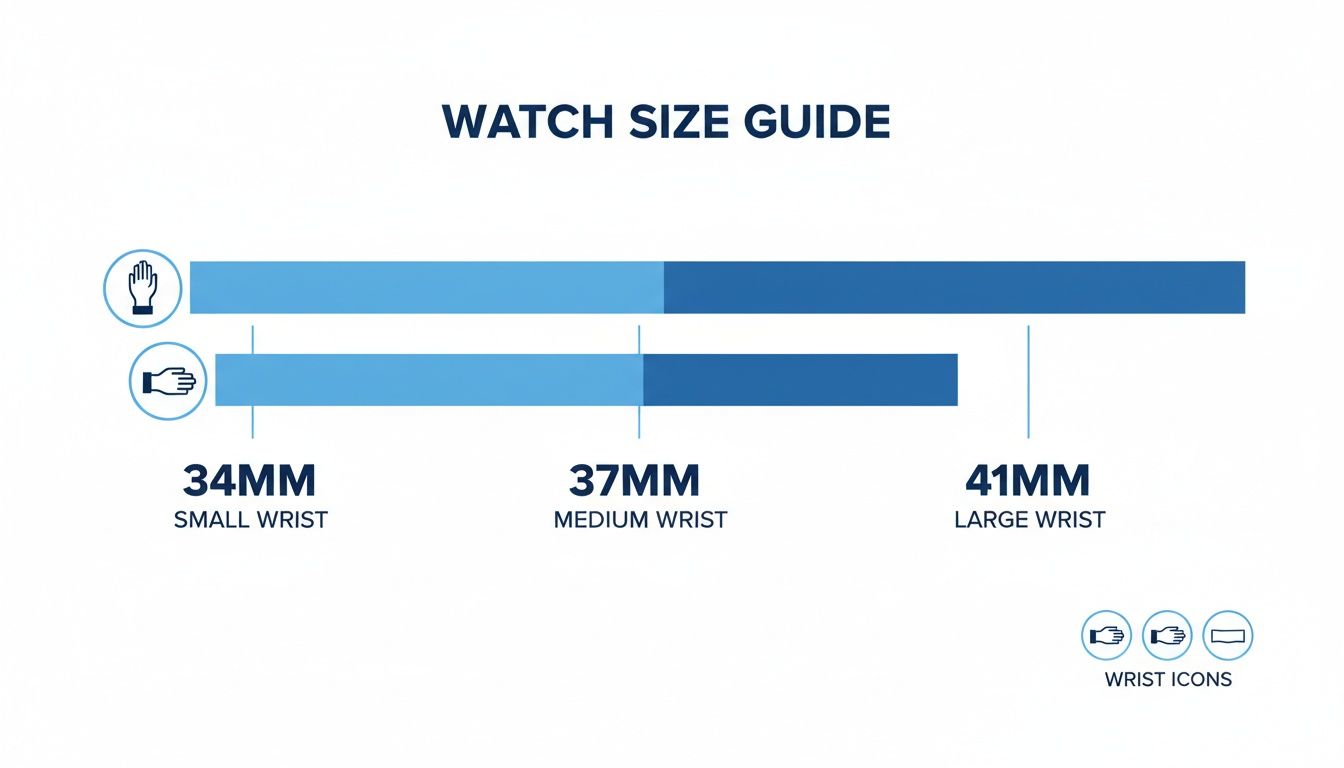
Picking the right size is about more than just comfort. It can seriously impact future resale value, as certain sizes have a much broader appeal on the market.
Why Some Models Command Extreme Premiums
Not all Royal Oaks are created equal in the market’s eyes. Certain references—especially those with historical weight or produced in very small numbers—can trade for jaw-dropping multiples of their original retail price. This is where the details really start to matter.
A watch that comes with its original box, papers, and service records (what collectors call a “full set”) is always worth significantly more. These accessories don’t just prove it's real; they tell its story, giving the next owner a layer of confidence you can't put a price on.
- Condition Is King: A crisp, unpolished watch with sharp, factory-fresh case lines will always fetch top dollar. Any sign of over-polishing or damage will bring the value down.
- Provenance Matters: The history of the watch can add huge value, especially with vintage models. Knowing who owned it and where it's been is part of the magic for serious collectors.
- Completeness Adds Value: That "full set" gives a buyer peace of mind and makes the watch a much more complete and attractive package.
For anyone looking at a Royal Oak as more than just a timepiece, it's smart to understand the numbers. Learning how to properly calculate the potential return on your investment will help you track its performance and make smarter buying or selling decisions down the line.
Thinking of a luxury watch as a hard asset is a savvy move in today's world. For a deeper dive, check out our guide on investing in luxury watches. The Royal Oak isn't just a purchase; it's the acquisition of an asset with a decades-long track record of retaining and growing its value.
How To Acquire A Royal Oak With Confidence
So, you're ready to make a Royal Oak your own. Navigating this process requires a smart strategy, as your journey will likely go down one of two roads: trying your luck with an Audemars Piguet authorized dealer (AD) or diving into the pre-owned market.
Each path comes with its own set of challenges and rewards, and knowing what to expect is half the battle.
Going through an official boutique is the most straightforward way to get a brand-new watch at its retail price. Simple, right? Not exactly. This is actually the hardest route. Insane global demand and tightly controlled production mean the most popular steel models have waitlists that can stretch for years. Building a relationship with an AD is key, but even that is no guarantee. It’s a true test of patience.
Navigating The Pre-Owned Market
For anyone who wants a specific model without playing the waiting game, the secondary market is your answer. This route gives you instant access to a massive inventory of current production models, recently discontinued gems, and true vintage pieces. But be warned: this path has risks that demand a sharp eye and, more importantly, a trusted partner.
The biggest dangers are the incredibly sophisticated fakes and "Frankenwatches"—timepieces cobbled together from a mix of genuine and aftermarket parts. These can fool even seasoned collectors, which makes professional, third-party verification an absolute must for a purchase of this size. This is precisely why understanding the value of certified pre-owned watches is so critical; it’s your guarantee of authenticity from a specialist you can trust.
It's impossible to talk about buying a Royal Oak without acknowledging a market reality: an authentic watch in great condition will sell for a premium over its original retail price. This isn't just a random markup; it's what the market dictates for immediate availability and verified quality.
Your Pre-Purchase Inspection Checklist
Whether you're looking at a watch in person or just have high-res photos to go by, a meticulous inspection is your best line of defense. The safest bet is to partner with an expert who can do these checks for you. They have the tools and, crucially, the experience to spot red flags that an untrained eye will always miss.
Here’s what a professional inspection zeros in on:
- Dial and Hands: The famous ‘Tapisserie’ pattern needs to be perfectly aligned. The lume on the hands and hour markers should be flawlessly applied. The AP logo itself must be crisp and placed with precision.
- Case and Finishing: Those signature brushed surfaces and mirror-polished chamfers should be razor-sharp. A case that’s been over-polished will lose those crisp edges, which dramatically hurts the watch's value.
- Bracelet Integrity: The integrated bracelet should have very little "stretch" or sag when you hold it sideways. Every link should feel solid and move smoothly—it’s a hallmark of AP's incredible craftsmanship.
At the end of the day, confidence comes from who you buy from. A reputable, expert dealer like ECI Jewelers provides the authentication, deep knowledge, and transparency you need for a secure transaction. That partnership is what turns a potentially stressful purchase into the rewarding experience it should be, protecting your investment and making sure you walk away with the legendary watch you deserve.
Your Royal Oak Questions, Answered
Once you get past the history and the design, the practical questions of ownership start to surface. Let's tackle the most common things potential buyers and new owners ask about the Audemars Piguet Royal Oak.
So, can you actually wear a Royal Oak every day? Absolutely. For all its luxurious finishing and hefty price tag, its DNA is that of a tough, steel sports watch. It’s built solidly and has enough water resistance to handle daily life with ease—just maybe leave it in the watch box for extreme sports or anything involving heavy impacts.
Keeping Your Watch Running Perfectly
Another question that comes up a lot is about maintenance. How often does a Royal Oak need a service? The official recommendation from Audemars Piguet is a full service every five to seven years. This isn't just a quick check-up; it's a meticulous process where the entire movement is disassembled, cleaned, lubricated, and put back together to perform like new.
Think of it like the engine tune-up for a high-performance car. Sticking to this schedule is the best way to protect your investment and make sure the watch runs flawlessly for decades to come.
Be prepared: servicing a watch of this caliber is a serious expense, often running into several thousand dollars. It's smart to factor this cost into your long-term budget from the beginning.
Investment Value and the Secondary Market
Finally, the big one: does the Royal Oak hold its value? While no market is guaranteed, the Royal Oak has an incredible track record. Thanks to its brand power, tightly controlled production, and huge demand, popular steel models often sell on the pre-owned market for far more than their original retail price.
A few things to remember about value:
- Scarcity drives price: The harder a model is to get from a boutique, the better it typically performs on the secondary market.
- "Full set" is king: A watch with its original box, papers, and accessories will always be worth more.
- Condition is critical: A sharp, unpolished case is what collectors crave and are willing to pay a premium for.
This powerful performance on the secondary market is a huge part of any serious Audemars Piguet Royal Oak review. It solidifies its status not just as a beautiful timepiece, but as a hard asset with a proven history of retaining—and often gaining—value.
For a secure and transparent purchasing experience, trust the experts at ECI Jewelers. Our specialists provide the authentication and guidance you need to acquire your Royal Oak with complete confidence. https://www.ecijewelers.com


