


Investing in a fine watch can be an incredibly smart financial move, but only if you know what you're doing. Far more than just a beautiful accessory, the right timepiece is a tangible asset. Its value is built on a powerful mix of masterful craftsmanship, deep brand history, and pure scarcity.
It's this unique blend of art and engineering that creates such lasting appeal, turning a passion for horology into a seriously viable investment.
The Real Value of Investing in Luxury Watches
Most people see a high-end watch and just see the price tag. An experienced investor, however, sees something completely different: a portable, appreciating asset that can add some real diversity to a portfolio.
Unlike stocks or bonds that exist on a screen, a luxury watch is something physical. You can actually wear it and enjoy it while its value quietly climbs over time. This puts fine timepieces squarely in the category of alternative investments—assets that don't fit into conventional boxes like cash or stocks.
To really get it, you have to understand what constitutes an alternative investment and the role these assets play in a modern financial strategy.
Market Growth and Potential
The buzz around watch investing isn’t just talk; the numbers back it up. The luxury watch market, valued at roughly USD 53.69 billion in 2024, is on a serious upward trajectory.
Forecasts project it will nearly double to an incredible USD 134.53 billion by 2032. That's a compound annual growth rate (CAGR) of 12.23% from 2025 to 2032, signaling a strong and sustained interest in these timepieces as assets.
A few key factors are driving this incredible growth:
- Controlled Supply: Heavy-hitters like Rolex and Patek Philippe are masters of managing production. They intentionally create scarcity, which is a huge driver of demand and sky-high prices on the secondary market.
- Brand Heritage: We're talking about decades, sometimes centuries, of history and innovation. That kind of legacy builds a story that collectors are more than willing to pay a premium for.
- Timeless Design: Models like the Audemars Piguet Royal Oak or the Rolex Submariner are true icons. They never go out of style, which guarantees they'll be just as desirable for the next generation as they are today.
At its core, investing in luxury watches is about finding those rare pieces where exceptional craftsmanship, brand prestige, and market scarcity all meet. It’s less about trying to time the market and more about recognizing lasting value in a tangible piece of art.
Key Factors That Drive Investment Value
To pinpoint a watch with true potential, you need to understand the specific elements that drive its value up. The table below breaks down the most critical factors.
| Factor | Why It Matters for Investment |
|---|---|
| Brand Recognition | Top-tier brands like Rolex, Patek Philippe, and Audemars Piguet have a global reputation that ensures strong, stable demand. |
| Model & Reference | Certain models (e.g., Submariner, Nautilus) are icons. Specific, desirable reference numbers often command the highest prices. |
| Rarity | Limited production runs, discontinued models, or unique features create scarcity, which is a primary driver of value appreciation. |
| Condition | The closer a watch is to its original, factory condition, the more valuable it is. Unpolished cases are highly sought after. |
| Provenance | A complete set—original box, papers, and receipts—verifies authenticity and adds a significant premium to the watch's value. |
Ultimately, a watch that checks all these boxes isn't just a purchase; it's a strategic acquisition. This guide will give you the framework to navigate this exclusive market, helping you identify investment-grade timepieces and understand the unique risks and rewards that come with them.
How the Luxury Watch Market Really Works
If you're going to succeed in watch investing, you have to understand the forces that actually move prices and create demand. This isn't the stock market. It’s much closer to the world of fine art, where a piece's value is a tangled web of tangible quality and intangible desire.
The entire ecosystem runs on a delicate balance of supply and demand, but it’s heavily swayed by brand strategy, what collectors are chasing, and even global economic news. Some iconic models become financial instruments in their own right, with values that can swing based on anything from a social media trend to a record-breaking auction result.
The Primary and Secondary Markets
The luxury watch world is split into two very different arenas: the primary market and the secondary market. The primary market is simple enough—it’s the authorized dealers (ADs) who sell brand-new watches straight from the manufacturer. Think of it like buying a new car directly from an official dealership.
But here’s the catch. For the hottest models from brands like Rolex or Audemars Piguet, you can’t just walk into an AD and buy one. Insane waitlists and the need for a strong purchase history mean most new investors will spend almost all their time in the secondary, or pre-owned, market.
And that’s where things get really interesting. The secondary market is where watches are bought, sold, and traded after their first sale. It's also where many watches, especially the steel sports models, sell for prices far higher than their original retail price. This premium isn't an accident; it's a direct result of scarcity clashing with overwhelming demand.
The secondary market is the true pulse of luxury watch investing. It's a living ecosystem where the real-time value of a timepiece is determined by what collectors and investors are willing to pay for immediate access, bypassing the long waits of the primary channel.
The Drivers of Market Value
A few key forces are pushing the market forward, creating both big opportunities and predictable cycles. Getting a handle on these drivers is critical if you want to make smart moves instead of just chasing the latest trend.
The global appetite for luxury goods just keeps growing, powered by a new generation of affluent millennials and high-net-worth individuals. In fact, the market is projected to climb from around USD 47.91 billion in 2025 to nearly USD 87.11 billion by 2034. This isn’t just a fad; it’s a powerful demographic shift where luxury watches are seen as essential, everyday icons.
This boom is especially strong in the Asia Pacific region, which has become a powerhouse for luxury spending, creating fresh demand for both modern and vintage timepieces.
- Scarcity and Controlled Production: Top brands carefully manage how many watches they make to keep them exclusive. This isn't a bug in the system; it's a core feature of their business model, making sure demand always outpaces supply for key models.
- Provenance and Condition: Just like with a rare painting, a watch's history (provenance) and its physical shape are everything. A full set—original box and papers included—dramatically boosts value, as does a clean, unpolished case in pristine condition.
- Cyclical Demand: Tastes change. Certain models or styles can go through periods of intense popularity. While classics like the Rolex Submariner seem to have timeless appeal, other watches can see their values rise and fall with the market's mood.
To really get these dynamics, it helps to see how similar markets work. A great place to start is understanding consignment shopping for designer items, because the principles of authentication, condition, and market value for pre-owned luxury goods apply directly here. Entering this world means learning the rules of a game where a watch's story and condition are just as important as the name on the dial.
Identifying Watches That Appreciate in Value
Let's be clear: not all luxury watches are created equal, especially when you start looking at them as an investment. While tons of timepieces are incredible feats of engineering and design, only a select few have the right ingredients to actually grow in value. Knowing what separates a fleeting "hype watch" from a genuine, timeless asset is the single most important skill you can develop as a watch investor.
It helps to think of it like prime real estate. A beautifully designed house is one thing, but a beautifully designed house in a fantastic neighborhood with very few homes for sale is a true asset. The same idea applies here: the brand is your neighborhood, while things like rarity and condition determine its real market value over the long haul.
The Power Trio and the Crown
In the world of watch investing, a few names always rise to the top of the conversation. The "Holy Trinity" of watchmaking—Patek Philippe, Audemars Piguet, and Vacheron Constantin—are held in the highest regard for their mind-blowing craftsmanship, deep historical roots, and incredibly complex movements. These brands produce watches in very small numbers, making them rare and sought-after from the moment they're made.
Standing right alongside them is the undisputed king of the market: Rolex. While maybe not as mechanically intricate as a Patek Philippe, the power of Rolex comes from its unmatched brand recognition, legendary toughness, and brilliant control over its supply chain. This potent mix has turned its stainless steel sports watches into some of the most liquid and consistently appreciating assets you can find. To really get a handle on this dominance, understanding the resale value of Rolex watches is essential context for why the crown reigns supreme.
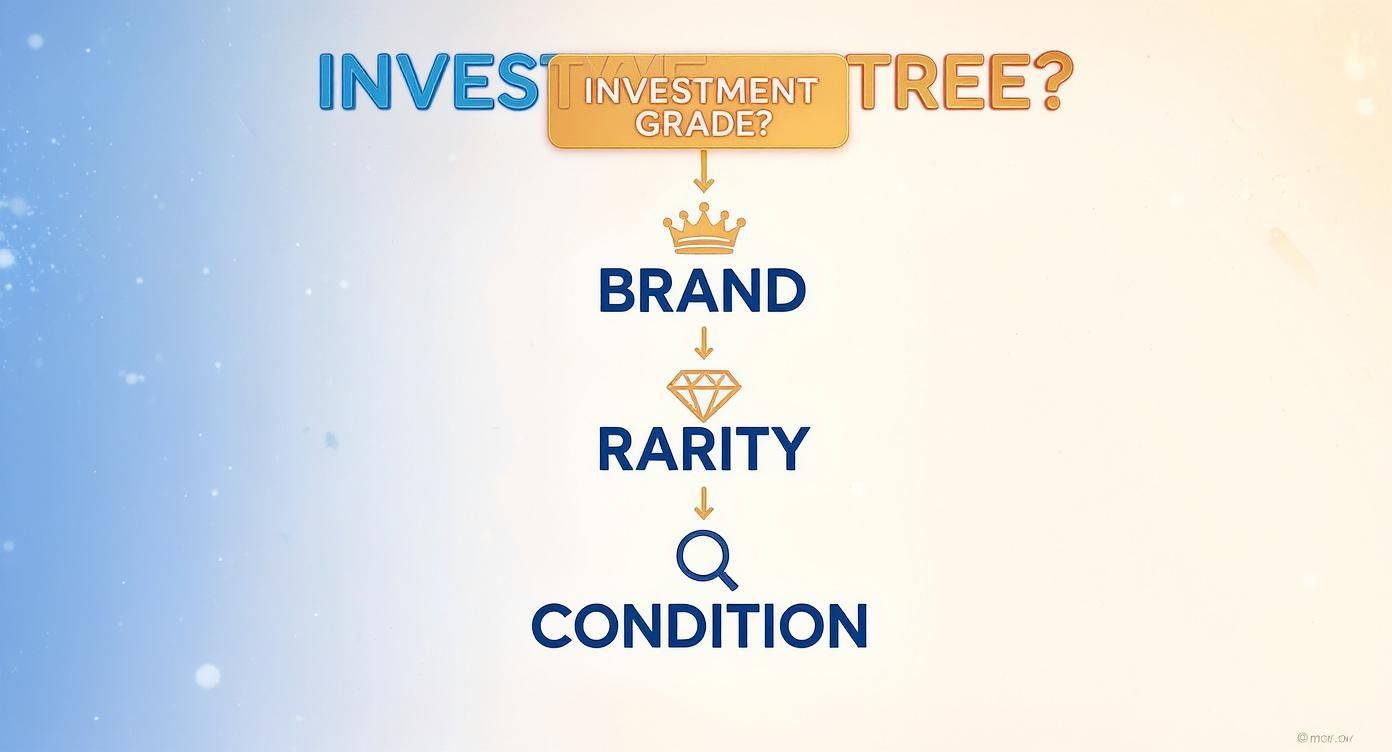
This guide nails the core idea. A strong brand is your foundation, but rarity and pristine condition are the multipliers that really unlock a watch's potential to appreciate.
To give you a clearer picture, here's a quick breakdown of what makes these top-tier brands such strong investment candidates.
Comparing Top-Tier Investment Watch Brands
| Brand | Iconic Investment Model(s) | Key Investment Driver |
|---|---|---|
| Rolex | Submariner, Daytona, GMT-Master II | Unmatched brand power, controlled supply, high liquidity. |
| Patek Philippe | Nautilus, Aquanaut, Calatrava | Rarity, historical significance, complex movements. |
| Audemars Piguet | Royal Oak | Gérald Genta design legacy, limited production, strong demand. |
As you can see, each brand brings something unique to the table, but they all share the common threads of scarcity, brand prestige, and unwavering demand from collectors.
Key Attributes of an Investment-Grade Watch
Looking past just the name on the dial, there are a few specific traits that separate the true winners from everything else. When you're sizing up a potential purchase, these are the non-negotiables to hunt for.
- Iconic Models: Stick with the classics. A Patek Philippe Nautilus, an Audemars Piguet Royal Oak, or a Rolex Submariner aren't just watches—they're cultural touchstones with decades of proven demand.
- Rarity and Scarcity: This is just simple economics. Limited editions, discontinued models, or references with very short production runs are naturally more valuable because the supply is permanently capped.
- Materials Matter (But Not How You Think): Here's a twist that surprises many newcomers: stainless steel sports models often outperform their gold or platinum cousins. The demand for durable, everyday watches like the steel Rolex Daytona is so intense that it pushes secondary market prices to unbelievable levels.
- Movement Complexity: For the "Holy Trinity" brands, a watch with a "complication"—like a perpetual calendar or a chronograph—adds serious value. It’s a showcase of the brand's technical mastery and a hallmark of true haute horology.
The sweet spot for investing in luxury watches is finding an iconic, discontinued reference model from a top-tier brand, in stainless steel, with its complete original set. This combination creates a perfect storm of desirability, scarcity, and authenticity that drives long-term growth.
Hype Watches Versus Timeless Classics
Today's market is full of "hype watches"—models that see a sudden, crazy price spike because of a celebrity post or a social media trend. While it's tempting to try and chase those quick profits, it's an incredibly risky game. Hype doesn't last, and those prices can crash just as fast as they shot up.
A true investment piece, like a classic Rolex GMT-Master II, has value built on a foundation of heritage and decades of consistent demand, not a fleeting moment. Its appreciation is slower, sure, but it's also far more stable and predictable. An investor's goal should be to build a collection of these timeless classics and leave the speculative hype to the day traders. By focusing on the fundamentals of brand, rarity, and condition, you build a foundation for sustainable, long-term returns.
Your Playbook for Buying and Selling Watches
Navigating the world of luxury watches is a skill. Knowing which models to pick is one thing, but understanding where to buy and how to sell is what separates a casual collector from a serious investor.
Each channel—whether you're buying or selling—comes with its own rules, risks, and rewards. You wouldn't walk into an auction house expecting the same experience you'd get at an authorized dealer. Mastering this playbook is how you protect your money and make sure you come out ahead.
Where to Buy Your Next Investment Piece
When you're ready to buy, you've got three main paths to choose from. Each has its pros and cons, so the right choice depends on what you're trying to accomplish.
-
Authorized Dealers (ADs): This is the official storefront for brands like Rolex or Patek Philippe. The biggest plus? You're guaranteed 100% authenticity and a brand-new watch with a full factory warranty. The downside is that for the hottest models, you'll be put on a long waitlist—if you can even get on it without a serious purchase history.
-
The Grey Market: These are the independent dealers who sell authentic watches outside the official network. Their biggest advantage is immediate availability. You can get that "unobtainable" steel sports watch today... if you're willing to pay the premium. The key here is to find a reputable, trusted seller to avoid any funny business.
-
Auction Houses: Think Christie's or Phillips. This is where you'll find the truly rare stuff—vintage pieces with incredible history or unique models you won't see anywhere else. It’s a high-stakes game that offers the biggest potential returns, but it demands deep knowledge. You’re not just buying a watch; you’re bidding on a piece of history, and prices can be unpredictable.
So, what's the right move? If you're buying a less-hyped model and want total peace of mind, the AD is your safest bet. If you have to have a hot Rolex Submariner right now, a trusted grey market dealer is the way to go. And if you're hunting for a vintage "grail" watch, the auction block is your only real option.
Performing Your Due Diligence
Never, ever buy a watch without doing your homework first. This is your defense against getting a fake, overpaying, or buying a piece with hidden issues. A few minutes of inspection can save you thousands of dollars.
Start with the "box and papers." An investment-grade watch should come as a complete set, including the original box, warranty card, and manuals. This paperwork helps prove the watch is legit and can add 20-30% to its value down the road. Double-check that the serial numbers on the watch match the papers exactly.
Next, get a good look at the watch's physical condition. Are the case edges sharp, or have they been softened by over-polishing? Are there any major dings or deep scratches? For an investor, an unpolished watch in top condition is always the goal.
Finally, research the reference number. Know its production years, any important variations, and what similar watches have sold for recently. This context will help you make a smart offer and truly understand what you're buying into.
Strategies for Selling Your Watch
When it's time to cash in, how you sell is just as important as when you sell. Selling when your model is in high demand can make a massive difference in your profit.
You can go for a direct sale to a dealer or another collector. This is usually the fastest and simplest way to get cash in hand. Another option is consignment, where you leave the watch with a trusted dealer who sells it for you. This often gets you a higher price, but the dealer takes a commission, and it can take longer.
If you want to dive deeper into this process, our guide on how to sell luxury watches breaks down every step to get you the best possible return. Choosing the right path is key to capitalizing on the asset you’ve taken such good care of.
Protecting Your Assets and Navigating Risks
Getting your hands on that perfect timepiece is an incredible feeling, but it’s really only half the battle. Once you own a high-value watch, or several, you have to shift your mindset from collector to custodian.
Proper storage, insurance, and maintenance aren't just tedious afterthoughts—they are the absolute cornerstones of a smart investment strategy. Neglecting them is like leaving a classic car out in the rain.
Essential Asset Protection Strategies
First things first: storage. Let's be clear, leaving a watch worth more than your car on a nightstand just isn't an option. At a bare minimum, you need a high-quality, fireproof safe for home storage.
For a serious collection, many investors take it a step further and use a bank's safe deposit box. It provides unmatched security against theft and environmental damage, making sure your assets stay in perfect condition.
Next up is insurance. Don't assume your standard homeowner's policy has you covered—it almost certainly doesn't for the full value of a luxury watch. You'll need a specialized policy, often called a valuable articles policy or a personal articles floater, to properly protect against theft, loss, and damage.
A critical part of keeping your insurance up to snuff is getting regular appraisals. The market value of an in-demand watch can jump significantly in just a year or two. Keeping your coverage aligned with current values is the only way to avoid being underinsured if the worst happens.
Finally, regular servicing is completely non-negotiable. A mechanical watch is a complex machine with hundreds of tiny, moving parts. Following the manufacturer’s recommended service intervals—usually every 5-10 years—is crucial for preventing wear, maintaining accuracy, and preserving its long-term value.
Avoiding Common Pitfalls and Threats
The world of luxury watch investing comes with its own unique set of risks. One of the biggest threats out there right now is the explosion of incredibly sophisticated counterfeit watches. These "super fakes" are getting so good that they can easily fool an untrained eye.
The spread of these fakes is a direct threat to the market's stability and the integrity of the brands we love. It's a massive issue in major markets across Europe and North America, including the United States and the United Kingdom, which drive a huge chunk of global demand. You can get a sense of these market dynamics in this detailed industry report.
This is exactly why professional authentication is so important. If you want to see what the experts look for, our guide on how to authenticate a Rolex watch gives a great inside look at the meticulous process.
Understanding Market Volatility and Ownership Costs
While the watch market has shown fantastic long-term growth, it’s not immune to bumps in the road. Prices for certain models can swing based on economic news, shifting trends, or speculative bubbles. Smart investors know this is a long game and don't make panic decisions based on short-term market noise.
You also need to be realistic about the hidden costs of ownership that go beyond the initial price tag. These ongoing expenses are a real part of your total investment.
- Insurance Premiums: That specialized coverage is an annual expense you need to budget for.
- Servicing Costs: A full overhaul from a top-tier brand can easily run hundreds, or even thousands, of dollars.
- Appraisal Fees: You'll need to pay for professional appraisals every few years to keep your insurance policy current.
When you factor these costs into your strategy, you get a much more realistic picture of your potential returns. By staying on top of these responsibilities, you’re not just protecting a timepiece—you’re safeguarding a valuable, appreciating asset for years to come.
Building Your Long-Term Investment Strategy
If you want to succeed in luxury watch investing, you need to shift your mindset. This isn't about chasing fast profits or flipping the latest "hype" model that everyone's talking about. It's about playing the long game—a marathon that rewards patience, deep knowledge, and a real passion for the art of watchmaking.
Think of it like building a fine wine cellar. You wouldn't just buy any bottle that's popular this week. Instead, each one is chosen for its heritage, quality, and potential to mature into something special over many years. Rushing the process or picking based on a fleeting trend almost always ends in disappointment. A smart watch investor acts as a patient caretaker of horological history.
The Core Principles of a Winning Strategy
To build a collection that actually appreciates over time, you have to stick to a few core, non-negotiable principles. Think of these as your roadmap for navigating market ups and downs and making choices that deliver real, long-term value.
-
Focus on Icons: Always prioritize proven, iconic models from the top-tier brands. A Rolex Submariner or a Patek Philippe Calatrava has decades of built-in demand, which makes them far more stable assets than some flashy, unproven limited edition.
-
Condition and Completeness Are Everything: An investment-grade watch has to be in the best possible shape. Ideally, that means it's unpolished and comes with its full original set of box and papers. This "completeness" is your proof of where it came from and can add a huge premium to a watch's future value.
-
Prepare to Hold: Real appreciation doesn't happen overnight. You should plan to hold your most important pieces for at least 5-10 years. This timeframe lets you ride out any short-term market noise and capture the steady, compounding growth that defines blue-chip timepieces.
Don't treat each purchase like a simple transaction. See it as a deliberate addition to a carefully curated collection. Your goal is to assemble a portfolio of watches whose value is built on history, scarcity, and timeless design—not just temporary market buzz.
Integrating Watches into Your Broader Portfolio
Finally, you need to be realistic about where watches fit into your overall financial plan. Luxury timepieces are what's known as an alternative asset, which means they can be a great way to diversify your holdings away from traditional stocks and bonds.
But you have to remember they aren't as liquid as financial securities. You can't just sell a high-value watch in seconds with the click of a button. For that reason, your watch collection should complement, not replace, your main financial investments. By balancing your passion with a smart, patient, and long-term strategy, you can turn a personal interest into a rewarding and tangible asset for years to come.
Frequently Asked Questions
When you're first getting into watch investing, you’re bound to have a few questions. We get it. Here are some straightforward answers to the things people ask us most often.
Which Watch Brands Hold Their Value Best?
Historically, two giants stand head and shoulders above the rest for holding and appreciating in value: Rolex and Patek Philippe. It’s hard to overstate Rolex’s brand power. Their tightly controlled supply means stainless steel sports models—think the Submariner, Daytona, and GMT-Master II—often sell for way more than their retail price on the secondary market.
Patek Philippe is really the pinnacle of haute horlogerie, or high watchmaking. Its famous models, especially the Nautilus and Aquanaut, have seen absolutely phenomenal growth. You can also add Audemars Piguet to this top tier, mostly thanks to its legendary Royal Oak. While other brands can be solid investments, these three consistently have the strongest and most reliable performance out there.
Do I Need the Original Box and Papers?
Yes. A thousand times, yes. For any watch you're considering a serious investment, the original box and papers are non-negotiable. The community calls this a "full set," and it's basically the watch's birth certificate and passport all in one. It’s the best proof you have of its authenticity and history, or provenance.
A watch with its complete set can easily be worth 20-30% more than the exact same watch without them. You can always buy a "naked" watch (just the watch itself), but its potential to grow in value will be seriously limited, and you’ll have a much tougher time selling it for a top price down the road. Always, always prioritize a full set.
Is It Better to Buy a New or Pre-owned Watch?
That's a great question, and it really depends on what watch you’re after. If you’re targeting the hottest models from Rolex or Patek Philippe, buying new from a dealer is practically impossible unless you have a long buying history with them and are willing to wait years. For those watches, the pre-owned market is your only real shot, but prices are already sky-high over retail.
For models that aren't quite as hyped up, buying new is an option, but you'll probably face some initial depreciation—just like driving a new car off the lot. Honestly, the smartest play for an investment is often buying a popular pre-owned model. It's already proven it can hold or increase its value on the secondary market, which makes it a much less risky asset to own.
The luxury watch market has shown incredible stability, with annual volatility of just 3.90%. That’s lower than fixed income, real estate, and even stocks, making certain pre-owned watches a very appealing way to diversify a portfolio.
How Long Should I Hold a Watch Investment?
Think of this as a marathon, not a sprint. Watch investing is a long-term game, and you should be prepared to hold onto your piece for 5-10 years or more. Sure, some models see quick, exciting jumps in price, but that market can be volatile. Chasing fast flips is a great way to get burned.
Real, lasting value comes from a mix of things over time: brand price increases, inflation, and a watch slowly cementing its legacy as a timeless icon. A patient, long-haul approach lets your watch ride out the bumps in the market and benefit from the steady, compounding growth that makes a timepiece a truly great investment.
Whether you're looking for your first investment piece or seeking to add a rare reference to your collection, ECI Jewelers offers a curated selection of authenticated timepieces from the world's most desirable brands. Explore our inventory and discover the perfect asset backed by our guarantee of quality and trust at https://www.ecijewelers.com.


