


When you decide to sell a luxury watch, getting it right from the start makes all the difference. The whole process really comes down to three things: solid preparation, an honest valuation, and picking the best place to sell. If you nail these first steps, you’ll present your watch like a pro, price it for what it's truly worth, and attract serious buyers you can trust.
Your First Steps to a Successful Watch Sale
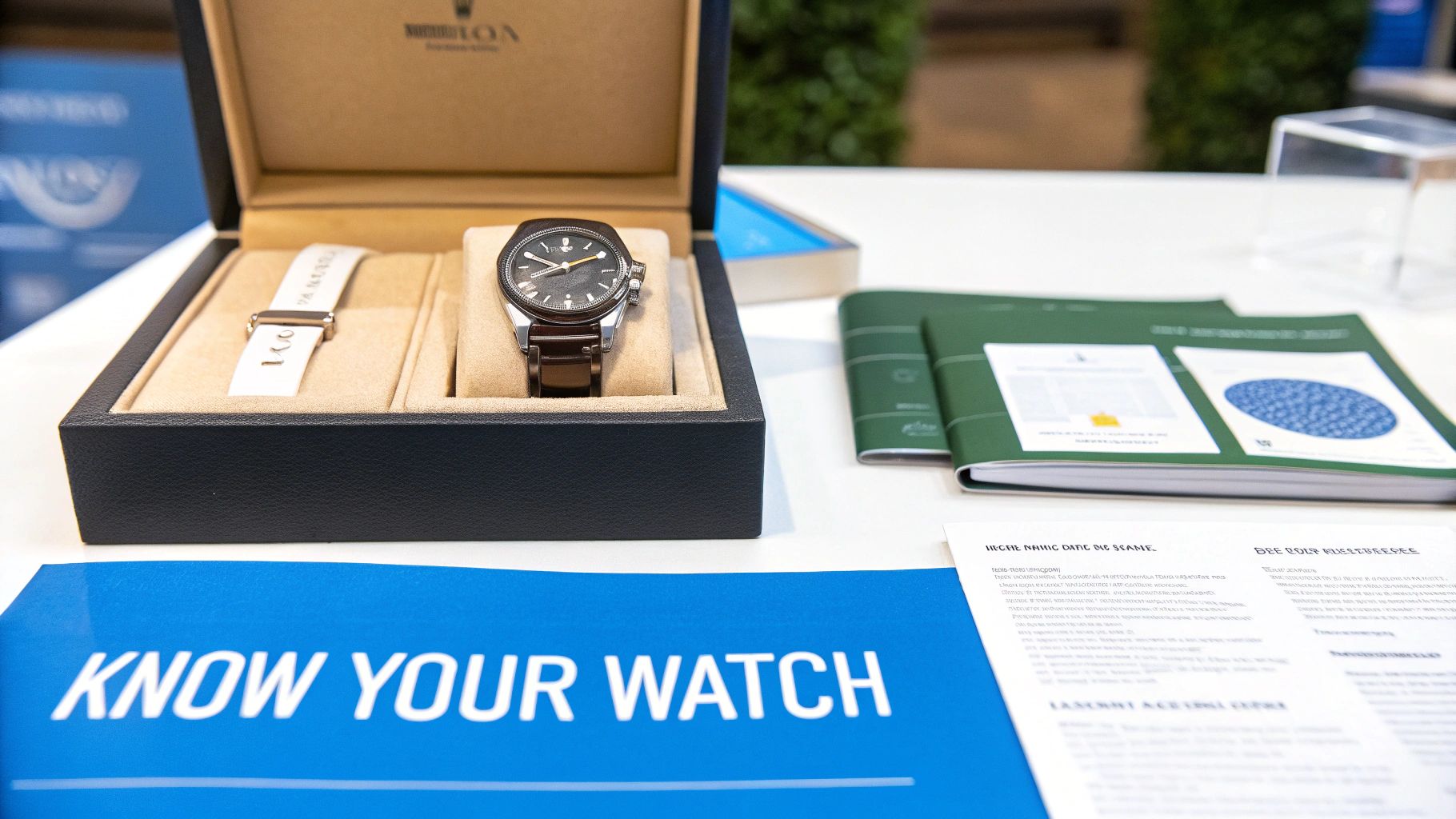
Jumping into the world of selling a high-end timepiece can seem a little intimidating, but breaking it down into clear, methodical steps turns it into a straightforward—and profitable—experience. The market for these watches is hotter than ever. Collectors and enthusiasts don't just see them as beautiful objects; they see them as functional art and a smart place to put their money.
This isn't just a small collector's hobby anymore. We're talking about a massive global market. The demand is fueled by the dual appeal of watches as both status symbols and tangible assets. In 2024, the global luxury watch market hit a value of USD 53.7 billion, and it's projected to climb to an incredible USD 134.5 billion by 2032. You can dig into more data on the luxury watch market to see just how fast it’s growing, especially in the pre-owned space.
Gather Every Piece of Documentation
Before you even think about snapping photos or writing a listing, your first job is to track down every single item that originally came with the watch. Trust me, this is absolutely non-negotiable if you want to get the best possible price.
The "box and papers" aren't just packaging. Think of them as your watch's birth certificate and passport. They prove its authenticity, where it came from, and its history. Having a complete set can easily boost a watch's value by 15-25%.
You'll want to find these specific items:
- The Original Box: This includes both the inner presentation box and the outer protective one.
- Warranty Card/Papers: This is critical. It has the serial number and the original purchase date.
- Instruction Manuals: Any booklets that were included.
- Extra Links: If you had the bracelet sized, find those links that were removed.
- Service Records: Any receipts or documents from maintenance, repairs, or polishing.
A "full kit," as collectors call it, instantly builds confidence with a potential buyer. It tells them the watch has been looked after and removes any nagging doubts about its authenticity, making it much easier to justify a premium price.
To make sure you've covered all your bases, here’s a quick checklist to work through before you move on to the next stage.
Pre-Sale Checklist for Your Luxury Watch
Getting organized now will save you headaches later and put you in the strongest possible position to negotiate.
| Item/Action | Why It's Important |
|---|---|
| Locate Box & Papers | The single most important factor for proving authenticity and maximizing resale value. |
| Find Extra Bracelet Links | Ensures the watch can be sized to fit the new owner, a common point of negotiation. |
| Gather Service History | Shows the watch has been properly maintained, justifying a higher price. |
| Identify Model & Serial # | Needed for accurate valuation and to verify the watch's production year and details. |
| Assess Overall Condition | Honestly note any scratches, dings, or wear. Transparency builds trust with buyers. |
| Clean the Watch Gently | A clean watch photographs better and makes a much stronger first impression. |
Once you have everything on this list gathered, you’re officially ready to figure out exactly what your timepiece is worth.
Understanding Your Watch's True Market Value
One of the biggest mistakes I see sellers make is confusing an insurance appraisal with what their watch is actually worth on the market today. It's an easy trap to fall into. That insurance paper usually shows the full retail replacement cost, which can be a much higher number than what a real buyer is willing to pay for a pre-owned piece.
Getting this right from the start is crucial. What you’re really after is the fair market value—the price a knowledgeable buyer would pay a willing seller in the current market. This number isn’t static; it breathes with supply, demand, and the recent sales of similar watches.
What Drives a Watch's Resale Price
Not every luxury watch is created equal when it comes to holding value. The price you can expect is a cocktail of brand power, rarity, and its physical state. A Patek Philippe Calatrava and a Rolex Submariner from the same production year, for instance, are on completely different journeys when it comes to value.
Here are the factors that really move the needle:
- Brand and Model Prestige: Some names just have that magic. Models like the Rolex Daytona or the Audemars Piguet Royal Oak consistently fetch a premium because demand is relentless and supply is tight.
- Condition: This one is huge. I’m talking about deep scratches, dings on the case, or any parts that aren’t original. To a serious collector, an unpolished watch that shows its history but keeps its original sharp case lines is often far more valuable than one that’s been polished to look brand new.
- Completeness of Set: As we talked about earlier, having the original box, warranty card, and manuals—what we call a "full set"—is a massive plus. It doesn't just boost the value; it gives the buyer a huge dose of confidence.
- Rarity and Provenance: Limited editions or models that had a very short production run are obviously harder to find and thus more desirable. And if you have any paperwork or history connecting the watch to a notable owner? That can add incredible value.
A watch's value is a story told by its condition, papers, and brand reputation. A pristine, fully-documented piece from a top-tier brand doesn't just sell faster—it commands a price that reflects its legacy and desirability in the collector market.
Getting a Reliable Valuation
So, how do you nail down that magic number? You need an expert eye. Those free online value calculators can give you a rough ballpark, but they can't see the tiny details of your specific watch that make all the difference.
Your best bet is to get a quote from a specialist dealer—someone who buys and sells these pieces every single day. They have the real-time data on what the market is truly paying. For instance, figuring out the resale value of Rolex watches requires deep knowledge of how specific references have performed over the years.
A professional valuation is your best tool to make sure you don't leave money on the table or, just as bad, price your watch so high that it sits forever.
Where to Sell Your Luxury Watch
Deciding where to sell your luxury watch is a huge step. It directly impacts your final payout, how fast the sale happens, and your overall peace of mind.
The best platform really comes down to what you're trying to achieve. Are you aiming for the highest possible profit? Or is a quick, hassle-free transaction more your style? Maybe minimizing fees is your top priority. Each channel has its own mix of pros and cons.
Comparing Your Sales Options
Selling directly to a specialist dealer is almost always the fastest and simplest way to go. You'll get an immediate, firm offer and get paid quickly—often on the same day. While it's incredibly convenient, just know that the offer will be below full market value. That’s how the dealer makes a profit. This is a fantastic choice if speed and security are what you value most.
Online marketplaces like Chrono24, on the other hand, open your watch up to a massive global audience. This gives you the potential for a much higher sale price, but it also comes with more work on your end. You'll have to handle the photography, write a compelling listing, talk to potential buyers, and figure out the logistics of fully insured shipping. Be ready for commission fees, which usually fall somewhere between 6.5% to 15%.
Consignment offers a nice middle ground. You hand your watch over to a reputable dealer, and they manage the entire sales process for you in exchange for a commission. This route often brings in a higher net return than selling directly to a dealer, but it requires patience while you wait for the right buyer to come along.
If you want an expert's help without the legwork of a private sale, a watch concierge service can be a game-changer.
This decision tree shows how one simple thing—having the original box and papers—can immediately boost your watch's perceived value.
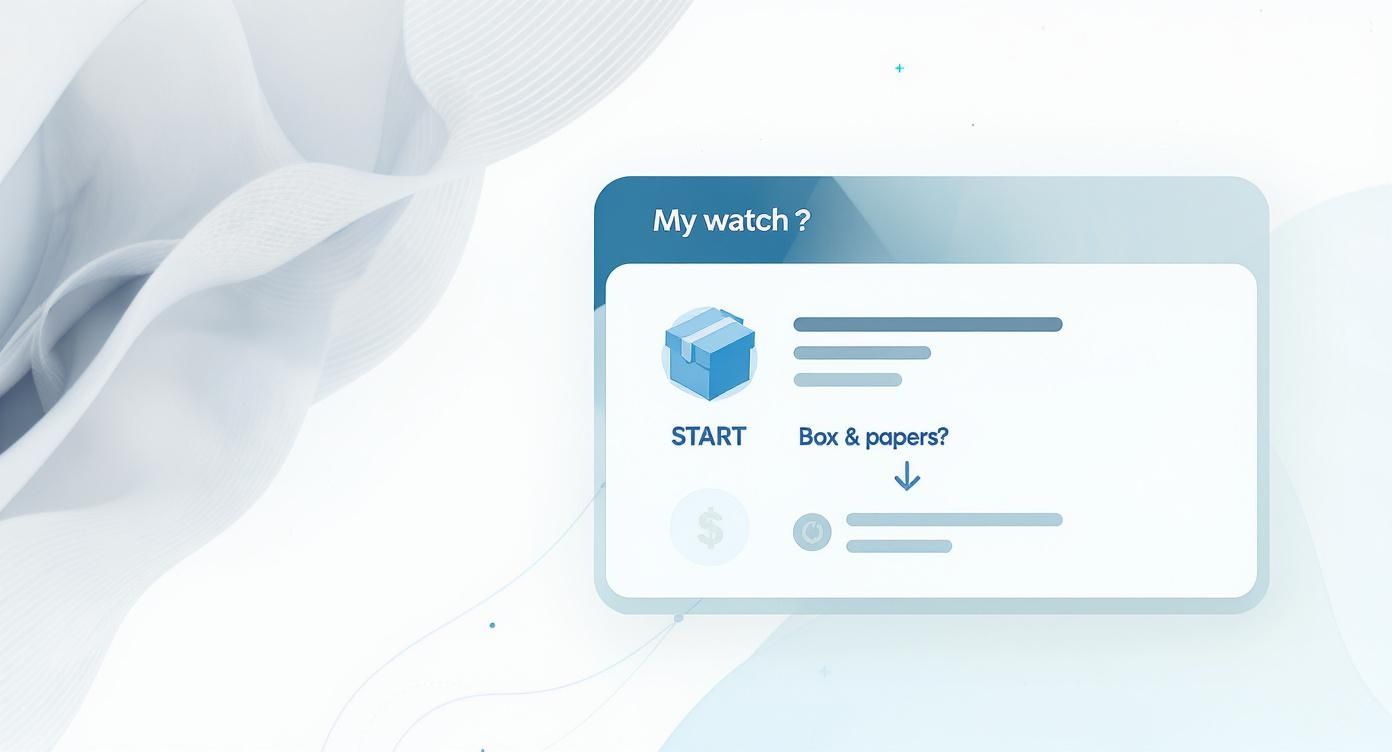
As you can see, presenting a "full set" is a clear signal of authenticity and good ownership, giving you a much stronger negotiating position right out of the gate.
Finally, you have high-end auction houses. These are really best for exceptionally rare or historically important timepieces. While they can achieve record-breaking prices, the process is long, and the commissions are steep. It’s a growing market, expected to hit USD 87.1 billion by 2034, and we're seeing more brands jump into certified pre-owned channels to meet buyer demand. You can dig deeper into the luxury watch market's growth and how sales strategies are evolving.
Creating a Listing That Attracts Serious Buyers
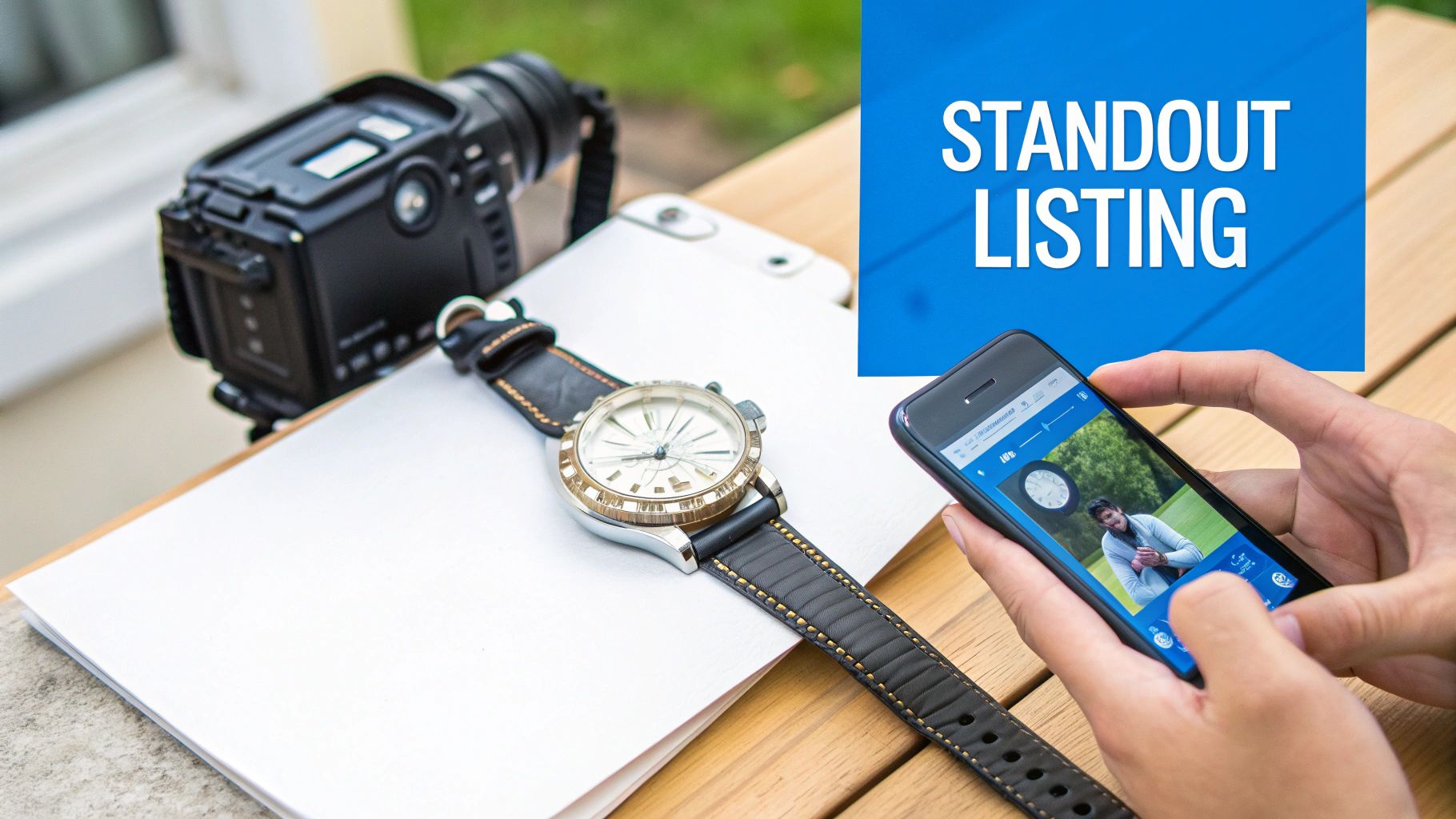
Think of your online listing as your digital handshake with a potential buyer. A sharp, detailed presentation doesn't just get you more views—it builds the trust you need to command a premium price and close the deal without any drama.
Your listing should tell the complete, honest story of your timepiece. High-quality photography is completely non-negotiable here. You don’t need a fancy studio; just find some good natural, indirect light and shoot against a clean, neutral background.
Make sure you capture every angle and detail a serious collector would want to see. Think like a buyer. What would you want to inspect?
- A clear, straight-on shot of the dial.
- Photos of the case from both sides, showing the crown and lugs.
- A picture of the case back, highlighting any engravings or serial numbers.
- Shots of the bracelet and clasp, both open and closed.
Crafting a Compelling and Honest Description
When it comes to the description, transparency is your most powerful tool. Start with the basics: brand, model, reference number, and production year. Then, describe the watch’s condition with total honesty. Be specific. Mention any small scuffs on the clasp or that tiny hairline scratch on the crystal.
Being upfront about minor imperfections is a sign of a confident and trustworthy seller. It prevents disputes later and shows buyers you have nothing to hide, making them more comfortable with the purchase.
This approach is more important than ever. A younger, digitally-savvy audience is flooding the market. In fact, Millennials and Gen Z are expected to make up 75% of all luxury buyers by 2026, and they value authenticity above all else.
Finally, include all the details about its history. Talk about its service records and whether it comes with the "full set"—the original box, papers, and any accessories. If you need a refresher on what details to highlight, our guide on how to authenticate a Rolex watch is a great place to start.
Navigating Negotiations and Closing the Deal Safely
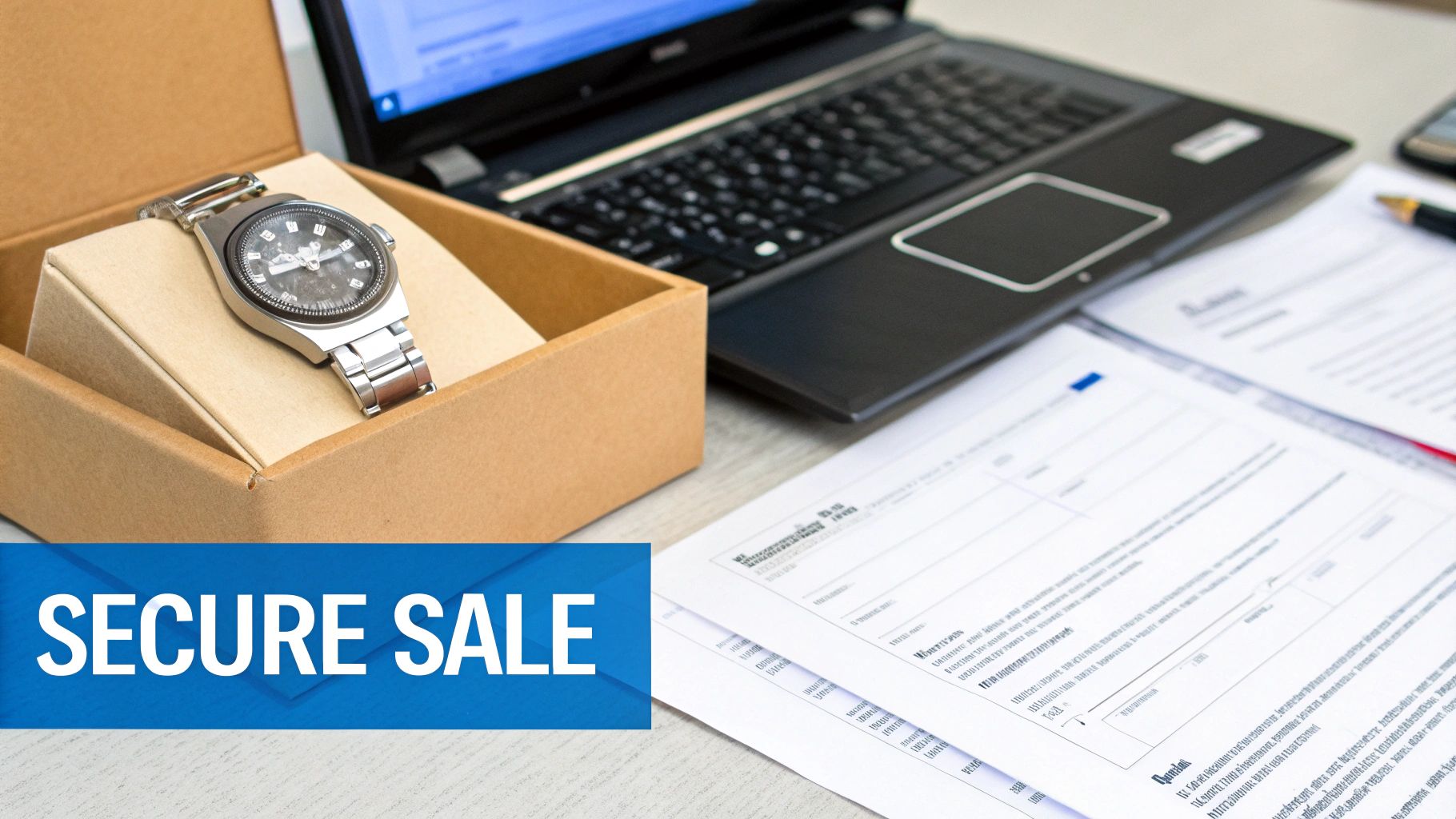
Getting that first offer is always a rush, but don't let the excitement cloud your judgment. This final stretch is where you need to be the sharpest. A successful sale isn’t just about getting your price; it’s about navigating the deal with confidence and ensuring every part of the transaction is ironclad.
You can expect a mix of offers. Some will be serious, while others are just lowballers feeling you out. For the ridiculously low offers, a simple but firm "no, thank you" is all you need. When a serious buyer comes along, be ready to stand behind your asking price, using your research, the watch's pristine condition, and its complete set of box and papers as your leverage.
Securing Your Payment
This is it—the single most critical part of protecting yourself. Not all payment methods are created equal, and frankly, the wrong one can lead to disaster. The only goal here is to have irreversible funds cleared in your account before that watch is out of your hands.
For private sales, stick to the tried-and-true methods:
- Bank Wire Transfer: This is the gold standard for a reason. Once a wire transfer hits your account, it's final. The funds are yours, and they can't be clawed back. It's the cleanest and safest way to handle a high-value sale.
- Platform Escrow Service: If you're selling on a marketplace like Chrono24, their built-in escrow service is your best friend. The buyer pays them, they hold the money, you ship the watch, and they release the funds to you once the buyer confirms receipt. It protects everyone involved.
- In-Person at a Bank: Selling locally? Meet the buyer at their bank. This is a pro move. You can watch the teller issue a cashier's check or initiate the wire transfer right there, removing any doubt about the payment's legitimacy.
A word of warning: never, ever accept payment via Zelle, Venmo, or a standard PayPal "Goods & Services" transaction for a luxury watch. These platforms are designed for small, personal transfers and offer almost zero seller protection against scams or chargebacks. You could easily end up with no watch and no money.
Shipping Your High-Value Timepiece
Once the money is safely in your account, it's time to ship. This isn't like sending a regular package; you're transporting a precision instrument worth thousands of dollars. Always use a trusted carrier like FedEx or UPS and ask specifically for their high-value or declared-value shipping options.
Proper packing is non-negotiable. The watch box should be snugly cushioned inside a larger, sturdier shipping box—a technique called double-boxing—so it can't shift around during transit.
Most importantly, declare the full sale value and purchase full insurance. It might add a small amount to the shipping cost, but that's nothing compared to the peace of mind you get. It’s your only protection against the rare but real possibility of the package being lost, stolen, or damaged on its journey.
Common Questions We Hear from Watch Sellers
When you’re getting ready to sell a high-end timepiece, a few questions always seem to come up. Getting the right answers can be the difference between a smooth, profitable sale and a costly headache. Let's tackle two of the most common ones we hear.
Should I Get My Watch Serviced Before I Sell It?
This is probably the number one question we get, and it makes sense. You want to present your watch in the best possible light. But here's the honest answer from someone who's seen it all: no, don't pay for a full service.
A complete overhaul can run you hundreds, sometimes thousands, of dollars. The hard truth is you're almost never going to get that money back in the sale price. Most professional buyers and dealers have their own trusted watchmakers they prefer to use, so they'd rather buy the watch as-is and handle the service themselves.
Now, that doesn't mean you should do nothing. A light, professional cleaning is always a great idea. It costs very little but makes a world of difference in your photos and for an in-person inspection. First impressions matter.
Is It a Good Idea to Sell to an International Buyer?
Opening your sale to the global market seems like a great way to find more buyers and maybe even get a better price. While that can be true, it also opens a can of worms that most private sellers aren't prepared for.
Selling a luxury watch across borders is a whole different ballgame. You're suddenly dealing with:
- Insured Shipping: This is non-negotiable and can get very pricey for high-value items going overseas. You need a carrier with rock-solid international coverage.
- Customs, Duties, and Taxes: While the buyer usually pays these, you are responsible for filling out the customs declarations perfectly. One small mistake on the declared value can cause massive delays, get the watch seized, or create legal trouble for you and the buyer.
- Payment Risks: Confirming international payments is much trickier. A bank wire transfer is the only method you should even consider. Anything else is just too risky.
For most first-time or casual sellers, our advice is to stick to a domestic sale. The stress, risk, and logistical hurdles of an international deal often wash out any potential for a slightly higher offer. A secure, straightforward local or national sale is almost always the smarter play.
Knowing the answers to these questions ahead of time helps you make the right calls, ensuring your sale is as seamless and profitable as possible.
Ready to sell your watch without the guesswork? The experts at ECI Jewelers offer fair, transparent valuations and immediate payment, providing a secure and professional experience from start to finish. Get your free, no-obligation quote today.


