


It’s no secret that a Rolex often fetches more on the pre-owned market than its original sticker price. This isn't just luck; it's the result of a masterful blend of brand power, controlled manufacturing, and timeless appeal that turns a watch into a hard asset.
When you buy a Rolex, you’re not just acquiring a timepiece. You're buying into a legacy.
What Makes a Rolex Hold Its Value So Well?
So, why can a Rolex be such a solid investment? It really boils down to three core principles that the brand has perfected over decades. Think of it as a three-legged stool—if one leg were missing, the whole thing would wobble. But Rolex keeps all three firmly in place.
The Pillars of Rolex Value
These three factors work in perfect harmony to drive the incredible resale value of Rolex watches:
- Unmatched Craftsmanship: Every single Rolex is assembled by hand. This isn't an exaggeration. They use premium materials like their own proprietary gold alloys and tough 904L stainless steel. This obsessive focus on quality means these watches are built to be passed down through generations, not just worn for a few years.
- Calculated Scarcity: Rolex is famous for intentionally limiting how many of its hottest models it produces. This isn't a supply chain issue; it's a deliberate strategy. It creates massive waiting lists at authorized dealers and sends hungry buyers straight to the secondary market, where prices naturally climb.
- A Powerful Heritage: The Rolex story is tied to deep-sea explorers, pioneering pilots, and legendary race car drivers. Owning one is seen by many as a mark of success. It’s a symbol. You can dive deeper into what makes them the epitome of luxury watches in our detailed article.
This mix of world-class quality, planned scarcity, and pure brand prestige has effectively turned Rolex watches into a respected alternative asset class. Their performance can often stand toe-to-toe with traditional investments, making them a unique way to store value.
Let’s put some numbers to that. The average resale value of a Rolex has skyrocketed by over 550% since 2010. That’s a climb from an average price of around $2,000 to over $13,000 today, a testament to their strength as a tangible asset. Bob's Watches put together a fantastic market report that digs into this trend. This solid foundation is exactly why the pre-owned Rolex market isn't just surviving—it's thriving.
To make it even clearer, here’s a quick breakdown of the key drivers behind a Rolex’s value.
Key Drivers of Rolex Resale Value at a Glance
This table sums up the main factors that can make or break a watch's price on the secondary market.
| Factor | Impact on Value | Example |
|---|---|---|
| Model Desirability | High | A stainless steel Daytona or GMT-Master II will almost always sell for a significant premium over its retail price due to intense demand. |
| Condition | High | A watch in mint, "unpolished" condition with sharp edges will command a much higher price than one with visible scratches or dings. |
| Provenance | Medium to High | A watch with its original box, warranty card, and receipts ("full set") is more valuable than a "naked" watch. Celebrity ownership can add immense value. |
| Scarcity & Rarity | High | Discontinued models, "error dials," or limited production runs like the "Paul Newman" Daytona are legendary for their astronomical values. |
| Service History | Medium | A recent, documented service from an official Rolex Service Center adds confidence for the buyer and can boost the price, ensuring authenticity and proper function. |
Understanding these elements is the first step in figuring out what a specific Rolex might be worth. They all play a part in the final number.
The Best Performing Rolex Investment Models
While any Rolex is a symbol of value, not all models are created equal when it comes to investment. Some pieces are simply superstars on the secondary market, drawing fierce demand and consistently impressive returns. Knowing which models lead the pack—and why—is key if you're looking at the resale value of Rolex watches as an investment.
You can think of the Rolex catalog a bit like a stock portfolio. Sure, they're all part of the same market, but a handful of "blue-chip" stocks always seem to outperform the rest. In the Rolex world, the stainless steel professional models are those blue-chip assets. These are the watches that create multi-year waiting lists and dominate collector forums.
The Holy Trinity of Rolex Resale
Three models, in particular, stand as the undisputed holy trinity of modern Rolex investments. Their blend of iconic design, deep history, and purpose-built function has turned them into legends on the pre-owned market.
- The Cosmograph Daytona: Originally designed for race car drivers, the Daytona is the undeniable king of Rolex resale. Its chronograph function, slick design, and famous association with motorsport icons like Paul Newman have given it a near-mythical status. It's not uncommon for stainless steel versions to trade for double their retail price, or even more.
- The GMT-Master II: As the ultimate pilot's watch, the GMT-Master II is known for its colorful, bi-directional bezels that track multiple time zones. Nicknames like "Pepsi" (red and blue), "Batman" (black and blue), and "Root Beer" (brown and black) aren't just collector slang; they represent highly sought-after assets that perform exceptionally well.
- The Submariner: The original dive watch, the Submariner is arguably the most recognized luxury watch on the planet. Its rugged, no-nonsense design has made it a must-have for collectors. While both date and no-date versions are hot, certain references—like the green-bezeled "Hulk" or "Kermit"—have seen their values skyrocket.
These professional models are widely considered the safest bets for both value retention and appreciation. You can see how these models consistently rank in lists like these top Rolex watch series to buy in 2022.
Why Steel Is Gold in the Rolex World
It might sound strange, but stainless steel professional models often boast better resale value than their precious metal or two-tone cousins. The reason boils down to a classic case of supply and demand.
Steel models come with a more accessible retail price tag, which creates a massive pool of potential buyers.
The perfect storm for secondary market demand is created by lower retail prices combined with Rolex's tightly controlled production of steel sports watches. Buyers who can't get one from an authorized dealer are often willing to pay a serious premium to get one right away.
This infographic breaks down the core elements that give every Rolex its value, especially these high-demand models.
The chart shows how craftsmanship, scarcity, and heritage all work together to create a solid foundation for strong resale performance.
To give you a clearer picture, here's a quick look at how some of the most popular models stack up.
Top Performing Rolex Models Resale Value Comparison
| Rolex Model | Key Feature | Typical Resale Value Trend |
|---|---|---|
| Cosmograph Daytona | Chronograph for racing; high-status symbol | Consistently trades for 2x-3x retail, especially steel models |
| GMT-Master II | Dual time zone functionality; iconic "Pepsi" or "Batman" bezels | Strong appreciation; popular references command significant premiums |
| Submariner | The original dive watch; robust and universally recognized | Excellent value retention; discontinued versions ("Hulk") see massive gains |
| Datejust | Classic, versatile design; signature Cyclops lens | Steady, long-term growth; a reliable performer over decades |
This table shows that while professional models lead the pack, even classic dress watches offer impressive long-term growth, proving the strength of the Rolex brand across the board.
Beyond the Big Three
While the Daytona, GMT-Master II, and Submariner grab most of the headlines, other models also show impressive performance. The trick is to look for pieces with unique histories, discontinued features, or timeless appeal.
The Rolex Datejust, for instance, has shown incredible staying power. Over one 15-year period, its average resale value jumped from $1,150 to $8,500—a stunning 639% increase. The GMT-Master II has appreciated by over 506% since 2010, with vintage "Pepsi" references and modern "Batman" configurations leading the charge.
At the end of the day, the best-performing models are the ones that capture the true spirit of the Rolex brand: timeless design, rugged functionality, and an unmistakable air of exclusivity. Whether it's the racing history of a Daytona or the adventurous soul of a Submariner, it's the story behind the watch that fuels its legendary value.
How Condition and Originality Determine Value
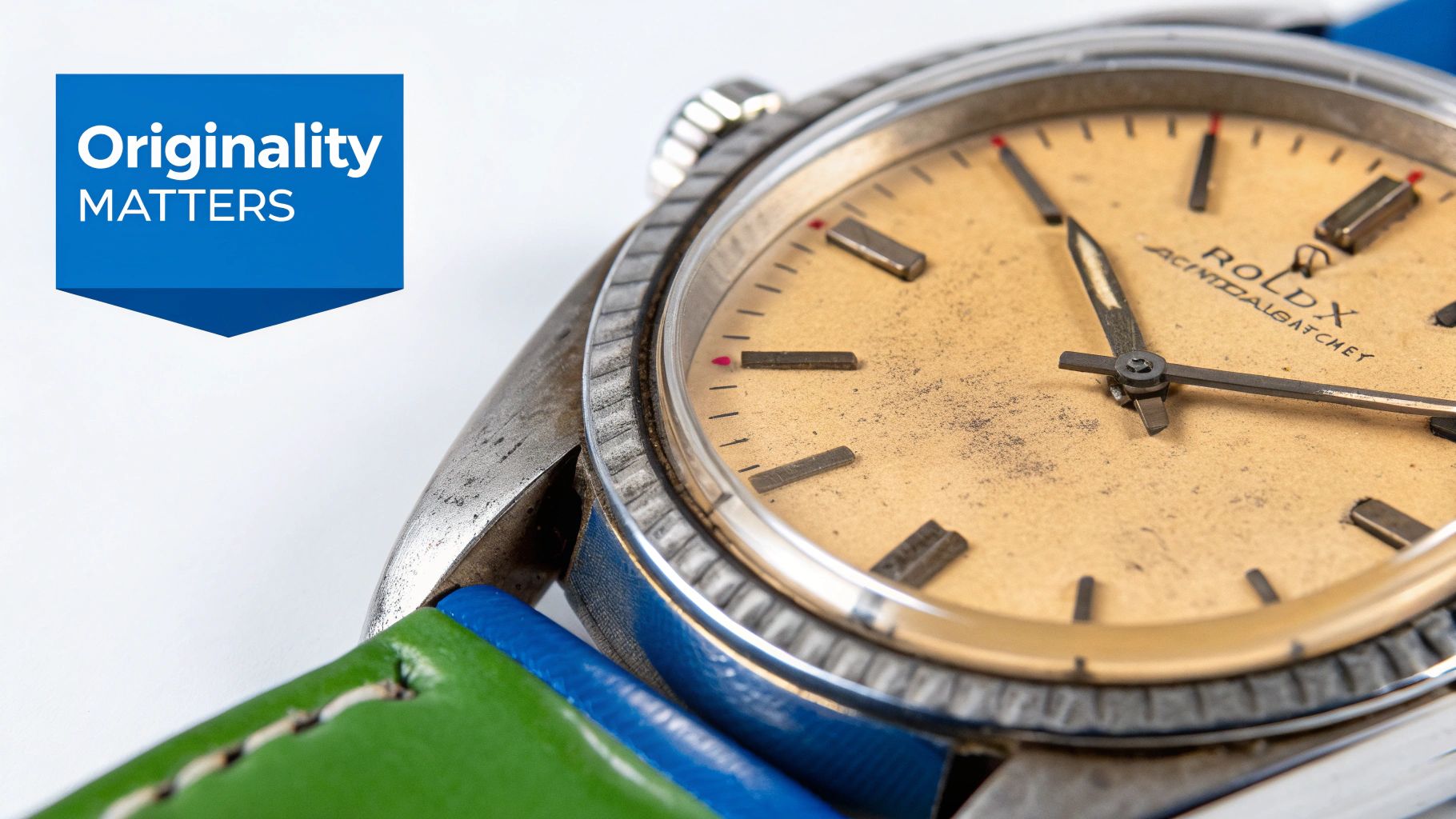
Once you get past the model and reference number, the two factors that really move the needle on the resale value of Rolex watches are condition and originality. This is what separates a good watch from a truly exceptional, investment-grade timepiece. It’s like learning to spot the subtle brushstrokes that reveal a masterpiece.
Think of a vintage Rolex like a classic car. A 1960s Ferrari with its original engine, paint, and interior is infinitely more valuable to a collector than one retrofitted with modern parts—even if those new parts make it run "better." The soul of the car is in its history and authenticity. The very same principle applies to Rolex watches.
The Collector’s Obsession with Originality
In the world of high-end watch collecting, originality is king. This means every single component of the watch—from the dial and hands to the bezel and bracelet—is the same one it left the factory with decades ago. A watch in this state is considered "all original" and will always command a serious premium.
Collectors prize these untouched pieces because they are historical artifacts. Each fade, mark, and imperfection tells the story of the watch's life. When you replace these original parts, even with genuine Rolex service parts, you risk erasing that history and, in turn, torpedoing its collector value.
When assessing a Rolex, just remember the collector's mantra: Originality over perfection. A brand-new, factory-fresh look is often far less desirable than the authentic, time-worn character of an original piece. This is a core concept that drives the entire vintage market.
This is why a watch with a slightly faded "ghost" bezel or a dial that has developed a creamy, even "patina" can be worth thousands more than a pristine, modern version. These aren't flaws; they're badges of honor that simply can't be faked. Verifying these original components is a crucial step, and our comprehensive guide on how to authenticate a Rolex watch can help you spot the key details.
What Does "Unpolished" Really Mean?
You’ll hear the term "unpolished" thrown around a lot in the pre-owned Rolex market. This refers to a watch case that has never been touched by a polishing wheel during a service. While polishing can buff out surface scratches and make a watch look new, it also shaves off a microscopic layer of metal each time.
Over-polishing is the enemy of value because it softens the sharp, crisp lines and chamfers (the beveled edges) that define the watch's original architecture. An unpolished case still has those factory-fresh edges, proving its integrity and originality.
- Sharp Lugs: The points where the bracelet connects to the case should have defined, sharp edges, not rounded or soft ones.
- Defined Bevels: The original chamfered edges should be clearly visible and consistent all the way around the case.
- Thick Crown Guards: On sports models, the guards protecting the winding crown should look thick and robust, not thin and worn down.
A seasoned collector can spot a polished case from across the room. Keeping that original finish is one of the single most effective ways to protect the long-term resale value of your Rolex. Each polish is like sanding away a piece of its history—and its worth.
The Role of Components in Overall Value
Beyond the case, every single part of the watch contributes to its final price tag. Even the smallest details can have a major financial impact.
A vintage Submariner with its original "rivet" style bracelet is far more valuable than the same watch head fitted with a later, more modern bracelet. In the same way, a dial with original tritium lume plots that have aged to a beautiful pumpkin color is more sought-after than one where the lume has been replaced or has degraded poorly.
Understanding these nuances is what separates a casual owner from a savvy investor. By learning to appreciate the beauty in imperfection and the value in originality, you can navigate the market much more effectively and protect the integrity and resale value of Rolex watches in your collection.
The Importance of Box Papers and Provenance
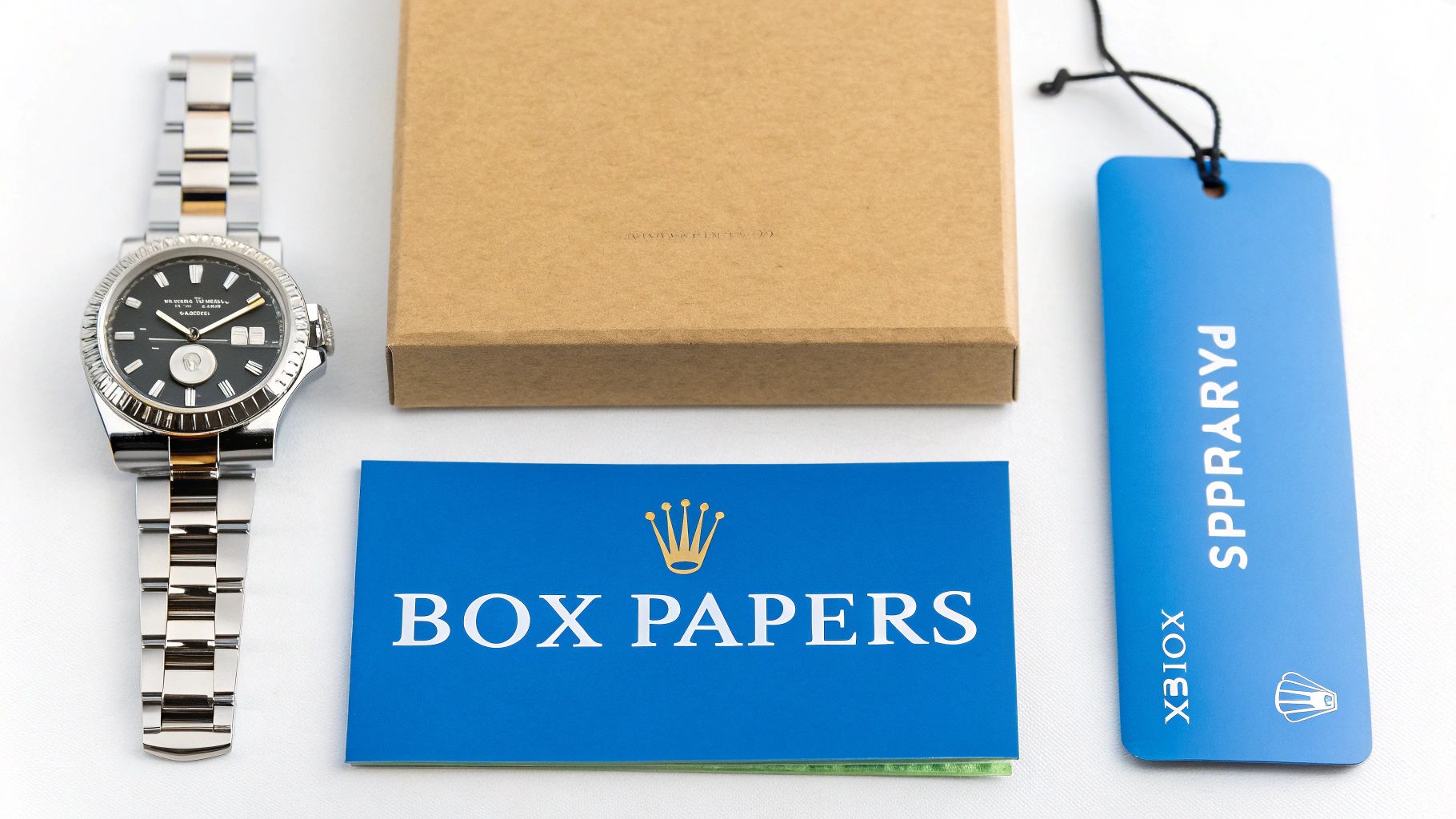
When you buy or sell a pre-owned Rolex, you're not just trading a piece of machinery; you're trading its story. The components that tell this story—the original box, warranty card, manuals, and hang tags—are absolutely critical.
We call this collection of items "box and papers," and they do way more than just accessorize the watch. They authenticate its entire journey, from the moment it left the Rolex factory to the present day.
Think of it this way: a watch by itself is like a classic car without its original title or service records. It might look incredible and run perfectly, but there’s always a little cloud of uncertainty hanging over it. The papers are the watch’s birth certificate, proving where and when it was sold, while the box is its original home. Together, they create what collectors call a “full set.”
A full set gives a buyer immediate confidence and peace of mind, confirming the watch's authenticity and lineage. That confidence translates directly into dollars and cents. A Rolex sold as a full set can easily command a premium of 15% to 25% over an identical "naked" watch (one without its box or papers). For certain rare or vintage models, that premium can be even higher.
Understanding the Power of a Full Set
A complete Rolex set provides an unbroken chain of ownership and authenticity, something that's priceless in the pre-owned market. It’s the closest you can get to buying the watch brand new from an authorized dealer. Each piece of the set plays a specific role in building this narrative and boosting the resale value of Rolex watches.
Here’s what you'll typically find in a full set:
- Original Box: This includes both the outer cardboard sleeve and the iconic inner green presentation box.
- Warranty Card/Certificate: This is the most crucial document. It features the watch’s unique serial number, model number, and the original date and place of purchase.
- Instruction Manuals: Booklets specific to the watch’s model and movement.
- Hang Tags: You should see two: the green chronometer tag and the plastic tag with the serial number.
- Bezel Protector: A small, simple plastic ring used to protect the bezel during shipping.
When all these items are present and in good shape, it tells a potential buyer that the original owner was meticulous. It shows they cared for their purchase, a trait that future owners value highly. It simply removes doubt and adds a layer of security that makes the watch far more desirable.
When History Makes a Watch Priceless
Beyond the standard box and papers lies the far more romantic and powerful concept of provenance. This is all about the documented history of a watch's ownership, especially if it belonged to someone famous or was present during a significant historical event.
While a full set might add a nice percentage to a watch's value, exceptional provenance can multiply it by an insane amount.
Provenance is the story that transforms a luxury item into a historical artifact. It’s the invisible thread connecting the watch to a person, a place, or a moment in time, making it truly one-of-a-kind.
Look no further than the legendary Rolex "Paul Newman" Daytona owned by Paul Newman himself. The watch, a gift from his wife, was beautifully engraved with the words "DRIVE CAREFULLY ME." On its own, the reference 6239 is an incredibly valuable watch. But with that irrefutable, personal connection to the actor and racing icon, it sold at auction for a mind-blowing $17.8 million. That's the ultimate example of provenance in action.
Of course, not every watch has a celebrity story behind it. But even simple provenance can add real value. Original purchase receipts, service documents with the owner's name, or even old photos of the watch being worn can help build its history and make it more appealing to collectors. In the world of high-end collectibles, a compelling and verifiable story is often the most valuable part of the package.
Diving Into Rolex Market Dynamics and Pricing
To really get why a pre-owned Rolex holds its value so well, you have to look beyond the watch itself and see the financial world it lives in. The market for second-hand Rolexes isn't some isolated bubble. It's a living, breathing ecosystem shaped by global economics, the mindset of collectors, and Rolex's own brilliant (and often secretive) strategies. Getting a handle on these forces is a bit like learning to read the stock market—it lets you see the full picture.
At its heart, it all boils down to classic supply and demand. Rolex is famously tight-lipped about how many watches they make, but it’s an open secret that the supply of their hottest models—especially the professional steel sports watches—is deliberately kept way below what the world wants. This masterful control over scarcity is what creates those infamous waiting lists at authorized dealers and, in turn, fuels a red-hot secondary market where watches often sell for a hefty premium.
How Rolex Steers the Ship
One of the biggest factors propping up pre-owned prices is something Rolex does itself: its annual price adjustments. Almost every year, Rolex raises the manufacturer's suggested retail price (MSRP) on its new watches. This isn't just a simple tweak for inflation; it's a calculated move that sends ripples across the entire market.
Think of the MSRP as the starting line for all Rolex pricing. When Rolex moves that line forward, it pulls everything else up with it. A Submariner that was already selling for more than its old retail price now has a new, higher retail price to be measured against. Naturally, its secondary market value climbs as a result. This combination of strategic pricing and managed scarcity is why so many of their watches consistently trade above retail. As those retail prices creep up, they lift the entire pre-owned market, which is fantastic news for anyone holding a well-kept piece. You can find more expert takes on Rolex’s investment value here.
The Influence of Economic Tides
What’s happening in the wider world economy plays a huge part, too. When times get uncertain or inflation starts to bite, people often flock to tangible assets like gold, art, and, you guessed it, high-end watches. Investors start looking for "safe havens" to park their wealth, and a Rolex has proven time and again to be a solid, portable store of value.
On the flip side, a major economic downturn can cool things off a bit, causing secondary market prices to dip from their highs. But here’s the thing about Rolex: thanks to the brand's immense prestige and carefully managed supply, their values are far more resilient than most other luxury goods. They might wobble, but they rarely crash, making them a true blue-chip collectible.
A Rolex is more than a watch; it's a form of currency recognized worldwide. Its value is underpinned not just by its materials and craftsmanship but by decades of strategic brand management that has made it a blue-chip asset in the world of collectibles.
The New Game: Certified Pre-Owned
Just recently, Rolex decided to step into the secondary market in a big way with its Rolex Certified Pre-Owned (CPO) program. This move allows a select few authorized dealers to sell authenticated, serviced pre-owned watches that come with a fresh two-year international Rolex guarantee.
This is a game-changer, and it affects the market in a few key ways:
- It Validates the Secondary Market: With Rolex officially in the game, it removes a lot of doubt and adds a huge layer of trust. This encourages new buyers who might have been hesitant to jump in.
- It Sets a New Price Bar: CPO watches are generally priced at a premium. This creates a new, higher benchmark for what a professionally vetted, top-condition pre-owned Rolex should cost.
- It Cements Long-Term Value: By putting a factory warranty on a used watch, Rolex is making a powerful statement: these timepieces are built to last and are intended to hold their value for generations.
By understanding how these forces connect—Rolex's own pricing moves, shifts in the global economy, and new programs like CPO—you can make much smarter decisions, whether you're buying your first Rolex or selling a cherished piece from your collection.
Maximizing Your Return When Selling a Rolex
When it's finally time to part with your Rolex, a few smart moves can make a massive difference in the offer you get. Cashing in successfully isn't just about posting an ad online. It’s about being thoughtful with your preparation, servicing decisions, and where you choose to sell.
Getting these final steps right is how you lock in the maximum resale value of Rolex watches—the value you've worked so hard to maintain.
Think of preparing your watch like staging a home before an open house. You want to present it in the best possible light, showing off its strengths while being completely honest about its history.
Start with a gentle but detailed cleaning. A simple wipe with a microfiber cloth goes a long way, removing fingerprints and dust to instantly boost its appeal. Then, pull together every piece of paperwork you have: the original box, warranty card, receipts, and any service records. A complete set tells a story of authenticity and care, building buyer confidence and justifying a higher price tag.
To Service Or Not To Service
One of the biggest decisions you'll face is whether to service the watch before selling. This isn’t a simple yes or no. The right answer really hinges on the watch's age and its current state.
It's a bit like restoring a classic painting. Sometimes, a professional cleaning brings out its true beauty, but an overly aggressive restoration can strip away the very history that makes it valuable.
For a modern Rolex (say, less than 20 years old) that's showing some wear or not keeping perfect time, a fresh service from an authorized center can be a huge asset. It gives the next owner total peace of mind, confirming the watch is authentic, water-resistant, and running flawlessly. That service paper is like a clean bill of health and often adds real money to its value.
But for a vintage Rolex, an official service can be a disaster. Rolex's standard procedure is to make a watch look brand new, which means replacing aged parts like the dial, hands, and bezel with modern replacements. While the watch looks pristine, this process erases the unique patina and originality that collectors will pay a premium for. In this situation, you’re far better off selling the watch as-is or finding a specialist in vintage restoration who knows how to preserve original components.
The golden rule for vintage pieces is simple: do not replace original parts. A true collector will always choose a watch with an original, faded "ghost" bezel over one with a shiny new factory replacement. Originality is everything when it comes to maximizing a vintage model's value.
Choosing Your Selling Avenue
Where you sell your Rolex is just as important as how you prepare it. Every sales channel offers a different mix of profit, convenience, and security.
-
Selling to a Trusted Dealer: This is usually the fastest and safest way to go. Reputable dealers like ECI Jewelers have the market knowledge to give you a fair, on-the-spot valuation and offer. You might get a bit less than a private sale to cover their margin, but you skip all the risks, negotiation headaches, and potential scams.
-
Selling via Auction: If you have an exceptionally rare piece or one with significant provenance, a major auction house could be your best bet. They connect you to a global network of serious collectors and can sometimes hit record-breaking prices. Just be aware the process is slow, and their commission fees can be quite high.
-
Private Sale: Going direct to another person through online marketplaces can net you the highest profit since there's no middleman. However, this path is also loaded with the most risk. You’re responsible for everything—vetting buyers, securing payment, and managing insured shipping. It takes a lot of time and effort.
Ultimately, the right strategy is the one that fits your goals. For a secure, hassle-free sale that gets you a fair price, a trusted dealer is hard to beat. By preparing your watch carefully, making a smart call on servicing, and picking the right place to sell, you’ll be in a great position to get an excellent return on your investment.
Frequently Asked Questions
When you're dealing with the Rolex secondary market, a lot of questions can pop up, especially when there's serious money involved. We've put together answers to some of the most common ones to help you navigate buying, selling, and protecting the resale value of Rolex watches.
Does An Official Rolex Service Ever Decrease Value?
It's surprising, but yes—it absolutely can, particularly with vintage models. When you send a watch to Rolex for service, their goal is to make it look and run like it just left the factory. That often means replacing aged parts like the dial, hands, or bezel insert with brand-new service components.
For a collector, however, originality is everything. They will pay a premium for the unique character of a faded "ghost" bezel or a dial that has developed a warm, creamy patina. Replacing those parts effectively erases the watch's history and can crush its value. A recent service is great for a modern Rolex, but for a vintage treasure, it's often best to leave it as-is.
Is Selling To A Dealer Better Than Selling Privately?
This really comes down to what you value most: speed and safety, or the absolute highest price. Selling to a reputable dealer is hands-down the fastest, safest, and easiest way to go. You'll get a fair market offer right away without the headaches of finding a trustworthy buyer, dealing with negotiations, or worrying about scams. The trade-off is a slightly lower price to cover the dealer's overhead.
Going the private route might get you a bit more cash, but it's a lot more work and comes with real risks. You're on the hook for everything—marketing the watch, vetting buyers who might be scammers, and figuring out secure payment and insured shipping. For most people, the peace of mind and convenience a trusted dealer offers is well worth it.
How Much Do The Box And Papers Really Add?
A "full set"—meaning the original box, warranty card, and manuals—can boost a Rolex's value by 15% to 25%. For some rare models, that number can be even higher. Think of these items as the watch's birth certificate; they provide undeniable proof of its authenticity and origin story.
Buyers have immense confidence in a full set, making the watch far more desirable and easier to sell. A watch without these items is considered "naked" and will almost always fetch a lower price, making the box and papers a crucial part of the investment.
Will My Rolex Always Go Up In Value?
While many of Rolex's professional steel sports models have an incredible history of appreciation, there's no such thing as a 100% guarantee. The market is always shifting based on the economy, collector tastes, and new releases.
That said, Rolex has proven to have stronger value retention and growth than nearly any other luxury brand out there. This track record makes it one of the most stable and reliable watch investments you can make, and history shows it tends to reward owners who play the long game.
At ECI Jewelers, we provide expert appraisals and transparent, fair offers for luxury timepieces. Whether you're ready to sell, trade, or find your next investment piece, our team is here to give you a seamless and trustworthy experience. Take a look at our curated collection or get a free valuation today.


