

When you hear the names Tissot, Longines, Tudor, and TAG Heuer, what comes to mind? For many, it's the perfect sweet spot: Swiss craftsmanship, a rich brand heritage, and timeless design, all without a stratospheric price tag. These are the brands that offer an inviting doorway into the world of fine watchmaking, delivering serious value that lasts a lifetime.
Your First Step into Fine Timepieces

Dipping your toes into the world of fine watches can feel like a big deal, maybe even a little intimidating. It doesn't have to be. Think of this guide as your personal roadmap to finding a watch with real meaning, something that will be with you for years to come—not just a flashy accessory for a season.
Let's clear something up right away: "luxury" doesn't have to mean a price tag that requires a second mortgage. In the "entry-level luxury" space, the focus is less on the cost and more on the incredible value you get. We're talking about the meticulous craftsmanship, the history baked into the brand, and the kind of thoughtful design that makes a watch feel special.
It’s the difference between a mass-produced t-shirt and a handmade leather wallet. One is temporary, the other is built to get better with age.
What You Will Discover
This guide is your introduction to the fascinating world of horology—the art and science of keeping time. We'll break down the core things that elevate a watch from a simple gadget to a piece of mechanical art you can wear every day. Our goal is to arm you with the confidence to start a collection you'll be genuinely proud of.
Here’s a look at what we’ll cover:
- The Pillars of Quality: We'll dig into what separates a true luxury piece from a standard watch, looking at everything from the movement ticking inside to the materials used for the case and crystal.
- Iconic Brands and Models: You'll meet the key players like Longines and Tudor and discover the specific models that punch way above their weight, offering the perfect starting point.
- Making an Informed Choice: Get practical advice on things like water resistance, different movement types, and case sizes, so you can pick a watch that actually fits your life.
Think of your first luxury watch not as an expense, but as an investment in a tradition of excellence. It's a daily companion that connects you to a legacy of innovation and timeless style, becoming a part of your personal story.
At the end of the day, finding the right entry-level luxury watch is about discovering a piece that just clicks with you. It’s a sophisticated hobby that only gets more rewarding the deeper you go. Whether you're marking a milestone or just have an appreciation for great engineering, this guide is here to help you make a choice that brings a little joy every time you glance at your wrist.
Let’s get started.
What Makes a Watch Entry-Level Luxury?
So, what’s the real difference between a simple accessory and an "entry-level luxury" watch? It’s a question that goes way beyond the price tag. Think of it like this: anyone can buy a fast-fashion jacket that looks good for a season, but a well-made leather jacket gains character and lasts for decades. That’s the leap we’re talking about.
A fashion watch is designed to catch a trend. An entry-level luxury watch is engineered to perform beautifully for a lifetime. This distinction really boils down to three core pillars that separate a disposable item from a true horological investment.
The Foundation of Quality Materials
The first thing you can actually feel is the quality of the build. These aren't just cosmetic upgrades; they are deliberate choices made to ensure the watch can handle daily life and still look incredible years down the road. You’ll find the best entry-level luxury watches are built with materials that are leagues ahead of the norm.
Here’s what you should be looking for:
- Sapphire Crystal: Unlike the mineral glass on cheaper watches that scratches if you look at it wrong, sapphire crystal is virtually impervious to daily wear. In fact, only a diamond can reliably scratch its surface, keeping your watch face clean and clear.
- 316L Stainless Steel: This is the good stuff—surgical-grade steel known for its exceptional resistance to corrosion and a brilliant finish. It has a satisfying heft on the wrist and won't tarnish or ding easily like lower-grade metals.
- High-Quality Straps and Bracelets: You'll notice the difference immediately. A quality bracelet has solid links and a secure clasp that clicks shut with authority. A leather strap will be made from genuine, durable hides that don’t just last but actually look better as they age.
These materials are the building blocks. They ensure your investment looks and feels premium from the moment you put it on.
The Heartbeat of a Swiss Movement
Under the dial is where the magic really happens. While most fashion watches run on cheap, mass-produced quartz movements, the hallmark of an entry-level luxury watch is almost always a reliable Swiss mechanical movement. These are intricate little engines, a symphony of tiny gears, springs, and jewels working in perfect harmony to keep time.
Most brands in this category use robust, proven movements from specialized makers like ETA or Sellita. These are the workhorses of the Swiss watch industry, respected for being incredibly reliable and easy for any qualified watchmaker to service. This means your watch can be maintained for generations.
A Swiss movement is more than just a component; it's a connection to centuries of horological tradition. It represents a commitment to precision engineering that battery-powered watches simply cannot replicate.
Brand Heritage and Design Integrity
Finally, what truly cements a watch in the luxury category is its story. We’re talking about brands like Longines, Tissot, and Tudor that have histories stretching back over a century. These are companies that pioneered innovations, supplied watches for historic expeditions, and created designs so iconic they’ve remained relevant for decades.
This heritage is what fuels their design integrity. An entry-level luxury watch isn’t chasing fleeting trends. Its design is timeless, often pulling from the brand’s own archives to create something that feels both classic and perfectly modern. You’re not just buying a time-telling device; you're buying a piece of a legacy.
This blend of prestige and heritage has made the market for these watches, typically priced between $1,000 and $3,000, explode in recent years. In fact, a Deloitte Swiss Watch Industry report highlighted that nearly 58% of buyers prefer not to spend more than approximately $1,650, showing just how vital this accessible luxury segment is.
Put these three pillars together—premium materials, a quality Swiss movement, and a strong brand heritage—and you have the definition of an entry-level luxury watch. It’s an investment in enduring quality, not just a purchase.
Top Brands and Models to Start Your Collection
Alright, you've got the basics down on what makes a watch tick—both literally and in the world of luxury. Now for the fun part. We're moving from theory to the actual hardware, shining a spotlight on the specific brands and models that have earned their stripes as the best entry level luxury watches out there. These are the timepieces that give you an incredible mix of history, performance, and style, making them a perfect place to start your collection.
Every brand brings a little something different to the table. Think of it like looking at car manufacturers. Some are known for building rugged, off-road beasts, while others focus on sleek, high-performance track cars. It's the same with watches—some brands are masters of the dive watch, while others own the skies with aviation pieces or craft elegant dress watches.
This infographic breaks down the three pillars you should look for in any of these top brands: Craftsmanship, Heritage, and Materials.
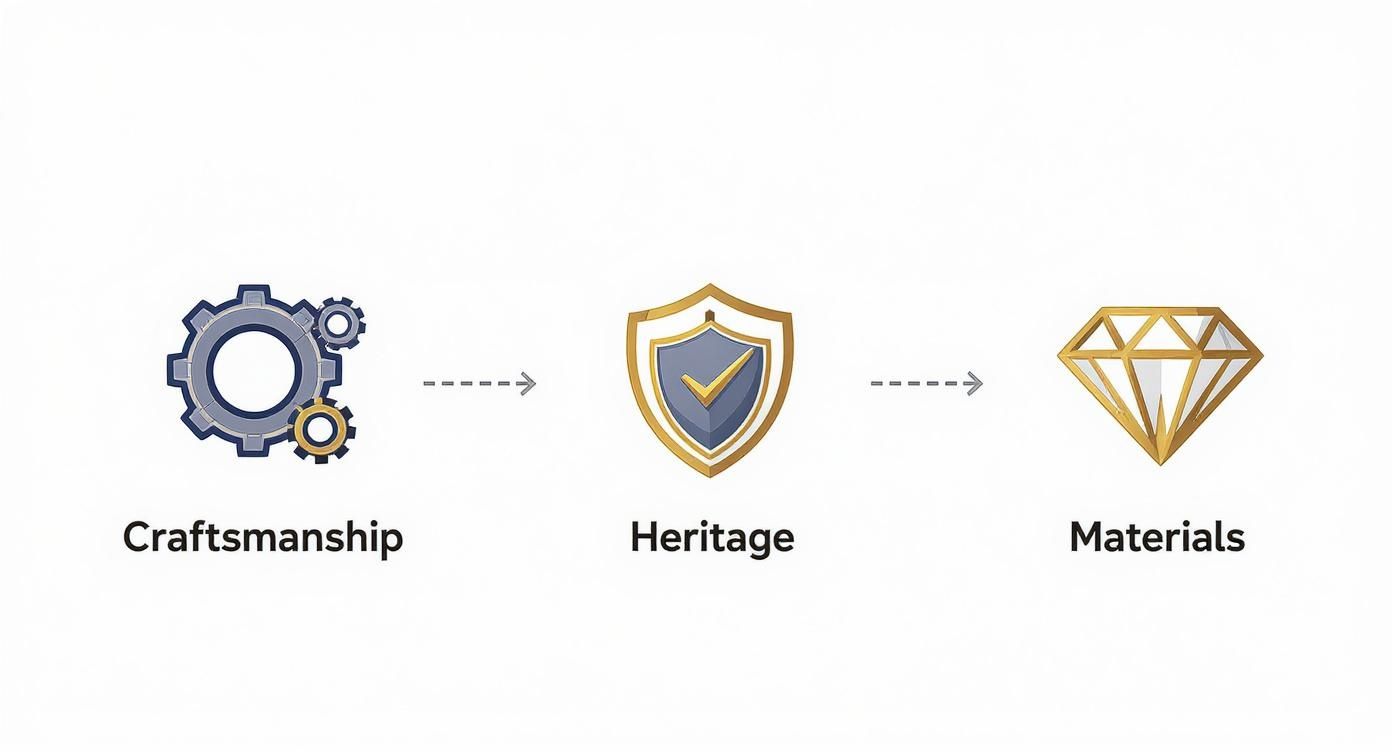
It’s a great reminder that a true entry-level luxury watch isn't about just one thing. It's a perfect storm of precision engineering, a compelling backstory, and top-notch components that are built to last.
Longines: A Legacy of Elegance and Adventure
Longines has a seriously impressive history, founded way back in 1832. They have deep roots in both aviation and sports timing, which gives their watches a fantastic duality. You'll find everything from classy dress watches to tough tool watches, all backed by the engineering muscle of the Swatch Group.
Two models are perfect starting points:
- The HydroConquest: This is Longines’ take on the classic dive watch. It’s a handsome, tough-as-nails timepiece with 300 meters of water resistance, a scratch-proof ceramic bezel, and a rock-solid automatic movement. It's the perfect choice if you want a versatile, do-it-all sports watch that looks great at the office and by the pool.
- The Spirit: Pulling from its rich aviation history, the Spirit collection has that cool, vintage pilot's watch vibe. With its oversized crown, super-readable dial, and chronometer-certified movement, the Spirit delivers killer accuracy and a great story. This one’s for the collector who geeks out on history and precision.
Tudor: The Modern Contender with a Royal Lineage
Tudor is often called Rolex's younger sibling, and for good reason—it was started by the same guy, Hans Wilsdorf. The whole idea was to offer Rolex-level quality and reliability at a more approachable price. But in the last few years, Tudor has stepped out of that shadow and become a powerhouse, loved by enthusiasts for its neo-vintage designs and fantastic in-house movements.
The Black Bay series is the undisputed star of the show.
The Tudor Black Bay is arguably the king of entry-level luxury dive watches. It perfectly captures the spirit of vintage 1950s divers while incorporating modern manufacturing and robust, often in-house, movements. It’s a watch that commands respect from even the most seasoned collectors.
The Black Bay 58 and the newer Black Bay 54 are huge hits because their cases are perfectly proportioned for almost any wrist. Owning a Tudor gives you a direct link to the Rolex legacy, phenomenal build quality, and a design that’s both timeless and just plain cool. It’s a fantastic first "serious" watch. To see where Tudor fits in the bigger picture, you can check out our guide on top luxury watch brands.
TAG Heuer: The Spirit of Racing and Avant-Garde Design
TAG Heuer’s story is forever linked with motorsport, a connection that gives its watches a sense of speed and precision. The brand is famous for its chronographs (watches with a stopwatch function) and has a bold, sporty look that clicks with people who live a dynamic life. While their high-end stuff can get pricey, their entry-level watches are a great way to get into the brand.
Consider these two icons to start:
- The Formula 1: This collection is a fun, colorful, and durable entry into Swiss watches. You can often get it with either a quartz or automatic movement, making it a tough, reliable sports watch that carries the brand's racing DNA without the huge price tag.
- The Aquaracer: As TAG Heuer's dedicated dive watch, the Aquaracer goes head-to-head with the Longines HydroConquest. It has a bold, angular design, 300 meters of water resistance, and a dependable automatic movement. It’s a killer choice if you want a modern, aggressive-looking diver from a brand with serious name recognition.
To give you a quick way to compare these excellent starting points, we've put together a simple table.
Comparison of Top Entry Level Luxury Watch Models
| Model | Brand | Movement Type | Approx. Price ($USD) | Best For |
|---|---|---|---|---|
| HydroConquest | Longines | Automatic | $1,500 - $2,500 | Versatile, everyday sports watch |
| Black Bay 58 | Tudor | Automatic (In-house) | $3,500 - $4,500 | Vintage-inspired style & quality |
| Aquaracer | TAG Heuer | Automatic | $2,000 - $3,500 | Modern, bold dive watch design |
| Spirit | Longines | Automatic (COSC) | $2,500 - $3,500 | History buffs & precision lovers |
| Formula 1 | TAG Heuer | Quartz/Automatic | $1,000 - $2,000 | A fun, durable entry to a Swiss brand |
This table helps lay out the key differences, but the best watch is always the one that speaks to you and fits your lifestyle.
The popularity of these brands isn't just talk among watch nerds; it's backed by market data. Brands known for accessible luxury have seen huge sales volumes. For example, Breitling, which has many models in this same price bracket, sold around 160,000 watches in a recent year. This shows just how strong the demand is for timepieces that mix Swiss engineering with a name people recognize.
Essential Features to Look for in Your First Watch
Diving into the world of luxury watches can feel like learning a new language. You'll hear terms like "automatic movement" and "sapphire crystal" thrown around, but what do they actually mean for the watch on your wrist? This section is your no-nonsense checklist, breaking down the features that separate a truly great timepiece from just a pretty one.
Once you know what to look for, you can see past the brand name and judge a watch on its real merits. It’s the difference between buying something that just looks good today and investing in a piece of engineering that’s built to last a lifetime. Let's decode the details that matter.
The Heartbeat of the Watch: The Movement
The movement, also called the caliber, is the engine that makes your watch tick. It’s the single most important part, defining how the watch keeps time and what it feels like to own. In the entry-level luxury space, you’ll mainly run into three types.
- Quartz Movement: This is your battery-powered option. It's incredibly accurate and low-maintenance, but it lacks the soul and intricate craftsmanship that collectors really value. Think of it as the reliable, efficient engine in your daily driver.
- Manual-Wind Movement: A mechanical movement you have to wind by hand every day or two. This creates a direct, personal connection to your watch—a daily ritual that many enthusiasts love.
- Automatic Movement: The most common type you'll find in luxury watches. It’s a self-winding mechanical movement that's powered by the motion of your arm. It gives you all the artistry of a mechanical engine without needing a battery or daily winding.
For many collectors, a Swiss automatic movement is non-negotiable. It represents a connection to centuries of horological tradition—a miniature, living machine on your wrist that is a marvel of engineering.
While quartz is dead-on accurate, the sweeping second hand and visible mechanics of an automatic movement are a huge part of the luxury experience. To dive deeper, you can learn more about automatic vs. quartz movements in our detailed guide.
The Unseen Shield: Sapphire Crystal
The "glass" covering the watch face is called the crystal. For any luxury watch worth its salt, there's only one material you should accept: sapphire crystal. Cheaper watches often use mineral or acrylic crystals, which get scratched up from everyday bumps against desks, walls, and zippers.
Sapphire, however, is one of the hardest substances on earth. It's virtually scratch-proof; only something like a diamond can really damage it. This means that years from now, the face of your watch will still look pristine and clear, protecting your investment and keeping it looking brand new.
Sizing It Up: Case Diameter and Lug-to-Lug
A watch that wears too big or too small can ruin an otherwise perfect design. The number everyone talks about is case diameter, but the secret spec that really matters for fit is lug-to-lug.
- Case Diameter: This is just the width of the watch case, not including the crown. For men's watches, this typically ranges from a classic 36mm to a large 44mm.
- Lug-to-Lug: This is the distance from the top set of lugs (the "horns" where the strap attaches) to the bottom set. This measurement is what truly determines how the watch spans across your wrist.
A watch might have a large diameter but short lugs, making it wear smaller than you'd think. The golden rule is to make sure the lugs don’t hang over the edges of your wrist. That’s the key to a comfortable and proportional fit.
Water Resistance: What the Numbers Mean
Water resistance ratings can be seriously misleading. They’re based on tests in a static, controlled lab, not in a real-world swimming pool. Here’s a simple guide to what those numbers actually mean for you.
| Rating | What It Really Means |
|---|---|
| 30 meters | Splash resistant. It's fine for washing your hands, but that's it. |
| 50 meters | Okay for a light swim in a pool. Don't go diving or do cannonballs. |
| 100 meters | A fantastic all-rounder. Safe for swimming, snorkeling, and most water fun. |
| 200+ meters | A true dive watch. Built for recreational scuba diving and serious water sports. |
For a versatile, do-it-all watch, 100 meters of water resistance is the sweet spot. It gives you the peace of mind to handle anything from a surprise rainstorm to a spontaneous beach trip. This level of durability is a hallmark of the best entry-level luxury watches.
Choosing Between New and Pre-Owned Watches
One of the biggest decisions you'll face when buying your first serious watch is whether to go brand-new or explore the pre-owned market. This isn't just about price—it's about choosing between two completely different ownership experiences. Each path has its own set of pros and cons.
The best way to think about it is like buying a car. A new car gives you that perfect, untouched feeling and a full warranty, but it also takes a depreciation hit the second you drive it off the lot. A certified pre-owned car, however, can save you a serious chunk of change while still offering proven reliability. The watch world works in a very similar way.
The Allure of a Brand-New Watch
There's something special about buying a watch new from an authorized dealer. It's an event. You get the pristine box, the satisfaction of peeling off the protective plastics, and the certainty that you're the very first person to wear it. This route offers total peace of mind.
Key benefits of buying new include:
- Full Manufacturer's Warranty: This is a huge draw. Your watch is covered for several years against any manufacturing defects, which is a great safety net for your investment.
- Pristine Condition: You get a flawless timepiece with zero scratches, dings, or signs of wear. It's perfect.
- The Unboxing Experience: For many collectors, the ceremonial unboxing is a major part of the joy of getting a luxury item.
But, this perfection comes at a price. New watches are sold at a fixed retail price, and like that new car, certain models can lose a portion of their value the moment you walk out of the store.
Unlocking Value in the Pre-Owned Market
The pre-owned or "secondary" market is where you'll find some of the best deals, and it's where many seasoned collectors spend their time. This route is about more than just savings; it opens up a world of variety you simply won't find at a retail boutique.
For instance, the secondary market for entry-level luxury watches has grown remarkably, proving these timepieces have lasting appeal. Brands like Omega and TAG Heuer have steadily increased their market share in pre-owned sales, with Omega's growth being especially strong over the last three years. This trend is fueled by collectors who appreciate great craftsmanship and history at every price point.
The pre-owned market isn't a "second-best" option. It's a strategic move that gives you access to a much wider range of models, including discontinued classics, often at a price that has already stabilized against initial depreciation.
Navigating the Secondary Market Safely
Dipping your toes into the pre-owned world requires a bit more homework, but the rewards are well worth it. Your main goal is to find a trusted source who guarantees authenticity and can give you a transparent history of the timepiece.
Here are a few essential tips for a secure pre-owned purchase:
- Work with Reputable Dealers: Stick to established sellers with a long track record of positive reviews and, if possible, a physical storefront. They have a reputation to protect and are your best defense against fakes.
- Verify Authenticity: A trustworthy dealer will always stand by the authenticity of their watches. To learn more about how this is done, you can explore our detailed guide on what certified pre-owned watches truly offer.
- Insist on "Box and Papers": This means the original presentation box, warranty card, manuals, and sales receipt. While not always a deal-breaker for a great watch, having the full set can seriously boost its future resale value and adds another layer of provenance.
Ultimately, choosing between new and pre-owned boils down to your priorities. Do you value the pristine experience and warranty of a new watch, or are you drawn to the potential savings and unique finds on the secondary market? Either way, making an informed choice is the first step toward a purchase you'll love for years to come.
Common Questions About Starting a Watch Collection
Diving into the world of fine watches always brings up a lot of questions. That’s actually a great sign—it shows you’re starting to think like a real collector. Here, we’ll give you some clear, straightforward answers to the queries we hear most often, so you can feel confident choosing the right entry-level luxury watch.
We’ll cover everything from what you should budget and how to care for your new timepiece to whether it’s a smart investment. The goal is to give you all the info you need to make a purchase you’ll be happy with for years to come.
How Much Should I Really Spend on My First Luxury Watch?
This is always the first question, and the honest answer is pretty simple: spend what you’re comfortable with. There isn't some magic number you have to hit. The "entry-level" luxury space is pretty wide, generally falling somewhere between $1,000 and $4,000. The most important thing you can do is set a firm budget before you even start looking.
Think of it this way: your first quality watch is a starting point, not the end of the road. It's far better to buy an incredible $1,500 timepiece that you absolutely love and can afford without any financial stress than to stretch for a $4,000 piece that gives you anxiety. You want to feel a sense of joy every time you glance at your wrist, not a pang of buyer's remorse.
A little practical advice:
- Set a Clear Range: Decide on a minimum and maximum you're willing to part with before the temptation of browsing takes over.
- Think About Future Costs: Don't forget that mechanical watches need a service every 5-7 years, and that can run you several hundred dollars. It's part of the ownership experience.
- Focus on Real Value: Sometimes, paying a bit more for a watch with a superior movement, better finishing, or a stronger brand heritage is the smarter move for the long haul.
What's the Best Way to Care for My New Automatic Watch?
Owning a great automatic watch is a bit like owning a classic car; its intricate little engine needs some mindful care to keep humming along. The good news is, the day-to-day stuff is easy and often becomes a satisfying part of your routine.
If you wear it every day, the natural motion of your wrist will keep it wound. Simple as that. But if you rotate between a few watches, you'll find it might stop running after a day or two. To get it going again, just give the crown a gentle 20-30 winds by hand, set the time, and you're back in business. Whatever you do, avoid the urge to shake it back to life—a manual wind is much kinder to all those tiny, delicate parts inside.
An automatic watch is like a living machine powered by you. Wearing it regularly is the best thing for it, as this keeps the lubricants inside the movement properly distributed and prevents them from settling and getting gummy.
Beyond winding, it's all about basic upkeep. Keep it looking sharp with a soft, microfiber cloth. Try to avoid strong magnetic fields from things like big speakers, as they can mess with its accuracy. And most importantly, stick to the manufacturer's recommended service schedule. Do that, and it will perform beautifully for a lifetime.
Are Entry-Level Luxury Watches a Good Investment?
This is a question that requires a bit of nuance. While it's true that some ultra-high-end watches can famously appreciate in value, most timepieces—including those in the entry-level space—should be seen as an investment in personal enjoyment, style, and an appreciation for craftsmanship. You're buying a durable, beautiful object, not a stock or a bond.
That said, one of the best things about a quality entry-level luxury watch is its ability to hold its value incredibly well compared to a fashion watch, which often becomes nearly worthless the moment you buy it. A well-chosen piece from Tudor, Longines, or TAG Heuer can retain a huge portion of its original value, especially if you hang on to the original box and papers.
Think of it like this: you get the pleasure of wearing a beautifully engineered piece of art for years, and if you ever decide to sell it or trade up, you can get a big chunk of your initial money back. That's a pretty fantastic return on enjoyment.
What Common Mistakes Should I Avoid?
Like any new hobby, watch collecting has a learning curve. Knowing about a few common pitfalls from the get-go can save you from making a decision you'll kick yourself for later.
Here are the top mistakes to sidestep when you're buying your first piece:
- Ignoring Wrist Size: A watch that’s too big or too small for your wrist is just never going to look or feel right. Pay attention to the case diameter, but even more importantly, look at the lug-to-lug distance. That's the real key to a proportional, comfortable fit.
- Buying the Brand, Not the Watch: It's easy to get swept up by a famous name. Before you pull the trigger, make sure you genuinely love that specific model's design, its features, and how it feels on your wrist. Don't buy it just for the logo on the dial.
- Forgetting Your Lifestyle: That fragile, gold-plated dress watch on a thin leather strap is a beautiful thing, but it’s a terrible choice if you work with your hands or spend weekends hiking. Be honest about where and when you'll actually wear your watch and pick something with the right durability—especially water resistance—to match.
Keep these points in mind, and you'll be able to navigate your first purchase like a seasoned pro and end up with a watch that will be a trusted companion for years.
Ready to find the perfect timepiece to start or expand your collection? ECI Jewelers offers a curated selection of the world’s finest luxury watches, each authenticated by our expert team. Explore our inventory online or visit our NYC showroom for a personalized experience. https://www.ecijewelers.com


