


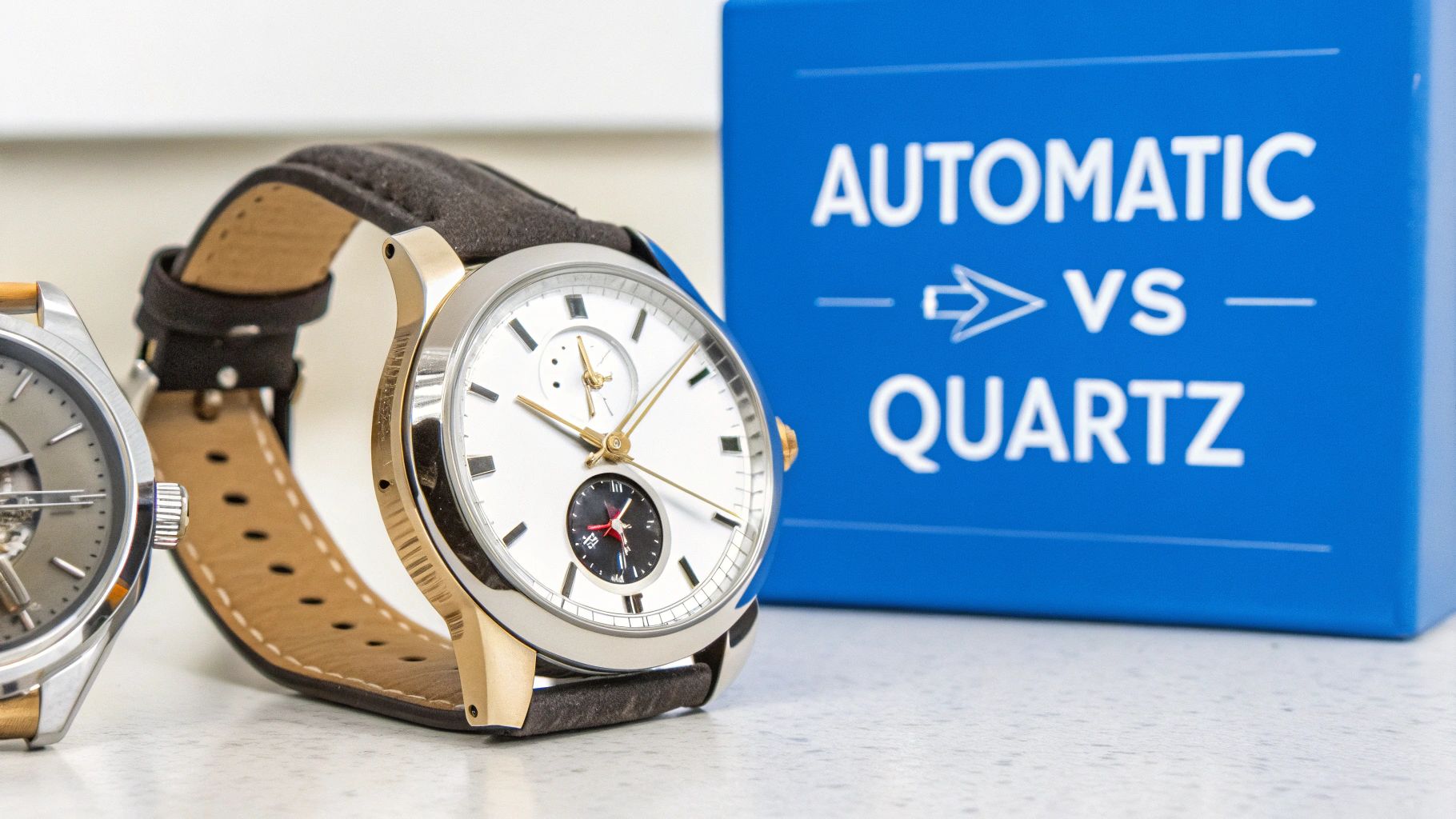
When you first get into watches, one of the biggest choices you'll face is between an automatic and a quartz movement. The difference is pretty straightforward: automatic watches run on the motion of your wrist, while quartz watches use a battery.
Your decision really boils down to what you value more—the intricate, old-world craftsmanship of an automatic or the grab-and-go precision of a quartz.
Automatic vs. Quartz: A Quick Comparison
Let's break down what really separates these two. An automatic movement is a tiny mechanical engine, a beautifully complex world of springs and gears that winds itself with your body's natural kinetic energy. Owning one is like wearing a piece of horological art.
On the other hand, a quartz movement is a product of modern electronic technology. It uses a battery to pass a current through a tiny quartz crystal, making it vibrate at an incredibly precise frequency. These vibrations drive the motor that moves the hands, giving you phenomenal accuracy with almost no fuss.
You can see the sheer complexity of a mechanical movement, like those in automatic watches, in the diagram below.
This image really highlights the intricate dance of gears, springs, and jewels required to power the watch. It’s a world away from the simpler, circuit-based design of a quartz movement.
Key Differences At a Glance
For a quick summary, this table lays out the fundamental differences you need to know when choosing between the two.
| Criteria | Automatic Movement | Quartz Movement |
|---|---|---|
| Power Source | Kinetic energy (wearer's motion) | Battery |
| Accuracy | +/- 5 to 25 seconds per day | +/- 15 seconds per month |
| Maintenance | Service every 3-5 years | Battery change every 1-3 years |
| Price | Generally more expensive | More affordable |
Ultimately, there's no "better" choice—only what's better for you. Whether you're drawn to the soul of a mechanical engine or the practicality of a battery-powered device, both have a solid place in any watch collection.
Understanding How Each Watch Movement Works
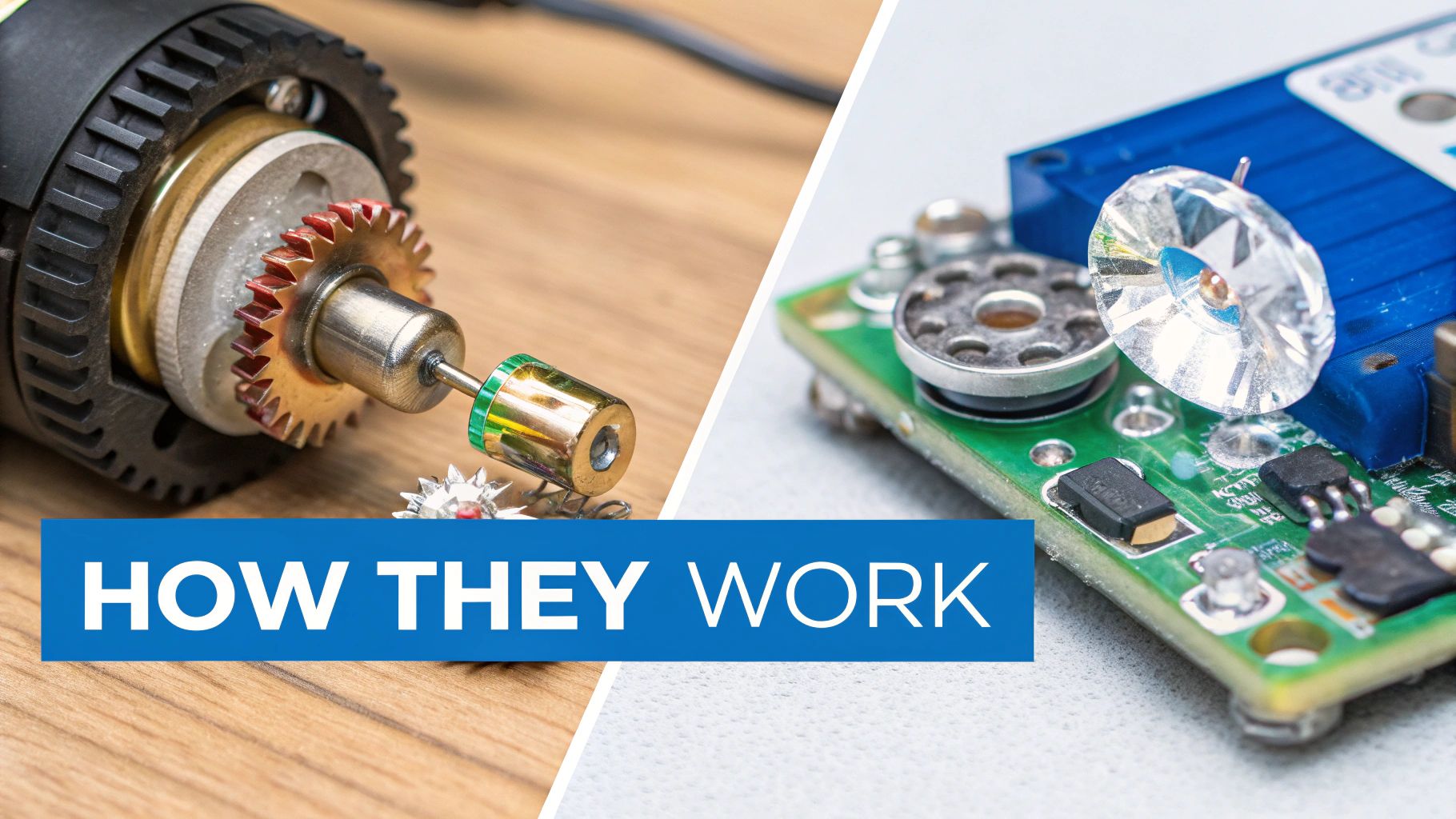
At the very core of the movement automatic vs quartz debate is a massive difference in how each watch gets its power. One is a testament to centuries of mechanical art, while the other is all about modern electronic precision. Getting a handle on these technologies is the first real step in picking the watch that's right for you.
An automatic movement is a tiny, self-powering engine you wear on your wrist—a true marvel of traditional watchmaking. It runs completely without a battery. Instead, it captures the kinetic energy you create just by moving around. A weighted rotor inside the watch spins with your arm's motion, winding the mainspring and storing up energy to drive an intricate dance of gears and wheels.
This is a purely mechanical process, and it’s a showcase of incredible, old-world craftsmanship. If you want to get into the nitty-gritty of the components, you can explore our guide on how a mechanical watch works. It’s this living, breathing mechanism that gives an automatic watch what collectors call its "soul."
The Precision of Quartz Technology
A quartz movement, on the other hand, is a different beast entirely. It’s powered by a simple battery. This battery zaps a tiny, tuning-fork-shaped quartz crystal with an electrical current, making it vibrate at an astonishingly stable frequency of 32,768 times per second.
A small integrated circuit counts these vibrations and converts them into a single electrical pulse each second. That pulse then drives a tiny motor that moves the hands.
Key Insight: The secret to a quartz watch's incredible accuracy lies in the unwavering stability of that crystal's vibrations. Where a mechanical watch can be nudged off-kilter by gravity or temperature, a quartz watch just keeps on ticking with remarkable consistency.
This blend of efficiency and reliability is what triggered the "quartz crisis" back in the 1970s and 80s, an event that almost brought the traditional Swiss watch industry to its knees. The technology suddenly made hyper-accurate timekeeping affordable for everyone.
That preference for quartz still dominates the market today. In 2023, quartz watches accounted for a massive 75% of total watch volume shipped globally. To put that in perspective, the Asia-Pacific region alone saw 45 million quartz units shipped, compared to just 5 million mechanical watches shipped worldwide. The data clearly shows just how much consumers value the accuracy and low cost that quartz movements bring to the table.
Performance and Precision: A Side-by-Side Look
When you get down to the nuts and bolts of a movement automatic vs quartz, the conversation always lands on one thing: accuracy. It’s here that the deep engineering differences really show, creating two very different experiences for the owner.
A standard quartz watch is a modern miracle of timekeeping. Its battery sends a current through a tiny quartz crystal, causing it to vibrate at an incredible 32,768 times per second. The result? Accuracy measured in seconds per month, not per day. Most will only gain or lose about 15-20 seconds a month, making them the definition of grab-and-go reliability. You can toss one in a drawer for weeks, pick it up, and it's ready to go—no questions asked.
Automatic movements, on the other hand, are a different breed entirely. They operate on a much wider tolerance, with accuracy measured in seconds per day. A good, non-chronometer-certified automatic might run anywhere from -10 to +25 seconds daily and still be considered well within spec. Even a top-tier, COSC-certified chronometer is only guaranteed to an impressive -4 to +6 seconds per day.
The Impact of the Outside World
The mechanical soul of an automatic watch is a delicate thing. Its precision is at the mercy of the world around it in ways that a quartz movement simply isn't.
- Gravity and Position: Just the way you set your watch down at night—dial up versus crown down—can slightly change the speed of the balance wheel.
- Temperature Swings: The tiny metal components inside expand and contract with heat and cold, which can throw off the timing.
- Magnetism: Get too close to a strong magnet (think speakers or tablets), and you can magnetize the hairspring, causing the watch to run wildly fast.
This image gives you a peek into the beautiful complexity of an automatic movement, including the rotor that keeps it wound.
Every single one of those tiny parts, from the mainspring to the balance wheel, has a role to play—and each adds to its sensitivity.
Power Reserve and Autonomy
Another huge point of comparison is autonomy—how long a watch will run on its own. It's less a question of which is "better" and more about two completely different philosophies of watch ownership.
For a quartz watch, autonomy is just battery life. Most will run for 1 to 3 years straight until the battery gives out. Replacing it is quick, easy, and inexpensive.
An automatic watch has a power reserve, which is the energy stored up in its mainspring. This is what keeps it ticking when you're not wearing it. Most modern automatics hold a charge for 38 to 80 hours. If you let it sit for longer, it will stop, and you’ll need to wind it and reset the time. Of course, luxury brands are always pushing the envelope; you can learn about the different Rolex movements that store power for several days.
Let's break down the key performance differences in a table.
Performance Metrics Comparison
| Metric | Automatic | Quartz |
|---|---|---|
| Accuracy | -10 to +25 seconds per day (non-certified) | +/- 15 to 20 seconds per month |
| Autonomy | 38 to 80+ hours (Power Reserve) | 1 to 3 years (Battery Life) |
| Servicing | Every 5-10 years (Complex & costly) | Every 1-3 years (Simple battery swap) |
| Sensitivity | High (Affected by magnetism, temp, position) | Very Low (Unaffected by most external factors) |
As you can see, the choice comes down to what you value most in a timepiece.
The Trade-Off: Quartz offers you years of set-it-and-forget-it convenience. Automatics, however, offer the promise of perpetual power, but only if you interact with them daily. They demand a relationship but reward it with mechanical artistry.
Long-Term Maintenance and Durability

When you’re weighing a movement automatic vs quartz, the conversation always shifts to the long haul. It’s one thing to talk about how a watch performs out of the box, but the real difference shows up years down the line in terms of upkeep and durability. The ownership experience for these two movements couldn't be more different over time.
A quartz watch is the definition of "set it and forget it." Its main requirement is a simple battery replacement every 1 to 3 years—a quick, affordable task any jeweler can handle. Beyond that, a quartz watch asks for very little, making it a reliable and fuss-free companion for everyday life. Even with luxury brands, the process is straightforward, as you can see with something like a Rolex battery change.
An automatic watch, on the other hand, demands a more intimate relationship. Its complex mechanical engine, full of tiny moving parts, needs regular servicing to stay healthy and keep accurate time. Think of it like owning a classic car; you don't just drive it, you maintain it.
Key Takeaway: Think of quartz maintenance as a quick pit stop for a new battery every few years. Automatic maintenance is more like a scheduled engine overhaul—a deep-dive service that ensures a lifetime of peak performance.
Servicing Schedules and Costs
For an automatic watch, a full service is generally recommended every 5 to 10 years, though this varies by manufacturer. This isn't just a quick tune-up; it's a meticulous process.
The service involves:
- Completely disassembling the movement down to its individual parts.
- Cleaning every single component.
- Replacing any worn-out parts and gaskets.
- Carefully reassembling and lubricating the movement.
- Testing for timekeeping accuracy and water resistance.
This comprehensive overhaul ensures the watch will run beautifully for another decade, but it’s a specialized skill that costs significantly more than a simple battery swap.
In contrast, a quartz watch gets its durability from its simplicity. With far fewer moving parts, it's naturally more resistant to the shocks and bumps of daily life. The trade-off is that its electronic circuit has a finite lifespan. An automatic watch, if properly cared for, can genuinely last for generations, becoming a treasured family heirloom.
This potential for longevity is a huge reason the luxury mechanical watch market, valued at USD 61.9 billion, continues to grow. It proves that for many enthusiasts, the investment in long-term care isn't a burden—it's part of the charm of owning a piece of timeless engineering.
Analyzing Cost and Overall Value
When you’re weighing a movement automatic vs quartz, the price tag is usually the first thing that comes to mind. But the real story is in the overall value—what you pay upfront is just the beginning. To make a smart choice, you need to look at both the initial cost and what you'll be spending down the road.
Quartz watches, without a doubt, are the kings of affordability. Their straightforward, battery-powered mechanics are just simpler and cheaper to produce. This makes them incredibly accessible, which is a huge part of their mass appeal.
You can see this play out in the market numbers. Thanks to their mix of precision and low cost, quartz watches grabbed about 70% of the market revenue share in 2023. Analysts expect that market to keep growing, which tells you just how much consumers love this technology. You can dig into the full quartz market research for a deeper look.
Understanding Price Tiers
Of course, a watch’s price isn't just about what’s ticking inside. The brand, the materials used, and the overall complexity all slot a watch into different price tiers. This chart from Wikipedia does a great job of showing the general price breakdown in the watch world.
As you can see, while there are tons of cheap quartz options, both movements exist across the spectrum, from everyday watches to jaw-dropping luxury pieces.
This is where the idea of "value" gets a little more interesting. An automatic watch usually costs more right out of the box because of the sheer craftsmanship involved. We're talking about hundreds of tiny, intricate parts, often assembled by hand. You're not just paying for a time-telling device; you're investing in a piece of mechanical art.
The Value Equation: Quartz delivers instant value with its low price and high accuracy. An automatic watch offers a different kind of value—one built on craftsmanship, the potential to appreciate over time, and the chance to become a family heirloom with the right care.
Lifetime Ownership Costs
The costs really start to diverge the longer you own the watch. For a quartz, maintenance is a breeze. Every few years, you'll need a new battery, which is a quick and cheap fix. Its long-term cost is almost nothing, built entirely around convenience.
Automatic watches are a different beast. They need a full service every 5 to 10 years. This isn't just a simple tune-up; it involves taking the entire movement apart, cleaning every component, and re-lubricating it. It’s a job for a skilled watchmaker, and it costs accordingly.
While that service is a real investment, it’s what gives an automatic watch its incredible longevity. It’s what allows it to be passed down through generations, often holding—or even gaining—value over time. That’s something your average quartz watch just can't do, adding a whole other dimension to its value.
Let's break down the costs more clearly.
Cost Breakdown By Movement Type
The table below gives you a general idea of what to expect in terms of purchase price and ongoing maintenance for both automatic and quartz watches across different market tiers.
| Cost Category | Automatic Movement | Quartz Movement |
|---|---|---|
| Entry-Level Purchase | $200 - $1,000+ (Seiko, Tissot) | $50 - $500 (Casio, Timex, Citizen) |
| Mid-Tier Purchase | $1,000 - $5,000 (Oris, Longines) | $500 - $1,500 (Tissot, Hamilton) |
| Luxury Purchase | $5,000+ (Rolex, Omega, Patek Philippe) | $1,500+ (Grand Seiko, Breitling, Cartier) |
| Routine Maintenance | $300 - $1,000+ service every 5-10 years | $10 - $60 battery change every 2-5 years |
| Long-Term Value | Can hold or appreciate in value | Generally depreciates, except for rare/iconic models |
Ultimately, the choice comes down to what you value more. Quartz offers a low-maintenance, budget-friendly experience, while an automatic offers a connection to traditional watchmaking with the potential for long-term financial and sentimental value.
Choosing the Right Movement for Your Lifestyle
All the technical specs of a movement automatic vs quartz are interesting, but what really matters is how a watch fits into your day-to-day life. The best choice always comes down to you. Your job, your hobbies, and even your personal style will steer you toward either the intricate soul of an automatic or the bulletproof reliability of a quartz.
Let's break down the specs into some real-world situations.
For the Daily Commuter and Office Professional
If your days are a steady rhythm of meetings, deadlines, and commutes, convenience is your best friend. You need a watch that’s always ready to go, dependably accurate, and looks the part without needing any fuss.
A quartz watch is the perfect sidekick for this routine. Its grab-and-go nature means you never have to think twice. Pull it out of the drawer on Monday morning, and it’s showing the correct time, right down to the second. That kind of set-it-and-forget-it reliability is a godsend when you’re trying to catch a train or make that critical client call on time.
An automatic can absolutely hold its own in an office setting, but it asks for a little more from you. If you leave it on the dresser all weekend, you’ll be resetting the time and date come Monday morning—a small, but sometimes annoying, task in a busy routine.
For the Adventurer and Athlete
When your life involves hiking, sports, or any activity with hard knocks and unpredictable conditions, you need a watch that's tough, precise, and won't let you down.
In this arena, a quartz movement often comes out on top. Because it has far fewer moving parts, it's naturally more resistant to shocks than a mechanical watch. It's no accident that high-performance quartz watches, like the Casio G-Shock DW9052, were standard issue for US Navy divers for years. They are built to take a beating in the most extreme environments.
That said, many automatic dive watches are absolute tanks. Take the Seiko Prospex "King Turtle," for instance. It's a modern icon beloved by professional and "desk divers" alike for its rugged build and incredible lume. Here, the choice boils down to whether you need the absolute peak of resilience (quartz) or prefer the old-school appeal of a mechanical tool watch (automatic).
Situational Insight: For activities where split-second timing is non-negotiable—like tracking lap times or coordinating a dive—the unwavering accuracy of a quartz movement is a huge plus. An automatic's minor daily deviation, while charming to some, could become a real factor in performance-driven scenarios.
This decision tree helps visualize the core choice: are you prioritizing low maintenance or celebrating traditional craftsmanship?

As the infographic shows, the path is pretty clear. If affordability and ease of use are your main goals, a quartz watch is the logical pick. But if a passion for fine engineering and artistry is what drives you, an automatic is the only way to go.
For the Watch Enthusiast and Collector
For those who see a watch as something more than just a tool for telling time, the whole conversation changes. A collector or a true enthusiast values the history, the artistry, and the incredible mechanical ingenuity ticking away inside the case.
This is where the automatic movement truly comes alive. Owning an automatic is an interactive relationship. You can feel the rotor spin on your wrist, you can watch the hypnotic sweep of the second hand, and you get to appreciate centuries of watchmaking history right there with you.
It's a miniature piece of mechanical art that rewards your attention. Many collectors would say this connection is what gives the watch its "soul," turning it into a potential family heirloom that, with the right care, can be passed down for generations.
Common Questions Answered
What Accuracy Can I Realistically Expect?
When you’re deciding between an automatic and a quartz movement, accuracy is one of the biggest dividing lines. A quartz watch is incredibly precise, typically losing or gaining only +/- 15 to 20 seconds per month. For most people, this means setting it and forgetting it.
An automatic, on the other hand, is a different beast entirely. Its accuracy is measured daily, not monthly. A well-regulated automatic might run anywhere from -10 to +25 seconds per day and still be performing exactly as it should. This isn't a flaw; it's just the nature of a complex mechanical engine humming away on your wrist.
Why Do Automatic Watches Need Regular Servicing?
Think of an automatic watch as a miniature, high-performance engine with hundreds of tiny parts constantly in motion. Just like a classic car, it needs a tune-up to keep running smoothly. The specialized oils that lubricate all those gears and springs break down over time, leading to friction and wear.
A full service, which we recommend every 5 to 10 years, is a complete teardown. The watchmaker disassembles the movement, cleans every component, re-lubricates it, and puts it all back together. This isn't just a repair; it's essential maintenance that prevents serious damage and ensures your watch can last for generations. A quartz watch, in contrast, just needs a simple battery swap every few years.
The Bottom Line: Servicing is proactive care, not a reaction to a problem. It’s what preserves the intricate craftsmanship of an automatic and turns it into a potential family heirloom, justifying the higher long-term cost compared to a quartz movement.
Is One Movement Better for Sports?
If you’re into high-impact sports or just need something that can take a beating, a quartz watch usually has the advantage. Its simpler design with fewer delicate moving parts makes it inherently more resistant to shocks and jolts. Plus, its consistent accuracy is a bonus for precise timing.
That said, many automatic dive watches are built like absolute tanks. Legendary pieces like the Seiko Prospex "King Turtle" are trusted by professional divers for their sheer robustness. Ultimately, any high-quality sports watch will serve you well, but for the most extreme conditions, the straightforward durability of quartz offers an extra layer of confidence.
Whether you appreciate the intricate soul of an automatic or the reliable precision of quartz, ECI Jewelers offers an authenticated collection of the world's finest timepieces. Explore our curated selection of luxury watches at https://www.ecijewelers.com and find the perfect movement for your lifestyle.


