


Before you even think about a Rolex battery change, there's a critical detail you need to know: the vast majority of Rolex watches don’t have batteries at all. The brand built its legendary reputation on intricate, self-winding mechanical movements powered by the motion of your wrist, not a battery cell.
Does My Rolex Have a Battery?
The smooth, sweeping glide of a Rolex second hand is the dead giveaway of a mechanical marvel, not a quartz timepiece. This is a fundamental distinction. While plenty of luxury watch brands offer both, Rolex has been almost exclusively dedicated to perfecting its self-winding "Perpetual" movements since patenting the technology way back in 1931.
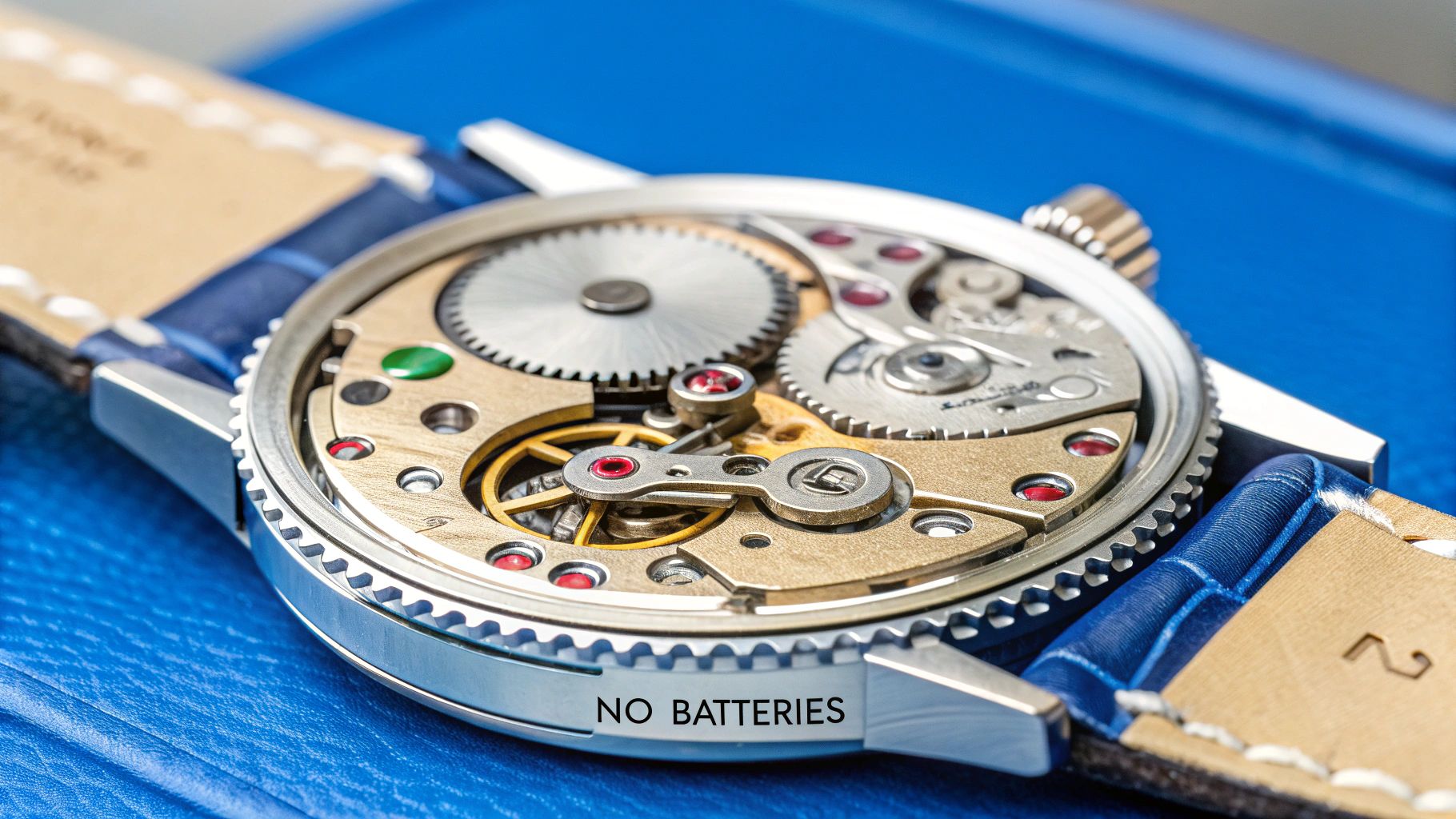
What this means is that for iconic models like the Submariner, Datejust, and Daytona, a battery simply isn't part of the equation. These watches run on a complex system of gears and springs that captures and stores energy from your everyday movements.
A Quick Look: Mechanical vs. Quartz Rolex
Still not sure what you have? This quick table breaks down the key differences between the common mechanical Rolex and the much rarer battery-powered versions.
| Key Indicator | Mechanical Rolex (Most Models) | Quartz Rolex (Rare Models) |
|---|---|---|
| Second Hand Movement | Smooth, continuous sweep | Distinct "tick-tock" motion, once per second |
| Power Source | Wrist motion winds an internal mainspring | A battery cell |
| Maintenance | Needs a full service every 5-10 years | Requires a battery change every 2-3 years |
| Stopped Watch | Needs to be wound and reset if not worn | Will stop when the battery dies |
Essentially, if your Rolex second hand glides, it's mechanical. If it ticks, you likely have the rare exception to the rule.
How a Mechanical Rolex Works
At the heart of a standard Rolex is the Perpetual rotor. It's a semi-circular weight that spins freely as you move your arm. This rotation winds the mainspring, which acts as the watch's power reserve. A fully wound Rolex can keep ticking for about 48 to 72 hours even when it's sitting on your nightstand.
The Lone Exception: The Oysterquartz
So, are there any Rolex watches with batteries? Yes, but they are few and far between. The only significant line Rolex ever produced with a battery was the vintage Oysterquartz.
Made from roughly 1977 to 2001, the Oysterquartz was Rolex's answer to the "Quartz Crisis" when battery-powered watches were disrupting the entire industry. These watches are true collector's items today, easily identified by their unique, angular case design that looks quite different from a classic Datejust or Day-Date.
Rolex has always hung its hat on mechanical precision. Vintage movements like the Rolex Caliber 1600, which powered Datejust and Day-Date models from the late 1960s to the early 1970s, cemented the brand’s legacy in pure mechanical engineering long before the quartz era. You can discover more insights about Rolex power systems and their fascinating history.
How To Identify A Quartz Rolex Model
Before you even think about a Rolex battery change, you have to be absolutely sure you own one of the rare models that actually uses one. Almost all Rolex watches are mechanical marvels, so finding a battery-powered one is really a process of spotting the exceptions—namely, the vintage Oysterquartz line made between 1977 and 2001.
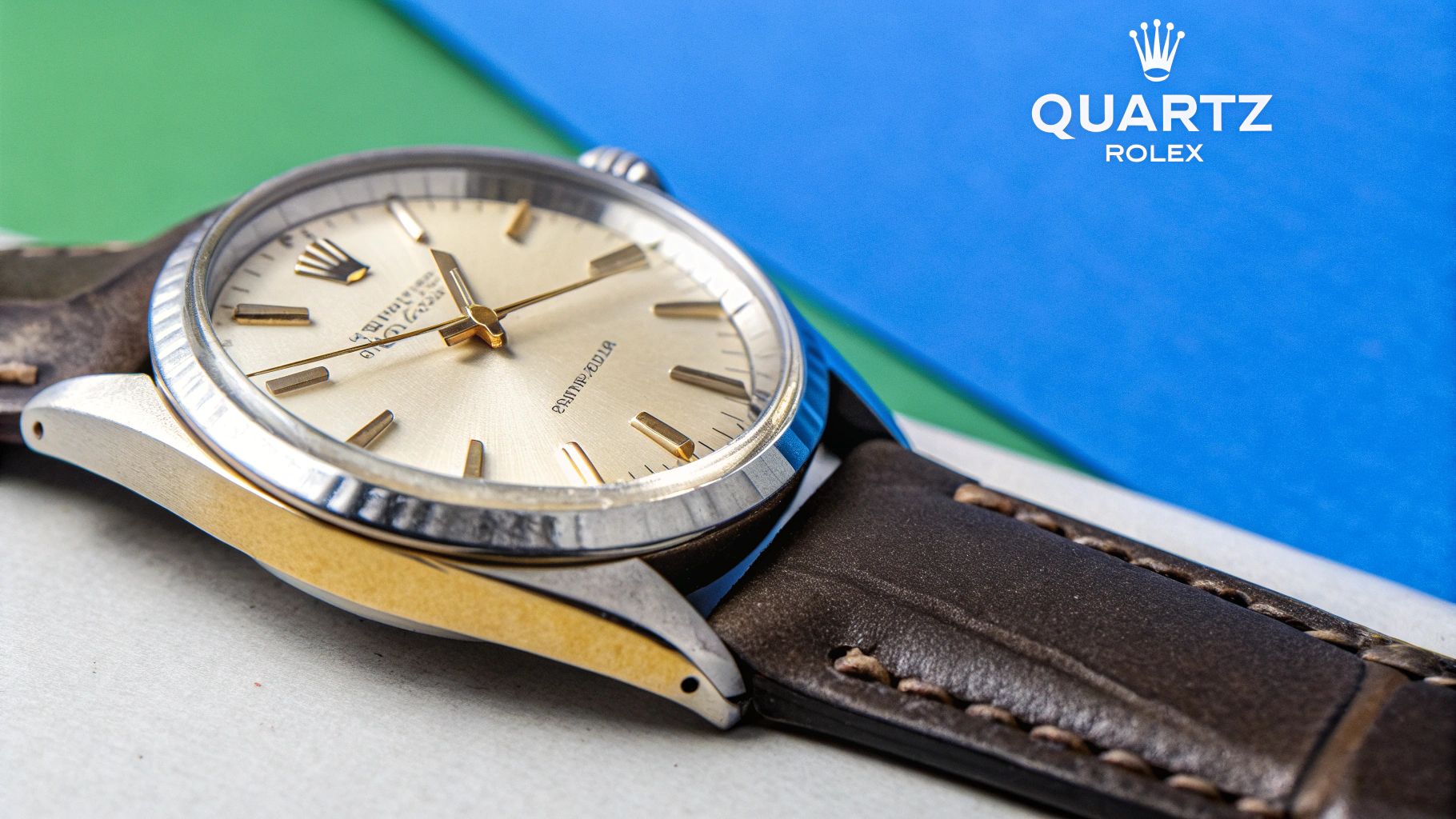
The quickest and most obvious test? Just watch the second hand. A mechanical Rolex is famous for that smooth, elegant sweep as the hand glides around the dial. A quartz Rolex, on the other hand, will have a very distinct "tick-tock" motion, jumping forward once per second. This is the dead giveaway.
Spotting The Physical Design Cues
Beyond the second hand's movement, the Oysterquartz just looks different from its mechanical siblings like the classic Datejust. Its design is pure 1970s and stands out immediately if you know what to look for.
- Angular Case: Look for a sharp, almost blocky case with an integrated bracelet. It's a stark contrast to the soft, curved lines of a typical Oyster case.
- Integrated Bracelet: The bracelet doesn’t just attach to lugs; it flows directly from the case, making it look like one solid, cohesive piece.
For most collectors, this unique look is the first thing that tips them off.
Check The Reference Number
Of course, the most foolproof method is checking the watch's reference number. This number tells you everything—the exact model and the type of movement inside.
You’ll find it engraved between the lugs at the 12 o'clock position, but you'll need to remove the bracelet to see it. For a much deeper dive into what all those digits mean, this detailed guide to Rolex reference numbers is a fantastic resource for understanding your watch's history.
An Oysterquartz reference number will always start with a "1". For instance, a steel Datejust Oysterquartz is 17000, and the two-tone is 17013. A Day-Date Oysterquartz will start with "19," like the yellow gold 19018. If your reference number doesn't start with those digits, you're holding a mechanical model.
The Right Tools for a DIY Battery Change
So, you've confirmed your watch is one of the rare quartz Rolex models and you're feeling brave enough to pop it open. Before you even think about it, let's talk about tools. Trying this with a screwdriver from your kitchen drawer is a guaranteed way to cause expensive, heartbreaking damage.
To pull off a Rolex battery change without a hitch, you absolutely need specialized equipment designed for the delicate nature of a luxury timepiece.
The single most important piece of gear you'll buy is a high-quality Jaxa-style case back opener. This isn't just any wrench; it uses multiple prongs that grip the fluted notches on a Rolex Oyster case back perfectly. This design lets you apply even pressure and twist it open smoothly, without slipping. Trust me, a cheap, poorly-made opener is the fastest way to gouge a deep, permanent scratch into the back of your watch.
Setting Up Your Workspace
Beyond the opener, a few other items are non-negotiable for protecting your investment. You’ll want to work in a clean, brightly lit area that’s as free from dust as possible. The last thing you want is a tiny speck of dust getting into the movement.
Here’s a quick checklist of what you'll need on hand:
- A Padded Watch Holder: This is a small vise that gently but firmly holds the watch in place, preventing scratches to the case or bracelet while you work.
- Non-Magnetic Brass Tweezers: Standard steel tweezers can magnetize the tiny screws and components inside the movement, which can throw off its timekeeping. Brass or bronze is what the pros use for a reason.
- A Loupe or Magnifying Glass: You’ll need a good look at the tiny battery clamp and the all-important gasket to check for any wear, cracks, or damage.
- A Soft, Lint-Free Cloth: Perfect for handling the watch and wiping away any fingerprints without leaving behind tiny fibers that could get into the works.
Just remember, investing in proper tools is a fraction of the cost of paying a professional to fix a mistake. One slip with a cheap wrench can easily lead to a repair bill ten times the cost of the right equipment.
Replacing The Battery With Precision
With your specialized tools laid out and ready, it's time to begin the actual battery change. This is where patience and a steady hand are non-negotiable—the internal components of an Oysterquartz are incredibly delicate. The first real challenge is getting the case back open without leaving a single, tell-tale mark.
Start by securing your watch in a padded holder to prevent it from slipping. You'll want to carefully align the prongs of your Jaxa-style wrench with the grooves on the case back, making sure you have a snug, perfect fit. Apply firm, consistent pressure in a counter-clockwise motion to unscrew it. Take your time here; rushing this step is the number one cause of deep, regrettable scratches on an otherwise pristine case.
Once it's open, you’ll be greeted by the intricate Caliber 5035 or 5055 movement. The battery itself is held in place by a tiny retaining clip or screw. Using your non-magnetic brass tweezers, gently release this clip. Be warned—it can be fragile, and bending it will prevent the new battery from seating correctly later on.
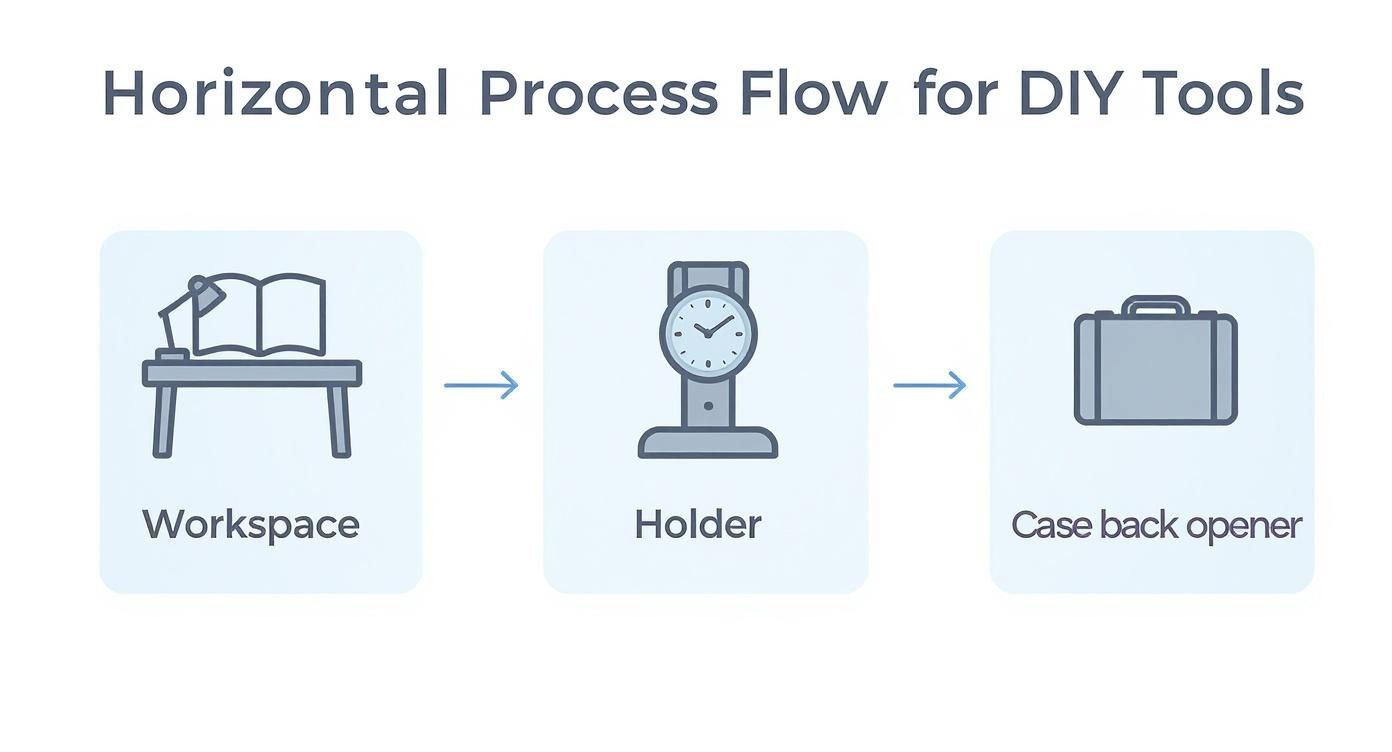
This image really drives home how crucial a proper setup is. A clean space, a secure watch holder, and the right opening tool form the foundation for a successful and scratch-free replacement.
Handling And Seating The New Battery
When it comes to handling the new battery, whatever you do, avoid touching it with your bare fingers. The oils from your skin can interfere with the electrical connection and can actually shorten the battery's life. Always, always use your non-magnetic tweezers to lift the old battery out and place the new one in.
Gently slide the new battery into its slot, making sure the positive (+) side is facing up. Now, carefully secure the retaining clip back into place. You should feel it click or see the screw tighten snugly, but don't apply excessive force. At this point, you should see the second hand spring to life with its characteristic one-second tick.
The single most critical step after replacing the battery is inspecting the case back gasket. This thin rubber O-ring is what gives your watch its water resistance. If it looks cracked, brittle, or flattened, it must be replaced to protect your investment from moisture damage.
Before you seal everything up, double-check that the gasket is perfectly seated in its groove, with no dust or debris in sight. Screw the case back on by hand until it’s finger-tight, then grab the wrench for the final turn to create that all-important secure seal. Once it's closed, you’ll likely need to set the time. For a full walkthrough on this, our post on how to adjust the time on a Rolex provides clear, easy-to-follow instructions.
Why A Professional Watchmaker Is Your Best Bet
The thought of a DIY **Rolex battery change** might feel empowering, but let's be honest—it’s a high-stakes gamble with a very expensive timepiece. The real value in a professional service isn't just swapping out the old battery. It's about everything else that comes with it, things you simply can't replicate on your kitchen table.
A certified watchmaker does far more than just pop open the case. They perform critical procedures that protect your investment, most importantly pressure testing. After sealing your watch back up, they use specialized equipment to make sure its water resistance is completely intact. Skip this, and your next dip in the pool or even a heavy downpour could cause catastrophic damage inside.
Beyond The Battery
A trained eye also spots tiny issues you'd almost certainly miss. A professional will inspect the gasket for any signs of drying or cracking, check for early signs of movement fatigue, and ensure no microscopic dust particles are left behind to compromise the delicate mechanism. Think of it as a mini health check-up for your watch.
Catching a worn-out gasket during a routine battery change might cost you an extra $20. Failing to notice it could lead to water damage costing thousands in movement repairs down the line. It's a clear case of preventative care saving a fortune.
While Rolex suggests a full service every 10 years, a professional battery change serves as a valuable check-in between those major overhauls. A complete service, which can run from 650 to 800 euros, is a totally different beast from a simple battery swap. You can learn more about Rolex's official servicing recommendations and what they entail.
Ultimately, the modest cost of a professional battery replacement is invaluable insurance against a much more significant financial—and sentimental—loss.
Common Rolex Battery Questions Answered
When you own a Rolex, even something as seemingly simple as a battery change can feel like a big deal. It's not just any watch, after all. A few common questions pop up, and getting the right answers is key to making sure your timepiece is handled correctly.
One of the first things people ask is about cost. What's a fair price for a professional battery swap? You can generally expect to pay between $75 and $200 at a certified watchmaker. The price difference usually comes down to whether the service includes the essentials—things like replacing the case back gasket and doing a pressure test to make sure it's still water resistant. We always recommend getting both done.
Are All Rolex Datejust Models Mechanical?
This question comes up a lot. Yes, nearly every Rolex Datejust you'll encounter is a mechanical, self-winding watch powered by their famous Perpetual movement.
The big exception to the rule is the vintage Rolex Oysterquartz Datejust. These were made from the 1970s up to the early 2000s and are the only Datejust models that run on a battery. If your watch doesn't have the unique, angular case of an Oysterquartz, it's mechanical and doesn't need a battery. For more answers to common queries, our guide on frequently asked Rolex questions is a great resource.
Using the wrong battery is a recipe for disaster. An incorrect voltage can easily fry the movement's delicate electronics, leading to a costly repair. Similarly, a battery that's the wrong physical size might not make a secure connection, causing the watch to stop intermittently or preventing the case back from sealing correctly.
This compromises its water resistance and puts the entire movement at risk. Always ensure you or your watchmaker uses the exact battery specified for your watch's caliber to avoid irreversible damage and maintain its integrity for years to come.
At ECI Jewelers, we understand the precision and care required to service a luxury timepiece. Whether you need an expert battery replacement for your Oysterquartz or a full service for your mechanical Rolex, our specialists are here to help protect your investment. Explore our services and collection at https://www.ecijewelers.com.


