


A classic dress watch is a minimalist timepiece designed for formal occasions, defined by its simplicity, slim profile, and elegant design. It’s built to be a subtle companion to a suit or tuxedo, focusing on pure sophistication over flashy, complex features.
What Is a Classic Dress Watch Anyway?
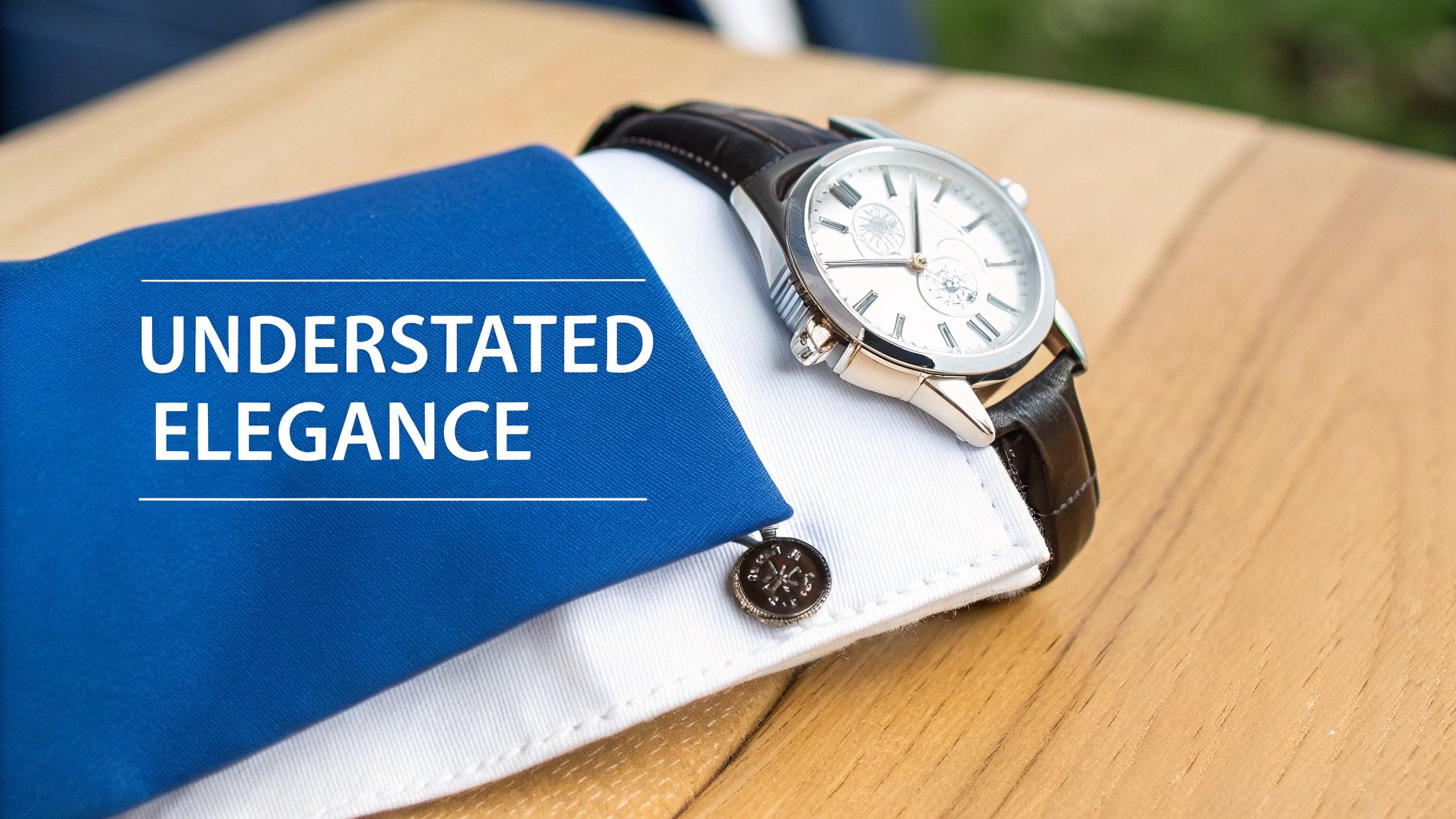
Think of a classic dress watch as the perfectly tailored suit of the watch world. Its job isn't to shout for attention but to complete a look with quiet grace. Unlike those bulky sports or field watches loaded with extra functions, a dress watch follows a "less is more" philosophy. Its whole purpose is to slip discreetly under a shirt cuff, making an appearance only when you need it.
This kind of timepiece is a clear statement of refinement. It shows you appreciate tradition, fine craftsmanship, and the little details that matter. The core idea is simple: for formal events, your accessories should harmonize with your outfit, not compete with it. A classic dress watch pulls this off with a specific set of design rules that have stayed pretty much the same for a century.
The Core Philosophy of Elegance
At its heart, the classic dress watch is all about purity and function in their most elegant forms. It strips away every non-essential element to do one thing and one thing only: tell time beautifully. This design focus leads to a few key traits that define the entire category.
- Simplicity Above All: A clean, uncluttered dial is its most recognizable feature. You'll usually just see the hours and minutes, and maybe a simple seconds hand.
- Slim and Refined Case: The case is crafted to be thin, letting it slide easily under a cuff without catching. It's often made from precious metals like gold or platinum.
- Understated Size: Traditionally, these watches have a modest diameter, usually between 34mm and 40mm, making sure they don't overpower your wrist.
A dress watch is a timeless accessory that embodies sophistication, elegance, and understated style. Unlike its more robust counterparts, the dress watch is crafted with a focus on subtlety and is intended to be worn with formal or business attire.
A Nod to Horological Tradition
Beyond just how it looks, a classic dress watch often represents a deep respect for the history of watchmaking. Many of them run on mechanical movements—either hand-wound or automatic—which are celebrated for their intricate, old-school engineering. This connection to horological heritage is a huge part of their lasting appeal.
The iconic Patek Philippe Calatrava, for instance, is a perfect example of a timepiece that has defined this category for generations. You can see these principles in action by exploring this exceptional Patek Philippe 6119G-001 Calatrava available at ECI Jewelers.
Ultimately, owning a classic dress watch is about more than just telling time. It’s about embracing a legacy of elegance that feels just as right today as it did a hundred years ago.
Tracing the History of Timeless Elegance
The story of the classic dress watch really kicks off in the early 20th century, right when the whole idea of personal timekeeping was getting a major shakeup. Before then, men carried pocket watches. But the trenches of World War I made that impractical, giving rise to the “trench watch”—basically a small pocket watch with lugs crudely soldered on to hold a strap. They were rugged and got the job done, but elegant they were not.
As the world moved past the war and into the Roaring Twenties, everything changed. A new sense of sophistication swept through menswear, and a bulky, utilitarian military watch just didn't cut it with a sharp suit anymore. This left a perfect opening for some forward-thinking designers to create a totally new kind of timepiece, one built for a gentleman.
From the Battlefield to the Ballroom
Visionaries like Louis Cartier and iconic brands such as Patek Philippe saw this gap in the market immediately. They started designing watches that were the complete opposite of the trench watch: slim, sleek, and stunningly minimalist. The whole point was to create a watch that could slide discreetly under a shirt cuff, adding to a formal look rather than overpowering it.
A perfect example is the iconic Cartier Tank, which debuted in 1917. Inspired by the shape of military tanks, it was a game-changer. It swapped the traditional round case for a clean, rectangular form, a bold move toward a more artistic and refined look that would become a signature of the dress watch.
The classic dress watch was born from a desire to blend function with fashion. It marked the moment a watch became more than a tool; it became an essential element of personal style and a symbol of refined taste.
An Enduring Symbol of Style
Decades have passed, but the core design of the classic dress watch has stayed remarkably consistent. It’s a testament to just how timeless its principles are. And make no mistake, it’s as popular as ever. Consumer data shows some interesting patterns: search interest for terms like ‘luxury dress watch men’ often spikes in March, right around major industry events. Meanwhile, searches for ‘classic dress watch men’ tend to climb in November as the holiday season approaches. You can explore more about these cyclical trends and see what they reveal about the market.
This lasting interest proves the classic dress watch isn’t some stuffy relic. It's a piece of history that continues to signify elegance and good taste, even in a world of fleeting trends. It’s living proof that true style never really goes out of fashion.
The Anatomy of a Classic Dress Watch
A classic dress watch is a masterpiece of elegant restraint. Every single component works together in perfect harmony to create a look of pure, unadulterated sophistication. Think of it as the horological equivalent of a perfectly tailored suit—each element is chosen not for flash, but for its quiet contribution to the whole.
To truly appreciate why this style has been a pillar of formalwear for over a century, you have to understand the individual parts that make it so timeless.
This infographic captures the design journey beautifully, showing how we went from bulky, functional military timepieces to the refined, elegant style we recognize today.
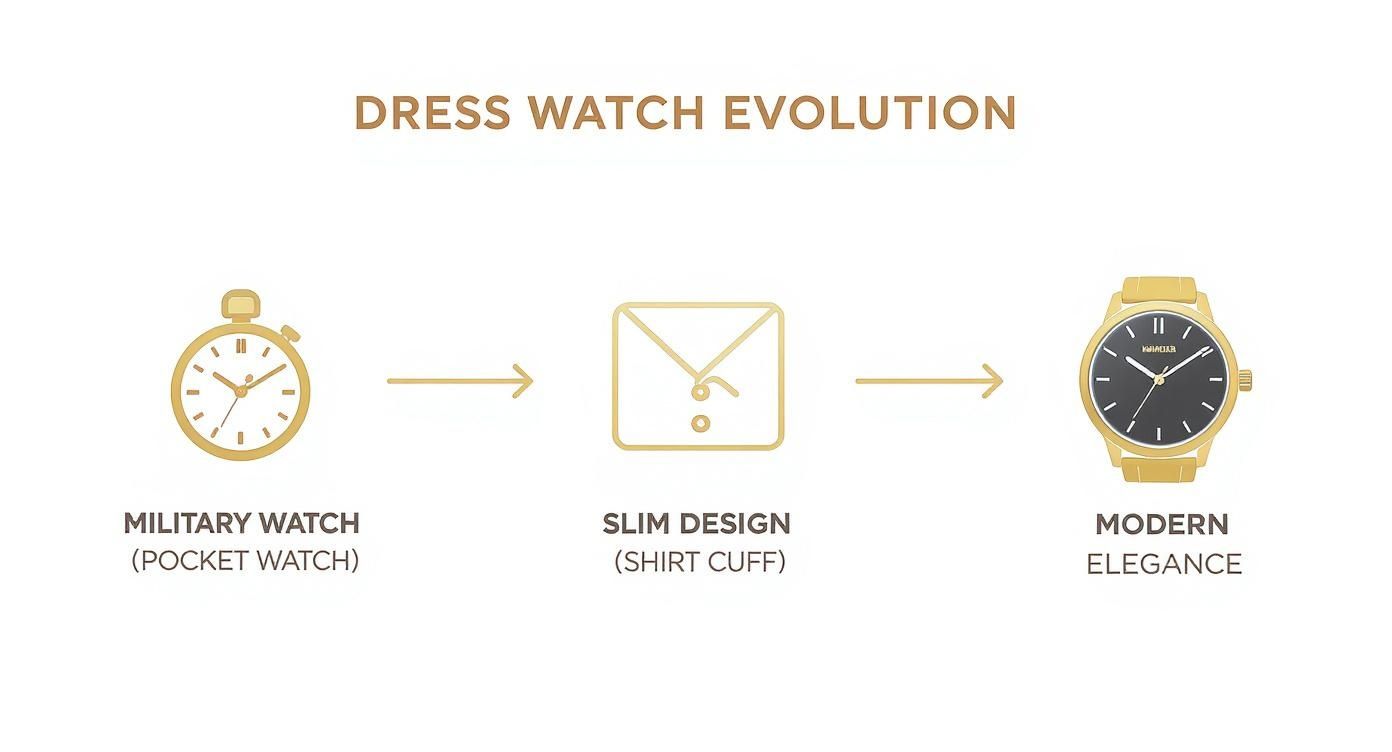
You can see a clear evolution toward minimalism. This was driven by a simple, practical need: a watch that could complement formal attire, not clash with it.
The Slim and Polished Case
The case is the watch's chassis, its foundation. For a classic dress watch, the most critical feature is a slim profile. We're typically talking between 7mm and 10mm thick, engineered specifically to slide under a shirt cuff without a hint of a snag. Subtlety is the name of the game here.
Cases are almost always round and traditionally crafted from precious metals—yellow gold, rose gold, white gold, or platinum. Of course, polished stainless steel is an incredibly popular and durable modern alternative that still captures that classic look.
The Uncluttered and Clean Dial
The dial is the face of the watch, and its design philosophy can be summed up in three words: "less is more." It has one job—to tell the time with absolute clarity. You won't find busy subdials, chronographs, or complex features cluttering the view.
- Simple Indices: Hour markers are kept elegant and minimal. Think thin applied batons, classic Roman numerals, or sometimes just small, understated dots.
- Minimal Text: The only text you'll usually find is the brand's logo and maybe a quiet nod to the movement type, like "Automatic."
- Classic Colors: Dials stick to a timeless palette of white, silver, black, or champagne. These colors enhance readability and make the watch incredibly versatile.
This deliberate simplicity is what gives the dress watch its power. While the dial looks simple, the mechanics ticking away behind it are anything but. If you're curious about what makes it all work, you can explore our guide on how a mechanical watch works.
The essence of a dress watch dial lies in its negative space. The uncluttered layout is intentional, creating a sense of calm and legibility that feels both timeless and confident.
Elegant Hands and a High-Quality Strap
The hands are often just as graceful as the rest of the watch. Styles like Dauphine, leaf, or simple stick hands are common choices, all designed to complement the minimalist dial without overwhelming it.
Finally, the strap is the finishing touch. The traditional choice is a high-quality leather strap, usually black or brown alligator or calfskin. This choice is a direct link to classic sartorial tradition, designed to perfectly match your leather shoes and belt.
Classic Dress Watch vs Sports Watch Key Differences
To really appreciate the unique identity of a dress watch, it helps to see it side-by-side with its more rugged counterpart, the sports watch. Their design philosophies are worlds apart.
| Feature | Classic Dress Watch | Sports Watch |
|---|---|---|
| Primary Goal | Elegance, discretion, and complementing formal attire | Durability, functionality, and legibility in active conditions |
| Case Size/Profile | Thin (7-10mm), slides under a cuff | Thicker and larger, built for toughness and water resistance |
| Case Material | Precious metals or polished steel | Stainless steel, titanium, ceramic, carbon fiber |
| Dial Design | Minimalist, clean, simple indices, often no date | Busy, with subdials, tachymeters, lume, and multiple functions |
| Complications | Minimal (time-only, maybe a date) | Multiple (chronograph, GMT, diver's bezel, etc.) |
| Strap/Bracelet | High-quality leather (alligator, calfskin) | Metal bracelet, rubber strap, or durable fabric (NATO) |
| Water Resistance | Low (30-50m), splash-resistant at best | High (100m+), designed for swimming, diving, and activity |
As you can see, one is built for the boardroom, the other for the battlefield (or at least the beach). Each has a distinct purpose, and knowing the difference is key to building a versatile watch collection.
How to Choose Your Ideal Dress Watch
Choosing a dress watch isn't just about picking something that tells time—it's a personal journey. You're looking for a piece that feels like it was made for you, a natural extension of your style that clicks into place for any formal occasion.
Forget the generic advice. The real secret is focusing on a few key details that make all the difference. Get these right, and you'll have a watch that perfectly suits your wrist, your wardrobe, and your lifestyle.
The first, and most important, step? Nailing the size. A classic dress watch should be discreet, never loud. That means the case diameter has to be proportional to your wrist. Too large, and it looks clunky, ruining the clean lines of a suit. Too small, and it can get lost entirely.
Finding the Perfect Proportions
Getting the proportions just right is the absolute key to achieving that classic, understated look. The perfect size is what allows the watch to complement your wrist instead of overpowering it.
So, how do you find it? Grab a flexible tape measure and get your wrist circumference. This one simple measurement is your best starting point.
- For wrists 6 to 7 inches: A case size between 34mm to 38mm is usually the sweet spot. This range keeps things classic and hits those vintage-inspired proportions that are at the heart of the dress watch aesthetic.
- For wrists over 7 inches: You can comfortably step up to a case size of 40mm. While modern dress watches have grown slightly, going beyond 40mm starts to feel more like a sports watch than a refined dress piece.
One non-negotiable rule: the lugs—those are the points where the strap meets the case—should never hang over the edges of your wrist. If they do, the watch is too big for you, period. It creates an awkward, unbalanced look that you want to avoid.
Selecting Materials and Colors
Once you've got a size range in mind, it's time to think about materials. The metal of the case and the color of the dial have a huge impact on the watch's versatility and how it pairs with the rest of your wardrobe.
Polished stainless steel is a fantastic all-rounder. It's modern, durable, and versatile enough for business meetings and formal events alike. If you want something a bit warmer and more traditional, precious metals like yellow or rose gold are an excellent choice, especially for those truly special occasions.
For the dial, you can't go wrong with timeless colors like white, silver, or black. They offer maximum versatility and will pair effortlessly with pretty much any suit or color combination you can throw at them.
Understanding the Engine Inside
Finally, you need to consider the watch's movement—the engine that makes it tick. The three main types each offer a completely different ownership experience.
- Manual-Wind: This is the old-school classic. It requires you to wind it daily, creating a hands-on, interactive connection with your timepiece.
- Automatic: A mechanical marvel that winds itself using the motion of your wrist. It gives you all the charm of a mechanical movement with added convenience.
- Quartz: This is the battery-powered option, offering dead-on accuracy and minimal maintenance. Just set it and forget it.
The choice really comes down to personal preference. Watch purists might lean toward the beautiful craftsmanship of a mechanical movement, while others will prefer the grab-and-go reliability of quartz. To help you figure out what's right for you, we have a detailed guide breaking down the differences between automatic vs. quartz movements and what each brings to the table.
Mastering the Art of Styling Your Watch
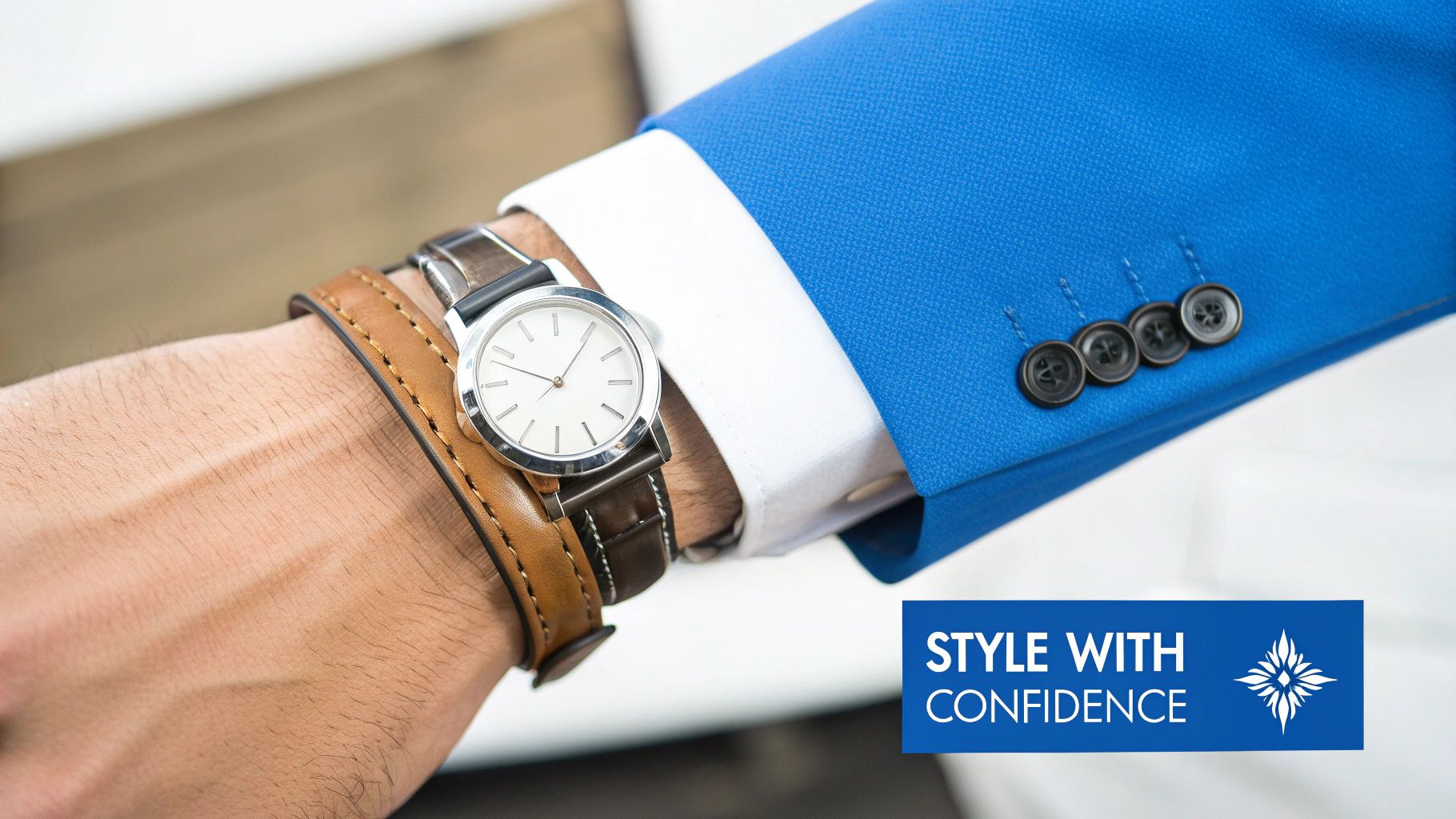
A classic dress watch isn't just a tool for telling time; it's the final piece of the puzzle that pulls your entire look together. Getting it right comes down to a few subtle but critical details that quietly signal sophistication. When all the elements are in sync, your watch doesn't just complete your outfit—it elevates it.
The single most important rule? Coordination. For a truly seamless look, the metal of your watch case should echo the other metals you're wearing. This small detail is what creates a cohesive and intentional appearance.
The Power of Coordination
Think of your accessories as a team. You want them working in harmony, not competing for attention.
- Match Your Metals: If your dress watch has a yellow gold case, make sure your cufflinks, belt buckle, and any rings are also yellow gold. A stainless steel, white gold, or platinum watch? That calls for silver-toned accessories.
- Match Your Leathers: This one is a non-negotiable tenet of classic style. The leather strap on your watch absolutely must match the color of your belt and shoes. Brown strap with brown shoes, black strap with black shoes. Simple as that.
The secret to great style isn't about having the most expensive pieces, but about ensuring every element works in concert. A perfectly coordinated watch, belt, and shoes create a powerful, unified statement of attention to detail.
This level of precision shows you understand the nuances of dressing well. It’s a quiet signal of good taste that makes a polished look truly stand out.
Dress Codes and Occasions
While a classic dress watch was born for formalwear, its understated elegance also plays beautifully with smart-casual attire. The key is to read the room and understand the context of the event.
For a black-tie event or a serious business setting, the rules are at their strictest. Here, you'll want to stick to a simple, slim watch on a dark leather strap. Its job is to complement your tuxedo or dark suit, not steal the show. The ultimate sign of elegance is a watch so discreet that it slides effortlessly under your shirt cuff without a snag.
In a smart-casual environment—think a nice dinner out or a business-casual office—you have a bit more freedom. Your dress watch can add a perfect touch of refinement to a blazer and chinos or even a quality knit sweater. Its minimalist design keeps it from looking out of place, instead adding a layer of polish to a more relaxed outfit. No matter the occasion, a classic dress watch is your best partner in crafting a sharp, considered appearance.
Investing in a Legacy Timepiece with ECI Jewelers
Buying a classic dress watch isn't like any other purchase. It's an investment in a piece of history, something crafted to become an heirloom that carries stories from one generation to the next. It’s a real commitment to timeless style and mechanical artistry, which makes where you buy just as important as what you buy.
This is exactly where a trusted partner like ECI Jewelers makes all the difference. The world of luxury watches can be tricky to navigate, and making sure you’re getting an authentic timepiece that will hold its value requires real expertise. Our specialists are here to give you the guidance you need to make a decision you'll feel great about for years to come.
The Value of Expert Guidance
When you bring home a classic dress watch, you're not just getting a beautiful accessory—you're acquiring a potential asset. The global luxury watch market is healthier than ever, projected to climb to USD 68.17 billion by 2029. That kind of growth shows just how much lasting demand there is for these pieces, especially with new generations of collectors entering the market. You can explore the full market analysis on Mordor Intelligence to see the numbers for yourself.
At ECI Jewelers, our job doesn't end when the sale is made. We’re here to build a lasting relationship with you and your timepiece.
- Guaranteed Authentication: Every single watch in our collection is put through a rigorous inspection by our specialists to guarantee it's authentic and in top condition.
- Personalized Service: We take the time to really understand your personal style, what you need from a watch, and your investment goals. It’s all about finding the watch that truly speaks to you.
- Long-Term Support: Our commitment to you includes comprehensive support for maintenance and repairs, making sure your watch performs perfectly for decades.
Choosing the right partner to purchase from is the first step in protecting your investment. It ensures your timepiece is genuine, fairly priced, and will be cared for properly throughout its life.
Ultimately, investing in a classic dress watch is a deeply personal journey. With ECI Jewelers, you get a dedicated expert to guide you every step of the way, helping you select a legacy timepiece that will not only be cherished but may even appreciate in value over time.
Frequently Asked Questions About Dress Watches
Jumping into the world of horology can bring up a lot of questions. We get it. Here are some straightforward answers to the things people ask us most about owning and styling a classic dress watch.
Can You Wear a Classic Dress Watch Every Day?
You absolutely can, but there are a few things to keep in mind. Traditionally, a classic dress watch was saved for formal occasions, but modern style rules are much more flexible. That minimalist design looks fantastic with business-casual outfits, lending a bit of class to a blazer or even a nice sweater.
The main thing to remember is how they're built. Dress watches usually have lower water resistance (30-50m) and aren't designed to be as tough as a sports watch. So, while it's perfect for the office, you’ll want to swap it out before hitting the gym or doing anything where it might get knocked around or wet.
What Is the Difference Between Mechanical and Quartz Movements?
You can think of it like the engine in a classic car versus an electric one. They both get you where you need to go, but the feeling and the engineering are completely different.
- Mechanical Movement: This is the old-school, intricate engine powered by a tightly wound spring. It’s what watch lovers geek out over—the incredible craftsmanship, the history, and that beautifully smooth sweep of the seconds hand. It needs a tune-up (servicing) every few years, but it connects you to a long tradition of watchmaking.
- Quartz Movement: This is the modern, battery-powered equivalent. It's ridiculously accurate, more affordable, and needs almost no attention besides a new battery every few years. It just works.
Ultimately, your choice boils down to what matters more to you: the art and soul of traditional engineering or the simple, reliable convenience of modern tech.
A mechanical watch is an emotional choice celebrating craftsmanship, while a quartz watch is a logical choice celebrating precision and ease of use. Neither is "better"—they simply serve different purposes for the wearer.
How Should I Care for a Leather Watch Strap?
With a little care, a good leather strap can look great for years. The number one rule is to keep it dry. Water is the enemy—it weakens the leather and causes it to break down over time. It's also a smart move to rotate your watches, giving the strap a day off to air out and recover from your skin's natural oils.
Every so often, a quick wipe with a soft, dry cloth will do the trick. If it needs more, use a dedicated leather cleaner, but sparingly. To keep the leather from getting dry and cracked, treat it with a quality leather conditioner every few months. This will keep it feeling supple and looking sharp.
Ready to find the perfect timepiece to complement your style? Explore the curated collection of authenticated luxury watches at ECI Jewelers and let our experts guide you to your next investment. Discover your legacy piece today at https://www.ecijewelers.com.


