


When you start thinking about getting your Rolex serviced, the first question is always the same: "How much is this going to cost me?"
The short answer is that a standard overhaul typically runs between $800 and $1,200. But that's just the starting line. Depending on your watch's age, its specific model, and what parts it needs, that figure can easily climb past $1,500. It’s the difference between a routine tune-up for a performance car and a full-blown restoration.
This guide will give you a clear, realistic idea of what to budget for this crucial investment in your timepiece.
Decoding Rolex Service Costs for Popular Models
Asking for a flat "cost to service a Rolex" is a bit like asking for the price of a car—it all depends on the model. A complex chronograph movement like the one in a Daytona is a completely different beast than the classic, time-only engine in an Oyster Perpetual. That intricacy is the biggest driver of the final price.
Think of it this way: a V12 engine just requires more specialized skill and time than a standard four-cylinder. The same logic applies here.
To give you a real-world starting point, we've put together a quick breakdown of what you can expect to pay. This table shows the typical baseline costs at an official Rolex Service Center (RSC) compared to what a top-tier independent watchmaker might charge.
Estimated Baseline Service Costs For Popular Rolex Models
This table provides a quick-glance comparison of typical starting service costs for various Rolex models at both Authorized Service Centers and reputable Independent Watchmakers.
| Rolex Model | Estimated Independent Cost (USD) | Estimated Authorized Cost (USD) |
|---|---|---|
| Oyster Perpetual / Datejust | $400 - $800 | $800 - $1,000 |
| Submariner / Explorer | $500 - $900 | $850 - $1,100 |
| GMT-Master II | $600 - $1,000 | $900 - $1,200 |
| Day-Date (President) | $700 - $1,100 | $1,000 - $1,300 |
| Daytona (Chronograph) | $800 - $1,200 | $1,300 - $1,600 |
A quick note: These are just estimates for a standard movement service. They don't include the cost of replacing major parts like a cracked crystal, a worn-out crown, or a damaged bezel. You'll get a separate quote for those after the watchmaker has a chance to inspect your watch up close.
Rolex officially suggests a service interval of about every ten years, which is a real credit to their modern engineering. At their official service centers—there are about 900 of them worldwide—you can expect a bill between €650 and €800 for popular models like a Datejust or GMT-Master II. That initial price usually covers routine wear-and-tear parts, but if your watch needs anything extra, the final cost will go up. For more on the official numbers, SwissWatches Magazine has some great insights.
Getting a handle on these figures is the first step in understanding the true cost of owning a Rolex over its lifetime. To go even deeper, take a look at our complete guide on Rolex watch repair costs to see what really drives the price of keeping these incredible machines ticking.
What Happens During a Full Rolex Overhaul
When you hear "Rolex service," it's easy to picture a quick tune-up, but the reality is a deep, meticulous process handled by master technicians. Understanding what goes on behind the curtain makes it clear why the cost to service a Rolex is an investment in its future.
Think of it less like an oil change and more like a complete engine rebuild for a high-performance car. The goal isn't just to fix what's broken; it's to restore your watch to the exact factory specifications it had on day one—for precision, function, and appearance.
From the moment it arrives, every single component is about to get an expert's undivided attention. This graphic shows how the process kicks off, from the initial drop-off to the formal evaluation.
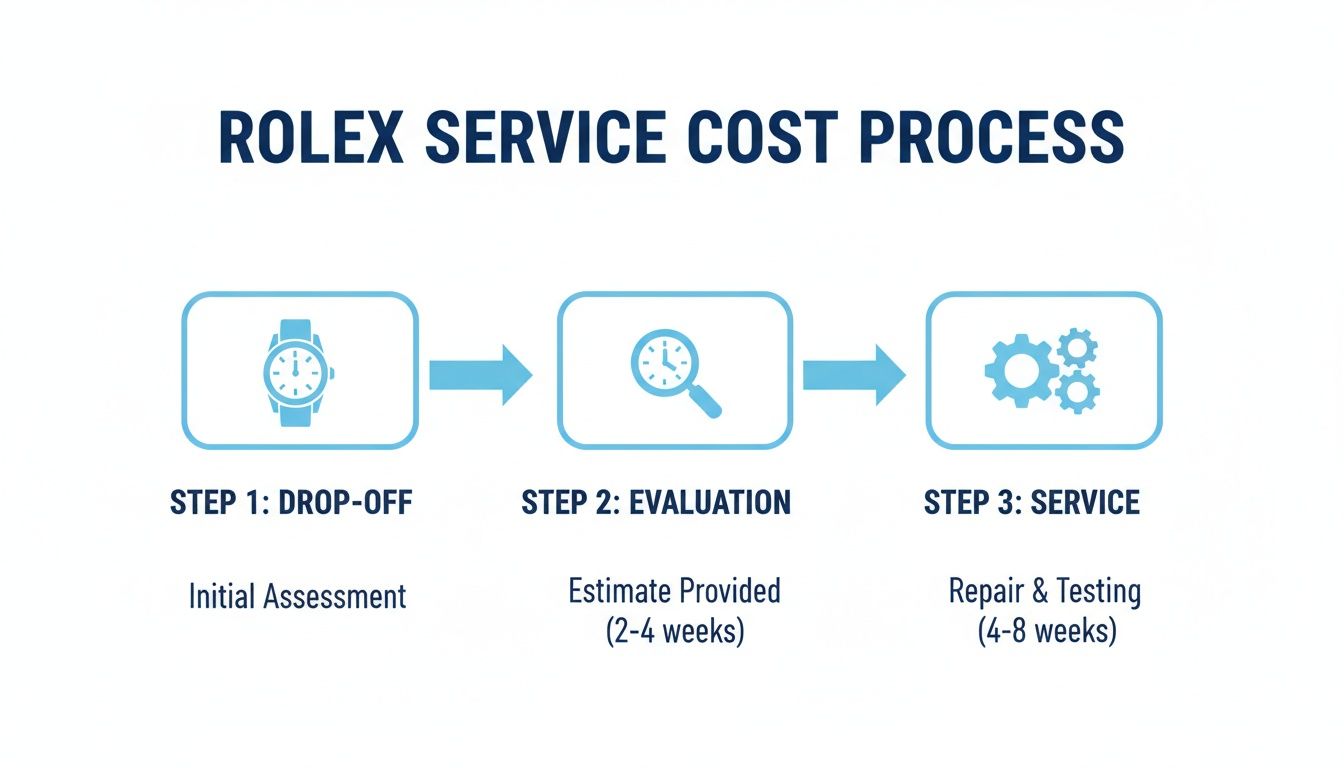
As you can see, before a single tool touches your timepiece, a detailed evaluation is performed to create a service estimate for you to approve.
The Art of Disassembly and Cleaning
The first true step in the overhaul is the complete teardown of the movement. A certified watchmaker methodically dismantles the entire mechanism, which can be made up of over 200 individual parts. Every tiny screw, gear, and spring is carefully removed and inspected for microscopic signs of wear.
Once apart, every component is placed in specialized baskets and run through an ultrasonic cleaning bath. This machine uses high-frequency sound waves to blast away years of accumulated grime, old lubricants, and microscopic dust particles. It's a deep clean that leaves every part pristine and ready for reassembly.
Meticulous Reassembly and Lubrication
With everything spotless, the watchmaker begins the painstaking process of putting the movement back together. This is where true mastery is on display. As each part is reinstalled, it is lubricated with up to five different types of specialized oils and greases.
Just like a high-performance engine needs different fluids for different parts, a Rolex movement requires specific lubricants for high-friction gears versus slow-moving components. This precise application is key to ensuring minimal wear and peak performance for another decade. To learn more about the mechanics, you can explore the complexity of different Rolex movements in our detailed article.
Calibration and Case Refinishing
After the movement is reassembled, its balance wheel is carefully calibrated. The technician adjusts the timing to meet the strict standards set by the Official Swiss Chronometer Testing Institute (COSC), which is typically -2/+2 seconds per day for modern Rolex calibers. This is what guarantees your watch keeps time with exceptional accuracy.
While the movement is being serviced, the case and bracelet get their own spa treatment. This includes:
- Disassembly: The bezel, crystal, and case back are all removed.
- Refinishing: The case and bracelet are expertly polished and satin-finished to remove surface scratches and bring back their original luster. This is an optional step, and owners—especially of vintage watches—can choose to skip it.
- Seal Replacement: All gaskets and seals are replaced to guarantee water resistance.
A full Rolex overhaul is a top-to-bottom restoration. It brings the watch back to peak mechanical and aesthetic condition, ensuring it performs just as it did the day it left the factory.
Final Testing and Quality Control
The last stage is perhaps the most critical. The freshly serviced movement is placed back into its refinished case, and the watch is put through a battery of tough tests. It’s subjected to intense pressure tests to confirm its water-resistance rating is fully restored, sealing it against moisture and dust.
Finally, the watch is monitored for several days to check its real-world timekeeping and power reserve. Only after it passes every single quality control checkpoint is the watch considered ready to be returned, complete with a new two-year service warranty.
The Hidden Factors That Drive Up Your Service Bill
That initial quote you get for a Rolex service? It's best to think of it as a starting point. While a standard movement overhaul has a fairly predictable baseline cost, the final invoice can look a whole lot different once a watchmaker actually gets inside your watch. Several hidden factors can push the total up, turning what you thought was routine maintenance into a more serious investment.
It’s a bit like taking a classic car to a trusted mechanic for a tune-up. They might quote you for new spark plugs and an oil change, but if they pop the hood and discover a cracked engine block, the scope—and cost—of the job changes dramatically. The same thing happens with the intricate world inside your Rolex.
Knowing what these variables are ahead of time will help you anticipate potential costs and make informed decisions, so there are no nasty surprises when the final bill comes.
Model Complexity and Complications
Not all Rolexes are built the same. The single biggest reason for a higher service bill is the complexity of the watch's movement, specifically its "complications." In watch-speak, a complication is any function beyond just telling time—think displaying the date, tracking a second time zone, or acting as a stopwatch.
A simple, time-only model like an Oyster Perpetual has a relatively straightforward movement. A Rolex Daytona, on the other hand, is a high-performance chronograph packed with hundreds of extra, tiny, interacting parts that let it work as a precision timer.
Here’s why that makes a huge difference in the service cost:
- More Parts to Service: A chronograph like the Daytona has way more components than a Datejust. Every single one of those parts needs to be taken apart, cleaned, inspected, and lubricated. That takes a lot more time and skill.
- Specialized Expertise: Working on complex movements isn't for rookies. The watchmakers who can master a Daytona or a Sky-Dweller's annual calendar are true specialists, and their time simply costs more.
- Higher Risk of Wear: With more moving parts, there’s just a greater chance some will need to be replaced, adding to the total.
This is exactly why a basic service for a Daytona can easily start at $1,300 or more, while a Datejust might begin closer to $800. The more your watch can do, the more it costs to keep it doing it right.
Age and The Hunt for Vintage Parts
The age of your Rolex is another huge factor, especially for vintage models made before the 1990s. Rolex is legendary for its build quality, but parts still wear out. On a modern watch, getting a replacement part is no big deal. For a vintage piece, it can turn into a full-blown treasure hunt.
At some point, Rolex stops making parts for older models. When an original component is needed for, say, a 1960s Submariner, the service center can't just order one from the factory. This creates a few problems:
- Scarcity Drives Price: The supply of original, "new old stock" (NOS) parts is tiny and highly coveted by collectors. This scarcity makes them incredibly expensive.
- Labor-Intensive Sourcing: Just finding the right part can take weeks or months of searching through a global network of suppliers, adding labor costs to your bill.
- Custom Fabrication: In very rare cases where a part is impossible to find, a master watchmaker might have to custom-make a replacement—a highly skilled and very costly job.
For vintage Rolex owners, originality is everything. A service that requires rare, period-correct parts will always cost more, reflecting the difficulty and expense of sourcing them.
Necessary Part Replacements
Beyond the movement, the outside of your watch takes a beating from daily wear. During the initial diagnosis, the watchmaker will inspect several key external parts that often need replacing. These are almost never included in the baseline service quote.
Think of these as the tires and brake pads on your watch. They're designed to wear down over time to protect more critical (and expensive) components. Replacing them is crucial for keeping your watch's integrity and function intact.
Common replacement parts that will add to your cost include:
- Crystal: A scratched, chipped, or cracked sapphire crystal ruins the look and compromises water resistance. A replacement can run anywhere from $300 to $600, depending on the model.
- Crown and Tube: The winding crown and the tube it screws onto are the main seal against water. Over years of use, the threads wear down, and they'll need to be replaced to keep it watertight.
- Bezel or Bezel Insert: A dented bezel or a cracked ceramic insert on a Submariner or GMT-Master II needs to be replaced to restore the watch's appearance and functionality.
On top of that, larger economic forces are at play. Recent macroeconomic shifts and new tariffs on Swiss imports have driven up the price of parts for service centers. Some industry reports suggest these changes could hike part costs by as much as 30%, an increase that ultimately gets passed on to you. For example, a sapphire crystal that once cost a service center around $450 might now be closer to $650, directly hitting your final bill. This new reality makes understanding potential part replacements more important than ever.
Official Rolex Center vs Independent Watchmaker
Once you decide your Rolex needs a little TLC, you’re at a crossroads. This next decision will impact everything from the final bill to your watch's future value. Do you send it to an official Rolex Service Center (RSC), the brand’s own highly controlled environment? Or do you trust it to a skilled independent watchmaker?
This isn’t just about finding someone to fix your watch; it's a choice between two very different philosophies of care. Think of it like deciding between a dealership and a trusted local mechanic for a classic car. Both can get the job done right, but they offer completely different experiences, costs, and outcomes.
The right path really depends on your priorities. Are you looking for the absolute certainty of a factory warranty and guaranteed genuine parts? Or do you prefer a more personal touch, faster turnaround, and potentially lower costs? Let’s break down what each option brings to the table.
The Authorized Rolex Service Center Experience
An official RSC is Rolex's embassy for watch care. It offers the highest possible level of assurance, as every single service is performed to the brand’s famously exacting standards. For owners of modern Rolexes, this path provides total peace of mind.
Of course, that guarantee comes with a few trade-offs. The official process is methodical and often involves a longer wait, sometimes stretching from four to eight weeks or even more.
Key benefits of going through an RSC include:
- Guaranteed Genuine Parts: Every replacement component comes directly from Rolex, ensuring a perfect fit and flawless function.
- Two-Year International Warranty: The service is backed by a robust warranty recognized by any RSC worldwide—a powerful stamp of quality.
- State-of-the-Art Equipment: RSCs use the latest diagnostic and servicing tools, all specified by Rolex headquarters in Switzerland.
The main drawback is a rigid adherence to factory specifications. For vintage watch owners, this can be a huge issue. RSCs will often replace aged parts like dials, hands, and bezels with modern service replacements to ensure performance. While this makes the watch look new, it can dramatically reduce a vintage piece's originality and collector value.
The Independent Watchmaker Alternative
A reputable independent watchmaker offers a more flexible, and often more personal, approach to servicing. These are typically smaller workshops run by highly skilled artisans, many of whom may have even received Rolex training earlier in their careers. For a lot of owners, especially those with vintage watches, this is the preferred route.
The biggest advantages are usually cost and customization. An independent can often perform a standard service for less money and in a much shorter timeframe—sometimes in just two to four weeks. You also get a level of communication you just won't find with a large corporation, allowing you to have direct conversations about the work being done on your watch.
The most critical benefit of an independent watchmaker is their ability to preserve a watch's originality. They will work to repair and restore original components rather than simply replacing them, which is absolutely vital for maintaining the value of a vintage Rolex.
Naturally, this path has its own risks. The quality of work can vary widely, so it's essential to find a watchmaker with a stellar reputation and proven Rolex expertise. There's also the potential for non-genuine or aftermarket parts to be used if you aren't careful. This is why partnering with a trusted source is so important. For expert guidance, exploring options like the ECI Jewelers watch concierge service can help you navigate these choices with confidence.
Rolex Service Options At A Glance
Choosing the right service provider comes down to balancing cost, time, and your personal philosophy of watch care. The cost to service a Rolex is often a key differentiator. To help you decide, here’s a direct comparison of what to expect from each.
| Feature | Authorized Rolex Service Center (RSC) | Independent Watchmaker |
|---|---|---|
| Cost | Typically higher, reflecting factory overhead. | Generally more competitive and affordable. |
| Parts | Exclusively new, genuine Rolex parts. | Can source genuine, salvaged, or high-quality aftermarket parts. |
| Warranty | Standard two-year international warranty. | Varies by shop, usually one to two years. |
| Vintage Care | May replace original parts with modern ones. | Focuses on preserving originality and repairing vintage parts. |
| Turnaround | Longer, often 4-8+ weeks. | Faster, typically 2-4 weeks. |
Ultimately, there’s no single “best” choice—only the best choice for you and your watch. For a modern daily wearer under warranty, an RSC is often the safest bet. For a cherished vintage piece where originality is everything, a skilled independent is almost always the way to go.
Understanding Service Timelines and Warranties
After you've approved the service estimate and handed over your watch, the next big question is always the same: "When do I get it back?" The answer, in short, is that it takes a bit of patience. A proper Rolex overhaul is a meticulous process that simply can't be rushed.
Think of it like sending a classic car for a full, frame-off restoration. You wouldn't expect it back in a couple of days. The same principle applies here—precision and perfection take time, and that's exactly what you want for a timepiece of this caliber.
How Long Does a Rolex Service Take?
A standard service timeline can vary quite a bit depending on where you send your watch and what it needs. Generally, you can expect to be without your Rolex for anywhere from three to eight weeks, but don't be surprised if that window stretches a little longer.
Several things can affect the wait time:
- Service Center Workload: Just like any top-tier workshop, both authorized centers and popular independent shops have a queue. Your watch gets worked on in the order it arrived.
- Sourcing Parts: If your watch needs a specific part that isn't in stock, it has to be ordered directly from Rolex in Switzerland. That alone can add several weeks to the process.
- The Complexity of the Job: A routine overhaul on a modern Datejust will be much quicker than a complicated repair on a vintage Daytona that might need custom fabrication or a deep search for rare components.
The key is to have realistic expectations. A quick turnaround is nice, but a longer wait usually means every single detail is getting the obsessive attention it deserves. For a Rolex, that's a good thing.
The Value of the Two-Year Service Warranty
When your watch finally returns, it doesn't just look and run like new—it also comes with a serious guarantee. An official Rolex Service Center provides a two-year international service warranty, which is a powerful document that offers incredible peace of mind.
This warranty covers all the work that was done and any parts that were replaced during the service. If any issue related to that service pops up within those two years, Rolex will fix it for free at any authorized service center in the world. It’s a huge testament to the confidence Rolex has in its own craftsmanship.
Protecting Authenticity and Future Value
Perhaps the most critical, long-term benefit of an official service is the ironclad guarantee of authenticity. When Rolex services your watch, they verify every single component is genuine. The service papers you get back are much more than a receipt; they're official documentation from the brand itself, confirming your watch’s integrity.
This is incredibly valuable for a few reasons:
- It Boosts Resale Value: Having recent, official service papers can significantly increase what your watch is worth on the secondary market. Buyers will happily pay a premium for a watch with a proven, documented service history straight from the source.
- It Prevents Future Headaches: Taking your watch to an unvetted shop that might use aftermarket parts can be a disaster down the road. If Rolex later opens the watch and finds non-genuine components, they will flat-out refuse to service it until those parts are replaced with authentic ones—a fix that can be shockingly expensive.
Ultimately, a proper service is an investment in your watch's health, performance, and long-term value. It’s how you ensure your Rolex remains a genuine, highly-functional masterpiece for decades to come.
Common Questions About Rolex Service Costs
Even with a good grasp of the process, a few key questions always pop up. Think of this as your quick-reference guide, where we tackle the most common concerns every Rolex owner has before sending their watch in for service.
How Often Should I Really Service My Rolex?
Rolex officially suggests a service every 10 years or so for their modern watches, but that's more of a guideline than a hard rule. The real answer depends on how you live with your watch.
- Daily Wear: If your Rolex is your trusty companion on your wrist every day, its oils and lubricants are in constant motion. To keep it running like a top, consider a service every 5 to 7 years.
- Occasional Wear: For a watch that only comes out for special occasions, you can easily stretch it to the full 10-year mark, maybe even a bit longer, without any trouble.
- Listen to Your Watch: Ultimately, your watch will tell you when it needs help. If it starts losing or gaining significant time, or if the power reserve isn't lasting as long as it used to, it's time for a check-up, no matter how long it's been.
Will Polishing My Rolex Decrease Its Value?
This is one of the most important questions an owner can ask, and the answer is a definite "it depends." Polishing is a touchy subject in the collector world, where originality is everything.
For a modern Rolex, a light, professional polish during a service is generally no big deal. It simply restores that crisp factory finish and buffs out the minor scuffs of daily life, making the watch look brand new.
For a vintage model, however, it's a completely different story. An aggressive polish can round off the sharp, clean lines of the case and lugs—hallmarks of an unmolested original. This can absolutely tank its collector value. You need to be crystal clear with your watchmaker: explicitly state whether you want the watch polished or left as-is.
A vintage watch's soul is in its history, and that includes its battle scars. For many collectors, preserving the original case finish is non-negotiable, so always specify "no polishing" if your watch has a story to tell.
Does Rolex Service Very Old or Vintage Watches?
Yes, Rolex will service many of its older timepieces, but there's a huge catch. To stand by their performance and water-resistance guarantees, an official Rolex Service Center will often insist on replacing original aged parts—like the dial, hands, and bezel—with modern service components.
While this makes the watch run perfectly and look new, it effectively erases its vintage character and originality, which can be devastating to its market value. This is precisely why savvy owners of valuable vintage pieces almost always turn to specialized independent watchmakers who have the skill to preserve and repair the original parts.
Can I Just Get a Battery Change For My Rolex?
It's a common question, but one based on a misconception. The overwhelming majority of Rolex watches are purely mechanical. They don't have batteries; they're powered by an incredible micro-machine of springs and gears that runs on the energy from your wrist's motion (for automatic models) or from manual winding.
The only major exception to this rule is the Rolex Oysterquartz, a unique quartz line they produced from the 1970s into the early 2000s. Those do, in fact, use a battery. But for any other Rolex, a "service" means a full mechanical overhaul, not a simple battery swap.
Navigating the world of Rolex servicing requires a partner you can trust. At ECI Jewelers, we offer a watch concierge service to guide you through every step, ensuring your timepiece receives the expert care it deserves. Whether you're looking to service a modern classic or preserve a vintage heirloom, we connect you with the right specialists to protect your investment. Explore our services and discover a seamless ownership experience at ECI Jewelers.


