


So, what's the real bottom line for a Rolex service? You’ll often see a baseline figure of $800 to $1,200, but it’s crucial to understand that this is just a starting point. The final Rolex watch repair cost really hinges on your specific model, its age, and what's actually going on under the hood.
The Real Cost of a Rolex Service
Think of a Rolex service less like ordering from a fixed menu and more like taking your car in for maintenance. A simple oil change is one thing; a full engine rebuild on a vintage sports car is another beast entirely. In the same way, a routine overhaul for a modern Rolex Datejust will cost less than a complicated restoration for a vintage Daytona.
The initial quote you get covers the standard overhaul—the meticulous labor involved in completely disassembling the movement, deep-cleaning every single component, and carefully putting it all back together with fresh, high-grade lubricants. This baseline cost, however, doesn't include any parts that might be worn out and need replacing.
Initial Cost Estimates for Popular Models
While every watch has its own story and condition, there are some established price ranges that can give you a good financial snapshot. For instance, sending your watch directly to Rolex for a complete overhaul will vary by model. A Datejust might start around 650 euros, a GMT-Master II at 700 euros, and a more complex chronograph like the Daytona could begin at 800 euros or more. That translates to roughly $700 to $860 USD before any additional parts are factored in. You can dive deeper into these service figures and learn how they are calculated.
To help you get a clearer picture, let's break down what you might expect to pay for a standard service on some of the most popular models.
Keep in mind: These numbers are for the movement overhaul itself. If your watch needs a new crystal, crown, or any other specific parts, the final bill will be higher.
Here's a quick table to give you an at-a-glance idea of potential costs.
Quick Guide to Estimated Rolex Service Costs
| Service or Model | Estimated Cost Range (USD) |
|---|---|
| Standard Overhaul (no parts) | $800 – $1,200 |
| Rolex Datejust | $800 – $1,100 |
| Rolex Submariner | $850 – $1,200 |
| Rolex GMT-Master II | $1,000 – $1,400 |
| Rolex Daytona | $1,300 – $1,800+ |
| Crystal Replacement | $300 – $600 |
| Case & Bracelet Polish | $200 – $500 |
As you can see, the complexity of the watch—like the chronograph function in a Daytona—directly impacts the service cost. Use this as a guide to budget accordingly, but always be prepared for the final estimate after a watchmaker has had a chance to properly inspect your timepiece.
What Drives Your Rolex Repair Bill
Ever wonder why your buddy’s Submariner service was a flat $800, but the estimate for your vintage Daytona came back at over $2,000? The final Rolex watch repair cost isn't a fixed menu price. It’s a custom calculation, and the final number boils down to a few critical factors that make every watch a unique project.
Think of it like taking a car to the shop. A routine oil change on a new sedan is predictable. But an engine rebuild for a classic sports car? That involves hunting down rare parts, specialized labor, and a whole lot more complexity—driving the cost way up. Your Rolex is no different. The specific needs of your watch dictate the investment required to bring it back to perfect running order.
Three main things drive your repair bill: the watch's model, its age, and its current physical condition. Let’s break down how they all work together.
The Impact of Model Complexity
The single biggest factor in your service cost is the watch’s mechanical complexity. A straightforward, time-only Oyster Perpetual has a much simpler movement than a Daytona, which is packed with intricate chronograph functions. More complications mean more parts, more hours on the watchmaker's bench, and a higher starting price for the service.
- Simple Models: Watches like the Oyster Perpetual or Datejust have fewer moving parts, which makes servicing them a more direct process.
- Complicated Models: A GMT-Master II needs special attention for its dual-time mechanism. A Sky-Dweller, one of Rolex's most complex creations, requires a true expert to handle its annual calendar and Ring Command bezel.
This is exactly why servicing a Daytona can easily cost 50% more than a Submariner's service, and that's before a single replacement part is even factored in.
Age and the Hunt for Parts
A watch's age plays a huge role in the final cost, especially when you're dealing with vintage pieces. Modern Rolex models have a steady supply of factory parts ready to go, but older watches are a different story. Servicing a watch from the 1970s often turns into a treasure hunt for discontinued, "new old stock" components.
The search for rare, period-correct parts can be time-consuming and expensive. This scarcity directly impacts the final cost, as a single vintage component can sometimes cost as much as a modern service itself.
For instance, finding an original bezel insert or a specific gear for a 50-year-old movement isn't as simple as ordering from a catalog. It requires a global network of suppliers, and that specialized effort is a key reason vintage Rolex repair costs can climb so high.
Condition and Necessary Replacements
At the end of the day, the watch's current condition is the biggest variable. A well-maintained watch that's been worn with care might only need a standard overhaul. But a watch that has seen heavy use, suffered water damage, or taken a hard knock will need much more extensive work.
Damage is rarely just cosmetic; it often affects critical internal components. If water gets inside, for example, it can cause rust on dozens of tiny, precision-milled parts, and every single one will need to be replaced. This is how a standard $900 service can quickly balloon into a multi-thousand-dollar restoration project. The more components that fall outside Rolex's strict performance standards, the higher your final invoice will be.
Inside a Standard Rolex Overhaul
When you get an estimate for a Rolex service, you're not just signing off on a quick tune-up. You're commissioning a complete, top-to-bottom restoration designed to bring your watch back to the exact specifications it had when it left the factory. This meticulous process is why the Rolex watch repair cost reflects such an incredible level of craftsmanship. It’s an intricate dance of disassembly, deep cleaning, and precision engineering.
The journey starts with a full teardown. A certified watchmaker will carefully dismantle the entire movement, piece by piece, until hundreds of tiny components are laid out for a thorough inspection. This isn't just about taking it apart; it's a critical diagnostic step where every single gear, spring, and jewel is examined for signs of wear and tear.
This following infographic breaks down the core factors that build the foundation of your final service cost, from the model's complexity to its current condition.
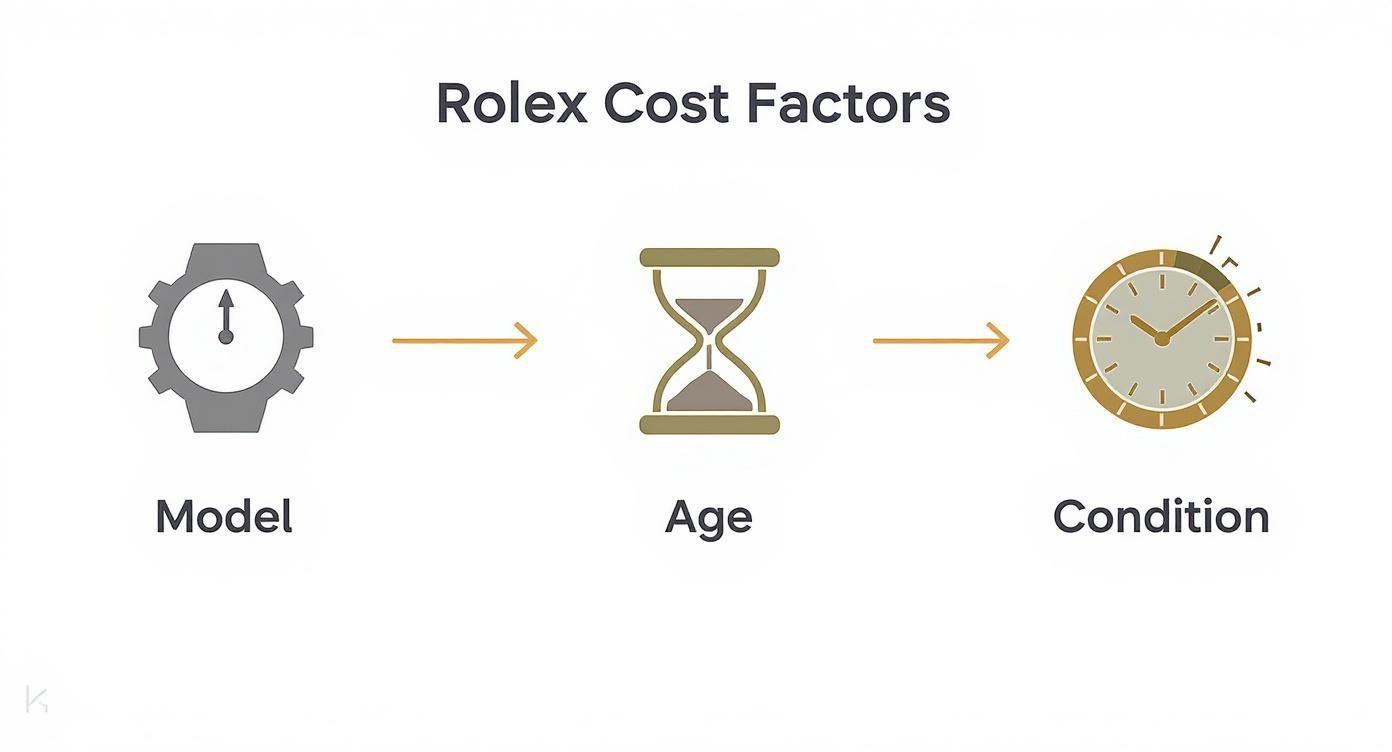
As you can see, the specific model, its age, and its physical condition are the three pillars that determine the bill before the actual overhaul even begins.
The Cleaning and Reassembly Phase
Once disassembled, every single part gets a bath in a specialized ultrasonic cleaner. This machine uses high-frequency sound waves to gently but completely remove all traces of old lubricants, microscopic dust, and grime that have built up over the years. It’s a true deep clean that leaves each component in pristine condition.
Next up is the careful reassembly. The watchmaker methodically rebuilds the movement, lubricating each component with up to seven different types of proprietary oils and greases. Different parts need different viscosities to function correctly—a tiny detail that is absolutely critical for performance. You can learn more about the complexities of these tiny engines in our guide to different Rolex movements.
This entire process typically involves a 9-step overhaul. It’s a comprehensive procedure that goes far beyond a simple polish, justifying the investment needed to keep these exceptional timepieces running perfectly.
Any parts that no longer meet Rolex’s incredibly strict standards, like gaskets and seals, are systematically replaced with genuine factory components. This is essential to guarantee the watch's water resistance is fully restored.
Calibration and Final Testing
With the movement back together, the watch enters the crucial calibration stage. Using sophisticated timing equipment, the watchmaker painstakingly adjusts the balance wheel to regulate the watch's accuracy. The goal is to bring it back within COSC chronometer standards of -4/+6 seconds per day—or often even tighter to Rolex’s own internal standard of -2/+2.
Finally, the refinished case is reassembled, and the entire watch undergoes a series of rigorous pressure tests to ensure its waterproofness is back to factory spec. The watch is then tested for several days to monitor its real-world performance and power reserve before it’s deemed ready to be returned.
This complete overhaul, which can run anywhere from $800 to over $1,200 for a standard service, is a testament to the level of detail required to properly maintain a Rolex.
Official Service Center vs. Independent Watchmaker
Deciding where to get your Rolex serviced is a big deal. It’s a choice that has a direct impact on the final Rolex watch repair cost, how long you’ll be without your watch, and even its future value. You’re essentially choosing between two paths: the official Rolex Service Center (RSC) or a trusted independent watchmaker.
It's a classic head-to-head scenario, and honestly, the "best" option really boils down to what you prioritize.
Think of an RSC as the factory-certified route—like taking your high-performance car back to the original dealership for service. You get an ironclad guarantee that only 100% genuine Rolex parts will be used, and the work is backed by a solid two-year international warranty. That kind of peace of mind is huge, especially for modern pieces.
Of course, that official stamp of approval comes at a premium. RSCs almost always have higher service costs and much longer turnaround times. You can expect to be without your watch for anywhere from four to eight weeks, and sometimes even longer depending on their backlog.
The Independent Watchmaker Advantage
On the flip side, a reputable independent watchmaker offers a pretty compelling alternative, especially if you’re focused on value and flexibility. They often have more competitive pricing and can get a full service done in a fraction of the time—usually two to four weeks. For anyone who wears their Rolex daily, getting it back sooner is a massive plus.
You also tend to get a more personal touch. It’s not uncommon to speak directly with the person who will be working on your watch, a level of communication you just don’t get from a large corporate service center. If you want a more hands-on approach or need specialized advice, looking into a dedicated watch concierge service can connect you with that tailored expertise.
The biggest advantage of an independent watchmaker, however, often comes into play with vintage models. An RSC has a strict policy: if a part is worn, it gets replaced with a modern equivalent. For collectors who prize originality, this can crater a vintage watch's value.
An independent expert gets it. They understand the importance of preservation and will do everything they can to repair original components, helping maintain the watch’s history and its investment value.
Comparing Your Rolex Service Options
To make things clearer, let's break down the key differences. Choosing the right path depends on your specific watch and what you value most in a service.
| Factor | Rolex Service Center (RSC) | Independent Watchmaker |
|---|---|---|
| Cost | Generally higher, reflecting factory overheads and branding. | Often more competitive and affordable. |
| Turnaround Time | Slower, typically 4-8 weeks or more. | Faster, usually 2-4 weeks. |
| Parts | Guaranteed 100% new, genuine Rolex parts. | Can source genuine Rolex parts, but also has the flexibility to use high-quality aftermarket or refurbished original parts if needed. |
| Warranty | A 2-year international warranty comes standard. | Warranty varies, but reputable independents offer their own, typically 1-2 years. |
| Vintage Watches | Strict policy of replacing old parts with new ones, which can decrease originality and value. | Focuses on preserving original parts whenever possible, maintaining historical integrity. |
| Personalization | Standardized, corporate process. Direct contact with the watchmaker is rare. | Highly personal. You can often speak directly to the expert working on your timepiece. |
Ultimately, weighing these factors will point you in the right direction for your watch and your budget.
Making the Right Choice for Your Watch
So, how do you decide?
If you own a modern Rolex and your top priorities are the factory warranty and the absolute guarantee of new, genuine parts, the RSC is an excellent, worry-free choice. You're paying for the official Rolex pedigree and the assurance that comes with it.
But if you value a lower cost, a much faster turnaround, and a more collaborative service experience, a well-regarded independent is probably your best bet. This is especially true for vintage owners who need a service that respects and preserves the timepiece's originality.
Costs for Specific Rolex Repairs and Restorations
While a standard overhaul takes care of the intricate health of the movement, sometimes your watch needs more focused attention. These specific repairs fall outside the baseline Rolex watch repair cost and fix everything from cosmetic scuffs to critical part failures. Getting a handle on these potential expenses helps paint a full picture of what it takes to maintain your timepiece.
Think of it this way: a routine service is like your watch’s annual physical. But if you break a bone, that’s a different visit to a specialist with its own set of costs. The same idea applies here. Specific damage calls for specific—and often pricey—solutions.
Breaking Down Individual Repair Costs
When you get an estimate from a watchmaker, it will list any work needed beyond the standard movement service. These line items can range from minor cosmetic touch-ups to major replacements, and each one adds to the final bill.
For instance, a simple polish to buff out surface scratches on the case and bracelet will generally run between $200 and $500. If you've chipped or shattered the crystal, a new sapphire glass replacement is typically priced from $300 to $600.
Of course, the most significant costs pop up when there's severe damage to the movement itself. In those cases, a full overhaul can climb anywhere from $1,200 to $3,000. You can find more details on these restoration cost estimates on WatchMyDiamonds.com.
Key Takeaway: The priciest repairs almost always involve the movement or the dial. Water getting inside or a hard drop can set off a domino effect of part replacements, quickly turning a routine service into a full-blown restoration project.
High-Cost Scenarios to Be Aware Of
Certain issues are notorious for sending repair costs through the roof. Knowing what they are can help you protect your watch from preventable—and expensive—damage. It’s also worth noting that while Rolex watches are automatic, some owners confuse this with quartz movements. If you're curious about the difference, check out our guide on whether a Rolex ever needs a battery change.
Here are a few common high-ticket repairs to watch out for:
- Dial Restoration: A faded, water-damaged, or peeling dial requires a true artist's touch. Restoring or replacing one can cost $500 to $1,500+, especially for rare or vintage models where finding a period-correct replacement is a serious challenge.
- Bracelet Repair or Replacement: A stretched-out "President" or "Jubilee" bracelet is a common issue that requires painstaking work to tighten up the links. A full replacement is even steeper—a genuine Rolex bracelet can set you back several thousand dollars.
- Water Damage Overhaul: This is often the worst-case scenario. If moisture gets inside, it can cause rust and corrosion on dozens of tiny, delicate parts. The fix usually requires a complete movement rebuild where nearly every component might need to be replaced, easily pushing the final bill past $2,500.
Common Questions About Rolex Service Costs
Even after you get a handle on the numbers, a few big questions usually pop up when you're thinking about Rolex watch repair costs. It’s totally normal. The world of high-end watch care can seem a little complicated, so let’s cut right through the noise and get you some straight answers.
We're going to tackle the three most common concerns every Rolex owner runs into eventually: how often you really need a service, whether that service bill adds any value to your watch, and what happens if you don't agree with a recommended repair.
How Often Should I Service My Rolex?
Officially, Rolex suggests a service about every 10 years. That’s a pretty incredible timeframe and a real credit to their modern engineering and advanced lubricants. But think of that as more of a maximum guideline, not a hard-and-fast rule.
Most watchmakers and seasoned collectors will tell you a 5-to-7-year interval is a much safer bet, especially if your Rolex is a daily driver. It’s a lot like maintaining your car. The manufacturer might say you can go 10,000 miles between oil changes, but if you’re driving in tough conditions all the time, you’re going to do it sooner. Same idea here. Daily wear puts more stress on all those tiny moving parts and the gaskets that keep it water-tight.
For a watch that only comes out on special occasions, waiting the full ten years is probably fine. But for your trusty daily companion, being a bit more proactive is the best way to avoid premature wear on internal parts that can get very expensive to replace down the line.
And of course, sometimes your watch will just tell you it's time. If it starts losing a lot of time, the power reserve isn't what it used to be, or the crown feels a bit crunchy when you wind it, it’s asking for attention—no matter what the calendar says.
Does a Rolex Service Increase Its Value?
This is a great question, and the answer is a definite "it depends"—mostly on how old your watch is.
For any modern Rolex, getting it serviced at an official center absolutely makes it more attractive on the market and can bump up its value. A buyer sees that recent service record and the two-year warranty that comes with it, and that’s a huge dose of confidence.
But for vintage pieces, a standard service can be a total disaster.
Sending a vintage model to Rolex for a standard service can actually destroy its value in the eyes of serious collectors. Why? Rolex’s policy is to make the watch like new, which means replacing old parts—like a beautifully faded "tropical" dial, aged hands, or a worn bezel insert—with brand new, perfect ones. Collectors want the originality, the history, the character. Those "new" parts erase all of it. For a vintage piece, the only way to protect its value is with a careful mechanical service that preserves every single original component.
Can I Decline Parts of a Recommended Service?
Yes and no. You have some say in the matter, but Rolex holds the final cards.
You can almost always say no to cosmetic work. If you love the scuffs and scratches your watch has earned over the years—the story of its life on your wrist—you can just tell the service center not to polish the case and bracelet. That’s a common request.
What you can’t decline are repairs Rolex considers essential for the watch to function correctly and maintain its water resistance. If they find a worn-out gear in the movement or a critical gasket that's failed, that’s non-negotiable.
If you refuse those mandatory fixes, Rolex won't proceed with the service at all. They won't do half the job or issue that two-year warranty. They'll simply put your watch back together and send it back to you, because they can't put their name on a repair that doesn't meet their strict quality standards.
At ECI Jewelers, we understand all the little details of Rolex care, from a simple tune-up on a modern watch to a delicate restoration of a family heirloom. Whether you need a service you can trust or just some expert advice on preserving a vintage treasure, our team is here to give you a transparent, personalized experience. Visit us online to explore our services or schedule a consultation.


