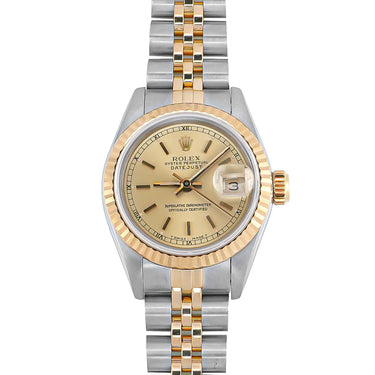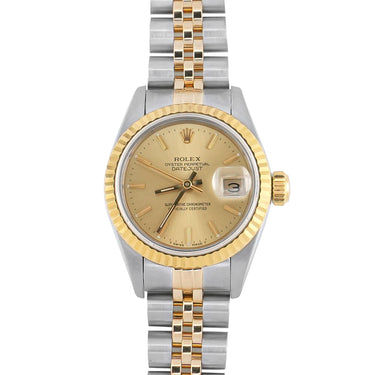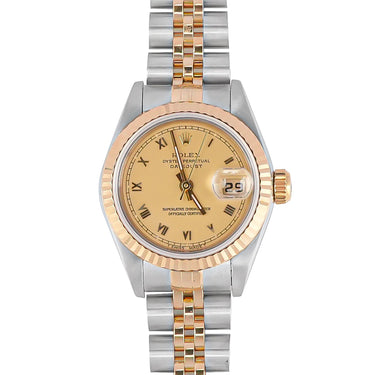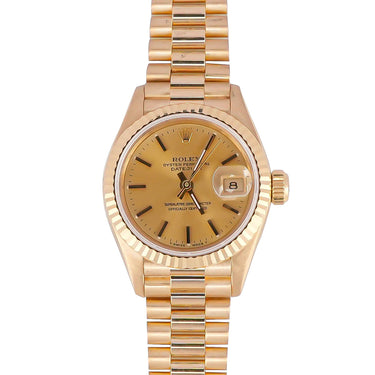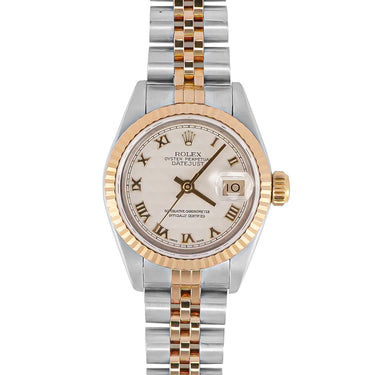

Why do two Rolex Datejust watches carrying the exact same 41 mm label feel like completely different timepieces the moment you place them on your wrist? In a Datejust 41 vs Datejust II comparison, the discontinued Datejust II brings a chunkier case, an earlier mechanical calibre, and an Oyster-only bracelet setup, while the current Datejust 41 trims the lugs, runs roughly a full day longer off the wrist, and opens up far more metal, dial, and bracelet choices.
Across our counter, buyers often assume the switch between these two watches was just a quick name change. Looking closely at the case silhouette, inside the movement, and at the paperwork tells a very different story. Below, we walk through how each model wears, which configurations change the look most, what separates the two movements in daily rotation, and what you should verify before buying a pre-owned example.
What is the difference between the Datejust 41 and Datejust II?
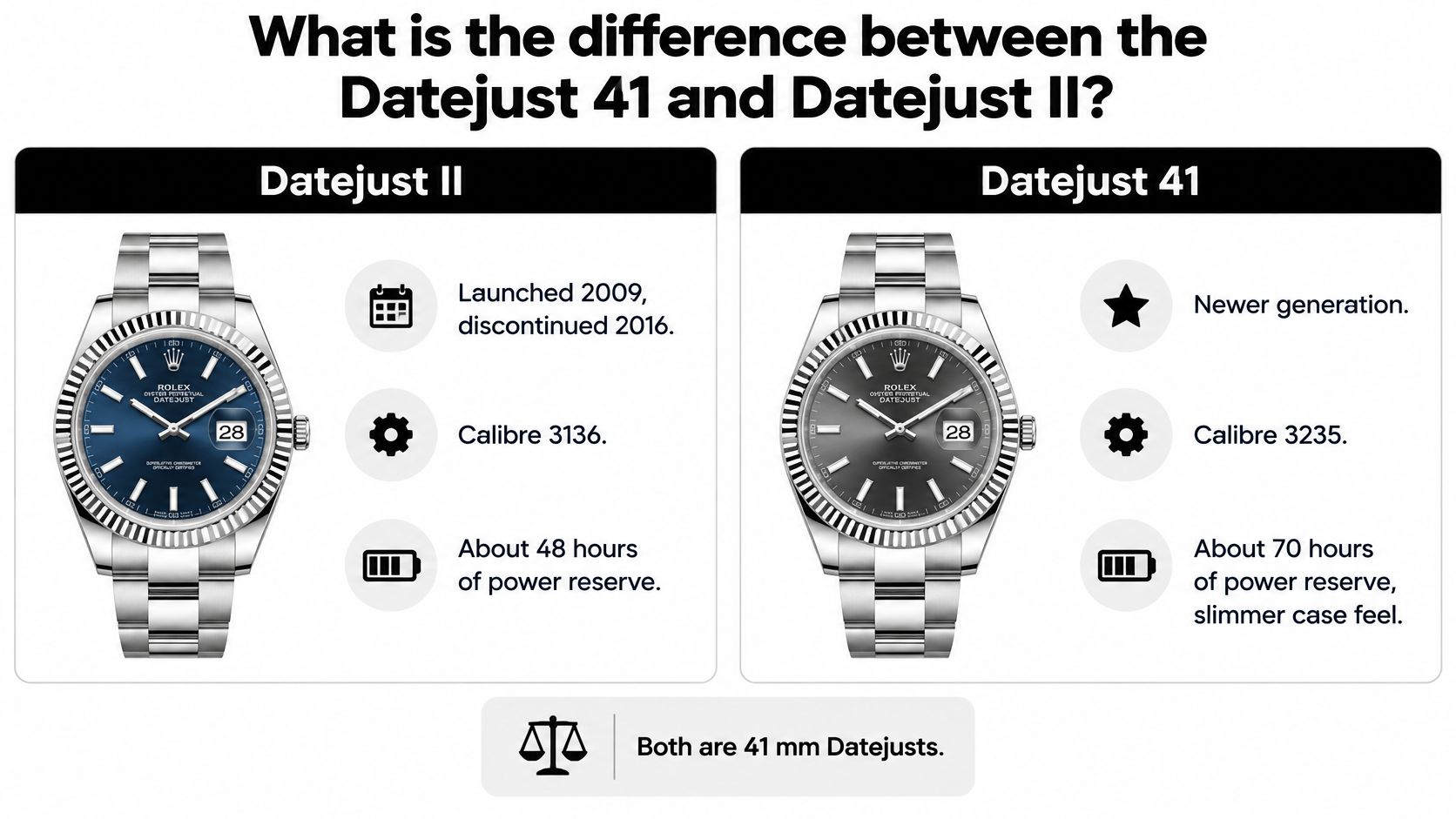
Both watches share a 41 mm nominal case diameter and the signature date display under a Cyclops lens. The Datejust II is Rolex's original large-format take on the design, produced from 2009 to 2016 and powered by calibre 3136. The Datejust 41 is the 2016 redesign, housing calibre 3235 inside a reworked case profile.
The Datejust name itself reaches back to 1945, when Rolex introduced its classic date-display wristwatch with the magnified window at 3 o'clock. For decades, the standard men's case measured 36 mm. As detailed in the Second Movement overview of the Datejust II, Rolex launched the Datejust II in 2009 as its first major expansion to 41 mm, answering the 2000s appetite for larger luxury watches, and retired the line in 2016 after roughly seven years in favor of the Datejust 41.
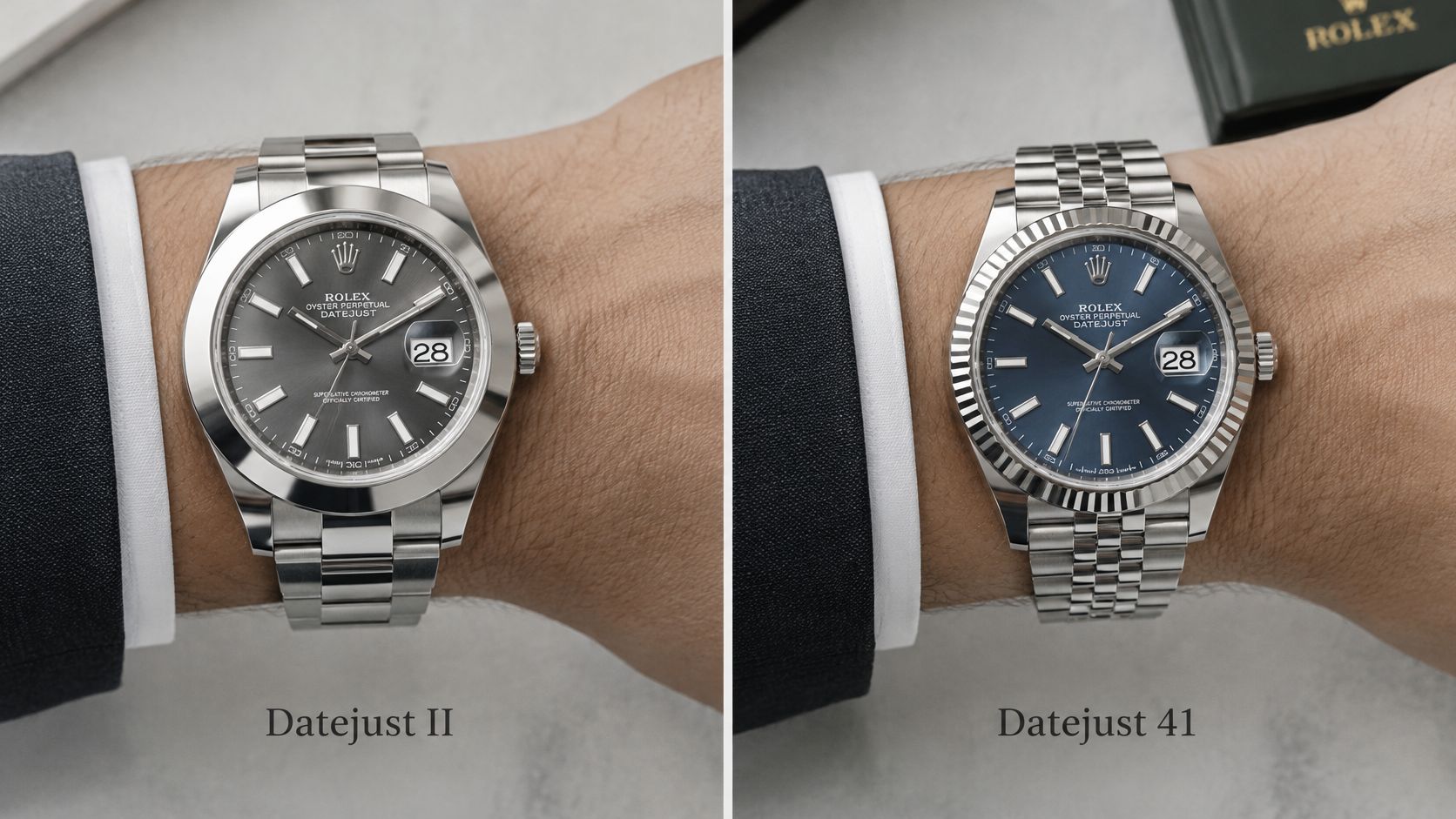
The visual shift between generations shows immediately in a side-by-side view. Broader lugs, a wider bezel, and heavier dial markers push the Datejust II toward sport territory, while the Datejust 41 slims the lugs and rebalances bezel against dial. The choice sits between two distinct design eras, not an older reference and a newer one.
Side by side specifications
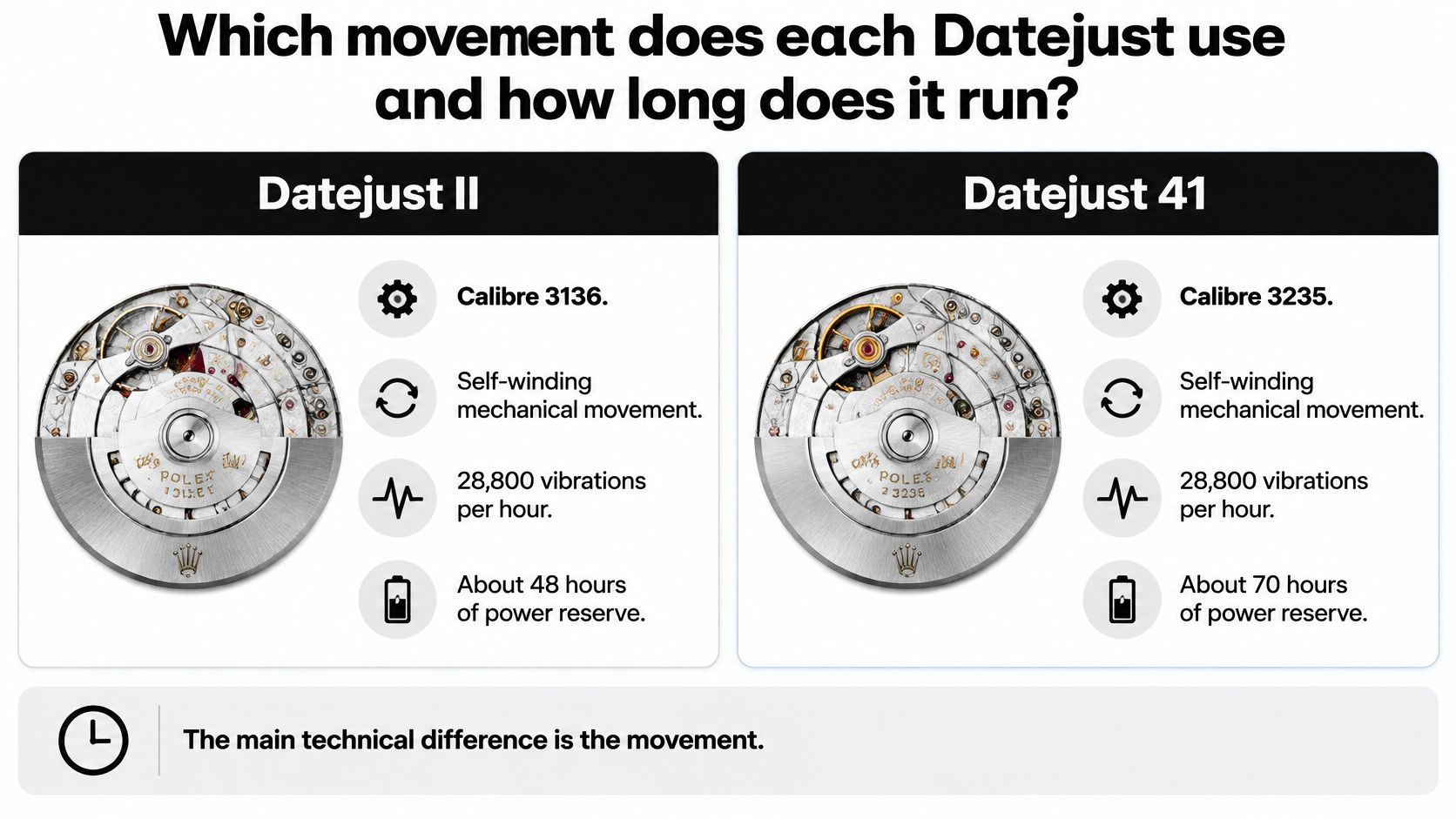
Under the dial, the mechanical gap matters just as much. According to the SwissWatches comparison of the Datejust II and Datejust 41, both movements beat at 28,800 vibrations per hour, yet the Datejust II runs calibre 3136 with an approximately 48-hour power reserve while the Datejust 41 runs calibre 3235 with an approximately 70-hour power reserve, adding about 22 hours (roughly 46% more reserve). Both calibres incorporate Paraflex, Rolex's shock-absorber system engineered to cushion the movement's regulating components against impacts.
| Feature | Datejust II | Datejust 41 |
|---|---|---|
| Launch year | 2009 | 2016 |
| Production period | 2009 to 2016 | 2016 to present |
| Nominal case diameter | 41 mm | 41 mm |
| Movement calibre | 3136 | 3235 |
| Power reserve | About 48 hours | About 70 hours |
| Shock protection | Paraflex shock absorbers | Paraflex shock absorbers and blue Parachrom hairspring |
| Lug-to-lug stance | Reads longer across the wrist with broad, flat lugs | Reads more compact with tapered, slimmer lugs |
| Case profile | Tall, substantial presence on the wrist | Leaner, lower-slung presence on the wrist |
| Dial and bezel range | Smooth steel or fluted gold bezel across steel, white Rolesor, and yellow Rolesor | Smooth or fluted bezel across steel and all three Rolesor alloys, with wide dial choices |
The shared 41 mm number on the spec sheet is what trips up most buyers. Case shaping, bracelet compatibility, and the calibre inside mark these as separate generations wearing the same label.
Which 41 mm Datejust fits your wrist and suits daily wear?
Two watches printed with the same 41 mm case number shouldn't feel worlds apart, yet these two do. The Datejust II spreads its visual weight outward across thicker, flatter lugs, a broader bezel, and chunky hour markers, so it reads noticeably larger across the top of the arm. By contrast, the Datejust 41 tapers its lugs more cleanly and narrows the bezel, pulling the visual mass toward the center of the dial.
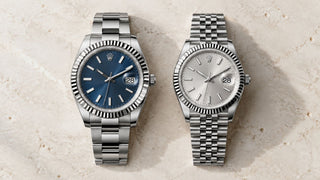
The visual comparison below shows how those case proportions change the stance of each watch before you ever fasten the clasp.
Dial color and contrast also shift perceived size more than most shoppers expect. A light silver, white, or champagne dial inside a thin bezel makes the watch face look open and wide, whereas a dark blue, black, or slate dial pulls the eye inward and tightens the footprint. If you're weighing whether a 41 mm case might overpower your frame altogether, our guide on choosing between a 36 mm and 41 mm Datejust without trying it on breaks down how case width translates across wrist shapes.
Four steps to check fit before buying
- Measure your wrist circumference with a flexible tape. Wrap it snugly right above the wrist bone. As a practical sizing benchmark, a wrist around 6.5 inches usually finds the Datejust II's flat lugs close to overhanging, while a 7-inch wrist handles the Datejust 41 cleanly and a 7.5-inch wrist supports either watch with room to spare.
- Look up lug-to-lug length and case thickness for your exact reference. Confirm those measurements against Rolex's official sheets at rolex.com or verified measurement archives like Bob's Watches before committing online, because lug span dictates overhang far more than case diameter.
- Test sleeve and bracelet clearance. Put on a buttoned dress shirt if you wear fitted clothing to work and check whether the bezel edge catches the cuff fabric.
- Try the watch on whenever possible. Pay attention to how the clasp sits under your wrist bone and confirm enough removable links are present for seasonal sizing adjustments.
Bracelets and daily wear scenarios
All-day comfort comes down to lug shape, case height, metal weight, and bracelet design rather than the 41 mm number on the spec sheet. Every Datejust II left the factory on the flat three-link Oyster bracelet, giving it a solid, sporty drape with slightly firmer articulation. The Datejust 41 gives you both the Oyster and the five-link Jubilee bracelet, whose smaller sculpted links flex easily around the wrist and lend a dressier look, though precious-metal center links on two-tone models add noticeable heft.
- Desk professionals typing all day: The Datejust 41 on a Jubilee bracelet distributes pressure smoothly when your wrist rests against a laptop edge, while the broader Datejust II Oyster clasp feels more rigid over eight hours at a keyboard.
- Wearers under suit cuffs: Tapered lugs and a slimmer bezel help the Datejust 41 glide beneath a buttoned cuff without snagging, whereas the Datejust II often catches tighter sleeves.
- Collectors rotating multiple watches: Anyone alternating between sport watches and dress pieces tends to appreciate the Datejust 41's versatility on either bracelet, while buyers who want one bold, steel-forward daily watch often enjoy the Datejust II's muscular feel.
Seeing both watches move on a real wrist makes these proportion shifts much easier to judge than still photography alone.
Fitting rule: If your wrist is on the slimmer side or the watch will live under shirt cuffs, verify lug-to-lug span and thickness first, then check clasp comfort and confirm the bracelet has enough links to size cleanly.
What dial, bezel and metal options change the look?
Case metal, bezel cut, and dial color reshape a 41 mm Datejust far more dramatically than the generational shift alone. Two buyers can hold the exact same model family and walk away with completely different watches, one looking quiet enough for jeans and a sweater and the other dressed for a formal dinner.
Metal combinations and Rolesor
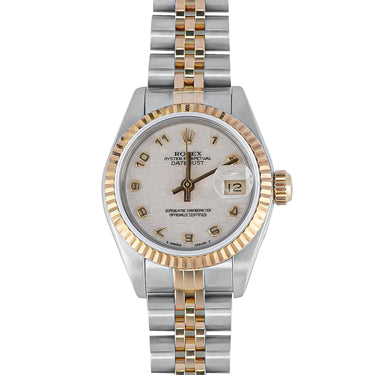
According to Rolex's official Datejust 41 specifications, the current Datejust 41 lineup spans four metal families: all-Oystersteel, Oystersteel paired with 18-carat yellow gold, Oystersteel paired with white gold, and Oystersteel paired with Everose gold. Rolex calls its two-tone construction Rolesor, which is the brand's name for combining durable Oystersteel with precious gold on the same watch. Yellow Rolesor (Oystersteel with 18-carat yellow gold) and White Rolesor (Oystersteel with white gold) are the two most recognizable pairings, while Everose Rolesor adds Rolex's warm rose gold alloy to the modern 41 mm lineup.
An all-Oystersteel model keeps the tone low-key and durable for heavy daily wear. Stepping into Yellow Rolesor or Everose Rolesor brings stronger contrast across the bezel and center links, moving the watch into dressier territory. Because the discontinued Datejust II also varied across steel, white Rolesor, and yellow Rolesor depending on reference number, you should always compare exact references and metal mixes rather than relying on the model name alone.
Fluted versus smooth bezels
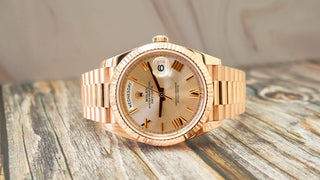
Rolex pairs smooth bezels with steel models for a clean, understated profile that resists drawing attention across a room. Fluted bezels are crafted in precious metal and catch overhead light from every angle, instantly giving the watch traditional Datejust character. If you're torn between subtle everyday polish and classic light play, we compare fluted versus smooth bezel pros and cons on a Datejust in detail.
Dial options that shift personality
At ECI Jewelers, we carry Rolex Datejust models in 31 mm, 36 mm, and 41 mm sizes across Oystersteel, White Rolesor, Yellow Rolesor, and Everose Rolesor, with fluted or smooth bezels, Jubilee or Oyster bracelets, and dials ranging from classic blue and champagne to Wimbledon and diamond-set variations. Each dial family changes how the watch dresses up or down:
- Blue and dark index dials: Crisp, modern, and easy to pair with either casual clothing or business attire.
- Wimbledon dials: Slate gray with green-outlined Roman numerals, offering a distinctive look that stands out on both steel and two-tone cases.
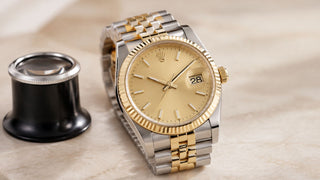
- Champagne and gold-toned dials: Warm and traditional, especially when matched with Yellow Rolesor and a fluted bezel.
- Diamond-set dials: Formal and high-contrast, shifting the Datejust cleanly into evening and milestone-gift territory.
Because every pre-owned watch carries its own exact configuration, treat the live product listing as the final word on dial markers, bezel metal, and bracelet pairing. Those material choices alter both wrist presence and secondary-market positioning far more than buyers realize before seeing them side by side.
Which movement does each Datejust use and how long does it run?
Beneath the dial lies the single largest mechanical divide between the two watches. The Datejust II runs calibre 3136, while the Datejust 41 introduced Rolex's newer calibre 3235.
As detailed in the Rolex Datejust 41 movement specifications, calibre 3136 evolved from the proven 3135 platform with Paraflex shock protection, whereas calibre 3235 arrived in 2016 as a next-generation self-winding mechanical movement incorporating the Chronergy escapement, which is Rolex's high-efficiency escapement design built to cut energy loss inside the gear train. That efficiency boost extends running autonomy to approximately 70 to 72 hours, giving the newer model roughly one extra full day of power when fully wound.
Inside calibre 3136 and calibre 3235
Both movements keep Rolex's self-winding architecture, instantaneous date display, and Cyclops magnifier, meaning you aren't gaining or losing a watch complication by picking one generation over the other. Instead, the upgrade shows up in precision tolerances, magnetic resistance, and daily convenience.
According to Rolex's technical sheet for the Datejust 41, calibre 3235 is regulated to -2/+2 seconds per day after casing and includes instantaneous date changing with rapid setting, stop-seconds for exact time synchronization, and bidirectional self-winding through the Perpetual rotor. On top of that, Rolex's movement component specification highlights a paramagnetic blue Parachrom hairspring alongside high-performance Paraflex shock absorbers. The Parachrom hairspring is Rolex's proprietary paramagnetic alloy spring designed to resist magnetic-field interference from everyday electronics like laptops, phone cases, and magnetic bag clasps.
If you want to see how these two calibres fit into Rolex's broader engineering timeline, we break down how different Rolex movements compare across generations.
What extra power reserve means for weekly rotation
The practical payoff of calibre 3235 becomes obvious the moment you own more than one watch. Imagine taking your watch off Friday evening after work and wearing a casual timepiece or going watch-free all weekend.
Set a fully wound Datejust 41 on your dresser Friday night and it'll still be ticking accurately on Monday morning. Do the same with a Datejust II, and you'll usually need to wind it and reset the time and date before heading out the door.
Calibre 3136 remains a reliable, proven mechanical workhorse if you wear one watch every single day, since regular wrist motion keeps its mainspring topped up. For buyers who rotate two or three pieces through the week, the 3235's extra day of autonomy removes weekly resetting from your routine. When shopping pre-owned listings where informal titles blur the two models together, checking the movement calibre on the listing and paperwork is the surest way to confirm which generation you're looking at.
What should you check before buying a pre-owned Datejust?
Start every pre-owned inspection with the reference number, not the seller's headline. That six-digit code locks in the movement generation, case metal, and bezel configuration (for example, 1163xx references identify the Datejust II family, while 1263xx references identify the Datejust 41). Before you read a single paragraph of description, match that reference number directly against the listing photographs to make sure the bezel, bracelet, and dial agree with what Rolex built for that code.
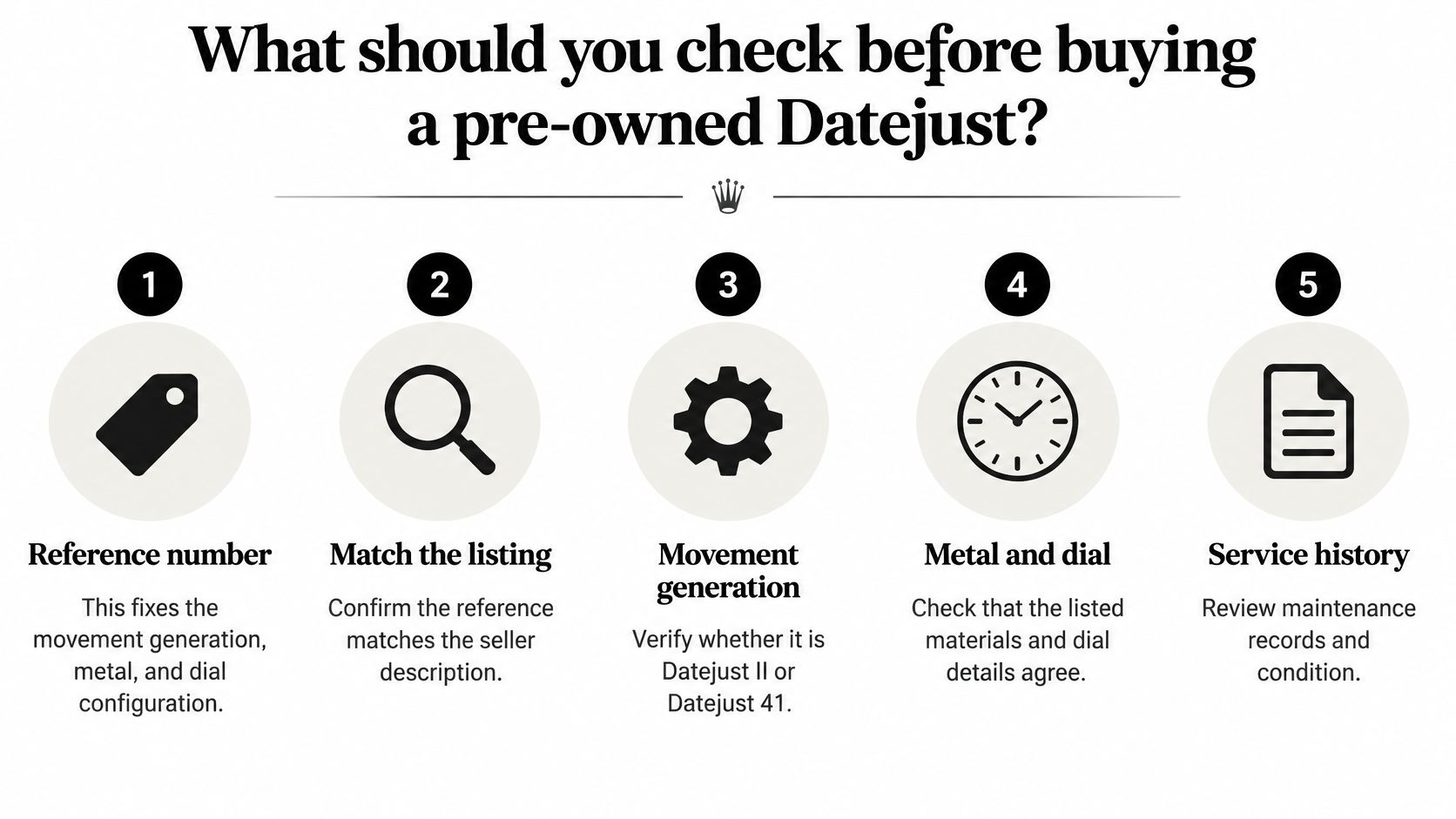
Inspection checklist for Datejust 41 and Datejust II
Once the reference checks out, work through six physical and documentation details before committing your budget.
| Check | What to verify | Why it matters |
|---|---|---|
| Reference number | Match the exact reference to the listing and photos | Determines movement generation, metal and dial configuration |
| Movement calibre | Confirm 3136 for Datejust II or 3235 for Datejust 41 in the listing or paperwork | Sets power reserve and mechanical features |
| Metal and bracelet | Oystersteel, Rolesor, gold or Everose, with Oyster or Jubilee bracelet | Changes weight, look and price |
| Box and papers | Original box and papers included or not | Completeness affects value and resale |
| Dial and bezel | Fluted or smooth bezel, dial color and any diamond dial | Changes the look and the market position |
| Condition | Case, crown, bracelet links and crystal | Determines likely service needs and price |
Pay extra attention to physical wear on discontinued Datejust II pieces, since even the newest examples are now a decade or more old. Inspect the lug edges for heavy over-polishing, check for bracelet stretch between links, examine the sapphire crystal edge for tiny flea-bite chips, and confirm the crown screws down smoothly against the case tube. Because water resistance depends on fresh gaskets rather than original factory specs, asking about recent maintenance helps you anticipate upcoming service costs.
On any discontinued watch, sharp unpolished case edges and clean crown threading protect long-term ownership far better than chasing the lowest sticker number on a worn example.
What drives pre-owned Datejust pricing
Pre-owned Datejust pricing moves primarily with case metal, bezel style, dial rarity, bracelet type, physical condition, and whether the watch retains its original accessories. Across our broader pre-owned Datejust selection spanning all sizes and configurations, listings generally range from roughly $5,000 to $20,000 or more, with smooth-bezel steel pieces sitting lower and white-gold fluted, two-tone, or sought-after dial combinations sitting toward the upper end. Understanding how original Rolex box and papers affect pre-owned value helps you weigh a full set against a watch-only listing fairly.
Datejust watches tend to hold value well over time because collector demand stays consistent and discontinued references like the Datejust II have a fixed supply, though no luxury watch comes with a promise of price growth. We sell pre-owned watches, and every piece in our showroom is one of a kind, so always inspect the exact high-resolution photos on the specific listing you plan to buy rather than relying on stock imagery.
Which Datejust 41 or Datejust II should you buy?
Choosing between these two 41 mm watches comes down to how you wear your watch, how often you rotate pieces, and which design proportions look right on your wrist. Rather than declaring one universally better, match your priorities against the decision guide below and cross-check the specification table earlier in this guide for exact movement and era details.
| Your situation | Better fit | Why |
|---|---|---|
| Newest movement and longest power reserve | Datejust 41 | Calibre 3235 adds modern efficiency and extra weekend autonomy |
| Original modern 41 mm design with a bounded production era | Datejust II | Seven-year discontinued run with bold, distinct case proportions |
| Smaller wrist or cuff-worn use | Either, after measuring | Lug-to-lug distance and thickness decide the fit |
| Matching watch for a partner | Datejust 41 or Datejust II | Choose the same reference style for both watches |
| Budget-led search | Compare exact references | Metal, dial and bezel change the price more than the model name |
A closer look at a current Datejust 41 configuration
Seeing how metal, bezel, dial, and bracelet come together on a real listing makes the decision concrete. Below is an example from our current 2026 inventory showing how a sought-after Datejust 41 configuration prices out when complete with original box and papers.
Rolex Datejust 41 ref. 126334 (Mint Green Dial, Jubilee Bracelet) 41 mm White Rolesor configuration pairing Oystersteel with an 18K white gold fluted bezel, mint green dial, Jubilee bracelet, and original box and papers. Price: About $19,000 (current 2026 listing; each pre-owned watch is one of a kind). View current watches in our Rolex Datejust collection →
Because every pre-owned watch sells individually and inventory rotates daily, checking our full Datejust collection lets you compare available steel, fluted, and two-tone references side by side as new pieces arrive.
Pairing watches for couples and weddings
Shoppers choosing a 41 mm Datejust for a wedding or anniversary often want a coordinated look alongside their partner's watch. Matching the metal tone, bezel cut, and dial family across both wrists creates a cohesive pair even when the case diameters differ. Couples planning a shared set can explore matching his and hers Rolex pairings for practical combinations, while grooms selecting a dress-ready timepiece for the ceremony can review our guide to choosing a Rolex wedding watch for the groom.
Your cleanest next step is simple: verify the exact six-digit reference number, confirm the calibre and box-and-papers status, and compare two or three specific listings against your wrist measurement before making a final call.
How can you pay for it?
Buying a pre-owned Rolex doesn't require paying the entire balance in a single lump sum if you prefer to spread out the cost. At ECI Jewelers, buyers can apply for financing through Affirm, Synchrony, Acima, and Snap Finance, with approval decisions and repayment terms set directly by each provider. You can review all four programs on our flexible financing and leasing options page and read each provider's terms carefully before signing an agreement.
If you want a clearer picture of monthly budgets and application steps ahead of time, we also explain how financing a Rolex watch works.
Customers who already own a timepiece they no longer wear can also trade in or sell a luxury watch to put its value toward a Datejust 41 or Datejust II. Keep in mind that a trade-in valuation is handled as a separate step from financing. Whichever payment path fits your budget, always confirm the exact reference number and live listing price on the specific watch before submitting your application or trade-in request.
Frequently asked questions
Is the Datejust 41 bigger than the Datejust II?
Both watches carry an official 41 mm case diameter, so the label alone does not answer the fit question. The Datejust II usually looks and feels larger because its broader lugs, wider bezel, and bolder hour markers add visual bulk. The Datejust 41 has a more tapered presence. Before choosing, compare lug-to-lug measurements, bracelet width, and how the case sits across the wrist.
How long does the Datejust 41 run without winding?
A fully wound Datejust 41 runs for about 70 hours on calibre 3235, compared with about 48 hours on the Datejust II's calibre 3136. That extra margin gives you roughly an additional day off the wrist, which makes weekend watch rotation easier without resetting the time.
How can I tell which movement a pre-owned watch has?
Check the reference number first, then verify calibre 3136 or calibre 3235 in the listing details and accompanying paperwork. Match the photos to the stated reference, including the lugs, bezel, dial, and bracelet. Consistent details matter because a pre-owned watch should read as one complete configuration rather than a mix of parts.
Which watch should a couple choose for matching pieces?
Coordinate the metal finish, bezel style, and dial tone first. Those choices shape how the pair reads together more than the case label does. A fluted bezel with a Jubilee bracelet gives a dressier look, while a smooth bezel with an Oyster bracelet feels more understated. Many couples pair a 41 mm Datejust with a smaller model after comparing Lady-Datejust 26, 28, and 31 mm sizes. Formal styling details matter too, and some buyers also review Alexander Noel's bespoke shoe FAQ when coordinating wedding or formal attire.
Prices shown reflect current 2026 listings, and each pre-owned watch is one of a kind.
Whether you prefer the bolder Datejust II proportions or the slimmer Datejust 41 profile with its longer power reserve, compare real references side by side. ECI Jewelers offers pre-owned Datejust watches across steel, Rolesor, fluted, smooth, Oyster, and Jubilee configurations, many with original box and papers.