


When you hear collectors talk about a Rolex with "box and papers," they're referring to the complete original kit that came with the watch when it was first sold. This means the iconic green presentation box, the official warranty card (or older paper certificate), instruction manuals, and even the little hang tags.
Essentially, it's the watch's birth certificate and passport all rolled into one, proving exactly where it came from and that it's the real deal.
Why Rolex Box and Papers Are a Watch Collector's Secret Weapon
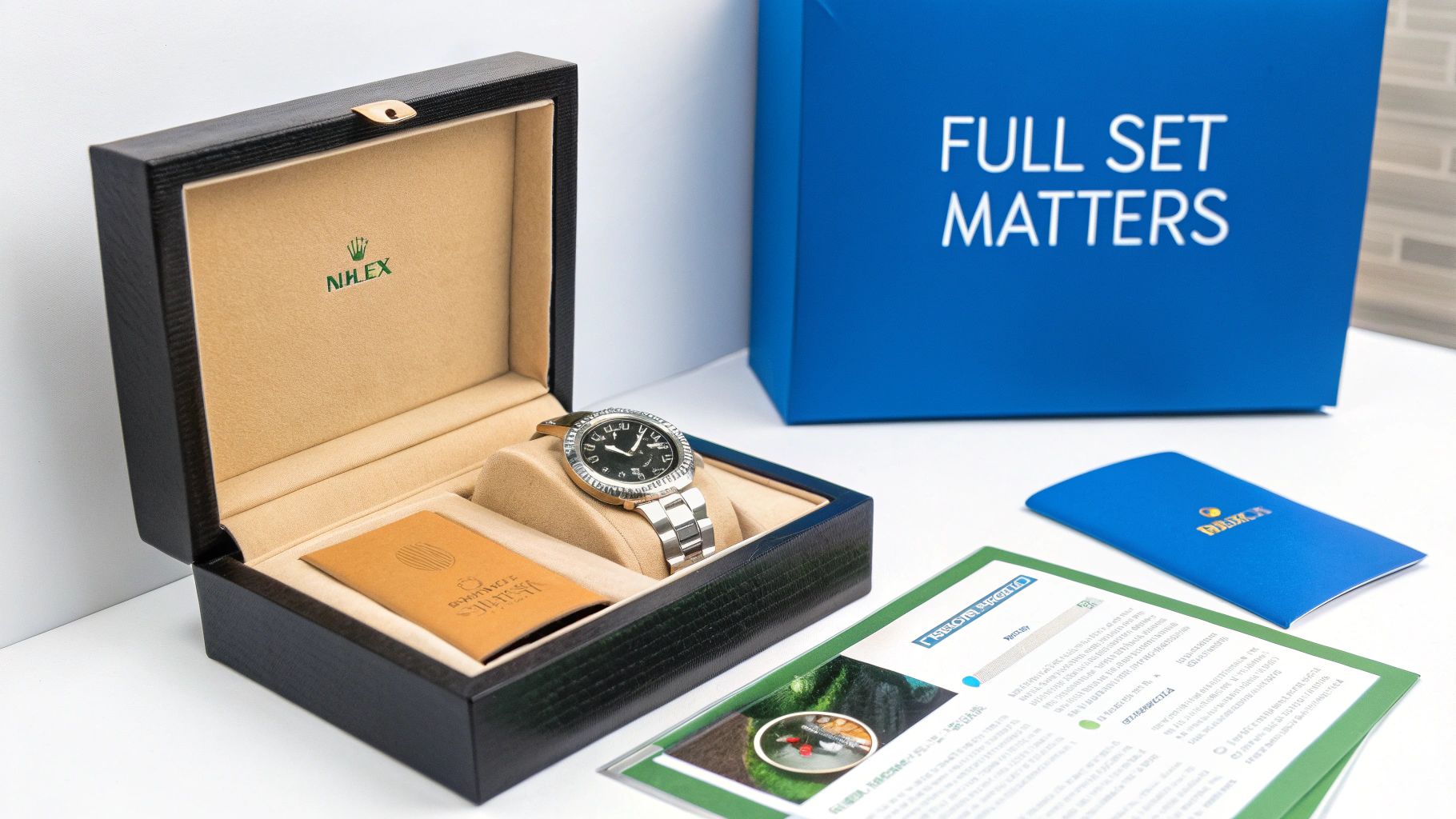
Before you even get a chance to admire the polished steel of a Rolex, the box and papers sitting next to it can tell you a huge part of its story. For seasoned collectors and first-time buyers alike, these items are so much more than just fancy packaging. They represent trust, authenticity, and a direct link to the watch's history.
Think of it like buying a vintage sports car. You wouldn't just kick the tires and take it for a spin; you'd demand the original title, a thick folder of service records, and maybe even the window sticker. These documents prove ownership, verify its history, and give you the confidence that you're getting exactly what you're paying for. The same logic applies perfectly to a Rolex.
A "full set," as we call it in the industry, is the gold standard. It gives you instant peace of mind, confirming the watch is genuine and has a clear history, or provenance. This completeness is what elevates a simple pre-owned watch into a true collector's piece.
What's Inside a Complete Rolex Set
While the exact contents have changed a bit over the decades, a modern, complete Rolex set usually contains several key items. Understanding what each piece is and why it matters is the first step to appreciating the value of the whole package.
Here’s a quick breakdown of what makes up a "full set."
| Component | Description | Primary Purpose |
|---|---|---|
| Outer Box | A simple white or beige cardboard sleeve. | Protects the more valuable inner box during shipping. |
| Inner Box | The iconic green "wave" or leatherette presentation box. | The primary display and storage case for the watch. |
| Warranty Card | A credit card-style plastic card (modern) or paper certificate (vintage). | The most crucial document, listing the serial number, model, and date of sale. |
| Manuals & Booklets | Includes the watch's instruction manual and a warranty information booklet. | Provides operating instructions and details the factory warranty. |
| Hang Tags | A green "Superlative Chronometer" seal and a white tag with serial/model numbers. | Certifies the watch's chronometer status and identifies it at the point of sale. |
| Bezel Protector | A small plastic or metal ring. | Shields the bezel from scratches before the initial sale. |
Having all these components together gives you a complete picture of the watch's identity from the moment it left the factory.
The Financial Impact of Completeness
This collection of cardboard and paper does more than just build confidence—it has a major impact on the watch's bottom line. In the highly competitive resale market, having the original Rolex box and papers can seriously boost its value.
Most experts agree this premium is somewhere in the 15-20% range, and sometimes even more for rare vintage models. For example, a pristine Rolex Submariner that might sell for $14,000 "naked" (watch only) could easily command an extra $2,800 or more with its full set. That turns a nice watch into a much stronger investment. You can find more data on how sets impact pricing in recent Rolex valuation reports.
At the end of the day, these accessories are the watch's passport. They validate its entire journey, from the Rolex factory to the authorized dealer and finally to you. Understanding this is key to seeing why a complete set is worth the premium and why savvy collectors consider it their secret weapon for a safe and valuable purchase.
Decoding Every Piece of the Rolex Puzzle
To really get what makes a Rolex box and papers so valuable, you have to stop seeing it as one thing. Instead, think of yourself as a detective piecing together a case. Every single booklet, tag, and piece of cardboard tells a part of the watch's life story.
Knowing what you’re looking at is everything. It's the only way to tell a genuine, period-correct set from a sloppy mismatch or an outright fake. Think of it like a high-stakes puzzle where every piece has to fit perfectly—not just in shape, but in style, material, and historical context. A single wrong component can throw the whole picture into doubt.
The Evolution of the Rolex Box
The box itself is your first clue. Over the decades, its design has changed dramatically, making it a surprisingly reliable way to date a watch's production era. A vintage Rolex from the 1960s simply shouldn't be sitting in a modern green wave box from 2024.
Early boxes often had wood grain finishes and velvet interiors, earning them nicknames like "coffin boxes" among collectors. As Rolex ramped up production, the packaging changed. Today's boxes are made of sustainable plywood wrapped in recycled leather, with a soft, cream-colored velour lining.
- Outer Sleeve: This is just the protective cardboard shell, usually white or cream, that shields the main presentation box. It should have a sticker on it listing the watch's specific model or reference number.
- Inner Presentation Box: This is the iconic green box everyone pictures. But the texture, the exact shade of green, and even the style of the Rolex crown logo have all been updated over time. The latest redesign features a new wave pattern on the lid and a green outer sleeve, replacing the older cream one.
Pro Tip: Don't panic if a brand-new Rolex comes in the slightly older cream-sleeved box. Authorized Dealers often use up their existing packaging stock before switching to the newest design, so there's always a transition period.
The All-Important Warranty Document
If the box is the house, the warranty document is the deed. It is, without a doubt, the single most critical piece of the "papers" puzzle because it directly ties the watch to its original sale. This is also the document that has changed the most over the years.
- Vintage Paper Certificates: Older watches came with a folded paper guarantee. These were filled out by hand with the watch’s serial number, model number, and the official stamp of the authorized dealer.
- Modern Warranty Cards: After 2009, Rolex switched to a durable, credit card-style plastic warranty card. These cards hold the same vital information but are built to last. The newest versions even include a scannable NFC chip for Rolex's internal service tracking.
Verifying the information on this card is non-negotiable. The serial and model numbers printed on it must perfectly match the engravings on the watch itself. Any difference is an immediate, glaring red flag. For a deeper dive into checking these details, our experts explain exactly how to authenticate a Rolex watch.
The Supporting Cast: Hang Tags and Booklets
While the warranty card is the star of the show, the supporting documents complete the story and add to the set's authenticity and value. These are often the first things to get lost or thrown away, so having them is a great sign of a meticulous original owner.
The Hang Tags
Two small tags typically hang from the bracelet of a new Rolex:
- The Green Seal: This is the "Superlative Chronometer" tag. It's a wax-like seal certifying the watch has passed Rolex’s incredibly strict in-house accuracy tests of -2/+2 seconds per day.
- The White Tag: In the old days, this was just a price tag. Now, it’s a small white barcode tag that also displays the watch's unique serial number and model reference number.
That serial number on the white tag gives you another point of verification—it should match both the watch and the warranty card.
Manuals and Booklets
Finally, a complete set includes all the original literature. These booklets are specific to the watch model and its era, giving you yet another layer of authentication. A full set should have:
- Owner’s Manual: A detailed guide for the specific model you bought.
- Warranty Booklet: This explains the terms of Rolex’s 5-year international guarantee.
- Factory Service Guide: Provides information on how to maintain the timepiece.
Every one of these items—from the outer cardboard sleeve to the smallest booklet—plays a role. By carefully decoding each piece, you can be confident you're not just buying a watch, but its complete and verified history.
How a Full Set Translates to Real Market Value
Let’s get down to what really matters for collectors and investors: the cold, hard cash value of a complete Rolex box and papers set. The watch is obviously the main event, but don't mistake its accessories for a simple afterthought. They are a powerful value multiplier that puts more money in your pocket on the secondary market.
This premium for a "full set" isn't just some quirky collector preference. It's all about trust. For any potential buyer, a complete package is an instant stamp of authenticity and provenance. It answers all the big questions—is it fake? is it stolen? is it a "Frankenwatch"?—before they even have to ask.
That peace of mind is something buyers will always pay for. Having the original documentation makes the whole deal feel safer, smoother, and just plain better.
Quantifying the Premium
So, what’s that confidence worth in dollars and cents? Market data is crystal clear on this: a Rolex with its original box and papers consistently sells for a major premium over a "watch only" or "naked" version. The exact percentage shifts based on the model’s rarity, age, and what’s hot at the moment.
As a general rule, a full set can increase a Rolex's resale value by 10% to 20%. For super sought-after or rare vintage models, that premium can soar even higher. In those cases, the papers can be almost as valuable as some parts of the watch itself.
This isn't just theory. You can see this trend play out across all the big resellers. Take a hot reference like the Rolex GMT-Master II "Pepsi" or "Batgirl." Their already sky-high resale values get an extra boost from a full set. On the flip side, a steel Submariner without its papers might take a 10-15% hit from its peak market price. You can dive deeper into how this works by checking out Rolex resale performance on realstyle.therealreal.com.
Value Impact of a Full Set on Popular Rolex Models
To see how this plays out with real numbers, let's look at some popular models. The table below gives a ballpark idea of the value jump a full set can provide. Keep in mind, these are estimates and can change with market conditions, but the pattern is undeniable.
| Rolex Model | Estimated Value (Watch Only) | Estimated Value (Full Set) | Potential Value Increase |
|---|---|---|---|
| Submariner Date 126610LN | $12,500 | $14,000 | ~12% |
| GMT-Master II "Pepsi" 126710BLRO | $19,000 | $22,000 | ~16% |
| Daytona "Panda" 116500LN | $28,000 | $33,000 | ~18% |
| Datejust 41 126334 (Blue Dial) | $12,000 | $13,500 | ~12.5% |
As you can see, we're not talking about small change. For high-demand pieces like the Daytona, having the box and papers can mean a difference of thousands of dollars. It's a tangible asset that directly impacts your return on investment.
The Value Varies by Model and Era
While that 10-20% rule is a good starting point, the impact isn't the same for every Rolex. In fact, the older and more collectible the watch gets, the more important those papers become.
- Modern Models: For any Rolex still under its 5-year warranty, that warranty card is non-negotiable. It’s your ticket to factory service and a must-have for a complete set.
- Neo-Vintage Models: On watches from the '80s to the early 2000s, a full set is a huge plus. It helps prove originality and separates the well-cared-for examples from the pack.
- Vintage Models: Here’s where it gets serious. With vintage pieces (pre-1980s), original papers are incredibly rare and can send the value into another stratosphere. They are one of the best defenses against fake dials, incorrect hands, or other non-original parts, creating a verifiable history for the watch.
For legendary references like a vintage Daytona or a "Red" Submariner, the original punched papers can add tens of thousands of dollars to the final price. The papers themselves become historical artifacts, documenting the moment a classic was born. This is a huge factor in understanding the overall resale value of Rolex watches.
Ultimately, buying a Rolex with its box and papers is a smart move. You're not just getting some extra accessories; you're securing a trusted, verifiable asset that will hold its value better and sell for more when the time comes.
Spotting a Period Correct Set From Every Era
Authenticating a Rolex isn't just about the watch on your wrist; it's about confirming its entire story. A Rolex from 1980 should never show up in a box designed in 2020. This simple logic is a powerful tool for any collector and your first line of defense against mismatched sets.
Mismatched sets are often pieced together to mislead buyers about a watch's true origin or completeness. Learning to spot the subtle clues in packaging is like learning to read the rings of a tree. Each era has its own distinct characteristics, from the materials used in the box to the design of the warranty papers.
Recognizing these historical markers lets you instantly tell if a "full set" is a genuine, factory-original package or just a collection of unrelated parts.
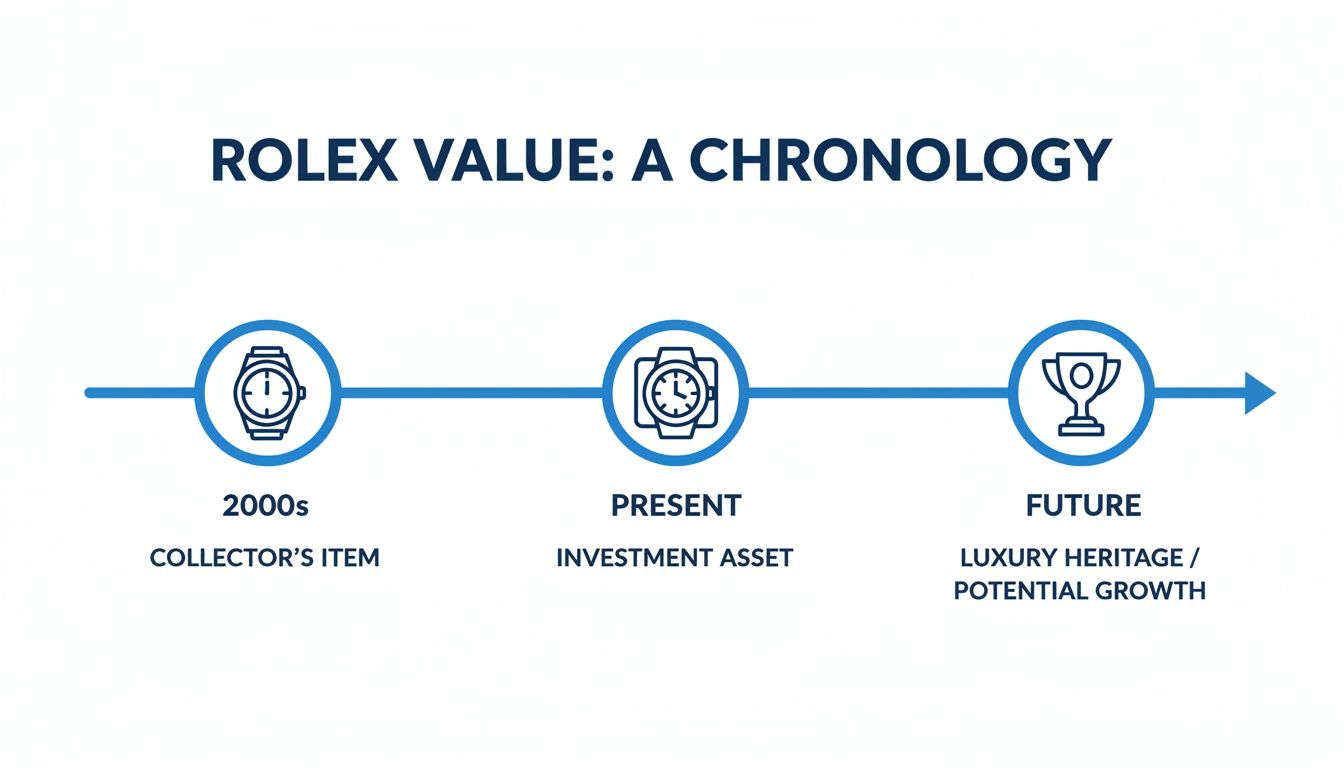
As you can see, the journey from a simple luxury item to a recognized investment asset makes provenance more important than ever. The box and papers are now essential proof of a watch’s identity.
A Journey Through Rolex Box Designs
The iconic green box everyone associates with Rolex is actually a pretty modern invention. The presentation cases have changed dramatically over the decades, and these changes give us clear visual cues for dating a watch.
- Vintage Era (1950s-1970s): Early boxes were often more decorative, with wood grain finishes, unique shapes, and velvet or cotton interiors. Collectors have even given them nicknames like "coffin boxes" for their long, distinct shapes.
- Transitional Era (1980s-2000s): During this time, boxes became more standardized. You'll find leatherette or faux-suede materials in different colors, usually with a simple gold Rolex crown on top. The inside was typically felt.
- Modern Era (2005-Present): Around 2005, Rolex rolled out the green "wave" box design that is so recognizable today. Even this design has seen small updates, with the newest version (post-2023) featuring a solid green outer sleeve instead of the old cream-colored one.
Here's a key takeaway: an older watch should come in a box that shows some appropriate age. A perfectly pristine box paired with a 50-year-old vintage watch is a major red flag that the set isn't original.
Matching Papers to the Production Year
Just like the boxes, the warranty documents have followed their own distinct timeline. Mismatched papers are a huge problem in the pre-owned market, so knowing the correct format for your watch's production year is crucial.
-
Punched Paper Certificates (Pre-2000s): For decades, Rolex used paper certificates. These documents had perforated holes—or "punches"—that spelled out the country code, serial number, and model number. They were filled out by hand at the authorized dealer.
-
Credit-Card Style Paper Certificates (Early 2000s): For a short while, Rolex switched to a paper certificate that was styled to look like a credit card. It was still paper, though, and came in a green sleeve.
-
Plastic Warranty Cards (Post-2009): Eventually, Rolex moved to the durable, plastic credit-card-style warranty card we see today. These have also evolved, with the latest versions containing an NFC chip for internal Rolex use.
The high value placed on a complete Rolex box and papers is something that has developed over decades. Market data shows that full sets from the 1950s onward consistently command 15-25% higher prices. For instance, a vintage Yacht-Master or Explorer with its period-correct box and punched papers offers undeniable proof of origin, which is critical for minimizing counterfeit risks in major markets like New York and Hong Kong. You can find more data on how these accessories impact market value and what makes a Rolex a sound investment.
By learning how to spot a period-correct set, you give yourself the power to make smarter buys and ensure you're investing in a genuine piece of watchmaking history.
What to Do When Your Box and Papers Are Missing
So, you've got a beautiful Rolex, but the original box and papers are nowhere to be found. It’s a bit like owning a classic car without its original title—a common situation, especially with watches that have been passed down through family or purchased pre-owned years ago.
Don't panic. While you can never get those specific, factory-issued documents back, you have a rock-solid option to re-establish your watch's authenticity and add serious credibility back to your investment.
Think of it this way: the watch’s original birth certificate is lost, but you can get an official, government-issued ID that proves who it is. For a Rolex, that "ID" comes directly from the brand itself.
The Power of Rolex Service Papers
The single best way to authenticate a "naked" watch (one without its original kit) is to send it to an official Rolex Service Center (RSC) for a full service. This is your number one alternative to having the original Rolex box and papers.
When the service is done, Rolex sends your watch back with a Rolex Service Card. This little green card is far more than a receipt; it’s a new set of papers that confirms:
- The watch’s unique serial number
- Its specific model or reference number
- The date of service
- A two-year international service guarantee
Here’s the critical part: Rolex will not service a fake or heavily modified watch. If they work on it, it's genuine. The existence of a modern Rolex Service Card is undeniable proof that your timepiece is authentic and contains the right parts. While it won't command the same collector's premium as the original papers, it instantly puts to rest any questions about legitimacy.
For any potential buyer, this service record becomes the new "papers." It provides the confidence they need to make a deal and boosts your watch’s resale value far beyond what a watch with no documentation could achieve.
Seeking an Extract from the Archives for Vintage Pieces
For truly old or rare vintage Rolex watches, there's another path, though it's much less common. Some luxury brands, like Omega or Patek Philippe, offer an "Extract from the Archives"—a document that details the watch's original production information.
Unfortunately, Rolex doesn't offer this service to the public. However, for exceptionally rare pieces, you might see high-end auction houses like Christie's or Phillips unearth some historical details through their deep industry connections. This isn't a standard option for most owners, but it can add incredible value to top-tier vintage collectibles.
For almost everyone else, an RSC service is the most practical and accessible solution.
Building a New History for Your Watch
Losing the original documents isn't the end of your watch's story. By getting official Rolex Service Papers, you're taking a proactive step to preserve its history and validate its authenticity for the future. It’s a smart move that protects both its integrity and its financial worth.
If you own a watch without its kit, you have a clear playbook. Sending it to Rolex not only ensures it runs perfectly but also gives you the modern-day proof of authenticity that every collector and buyer respects. It turns your timepiece back into a trusted, verified asset.
Smart Strategies for Buying, Selling, and Storing Your Full Set
Whether you're hunting for your next grail watch or getting ready to sell one, how you handle the Rolex box and papers is a huge part of protecting its value. These are the strategies that ensure every piece of your full set is verified, presented perfectly, and kept safe for the long haul.
For buyers, looking over a full set isn't just a quick glance. You have to be methodical. It's about making sure every single detail lines up perfectly. A mismatched or incomplete set can be a massive red flag, so a deep dive is your best defense against a bad investment.
The Buyer’s Final Inspection Checklist
Before you ever hand over the money, run through this checklist. It’s your final line of defense to confirm the authenticity and condition of the complete package.
- Serial Number Match: This is non-negotiable. The serial number on the warranty card must be an exact match to the engraving on the watch itself. You'll find it on the inner bezel ring (the rehaut) or between the lugs on older models.
- Condition Assessment: Give the box a good look. Is there any excessive wear, water damage, or musty odors? The papers should feel crisp, not torn or heavily creased.
- Period Correctness: Do your homework. Make sure the box style, the hang tags, and the warranty papers are all historically accurate for the year the watch was made.
- Dealer Stamp: The warranty card needs to have an official stamp or the printed name of a legitimate Authorized Rolex Dealer.
Maximizing Value When You Sell
If you're on the selling side, presentation is everything. The way you photograph and describe your full set can seriously swing the final sale price, especially when you're trying to attract serious collectors who pay top dollar for a complete, trustworthy package.
To get the best possible offer, build a listing that screams confidence. Take bright, clear photos of every single item: the box, the warranty card (just obscure a few digits of the serial for security), all the booklets, and the hang tags. That level of transparency builds instant trust and backs up your asking price.
A complete and well-documented set tells a story of meticulous ownership. When you showcase every piece of the puzzle, you’re not just selling a watch; you’re offering a verified, collectible artifact with an undeniable history.
Long-Term Storage and Care
Tucking your Rolex box and documents away properly is key to preventing the kind of environmental damage that can chip away at their value over time. Your biggest enemies here are humidity, direct sunlight, and wild temperature swings.
When figuring out where to keep these items, think safety first. You can find some great general tips for keeping valuable belongings safe in storage that apply here. For maximum protection, find a spot that's climate-controlled, dark, and dry. I'd even suggest using archival-safe sleeves for the paper documents to stop fading and acid damage in its tracks.
Ultimately, the safest route is often to work with pros. Buying from certified pre-owned Rolex dealers is one of the best ways to know you're getting a legitimate, well-cared-for timepiece right from the start, protecting your investment from day one.
Frequently Asked Questions
When it comes to a Rolex box and papers, a lot of questions pop up, especially if you're just getting into collecting or thinking about selling. Let's tackle some of the most common ones we hear every day.
Can I Get Replacement Original Papers From Rolex If I Lost Mine?
The short answer is no. Rolex has a strict policy: they will not issue replacement original warranty papers or certificates for any reason. If those original documents are lost, they are gone for good.
What you can do is get your watch serviced at an official Rolex Service Center. When they're done, they'll issue Rolex Service Papers. These documents are great for proving authenticity and showing a service history, but they don't carry the same weight or value for collectors as the original papers that came with the watch brand new.
Is It Safe to Buy a Rolex Without Box and Papers?
It can be, but you have to be extra careful and absolutely trust your seller. This is where buying from a highly reputable dealer is non-negotiable. A good dealer performs intense inspections on every watch and provides their own guarantee of authenticity, which takes all the risk off your shoulders.
Sure, a watch without its papers will always be cheaper, but out on the open market, the risk of it being a fake or pieced together with non-genuine parts skyrockets. Always, always prioritize the seller's reputation over what looks like a good deal.
Do All Rolex Models Have the Same Box and Papers?
Not at all. The design, materials, and even the size of the box have changed countless times over the decades, and the same goes for the warranty papers. A huge part of authenticating a "full set" is making sure every single accessory is correct for that specific watch's era.
For example, a beefy sports model like a Submariner usually came in a larger box than a sleeker, precious metal dress watch like a Cellini from the same period. To a seasoned eye, mismatched accessories are an instant red flag.
How Much Value Does Just the Box Add Without the Papers?
Having the original box is a nice touch, but its value is pretty minor compared to having the papers. The warranty card or certificate is the single most important piece of the puzzle because it directly ties the watch to its unique serial number and original sale.
Think of it this way: the box adds to the presentation and completes the set visually, maybe adding a few hundred dollars to the price. The papers, on the other hand, provide the hard proof of provenance that collectors are willing to pay thousands for.
Whether you're looking to buy, sell, or trade, navigating the world of luxury watches requires a trusted partner. At ECI Jewelers, we guarantee the authenticity of every timepiece we handle, providing you with the confidence and peace of mind you deserve. Explore our curated collection of authenticated luxury watches today.


