


If you're looking for a certified pre-owned Rolex, you're not just buying a watch—you're making a smart investment. The whole game changed recently, and now, thanks to Rolex's official Certified Pre-Owned (CPO) program, there's a clear, trustworthy path to owning a genuine timepiece backed directly by the brand.
Why Certified Pre-Owned Is the New Gold Standard
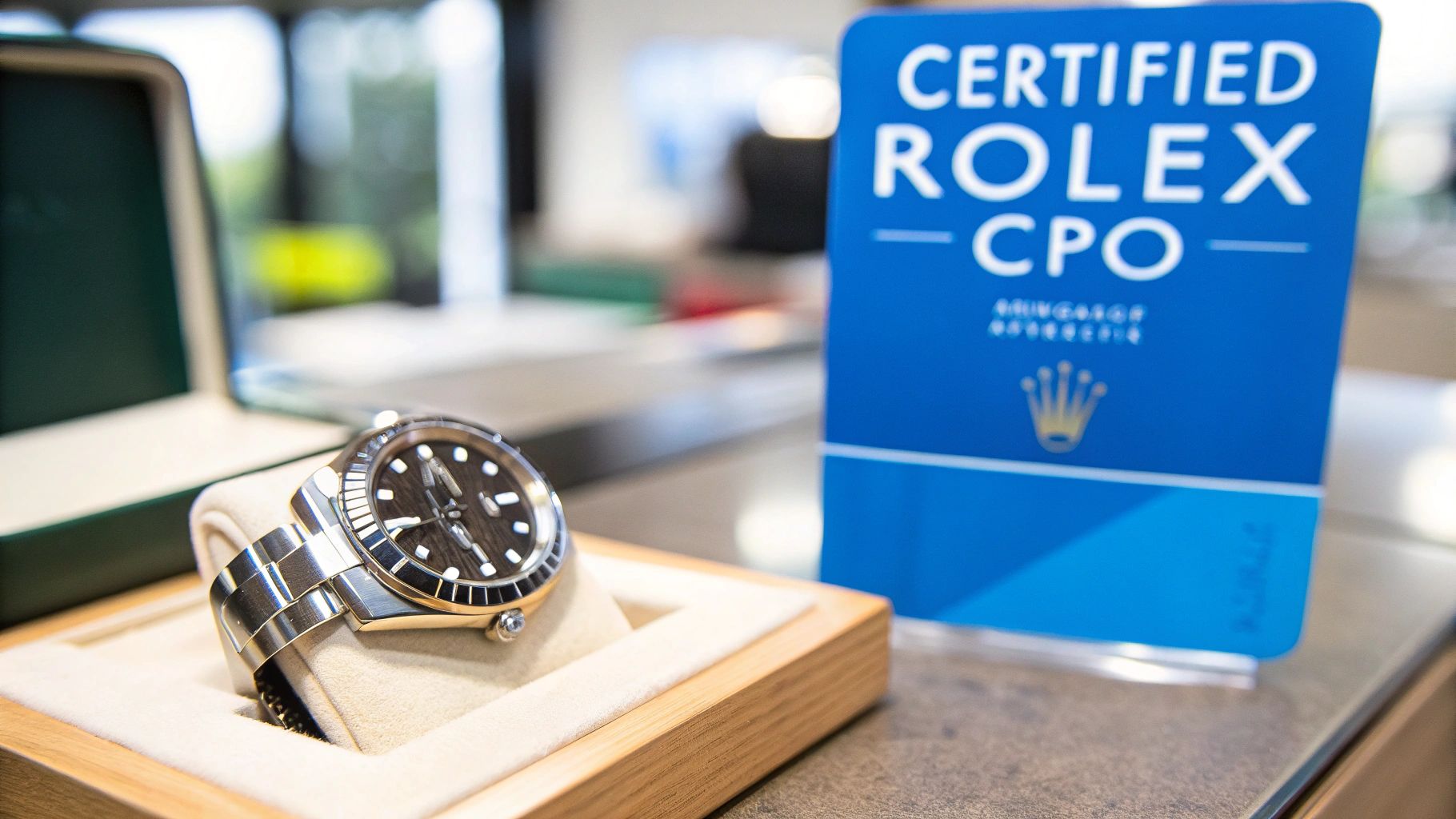
Not long ago, the pre-owned luxury watch market felt a bit like the Wild West. You had to put all your faith in an independent dealer's reputation and hope for the best. The risk of getting a convincing fake or a watch cobbled together with non-genuine parts was always there, creating a lot of uncertainty for buyers.
That all changed in late 2022 when Rolex officially rolled out its CPO program. This move sent a shockwave through the industry. For the first time, Rolex established a formal, brand-controlled process for authenticating and selling its own second-hand watches through its trusted network of authorized dealers.
What Is the Rolex CPO Program, Really?
This isn't just some fancy marketing sticker. The Rolex CPO program is a promise—a guarantee that the watch you’re buying is up to the brand's legendary standards. Here's what that actually means for your watch:
- Inspected by the Best: Every single watch is put under the microscope by Rolex-trained watchmakers who verify its authenticity down to the smallest screw.
- Factory-Fresh Performance: The watch gets a full, comprehensive service to bring its mechanical performance back to factory specs. It essentially feels and runs like a new watch.
- An Official Warranty: You walk away with a new two-year international warranty card, giving you the exact same peace of mind you'd get buying a brand-new model.
- The Seal of Approval: The watch comes with a special Rolex Certified Pre-Owned seal and hang-tag, so there's zero doubt about its status.
This level of assurance completely redefined what buyers should demand. Before, a dealer’s in-house warranty was the best you could get. Now, a Rolex-backed guarantee is the benchmark. You can explore the wider benefits by reading our guide on certified pre-owned watches.
This formal certification process is a game-changer. It removes the guesswork and ensures what you're buying is "good" in every sense—authentic, correct, and backed directly by the people who made it.
How CPO Reshaped the Market
The moment Rolex launched this program, the market felt it. Their decision in late 2022 to formalize the CPO process through authorized dealers kicked off a transformation that's expected to be fully in place by 2025.
This move gives Rolex incredible control over secondary market prices and what buyers expect. A CPO Rolex often commands a 25% to 35% premium over a similar, non-certified watch on the grey market. That premium isn't just for a piece of paper; it's for the rock-solid guarantee of authenticity and that official two-year international warranty.
Ultimately, the rise of certified pre-owned Rolex dealers has built a safer, more transparent world for collectors and first-timers. It cements the watch's history, protects your investment, and guarantees your timepiece will run perfectly for years. It's now the definitive way to own a piece of watchmaking history.
How to Find and Vet Reputable Rolex Dealers
Picking the right dealer is the most critical decision you'll make when buying a pre-owned Rolex. A great partner guarantees authenticity and gives you total peace of mind. The wrong one? Well, that can turn into a very expensive mistake. The first thing to know is that your search will lead you to two main types of sellers.
First, you have the Official Rolex Certified Pre-Owned (CPO) Partners. These are existing authorized Rolex jewelers who are part of the brand’s own CPO program. Buying from them is the next best thing to buying new. You get a Rolex-backed two-year international warranty and an ironclad promise of authenticity.
Then, there are the trusted independent specialists. These dealers aren't part of the official Rolex CPO network but have often spent decades building their reputations on nothing but deep expertise and trust. They conduct their own meticulous, multi-point inspections and usually offer their own substantial in-house warranty. For many collectors, these are the folks you build a lifelong relationship with.
Starting Your Search Online
Your hunt will almost certainly start online, and a dealer's digital presence is incredibly revealing. A professional, transparent website is table stakes. Look for sharp, high-resolution photos of the actual watches they have for sale—not generic stock images—paired with detailed, specific descriptions.
But don't just take their website's word for it. Third-party reviews are your best friend here. Get a feel for their reputation on platforms like:
- Google Reviews: A high rating (4.8 stars or better is a fantastic sign) is a good start, but you need to read the comments. Are they specific and personal, or do they feel canned and generic?
- Specialized Forums: Communities like The Rolex Forums (TRF) are invaluable. They have entire sections dedicated to dealer reviews where seasoned collectors give their honest, unfiltered feedback.
- Chrono24: If a dealer has a storefront on this massive marketplace, check their "Trusted Seller" rating and sales history. A long track record with hundreds of successful transactions speaks for itself.
Pay close attention to how a dealer handles negative feedback. A professional, helpful response shows they care about their reputation and customers. Defensive, angry, or dismissive replies are a huge red flag.
The Importance of a Physical Presence
While digging around online is essential, a physical showroom adds a layer of legitimacy that a website alone just can't match. A brick-and-mortar store, especially in a luxury hotspot like New York City’s Diamond District, signals a serious investment and commitment. It’s proof they are a real, established business you can actually walk into.
The way a dealer presents their store matters. Professional and effective retail window displays often reflect a broader commitment to quality and attention to detail that extends to the watches themselves.
Ultimately, a physical location enables the most important step of all: seeing the watch for yourself. There is absolutely no substitute for feeling its weight in your hand, examining the dial with a loupe, and watching that seconds hand sweep smoothly across the face.
Questions to Ask a Potential Dealer
Once you have a shortlist, it's time to start a conversation. A good dealer will be patient, knowledgeable, and more than happy to answer every question you have. Don't be shy—here’s what you need to ask:
- "Can you walk me through your authentication and servicing process?" They should be able to clearly explain their entire procedure, from verifying the movement to pressure testing the case for water resistance.
- "Who services your watches?" Find out if they have a certified watchmaker on staff or if they use a trusted third-party service center.
- "What can you tell me about the history of this particular watch?" They might not have its entire life story, but they should be able to tell you its approximate age, when it was last serviced, and if any parts are not original.
How they answer tells you everything. You're looking for transparent, confident, and detailed responses. Remember, a trustworthy dealer is a partner in your collecting journey, not just someone trying to make a sale.
Your Essential Pre Purchase Inspection Checklist
Alright, you’ve found a dealer you trust and a watch that catches your eye. Now for the fun part: the hands-on inspection. This is your chance to move from hopeful buyer to confident owner by making sure the watch is exactly what it claims to be. A methodical check here protects your investment and ensures you walk away with zero regrets.
The very first thing to confirm is whether the watch comes as a “full set.” In the watch world, this means the complete original package from when it was first sold. It’s more than just nice packaging; a full set is a massive tell for authenticity and provenance, directly impacting the watch’s value down the line.
Verifying the "Full Set"
So, what’s in a full set? While there are minor variations depending on the model and year, here are the absolute must-haves:
- The Original Box: This means both the outer cardboard sleeve and the iconic inner green presentation box. Look for quality, correct logos, and wear that matches the watch's age.
- Official Papers and Warranty Card: Think of the warranty card as the watch’s birth certificate. It must have the matching serial number, model number, and the original sale date stamped by an authorized dealer. You’ll cross-reference this with the serial number engraved on the watch.
- Instruction Manuals and Booklets: These small details complete the package and show the previous owner was meticulous.
- Hang Tags: You're looking for two: the green chronometer tag (which should also have the serial number) and the red wax seal tag.
A watch with its complete set isn't just more desirable—it’s a safer bet. The pre-owned market is incredibly competitive, especially for steel sport models like a Daytona. We’ve seen that a full set can boost a watch’s resale value by as much as 30% at auction. It's a huge deal.
Here’s a quick visual guide to vetting dealers and their inventory, which reinforces why these details matter so much.
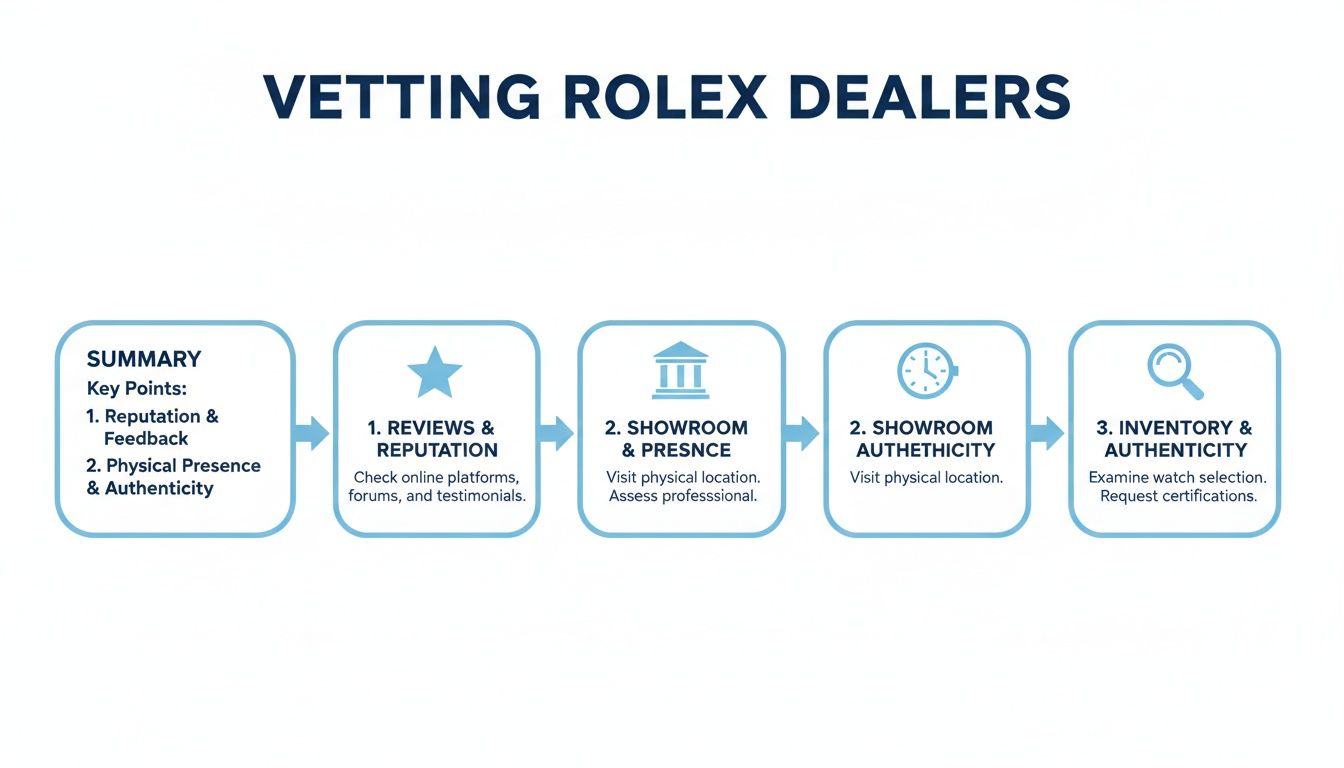
As the chart shows, a dealer’s reputation is built on the quality and authenticity of their watches—and that starts with verifying details like the full set.
Before you make a final decision, a detailed checklist can be your best friend. This table summarizes the critical components to inspect, ensuring you don't miss a thing.
Essential Rolex Pre Purchase Checklist
| Component | What to Check | Why It Matters |
|---|---|---|
| Box & Papers | Match serial numbers on the warranty card, hang tag, and watch. Verify the dealer stamp is legible. | This is your primary proof of authenticity and provenance. Mismatched numbers are a dealbreaker. |
| Case | Look for sharp, well-defined lugs. Check for deep scratches or dents. | Over-polishing softens the case lines and devalues the watch for collectors. |
| Dial & Hands | Text should be crisp and clean. Lume on hands and markers should be a consistent color. | Sloppy text, smudges, or uneven lume are classic signs of a counterfeit or poorly replaced dial. |
| Bracelet | Hold the watch sideways. Check for excessive "stretch" or droop between the links. | A stretched bracelet indicates heavy wear and can be very expensive to replace. |
| Crown & Functions | Winding should be smooth, not gritty. Date should click over sharply around midnight. | This gives you a feel for the movement's condition without opening the watch. |
Using this checklist helps you systematically evaluate the watch, turning a potentially emotional purchase into a well-informed one.
Conducting a Physical Examination
With the paperwork sorted, it's time to get up close with the watch itself. You don’t need to be a horologist, but a sharp eye is essential. If the dealer has a jeweler's loupe, ask to use it—it’ll show you things the naked eye can’t catch.
Start with the case. Are there any deep dings or scratches? More importantly, check for signs of over-polishing. While a light polish can be good, aggressive polishing wears down the sharp, factory-fresh lines of the lugs, which is a big turn-off for serious collectors.
Next, examine the dial and hands. The printing on a genuine Rolex dial is perfect—crisp, slightly raised, and flawless. Any fuzziness or uneven spacing is a massive red flag. Make sure the luminous material on the hands and hour markers matches in color and condition.
A critical—and often overlooked—area is the bracelet. A Rolex bracelet should feel robust and solid. If you hold the watch case and the bracelet sags excessively between the links, that's known as "stretch." It's a sign of serious wear and could mean a costly replacement is in your future.
Finally, give the functions a test run. Wind the crown. Does it feel smooth or gritty? Set the time and date, ensuring the date wheel snaps over cleanly. For a deeper dive into spotting fakes, check out our guide on how to authenticate a Rolex watch.
Crucial Questions to Ask the Dealer
Your inspection isn’t just about looking; it’s also about asking. A conversation with the dealer can reveal just as much as a loupe.
Don't be shy. Get right to the point with these key questions:
- “What can you tell me about the service history?” A watch with documented service records from Rolex or a certified watchmaker is worth its weight in gold.
- “Were any parts replaced during the last service?” For vintage pieces, knowing if the dial, hands, or bezel are original or service replacements is crucial for valuation.
- “Can you confirm all service parts are genuine Rolex?” Aftermarket parts kill a Rolex's integrity and value. The answer must be yes.
- “What kind of warranty do you offer?” Get the specifics: how long it lasts, what it covers, and who performs the repairs.
A reputable dealer will have no problem answering these questions clearly and confidently. Their transparency is the final piece of the puzzle, giving you the assurance you need to close the deal.
Decoding Pre-Owned Rolex Pricing and Value
Figuring out the price of a pre-owned Rolex can feel like trying to hit a moving target. You're not just buying a watch; you're buying an asset. Most things lose value the second you use them, but certain Rolex models are famous for trading well above their original retail price. This isn't just luck—it's the result of insane demand, brand power, and a long history of holding, and even gaining, value.
The entire market for certified pre-owned Rolex dealers is built on this very principle. Watches like the Cosmograph Daytona or the GMT-Master II aren't just tools to tell time. They're icons. Their prices are set by a living, breathing market that is constantly weighing rarity, condition, and desirability.
The Key Drivers of Rolex Value
Several key factors consistently determine what a pre-owned Rolex is worth. Getting a handle on these is crucial before you even start looking at price tags. A watch that looks like a steal might be missing something that torpedoes its long-term value.
These are the non-negotiables that drive the price up or down:
- Model and Reference Number: It's simple—some models are just in higher demand. A steel Submariner or GMT-Master II is almost always hotter than a more common Datejust, and the price reflects that.
- Condition: This is about more than just surface scratches. A watch with a sharp, unpolished case, a perfect dial, and a bracelet with no stretch will always command a huge premium over one that's been worn hard or polished aggressively.
- The "Full Set": We've said it before, but it's critical. The original box, warranty card, manuals, and hang tags are a huge deal. A complete set can boost a watch's value by as much as 30% because it provides a verifiable link to its history.
- Rarity and Provenance: Limited production models, discontinued fan favorites (like the "Hulk" Submariner), or a watch with a unique, documented history will always be worth more.
Think of it this way: two Rolex Submariners from the exact same year can have completely different price tags. One might be a "watch only" deal with a polished case, while the other is a pristine "full set" that's been babied its whole life. That second one isn't just a watch; it's a collector's package, and it's priced accordingly.
A Proven History of Appreciation
Some Rolex models have delivered returns that would make a stockbroker jealous. It comes down to a perfect storm of timeless design, limited supply from authorized dealers, and a constantly growing army of fans who want to own one. That imbalance is what keeps the pre-owned market so strong.
The GMT-Master II is a perfect example. This legendary pilot's watch, known for its iconic "Pepsi" and "Batman" bezels, has seen its value skyrocket. Pre-owned models have posted staggering returns, with the GMT-Master II appreciating over 506% since 2010. It went from an average price under $3,000 to the $12,000-$21,000 range we see in today's secondary market. This is exactly why working with knowledgeable certified pre-owned Rolex dealers is the smart play.
How to Gauge Fair Market Value
So, how do you know if the price you're looking at is fair? The best approach is to roll up your sleeves and do some homework. Compare listings from multiple trusted sources.
Start by browsing the websites of a few reputable independent dealers. Check marketplaces like Chrono24 to get a feel for what similar models are actually selling for. But pay attention to the details—is it a full set? What’s the condition really like? Does the seller have a solid reputation? This research will give you a solid baseline to work from.
And don't be shy about talking price with a dealer. A good dealer won't just give you a number; they'll explain why it's priced that way, pointing to its condition, service history, and completeness. That kind of transparency is usually a great sign you’re in the right place. To get even sharper, you can learn more about the factors that influence the resale value of Rolex watches in our detailed article. The more you know, the more confident you'll be when it's time to buy.
Securing Your Watch and Planning for the Future
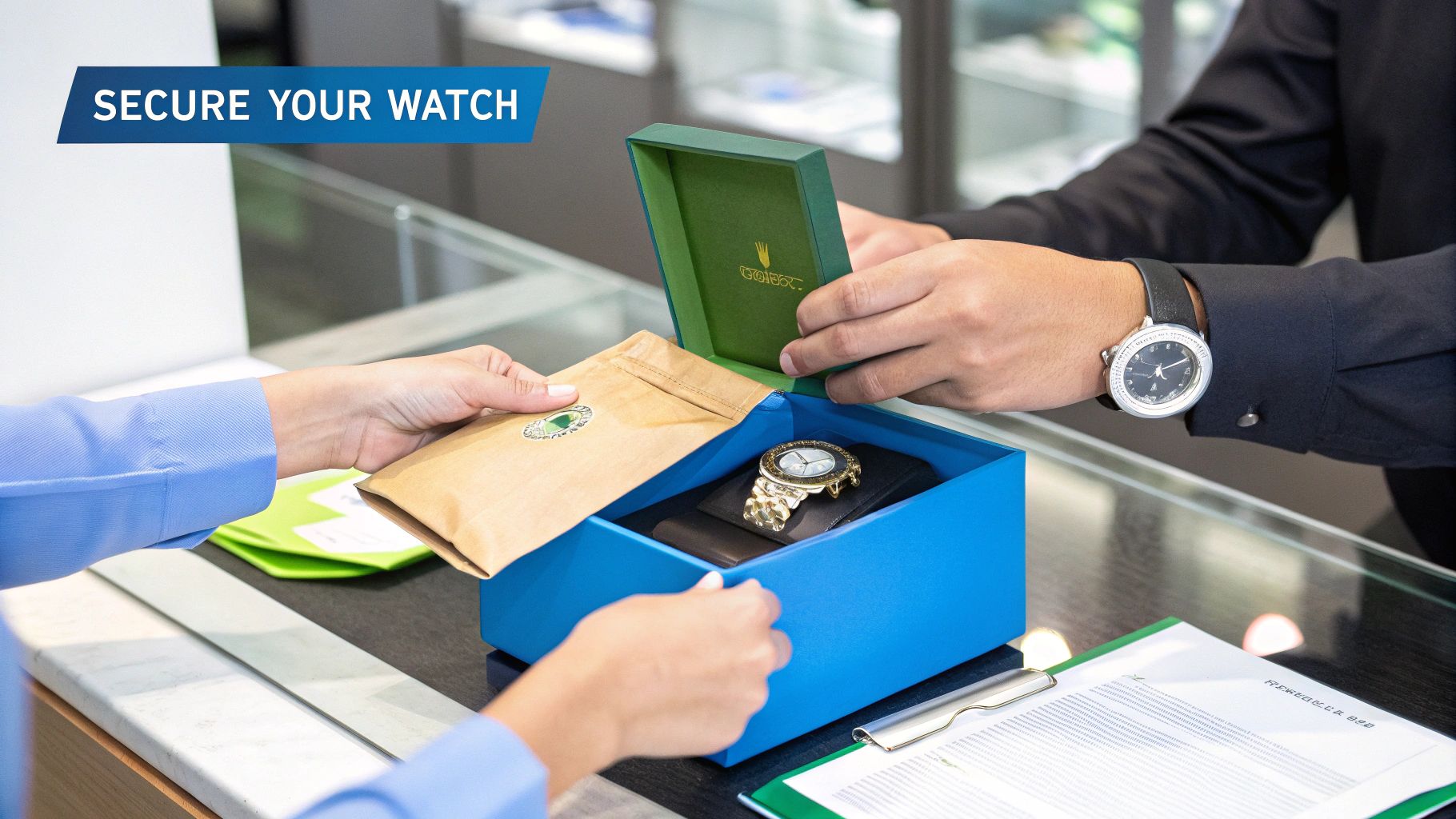
Once you’ve agreed on a price, the journey isn't quite over. Finalizing the purchase of a high-value timepiece requires the same care you put into selecting it. The steps you take now are what truly secure your investment for a lifetime of enjoyment.
For any significant watch purchase, a bank wire transfer is the industry standard. It’s secure, verifiable, and provides a clean paper trail for both you and the dealer. While some dealers might accept credit cards, keep in mind that processing fees can get passed on to you, adding a few percentage points to the final cost.
Insured Shipping: A Non-Negotiable Element
If you're buying from a dealer outside your area—like many of our nationwide clients—fully insured shipping is absolutely essential. A reputable dealer will never cut corners here. They should use a trusted carrier like FedEx or UPS and give you a tracking number the moment your watch is on its way.
The insurance policy is the most critical part. It must cover the full replacement value of the watch. Before it ships, get confirmation on these details:
- Carrier Used: Which shipping service is handling the package?
- Insurance Provider: Who underwrites the insurance?
- Coverage Amount: Does the policy cover the full purchase price?
- Signature Requirement: Will an adult signature be required upon delivery?
This diligence protects you from the nightmare scenario of a lost or damaged package.
Understanding Your Warranty Coverage
Your warranty is your main safety net after the sale. It’s crucial to know exactly what kind of coverage you're getting from certified pre-owned Rolex dealers, as there are two very different types.
The Official Rolex CPO Warranty is the gold standard. This is a two-year international guarantee backed directly by Rolex, meaning you can take your watch to any authorized Rolex service center in the world for covered repairs. It’s the same peace of mind you get with a brand-new watch.
A Dealer’s In-House Warranty is offered by trusted independent specialists. While not backed by Rolex, a strong in-house warranty from a dealer with a great reputation is still incredibly valuable. These typically last one to two years and cover the movement against mechanical defects. Always clarify who performs the warranty work—it should be a certified watchmaker using genuine parts.
A strong warranty, whether from Rolex or a reputable dealer, should always cover the watch's timekeeping accuracy and movement function. It generally excludes damage from accidents, misuse, or unauthorized repairs.
Long-Term Care and Building a Relationship
Your Rolex is a precision machine that needs periodic maintenance. Rolex generally recommends a full service about every 10 years, though this can vary. Sticking to this schedule keeps the movement properly lubricated and ensures its water resistance is maintained.
Always, always insist on servicing that uses 100% genuine Rolex parts. Using aftermarket components can seriously damage the watch's integrity and crush its value.
This is where your relationship with a dealer becomes invaluable. A great dealer can facilitate proper servicing and becomes a key partner as your collection grows. They can alert you to rare pieces, provide fair market valuations, and offer favorable terms for trading toward your next grail watch. This turns a single transaction into a lifelong partnership in the world of horology.
Your Top Rolex CPO Questions, Answered
Even with all the facts, buying a high-end watch can feel like a big step. When you’re making a serious investment, you want total clarity. Let's tackle some of the most common questions we hear from buyers exploring the world of certified pre-owned Rolex dealers.
This is your final check-in before you pull the trigger. We'll clear up any lingering doubts, from what that warranty really means to the practical differences between sellers.
Is a Rolex CPO Watch the Same as a New One?
This question comes up all the time, and it's a good one. While a Certified Pre-Owned Rolex is brought back to the brand's legendary performance standards, it's not a new watch. It has lived a life before.
The real story is in the meticulous refurbishment. Rolex-certified watchmakers give the movement a full overhaul, refinish the case and bracelet to restore that factory shine, and run it through a battery of quality control tests. It will perform like new and comes with a two-year international warranty straight from Rolex, but it might have tiny traces of its past that a brand-new piece wouldn't.
Can Any Jewelry Store Become a Rolex CPO Dealer?
No, absolutely not—and this is a critical distinction. The official Rolex CPO program is an exclusive club, open only to its existing network of Official Rolex Jewelers. These are the dealers who already have a long, trusted history of selling new watches for the brand.
Rolex built the program this way on purpose. They only entrust their name and reputation to partners who have consistently proven they meet the highest standards for expertise and customer care. An independent dealer, no matter how reputable, simply cannot offer the official Rolex-backed CPO designation.
The official Rolex CPO program is a completely closed ecosystem. This ensures every single step—from authentication to servicing and the final sale—is handled by people trained and approved directly by Rolex. It’s all about maintaining a perfect, consistent standard of quality across the globe.
What Is the Price Difference Between CPO and Independent Dealer Watches?
You can almost always expect to pay a premium for an official Rolex CPO watch compared to a similar model from a trusted independent dealer. This premium, often somewhere in the 25% to 35% range, isn't just for show.
What you're buying is the ultimate peace of mind. That higher price tag covers:
- The Rolex-Backed Warranty: A two-year international guarantee you can use at any official Rolex service center in the world.
- Guaranteed Authenticity: Verified by the people who made the watch, erasing every last shred of doubt.
- Official CPO Documentation: The branded box, seal, and papers that add to the watch's story and future value.
An independent dealer will offer their own in-house warranty and stand by their own reputation. Both are legitimate ways to buy, but the official CPO program provides a level of manufacturer backing that you just can't get anywhere else on the secondary market.
Do CPO Dealers Negotiate on Price?
Generally, you'll find that pricing on official Rolex CPO watches is much firmer than what you might see with an independent dealer. The prices are often set based on Rolex's own market data and the high cost of the certification and servicing process.
While you might find a tiny bit of wiggle room depending on the specific watch and the dealer's relationship with you, don't walk in expecting big discounts. The value here is built around the guarantee and the official certification, not about finding a rock-bottom price. Independent dealers, on the other hand, set their own prices and usually have more flexibility to negotiate.
Can I Trade My Current Watch Toward a CPO Rolex?
Absolutely. Most Official Rolex Jewelers in the CPO program are more than happy to evaluate your current luxury watch for a trade-in. It's a fantastic way to offset the cost of your new purchase.
The process is usually very straightforward:
- Evaluation: The dealer’s in-house experts will inspect your watch to assess its condition, confirm its authenticity, and determine its current market value.
- Offer: They’ll come back to you with a trade-in value based on their findings.
- Credit: If you accept the offer, that amount is applied directly toward the purchase of the CPO Rolex.
It makes for a smooth, seamless transaction and is one of the key services that make established dealers the go-to for serious collectors looking to upgrade.
At ECI Jewelers, we provide the expertise and transparency you need to navigate the luxury watch market with total confidence. Whether you are looking for a certified timepiece or wish to sell or trade your own, our team is here to offer fair, market-based valuations and five-star service. Explore our curated collection of authenticated luxury watches at https://www.ecijewelers.com.


