


This guide is here to pull back the curtain on diamond clarity and color—easily the two most misunderstood qualities of a diamond. I like to think of a diamond like a window: clarity is how clean the glass is, while color is its tint. Getting a handle on these two factors is the key to appreciating a diamond's true beauty and making a purchase you’ll feel great about.
Beyond the Sparkle Understanding Clarity and Color
When you first start shopping for a diamond, the amount of information thrown at you can feel like a tidal wave. Jewelers start tossing around terms like "VVS1," "G color," and "eye-clean," but what does that alphabet soup actually mean for the diamond on your finger? This guide will cut right through the technical talk and focus on what you really need to know.
The point isn't to have you memorize grading charts. It's about helping you understand how clarity and color actually affect what the diamond looks like and how much it costs. We'll break down the official systems, but more importantly, we’ll translate them into real-world advice to help you find that perfect balance for your budget.
The Foundation of Diamond Quality
Every single diamond is one-of-a-kind, but its quality is judged by a universal standard set by the Gemological Institute of America (GIA). Think of the GIA as the ultimate, impartial referee in the diamond world. Their grading framework is the gold standard, ensuring you can compare diamonds fairly and accurately, no matter where you're shopping.
By the time you're done with this guide, you'll be able to:
- Read GIA grades for clarity and color like a pro.
- Pinpoint the "sweet spots" that give you the most sparkle for your money.
- Make smart trade-offs so you don't have to sacrifice brilliance.
- Walk into any jeweler feeling confident and in control.
The global diamond market is a huge deal, valued at around USD 97.10 billion in 2022 and still growing. American buyers are a massive part of that, making up about 54% of all polished diamond purchases. In a market this big, knowledge is your best friend.
Why This Guide Matters to You
Let's be real: buying a diamond is an emotional decision, but it's also a major financial one. Our goal is to give you the insider knowledge to make a choice you’ll love for a lifetime. To really see these subtle differences, it helps to know how effective jewelry photography can either highlight a diamond's best features or hide its flaws. We firmly believe that an educated buyer is a happy buyer.
A diamond's beauty is a delicate dance between its internal purity (clarity) and its lack of color. While perfection is rare and expensive, brilliance is achievable at any budget with the right knowledge.
When you look past the initial sparkle and understand what's really going on inside the stone, you can navigate your options with total confidence. For an even deeper dive, check out our complete ECI Jewelers Diamond Education resource. Consider this guide your first step toward finding a diamond that isn’t just beautiful, but is perfectly you.
Navigating the GIA Diamond Clarity Scale
The GIA Clarity Scale gives us the technical language, but what really matters is how those grades look on an actual diamond. Think of clarity as a spectrum—ranging from absolutely perfect to having unique, natural characteristics. Instead of getting bogged down by letter grades, let's talk about what they mean in the real world.
At the very top, you have Flawless (FL) and Internally Flawless (IF) diamonds. These are the rarest of the rare, the kind of museum-grade specimens where even a trained gemologist can't find a single imperfection under 10x magnification. While their purity is incredible, that level of perfection comes with a serious price tag and isn't necessary for a visually stunning ring.
This chart shows how foundational qualities like clarity and color are the first things an expert assesses when evaluating a diamond.
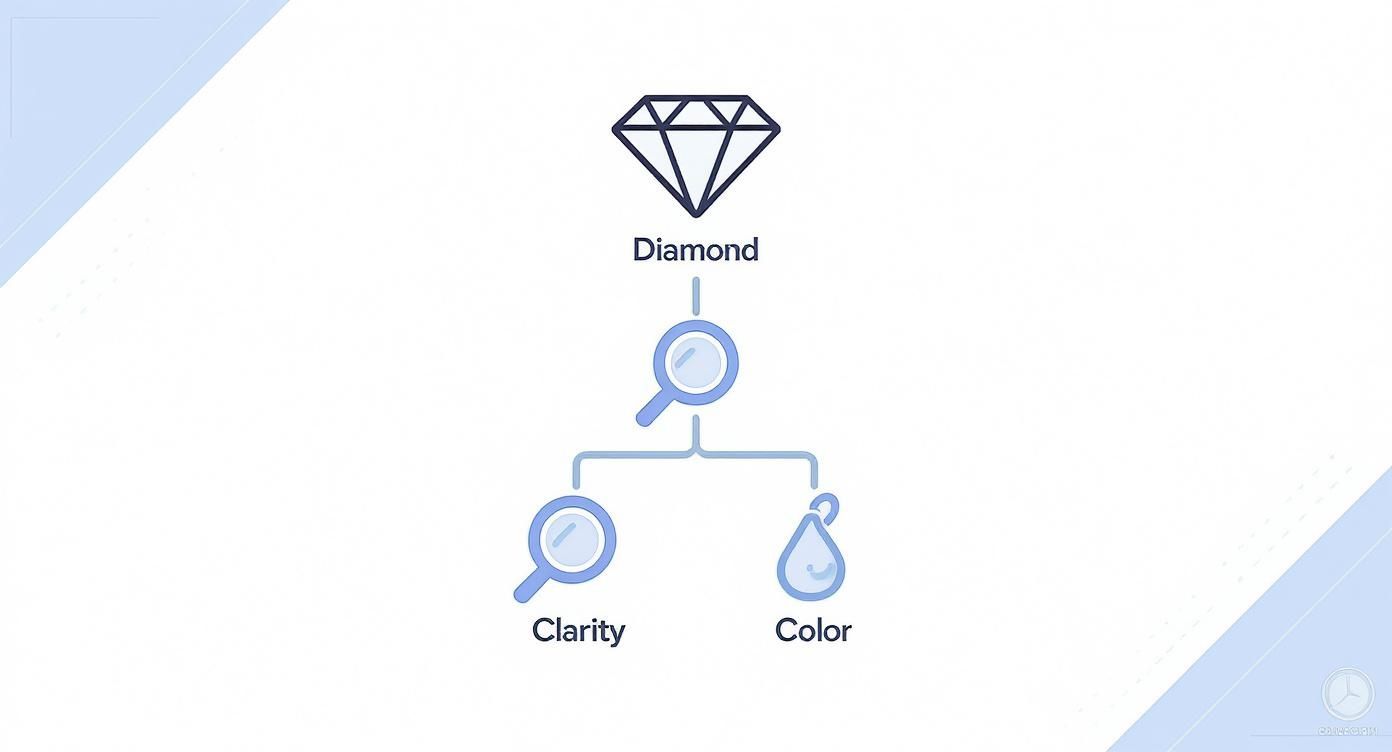
As you can see, once a diamond's basic form is checked, clarity and color are the two main paths for evaluation.
Understanding Inclusions: The Diamond's Fingerprint
Moving down the scale, we get into the VVS (Very, Very Slightly Included) and VS (Very Slightly Included) categories. For VVS diamonds, the inclusions are so tiny that a skilled grader has a tough time spotting them even with a loupe. VS diamonds have minor inclusions that are a bit easier to see under magnification but are still invisible to the naked eye.
These clarity characteristics are called inclusions (internal flaws) and blemishes (external marks), and they're basically natural birthmarks formed deep within the earth. Think of them like freckles—they make every single diamond one-of-a-kind. Some common types you might hear about include:
- Pinpoints: Tiny black or white crystals trapped inside the diamond, like a speck of dust.
- Feathers: Small internal cracks that can look like a feather when viewed from the right angle.
- Clouds: A tight group of tiny pinpoints that can give a spot a hazy look if they're dense enough.
The journey from a rough stone to a polished gem is a demanding one. In fact, only about 20% of all mined diamonds have the clarity needed to become gemstones; the rest are used for industrial purposes. GIA grades clarity by looking at these unique traits under 10x magnification, considering their size, number, location, and type.
A Practical Look at the GIA Clarity Scale
So, how do these grades translate into what you'll actually see and pay for? Here's a practical breakdown to help you find the best value for your budget.
| Clarity Grade | What It Means Practically | Inclusion Visibility (Under 10x Loupe) | Typical Naked Eye Appearance |
|---|---|---|---|
| FL / IF | Flawless / Internally Flawless | No inclusions visible | Flawless |
| VVS1 / VVS2 | Very, Very Slightly Included | Extremely difficult to see | Flawless |
| VS1 / VS2 | Very Slightly Included | Minor inclusions, fairly easy to see | Almost always "eye-clean" |
| SI1 / SI2 | Slightly Included | Noticeable inclusions | Often "eye-clean," especially SI1 |
| I1 / I2 / I3 | Included | Obvious inclusions | Inclusions are visible |
This table shows why the VS and SI categories are often the sweet spot, offering an "eye-clean" appearance without the premium price of a flawless stone.
The Smart Shopper's Guide to Clarity
This brings us to the SI (Slightly Included) grades, which include SI1 and SI2. This is where savvy shoppers often find incredible value. Many SI1 diamonds, and even some carefully selected SI2s, are completely "eye-clean"—meaning you can't see any flaws without a loupe. The secret is where the inclusions are located.
An inclusion tucked away near the girdle (the diamond's edge) is far less of an issue than one sitting right under the table (the big, flat top facet). Likewise, a white or transparent feather is much better than a dark pinpoint crystal in the center of the stone. An inclusion's location can even affect durability; a large feather reaching the surface could pose a chipping risk down the line.
Finally, we have the I (Included) category, where diamonds have inclusions that are obvious to the naked eye. While these stones are the most affordable, their imperfections can sometimes get in the way of the diamond's light reflection, which can dull its sparkle.
This is exactly why you can't rely on a grade alone. A GIA report is non-negotiable, but the final step is always to see the diamond for yourself—or have a trusted expert like our team at ECI Jewelers evaluate it for you. To learn more about why grading reports are so critical, read our guide on understanding diamond certification. This two-step approach ensures you choose a stone with character that doesn't sacrifice its beauty.
Making Sense of the GIA Diamond Color Scale
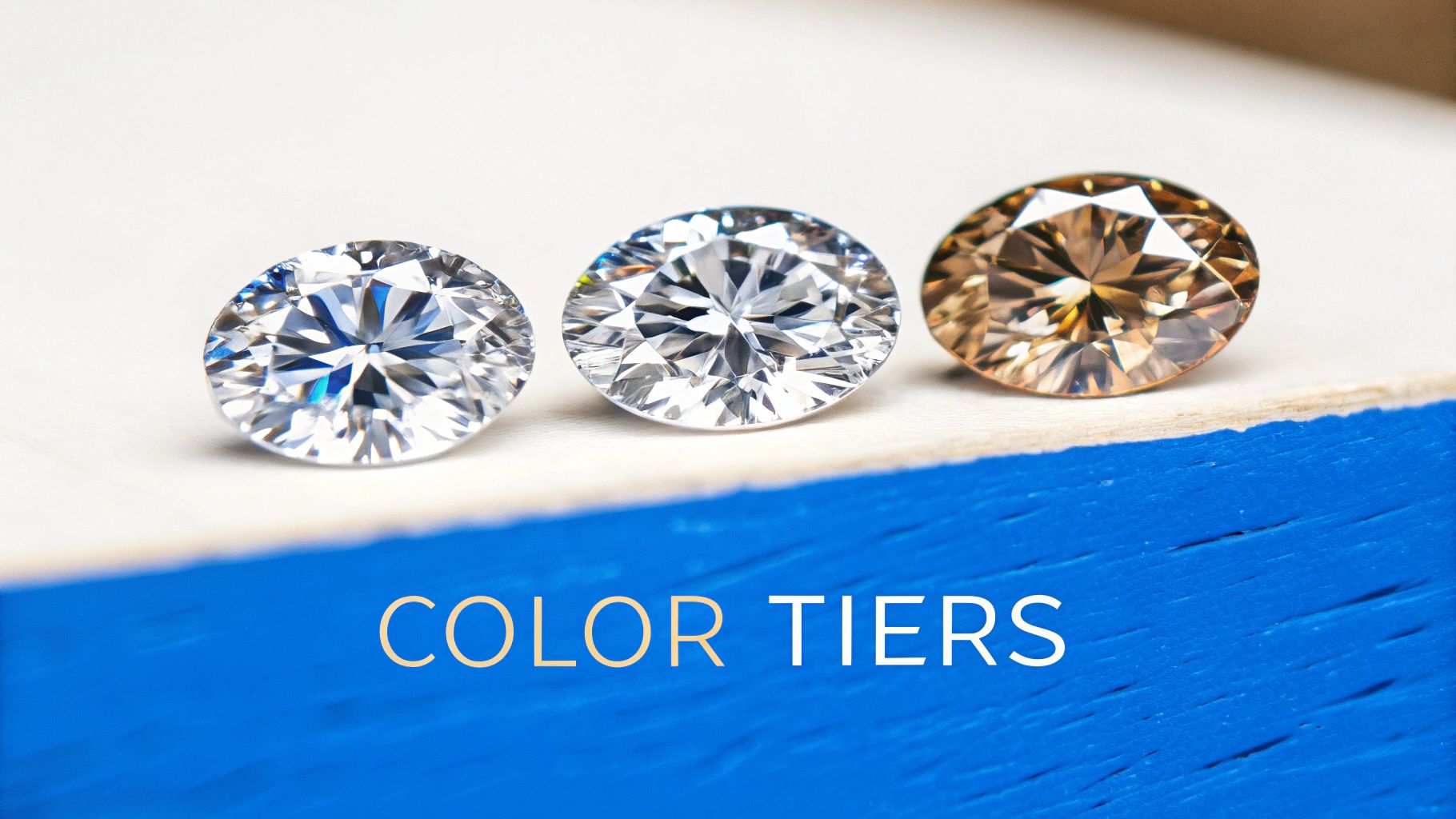
If clarity is all about a diamond's internal purity, then color is about the absence of tint. The global gold standard for this is the GIA Diamond Color Scale, which grades diamonds from D (completely colorless) to Z (light yellow or brown). The best way to think about it isn't as a measure of color, but of colorlessness. The less color a diamond has, the rarer and more valuable it becomes.
This scale was created by the Gemological Institute of America (GIA) way back in 1953 and it's still the international benchmark today. While the full alphabet runs down to Z, the vast majority of diamonds you'll find in jewelry—somewhere around 70-80%—fall between the D and M grades. For a deeper dive into how these grades play off each other, Diamonds.pro has a great comparison of diamond color vs. clarity.
Colorless Diamonds: D, E, F
Sitting at the very top of the pyramid are the Colorless grades: D, E, and F. These are the diamonds prized for their pure, icy-white appearance. They are the pinnacle of perfection.
- D Color: This is the highest grade possible. It’s absolutely colorless and acts as the benchmark against which all other diamonds are judged.
- E and F Colors: To the naked eye, these also appear perfectly colorless. Only a trained gemologist, comparing them side-by-side with a master D stone, could spot the minuscule traces of color that separate them.
Choosing a diamond in the D-F range guarantees a flawless, crisp white stone, but you'll definitely pay a premium for that level of perfection.
Near Colorless Diamonds: G, H, I, J
Welcome to the sweet spot. This is easily the most popular and value-driven range for engagement rings. Diamonds graded from G to J are considered Near Colorless, and frankly, they look beautifully white once they're set in a ring.
The difference between a G and an H, for example, is so subtle that most people will never see it. This is where smart buyers find incredible value—you get a diamond that looks colorless to the eye without shelling out for a D or E. A G or H color grade, in particular, delivers a brilliant white look that perfectly balances beauty and budget.
A diamond doesn't need to be perfectly colorless to be perfectly beautiful. The Near Colorless range (G-J) is the ultimate sweet spot where value and visual appeal meet.
For many buyers, this tier is the point of diminishing returns. Paying thousands more for a D-F grade often results in no visible difference once the diamond is on your finger every day.
How Your Setting Influences Color
This is the secret weapon every savvy diamond buyer should know: the metal you choose for your setting can completely change how a diamond's color is perceived. Think of the metal as a mirror, reflecting its own hue right up through the stone.
If you’re after that cool, icy look, platinum and white gold are fantastic. But because they are so stark white, they can actually make a faint yellow tint in a lower-grade diamond more obvious. For these settings, sticking to a G or H color is a smart move to keep that colorless vibe.
On the flip side, yellow and rose gold settings are incredibly forgiving. The warm glow from the metal naturally masks and complements diamonds with a slight tint. A J-color diamond, which might show a hint of warmth on a white background, can look stunningly white when it’s nestled in yellow gold. This is one of the best trade-offs you can make. It lets you save a significant amount on color, freeing up your budget for a better cut or a bigger carat.
How Color and Clarity Actually Affect Price
Knowing the GIA grades is one thing. But seeing how those letters and numbers connect to a price tag is where you gain real buying power. At its core, diamond pricing all comes down to rarity.
The closer a diamond gets to being perfectly colorless and flawless, the rarer it becomes, and its price tag shoots up exponentially—not in a straight line.
This means the price jump from a G to an F color is noticeable, but the leap from an F to a D can be astronomical. The same logic applies to clarity. A flawless (FL) diamond might cost 20-30% more than a VVS1 stone of the same size and color, even though you’d never tell them apart just by looking. This steep curve for top-tier grades is something every smart shopper needs to understand.
This brings us to maybe the single most important concept in buying a diamond: the point of diminishing returns. It’s that spot on the scale where paying more for a higher grade gives you zero additional beauty you can actually see. Why pay a premium for a D color if a G color looks just as icy white once it's set in a ring?
The Sweet Spot for Maximum Value
Finding this sweet spot is the secret to getting a truly brilliant diamond without blowing your budget. The goal is to put your money into the qualities you'll see and appreciate every single day. For the vast majority of people, that means focusing on diamonds that are "eye-clean" and "near colorless"—the perfect blend of beauty and value.
Let's break down where the best deals are usually hiding:
- Clarity Sweet Spot (SI1 and VS2): A well-chosen SI1 diamond is often the undisputed champion of value. Its inclusions are typically impossible to spot without a jeweler's 10x loupe, giving you a visually perfect stone for much less than VVS or IF grades. A VS2 gives you an extra layer of confidence and is still far more affordable than the top tiers.
- Color Sweet Spot (G and H): There’s a reason why G-H diamonds are the workhorses of the engagement ring world. They’re technically "Near Colorless" but look beautifully white to the naked eye, especially after being set. You get that crisp, bright appearance without the hefty price of a D-F colorless stone.
The goal isn't to buy the highest-graded diamond you can afford. The goal is to buy the most beautiful diamond you can afford. That often means choosing a G-color, SI1-clarity stone, which frees up more of your budget for a superior cut.
This strategy lets you spend more on the one factor that dictates sparkle above all else: the cut. A diamond with an Excellent cut will always outshine a poorly cut diamond with higher color and clarity grades. No contest.
Finding Your Value Sweet Spot: Color and Clarity Trade-Offs
Your personal taste should guide the final call. Are you trying to get the biggest stone possible for your budget, or is that pure, icy look what you're after? The table below breaks down how to find value based on what matters most to you.
| Buyer Priority | Recommended Clarity Range | Recommended Color Range | Why It Delivers Value |
| :--- | :--- | :--- |
| Maximize Carat Size | SI1 - SI2 (Eye-Clean) | I - J (Set in Yellow/Rose Gold) | Lowering color and clarity allows the budget to go toward a larger stone without visible compromise. |
| Icy White Appearance | VS2 or higher | G - H (Set in Platinum/White Gold) | Ensures a colorless look in white metals, with clarity that guarantees no visible flaws. |
| Balanced Brilliance & Budget | SI1 - VS2 | G - H | This is the ultimate sweet spot, offering a visually perfect diamond at an excellent price point. |
| Absolute Purity | VVS2 or higher | D - F | For those who value rarity and perfection, these grades deliver the best of the best, with a price to match. |
At ECI Jewelers, our experts live for helping you find this exact balance. We love showing clients two diamonds side-by-side—say, a D/VVS1 and a G/SI1—and letting them see for themselves how an excellent cut makes the "lower" grade stone pop with more fire and brilliance.
Our goal with this diamond clarity and color guide is to empower you to invest wisely in the qualities that truly make your diamond shine.
Making Smart Trade-Offs When Buying Your Diamond
Now that you've got a handle on the GIA scales, it's time to put that knowledge into action. Buying a diamond isn't about finding a "perfect" stone; it's about balancing priorities. Knowing where to give a little—and where to hold your ground—is the secret to finding a spectacular diamond that fits your budget. This is where a complete diamond clarity and color guide really proves its worth.
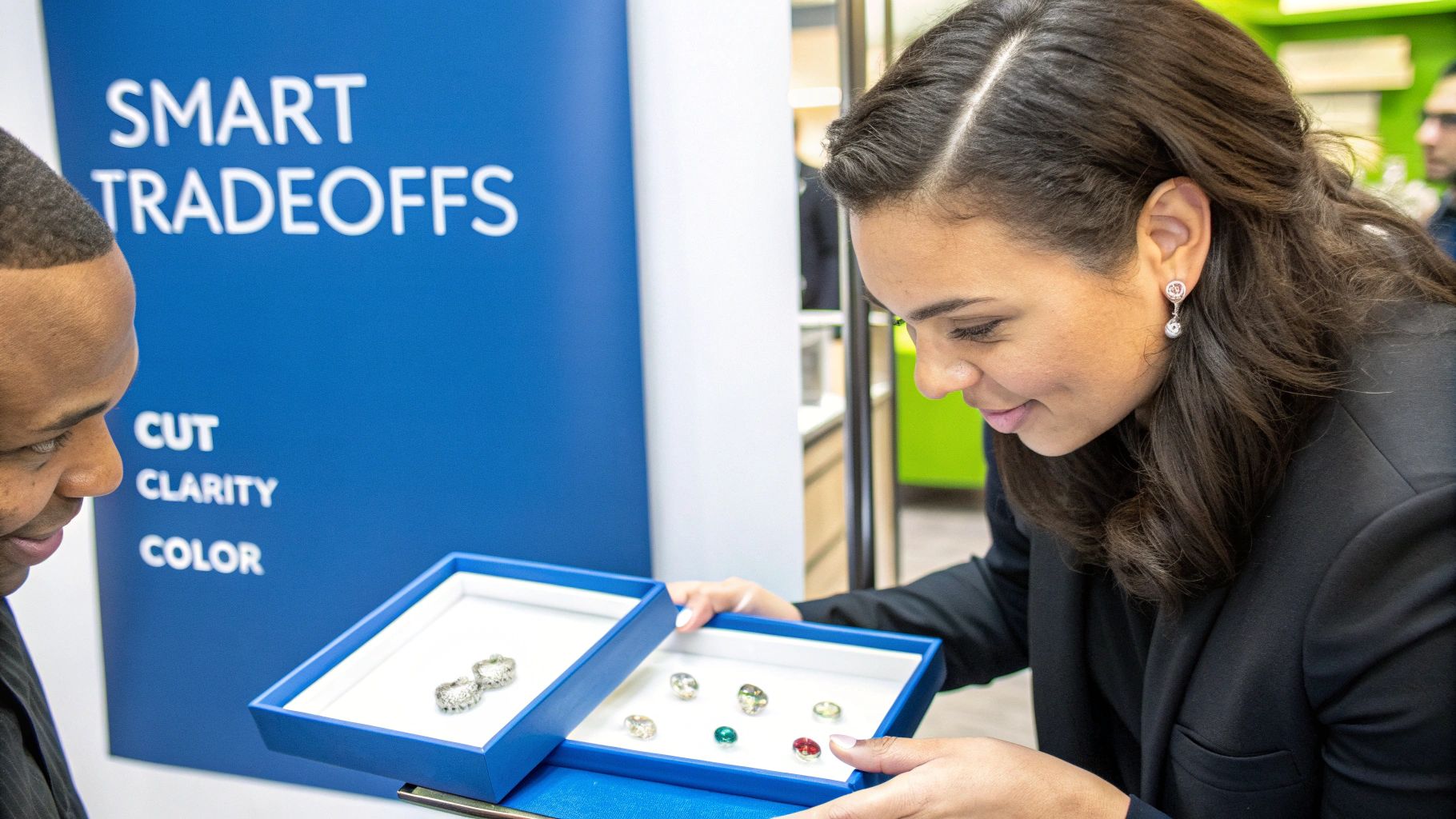
The first rule is simple, and it's not up for debate: the cut is king. A diamond's cut is what unleashes its fire, brilliance, and scintillation—that incredible sparkle everyone is after. You should never compromise on an Excellent or Very Good cut grade. It's the one C that has the single biggest impact on a diamond’s beauty.
In fact, a fantastic cut can even help hide minor inclusions and faint hints of color, making the whole stone look bigger, brighter, and more alive.
Real-World Scenarios for Smart Savings
Let's play out a common scenario. Your top priority is getting the biggest diamond you can for your money. You want that impressive size without sacrificing beauty. It's a popular goal, and it's totally achievable if you know where to focus.
Here’s a proven strategy for maximizing carat weight without blowing your budget:
- Prioritize Cut: This is your foundation for sparkle. Start by only looking at diamonds with an Excellent GIA cut grade.
- Target Eye-Clean Clarity: Next, look for diamonds in the SI1 clarity range. Many of these stones have inclusions that are completely invisible without magnification, giving you the exact same look as a much pricier VS or VVS diamond.
- Select Near-Colorless Grades: Finally, choose a diamond in the G to J color range. These diamonds look brilliantly white, especially once set in a ring, and offer huge savings compared to the D-F colorless grades.
Following this game plan lets you put the bulk of your budget directly toward carat weight, all while getting a diamond that’s bright, clean, and full of life.
How Diamond Shape Changes the Rules
Not all diamond shapes treat imperfections the same way. A diamond's faceting pattern has a massive effect on how well it can hide lower clarity and color grades. Understanding this is your key to avoiding a costly mistake.
Round brilliant cut diamonds, with their 58 perfectly angled facets, are the undisputed champions of sparkle. This intense light return acts as a brilliant disguise, making them fantastic at concealing small inclusions and slight color tints. It's why an SI1 clarity and H color can look completely flawless in a round cut.
The shape of your diamond dictates its personality and its needs. A brilliant cut dazzles and distracts, while a step cut offers a window into the soul of the stone, demanding purity.
Step cuts, however, are a whole different story. Shapes like the elegant emerald cut or the mesmerizing Asscher cut feature long, open, rectangular facets that create a "hall-of-mirrors" effect. They don’t have that same fiery sparkle; instead, their beauty comes from showcasing a diamond’s clarity with stark, geometric lines.
This means there is absolutely nowhere for inclusions to hide. For these shapes, clarity is everything. An SI1 inclusion that would disappear in a round brilliant might be glaringly obvious in an emerald cut. If your heart is set on a step cut, you should aim for a clarity grade of VS2 or higher to ensure it looks clean to the naked eye.
Likewise, their wide-open table makes color more noticeable, so sticking to a grade of H or better is a smart move. This shape-specific knowledge is critical for anyone using our complete guide to buying engagement rings, as it ensures your final choice is breathtaking from every single angle.
Your Questions on Diamond Clarity and Color Answered
When you start digging into the details of diamond clarity and color, a few key questions always seem to pop up. Let's tackle the most common ones head-on, so you can feel completely confident in your final choice.
What Is More Important Diamond Color or Clarity
For most people, putting a slight emphasis on color over clarity is the smartest move—as long as the diamond is "eye-clean." Think about it: a faint yellowish tint is something your eye might catch from across the table, while a tiny inclusion is usually invisible without a jeweler's loupe. A beautiful, eye-clean diamond in the G-J color range will look stunningly white to the naked eye and offers incredible value.
That said, the diamond’s shape can change the rules. Step cuts like emeralds and Asschers have large, open facets that act like windows into the stone, making inclusions more obvious. For these, you’ll want to prioritize higher clarity. Brilliant cuts, on the other hand, are much more forgiving.
The one rule that never changes? Always prioritize an Excellent cut above all else. A superior cut is what unleashes a diamond's fire and sparkle, and that brilliance is powerful enough to mask minor imperfections in both color and clarity.
Which Clarity Grade Offers the Best Value
Hands down, the SI1 (Slightly Included 1) clarity grade is where you'll find the best bang for your buck. In most cases, especially with round brilliant cuts, the inclusions in an SI1 diamond are too small to be seen without magnification. This means you get a diamond that looks flawless for a fraction of the price of a VS or VVS stone.
The key, however, is to look at the specific diamond you're buying. You (or your jeweler) should always review its GIA report to see where the inclusions are. A small white feather tucked away near the edge is no big deal, but a black carbon spot right in the middle of the table is a different story entirely.
Does the Setting Metal Affect Diamond Color
It absolutely does. The metal you choose for the setting plays a huge role in how your brain perceives the diamond's color. It's a bit of an optical illusion.
- White Metals (Platinum/White Gold): These cool, bright metals act like a mirror, reflecting white light back through the diamond. This makes any hint of warmth or color in the stone more noticeable. If you’re set on platinum or white gold, it’s best to stick with a diamond in the D-H color range.
- Yellow/Rose Gold: These warmer metals do the opposite—they impart some of their own golden or rosy hue onto the stone. This is great for your budget, because you can drop down to an I, J, or even K color diamond and it will still look perfectly white against the warm setting.
Making these kinds of smart trade-offs is what finding the perfect diamond is all about. And if you're looking for other ways to maximize sparkle on a budget, you might also want to explore diamond alternatives like moissanite.
At ECI Jewelers, our experts live and breathe these details. We're here to help you find that perfect balance of quality, beauty, and value. Visit us to explore our curated collection of fine diamond jewelry and find the piece that’s perfect for you.


