


A pre-owned gold Rolex typically runs from about $12,000 to $80,000, depending on the model, reference, and whether the watch comes with box and papers. The most common picks are the Datejust, Day-Date, Submariner, and Daytona, and the right one for you comes down to gold alloy, exact reference, and the document trail. If you're comparing listings right now, that's the frame to use. We'll keep this practical and focus on what actually moves a watch up or down in value. You'll see where the gold matters, where the reference matters, and where the paperwork matters.
What a Gold Rolex Actually Costs and Why Prices Vary So Much
A gold Rolex for sale can look cheap or expensive for the wrong reasons. One watch may be priced close to its metal value, another may carry a premium because it's the right reference with the right history, and a third may sit somewhere in between because it's complete but not especially rare. The essential task is to separate alloy, reference, and documentation, because those three levers control most of the outcome.
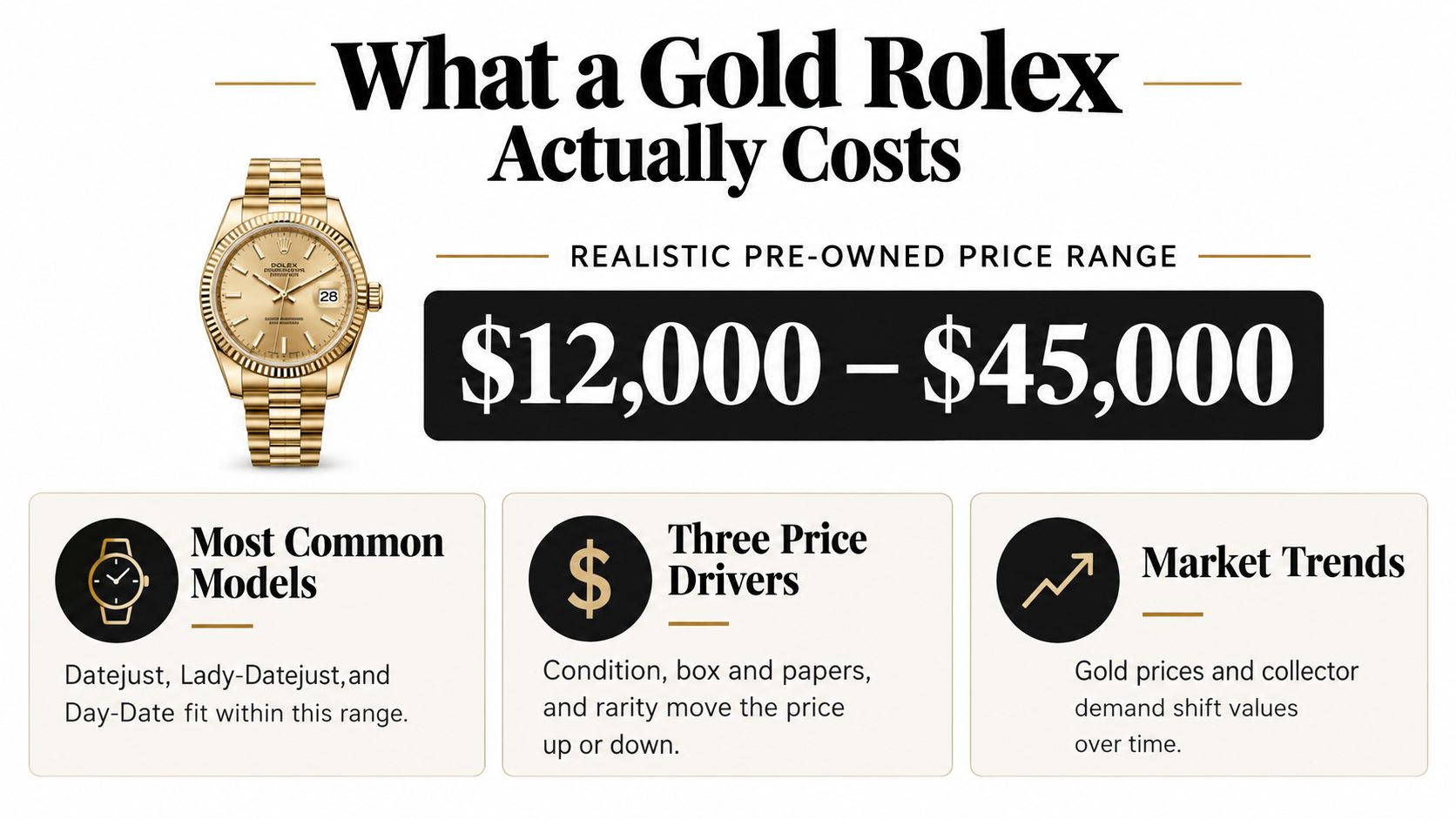
A clean way to think about pricing is the same way retailers think about premium positioning. The phrase premium pricing strategy explained captures the idea that a brand can command more than the sum of its raw materials because buyers pay for trust, design, and desirability. That matters with Rolex. The watch is not a gold bar with hands. It's a finished product with a market built around model history, condition, and buyer demand.
Practical rule: if two gold Rolexes look similar, the one with the stronger reference, cleaner condition, and better paper trail usually wins.
Gold-market context also matters. The World Gold Council reported that global gold-jewellery consumption in 2025 fell 18% year over year to 1,542 tonnes, while value demand rose 18% to a record US$172 billion. It also reported an average gold price of US$3,431 per ounce for the year, with a fourth-quarter average of US$4,135 per ounce, and 53 new all-time highs for the LBMA gold price in 2025. That doesn't set Rolex pricing by itself, but it does explain why the metal under the watch keeps drawing attention. A solid gold watch still carries a meaningful material floor, even though bullion value never tells the whole story. World Gold Council 2025 gold demand trends
For a buyer, the practical takeaway is simple. If the listing is a clean Datejust or Day-Date with the right papers, it's in the serious-money lane. If it's missing documentation or looks overpolished, price should come down fast. We also keep an eye on broader market shifts, including how gold price surges in 2025 and 2026 changed the value floor of luxury watches, because buyers feel those changes even when the watch itself doesn't change.
Yellow White and Everose Gold Explained in Plain English
Rolex uses 18 ct gold, which means 750 parts per thousand pure gold. The remaining metal is the alloy mix, and that mix is what gives the watch its yellow, white, or Everose color. The Federal Trade Commission's 18K standard says the same thing another way, 18 of 24 parts are gold, or 75% pure gold. That is the number that matters on a real gold Rolex, not a vague “gold-colored” label. Rolex newsroom on 18 ct gold and FTC guide to gold markings
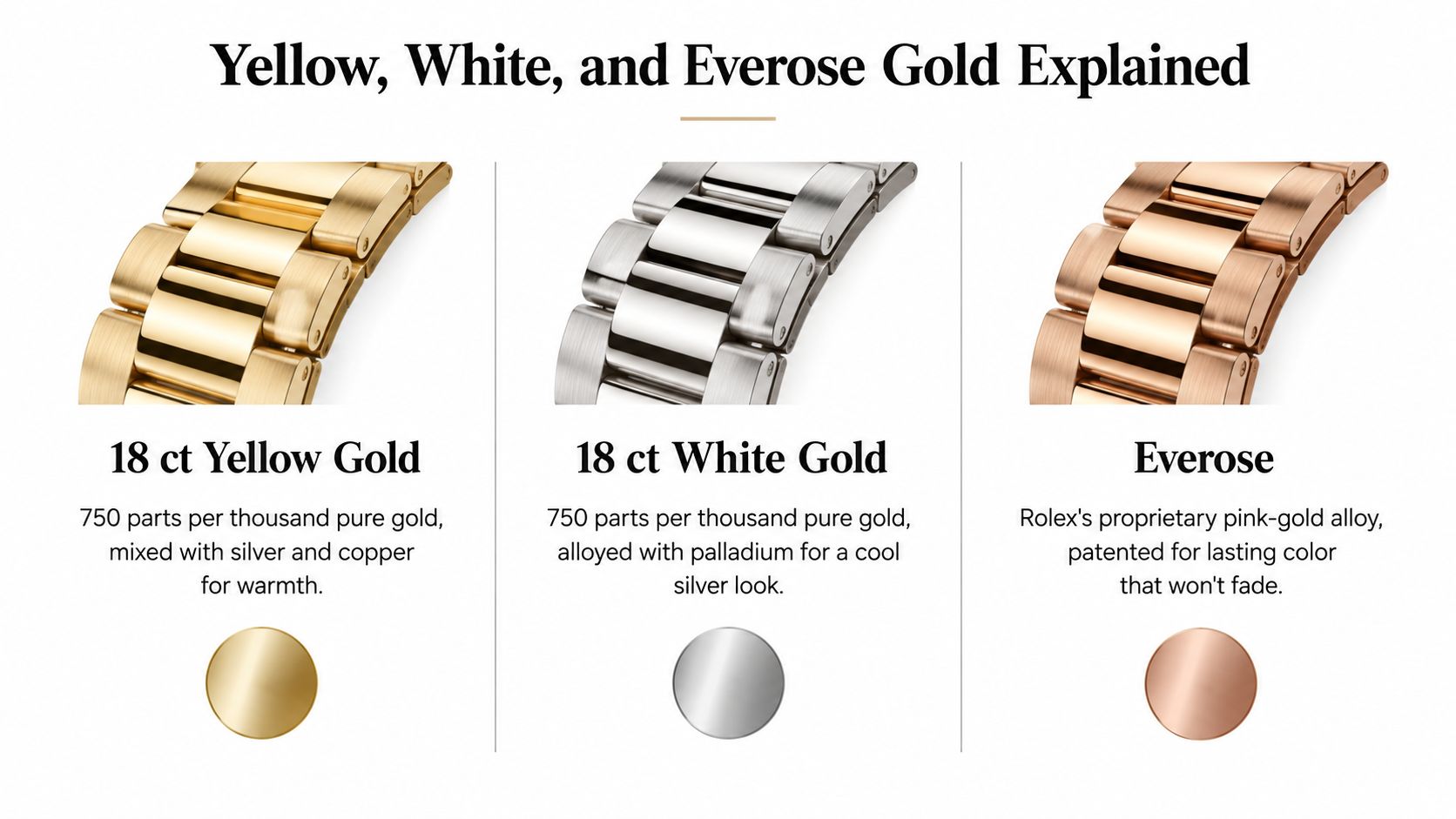
Yellow gold is the standard. It looks warm, traditional, and formal. White gold gives you the same precious-metal weight with a cooler, quieter look. Everose is Rolex's proprietary pink-gold alloy, introduced in 2005, and it keeps its rose tone better than the soft pink finish buyers often expect from lesser alloys.
Gold types at a glance
| Type | What it is | What to check |
|---|---|---|
| Yellow gold | 18 ct solid gold with a warm tone | Hallmarks, reference, and whether polishing has softened the edges |
| White gold | 18 ct solid gold with a paler alloy mix | Brightness, finish, and whether the listing confuses it with steel |
| Everose | Rolex's proprietary pink-gold alloy | Reference matching, case tone, and factory-spec consistency |
Rolesor is Rolex's name for two-tone gold and stainless steel. It is not solid gold, and that is the point. Buyers choose it when they want precious metal without paying full-gold money. Read the listing carefully, because that distinction matters more than the color in the photos.
A listing that says “gold” without saying 18 ct, Rolesor, or plating should make you slow down. I would rather see a buyer choose a plain 18 ct model with clear hallmarks than chase a glossy description that sounds richer than it is. The color should suit your wrist, but the construction should suit your risk tolerance. For a broader look at how gold watch choices stack up, see this gold watch guide from ECI Jewelers.
The Gold Rolex Models Worth Comparing Side by Side
A buyer standing in the shop has three real decisions to make: which gold alloy, which reference, and whether the paper trail matches the watch. Get those right and the rest is mostly taste. Get them wrong and you end up paying for a story instead of a watch.
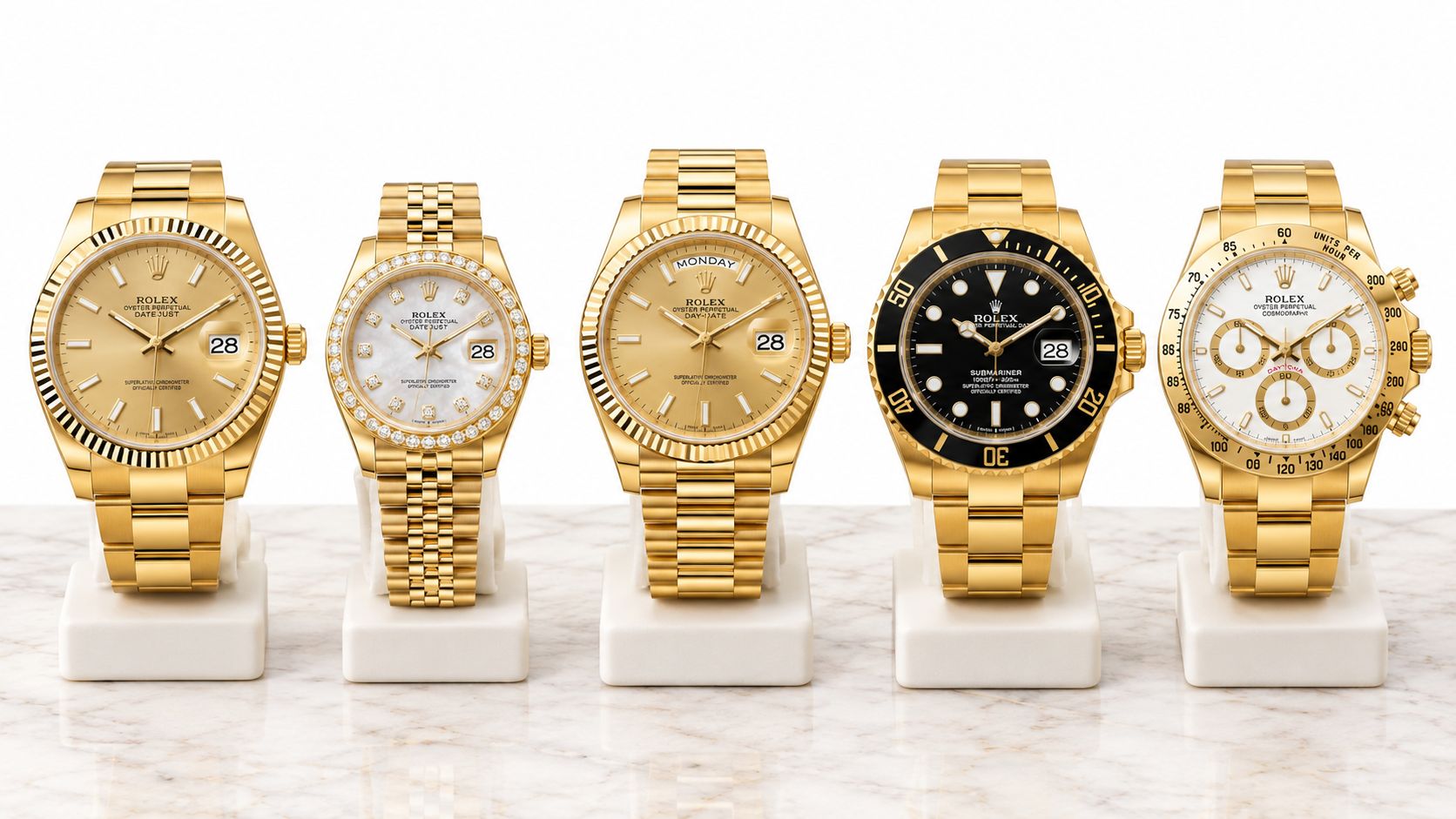
The Datejust is the gold Rolex wearers can wear every day without feeling overdressed. Rolex introduced the Datejust in 1945 to mark its 40th anniversary, and it was originally made exclusively in gold with the Jubilee bracelet. That history explains why the Datejust still reads as the core Rolex dress watch. Rolex history 1953 to 1967
The Lady-Datejust is the smaller, cleaner choice when the wrist asks for proportion before presence. The Day-Date sits at the top of the gold pile. Rolex launched it in 1956, and it was offered only in 18-carat gold or platinum, with the day written out in full. If you want the clearest precious-metal statement in the family, that is the one. Rolex Day-Date history
Which model suits which buyer
- Datejust: for the buyer who wants one gold Rolex to wear often, with a classic dress-watch feel.
- Lady-Datejust: for a smaller wrist or a buyer who wants a slimmer visual profile.
- Day-Date: for the buyer who wants the strongest gold statement and Rolex history in one watch.
- Submariner: for someone who wants gold with a tougher sport silhouette.
- Daytona: for buyers who like chronograph styling and stronger collector pull.
Some references give you a cleaner read on what Rolex is selling. The Day-Date 40 ref. 228235 uses 18 ct Everose gold, a 40 mm Oyster case, a screw-down case back and crown, sapphire crystal, and 100 m water resistance. It uses Calibre 3255, rated at -2/+2 seconds per day after casing and about 70 hours of power reserve. Those details should match the watch in front of you, line for line. Rolex Day-Date 40 brochure
The Oyster Perpetual 28 ref. 276205 shows the smaller Everose route. It has a 28 mm case, Twinlock waterproofness, 100 meters of water resistance, Calibre 2232, about 55 hours of power reserve, and -2/+2 seconds per day after casing. It proves that a gold Rolex can shrink down without losing the Rolex character. Rolex Oyster Perpetual 28
Buy the watch you will wear, not the one that looks strongest in a photo. A larger model that stays in the box does less for you than a smaller one you put on every week.
For a closer look at the Day-Date specifically, our Rolex Day-Date gold guide is the right place to compare references and case sizes before you decide.
How to Check a Pre-Owned Gold Rolex Before You Pay
Start with the reference. The number should match the case, movement, bracelet style, and dial configuration. If the seller says Day-Date 40 but the proportions or bracelet do not line up, stop and ask for clarification before any money changes hands. A good listing makes the watch easier to identify, not harder.
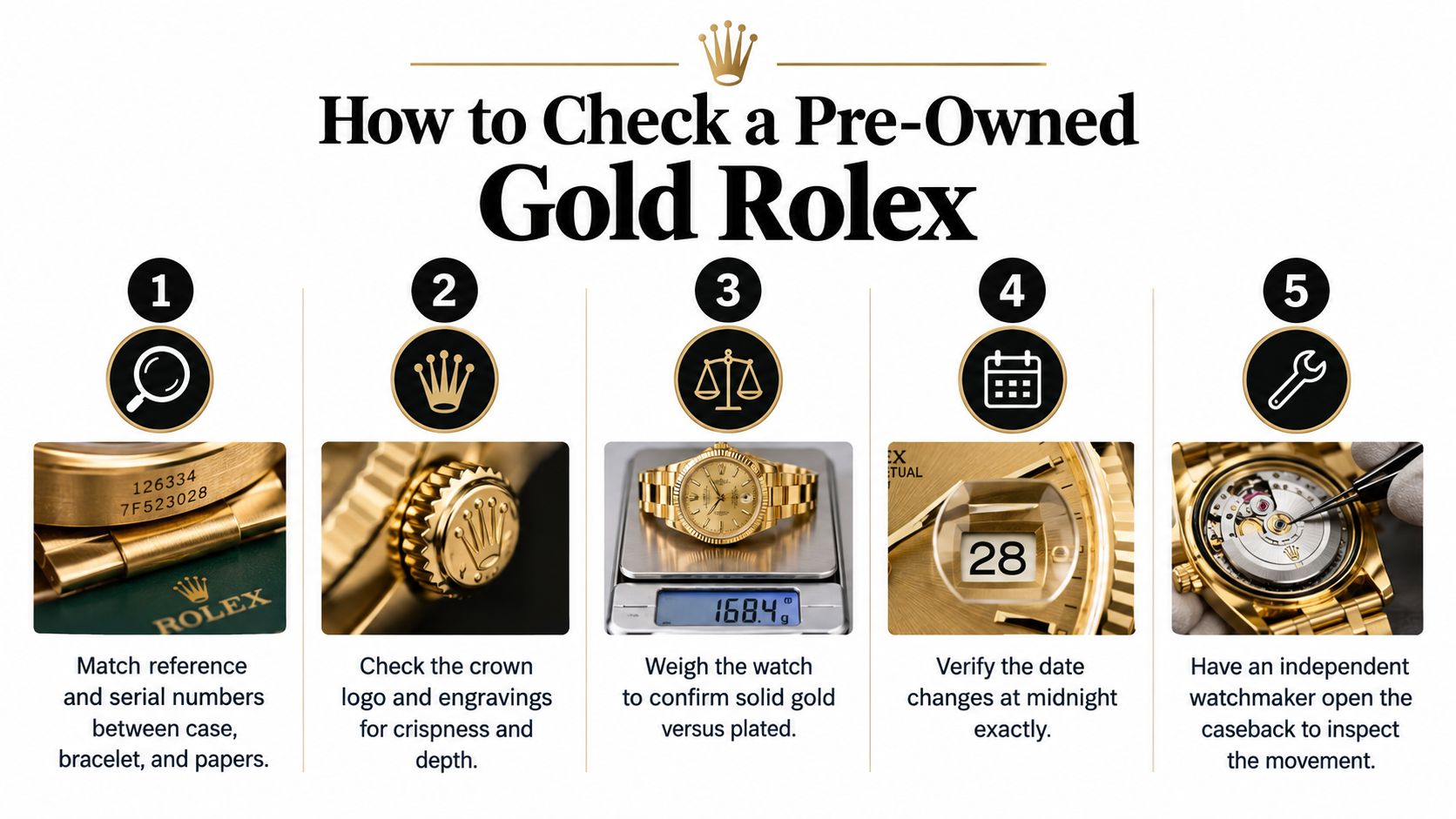
Then check the metal with your eyes and your hands. Compare the hallmarks on the case, clasp, and bracelet to the reference spec and photograph them in normal light, then have an independent watchmaker verify weight and stamping before you pay. If the engraving looks soft, the finish looks inconsistent, or the piece feels wrong for its size, treat that as a warning, not a small flaw.
What I'd verify on the spot
- Reference consistency: case, bracelet, clasp, and papers should tell the same story.
- Hallmarks: they should be clean and readable, not vague or overbuffed.
- Movement behavior: the watch should wind smoothly and run consistently after a full wind.
- Water resistance: treat it as unverified until a qualified watchmaker pressure-tests it.
- Service history: recent service records matter more than a shiny case.
Rolex says a new watch bought from an Official Rolex Retailer carries a five-year international guarantee, and the card has to be completed and dated at purchase. Rolex also says non-genuine components invalidate the guarantee. On the pre-owned market, that means the card supports provenance, but it does not prove every part still belongs to the watch. Rolex guarantee terms
If you want a deeper authenticity check framework, our guide on how to know if your Rolex is real is worth reading before you put down a deposit. I would also insist on seeing the watch under normal lighting, not just in a photo setup. Gold shows wear faster than people expect, and polishing can hide a lot without fixing the underlying issue.
Why a Gold Rolex Usually Holds Its Value Without Being an Investment
A gold Rolex tends to hold value, but that's not the same thing as making money. Buyers mix up resale strength, liquidity, and appreciation all the time. Those are different. A watch can be easier to sell later without delivering a profit after spread, servicing, taxes, and time on the market.
The useful question is not, “Will this go up?” It's, “What would I likely net if I sold it in two to five years?” That's a cleaner way to judge a purchase, especially for a gift watch or a wedding piece where exit value matters even if resale isn't the goal. The watch with the cleaner condition, original accessories, and documented service history usually has the easier resale path.
Practical rule: complete watches move faster than stripped or heavily polished ones, even when the gold content is identical.
Recent market reporting from the secondary-watch trade pointed to about US$16.73 billion in global secondary-watch sales in 2025, with growth described as liquidity-driven rather than mainly price-driven. Another market snapshot said Rolex secondary prices rose 4.6% in late 2025 while Rolex value retention fell 3.4 percentage points because retail prices increased faster. That's the right reminder for buyers. Asking price is not the same thing as realized resale value. EveryWatch secondary watch market report
For a gold Rolex, I'd care more about how easily it sells than what some headline claims about appreciation. The strongest examples are the ones with a full set, honest condition, and a reference people want. A clean watch can be sold. A vague watch sits.
Where to Buy a Gold Rolex Without Getting Burned
There are three real paths. The first is a brand-run pre-owned channel. The second is a trusted independent specialist. The third is a private seller. I'd choose the independent specialist more often than the other two, because you can inspect the watch, ask direct questions, and get a written condition assessment without paying for a lot of showroom mythology.
A private seller can be cheaper, but the risk shifts to you. A brand-certified channel may feel safer, but the price can jump before you've had a real chance to compare similar pieces. If the watch is being sold through an established jewelry counter, you can usually do the basic checks in person and make a cleaner decision.
What to ask before you buy
- Reference and serial information: ask for it in writing and compare it to the watch.
- Condition details: look for notes on polishing, bracelet stretch, dial originality, and replaced parts.
- Return terms: get them in writing before you pay.
- Accessories: box and papers help, but they don't replace inspection.
- Service status: a recent service can matter more than a perfect photo set.
When we work with buyers in the Diamond District, we keep the process simple. ECI Jewelers is one option for pre-owned Rolex shopping, especially if you want to handle the watch in person and compare a few pieces side by side. That matters with gold, because bracelet feel, case weight, and dial tone often change the decision once the watch is on the wrist.
For anyone comparing family pieces or gift purchases, I'd also keep an eye on our matching Rolex watches guide and our Rolex wedding watch guide for groom buyers. A gold Rolex for a milestone should feel right in the room, not just in a product photo.
Financing Trade-In Servicing and Your Pre-Purchase Checklist
We offer financing through Affirm, Synchrony, Acima, and Snap Finance, with approval and terms set by each provider. For watch buyers, we also accept a luxury watch trade-in toward the purchase. If you're comparing payment paths, our financing overview lays out the basics clearly.
Servicing matters too. A gold Rolex should be inspected and serviced when the movement needs attention, and the service record should stay with the watch if you ever resell it. Keep the receipt, the work order, and any parts notes. Buyers pay attention to that trail.
Bring this checklist to the showroom
- Reference matches: case, bracelet, clasp, and papers all line up.
- Gold is confirmed: 18 ct hallmarks are visible and consistent.
- Condition is honest: polishing, stretch, and replaced parts are disclosed.
- Movement runs right: the watch winds and keeps stable time.
- Paper trail is clear: box, papers, and service history are documented.
If you're narrowing a shortlist, compare the exact alloy first, then the reference, then the documents. That order saves time and money.
If you want to try on a few gold Rolex options and compare them side by side, visit ECI Jewelers. We keep pre-owned gold Rolex watches, answer direct questions about references and condition, and help buyers match the watch to the wrist and the budget without guesswork.


