


If you're looking at a Rolex Explorer 1 for sale, buy the watch for its condition, reference correctness, and wrist fit, not for the box or the sticker price alone. The safest choices are the current steel 36 mm and 40 mm models, or a clean vintage ref. 1016 with honest parts and clear history. The wrong watch is usually the one with a pretty dial photo and weak documentation.
The Explorer is a no-date Rolex with a simple job, tell time clearly and survive hard wear. That simplicity is why it's easy to love and easy to fake, so the details matter. We're going to cut through the noise and show you what to check before you pay.
Understanding the Explorer Identity and Dial Layout
The Explorer starts with Everest. On May 29, 1953, Sir Edmund Hillary and Tenzing Norgay reached the summit of Mount Everest as part of Sir John Hunt's British expedition, and Rolex launched the Explorer in 1953 after that achievement. Rolex ties the model to legibility, durability, and exploration, not ornamentation, which is exactly why the watch still feels honest on the wrist today. You can read more about the model's history in Rolex's own archive and compare it with our Explorer I vs Explorer II breakdown.
What the dial should look like
The standard Explorer dial is easy to recognize when you know what matters. Look for large Arabic numerals at 3, 6, and 9 o'clock, baton markers, and a triangle at 12 o'clock. That layout is the model's visual signature, and it separates the Explorer from other Rolex sports watches and from similar Oyster Perpetual pieces. Rolex describes that layout plainly on its Explorer page, which is the first place we'd send a buyer who's trying to confirm the watch in front of them (Rolex Explorer).
Practical rule: if the dial looks busy, decorative, or date-driven, you're probably not looking at a true Explorer I.
Why this matters when you're shopping online
Listings with old or poor photos can hide dial problems. If you're comparing a seller's images and the photos are soft, cropped, or badly lit, use a restoration tool to make the image legible before you make a judgment. A practical example is how Photo for Video restores old scans, which shows how better image clarity can help you read small details without changing the watch itself.
That matters because the Explorer's value starts with the right visual language. If the dial layout is wrong, the listing deserves a hard stop. If it's right, you still need to check the reference, case, and movement, because a correct dial alone doesn't prove much.
Choosing Between 36mm and 40mm Modern References
A buyer standing at the counter with two modern Explorers usually has one real decision to make, 36 mm or 40 mm. Rolex offers the 36 mm ref. 124270 and the 40 mm ref. 224270, and both run Calibre 3230. The movement family is the same, but the wrist presence is not. Rolex's newsroom confirms the 36 mm return in 2021 and the 40 mm addition in 2023 (Rolex newsroom).
How the two sizes wear
Choose 36 mm if you want the classic Explorer proportion, a watch that slips under a cuff, and a case size that stays close to the model's roots. Choose 40 mm if you want the dial to read bigger at a glance and prefer a more modern stance on the wrist.
For a closer look at how diameter changes wrist presence, see this guide to choosing the right watch case size.
The better example wins when condition is uneven. A clean 36 mm with honest papers, sharp lines, and a clean service record is the smarter buy than a louder watch with weak provenance.
Modern Explorer Reference Comparison
| Feature | Reference 124270 (36mm) | Reference 224270 (40mm) |
|---|---|---|
| Case size | 36 mm | 40 mm |
| Movement | Calibre 3230 | Calibre 3230 |
| Power reserve | Approximately 70 hours | Approximately 70 hours |
| Wearing feel | Closer to the original Explorer proportions | More contemporary wrist presence |
Rolex rates Calibre 3230 to -2/+2 seconds per day after casing, with approximately 70 hours of power reserve, and the current Explorer cases are built around that calibre (Rolex Explorer technical page). That matters for ownership. A healthy watch should run through a normal weekend off the wrist, and any seller claim that sounds loose should be treated as a service question until it is proven otherwise.
Use a simple fit rule. The 36 mm Explorer usually suits wrists up to about 6.5 to 7 inches, and the 40 mm ref. 224270 reads better above 7 inches. For the smaller reference, keep an eye on lug-to-lug length under 50 mm. If the watch stretches past your wrist edges, it will wear larger than the diameter suggests.
Evaluating Vintage References and Dial Transitions
The vintage Explorer market is led by the ref. 1016, and that is where many buyers overpay for the wrong details. Sotheby's dates its introduction to 1959 and says production ran until 1989, while Phillips places production from 1963 to 1989. The start date varies by cataloguing, but both agree on the same point, the 1016 defines the vintage Explorer era and stays collectible because of that long run (Sotheby's Explorer ref. 1016).
What changed inside the run
Early examples used a glossy gilt dial, then Rolex moved to a matte dial around late 1966 or early 1967. Phillips also records a jump in water resistance from 50 meters on the preceding ref. 6610 to 100 meters, along with a dial wording change to “Superlative Chronometer Officially Certified.” Those details are not trivia. They separate an original, correctly priced watch from a mixed example that needs discounting.
Collectors pay for what is still on the watch, not what a seller says used to be there. A clean matte 1016 with honest surfaces usually makes more sense than a polished, over-restored example with mystery parts. The dial, hands, and case need to tell the same story.
Buy the parts you can verify, not the story you're told. A vintage Explorer is only as strong as its originality, and originality lives in the dial, hands, case geometry, and paperwork trail.
Why condition drives the price
Auction results show the spread clearly. Sotheby's reported a circa-1960 ref. 1016 selling for 37,500 CHF in May 2013 (Sotheby's Explorer ref. 1016). Results like that do not set every price, but they do show how much dial type, originality, and documented provenance move the number.
If you are buying vintage, focus on the watch in this order:
- Dial originality first, because refinishing changes the watch most.
- Case sharpness second, because heavy polishing weakens collectability.
- Movement and service records third, because the watch should work as well as it looks.
- Paper trail last, because documents help, but they do not rescue a bad watch.
For a practical reference point, keep this vintage Rolex guide nearby while you compare examples. It helps you read the small differences that separate a strong 1016 from an expensive mistake.
Authentication Realities and Layered Verification
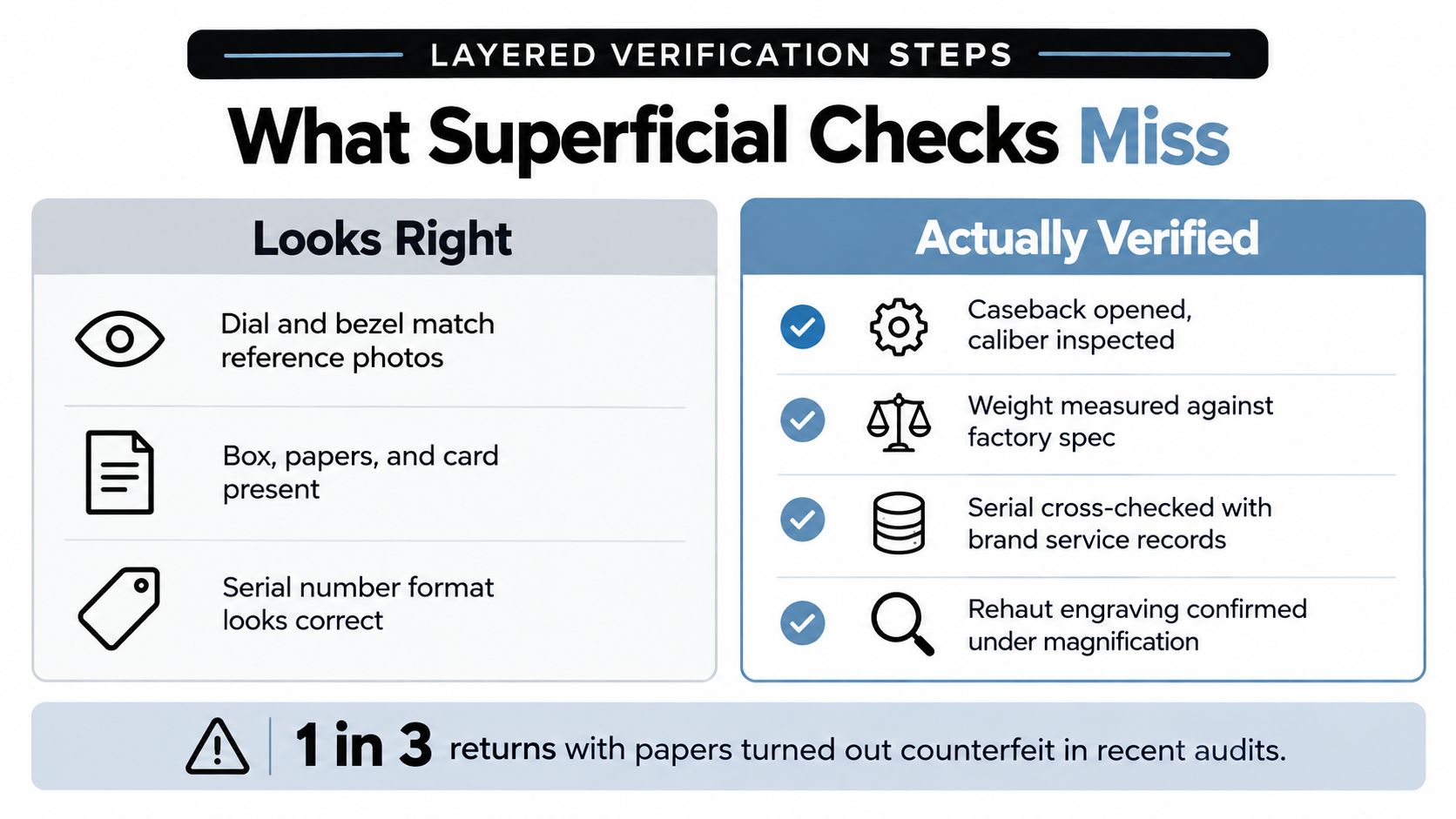
A box and papers set does not prove a Rolex is real. Neither does a strong sweep, a correct-looking serial, or a dial that matches a few online photos. Counterfeits can pass one check and fail another, and the Explorer's clean, date-free face gives counterfeiters fewer visual complications to imitate. Buyers need layered verification, not wishful thinking. A good practical guide to that mindset is how to know if your Rolex is real, which pushes the same basic idea, check the whole watch, not one clue.
What real verification looks like
Start with reference coherence. The case, dial, hands, bracelet, clasp, and movement should all belong to the same Explorer family. If one piece looks wrong, stop there.
Then verify the watch as a whole. A seller should state exactly what is being sold, and the reference should match the physical watch in front of you. Inspect the movement when appropriate, because the right calibre has to sit inside the right case. Ask for replacement-part disclosure too. Aftermarket hands, dials, or clasps change value and can change authenticity risk.
Use transaction protection. A written invoice, protected payment, and a return or inspection period matter more than a glossy listing. Price is a signal, not proof. A low price can still be real, and an expensive one can still be wrong.
Why box and papers aren't enough
Original papers help with history, but they do not open the caseback and they do not prove what is inside the movement. A seller can show a correct card and still have an incorrect watch. That is why a layered review works better, especially on remote purchases where you cannot inspect the watch before sending funds.
If you are buying online, ask for close photos of the dial, clasp, case edges, and movement when possible. If the seller resists that level of transparency, keep moving. Good watches survive scrutiny, and weak listings do not.
The buyer who wants a strong Explorer should combine authenticity checks with condition judgment and ownership cost. A correct watch with tired parts, a stretched bracelet, or a weak service history can still become an expensive mistake.
Inspecting the Oyster Case and Bracelet Condition
A pre-owned Explorer can look perfect in photos and still be tired in person. The Oyster case, Twinlock double waterproofness system, sapphire crystal, and Oyster bracelet with Easylink 5 mm comfort extension are the physical parts that tell you how the watch has been worn. Rolex lists the current 36 mm Explorer as 100 metres/330 feet water resistant and pairs it with the black Chromalight dial and Oysterlock clasp (Rolex Explorer technical page).
What to check first
Look at the case lines before you fall for the shine. Sharp lug edges, clean transitions between brushed and polished surfaces, and correct proportions are what you want. Over-polishing softens those lines and lowers both collectability and confidence.
Then check the bracelet:
- Clasp action: it should close firmly and open cleanly.
- Bracelet stretch: the links should not sag like a worn chain.
- Easylink presence: confirm the 5 mm extension is still there and functional.
- Link configuration: mismatched or replaced links can hint at prior damage or repairs.
Water resistance is not a cosmetic feature. It's a system property, which means seals, crystal seating, case-back torque, and crown components all matter. A pre-owned Explorer should get documented pressure testing before swimming or any water exposure, especially after a service or after case polishing has altered the watch.
Practical rule: if the seller can't tell you the last pressure test date, assume the watch needs one before real water use.
Total cost matters more than asking price
A cheap watch with a stretched bracelet and a tired crown can cost more to own than a cleaner example priced higher. That's why we don't look only at the asking number. We look at the watch as a package, case condition, bracelet health, service history, and what you'll need to spend after the sale.
For bracelet background and terminology, our Oyster bracelet guide is worth reading before you buy. It helps you judge whether the bracelet on the listing is healthy, original, or already near replacement territory.
Navigating Warranties and Flexible Payment Options
Rolex's five-year international guarantee applies to new watches bought from an Official Rolex Retailer, not automatically to pre-owned pieces on the secondary market. The guarantee card has to be completed and dated by the retailer, registered with Rolex, and presented with the watch when service is requested. Rolex also excludes normal wear and tear, theft, misuse, and damage tied to non-genuine parts or unauthorized repair work (Rolex guarantee).
What that means for a used Explorer
If you're buying pre-owned, check the card, check the date, and check whether the watch has been altered. If the watch has already been opened or modified by the wrong hands, the paperwork matters less than the actual condition. That's how the secondary market works.
For payment, we make the purchase more manageable through Affirm, Synchrony, Acima, and Snap Finance, with approval and terms set by each provider. For customers who want to offset the cost, we also accept a luxury watch trade-in through our watch-buying page: sell your luxury watch. If you want to review financing options, start here: flexible financing and leasing options at ECI Jewelers.
If you're comparing sellers, ask who explains the watch clearly, who documents the condition, and who gives you a simple paper trail. That's what lowers risk in a market full of nice photos and vague descriptions. We'd rather have you buy the right Explorer once than chase the wrong one twice.
Frequently Asked Questions
Is the Calibre 3230 better than older Explorer movements
It's the current standard for the modern Explorer line, and it brings a 70-hour power reserve, stop-seconds hacking, and Rolex's stated -2/+2 seconds per day after casing rating. Older movements are still solid, but if you're buying a current 124270 or 224270, the listing should match the 3230 specification.
Does the Easylink system make sizing easier
Yes, but it's not a substitute for proper bracelet sizing. The Easylink 5 mm comfort extension gives you a little breathing room when your wrist changes during the day, but the bracelet still has to be sized correctly at the links. If the watch is too loose or too tight before the extension comes into play, fix the fit first.
Can I wear an Explorer every day
Absolutely. That's what the model was made for, and Rolex builds it as a practical tool watch with a sapphire crystal, Oyster case, and no-date dial. The true question isn't whether it can be worn daily, it's whether you've checked the condition well enough to wear it daily without worry.
Should I buy box and papers over the watch itself
No. Buy the watch first. Papers help, but a correct watch with honest condition is better than a weak watch with complete paperwork.
Is a lower price always a red flag
No, but it is a signal. A lower price can reflect missing papers, service need, or an older bracelet, and those are normal reasons for a discount. What it can't do is prove the watch is genuine, so you still need layered verification.
At ECI Jewelers, we help buyers compare Explorer references, inspect condition, and choose the right watch without guessing at the details. If you're ready to narrow your shortlist, visit ECI Jewelers and compare what's available now before the right Explorer moves on.


