


An Oyster bracelet is Rolex's most recognizable metal watch band, known for its iconic flat three-piece link design. It’s far more than just a strap; it's a piece of Rolex history and a cornerstone of the brand's identity, patented in the late 1940s and celebrated ever since for its perfect blend of form, function, and comfort.
The Quintessential Rolex Sport Bracelet
An Oyster bracelet is Rolex’s signature three-link metal bracelet: broad, flat links, a sport-oriented profile, and a fit designed to integrate tightly with the case. Rolex itself describes the Oyster as its most universal bracelet, a long-running design used across core models including the Oyster Perpetual, Submariner, Daytona, and GMT-Master II, characterized by those flat three-piece links that define the look at a glance on Rolex’s own model pages.
It also helps to clear up the wording. In watch language, “bracelet” usually means a metal attachment made of articulated links, while “band” or “strap” is more often used for leather, rubber, fabric, or other non-metal materials. So when people ask what an Oyster bracelet is, or refer to an Oyster watch bracelet or Oyster watch band, they are usually talking about the same familiar Rolex-linked metal design rather than a soft strap.
From ECI’s review perspective, the Oyster’s appeal is easy to understand the moment it’s on wrist: it feels planted and purposeful. Compared with dressier Rolex bracelets, it has less jewelry-like drape and more of a secure, tool-watch stance, which is exactly why many buyers prefer it.
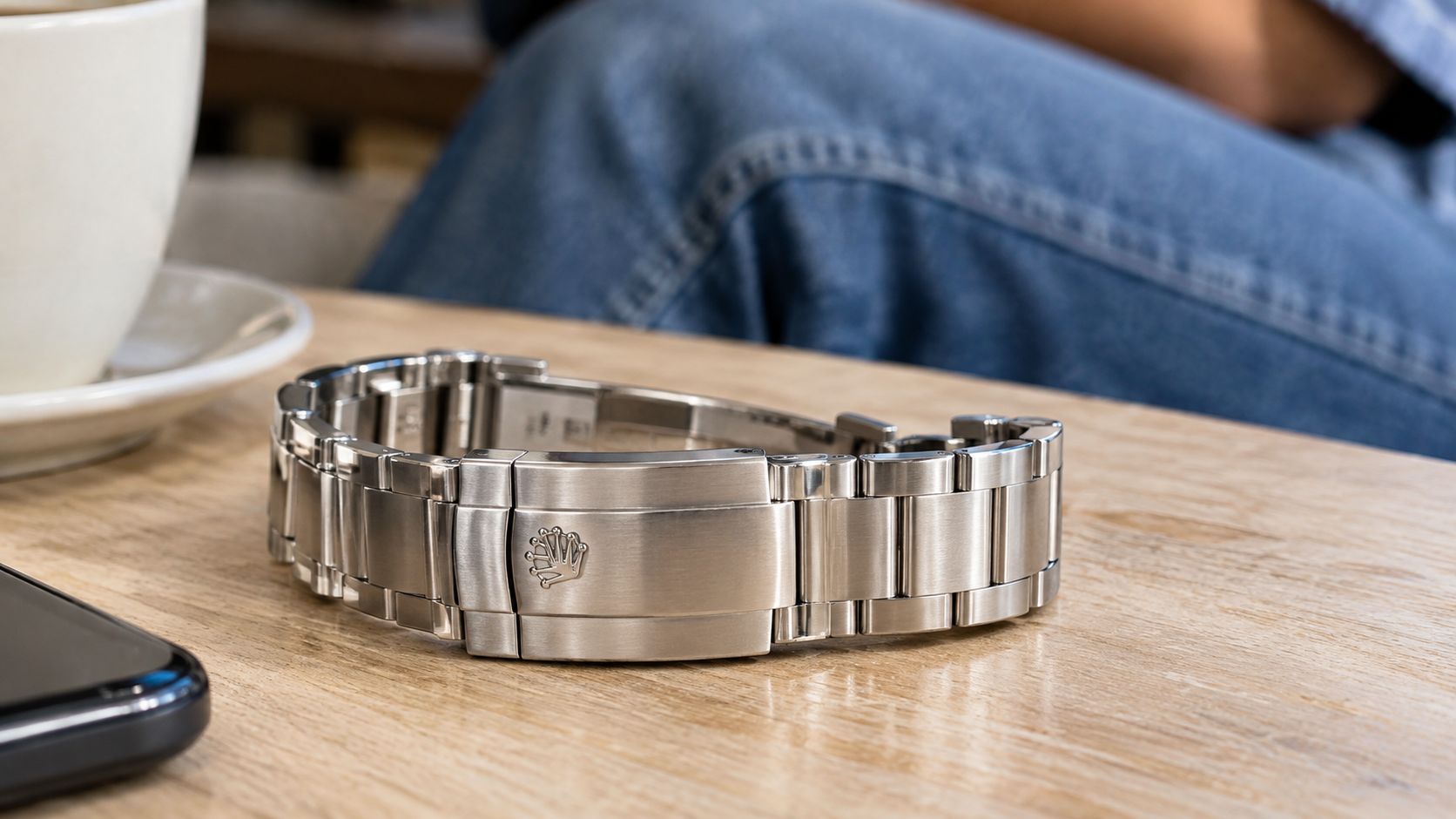
Defining Characteristics At a Glance
The defining formula is simple: one broad center link flanked by two outer links, all laid out in a flat, strong geometry that favors durability and daily wear. That makes an Oyster bracelet different from a generic three-link watch band in two important ways: first, the Rolex version is model-specific in its end-link fit and clasp execution; second, the name carries a historical meaning tied to Rolex production, patents, and case compatibility—not just a visual style.
If you see terms like “Oyster bracelet,” “Oyster watch bracelet,” or even the common misspelling “Oyster braclet,” they almost always point to this same three-link sport layout. “Oyster-style bracelet,” however, usually means a bracelet inspired by the Rolex pattern rather than one made by Rolex for a Rolex watch.
To appreciate its role, view it alongside Rolex's other famous designs. For a full comparison, see the guide to Rolex bracelets, which breaks down the key differences between the Oyster, Jubilee, and President styles.
The Oyster bracelet’s three-link configuration isn't just about looks; it's a deliberate design choice that prioritizes strength and reliability. This is why it remains the standard for nearly all Rolex Professional watches.
Here’s a quick overview of its key features, common materials, and the famous models it's most often paired with.
| Characteristic | Description | Common Models |
|---|---|---|
| Link Design | Flat three-piece links | Submariner, Daytona |
| Primary Use | Sport and professional | GMT-Master II, Explorer |
| Material | Oystersteel, Gold, Platinum | Datejust, Sky-Dweller |
| Feel | Robust and utilitarian | Oyster Perpetual, Air-King |
How We Evaluated Oyster Bracelet Features and Fit
Our review criteria for this article were practical rather than theoretical. We looked at five things that actually matter when someone is choosing, comparing, or verifying an Oyster bracelet: link geometry, case fit, clasp usability, wear over time, and authenticity markers.
First, we assessed construction by checking whether the bracelet follows true Oyster geometry: flat three-piece links, proper articulation, and end links that sit cleanly against the intended case without awkward gaps. Second, we looked at comfort and fit, including how different clasp systems affect day-to-day wear, how the bracelet balances a watch head, and how easy it is to fine-tune sizing.
Third, we evaluated authenticity cues buyers can verify: reference compatibility, finishing quality, clasp action, correct markings, and whether the bracelet’s age and build type make sense for the watch it is paired with. Fourth, we considered model compatibility, because a bracelet that is genuine but wrong for the case reference is still the wrong purchase. Finally, we treated any claim as suspect if it relied on vague language like “fits most Rolex models,” had missing end-link details, or paired a period-correct watch with a clearly later bracelet generation.
In our own handling and customer-service experience at ECI, the fastest disqualifier is usually not a dramatic fake hallmark but a mismatch: the bracelet may look convincing in photos, yet the end links, clasp era, or case reference do not match.
The History and Evolution of the Oyster Bracelet
To really get what the Oyster bracelet is all about, you have to go back to the years just after the war. Its story isn't one of a single flash of genius, but of a brilliant partnership and a very specific vision for what a "tool watch" should be.
The Oyster bracelet was born from a team-up between Rolex and the undisputed master of bracelet manufacturing at the time, Gay Frères. Rolex had already launched the dressier, more intricate Jubilee bracelet in 1945, but they knew they needed something else—something tougher, more practical, and built for action.
From Rivets to Solid Steel
The first Oyster bracelets, which started showing up in catalogs around 1948, don't look quite like the ones we see today. They were built with riveted links, where you could see the pins holding the sides of each link together. These bracelets were light and got the job done, a perfect match for the tool watches of that era.
But Rolex is always chasing perfection. To improve the bracelet's feel on the wrist and make it last longer, they moved on to folded links in the late 1960s. Instead of being solid blocks of metal, these links were made from a single sheet of steel that was folded into shape. This added a bit of weight and a lot more strength, a clear step up in engineering.
The final and most important evolution was the shift to solid links. This is the modern construction that gives the Oyster bracelet its famous, substantial feel. It also all but eliminates the "stretch" that could happen with the older riveted and folded designs after years of wear and tear.
A Landmark Partnership
The Oyster bracelet's entire journey is tied to Gay Frères. Patented in February 1947, the design was a joint project that put Rolex way ahead of the curve in bracelet design. It appeared in the Rolex catalog in 1948, and a further patent in 1952 introduced curved fitted end links that helped the bracelet integrate more cleanly with the case—a major part of the modern Oyster look as detailed by Hodinkee.
This legendary partnership came to a head in 1998 when Rolex officially bought Gay Frères. This move brought all bracelet manufacturing in-house, giving Rolex total control over quality, design, and innovation.
This acquisition marked a major shift. It allowed Rolex to perfect the Oyster bracelet into the precision-engineered piece of hardware it is today. From the metals they use to the high-tech clasp systems, every single part is now managed under one roof, guaranteeing the bracelet is just as masterfully built as the watch itself.
Anatomy of an Icon: Construction and Materials
So, what exactly makes the Oyster bracelet a true legend in the watch world? The secret is in its deceptive simplicity—a design that hides some serious engineering in its construction and materials. Its enduring strength and classic look all come down to one signature feature: a flat, three-piece link layout.
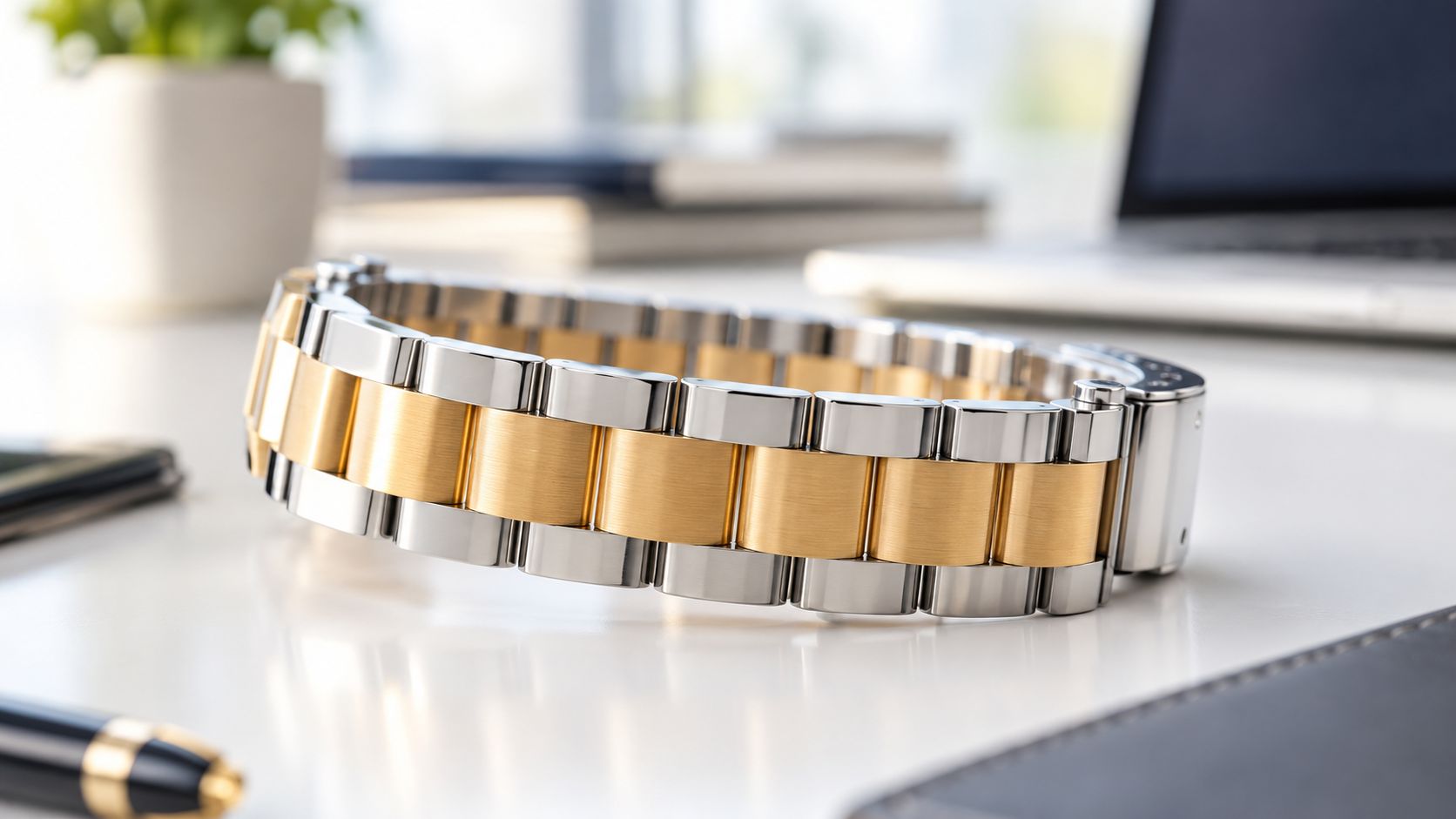
This iconic structure pairs a wide center link with two slimmer outer links. But it’s not just about aesthetics; this configuration strikes the perfect balance between toughness, comfort, and clean visual lines. It’s the blueprint for a sport bracelet that’s been copied countless times, but rarely matched.
Looking back, its construction tells a story of constant refinement. The first Oyster bracelets used hollow, folded links. They were lightweight, sure, but notorious for stretching out over the years. Rolex eventually upgraded to solid links, a move that completely changed the game by adding substantial weight, durability, and a much more premium feel on the wrist.
The Materials Behind the Legend
The choice of metal is every bit as important as the design itself. Rolex is famous for its use of high-performance materials, each picked for its unique look and functional properties. This dedication to material science is a massive part of the bracelet's identity.
- Oystersteel: This is what you'll find on most models. It's Rolex’s own proprietary 904L stainless steel, a grade that’s exceptionally tough against corrosion and polishes to an exceptional luster. It’s the perfect fit for a watch meant to be worn every day.
- Rolesor: This is the classic two-tone look, blending the ruggedness of Oystersteel with the luxury of 18k gold (Yellow, White, or Everose) for the center links.
- Precious Metals: For the ultimate statement, Oyster bracelets are also made from solid 18k gold or the dense and rare 950 platinum.
The Rolex Oyster bracelet is celebrated for its durable construction, often relying on specific metal compositions; for a broader understanding of how materials are blended, you can explore what is an alloy.
The move from hollow to solid links was a critical upgrade. This single engineering change transformed the bracelet from a functional component into a solid piece of luxury hardware, defining the modern Rolex experience.
This obsessive attention to both structure and substance is what elevates the Oyster bracelet from a simple watch band to an icon of horological design. Every single link, whether steel or solid gold, is proof of Rolex's relentless pursuit of perfection.
Oyster Bracelet Variants and Modern Clasp Systems
The most useful distinction in this category is between a true Rolex Oyster bracelet and an Oyster-style bracelet sold by third-party strap makers. A genuine Rolex Oyster bracelet is a Rolex bracelet built for a specific Rolex case, with the right end-link shape, fit tolerances, clasp family, and reference compatibility. An Oyster-style bracelet copies the visual recipe—usually the three-link layout—but it is not the same thing unless it was made by Rolex for that watch.
That matters because the differences show up quickly in real use. Compare them by five criteria:
- Three-link geometry: Rolex’s links are broad and flat, but the exact proportions vary by model and era; generic bracelets often get the silhouette close without matching the profile or taper.
- End-link integration: A true Oyster bracelet is case-specific. The end links are shaped to the watch, so the bracelet sits cleanly between the lugs instead of leaving visible gaps.
- Clasp type: Rolex uses model-specific clasp systems, from Oysterclasp to Oysterlock with Easylink or Glidelock. Third-party options may mimic the look without replicating the mechanism or finish quality.
- Fit to Rolex cases: A Submariner bracelet is not interchangeable with every Rolex just because lug width seems similar. The case curvature and end-link design have to match.
- Finishing and balance: On wrist, the genuine bracelet tends to feel better balanced against the case, with smoother articulation and more consistent brushing and polish transitions.
Many buyers get tripped up: a bracelet can be perfectly fine as an aftermarket Oyster-style watch band, but that does not make it a Rolex Oyster bracelet, and the resale value difference is significant.
Oyster-Style vs. Oysterflex
Another common point of confusion is Oysterflex. Even though the name includes “Oyster,” it is not a generic rubber band and it should not be grouped with third-party sport straps. Introduced in 2015, the Oysterflex bracelet is a separate Rolex bracelet family built around a metal blade overmolded with black elastomer, giving it the comfort of rubber with a more stable structure than a conventional strap.
That is why Oysterflex belongs in Rolex’s bracelet lineup rather than being treated as a simple alternative band. It serves a similar sport-luxury role, but it is mechanically and visually distinct from the classic three-link metal Oyster.
Model Examples: What People Usually Mean
When people refer to an “Oyster bracelet watch,” they are usually picturing one of a handful of core Rolex pairings:
- Submariner: the archetypal dive-watch pairing, typically with Oysterlock and Glidelock for precise sizing.
- GMT-Master II: a travel-focused sports model commonly seen with an Oyster bracelet and Easylink for quick comfort adjustment.
- Daytona: a more compact, motorsport-leaning fit where the Oyster keeps the watch feeling balanced and athletic.
- Oyster Perpetual: the cleanest expression of the design, often with Oysterclasp rather than the more elaborate dive-oriented systems.
Those examples also show why terminology gets blurred. Someone saying “oyster band watch” may mean the bracelet style, while another person means a specific Rolex configuration. The safest interpretation is the three-link Rolex sports bracelet unless the context clearly points to an aftermarket style.
Beyond the Links: The Genius of Rolex Clasps
Whether metal or Oysterflex, the clasp is where you’ll find some of Rolex's best work. The backbone for most professional models is the Oysterlock safety clasp. It's a simple but brilliant design featuring a folding cover that snaps shut over the main buckle, creating a secondary lock.
This feature is essential for an active lifestyle. It prevents the bracelet from accidentally popping open, whether you’re on the back nine or exploring a reef.
The ability to make instant, on-the-fly adjustments is what elevates the modern Oyster bracelet from good to perfect. It’s a practical solution to a problem every watch wearer has experienced.
However, the micro-adjustment systems built right into the clasp are the key feature. These allow for quick, tool-free sizing changes to accommodate your wrist swelling or contracting with temperature shifts throughout the day.
Adjustments on Demand: Easylink and Glidelock
Two main systems deliver this on-the-go comfort, each built for a specific purpose. Understanding the difference is key to picking the right watch for your needs.
- Easylink 5mm Comfort Extension Link: This is the most common system, found on models like the Daytona, GMT-Master II, and Datejust. Tucked discreetly inside the clasp is a small, foldable link. You can flip it out to instantly add 5mm to the bracelet's length, the perfect amount to relieve pressure on a hot day. It’s a quick, simple, and satisfying piece of design.
- Glidelock Extension System: Reserved for Rolex's hardcore dive watches like the Submariner and Sea-Dweller, the Glidelock is a sturdier system. It allows for fine-tuned adjustments in 2mm increments up to a total of about 20mm. Just lift the clasp’s inner panel and slide the bracelet to the perfect length. This feature is essential for divers who need to fit their watch over a thick wetsuit, but it's just as useful for achieving an absolutely perfect fit topside.
These clasp systems are a core part of the modern Rolex experience, demonstrating a commitment to not just telling time, but to making the watch an integrated, comfortable part of your daily life.
Below is a quick-reference table comparing the main adjustment systems you'll find on today's Oyster bracelets.
Oyster Bracelet Clasp and Extension Systems
| System Name | Primary Function | Adjustment Range | Common Models |
|---|---|---|---|
| Easylink | Quick comfort adjustment for daily wear. | 5mm (one-step extension) | Daytona, GMT-Master II, Datejust, Explorer |
| Glidelock | Fine-tuned, incremental adjustments for a precise fit or to wear over a dive suit. | Up to 20mm (in 2mm increments) | Submariner, Sea-Dweller, Deepsea |
| Oysterclasp | Standard folding clasp, often with several internal micro-adjustment points (requires a tool). | Varies | Oyster Perpetual, Air-King, older models |
Each system is perfectly suited to its watch's intended purpose, from the quick-fix comfort of the Easylink to the mission-ready precision of the Glidelock.
Oyster vs. Jubilee vs. President: A Rolex Bracelet Showdown
Think of Rolex bracelets like different types of tires for a high-performance car. The Oyster is your rugged, all-terrain option, but its siblings—the Jubilee and the President—are built for entirely different roads. Getting to know their personalities is the best way to see why the Oyster holds such a special place in the Rolex lineup.
The most frequent matchup is the Oyster against the Jubilee. Where the Oyster is all business with its wide, flat three-piece links, the Jubilee is pure elegance. It uses five smaller, more intricate links that create a fluid, almost jewelry-like drape on the wrist. This makes it a dressier choice, often paired with the Datejust. For a deeper dive on that, you can read our guide on what is a Jubilee bracelet.
The Three Titans of Rolex Bracelets
Then you have the President bracelet, which is in a class of its own. It's instantly recognizable from its semi-circular, three-piece links, blending the Oyster's strength with a far more refined, decorative look. It occupies a unique space between sporty and dressy, but its real calling card is exclusivity.
The President bracelet is reserved only for Rolex's top-tier models: the Day-Date and certain precious metal Lady-Datejust watches. It is never made in steel, only in 18k gold or 950 platinum, cementing its status as a symbol of achievement.
The image below shows some of the functional innovations Rolex developed specifically for the Oyster family, highlighting its versatility.

As you can see, Rolex has poured a ton of engineering into the Oyster, from quick-adjustment links for daily comfort to advanced extensions for professional divers.
Ultimately, picking a bracelet comes down to what you need it for and your personal style. Each one plays a distinct role.
- Oyster: The sporty, do-it-all workhorse for Professional and classic models.
- Jubilee: The comfortable, elegant option for a dressier feel.
- President: The ultimate symbol of prestige, reserved for the best of the best.
Putting these three side-by-side makes the Oyster's identity perfectly clear. It’s the very foundation of the Rolex collection, strong, versatile, and ready for anything. It defines the brand’s legacy of creating "tool watches" built to perform but styled to look great anywhere.
How to Spot an Authentic Oyster Bracelet
When you're navigating the pre-owned market, telling a genuine Oyster bracelet from a convincing fake is everything. At first glance, a counterfeit might look the part, but the actual story is always in the details, the quality of the steel, the precision of the finishing, and the feel of the mechanics. Knowing what to look for is the first step in protecting your investment.
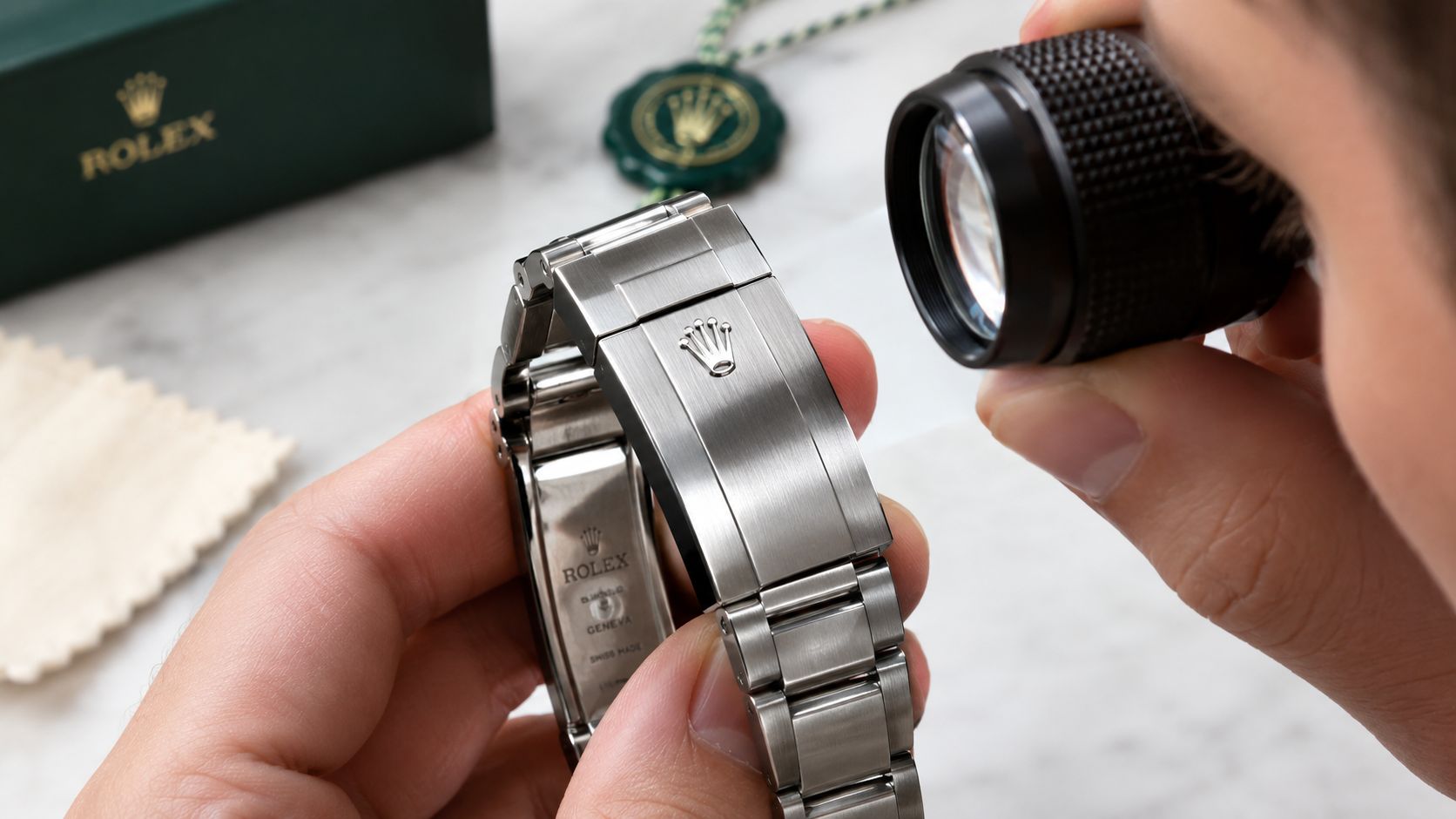
Start with the clasp. A real Rolex clasp closes with a crisp, secure click. It should never feel flimsy or loose. The Rolex coronet—that little crown logo—should be finely detailed, raised, and have distinct, rounded points. On fakes, the coronet often looks flat, muddy, or like it was crudely stamped on.
Next, get a feel for the bracelet itself. An authentic modern Oyster is built from solid links, giving it a substantial, weighty presence on the wrist. If a bracelet feels strangely light, rattly, or has sharp, unfinished edges, something is wrong. Run your fingers along the links; they should feel smooth and perfectly aligned. That said, older examples can be lighter by design: historical accounts of Rolex bracelet development note the long use of folded-link construction before the brand moved more decisively into solid-link sport-bracelet builds in the early 2000s in this bracelet history overview.
How People Actually Buy an Oyster Bracelet
In practice, buyers usually get an Oyster bracelet in one of three ways:
- With a complete watch purchase: the simplest route, because the bracelet is already matched to the reference.
- As an OEM replacement: typically through Rolex or an authorized service route, where fit and specification can be confirmed against the watch.
- Through the pre-owned market: common for vintage restorations, bracelet swaps, or buyers seeking a period-correct example no longer easy to source new.
If you are buying the bracelet separately, verify five things before money changes hands: the exact watch reference it fits, the end-link type, the clasp code or era, the amount of stretch or wear in the links, and whether the bracelet is period-correct for the watch. A genuine Rolex bracelet that fits the case poorly, comes from the wrong production era, or has severe link wear may still be a bad buy.
From ECI’s side, the most common pre-owned issue is not an obvious counterfeit—it’s a bracelet paired to the wrong case generation or sold with replacement parts that are genuine individually but incorrect as a set.
Decoding the Markings
One of the most revealing spots for an authenticator is the reference numbers. On both vintage and modern bracelets, you'll find a reference number stamped on the end link that connects to the watch case. These codes are vital for verification, as they correspond to specific watch models and production periods. See how to authenticate a Rolex watch for a detailed checklist.
Authenticating a vintage piece also means knowing its history. For nearly 50 years, Rolex outsourced its bracelet manufacturing. The most famous supplier was the legendary firm Gay Frères, but bracelets for the North American market were often made by the American company C&I. These US-made bracelets can have different rivet styles and often lack stamped reference numbers, a detail that could easily be mistaken for a fake if you don't know the history.
Common Wear vs. Red Flags
When you're looking at a pre-owned bracelet, you need to tell the difference between normal aging and the signs of a counterfeit.
- Bracelet "Stretch": This is the gradual loosening between links that happens over time from daily wear. A little bit of sag is perfectly normal on vintage pieces, but an excessive droop can signal severe wear that compromises the bracelet's integrity.
- Finishing: Look closely at the brushing and polishing. A genuine Rolex has a flawless, uniform finish. While re-polishing can soften the original sharp lines, a poorly made fake will have uneven, coarse brushing right from the factory.
The skills you use to verify a Rolex are universal for any collector. As you learn how to spot an authentic Oyster bracelet, it's helpful to understand the general strategies for identifying fakes. For some broader context, take a look at these tips on how to spot fake antiques to help sharpen your eye for detail.
Ultimately, the single most important thing you can do is buy from a trusted dealer. A reputable seller guarantees authenticity, giving you the peace of mind that your investment is genuine and has been professionally vetted.
Frequently Asked Questions About the Oyster Bracelet
What does “Oyster bracelet” mean?
It means Rolex’s classic three-link metal bracelet design. The name refers to a specific Rolex bracelet family rather than any random steel watch band with three links. In everyday conversation, people also say Oyster watch bracelet or Oyster watch band, but the core meaning is the same: the Rolex sports bracelet with a flat three-piece link layout.
Is an Oyster bracelet better than a Jubilee?
Better for what? For sport use, durability, and a more tool-watch feel, many buyers prefer the Oyster. For softness on wrist and a dressier look, the Jubilee often wins. In our handling, the Oyster usually feels more substantial and straightforward, while the Jubilee feels more flexible and decorative. Neither is universally better; the right pick depends on whether you want a cleaner sport profile or more bracelet drape.
Can you buy a Rolex Oyster bracelet separately?
Yes, but the route matters. The most straightforward option is an OEM replacement tied to a specific watch through Rolex service or an authorized channel. The secondary route is pre-owned sourcing, which is common for discontinued references and vintage bracelets. What you generally cannot assume is that any separate Oyster bracelet will fit any Rolex case just because it looks similar.
How much does an Oyster bracelet cost from Rolex?
Exact current pricing is not consistently published in a way that makes blanket quoting reliable, so the practical answer is scenario-based. An OEM steel replacement bracelet through Rolex is usually a meaningfully higher-cost option than a generic aftermarket bracelet because you are paying for exact fit, correct components, and brand sourcing. Pre-owned pricing varies heavily by model, age, metal, clasp type, and condition: a worn older steel bracelet can sit in a very different bracket from a late solid-link bracelet with tight tolerances and correct end links. If you are comparing options, ask whether the quote includes the clasp, end links, and confirmation of reference compatibility, because those details change the overall cost.
Can I put an Oyster bracelet on any Rolex watch?
Not safely or correctly in most cases. A proper fit depends on case size, lug width, end-link shape, and model-specific compatibility. A bracelet made for a Submariner will not automatically fit a Datejust or another Rolex reference the way it should. That is why separate bracelet purchases need to be verified against the exact watch, not just the general model family.
At ECI Jewelers, we offer expert servicing and a curated selection of authenticated Rolex timepieces, ensuring every watch and bracelet meets our exacting standards. Explore our collection of luxury watches today.


