


Jewelry was the leading Valentine's Day gift category by spending in 2026, with about $7 billion of the holiday's $29.1 billion total directed to jewelry, according to National Retail Federation reporting summarized by industry coverage. The right jewelry gift idea should fit the occasion, the recipient's daily habits, and the item's long-term usefulness, not just its appearance in the box.
A diamond ring can mark a commitment, a watch can become a daily companion, and a gold pendant can carry family meaning without creating a sizing problem. We'll help you compare fine jewelry with pre-owned luxury watches, evaluate diamonds and metals, personalize safely, and protect the gift's documentation and future flexibility.
Matching the Piece to the Occasion and Recipient
Jewelry carries unusual emotional and financial weight. The same National Retail Federation reporting found that jewelry ranked first for Mother's Day spending at approximately $7.5 billion, while 45% of consumers planned to purchase jewelry for a loved one. That makes jewelry a sensible choice for romantic partners, parents, and close family members, but the occasion should determine the format.
Choose by milestone
For an engagement or wedding, start with the pieces that carry the clearest commitment:
- Engagement: A diamond ring, selected for visible light performance and a setting that suits the recipient's lifestyle.
- Wedding: A wedding band or coordinated pair. A full eternity band, meaning diamonds continue around the entire circle, creates a strong anniversary or wedding statement, but sizing and future resizing require careful thought. Our eternity band guide explains the practical differences.
- Anniversary: A watch, diamond pendant, eternity band, or gold piece can mark a shared milestone without repeating the original engagement gift.
- Birthday or holiday: Earrings, a necklace, a bracelet, or a birthstone piece usually creates less sizing risk than a ring.
The global market context also favors rings. Grand View Research estimates placed global jewelry revenue at $381.5 billion in 2025, with rings accounting for 33.9% of revenue. The same analysis estimated Asia-Pacific generated 60.4% of global revenue. Rings matter across engagement, wedding, anniversary, and renewal traditions, but a thoughtful buyer still chooses based on the recipient's culture, wardrobe, and routine.
Match the person, not the fantasy
A practical buyer watches what the recipient already wears. Yellow gold suggests a warmer metal preference. Small studs suggest a preference for quiet daily pieces. A person who works with their hands may appreciate earrings or a pendant more than a delicate ring.
For men, a watch, gold chain, signet ring, or substantial bracelet often works better than a novelty item. Buyers comparing options for an older recipient may also find useful inspiration in this guide to practical gifts for men 50. For women, explore fine jewelry gifts for her by metal, stone, and occasion rather than selecting only by price.
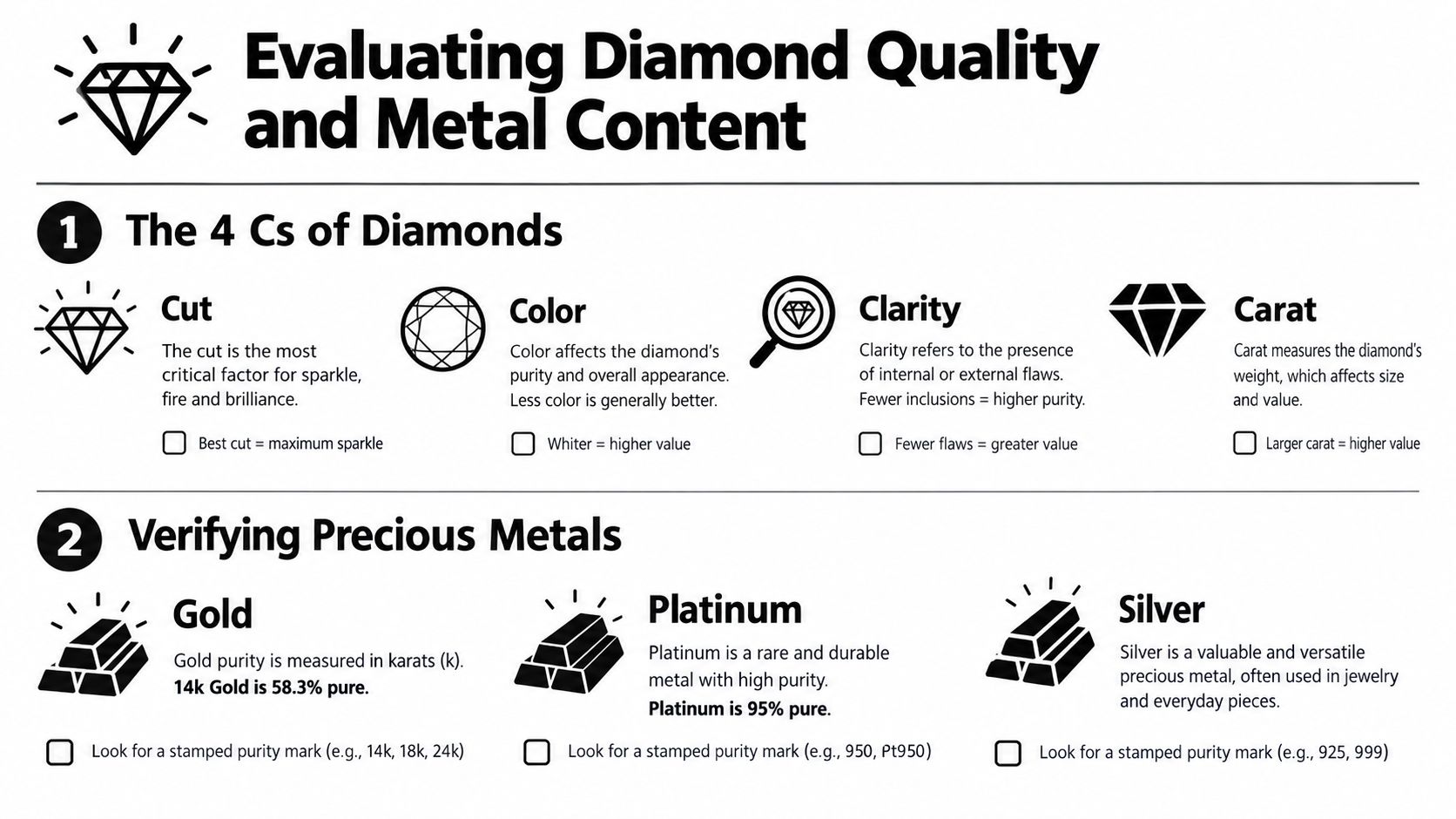
Evaluating Diamond Quality and Metal Content
A diamond gift should be judged by its report and its appearance, not by carat weight alone. The Gemological Institute of America explains that cut reflects proportions, symmetry, and polish, which control brightness, fire, and scintillation. For a standard round brilliant, GIA's scale runs from Excellent to Poor and considers components including face-up appearance, weight ratio, girdle thickness, symmetry, and polish.
Read the report in the right order
Start with cut. A well-cut, slightly smaller diamond can look more lively than a heavier stone with weak light performance. View it under diffused, spot, incandescent, and natural lighting, then tilt it and inspect whether bright and dark areas appear evenly distributed.
Next, compare color and clarity. GIA's diamond buyer guidance describes color on a controlled D-to-Z scale and clarity at 10× magnification, based on inclusions and blemishes. Fluorescence is recorded separately as None, Faint, Medium, Strong, or Very Strong. Don't reject a stone because it has fluorescence. Examine it face-up under several lighting conditions, especially if the fluorescence is strong.
A practical sequence is:
- Compare stones with similar cut and carat weight.
- Choose the lowest clarity grade that looks eye-clean at normal viewing distance.
- Match the color grade to the mounting metal.
- Keep the grading report and sales paperwork with the gift.
For a design-led option, buyers can also review a specialist guide to flower diamond rings, then apply the same report-based checks to the individual stone.
The ECI guide to diamond clarity and color can help you translate the report into a practical buying decision.
Verify the metal
Color alone doesn't tell you whether a piece is solid gold, an alloy, plated, or another material. Federal Trade Commission jewelry guidance says sellers must represent metallic content, quality, quantity, size, weight, durability, serviceability, origin, and price truthfully. Look for paperwork that identifies the metal and its content.
For diamonds and other gemstones, the FTC consumer guide explains that cut, color, clarity, and carat weight describe different attributes. A larger carat weight doesn't automatically mean a better-looking stone. Confirm treatments, origin details, care requirements, and stone weight when those details matter to the purchase.
Comparing Fine Jewelry and Luxury Watches
The choice between a diamond gift and a pre-owned luxury watch comes down to how the recipient lives. Fine jewelry offers direct personalization through stones, metal, engraving, and symbolism. A watch offers daily utility, mechanical interest, and a format that can be worn for work, travel, weddings, and anniversaries.
Pre-owned luxury watches also deserve a more careful value conversation. Some classic models tend to hold value because buyers recognize the design, the manufacturer, the condition, and the availability of supporting documentation. That isn't a promise of appreciation. It's a reason to prioritize an authenticated, serviceable, well-documented piece over a fashion watch chosen only for its logo.
The RealReal 2025 Resale Report found that 47% of consumers consider resale value before buying new. It also reported a 17% increase in resale value for Rolex Datejust models and a 20% increase for Van Cleef & Arpels Alhambra jewelry. Those figures don't predict what an individual gift will sell for, but they support a useful principle: classic design and strong documentation can preserve options.
| Feature | Fine Diamond Jewelry | Pre-Owned Luxury Watches |
|---|---|---|
| Best for | Engagements, anniversaries, family milestones, and personal symbolism | Daily wear, wedding gifts, major birthdays, and collecting |
| Personalization | Diamond shape, metal, setting, engraving, or birthstone | Dial, case size, bracelet, brand, and model |
| Main fit concern | Ring circumference and bracelet length | Bracelet adjustment and case comfort |
| Documentation | Grading report, metal details, receipt, and care information | Authenticity documentation, service records, box, papers, and receipt |
| Future flexibility | Can be passed down, worn, resold, or redesigned | Can be worn, serviced, traded, resold, or passed down |
Before buying a watch, ask whether the original box and papers are included, whether service history is available, and whether the condition is clearly documented. Our article on why luxury watches can be a sensible value decision offers additional context without treating any watch as a guaranteed investment.
Personalizing the Gift Without Sizing Risks
Ring size is the most common mechanical problem in surprise jewelry gifting. An incorrect size can force an exchange, delay engraving, or make a customized piece harder to return. Online returns were estimated at 19.3% of online sales in 2025, compared with 15.8% of total retail sales, according to the cited returns analysis. Size-dependent gifts deserve extra caution.
Use a lower-risk format
If you can't discreetly measure a ring, choose a piece that doesn't depend on exact circumference:
- Necklace: A pendant gives you room to personalize with a birthstone, initial, or meaningful motif.
- Earrings: Studs and hoops avoid ring-size problems and suit recipients who wear jewelry regularly.
- Bracelet: An adjustable design reduces fit risk. A fixed tennis bracelet requires more care.
- Open ring: This can offer some flexibility, though it still needs a comfortable starting fit.
- Watch: A bracelet can often be adjusted, but confirm the available links and the recipient's wrist preference.
A birthstone creates meaning without requiring a ring measurement. GIA's birthstone reference identifies diamond for April, ruby for July, sapphire for September, and opal or tourmaline for October. Sapphire also appears in many colors, so a September gift doesn't have to be blue.
Practical rule: If the surprise matters more than the exact format, give the recipient a size-independent piece first and choose a fitted ring together later.
If you're buying a ring
Borrowing an existing ring can help, but use a ring worn on the same finger. Ring systems differ internationally. ISO ring-size information describes standard sizes through inner circumference in millimeters, while U.S. sizing uses a different numbering system. Convert the measurement before ordering.
The safest ring styles for later adjustment are usually those with enough plain metal in the band. Eternity bands can be difficult or impossible to resize because stones continue around the circle. Wait to engrave until the fit is confirmed, and read the exchange policy before ordering a customized or altered piece. Our guide on how to measure ring size at home covers discreet measurement methods.
Financing Options and Securing the Purchase
A high-value gift should fit the buyer's finances without obscuring the total cost. ECI Jewelers offers financing through Affirm, Synchrony, Acima, and Snap Finance, with approval and terms set by each provider. Review the full agreement, payment schedule, fees, and purchase conditions before choosing a plan through ECI's financing and leasing options.
Payment is only one part of securing the purchase. Keep every document that describes what you bought and how it was evaluated.
- Diamond report: Retain the laboratory report and confirm that its details match the stone.
- Sales paperwork: Keep the receipt, metal description, stone information, and care instructions.
- Packaging: Save the original box, papers, tags, and service records where applicable.
- Condition record: Photograph the piece when you receive it, especially if the gift may later be insured, serviced, traded, or passed down.
This paperwork protects clarity years later. It helps the recipient identify the item, explain its materials, and demonstrate provenance if they eventually resell or trade it. For a watch, ask about condition, service history, and included accessories before checkout. For jewelry, confirm sizing, metal content, treatments, and the rules for customized pieces.
Our guide to jewelry financing options can help you compare the available routes. Whether you shop online or visit the New York City showroom, make the final choice only after the item, terms, documentation, and fit policy are clear.
Frequently Asked Questions
A gift should look good on day one and still make sense years later. That means choosing pieces that are easy to wear, easy to document, and easier to resell or trade if life changes.
What jewelry gift is safest when I don't know the recipient's size?
Choose earrings, a necklace, a pendant, or an adjustable bracelet. Those options remove most fit risk and still feel personal. If you want to give a ring, measure one they already wear on the correct finger. Avoid full eternity bands and close-fitting wedding bands unless you know the size is right, because resizing can be limited or impossible.
Is cut more important than diamond carat weight?
Yes. For visible sparkle, prioritize cut over increasing carat weight. GIA evaluates cut through proportions, symmetry, polish, and overall appearance, so a well-cut diamond often looks brighter and more lively than a heavier stone with weaker light performance.
What should I keep for future resale or trade-in?
Keep everything. Save the grading report, receipt, metal details, original packaging, and service records. For a pre-owned watch, the box and papers help support identification, while a clear record of condition and service history gives the next buyer more confidence and protects value.
Can every ring be resized?
No. Rings with enough plain metal are often adjustable, but full eternity bands and heavily detailed designs may allow little or no sizing change. Confirm the store's sizing policy before engraving or altering the piece, because custom work can affect exchange options.
How do I check a pre-owned luxury watch before gifting it?
Ask for the reference, condition, service history, and everything included in the sale. Then compare the watch's identifying details against its paperwork. Choose a seller that states these facts clearly instead of hiding behind vague authenticity claims.
ECI Jewelers offers fine diamond jewelry, wedding bands, gold pieces, and pre-owned luxury watches for anniversaries, weddings, birthdays, and holiday gifting. Browse the selection or visit ECI Jewelers to choose a meaningful piece with sizing, documentation, and payment options in mind.


