


Getting the right ring size is the first—and most important—step to finding a piece you’ll love to wear. The good news? You don't always need a trip to the jeweler to figure it out. The most reliable ways to measure your ring size at home often just require a simple strip of paper or a piece of string to get your finger’s circumference.
This guide will give you the confidence to get it right, ensuring your next jewelry purchase is a perfect fit from the very beginning.
Your Guide to a Perfect Ring Fit at Home
Knowing your ring size is critical, whether you're browsing for yourself or planning a surprise for someone special. An accurate measurement is the only thing standing between a perfect fit and the disappointment of a ring that’s too tight or, even worse, one that could slip off. An ill-fitting ring isn't just uncomfortable; it can be risky to wear and might even lead to costly resizing down the road.
Luckily, learning how to measure ring size at home is surprisingly straightforward. You can get a very accurate result with a few common household items, which takes the guesswork out of online shopping and boosts your confidence.
Why an Accurate Measurement Matters
A correct measurement does more than just ensure comfort—it protects your investment. Some of the most beautiful ring styles, like eternity bands with diamonds wrapping all the way around, often can't be resized at all. For these intricate designs, you have to get it right the first time.
A proper fit also makes sure the ring sits correctly on your finger, preventing it from spinning or looking off-center. This is especially true for designs with a distinct top, like most engagement rings.
Taking just a few minutes to measure accurately can save you weeks of waiting for a resize and the potential costs involved. It's a small effort for a significant reward: a perfect fit.
If you’re shopping for a gift, getting the size right is everything. Once you have that number dialed in, you can confidently explore a beautiful selection of watches and jewellery for her and find the perfect piece.
We'll walk you through several simple methods, from the classic string technique to printable sizers, so you can measure with precision. By the end, you'll understand the common pitfalls and nuances of sizing, fully prepared to select from a beautiful collection of rings that feel like they were made just for you.
Mastering the String and Paper Methods
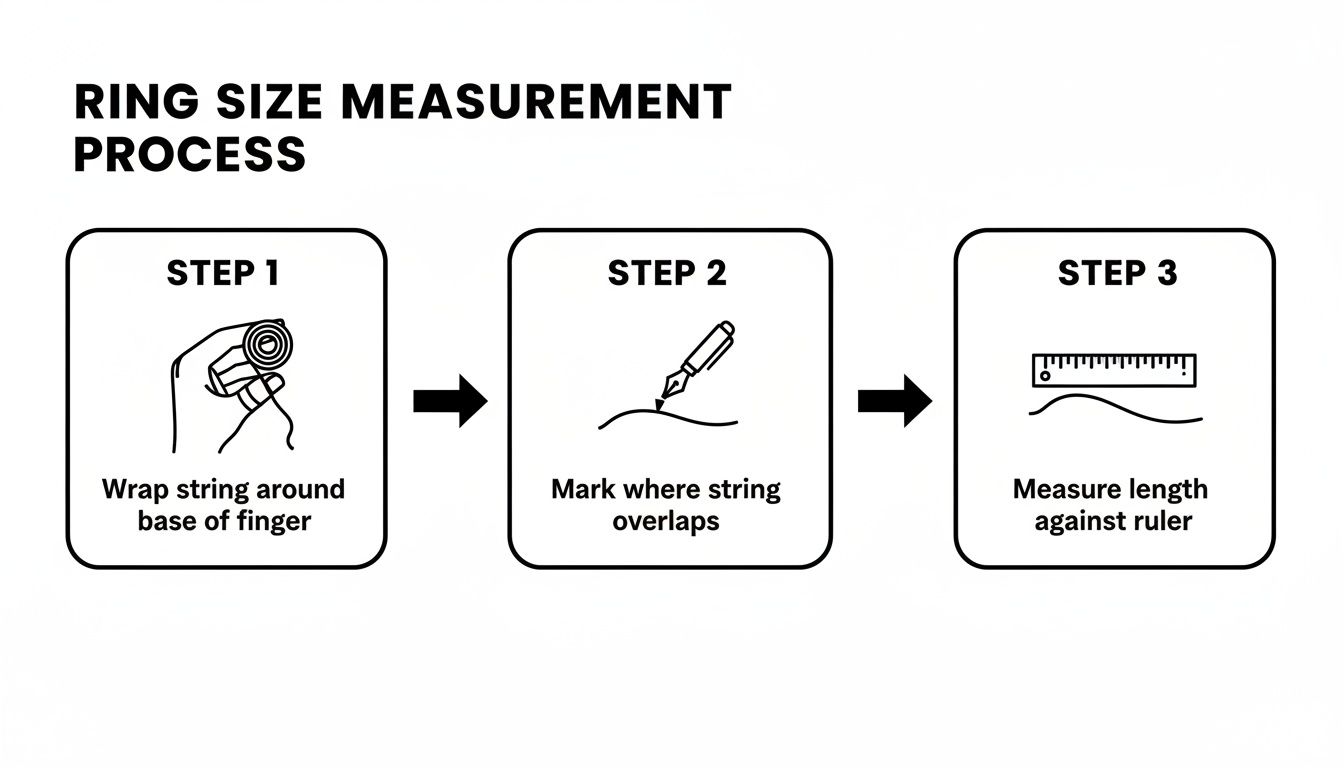
The string or paper strip method is a classic for a reason—it’s accessible, straightforward, and gives you a surprisingly solid starting point for finding your ring size. The real secret, though, is in the details. For this technique, you’ll want to grab something that doesn't stretch, like a thin ribbon, dental floss, or a narrow strip of paper.
Wrap your chosen material snugly around the base of your finger, right where the ring will actually sit. It needs to be firm, but not so tight that it’s digging into your skin. You're trying to mimic how a real ring would feel: secure enough that it won't fall off, but loose enough to slide over your knuckle without a struggle.
Once you’ve got a comfortable fit, use a fine-tip pen to carefully mark the exact spot where the end overlaps. Precision here is non-negotiable; being off by even a single millimeter can easily throw your size off by a half-size or more. After marking, unwrap the string or paper and lay it flat against a ruler. Measure the length from the end to your mark in millimeters (mm).
Turning Your Measurement into a Ring Size
Now that you have your finger's circumference in millimeters, it’s time to convert it into a standard ring size. Getting this right is absolutely crucial. Industry reports show that a staggering 60% of rings bought online are sent back because of sizing issues.
For instance, a measurement of 57mm typically corresponds to a US size 8. To help you translate your measurement, we’ve put together a handy conversion chart.
For context, the average ring size for women in the US falls between a 6 and 7, while for men, it’s usually between 9 and 10. While these are interesting benchmarks, your personal measurement is the only number that truly matters. You can discover more insights about jewelry industry sizing trends to see how you compare.
International Ring Size Conversion Chart
Shopping for a ring from an international jeweler? This table helps you convert your measurement in millimeters (circumference) to standard US, UK, and EU ring sizes, ensuring you can shop globally with confidence.
| Circumference (mm) | US & Canada Size | UK & Australia Size | EU Size |
|---|---|---|---|
| 49.3 | 5 | J 1/2 | 49 |
| 50.6 | 5.5 | K 1/2 | 51 |
| 51.9 | 6 | L 1/2 | 52 |
| 53.1 | 6.5 | M 1/2 | 53 |
| 54.4 | 7 | N 1/2 | 54 |
| 55.7 | 7.5 | O 1/2 | 56 |
| 57.0 | 8 | P 1/2 | 57 |
| 58.2 | 8.5 | Q 1/2 | 58 |
| 59.5 | 9 | R 1/2 | 59 |
| 60.8 | 9.5 | S 1/2 | 61 |
| 62.1 | 10 | T 1/2 | 62 |
| 63.4 | 10.5 | U 1/2 | 63 |
| 64.6 | 11 | V 1/2 | 65 |
| 65.9 | 11.5 | W 1/2 | 66 |
| 67.2 | 12 | X 1/2 | 67 |
Once you've found your corresponding size, you're one step closer to the perfect fit. But don't stop there—a few extra checks can save you a lot of trouble later.
Pro Tip: Your fingers swell and shrink throughout the day due to temperature, hydration, and even what you've eaten. For the most reliable reading, measure your finger at the end of the day when it’s likely to be at its largest and at room temperature.
For total confidence, it’s always best practice to measure your finger three separate times on different days or at different times of the day. If you get slightly different numbers, just take the average to find your most accurate fit. Think of it as a safety net against those daily fluctuations.
Using a Printable Ring Sizer for Better Accuracy
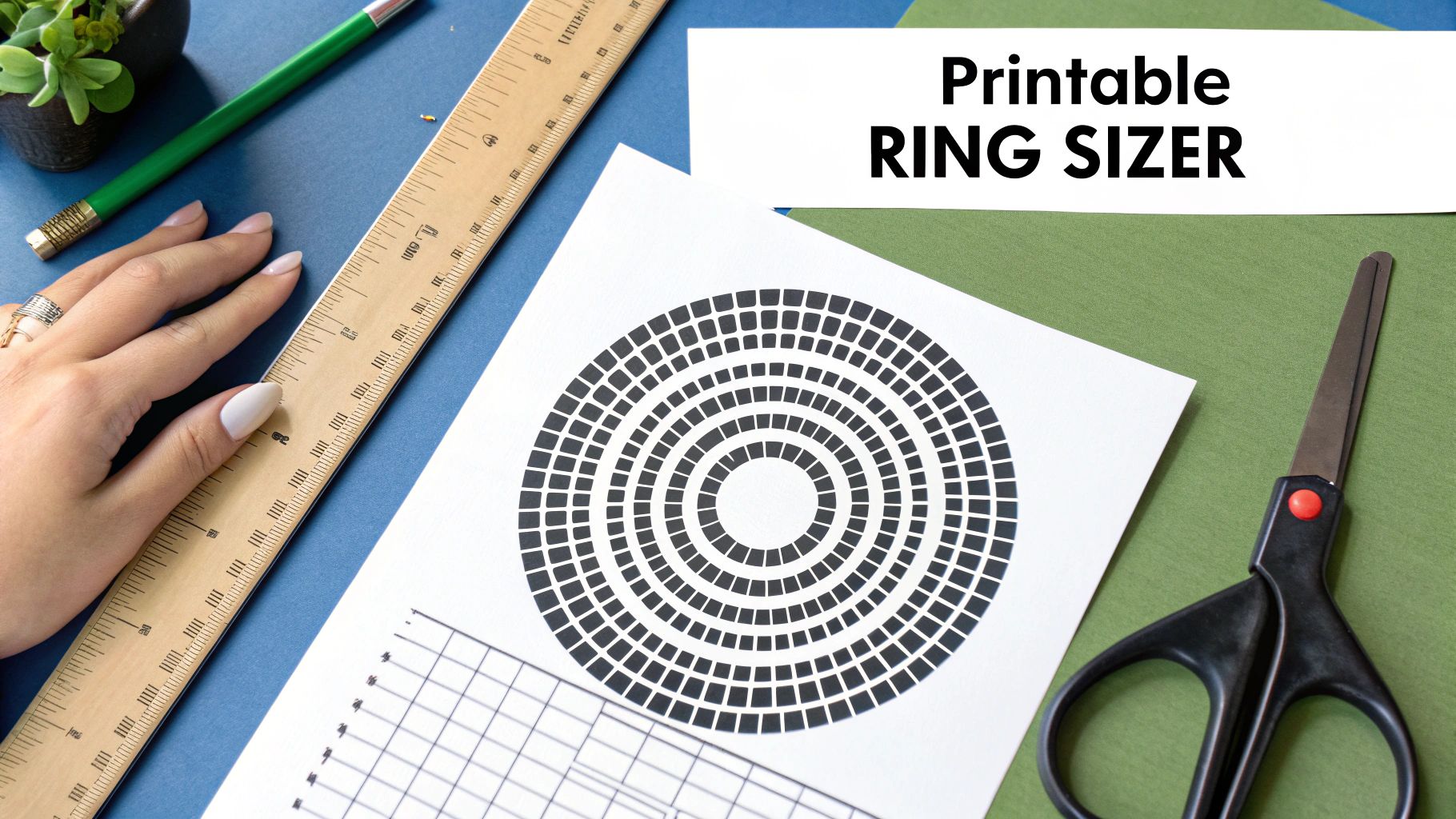
If the string method feels a little too much like guesswork, a printable ring sizer is your next best bet. This is a big step up in precision and one of the best ways to measure your ring size at home. It’s like bringing a small piece of a jeweler's toolkit right to your desk.
You’ll typically find two kinds of printable sizers online. One is a paper strip with sizes already marked on it—you just cut it out and wrap it around your finger. The other is a chart filled with circles, each representing a different ring size, which you use with a ring you already own.
Getting the Print Settings Just Right
This part is absolutely critical. If your printable sizer isn't printed at the correct scale, every measurement you take will be wrong. This is the single most common mistake people make, and it throws everything off.
Before you hit print, dive into your printer settings. Look for an option like "Page Sizing & Handling" and make sure it’s set to 100% scale, "Actual Size," or "Do Not Scale." Any setting like "fit to page" will automatically shrink the image, making your sizer useless.
After it's printed, grab a real ruler. Every printable sizer should have a measurement guide on the page itself. Check that one inch on the paper actually measures one full inch. If it doesn't line up perfectly, you need to go back, tweak your settings, and print again. If you downloaded the sizer as an image file, it can sometimes help to convert image to PDF first for more reliable printing results.
Using the Two Types of Printable Sizers
Once you have an accurately printed sizer, you’re ready to measure. Depending on what you have on hand, one of these methods will work perfectly.
The Cutout Sizer Strip
This is a more precise version of the paper strip method because the sizes are clearly marked for you.
- Carefully cut out the sizer along the lines, including the small slit on one end.
- Wrap the strip around the base of your finger with the numbers facing out.
- Feed the pointed end through the slit you cut earlier.
- Pull it gently until it’s snug. It should feel like a real ring—not too tight, but secure enough that it can still slide over your knuckle with a little effort.
- The number the arrow points to is your ring size. Simple as that.
The Ring Sizing Chart
This method is brilliant if you already have a ring that fits perfectly on the finger you’re sizing for. It’s also the best way to secretly figure out a partner's ring size for a surprise.
- Take their ring and lay it flat over the circles on your printed chart.
- Find the circle that matches the inside edge of the ring exactly.
- You’ve found the right size when the printed circle is perfectly visible just inside the ring, with no white space showing between the metal and the line.
Common Sizing Mistakes and How to Avoid Them
Even with the right tools, figuring out your ring size at home can be surprisingly tricky. A few tiny variables you might not even think about can throw off your measurement, leading to a ring that's just not right. Think of this as your field guide to dodging the most common pitfalls so you can measure with confidence.
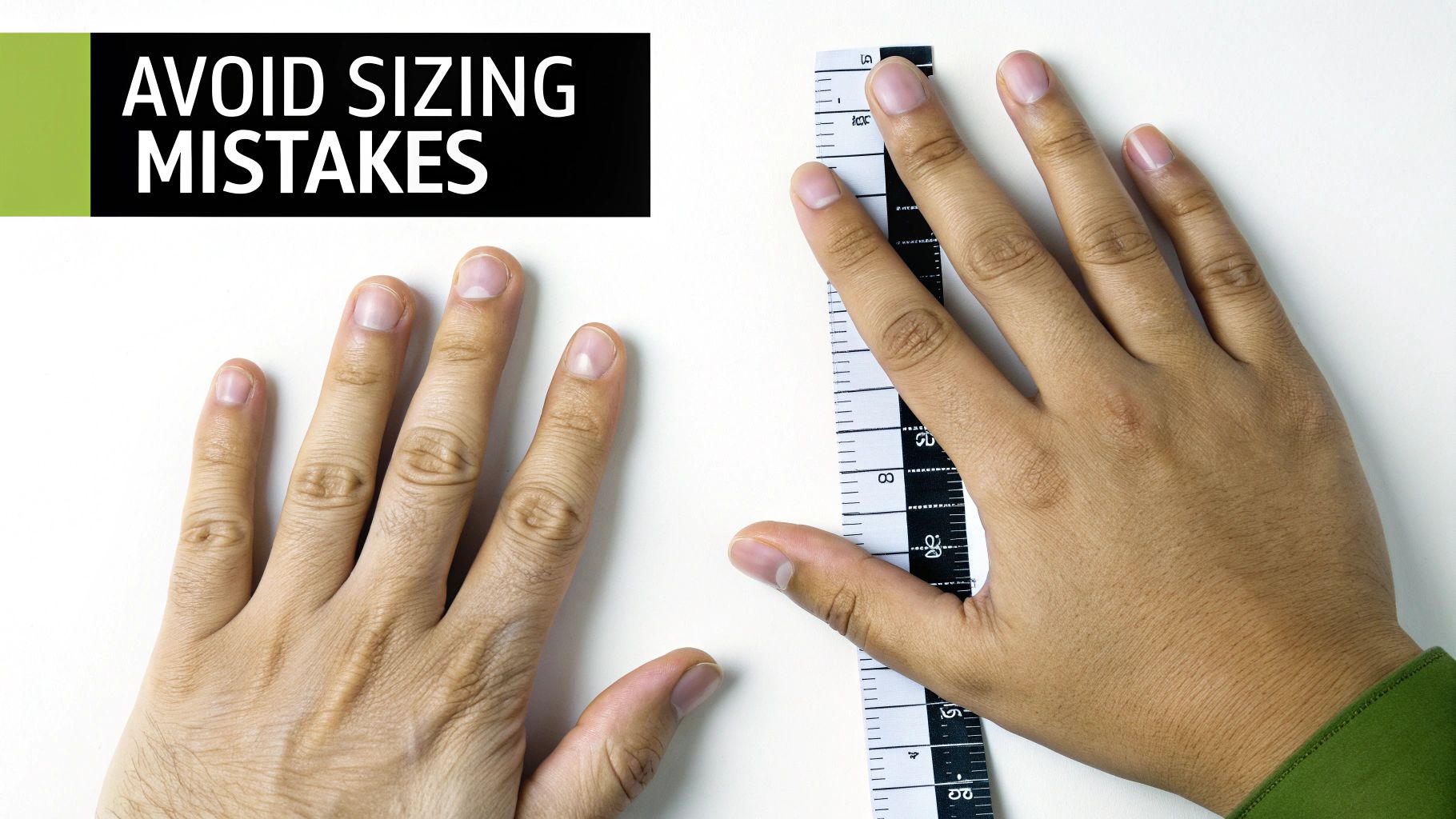
One of the biggest culprits behind a bad measurement? Your own body. Your fingers can swell and shrink throughout the day, sometimes by as much as half a ring size.
The Problem with Timing and Temperature
Your fingers naturally swell in the morning, after a workout, in warm weather, or even after a salty meal. On the flip side, they'll shrink when you're cold or dehydrated. Measuring at these times will give you a misleading reading that’s either too big or too small for everyday wear.
For the most accurate result, measure toward the end of the day when your body temperature is stable and your fingers are at their largest. This simple step ensures your ring will still feel comfortable even when you experience that normal, slight swelling.
A ring that feels perfect in a cold room might become uncomfortably tight after you've been walking around on a warm day. Always measure when you're calm and at a comfortable room temperature to get a true baseline.
Navigating Knuckle Size Challenges
Plenty of people have knuckles that are wider than the base of their finger. It’s a common issue that creates a sizing puzzle: you need the ring to be large enough to slide over the knuckle, but not so loose that it spins around once it’s on.
If this sounds like you, the trick is to measure both the base of your finger and your knuckle. The right size is usually a compromise between these two numbers. You're looking for a size that needs a gentle twist to get over the knuckle but then sits comfortably without spinning.
Why the Width of the Ring Band Matters
A detail that's very easy to overlook is the width of the ring band itself. It makes a huge difference. A wider band covers more skin, which creates more friction and a much snugger fit. A delicate, skinny band of the exact same size will feel noticeably looser.
Here’s a simple rule of thumb we use all the time:
- For narrow bands (under 3mm): Stick with your true measured size.
- For standard bands (3mm to 6mm): Your measured size should be spot on.
- For wide bands (over 6mm): You should almost always size up by a quarter to a half size.
Forgetting this is how people end up with a beautiful, wide wedding band they can barely squeeze on. Always keep the style of the ring in mind when you're measuring—it's a small adjustment that has a massive impact on comfort.
Sizing Tips for Different Types of Rings
You'd be surprised how much a ring's style can change the way it fits. A measurement is a great starting point, but it's not the whole story. Specialized designs, intricate patterns, and even the ring's interior profile all play a part in finding that perfect, comfortable fit.
One of the biggest game-changers you'll run into is the comfort fit band. Unlike a standard ring with a flat inside, a comfort fit band is slightly domed. This curve means less metal actually touches your skin, letting it glide over your knuckle more easily and sit more gently on your finger.
Because of this unique design, a comfort fit ring often feels looser than a standard one of the very same size. That's why we usually recommend sizing down by a quarter to a half size for a secure fit. So, if a standard sizer says you're a size 9, you'll likely find an 8.5 or 8.75 is the sweet spot for a comfort fit. To see how this works with different styles, take a look at our guide on how to choose a wedding band where we dive deep into band profiles.
Sizing for Rings That Cannot Be Resized
Some rings are a one-shot deal. Once they’re crafted, that’s it—the size is final. Trying to alter them would ruin the entire design, so getting it right the first time is absolutely critical.
- Eternity Bands: With a continuous circle of gemstones, there’s simply no place to cut and resize without breaking the pattern and compromising the stone settings.
- Intricate Engravings or Patterns: Think Celtic knots or detailed milgrain that wraps all the way around. Sizing would create an ugly, obvious gap, destroying the seamless look.
For these "forever-sized" rings, we can't stress this enough: get sized by a professional. The precision of a jeweler’s tools is the only way to guarantee a perfect fit when there are no second chances.
When buying a ring that can't be resized, you're not just buying a piece of jewelry; you're committing to a specific size. Taking the extra time to confirm your measurement with a professional protects your investment and ensures a lifetime of comfortable wear.
Tips for a Surprise Engagement Ring Purchase
Figuring out your partner's ring size on the sly is a time-honored tradition—and a bit of a challenge. The classic move is to borrow a ring they already wear and measure it, but that only works if they happen to wear it on their ring finger.
A better way? Enlist a trusted friend or family member. A close friend could casually suggest trying on rings for fun while out shopping and sneakily take note of the size that fits. It’s a great way to get an accurate measurement without blowing the surprise.
If you absolutely have to guess, it's always safer to go slightly larger. Sizing a ring down is a much simpler job for a jeweler than sizing it up, especially for classic solitaire diamond rings where the band is easier to work with.
When to Get a Professional Ring Sizing
While the DIY methods are a fantastic starting point, there are certain times when you absolutely need the precision of a professional jeweler. Think of it this way: at-home measurements give you a great estimate, but a professional fitting gives you certainty.
For those once-in-a-lifetime purchases—like an engagement ring or a diamond eternity band that can't be resized—an expert fitting isn’t just a good idea. It's essential for your peace of mind.
The Tools of the Trade
You won’t find a jeweler using a piece of string or a strip of paper. We use finely calibrated, professional-grade tools designed for one purpose: accuracy. A sizing set includes a complete gradient of metal rings, including quarter sizes, so you can feel the exact fit on your finger.
This hands-on experience is critical because it accounts for the unique shape of your finger and the size of your knuckle in a way no at-home method can replicate.
An expert also uses a ring mandrel, which is a tapered, marked metal cone, to verify the size of an existing ring with absolute precision. This process eliminates all the variables that can throw off a DIY measurement, like a string being pulled too tight or paper stretching.
A professional measurement removes all guesswork. When investing in a piece of fine jewelry, this level of certainty ensures your purchase is perfect from day one, with no need for costly and time-consuming adjustments.
If you’re considering a significant purchase or simply want guaranteed accuracy, we invite you to book an appointment with our specialists at ECI Jewelers. We'll provide a complimentary, precise sizing to ensure your next treasured piece fits flawlessly.
Frequently Asked Questions About Ring Sizing
Even after you’ve measured carefully, a few common questions always seem to come up. Getting these details right will give you the confidence that your measurement is spot-on, ensuring you end up with a ring that feels just right.
Think of this as a final check to clear up any lingering doubts before making a commitment.
Should My Ring Feel Tight or Loose?
A perfectly sized ring is all about finding that sweet spot. It needs to be snug enough that you’re never worried about it flying off during daily tasks, but still loose enough to slide over your knuckle with a bit of a twist.
The ring should make gentle, consistent contact with your skin all the way around without digging in. If it leaves a deep mark or feels like it’s squeezing your finger when your hands are a little warm, it’s probably too tight. A good test? It should take a little effort to get it off, but it shouldn’t feel stuck.
Is My Ring Size the Same on Both Hands?
This is a common misconception, but your ring size is almost never the same on both hands. For most people, the fingers on their dominant hand are a touch larger—often by about half a size. This small difference comes from the slightly greater muscle and bone density developed from everyday use.
Because of this, you have to measure the exact finger on the exact hand you plan to wear the ring on. For engagement and wedding rings, that’s traditionally the fourth finger of the left hand. A measurement from your right hand just won't be accurate for your left.
An accurate measurement is finger-specific and hand-specific. Always measure the finger that will wear the ring to avoid any sizing surprises.
What if I Am Between Two Ring Sizes?
It's incredibly common to land somewhere between two standard sizes, leaving you wondering which to choose. When you’re stuck in the middle, the safest move is almost always to choose the slightly larger size.
Why? A jeweler can typically size a ring down fairly easily by removing a tiny piece of the band and seamlessly rejoining it. Sizing a ring up, however, is a much tougher job. It’s more complex, costly, and sometimes not even possible without compromising an intricate design or a band set with stones. This is especially true for wider bands (6mm or more), which already feel much snugger than thinner rings of the same size.
For a guaranteed perfect fit or for help sizing an important ring, the experts at ECI Jewelers are here to assist. Visit our New York City showroom for a professional, complimentary sizing and explore our collection of fine jewelry.
Find your perfect piece today at https://www.ecijewelers.com.


