


A marquise diamond is an elongated, boat-shaped brilliant-cut that gives you strong face-up size and a vintage, flattering silhouette. If you choose it well, it can look larger than other shapes of the same weight, but the real trick is judging the bow-tie and protecting the pointed ends before you buy. That's the part most shoppers miss, and it's where money gets wasted. We're going to show you how to read the shape, spot weak light performance, and choose a setting that doesn't leave the tips exposed.
What makes a Marquise diamond unique
You're probably looking at a marquise because you want a ring that feels different without feeling strange. A marquise diamond is a long, pointed brilliant shape that spreads across the finger and gives you more visual presence than its carat weight suggests. That face-up spread is the big draw, and it's why the shape has stayed appealing for buyers who want drama without a bulky stone.
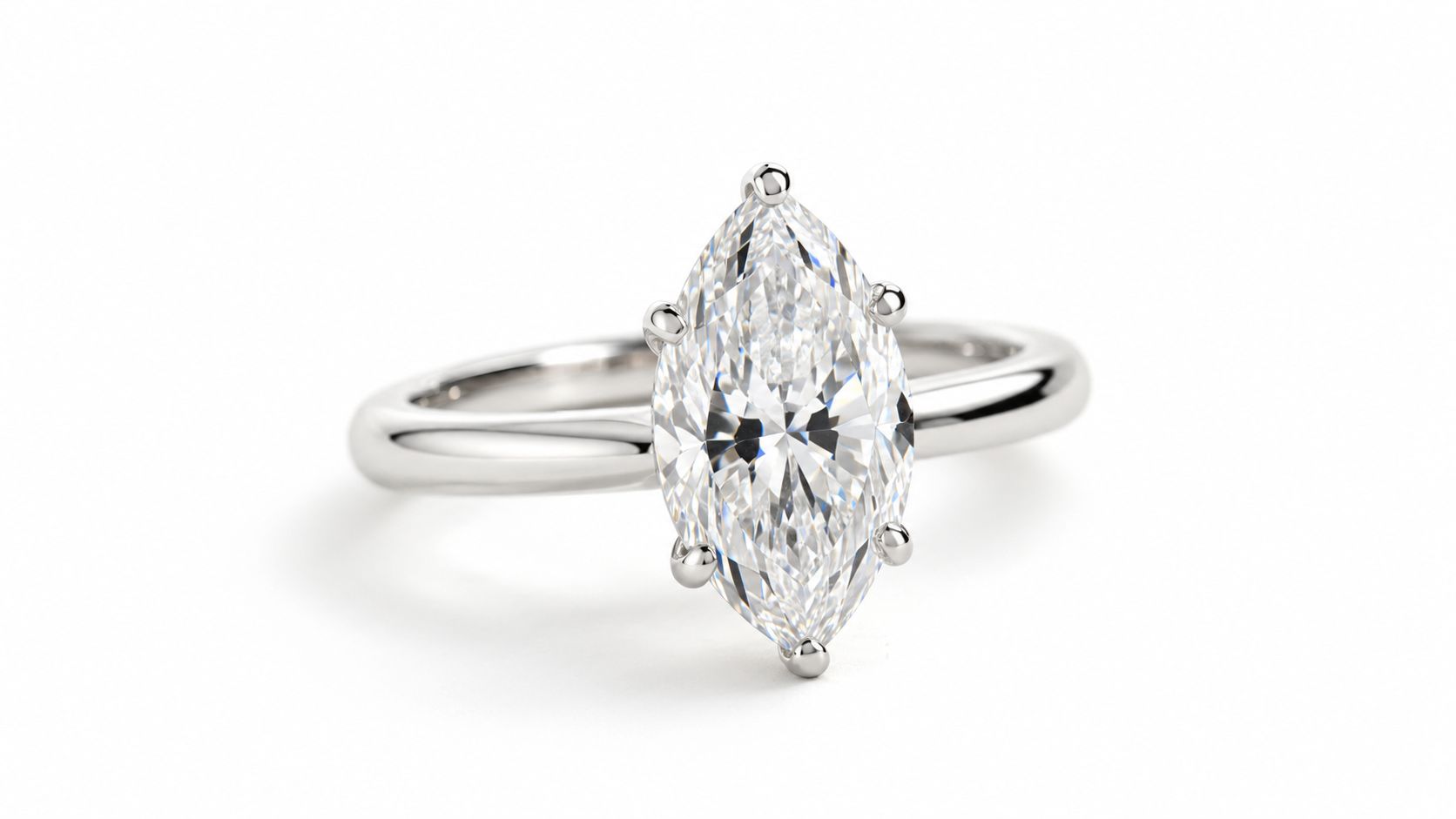
The silhouette does two jobs at once. It makes the stone look larger on the hand, and it gives the ring a vintage line that reads as elegant instead of common. If you want a quick starting point for shape browsing, we'd begin with our diamond shape guide and then come back to marquise once you understand how it sits visually beside round, oval, and pear cuts.
What to notice first
- Length: The stone should look elongated, not stretched thin.
- Points: Both ends need to feel intentional, not fragile or sloppy.
- Center line: Your eye should travel smoothly through the middle of the diamond.
A good marquise feels balanced. A bad one looks narrow, uneven, or dark in the middle. That's why shape matters more here than a lot of first-time buyers expect.
History and popularity of the Marquise Cut
The marquise has old-world roots, and that history is part of the appeal. Jewelry-industry accounts commonly trace the cut to 18th-century France, with approximately 1745 tied to King Louis XV and the Marquise de Pompadour connection, which helped establish the elongated shape as a luxury style rather than a simple round variation OM Jewels Inc.. That origin story still shapes how people read the ring today. It feels romantic because it was built that way.
The style didn't stay frozen in the past. Geometric marquise motifs showed up again during the Art Deco era of the 1920s, and the shape became especially visible in engagement jewelry during the 1970s and 1980s OM Jewels Inc.. Celebrity visibility helped too, including Norma Shearer's marquise engagement ring in 1927 OM Jewels Inc.. Those touchpoints are why marquise still reads as vintage, glamorous, and a little less expected than the usual suspects.
Why the shape keeps coming back
- It looks distinctive: The pointed ends stand out immediately.
- It fits vintage tastes: Art Deco and revival styles still influence buyers.
- It feels less ordinary: People who want a ring with personality keep circling back to it.
The market side matters as well. The Knot's engagement-ring data places marquise shapes at about 5% of center stones, up from roughly 2% between 2015 and 2025, while BriteCo's multi-year appraisal data recorded 4.7% in 2019 and 4.5% in 2020, compared with round diamonds at 57.0% and 54.6% in those years respectively The Knot. That tells us marquise isn't mainstream, but it isn't obscure either. It's a deliberate choice.
Practical rule: If you want a ring that feels classic without looking like everyone else's, marquise is one of the few shapes that does that cleanly.
How to choose the perfect Marquise proportions
The first thing to judge is the outline, not the label on the grading report. GIA notes that approximately 2:1 is a common length-to-width proportion for marquise diamonds, and the two halves should mirror each other with points that align GIA. That symmetry matters more than most shoppers realize. A marquise can be bright and still look off if the sides don't match.
What proportions actually do
A narrower stone feels sleeker. A broader one feels fuller and a little more traditional. We'd look at stones in the 1.75:1 to 2.25:1 range, then judge which outline looks best on the hand rather than chasing a number for its own sake GIA. The right ratio is the one that gives you elegant length without making the diamond feel needle-thin.
Protect the points, too. A very long, narrow outline can be more vulnerable, and an extremely thin girdle raises chipping risk, especially near the tips GIA. Slightly greater girdle thickness at the points is acceptable, because those areas take the most abuse. If the seller can't explain how the ends are protected, keep moving.
Buy with the setting in mind
- Choose V-shaped prongs: They shield the points better than standard prongs.
- Inspect under magnification: Look for chips, fractures, or inclusions near either tip.
- Ask about French tips: This faceting style can reinforce the ends while adding sparkle Gems Society.
If you want to compare proportions visually, our diamond cut guide is the right next stop. It helps you judge the cut style as a whole instead of treating the shape as a static outline.
Understanding the Bow-Tie Effect in Marquise Diamonds
The bow-tie is the part of marquise buying that trips people up most often. It's the dark band that can appear across the center of the stone when face-up, and it comes from the shape's elongated geometry and facet arrangement, not from color or clarity alone GIA. You can't grade your way out of it. A prettier certificate doesn't fix a poor light pattern.
What matters is how the stone looks in real lighting. GIA notes that elongated fancy shapes can produce bow ties and crushed-ice regions across many proportion combinations, and that the visible effect changes with viewing angle, lighting, and facet alignment GIA. That's why a lab report alone won't tell you enough. If you're buying by video, ask for diffused light, spot light, and normal viewing distance, then watch the stone as it moves.
How we'd inspect one before buying
- Hold it face-up first. Look for a lively center, not a dead strip.
- Tilt the stone slowly. A faint dark area that comes and goes is normal.
- Check from a few distances. A shadow that dominates at arm's length is a problem.
- Compare it against nearby stones. Two marquise diamonds with similar grades can look very different.
A slight bow tie can be fine if the diamond still looks bright and active from normal viewing distance.
That's the part shoppers overthink. You do not need a perfectly invisible bow tie. You need a stone that stays alive in real life. If you want a deeper primer on the broader grading conversation, our diamond clarity and color guide helps separate real visual problems from paper grades that sound scarier than they are.
Best Settings and Styles for Marquise Rings
The setting should protect the ring first and flatter the shape second. Start with the tips, because those are the weak points. GIA notes that protective V-prongs or another setting that securely covers the ends can reduce snagging and chipping risk, and the points deserve that kind of attention on a daily-wear ring Gems Society.
Marquise Setting Styles Comparison
| Setting Style | Best For | Pros | Cons |
|---|---|---|---|
| Solitaire | Buyers who want the shape to do the talking | Clean, classic, easy to read | Shows every proportion flaw and tip issue |
| Halo | People who want more visual presence | Boosts sparkle and frames the outline | Can overwhelm a smaller center stone |
| Three-stone | Buyers who want a fuller, more substantial look | Adds balance and finger coverage | Needs careful scaling so the marquise still stands out |
| East-west | Anyone who wants a modern twist | Bold, unusual, and finger-spreading | Not for everyone's taste |
Metal choice changes the mood, but not the core rule. Platinum and white gold keep the look crisp, yellow gold feels warmer and more traditional, and rose gold leans softer. If the ring will be worn daily, we'd favor a setting that secures the ends without making the stone look boxed in.
If you're comparing custom possibilities, find custom jewelry manufacturers can be a useful reference point for how different makers handle marquise-inspired forms, especially when you're studying settings rather than finished rings. We'd still use that only as a design reference, not as a replacement for seeing how the actual ring protects the points. For more setting ideas, our engagement ring setting styles guide is the better fit.
Practical rule: If the setting leaves the tips exposed, the ring isn't finished.
Sizing, Care, and Sourcing Your Marquise Ring
Sizing a marquise ring is still sizing, but the shape changes how the ring reads on the hand. The stone can be worn with the points running up and down the finger or set east-west, and that choice affects both comfort and visual length. If you want the longest look, keep the points aligned vertically. If you want something lower and a little less traditional, east-west can work well.
Care is plain, not fancy. Check the prongs regularly, clean the ring gently, and keep an eye on the tips after any knock or snag. Because the points are exposed, a loose prong can turn a small issue into a chipped stone fast.
What to check before you buy
- Documentation: The FTC advises getting sales paperwork that lists the diamond's origin, weight or size, treatments, and special-care requirements, and says cut includes proportions, polish, and symmetry FTC.
- Stone identity: Make sure the paperwork matches the actual ring, especially whether it's natural or lab-grown if that's relevant.
- Visual inspection: Don't skip the face-up view. A report won't tell you if the bow-tie bothers you.
That's where working with a jeweler who handles this daily pays off. ECI Jewelers in New York City carries fine diamond jewelry alongside pre-owned luxury watches, and that matters if you want help comparing stones, settings, and paperwork in one place. We also see buyers make the same mistake over and over, they chase size before they check light performance.
Our ring-size guide is useful before you order, especially if you're choosing a style with a taller setting or a more prominent center stone. A ring that fits well and protects the points is the one you'll enjoy wearing.
If you're shopping for a marquise engagement ring and want straight answers instead of sales talk, visit ECI Jewelers and compare the rings and guidance we have in stock. We can help you weigh the shape, the bow-tie, and the setting so you don't overspend on a stone that only looks good in a photo.


