


If you're choosing your first everyday Rolex, the Explorer is the better pick for low-light legibility, clasp security, and tool-watch character. The Oyster Perpetual is the better choice for broader sizing, more dial colors, and a quieter look that works with more wardrobes. Mechanically, neither is superior: comparable current models share Rolex calibre 3230, about 70 hours of power reserve, and 100-metre water resistance.
The real decision in a Rolex Explorer vs Oyster Perpetual comparison isn't sporty versus dressy. It's whether you'll use the Explorer's focused, high-contrast design or prefer the Oyster Perpetual's simpler, more adaptable format. Below we compare history, sizes, movements, daily wear, and what to check when buying pre-owned.
In this article
- Which everyday Rolex fits your wrist and lifestyle?
- How did the Oyster and Explorer lineages diverge?
- What case sizes and dials are available?
- Do the movements and water resistance differ?
- Which watch performs better day to day?
- How do you evaluate a pre-owned example?
- How can you pay for it?
- FAQ
Which Everyday Rolex Fits Your Wrist and Lifestyle?
Buyers who ask us this usually want one watch for work, weekends, and travel. No chronograph, no date, just a reliable three-hand Rolex that feels right every time they look down. Our recommendation:
- Choose the Explorer for a black dial, strong nighttime readability, the recognizable 3-6-9 numerals, and a safety clasp.
- Choose the Oyster Perpetual for more case sizes, more dial colors, and a clean design that moves from a business shirt to casual clothes without drawing attention.
- Choose a 36 mm model for a balanced, traditional wrist presence.
- Choose the Explorer 40 or Oyster Perpetual 41 if you want the watch to take up more visual space.
Neither is the "lesser" Rolex. The Oyster Perpetual is the broader foundation; the Explorer is a specialized expression of it.
Our advice: buy the watch whose useful features you'll notice every week, not the one that sounds more impressive on a spec sheet.
How Did the Oyster and Explorer Lineages Diverge?
Rolex introduced the waterproof Oyster case in 1926 and the self-winding Perpetual rotor in 1931. Combining the two created the Oyster Perpetual concept, the direct ancestor of today's collection (see Rolex's Oyster Perpetual history). The modern model family keeps that idea simple: time only, no adventure-specific markings.
The Explorer arrived in 1953, the year Sir Edmund Hillary and Tenzing Norgay first summited Everest on 29 May. The expedition carried Oyster Perpetual watches, and Rolex positioned the Explorer as its watch for exploration and demanding environments.
That explains the visual split. The Oyster Perpetual is the adaptable ancestor; the Explorer is the purpose-built evolution, with an identity tied to legibility and mountaineering heritage. Dial color shows how much character the OP can carry on its own: a pistachio Oyster Perpetual 41 reads completely differently from a silver one. For more on the collection, see our Rolex Oyster Perpetual guide.
What Case Sizes and Dial Options Are Actually Available?
Case size is where the Oyster Perpetual pulls ahead. Rolex lists the Explorer in 36 mm and 40 mm (Rolex Explorer specifications), while the Oyster Perpetual comes in 28, 31, 34, 36, and 41 mm. That range helps buyers with very small or very large wrists, and makes it easy for couples to wear related watches in different diameters.
| Feature | Rolex Explorer | Oyster Perpetual |
|---|---|---|
| Case sizes | 36 mm, 40 mm | 28, 31, 34, 36, 41 mm |
| Dial | Black, Arabic 3-6-9 numerals | Minimalist, wide color range |
| Movement (current models) | Calibre 3230 | Calibre 3230 (36 and 41 mm) |
| Power reserve | About 70 hours | About 70 hours |
| Water resistance | 100 m | 100 m |
| Clasp | Oysterlock safety clasp | Oysterclasp |
| Date | None | None |
| Primary appeal | Legibility, heritage | Versatility, color, sizing |
Wrist fit should come before dial preference. A watch that overhangs the wrist won't become a favorite because its color is attractive. Our guide to choosing between 36, 39, and 41 mm cases helps narrow fit first. For many buyers, the 36 mm Explorer and 36 mm OP are the sweet spot: same proportion, very different personalities.

In stock: the versatile pick
Rolex Oyster Perpetual 41 Ref. 124300, Silver Dial, 2023
Calibre 3230, 70-hour reserve, box and papers. The silver dial works with almost anything you wear.
$10,500 View the watch →
Do the Movements and Water Resistance Ratings Differ?
Much less than the designs suggest. Current 36 mm and 40 mm Explorers use calibre 3230, and so do the Oyster Perpetual 36 and 41. Rolex specifies about 70 hours of power reserve and Superlative Chronometer precision of -2/+2 seconds per day after casing (Rolex OP 41 brochure). Seventy hours means the watch can sit through a typical weekend and still be running on Monday, if it was fully wound.
Both share Oyster construction, a screw-down crown, a sapphire crystal, 100-metre water resistance, and a time-only dial. That's enough for swimming and everyday use when the crown is secured. The Explorer's advantage isn't a higher rating; it's how the dial and clasp are designed. For more background, see our explanation of different Rolex movements.
Which Watch Performs Better in Real-World Daily Scenarios?
The Explorer earns its place when you need to read the time instantly. The black dial, 3-6-9 numerals, and Chromalight lume are built for contrast in the dark: a dim restaurant, a night flight, an evening walk.
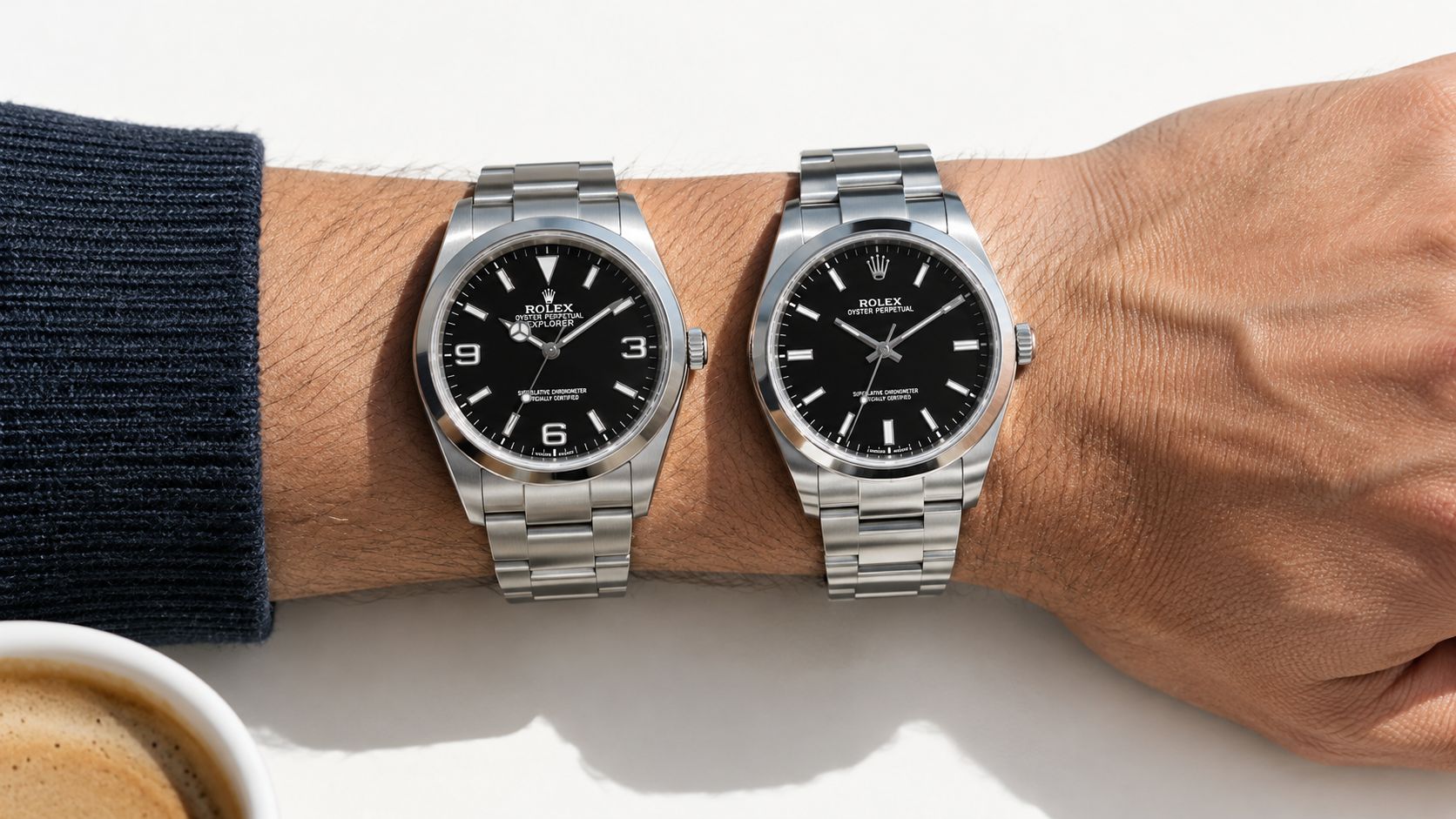
The Explorer also uses an Oysterlock safety clasp, which adds a hinged safety catch to reduce the risk of accidental opening, plus a 5 mm Easylink extension for tool-free fit adjustment. The newer Oyster Perpetual 41 (ref. 134300) also gets a 5 mm Easylink on its Oysterclasp, but no safety catch.
The Oyster Perpetual is no fragile office watch. It shares the water resistance, crystal, and movement above. Its edge is visual flexibility: a restrained three-hand dial under a shirt cuff, with casual clothes, or as part of a matched pair.
Where each model makes more sense
- Low light: Explorer. The numerals and lume give it a clear functional purpose.
- Office: either; choose by dial. The OP's colors add personality without a tool-watch message.
- Travel: either. The Explorer reads better in changing light; the OP blends with more outfits.
- Active use: Explorer, for legibility and the safety clasp.
- Wedding watch: usually the OP, thanks to its size and dial range. Our Rolex wedding watch guide for the groom covers that decision.
Want the Explorer's character with more tool-watch function? The Explorer II adds a 24-hour hand and a 42 mm case. We compare the two in Rolex Explorer 1 vs 2.

In stock: more tool watch
Rolex Explorer II Ref. 226570, Black Dial, 2026
42 mm, 24-hour hand, Oysterlock clasp, box and papers. The Explorer spirit with a second time zone.
$13,900 View the watch →
How to Authenticate and Evaluate Pre-Owned Condition
Judge a pre-owned Rolex by its exact reference, production details, condition, and documentation, not the model name alone. What we inspect first:
- Reference and calibre: case reference, movement, dial, and production year should make sense together. If a listing for a current model names a calibre other than 3230, verify before proceeding.
- Case shape: heavy polishing softens lugs and removes original definition.
- Dial: clean printing, correct lume, no moisture or refinishing.
- Bracelet and clasp: stretch, wear, replaced parts, and clasp function.
- Box and papers: they support the history but never replace inspecting the watch.
Condition rule: prefer honest originality and clear disclosure over a watch polished to look new.
Ask for clear photos of the dial, case sides, clasp, and caseback. Our guide to authenticating a Rolex has a fuller checklist.
How Can You Pay for It?
You can review financing through Affirm, Synchrony, Acima, and Snap Finance on our financing and leasing page; approval and terms are set by each provider. If you own a watch that no longer gets wrist time, our luxury watch trade-in page explains how to submit it toward another purchase. Decide the model and condition first, then compare payment options. More in our article on financing a Rolex.
Frequently Asked Questions About These Rolex Models
Is the Explorer more durable than the Oyster Perpetual?
Not on paper. Both use Oyster construction, screw-down crowns, sapphire crystals, and 100-metre water resistance. The Explorer's practical edge is its legibility and Oysterlock safety clasp.
Does the Oyster Perpetual have a date?
No. Current Oyster Perpetual models are time-only, and so is the Explorer.
Does the 36 mm Explorer look too small on a larger wrist?
It depends on wrist shape and taste. Its bold numerals make it look intentional rather than undersized, but the Explorer 40 or Oyster Perpetual 41 gives more visual weight.
Which model is more versatile for different wardrobes?
The Oyster Perpetual, thanks to more sizes and dial colors. The Explorer is versatile in function, but its black 3-6-9 dial carries a stronger tool-watch identity.
Which one holds value better pre-owned?
Clean examples of both hold value well. The Explorer's consistent design appeals to buyers wanting a defined identity; the OP's color and size range reaches a broader audience. Condition, originality, reference, and documentation matter more than the model name.
Find the Oyster Perpetual That Fits Your Wrist
Browse our pre-owned Oyster Perpetual collection, or ask our team which size and dial suit your routine.
Shop Oyster Perpetual →Financing and luxury watch trade-ins available.


