


So, you've got a luxury watch and you're wondering, "what's this actually worth?" The first thing to understand is that the final number comes down to three big factors: brand, condition, and market demand.
A vintage Rolex with its original box and papers might be worth tens of thousands. A modern, similar-looking watch from a less sought-after brand? It could be just a few hundred. This guide will walk you through the exact process we use to determine a watch's real-world value.
What Really Drives Your Watch's Value
Before you start plugging numbers into online calculators, it's critical to understand what separates a valuable collector's piece from a simple timepiece. Answering "how much is my watch worth?" means looking way beyond the name on the dial.
A watch's true market price is a complex mix of brand prestige, the rarity of that specific model, its known history, and what collectors are willing to pay for it right now.
Think of it like this: two watches from the same famous brand can have completely different values. One might be a common, mass-produced model you see everywhere. The other could be a limited-edition reference made for only a single year. That scarcity alone makes it instantly more desirable.
The Foundation of a Fair Valuation
The process really boils down to a few key areas, which we'll explore in detail. First, we have to nail the identification—pinpointing the exact model and reference number. Next comes a tough, honest assessment of its physical condition, looking for everything from tiny scratches to replacement parts. Finally, you have to dig into current market data to see what similar watches are actually selling for today, not just what they're listed for.
This simple flow chart breaks down the core steps in any accurate watch valuation.
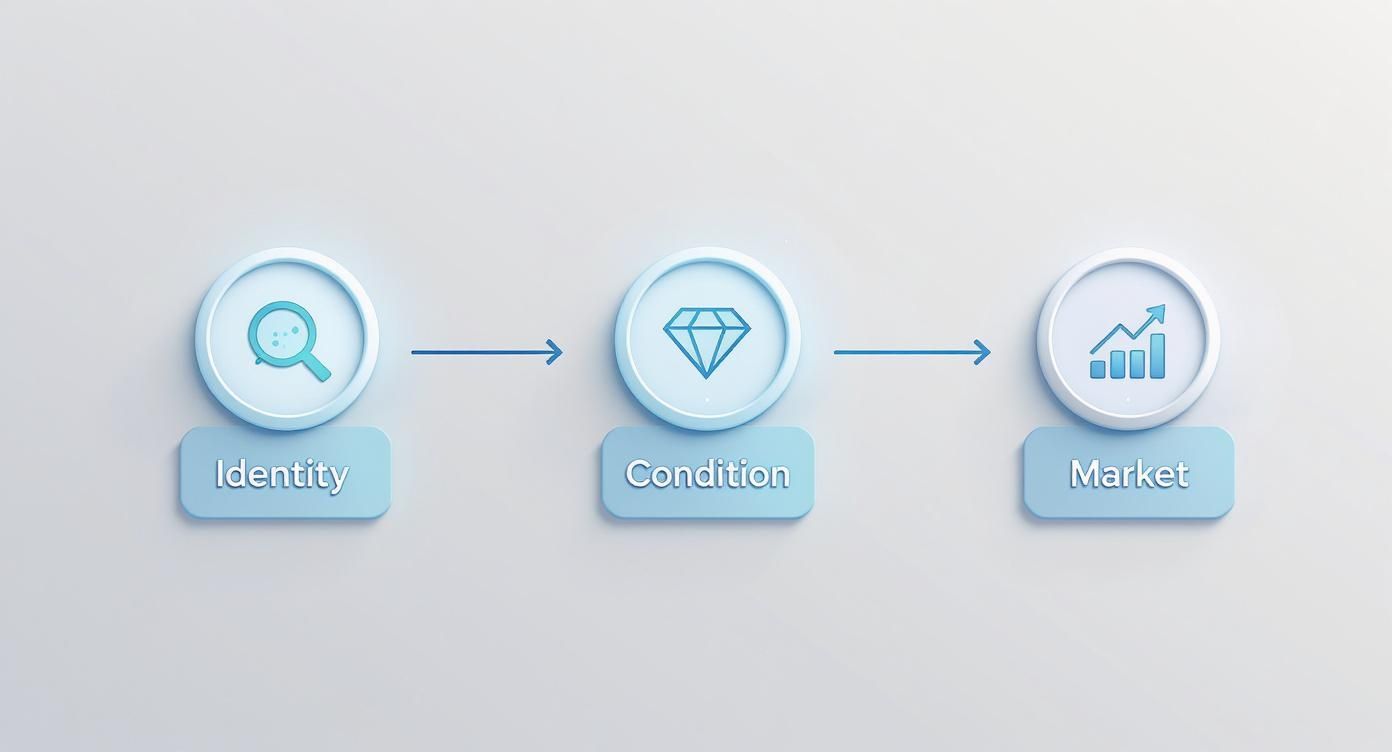
As you can see, each step builds on the last. You can't figure out the market value until you've correctly identified the watch and graded its condition. It all works together to create a complete picture.
To give you a quick cheat sheet, here’s a breakdown of the most important valuation factors.
Quick Guide to Key Watch Valuation Factors
| Valuation Factor | What It Means for You | Why It's Critical |
|---|---|---|
| Brand & Model | Is it a Rolex Submariner or a lesser-known dress watch? The brand and specific model are the biggest drivers of baseline value. | Iconic models from top-tier brands (Rolex, Patek Philippe, Audemars Piguet) have built-in demand and command higher prices. |
| Reference Number | This unique code identifies the exact version of the model, including its materials, bezel, and production era. | A single digit difference can mean a change in movement or a rare dial variant, drastically altering its value to collectors. |
| Condition | This covers everything from scratches on the case to the state of the movement. Honesty is key here. | "Mint" or "unpolished" examples are rare and highly sought after. Any signs of heavy wear, polishing, or damage will lower the value. |
| Authenticity | Are all parts original? Aftermarket dials, hands, or bezels can significantly decrease what a collector will pay. | A 100% original watch is the gold standard. Verifying authenticity protects both buyer and seller from costly mistakes. |
| Provenance | Does it come with the original box, warranty card, receipts, and service papers? This is the watch's "birth certificate." | A "full set" with complete provenance can increase a watch's value by 15-25% or more, as it proves authenticity and history. |
| Market Comps | What have identical watches in similar condition actually sold for recently? This is about real sales data, not asking prices. | This is the ultimate reality check. It grounds your estimate in what the market is truly willing to bear today. |
Getting these details right is the difference between a fair price and leaving money on the table.
Understanding the Broader Market Context
It's also important to remember that the value of any single watch is tied to the health of the entire luxury goods world. The global luxury watch market is no small pond—it's forecasted to grow from USD 33.17 billion in 2025 to USD 42.39 billion by 2029.
This shows a strong, sustained interest in high-end timepieces. People see these watches not just as tools, but as status symbols and hard assets, which directly supports their resale value. You can dig into more of the numbers behind these trends in a detailed report on the luxury watch market.
Uncovering Your Watch's Identity and History
So, how much is your watch actually worth? Every honest answer to that question starts in the same place: figuring out exactly what you have. Before you can even think about market prices or comparable sales, you need to nail down two key details: the model name and the all-important reference number.
Think of the reference number as your watch’s VIN. It's a specific code that tells a collector everything they need to know—from the case metal and bezel type to the exact movement ticking inside. A single digit difference can separate a common model from a rare and highly desirable classic.
Finding the Reference Number on Your Watch
Luxury brands tuck these numbers away in different spots, but they're almost always engraved on the case itself. You just have to know where to look.
Here’s a quick guide for some of the big names:
- Rolex: Traditionally, the reference number is engraved on the side of the case at the 12 o’clock position, hidden between the lugs where the bracelet connects. You'll need to carefully remove the bracelet to see it. The serial number, which helps date the watch, is found on the opposite side at 6 o'clock.
- Omega: Many modern Omegas make it easy, with the reference number engraved right on the caseback. For older Speedmasters and Seamasters, you might have to open the watch up to find it inscribed on the inside of the caseback.
- Patek Philippe: This information is almost always found on the original paperwork. Patek Philippe generally doesn't engrave reference numbers on the case exterior, which makes holding onto the original documents incredibly important.
If you're not comfortable removing a bracelet yourself, don't risk it. A professional jeweler can do it in seconds without leaving a scratch. While you're at it, you'll want to be sure everything is authentic. For a deeper look, check out our guide on how to authenticate a Rolex watch.
The Power of Provenance
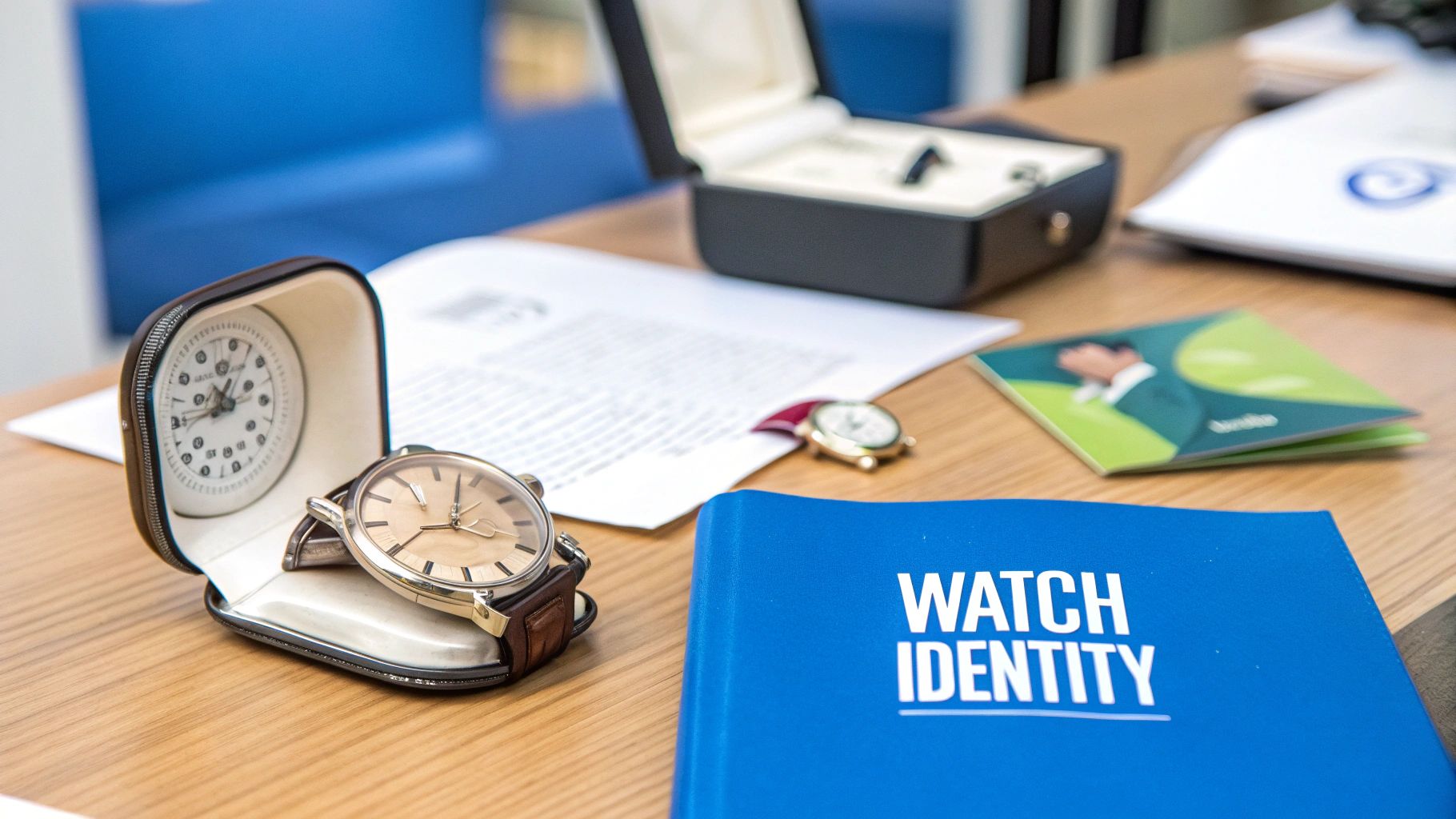
Once you have the reference number, you need to piece together your watch's history. In the collecting world, we call this provenance—the documented trail of ownership and care from day one. A watch with a solid story is always worth more than one without.
Provenance isn't just a box and some old receipts; it's the verifiable story of your timepiece. It proves authenticity, originality, and history, giving buyers the confidence to pay a premium. A complete "full set" can easily boost a watch's value by 20% or more.
So, what makes for great provenance? It's the collection of original items that came with the watch, plus any service records accumulated over its lifetime. The more complete, the better.
A "full set" typically includes:
- The Original Box: This means both the inner presentation box and the outer cardboard sleeve.
- Warranty Papers/Card: This is the big one. It's the watch's birth certificate, stamped by the authorized dealer with the date of sale and serial number.
- Instruction Manuals: The original booklets that came with the watch.
- Hang Tags: Both the green chronometer tag and the model-specific swing tag with the serial and reference numbers.
- Service Records: Any receipts from official services prove the watch was maintained with authentic parts.
Let's look at a real-world example. Say you have a Rolex Submariner, reference 16610. As a standalone "naked" watch in great shape, it might fetch around $9,000. But take that exact same watch with its original box, punched warranty papers, manuals, and hang tags, and it could easily sell for $11,000 to $12,000. That $2,000 to $3,000 gap is purely the value of its provenance. For a serious collector, it removes all doubt and makes your watch a top-tier example.
How to Grade Your Watch's Condition Accurately
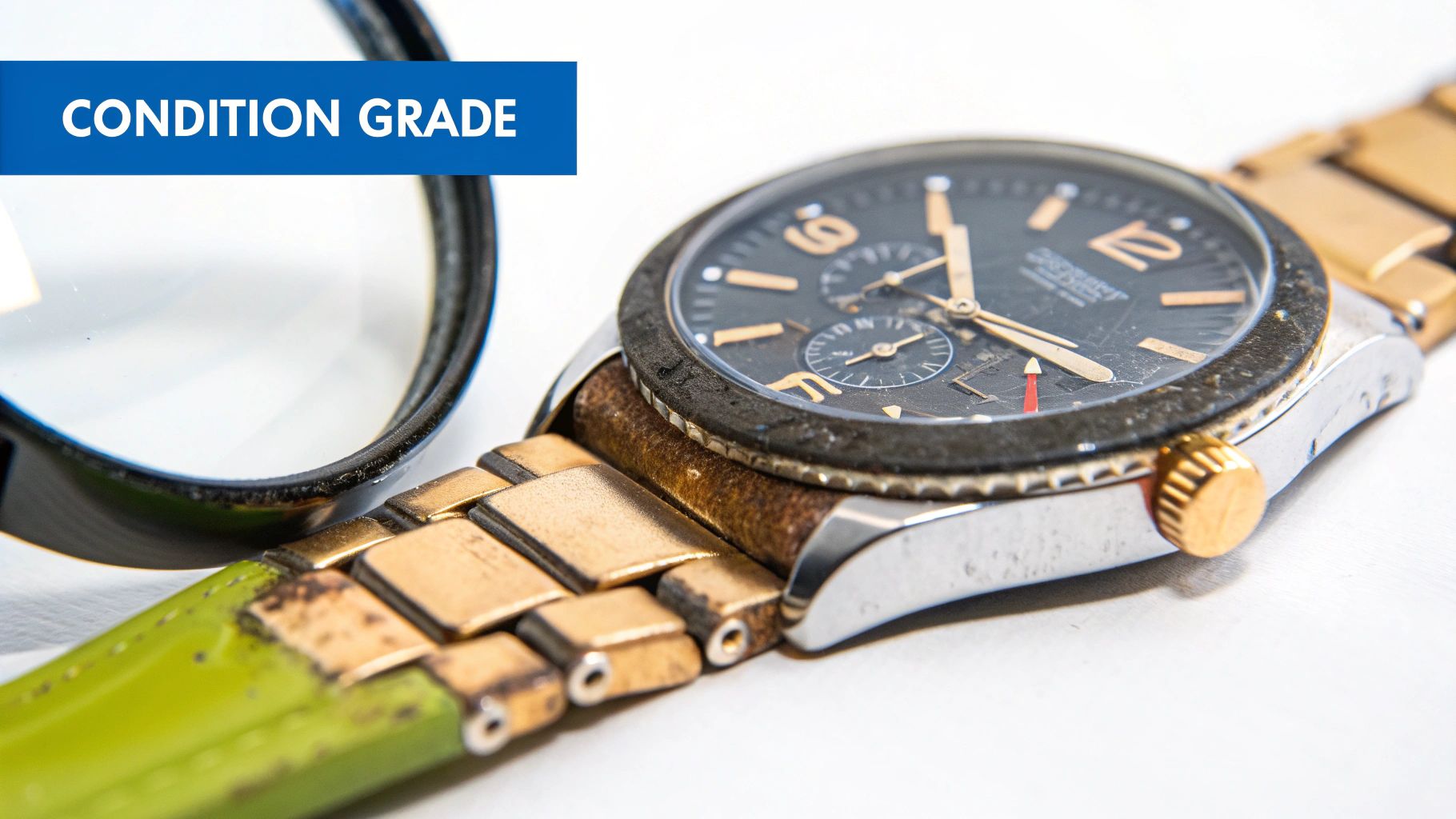
Once you've nailed down the model and its history, it's time for the hard part: an honest, tough-love assessment of your watch's physical condition. Two identical reference numbers can have values that are worlds apart, and it all comes down to preservation.
Collectors are a picky bunch. They aren't just buying a watch that tells time; they're buying originality, sharp factory lines, and history. Even the smallest imperfections can dramatically change the answer to "how much is my watch worth?"
This isn't just about spotting a few scuffs. It's a full-on inspection of every single part, from the crystal down to the clasp. Learning to see the subtle differences between a "good" watch and a truly great one is a skill that pays dividends.
A Four-Tier Grading System
To create a common language, the watch community generally sticks to a four-tier grading scale. This helps manage expectations so a buyer in Tokyo and a seller in New York are on the same page. Think of them as general buckets, each with its own nuances.
- Mint: Looks like it never left the box. No signs of wear, no scratches, no dings—even under a loupe. It's factory-fresh.
- Excellent: Shows only the lightest hints of being worn. Maybe a few faint hairline marks on a polished clasp, but the case still has its sharp, original edges. No deep gouges or dents.
- Good: Clearly a daily wearer, showing moderate use. You'll see visible scratches, maybe some small nicks on the case, and the bracelet might have a bit of "stretch." It’s used, but it was cared for.
- Fair/Poor: Has lived a hard life. We're talking deep scratches, noticeable dents, potential damage to the dial, or non-original replacement parts. The case might be over-polished, giving it soft, rounded edges.
Inspecting Your Watch Like a Pro
Alright, grab your watch, find some good natural light, and let’s get to work. A magnifying glass or your phone's camera zoom will be your best friend here.
First, the case. Pay close attention to the lugs—the "horns" that hold the bracelet. Are the edges crisp and defined? Or are they soft and rounded? Rounded lugs are the cardinal sin of over-polishing, a huge red flag for collectors who want originality above all else.
Next up, the crystal. Is it the original acrylic or a modern sapphire replacement? Hunt for any scratches, chips, or tiny cracks, especially around the rim where it meets the bezel.
Now for the main event: the dial and hands. Check for any spotting, discoloration, or damage to the luminous material (lume). On a vintage piece, a creamy, even patina is often a huge plus. Cracked, missing, or—even worse—re-lumed plots will tank the value.
A watch’s dial is its face. To a serious collector, a flawless but later "service dial" is almost always less valuable than a factory-original dial that shows its age. Originality is king.
Finally, look at the bezel and bracelet. Does the bezel turn with a satisfying click? Are the numbers faded? For the bracelet, check the clasp for wear and then inspect the links themselves. A common issue on older Rolex bracelets is "stretch"—a looseness that develops between the links over years. A tight, original bracelet can add significant value on its own.
Watch Condition Grading Checklist
Use this checklist to systematically evaluate and grade the condition of your watch's most important components.
| Component | Mint/Unworn Condition | Excellent Condition | Good Condition | Fair/Poor Condition |
|---|---|---|---|---|
| Case | Factory finish, sharp lugs, no marks. | Few faint hairline marks, lugs remain sharp. | Visible scratches and minor nicks, lugs may be slightly softened. | Deep scratches, dents, heavily polished with rounded lugs. |
| Crystal | Flawless original crystal, no scratches or chips. | A few microscopic marks, invisible to the naked eye. | Minor visible scratches or scuffs, no deep chips. | Heavily scratched, chipped, cracked, or incorrect replacement. |
| Dial & Hands | Perfect, no fading, original lume is untouched. | Original lume shows very light, even patina. No marks. | Minor spotting or aging, lume may be slightly degraded. | Discolored, stained, damaged, or has been poorly relumed. |
| Bezel | Perfect insert, rotates perfectly, sharp edges. | A few very light marks, crisp rotation. | Visible scratches or fading on insert, rotation may be stiff. | Heavily scratched, dented, missing insert, or doesn't turn. |
| Bracelet | Factory tight, no scratches, perfect clasp. | Minimal stretch, only a few light marks on the clasp. | Moderate stretch and visible scratches from regular wear. | Heavy stretch, deep gouges, or non-original replacement. |
Taking a methodical approach like this ensures you don’t overlook a tiny detail that could have a big impact on your watch's final market value.
Researching What Your Watch Actually Sells For
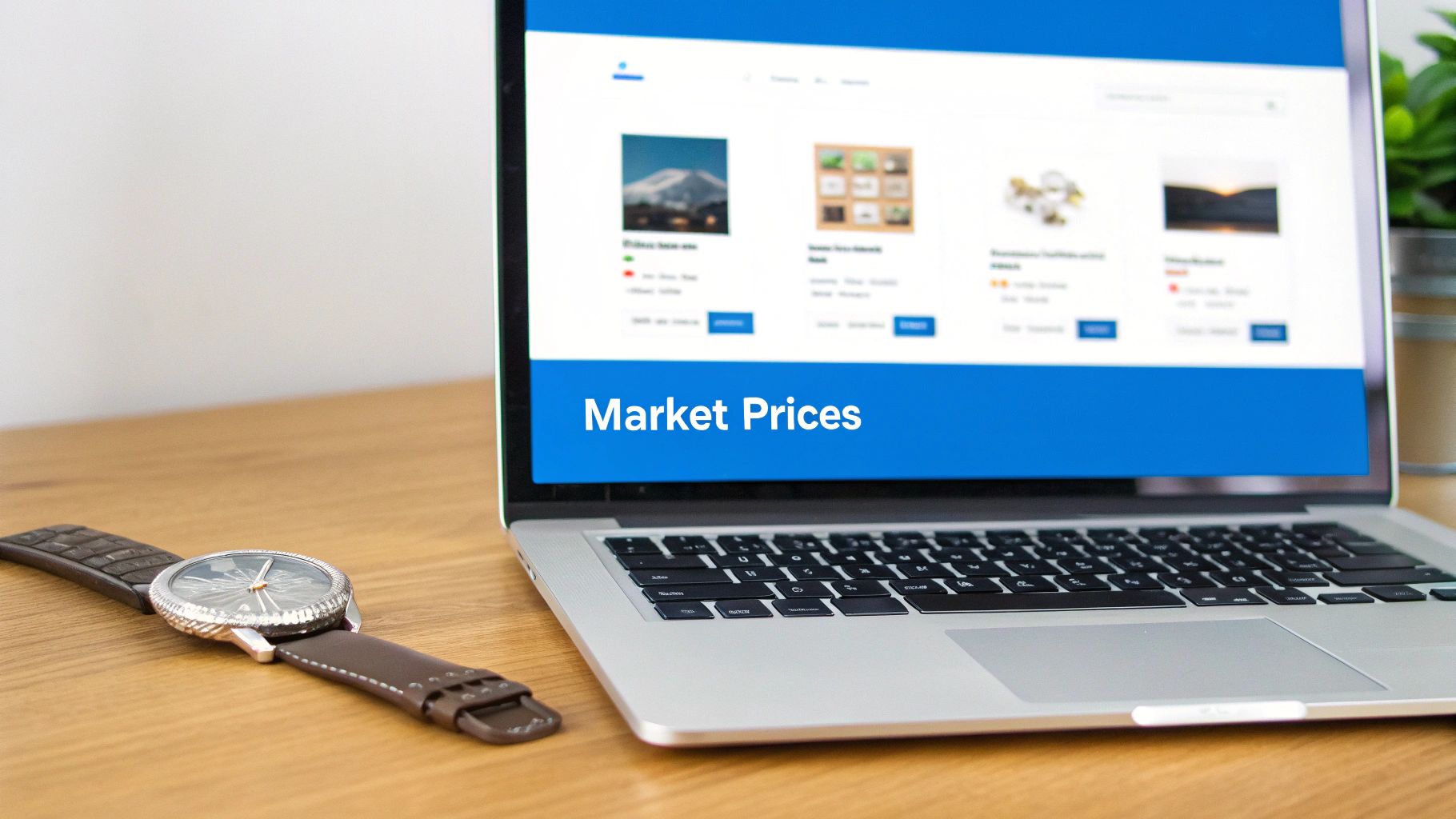
So you've identified your watch and given it an honest condition grade. Now comes the most important part: figuring out what someone will actually pay for it today.
Here's where a lot of sellers go wrong. They see sky-high dealer listings and assume that's the market rate. But there's a world of difference between an asking price and a sold price. An asking price is a wish; a sold price is a fact. Your valuation needs to be grounded in facts, not hopes.
This means digging into real market data to see where your specific watch truly stands.
Decoding the Online Marketplaces
Your best bet for research is the big pre-owned watch marketplaces. They're treasure troves of data, but you have to know how to separate the signal from the noise.
The two platforms you'll want to focus on are:
- Chrono24: As the world's largest marketplace, it gives you an incredible view of what dealers and private sellers are asking. Its filters are fantastic for zeroing in on your exact reference number, year, condition, and whether it's a "full set" with box and papers.
- eBay: While it can feel a bit like the wild west, eBay has a killer feature that Chrono24 lacks—the ability to see what watches have actually sold for. This is the single most valuable piece of data you can get your hands on.
Think of it this way: Chrono24 shows you the ceiling (what sellers are hoping to get), while eBay’s sold listings show you the floor (what buyers are actually paying). Using both gives you the complete picture.
How to Find Real-World Sold Prices on eBay
Finding this data is easier than you think. Go to eBay and search for your watch’s reference number. Once the results load, look at the filter sidebar on the left. Scroll down until you see a checkbox for "Sold Items" or "Completed Items."
Pro Tip: Ticking that "Sold Items" box on eBay is the fastest way to cut through the aspirational pricing and see reality. It filters out everything except successful sales, giving you a clear, unbiased look at what the market is truly willing to pay.
Check that box, and the page will refresh to show you a list of watches that have sold successfully, with the final prices displayed in green. This is your gold mine. Now you can find direct comparables—watches that match yours in condition, age, and whether they came with the original box and papers. This data is the ultimate reality check.
A Quick Research Example in Action
Let's say you own a Rolex Submariner, reference 116610LN. It's in excellent shape and you have the original box and warranty card.
-
Start on Chrono24: Search for "Rolex 116610LN" and filter for listings that include box and papers. You'll probably see a bunch of dealer listings ranging from $12,500 to $14,000. This tells you the top end of the market.
-
Jump over to eBay: Run the same search, but this time, immediately apply the "Sold Items" filter. Now you’re looking at real transactions. You might find several examples that sold in the last few months for between $11,800 and $12,600.
-
Analyze and Conclude: Compare the two. The high-end dealer prices aren't what private sellers are actually getting. The eBay data shows that a fair private sale price for your watch is likely around $12,200. You've just established a data-backed valuation.
This process takes the emotion and guesswork out of the equation and replaces it with cold, hard evidence. To understand more about what drives these figures, check out our deep dive on the resale value of Rolex watches. The market is always moving, so grounding your expectations in current, real-world sales data is the key to a successful transaction.
Deciding Your Next Steps: Appraisal vs. Selling
So you have a realistic price range in mind. Now you're at a crossroads, and your next move depends entirely on your goal. Are you just trying to get your watch insured, or are you actually looking to sell it? This is a critical distinction that leads down two very different paths.
Many owners get these two mixed up, but a formal appraisal and a market valuation serve completely different purposes. Let's break it down.
Formal Appraisal for Insurance
A formal, written appraisal is almost always for insurance coverage. This document gives a highly detailed description of your watch and, most importantly, assigns it a retail replacement value. This number is nearly always higher than what you could sell it for. Why? Because it reflects what it would cost to walk into an authorized dealer and buy a brand-new equivalent today.
For those wanting a professional opinion, it's helpful to understand the wider field of general asset valuation services. Just remember that an appraisal is about protecting your asset, not setting a sale price.
Think of it this way: An insurance appraisal is a defensive move to protect your watch. A market valuation is an offensive move to sell it. Don't use one when you need the other.
Market Valuation for a Potential Sale
On the other hand, a market valuation is what you've been working toward. It answers the real question: "How much can I get for my watch if I sell it tomorrow?" This number is grounded in reality, based on recent sales data for identical pre-owned models in similar condition. It's the cash you can realistically expect a buyer to pay.
Now, the only question left is finding that buyer. To get a head start, you might want to review a detailed guide on how to sell luxury watches.
Exploring Your Selling Options
You've got four main ways to sell a luxury watch. Each has its own timeline, fees, and level of risk. Picking the right one is just as important as knowing your watch's value.
-
Private Sale (Forums, Marketplaces): Selling directly to another collector on a forum or a platform like eBay gives you total control. You set the price, you negotiate, and you potentially keep the most profit. The catch? You also take on all the risk, from dealing with scammers to handling secure payment and insured shipping.
-
Consignment with a Dealer: This is a popular middle-ground. You give your watch to a reputable dealer, and they handle the professional photos, marketing, and sale for a commission, usually 10-20%. It’s far less work, but you have to wait for the watch to sell to get paid.
-
Direct Sale to a Dealer: This is the fastest and easiest route. A dealer makes you a direct cash offer. The price will be lower than a private sale—they have to make a profit, after all—but you get paid instantly with zero hassle. This is a great choice for common models or when you just want a quick, clean sale.
-
Auction House: If your watch is exceptionally rare, historically important, or extremely valuable, a major auction house like Phillips or Christie's is your best bet. They have access to the world's top collectors who are willing to pay a premium. The potential upside is massive, but so are the fees, which can be 25% or more. Plus, the process can take months.
The global luxury watch market is booming and projected to hit USD 107.59 billion by 2030. This growth is fueled by a new generation of buyers and a robust online marketplace, creating more opportunities than ever for sellers like you.
Common Questions About Watch Valuation
Once you start looking into what your watch is worth, the details get complicated—fast. A tiny nuance can make a huge difference in the final price. Below, we're tackling the most frequent questions we hear from owners, giving you straight answers to navigate these finer points.
Getting these details right helps you set realistic expectations and make smarter decisions, whether you're planning to sell, trade, or just get your timepiece properly insured.
Does Servicing My Watch Increase Its Value?
This is a classic "it depends" situation, and the answer is completely different for modern versus vintage pieces.
For a modern watch, a recent factory service with all the paperwork is a definite plus. It’s proof that the watch is authentic, functions perfectly, and gives the next owner peace of mind. In this case, yes, it can absolutely boost the value.
But for a vintage watch? A service can be a total disaster for its value. If original parts—the dial, hands, or bezel—are replaced with new "service parts," you can effectively destroy its collector appeal. Vintage collectors prize originality above all else. A dial with a bit of honest patina is almost always preferred over a shiny new replacement. Even over-polishing the case is a huge red flag, as it softens the sharp, original lines that define the watch's character.
The golden rule for vintage pieces is preservation over restoration. A careful mechanical overhaul that keeps all original cosmetic components intact is ideal. Originality is almost always worth more than looking new.
How Much Do the Original Box and Papers Really Add?
A "full set," meaning the original box and papers, adds a significant premium. This isn’t just a small bonus; it can increase a watch's value anywhere from 10% to over 30% for highly collectible models. The single most important document is the original warranty card—think of it as the watch's birth certificate.
For any watch made in the last 20 years, a full set is practically expected by serious buyers. A watch without its papers will be harder to sell and will always fetch a lower price than an identical one that has them.
With vintage watches, finding a complete original set is far rarer, which makes it even more valuable. It elevates a watch from being a nice example to a top-tier, investment-grade collectible.
Are Online Watch Valuation Calculators Accurate?
Treat them as a starting point, but never as the final word. Online valuation tools can give you a very rough ballpark figure, but they have serious limitations. These calculators typically scrape data from public dealer listings, which reflect optimistic asking prices, not what the watches actually sold for.
More importantly, an algorithm can't see your watch. It has no way to account for the critical details that truly drive value, such as:
- The specific condition of the dial, hands, and lume.
- Whether the case has been polished and how well.
- The originality of every single part.
- The completeness of its service history and provenance.
These tools are useful for getting a quick gut check, but they are no substitute for your own research into actual sold prices and, if needed, a professional's eye.
Should I Sell My Watch Now or Wait?
This question is less about the watch market and more about your personal financial goals. The pre-owned watch market has its own cycles, just like any other. Some popular "hype" models might see price corrections after a period of rapid growth. On the other hand, timeless classics and truly rare vintage pieces tend to appreciate steadily over the long term.
Look up the historical price trends for your specific reference number. If it shows stable, long-term growth, waiting might be a good strategy. If your watch is a model that saw a recent speculative bubble, selling could be a smart way to capitalize on that peak. For quartz models, even simple maintenance questions about the cost of watch battery replacement can be a factor for potential buyers.
Ultimately, try not to treat your watch purely like a stock. Consider its personal value to you and make a decision that aligns with your needs.
Ready to find out exactly what your timepiece is worth? At ECI Jewelers, our experts provide fair, transparent, market-based valuations for luxury watches. We offer immediate payment and a trusted, secure process for selling or trading your watch. Visit us online or in our NYC showroom to get your free valuation today.


