


Authenticating a Rolex isn't a single step—it's a careful process of inspecting its physical weight, microscopic details, and official paperwork. It's about combining what you can feel in your hand with what you can see under a loupe, and then backing it all up by verifying the numbers. It's the only way to separate true Swiss craftsmanship from the increasingly sophisticated fakes out there.
Why Rolex Authentication Is Non-Negotiable
The pull of a Rolex goes far beyond its iconic design. It’s a promise of perfection, a piece of history, and a solid asset. But in a market swimming with convincing replicas, that promise is always at risk.
Learning how to spot a fake isn't just a fun skill for watch nerds; it's a crucial defense for anyone about to make a significant investment. Without doing your homework, you could easily end up paying thousands for a watch that’s essentially worthless.
This guide gives you a real-world framework for spotting a genuine Rolex. But for absolute certainty, nothing beats a professional eye. At ECI Jewelers, our experts use years of hands-on experience and specialized tools to guarantee every single watch we sell is 100% authentic. We're here to protect your investment and ensure you're getting the real deal.
Key Inspection Pillars
The whole authentication process boils down to a few core principles. Before we dive deep into the nitty-gritty, it helps to know the high-level checkpoints that form the foundation of any good inspection. Often, these first few steps are enough to weed out the most obvious fakes without needing any special equipment.
You'll want to start with the general feel, move to a detailed visual check, and ideally, finish with an expert appraisal for total peace of mind.
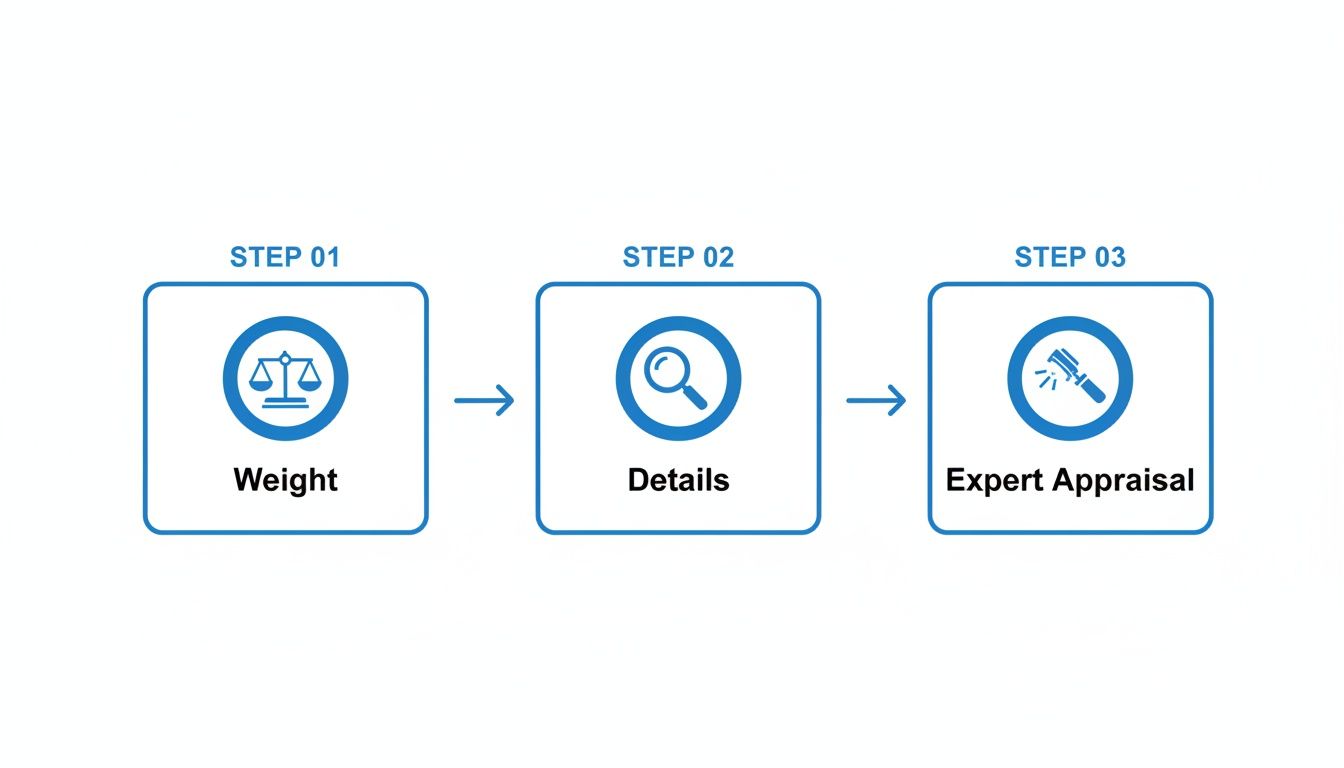
This workflow—from hands-on feel to fine details to professional confirmation—is the industry standard for a reason. It works.
And don't underestimate how many fakes are floating around. In the high-stakes world of luxury watches, platforms like Bezel reported that a staggering 23% of watches sent in for authentication didn't pass muster through Q3 2023. That’s nearly one in four. With Rolex being the most popular luxury watch brand, it's also the most counterfeited, making these checks more important than ever.
A Quick Rolex Authentication Checklist
To get you started, I've put together a simple table that breaks down the most critical differences between a real Rolex and a typical fake. Think of this as your first line of defense when you're looking at a watch.
| Feature | Authentic Rolex (What to Look For) | Counterfeit Rolex (Red Flags) |
|---|---|---|
| Weight & Feel | Substantial, solid feel from 904L steel or precious metals. | Surprisingly light, flimsy, or hollow-feeling bracelet links. |
| Second Hand | A smooth, sweeping motion—technically 8 ticks per second. | A choppy, ticking motion you'd see in a standard quartz watch. |
| Cyclops Lens | Magnifies the date exactly 2.5x and is perfectly clear. | Weak magnification (maybe 1.5x), distorted numbers, or a flat look. |
| Engravings | Deep, crisp, and laser-perfect serial and model numbers. | Shallow, fuzzy, or unevenly spaced numbers and letters. |
This checklist is a fantastic starting point, but be aware that the best "superfakes" are getting frighteningly good at mimicking some of these details.
Even having the original Rolex box and papers isn't a foolproof guarantee, as those can be forged, too. They add confidence, but they should also be scrutinized just as carefully as the watch itself.
Your First Impression: A Hands-On Physical Inspection

Before you pull out any tools or even a loupe, your own hands can tell you almost everything you need to know about a Rolex. The very first impression—the moment you pick it up—is often the quickest way to spot a cheap fake. Real Rolexes have a specific heft and density that counterfeiters just can't get right.
A genuine Rolex is milled from a solid block of 904L stainless steel (which Rolex brands as "Oystersteel") or heavy precious metals like 18k gold or platinum. This gives it a substantial, balanced weight that feels reassuring in your hand. Fakes often use cheaper 316L steel or, worse, plated base metals, making them feel light, hollow, or just plain wrong.
If the watch feels flimsy or cheap, trust that feeling. The difference isn't subtle; it's a fundamental quality that counterfeiters struggle to replicate without spending real money.
This isn't just about a quick glance. A serious hands-on inspection reveals the tiny details that separate the real from the fake, much like any practical verification guide for physical items will tell you. What you feel is every bit as important as what you see.
Evaluating the Case and Bracelet Finishing
Take a moment and just run your fingers along the edges of the case, lugs, and bracelet links. A real Rolex is finished perfectly. You'll feel flawlessly smooth polished surfaces and crisp, defined lines where different finishes meet. There should be absolutely no rough spots, burrs, or sharp edges anywhere.
Counterfeiters almost always cut corners on the finishing. Here’s where to look:
- Between the Lugs: Even though this area is hidden by the bracelet, Rolex finishes it properly. Fakes often leave it rough or unpolished.
- Crown Guards: Look for perfect symmetry. The guards should flow elegantly and seamlessly into the case.
- Bracelet Edges: The sides of every link should feel smooth. On a bad fake, they can feel almost sharp enough to snag your cuff.
The bracelet should feel solid, articulating smoothly without rattling or feeling loose. While vintage Rolex bracelets will naturally have some stretch from decades of wear, a modern Oyster or Jubilee bracelet is built with incredibly tight tolerances. A jangly, loose-feeling bracelet on a newer model is a dead giveaway.
The Sound and Feel of Precision Engineering
A Rolex isn’t a static object; it’s a high-precision tool. The way its parts move and sound provides critical clues to its authenticity. The two best places to test this are the winding crown and the bezel.
The winding crown on a real Rolex is an engineering marvel. Unscrewing it is a buttery-smooth action. Once it's unscrewed, winding the movement should feel quiet and consistent—like a tiny, well-oiled machine.
Pro Tip: When you unscrew a genuine Twinlock or Triplock crown, you’ll feel a distinct "pop" as it disengages from the threads and springs away from the case. Fakes almost never get this right. Their crowns often feel gritty, loose, or wobbly.
The rotating bezel on a professional model is another fantastic test. A genuine Submariner bezel, for instance, makes 120 firm, satisfying clicks in a full 360-degree rotation. Each click is sharp, precise, and sounds expensive. There is zero backward play or wiggle.
This is where many fakes fall apart completely. Their bezels might:
- Feel wobbly or loose.
- Produce a tinny, cheap click instead of a solid one.
- Have the wrong number of clicks (often 60 instead of 120).
- Exhibit significant "back play," where you can rock the bezel back and forth between clicks.
This initial physical inspection trains your senses to recognize what true craftsmanship feels like. If a watch feels light, has sloppy finishing, and operates with gritty mechanics, it fails the most basic test of authenticity. There’s no need to look any closer.
Analyzing the Dial and Microscopic Details
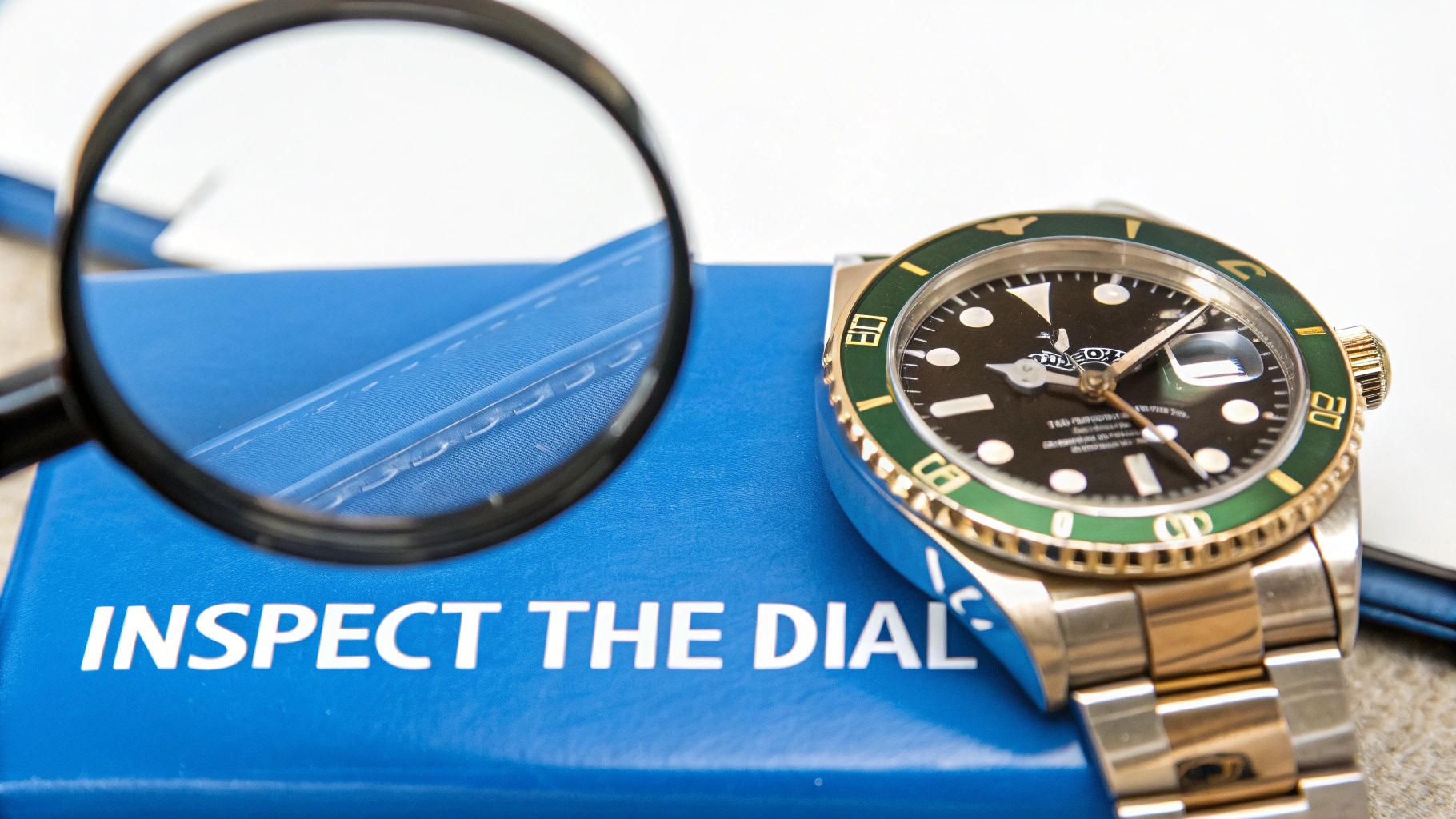
Once you’ve got a feel for the watch, it’s time to move in closer and look at the dial. This is where Rolex’s obsession with perfection really shines, and it’s also where counterfeiters almost always fall short. You don't need a high-powered microscope, but a good jeweler's loupe is essential for spotting the tiny mistakes that give fakes away.
Every letter, every marker, every tiny detail on a real Rolex dial is absolutely flawless. We’re talking about printing so sharp it looks like it was etched by a laser and hour markers applied with surgical precision. It’s an overall sense of quality that’s nearly impossible to replicate on the cheap. Now, let’s put the watch under that loupe and let the details tell their story.
Scrutinizing the Dial Text and Coronet
Start with the text on the dial—the model name, "Oyster Perpetual," or the "Superlative Chronometer Officially Certified" script. On an authentic Rolex, this lettering is crisp with perfectly defined, sharp edges. You should see absolutely no smudging, bleeding, or fuzzy lines, even under magnification. The spacing between each letter is mathematically perfect and consistent.
Next, get a good look at that iconic Rolex coronet at 12 o’clock. On virtually all modern models, this isn't just printed on; it's a separate, applied piece of metal. It should have a noticeable three-dimensional quality with sharp, distinct points. Most fakes will either print the logo flat or use a clunky, poorly made emblem with rounded, mushy-looking tips.
- Font Quality: Look for clean lines and consistent weight. Counterfeits often have text that looks slightly bubbly, raised, or uses an almost-but-not-quite-right font.
- Logo Application: Check that the coronet is an applied piece. It should look like a tiny, perfectly sculpted piece of jewelry in its own right.
- Alignment: Everything should be perfectly centered and aligned. If anything looks even a fraction of a millimeter off, it's a huge red flag.
The Cyclops Lens and Date Window
The Cyclops lens over the date window is one of Rolex’s signature features—and one of the most common tells for a fake. It has one job: make the date easier to read. A genuine Rolex Cyclops has a very specific magnification power that fakes rarely get right.
A real Cyclops lens magnifies the date by exactly 2.5x. This isn't a subtle bump; it's a powerful magnification that makes the date number fill nearly the entire bubble. When you look straight down at it, the date should be incredibly clear and seem to jump out at you.
A weak, distorted, or slightly-magnified date is one of the easiest ways to spot a fake, even from a distance. If the date looks small under that bubble, or if the numbers are blurry around the edges, you're almost certainly looking at a counterfeit.
The lens itself should also be a perfect, distinct bubble centered precisely over the date window. Fakes often have misaligned lenses, use cheap materials that scratch easily, or have a weird blueish anti-reflective coating, which Rolex doesn't use on the Cyclops.
Movement of the Second Hand
Now, just watch the second hand move. This simple test tells you a lot about the movement inside without ever opening the watch. A genuine Rolex has a high-beat mechanical movement, typically running at 28,800 vibrations per hour.
What does that mean? It means the second hand glides in what appears to be a perfectly smooth, continuous sweep. In reality, it’s making eight tiny ticks per second, but to your eye, the motion is fluid and graceful.
Most cheap fakes, on the other hand, use a standard quartz movement to cut costs. The difference is night and day.
| Movement Type | Second Hand Motion | Sound |
|---|---|---|
| Authentic Rolex | Smooth, sweeping motion (8 ticks/sec) | Nearly silent or a faint whir |
| Fake Quartz | Stuttering, ticking motion (1 tick/sec) | A distinct, audible "tick" |
If you see that classic "tick-tick-tick" jump from one second marker to the next, it's a dead giveaway. While some high-end fakes now use clone mechanical movements, they often can't match the buttery smoothness of a true Rolex caliber. Their sweep might look jittery or less fluid. This one observation is a powerful tool for weeding out the phonies.
Decoding Serial and Model Numbers
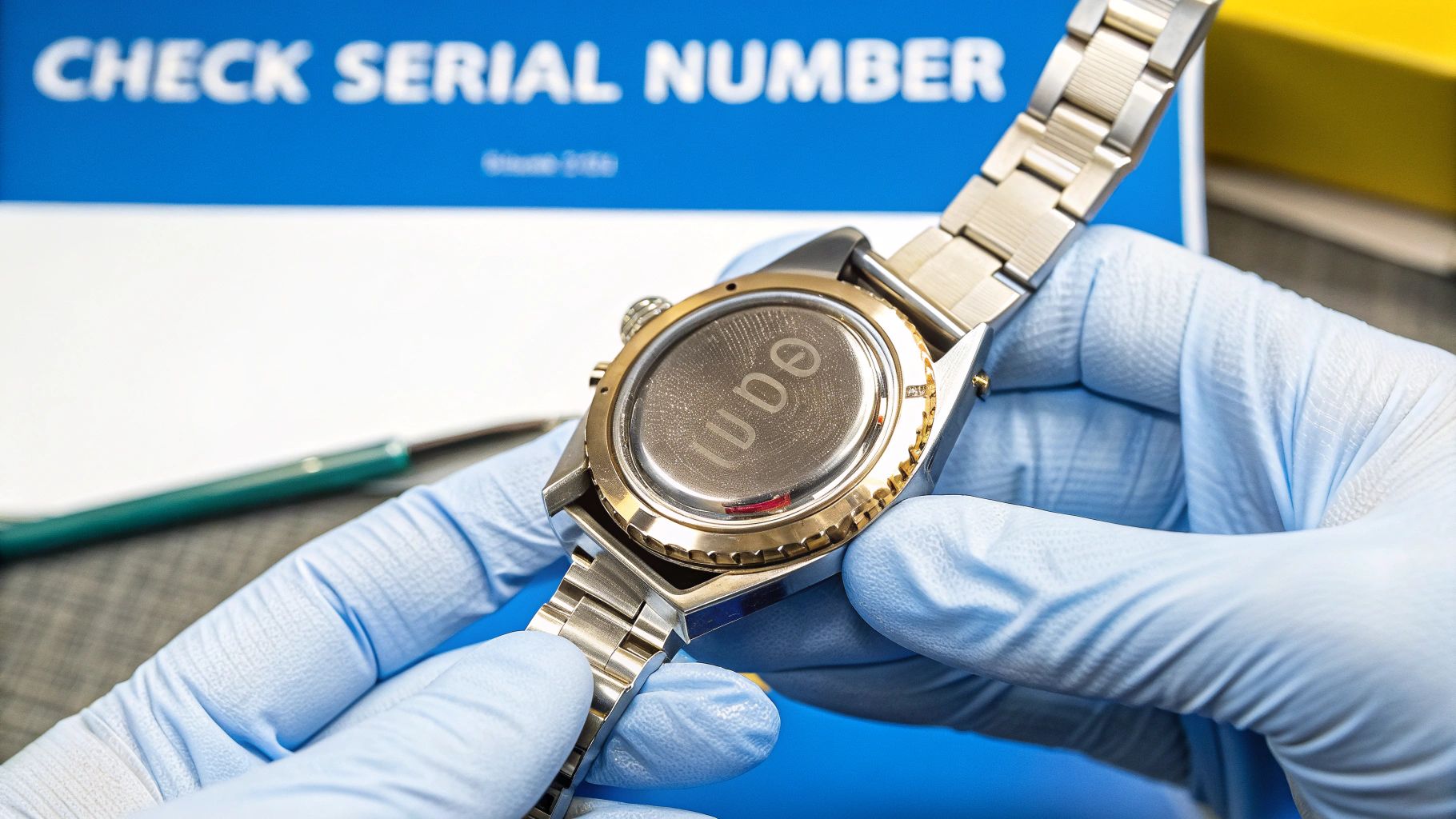
Every genuine Rolex has its own unique fingerprint etched right into the case: the serial and model numbers. Knowing where these are and what they should look like is a non-negotiable step in authentication. Forgers find it incredibly difficult to replicate the precision Rolex uses for these engravings, making them a fantastic tell.
For years, Rolex tucked these numbers away between the lugs of the watch case. You'd find the model (or reference) number at the 12 o’clock position and the unique serial number at the 6 o’clock side. This meant you had to carefully remove the bracelet to see them, which requires the right tool and a steady hand.
Things changed around 2005, and by 2008 it was standard practice for Rolex to start engraving the serial number on the rehaut—that’s the inner metal ring between the dial and the crystal. This was a smart move, making the serial number visible without any disassembly.
What Authentic Engravings Look Like
Here’s where a real Rolex shines and a fake stumbles. Rolex uses a high-precision laser that creates engravings that are stunningly sharp, deep, and clean. Get a loupe on it, and you'll see the numbers have a fine, sandblasted texture at the bottom of the etching. They catch the light almost like diamond dust. It's a beautiful detail.
Counterfeits almost never get this right. Their numbers are usually:
- Shallow and Acid-Etched: Fakes often rely on a crude acid-etching process. This leaves a faint, fuzzy marking that looks like it was made with a dot-matrix printer, totally lacking the deep, crisp lines of a real one.
- Poorly Spaced or Misaligned: You might see uneven spacing or crooked letters—flaws you would simply never find on a watch that passed Rolex's quality control.
- Smooth and Shiny: Instead of that signature textured finish, the engravings on a fake are often smooth and reflective at the bottom. They just look cheap.
When you have a real and a fake side-by-side, the difference is night and day. A genuine Rolex engraving feels permanent, like it’s an integral part of the steel. A fake one looks like a sloppy afterthought.
Cross-Referencing for Consistency
Just finding the numbers isn’t enough; you have to make sure they tell the right story. The model number should match the watch you're holding. A quick online search can tell you everything about a specific reference—its material, dial color, bezel, and more. Our guide to understanding Rolex reference numbers is an invaluable resource for this.
The serial number helps you approximate the watch's production year. While Rolex doesn’t publish official charts anymore, reliable databases from the collector community can match a serial number to a time frame. This is a crucial cross-check. Does the production year make sense for the watch's features? For example, you wouldn't expect a serial number from the 1990s on a model with a modern ceramic bezel.
These numbers should be deeply and consistently etched. Checking them against production charts can expose critical mismatches. For example, genuine watches made after 1985 from 904L stainless steel have specific codes tied to their production, like the 'G' series that kicked off in 2010.
At ECI Jewelers, this is a cornerstone of our authentication service. We don't just inspect the quality of the engravings. We also run the serial number through our databases to ensure the watch hasn't been reported lost or stolen, giving you an essential layer of security and peace of mind.
Why Professional Authentication Is Your Ultimate Safeguard
While the hands-on checks we've covered are great for spotting obvious fakes, think of them as the first line of defense, not the final word. The truth is, the world of counterfeiting moves fast. The rise of so-called "superfakes" has made simply looking at a watch more challenging than ever. These high-end replicas often get the weight, finishing, and even the Cyclops magnification frighteningly close to the real deal.
This is where you hit the limits of DIY authentication. Even a trained eye can be fooled by a watch that looks perfect on the outside. Then you have the sneaky world of "Frankenwatches"—timepieces built from a mix of genuine and aftermarket parts. A watch might have an authentic case and bracelet but hide a cheap, fake movement inside. Without opening it up, you'd never know. This is exactly why a professional look-over isn't just an option; it's the only way to get 100% certainty.
What Really Happens Inside a Professional Inspection
When you bring a watch to an expert at ECI Jewelers, the process goes way beyond what a loupe can see from the outside. The single most important step is opening the caseback to inspect the movement—the true heart of the watch. This is a delicate job that requires specialized tools to avoid scratching the case or messing with the watch's water resistance.
Once inside, a world of detail is revealed that fakers just can't get right. A genuine Rolex caliber is a piece of art.
- Flawless Finishing: Every single bridge and plate is meticulously finished, often with distinctive patterns and perfectly beveled edges.
- Branded Engravings: You'll find the Rolex name, caliber number, and other markings engraved with absolute precision.
- Signature Components: Key parts, like the iconic purple reversing wheels or the blue Parachrom hairspring, are dead giveaways of a genuine movement.
Counterfeit movements, even the best clones, always cut corners. You'll see poorly finished surfaces, sloppy engravings, or cheaper, generic parts that an expert can spot in a second. This internal exam is the definitive test. It’s what turns an educated guess into a verifiable fact.
A professional's tools and experience let them see what the naked eye can't. Inspecting the movement is the final, undeniable proof of a watch's legitimacy—it’s like checking its mechanical fingerprint. This is where you find real peace of mind.
It's an Investment in Certainty, Not an Expense
It’s easy to see professional authentication as just another cost, but that’s the wrong way to look at it. Instead, think of it as a small, essential investment to protect a much larger one. Whether you're buying, selling, or just checking on a family heirloom, the service provides priceless security. It confirms the watch's value, protects you from getting ripped off, and gives you the solid confidence that comes with knowing your timepiece is the real deal.
The industry knows how tough this has become. Rolex is even exploring blockchain technology to create a 'Watch Certificate' system that embeds NFC chips in watches to track their entire history. This move just highlights how complex verification is getting and why expert guidance is more critical than ever.
For anyone looking for that level of assurance, our experts are here to help. The ECI Jewelers watch concierge service provides comprehensive authentication, making sure every detail—from the dial to the deepest parts of the movement—is correct and genuine. It’s your ultimate guarantee in a very sophisticated market.
Common Questions About Rolex Authentication
Even after you've gone through a watch with a loupe, there are always a few lingering questions. It's totally normal. The world of pre-owned luxury watches is filled with nuances, and knowing the answers can mean the difference between a great buy and a huge mistake. Let's tackle some of the most common concerns we hear every day.
Think of this as your final confidence check before pulling the trigger.
Can I Trust a Rolex with Original Box and Papers?
Having the original box and papers is a great sign, but let me be clear: they are not a guarantee of authenticity. The counterfeit market has gotten scarily good at faking everything—the green hangtag, the warranty card, even the feel of the booklet paper. It’s a classic mistake to see a "full set" and immediately let your guard down.
Always, always authenticate the watch first. Treat the paperwork as supporting evidence, not the main event. A skilled counterfeiter can easily print a fake warranty card with a serial number that perfectly matches the fake number on the watch.
At ECI Jewelers, our process is non-negotiable. We verify the watch itself first—from the caliber of the movement down to the microscopic font on the dial. Only after the watch passes muster do we scrutinize the papers to ensure the serials, model reference, and purchase dates all line up.
What Is a Frankenwatch and Why Is It So Hard to Spot?
A "Frankenwatch" is exactly what it sounds like: a watch pieced together from various parts, some genuine, some not. You might find a watch with an authentic Rolex case and bracelet, but hiding inside is a cheap counterfeit movement or an aftermarket dial and hands. They are dangerously deceptive because some parts are real, allowing them to breeze through a quick, superficial inspection.
These watches are one of the biggest reasons you need a professional. A novice might see that the serial number engraving looks right and the bracelet feels solid, but they'd have no idea the engine inside is a cheap clone.
Spotting a Frankenwatch takes a trained eye and usually means opening the caseback. Our watchmakers know exactly which caliber movement, dial style, and handset belongs to a specific model from a specific year. That's a level of detail that a simple visual check just can't match.
Is It Safe to Buy a Rolex Online?
Buying a Rolex online can be perfectly safe, but only if you buy from a highly reputable dealer with a long, proven track record. In the online world, the seller's reputation is everything.
Here's what to look for:
- A Physical Showroom: A real brick-and-mortar store shows they're an established, accountable business.
- High-Resolution Photos: The dealer should provide crystal-clear images of the actual watch for sale, not generic stock photos.
- An Explicit Authenticity Guarantee: They must stand behind their watches with a clear, written guarantee. No vague promises.
- A Transparent Return Policy: This is your safety net. If there's an issue, you need a way out.
Steer clear of peer-to-peer marketplaces or sellers without a verifiable history of positive feedback. And never, ever rely on photos alone. A trustworthy dealer like ECI Jewelers backs every online sale with the same 100% authenticity guarantee we give to clients who walk into our showroom. We know the trust it takes to buy a luxury watch online, and we work to earn it with every single transaction.
Your journey to owning the perfect Rolex starts with confidence. At ECI Jewelers, our team of experts provides the assurance you need, meticulously authenticating every timepiece we offer. Explore our curated collection of guaranteed authentic luxury watches today. Find your next masterpiece at https://www.ecijewelers.com.


