


Starting a watch collection isn't about just buying expensive things. It's about finding the pieces that tell your story, defining your personal style, and diving deep into a passion. Before you even think about the watches, you need to understand your own motivation, set a realistic budget, and figure out what truly excites you.
Getting this right from the start is the difference between a meaningful collection and a drawer full of expensive, regrettable impulse buys.
Find Your Why Before You Buy Your First Watch
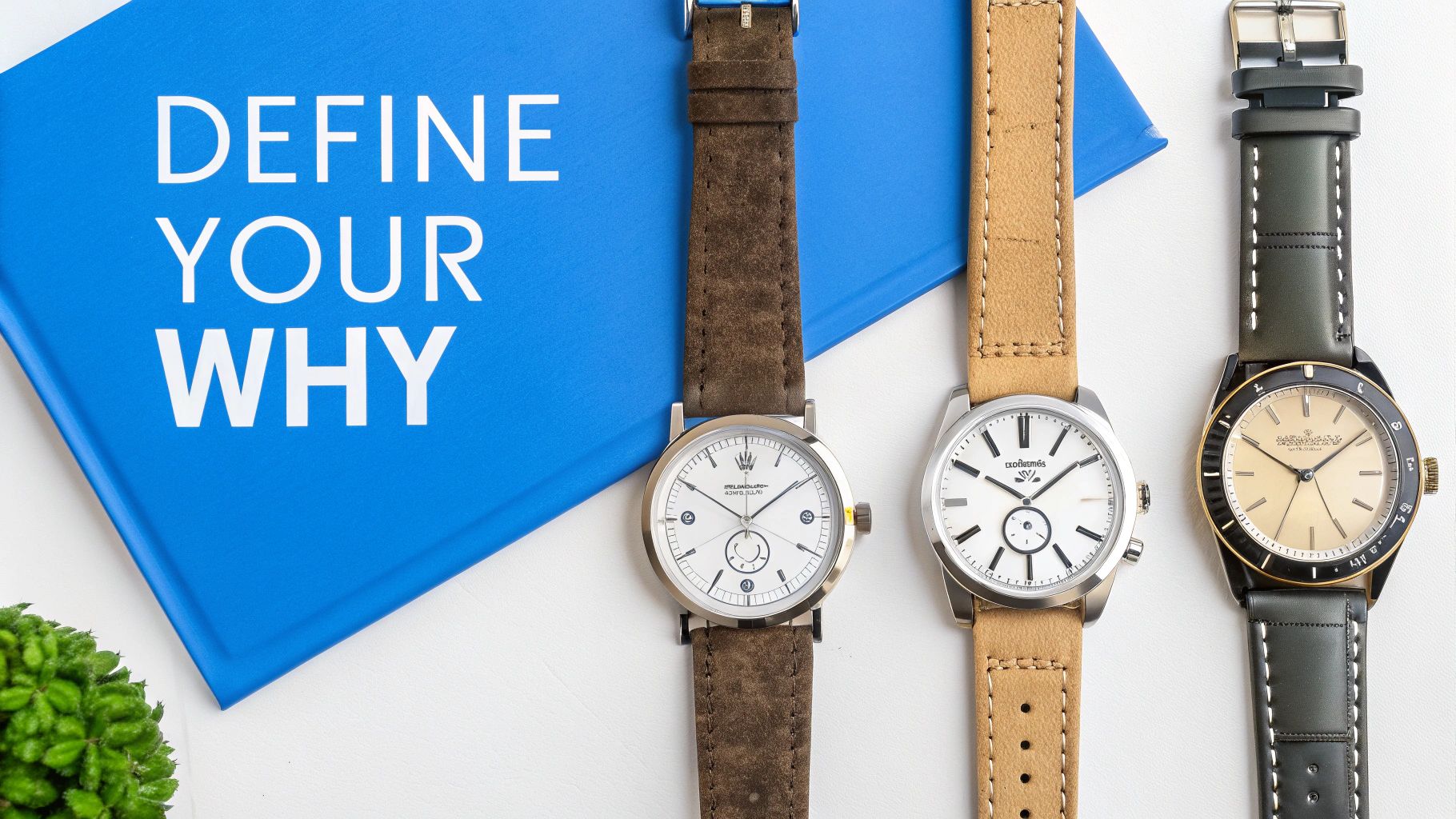
Before you hit the forums or walk into a boutique, the most critical step is to look inward. Ask yourself one simple question: Why do I want to do this?
The answer becomes your personal collecting philosophy—a North Star that will guide every purchase you make. Seriously, it will save you from so many costly mistakes down the line. Without a clear purpose, it's far too easy to accumulate a bunch of watches without ever building a real collection.
A collection isn't just a random group of timepieces. It's a curated selection connected by a common thread, a theme, or a personal narrative. This is what separates a thoughtful collector from someone who just buys what's popular. Your "why" brings focus to the vast world of horology, making it feel manageable and exciting instead of overwhelming.
Discover Your Collecting Path
Your motivation can be anything, and there are absolutely no wrong answers here. The goal is simply to find what genuinely speaks to you. If you're not sure where to start, it can help to explore a few common paths that other collectors have taken.
Some popular collecting philosophies include:
- Brand Loyalty: You might decide to go deep on a single brand, like Omega or Tudor. This allows you to explore its entire history, from iconic models to obscure references and technical innovations.
- Functional Focus: Maybe you're drawn to a specific complication or type of watch. You could build a world-class collection of chronographs, admiring their intricate movements, or focus on dive watches for their rugged, adventurous history.
- Historical Significance: Perhaps you're fascinated by military-issued field watches from World War II or the classic pilot watches that defined the golden age of aviation. Each piece tells a story of its time.
- Aesthetic Theme: Your collection could be united by a specific design element. Think blue dials, integrated bracelets, or a particular case material like bronze or titanium.
This initial exploration helps you develop a much more discerning eye. You'll start noticing the subtle details that differentiate one model from another and begin to understand the stories behind them—which, honestly, is where the real joy of collecting lies.
A great collection tells a story—not just about the watches, but about the collector. Every piece should be a chapter, representing a milestone, a passion, or a newfound appreciation for craftsmanship.
Navigating an Expanding Market
Defining your focus is more important today than ever before. The global watch market was valued at roughly USD 77.48 billion in 2024 and is projected to hit USD 120.78 billion by 2033. That explosive growth means a dizzying number of models and brands are all competing for your attention.
You can find more insights on the global watch market’s growth online, but the takeaway is clear: having a solid collecting philosophy helps you cut through the noise and zero in on the pieces that truly belong in your collection.
To get the gears turning, check out the table below. It’s a good way to start pinpointing what kind of collector you might be. Think of it as a starting point, not a set of rigid rules. Most collectors find their style evolves over time, borrowing elements from different profiles as their knowledge and taste deepen.
What Kind of Watch Collector Are You?
Use this table to identify your primary collecting motivation and get ideas for building a focused, personal collection.
| Collector Profile | Primary Motivation | Example Focus | Potential First Watch |
|---|---|---|---|
| The Historian | The story and heritage behind the watch | Military-issued timepieces from the 1940s | Hamilton Khaki Field Mechanical |
| The Engineer | Mechanical complexity and innovation | Watches with unique complications like chronographs | Omega Speedmaster Professional |
| The Investor | Value retention and potential appreciation | Iconic, high-demand models from top-tier brands | Rolex Submariner |
| The Designer | Aesthetics, design language, and visual appeal | Bauhaus-inspired minimalist dress watches | Junghans Max Bill |
Ultimately, your "why" will shape everything—your budget, your research, and the satisfaction you get from every single watch you add. By starting here, you're making sure the collection you build is uniquely and authentically yours.
Become a Knowledgeable Buyer, Not Just an Owner
Jumping into watch collecting without a solid base of knowledge is a bit like walking into a minefield. A high price tag doesn't always mean quality, and a famous brand name doesn't guarantee a watch is the right fit for you.
The real difference between someone who just owns watches and a true collector comes down to one thing: research. It's the single best tool you have to protect your money and build a collection that you'll actually be proud of for years to come. This homework transforms you from a passive consumer into an informed buyer who can see past the slick marketing. It’s your best defense against overpaying, buying a fake, or getting stuck with a piece that needs a shockingly expensive repair.
Learn the Language of Horology
First things first, you have to get comfortable with the lingo. When you dive into forums or start reading in-depth reviews, you'll hit a wall of vocabulary that can feel pretty intimidating. Don't sweat it. Just focus on a few key terms to get started.
- Reference Numbers: These are the specific model numbers (like Rolex Submariner 126610LN). They are absolutely critical for research because they pinpoint the exact model, production era, and materials.
- Complications: This is just a fancy word for any function on a watch beyond telling time. Common ones include a chronograph (stopwatch), a GMT (a second time zone), or a perpetual calendar that even accounts for leap years.
- Movements: The movement is the engine inside the watch. You need to understand the fundamental difference between quartz (battery-powered) and mechanical (powered by a wound spring). For a deep dive into the gears and springs powering the world’s most iconic timepieces, check out our guide on how a mechanical watch works.
Getting a handle on these terms empowers you to ask smarter questions. It’s the difference between saying, "I want a Speedmaster," and, "I'm looking for a Speedmaster Professional reference 310.30.42.50.01.001 with the caliber 3861 movement." The second one gets you exactly what you want.
Where to Find Trustworthy Information
Once you can speak the language, you need to know where the good intel is. The internet is flooded with opinions, but only a handful of places offer the kind of deep, unbiased information you need to build a serious collection.
Your goal here is to triangulate—cross-reference what you learn from one source against a few others. One guy’s glowing blog review might be completely undone by dozens of owners on a forum complaining about a faulty movement.
A great collection is built on knowledge, not just cash. Mastering the research process protects you from fakes and bad deals, turning you from a simple buyer into a confident connoisseur who can spot a true gem.
Here are the resources seasoned collectors actually use:
- Online Forums: Communities like WatchUSeek and The Rolex Forums are gold mines. You can read through years of discussions, see real-world photos, and ask questions to experienced owners who are more than happy to share what they know.
- Specialist Publications: Websites like HODINKEE, Fratello Watches, and A Blog to Watch offer professional reviews, industry news, and historical deep dives that are expertly written and well-researched.
- Brand-Specific Books: To get a truly granular understanding of a specific model, nothing beats a good book. Detailed volumes on the history of the Rolex Submariner or the Omega Speedmaster contain incredible details you'll never find in a quick online article.
Investigate the Watch’s Provenance
The final piece of the puzzle, especially when buying pre-owned, is digging into a specific watch's history—its provenance. You aren't just buying the watch; you're buying its story and its current condition.
When you're looking at a potential purchase, always ask for documentation. Service papers from a reputable watchmaker are a fantastic sign that the piece has been cared for. You should also check the serial number against online databases to confirm its production year. If a seller says it's a "full set," make sure the box, warranty card, and manuals are all correct for that exact reference number and era. A little bit of diligence here can save you a world of hurt later.
Where and How to Actually Buy Your Watches
Okay, you’ve done the research and picked your target. Now for the exciting part—actually buying the watch. This is where your collection starts to become real, but it’s also where you need to be the most careful.
The path you take, whether it’s a high-end boutique or a trusted online dealer, shapes your entire experience. Your options generally fall into three buckets: Authorized Dealers (ADs), the pre-owned market, and auction houses. Each has its own rhythm and rules, and knowing how to play the game is key to a smart purchase.
The Authorized Dealer Experience
An Authorized Dealer, or AD, is a retailer officially licensed by the brand to sell new watches. Walking into an AD is the classic luxury experience. You get impeccable service, a full manufacturer's warranty, and that unmatched feeling of receiving a brand-new, untouched timepiece.
But let’s be real. For the hottest models from brands like Rolex or Patek Philippe, you can't just stroll in and buy one off the shelf. This is where the infamous "relationship building" comes in.
- Be genuine: Don’t just ask for the "it" watch. Talk about the brand’s history, what you admire about their designs, and show you’ve actually done your homework.
- Show you're serious: Your purchase history is a big deal to them. Buying another item, perhaps a less-hyped model or a piece of jewelry, proves you're a real client, not a flipper.
- Keep in touch: Pop into the boutique from time to time. Check in with your sales associate. It’s a slow burn, but patience here is often rewarded.
This route is definitely a long game. It demands a true interest in the brand, but the payoff is a watch with perfect provenance, straight from the source.
Navigating the Pre-Owned and Secondary Market
The pre-owned market is where the real action is. This is where you’ll find everything from rare vintage pieces and discontinued models to the modern, sold-out references you can’t get at an AD. The secondary market has absolutely exploded and is a huge part of collecting today.
Here, you get immediate access to watches that have multi-year waitlists and often find better prices on less-hyped pieces. To win in this space, your mantra should be trust and verification. For a deeper dive into the specifics, check out our guide on the advantages of buying certified pre-owned watches.
A reputable pre-owned dealer is your first line of defense. They handle authentication, servicing, and verification, offering a level of security that a private sale just can't provide.
When you're looking at pre-owned watches, seek out established dealers with a physical showroom, solid reviews, and a crystal-clear authenticity guarantee. While platforms like Chrono24 offer escrow services for protection, you're ultimately the one responsible for vetting the seller. Scrutinize every photo, demand all documentation, and never be afraid to walk away if a deal feels even slightly off.
Understanding the Modern Watch Market Dynamics
The watch world is bigger than ever. The global market was valued at USD 66.38 billion in 2024 and is projected to hit USD 96.81 billion by 2033. A huge driver of this is the shift to online sales, which are expected to grow at a compound rate of 5.6% through 2033 as more collectors prioritize convenience and choice. You can see the full analysis of the watches market growth for more details.
This trend also tells a story about taste. While complicated mechanical watches are still the pinnacle for many collectors, there’s a rising demand for versatile, even minimalist designs. It's a good reminder of the first rule of collecting: buy what you genuinely love, not just what everyone else is chasing.
Trying Your Luck at Auction
For the truly rare, historically significant pieces, auctions are the main stage. Major houses like Phillips, Christie's, and Sotheby's curate sales featuring some of the most sought-after watches on the planet.
This is a more formal process and requires some prep work:
- Get the Catalog: Study it religiously as soon as it’s released.
- Inspect in Person: If you can, always attend the pre-auction viewing to handle the watch yourself.
- Set Your Limit: Know your absolute maximum bid before the auction starts and stick to it. Don't forget to factor in the buyer's premium, which can add a hefty 20-25% to the final hammer price.
Auctions are a thrill, no doubt. But they're best for seasoned collectors who know exactly what they’re looking for and have a firm handle on market values. It's not the place for impulse buys.
Your Hands-On Watch Inspection Checklist
When a potential new watch is finally in your hands, the real work begins. This is your last, best chance to verify its condition and authenticity before any money changes hands. Don't think of this as a chore; it's a critical part of the collecting journey—it’s how you avoid costly surprises and ensure you're getting exactly what you paid for.
The whole process of building a collection boils down to smart research, a confident purchase, and this final, thorough inspection.
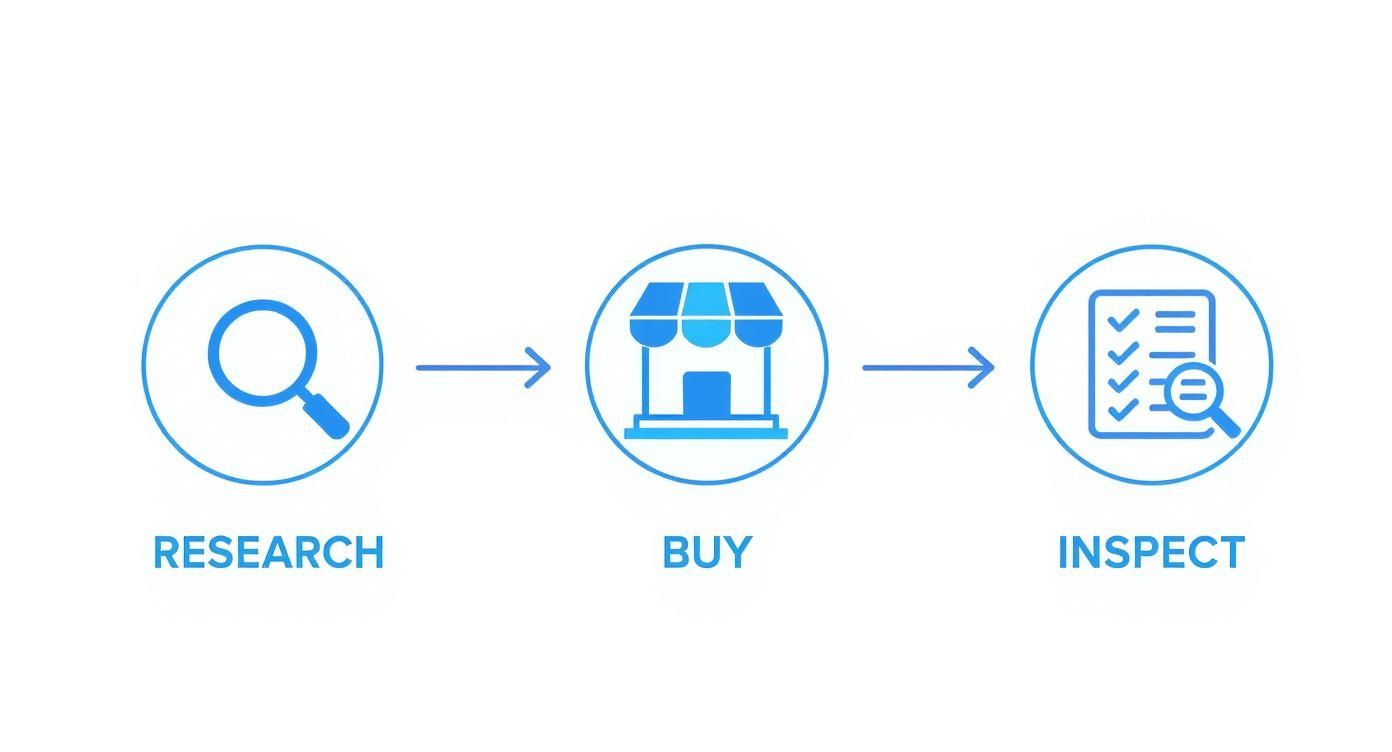
As you can see, that last check is the gatekeeper between a great buy and a terrible mistake. A meticulous hands-on evaluation protects both your investment and the integrity of your collection.
Examine the Case and Bracelet
Start with the overall physical condition. Hold the watch. Feel its weight, its finishing. An overly polished case is a huge red flag for vintage collectors, as aggressive buffing can soften the sharp, original lines and bevels, tanking its value.
- Check the Lugs: Are the edges crisp and well-defined? Rounded, soft lugs are a dead giveaway of heavy polishing over the years.
- Inspect the Crown: Does it screw down smoothly and securely? The logo on the crown should be sharp and correctly oriented when tightened—a small detail many fakes get wrong.
- Feel the Bracelet: A genuine bracelet has a solid, substantial feel. Fakes often feel light, cheap, or jangly. Check for excessive stretch between the links, a common issue on older models.
Scrutinize the Dial and Crystal
The dial is the face of the watch, and it tells the most revealing stories. You’ll absolutely want a loupe (a small magnifier) for this part. Look for any inconsistencies in the text—uneven spacing, fuzzy printing, or misspelled words are screaming signs of a fake or a poorly repainted dial.
A common sign of a refinished dial is lume plots (the glowing dots) that are sloppy or slightly misaligned with the hour markers. On a genuine dial, the application is perfect and precise.
Next, turn your attention to the crystal. Is it sapphire or acrylic, and is that correct for the reference number? Check for tiny chips around the very edge, which can compromise water resistance. A quick trick to test for an anti-reflective coating on modern watches is to hold it under a light; the coating often gives off a subtle blue or purple tint.
Test the Movement and Functions
Finally, it’s time to assess the heart of the watch. You can learn a lot even without opening the caseback. Give the watch a manual wind—it should feel smooth and consistent, not gritty or loose.
Listen closely. Put it up to your ear. Does the movement sound steady and clean? Any rattling or strange noises could signal a serious problem inside.
Now, test every single function, one by one:
- Set the Time: Pull the crown out to the time-setting position. The hands should move without any jumping or stuttering.
- Date Function: Advance the time past midnight. Does the date change crisply, right around 12 o'clock? Test the quick-set date function if it has one.
- Chronograph/GMT: For complications, start, stop, and reset the chronograph. Make sure the hands snap back perfectly to zero. If it’s a GMT, test the independent hour hand.
This hands-on checklist is your best defense against a bad buy. For brand-specific tells, especially with highly counterfeited models like Rolex, a detailed guide is invaluable. You can learn more by reading our expert instructions on how to authenticate a Rolex watch.
Caring For Your Collection Like a Pro
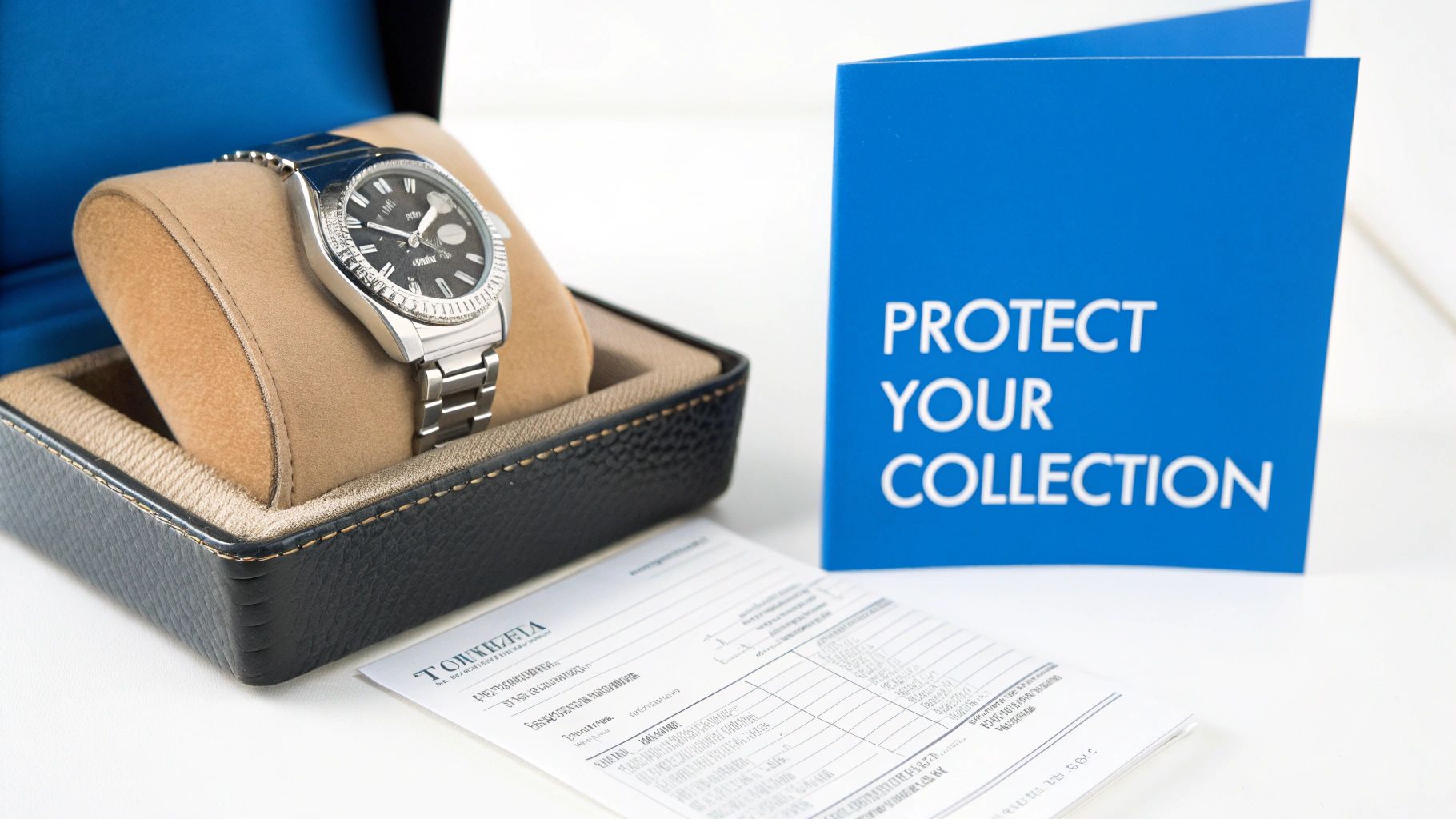
The thrill of the hunt is what gets most of us into collecting. But once the watch is yours, the game changes. True collectors understand that responsible ownership is what separates a passing hobby from a lasting legacy. You wouldn't buy a classic car and then skip the oil changes, and the same principle applies here.
Protecting your investment ensures each piece remains valuable, functional, and ready to be enjoyed for decades. Proper care really boils down to three pillars: regular servicing, smart storage, and the right insurance. Nail these, and you're building a collection that will stand the test of time.
The Importance of Regular Servicing
Think of a mechanical watch as a high-performance engine with hundreds of tiny, moving parts. Over time, the specialized oils that keep everything running smoothly break down, and friction starts to do its dirty work. This is why a full service isn't just a suggestion—it's essential maintenance.
Most brands recommend a complete service every five to seven years. This isn't just a quick tune-up. A watchmaker will completely disassemble the movement, clean every single component, replace any worn parts, re-lubricate everything, and then painstakingly reassemble it. It's the only way to guarantee your watch keeps ticking accurately.
Finding a watchmaker you trust is everything. Look for someone with certifications for your specific brands or at least deep, demonstrable experience with those movements. Be prepared for the cost: a standard service for a luxury piece can run from $500 to over $1,500, depending on how complex your watch is.
Smart Storage Solutions
What you do with your watches when they aren't on your wrist has a massive impact on their condition. The biggest enemies are moisture, magnetism (surprisingly common from modern electronics), and, of course, physical dings and scratches. Your storage solution is your first line of defense.
- Watch Boxes: A good watch box with soft, individual cushions is the baseline. It keeps your collection organized, dust-free, and prevents pieces from scratching each other.
- Watch Rolls: Absolutely essential for travel. A simple leather or canvas roll protects your watches from rattling around in your luggage.
- Safes: Once your collection grows in value, a home safe becomes non-negotiable for theft protection. I’d recommend looking for models that are also fire and water-resistant for total peace of mind.
Storing your watches properly is about more than just organization—it's about preservation. A controlled environment shields them from the elements that can degrade delicate movements and finishes over time.
For a deeper dive into protecting valuable items, this guide on how to store collectibles effectively is a great resource. The core principles of security and climate control apply perfectly to watches.
Insuring Your Growing Assets
As you add more pieces, relying on your standard homeowner's policy is a huge gamble. Most of those policies have laughably low limits for jewelry and watches, often capping coverage at just $1,500 to $2,500 for your entire collection. One incident could be financially devastating.
You have two much better options:
- Add a Rider: Contact your insurance agent and ask to "schedule" your watches by adding a rider (or "floater") to your existing policy. This covers each piece for its full, appraised value.
- Specialized Insurance: This is what most serious collectors do. Companies like Hodinkee Insurance or Jewelers Mutual offer dedicated policies built for watch collections. The key benefit is broader coverage, often including things like "mysterious disappearance," which your homeowner's policy will almost certainly deny.
No matter which path you take, keep updated appraisals for every valuable watch. Protecting your collection this way is the final, crucial piece of the puzzle for any serious collector.
How to Evolve Your Collection Over Time
A watch collection is never really finished. Think of it as a living, breathing journal of your tastes, your knowledge, and even your life. As you dive deeper into the hobby, what you thought you wanted on day one might change completely. That's not just normal—it's the best part of the journey.
This is where you shift from just being a buyer to becoming a true curator. It's about making deliberate moves, knowing when a watch has served its purpose in your collection, and planning what's next. This is the long game, and patience pays off.
Trading Up and Consolidating
One of the smartest ways to refine your lineup is by "trading up." This usually means selling or trading a few good-but-not-great pieces to fund one truly exceptional "grail" watch.
For example, maybe you've got a solid trio: a Tudor Black Bay, an Omega Seamaster, and a Hamilton Khaki Field. You could decide to part with all three to consolidate that value and put it toward a Rolex GMT-Master II. It's a classic move that focuses your collection's firepower into a single, iconic piece that might better represent where you are as a collector today.
Navigating the Sale
When it's time to sell, you've got a few paths to choose from. Each has its pros and cons.
- Private Sale: Going directly to another collector often gets you the best price—no middleman, no commissions. But it's also the most work. You're responsible for photos, finding a trustworthy buyer, and making sure the transaction is secure.
- Consignment: Handing your watch over to a reputable dealer gets it in front of a much larger, pre-vetted audience. They handle everything, but you'll pay for the convenience. Expect a commission of 15-25% of the final sale price.
- Direct Sale to a Dealer: This is your fastest, easiest option. Walk in, get an offer, walk out with cash. The offer will be below market value—that's their business model—but it's a guaranteed, zero-hassle transaction.
Want the best price? Presentation is everything. A watch with its full kit—the original box, papers, tags, and receipt—is always worth more. A recent service record is a huge bonus, too.
View your collection as a dynamic portfolio, not a static display case. Knowing when to sell or trade is just as important as knowing what to buy.
Your Collection as an Asset
Look, passion should always be the driving force. But it's a mistake to completely ignore the financial side of things. The global luxury watch market isn't just a niche hobby; it was valued at roughly USD 53.69 billion in 2024 and is on track to hit USD 134.53 billion by 2032. That's serious growth. If you're curious, you can read the full luxury watch market analysis for a deeper dive.
This boom means certain watches from brands like Rolex and Patek Philippe have become legitimate investment pieces. Keeping an eye on market trends helps you spot when a watch in your collection might be peaking in value. Selling at the right time can free up capital to reinvest in another piece that better fits your long-term vision. It's this asset-aware mindset that builds a collection that's both personally rewarding and financially smart.
Common Questions Every New Collector Asks
As you start diving into the world of watches, a few key questions always come up. Getting straight answers from the start helps you sidestep common mistakes and focus on what really matters: building a collection you'll actually love for years to come.
Here are the honest answers to the questions we hear most often.
How Many Watches Make a Collection?
Forget the idea that you need a dozen watches. There's no magic number. A "collection" could be just three perfectly chosen pieces that cover different bases—maybe a sleek dress watch, a reliable daily driver, and a rugged sports watch for the weekends.
Honestly, most seasoned collectors would be far more impressed by a focused trio like that than a watch box overflowing with ten random, disconnected purchases. The goal is always quality and personal connection, not just racking up a high count. Your collection truly begins the moment you buy that second watch with a clear purpose.
Should I Bother Keeping the Box and Papers?
Yes, absolutely. In the watch community, a timepiece that includes its original box, warranty card, manuals, and even the little hang tags is known as a "full set." It's the single best way to prove a watch's authenticity and has a huge impact on its future value.
A full set can easily boost a watch's resale price by 20% or more. It provides critical provenance and gives the next owner total confidence in its history and legitimacy. Find a safe, dry place for those items and hang on to them.
Is it Better to Buy New or Pre-Owned?
This is the classic debate, and the truth is, a great collection usually has a mix of both. Each path has its own clear advantages, and knowing them helps you decide what's right for your next purchase.
- Buying New: You get the peace of mind of a full manufacturer's warranty, that perfect out-of-the-box experience, and you start building a relationship with an authorized dealer. The obvious downside? Potentially long waitlists for the most popular models.
- Buying Pre-Owned: The secondary market gives you instant access to an incredible variety of watches—discontinued models, vintage gems, and modern classics, often at a better price. It's the best route for finding unique pieces with a story.
What Should I Budget for My First Watch?
Stop thinking about a specific dollar amount. You can find fantastic watches at nearly every price point, so it’s not about hitting a certain number. The real focus should be on value. A $500 Seiko with a tough, reliable automatic movement can be an absolutely brilliant starting point.
The best advice I can give is this: decide what you're comfortable spending, and then hunt for the absolute best example you can find within that budget.
At ECI Jewelers, we believe every great collection starts with a foundation of trust and knowledge. Whether you're seeking your first timepiece or a rare grail, our curated selection of authenticated luxury watches is the perfect place to start your journey. Explore our collection online or visit our NYC showroom today.


