


Before you even think about diamonds or settings, the very first step in choosing an engagement ring is figuring out a budget that actually works for you. This isn't about following some old-school rule or what you see on social media; it's about landing on a number that feels comfortable, ensuring this amazing milestone doesn't turn into a financial headache.
Setting a Budget That Feels Right
Let’s get one thing straight: forget the old "three-month salary" rule. That was a clever marketing ploy from decades ago, not a piece of sound financial advice. Today, it’s all about making a smart, heartfelt purchase that fits your real-life financial picture. This is the key to a stress-free experience—finding a ring that symbolizes your love, not your debt.
A great place to start is with an honest look at your finances. What's your income? Your savings? Are there any big expenses on the horizon? The goal here is to find a number that won’t get in the way of your other major plans, like saving for a wedding or a house. This isn't about being cheap; it's about being financially smart as you start this new chapter together.
Having the Money Talk
If you’re shopping as a couple, talking openly about the budget is a huge and healthy step. It can feel a little awkward at first, but it builds a fantastic foundation of trust and transparency for your future. It's a chance to talk about your shared financial goals and decide together what feels reasonable.
Planning a surprise? Then the homework is all on you. Take a moment to think about your partner's values. Would they be happier with a more modest, meaningful ring so you can splurge on an unforgettable honeymoon? Or is the ring itself something they've always dreamed about? Answering these questions honestly will point you in the right direction.
The best budgets are based on reality, not expectations. The perfect price is the one that lets you celebrate your commitment without a single worry about the bill that comes after. Go with what you can genuinely afford.
Maximizing Your Budget
Once you’ve got that number in mind, the real fun can start. Here’s how you can make every dollar work harder for you:
- Prioritize the 4Cs: Figure out which of the 4Cs—Cut, Color, Clarity, Carat—matters most to you both. You can often get a much more brilliant, eye-catching diamond by prioritizing an excellent cut over, say, a flawless clarity grade, saving you a good amount of money.
- Consider the Setting: A classic, simple solitaire setting is going to cost less than an intricate pavé or halo design. This frees up more of your budget to put toward a knockout center stone.
- Think About Metal Choice: Platinum is a top-tier choice, no doubt. But 14k gold offers a gorgeous and durable alternative that's much more accessible from a price standpoint.
The global engagement ring market is booming, with a valuation of around $79 billion in 2024. For a savvy shopper, a bigger market means more competition and more choices, which can definitely work in your favor.
Ultimately, figuring out how much to spend on an engagement ring is a deeply personal journey. There is no right or wrong answer—only what’s perfect for your story.
Discovering Their Perfect Ring Style
With your budget squared away, it’s time for the fun part: figuring out the ring style your partner will adore. Think of yourself as a style detective on a mission. The goal is to find a ring that feels so perfectly them, it’s almost like they picked it out themselves.
A great place to start is their current jewelry box. What do they already own and love? Pay close attention to the pieces they wear every day. Do they lean towards bold, modern designs, or are they drawn to delicate, vintage-inspired accessories? Notice the metal color, too—are they a yellow gold, rose gold, or platinum/white gold person? Their existing collection is full of clues.
Decoding Popular Ring Styles
The world of engagement rings can feel a bit overwhelming at first glance, but don't worry. Most designs fall into a handful of classic categories, and each one tells a unique story that complements a certain personality. Getting familiar with these will help you narrow down the search in no time.
To help you get started, we've put together a quick comparison of the most common engagement ring styles. This table should help you quickly identify which direction might be the best fit for your partner's taste.
Popular Engagement Ring Styles at a Glance
| Style | Description | Best For |
|---|---|---|
| Solitaire | A timeless classic featuring a single, stunning diamond on a simple band. | The partner with a sophisticated, traditional, and understated sense of style. |
| Halo | A center stone is surrounded by a circle of smaller diamonds, adding major sparkle and making the main diamond appear larger. | The glamorous partner who loves eye-catching sparkle and a "wow" factor. |
| Three-Stone | A center stone flanked by two smaller stones, symbolizing the past, present, and future of your relationship. | The sentimental partner who appreciates both meaning and a lot of visual impact. |
| Vintage-Inspired | Characterized by intricate details like milgrain, filigree, and unique, antique shapes. | The partner who loves one-of-a-kind, story-rich pieces with a romantic, old-world feel. |
Each of these styles has its own loyal following, and sometimes popularity even varies by location. For instance, the classic solitaire accounts for roughly 60% of engagement ring sales in the United States, proving its timeless appeal.
Understanding Ring Settings
The setting is just as important as the style—it’s how the diamond is physically held in the ring. This detail dramatically affects the ring's overall look, its sparkle, and even how durable it is for everyday wear.
Here are a few common settings you'll run into:
- Prong Setting: Uses small metal claws to grip the diamond, which allows the maximum amount of light to enter the stone for incredible brilliance.
- Bezel Setting: A thin metal rim encircles the diamond, offering the most secure and protective hold. This is a fantastic choice for someone with an active lifestyle.
- Pavé Setting: Involves embedding small diamonds very close together along the band, creating a continuous, glittering surface of sparkle.
This decision tree visualizes the initial steps of the ring buying journey, from confirming you're ready to aligning on finances before you start shopping.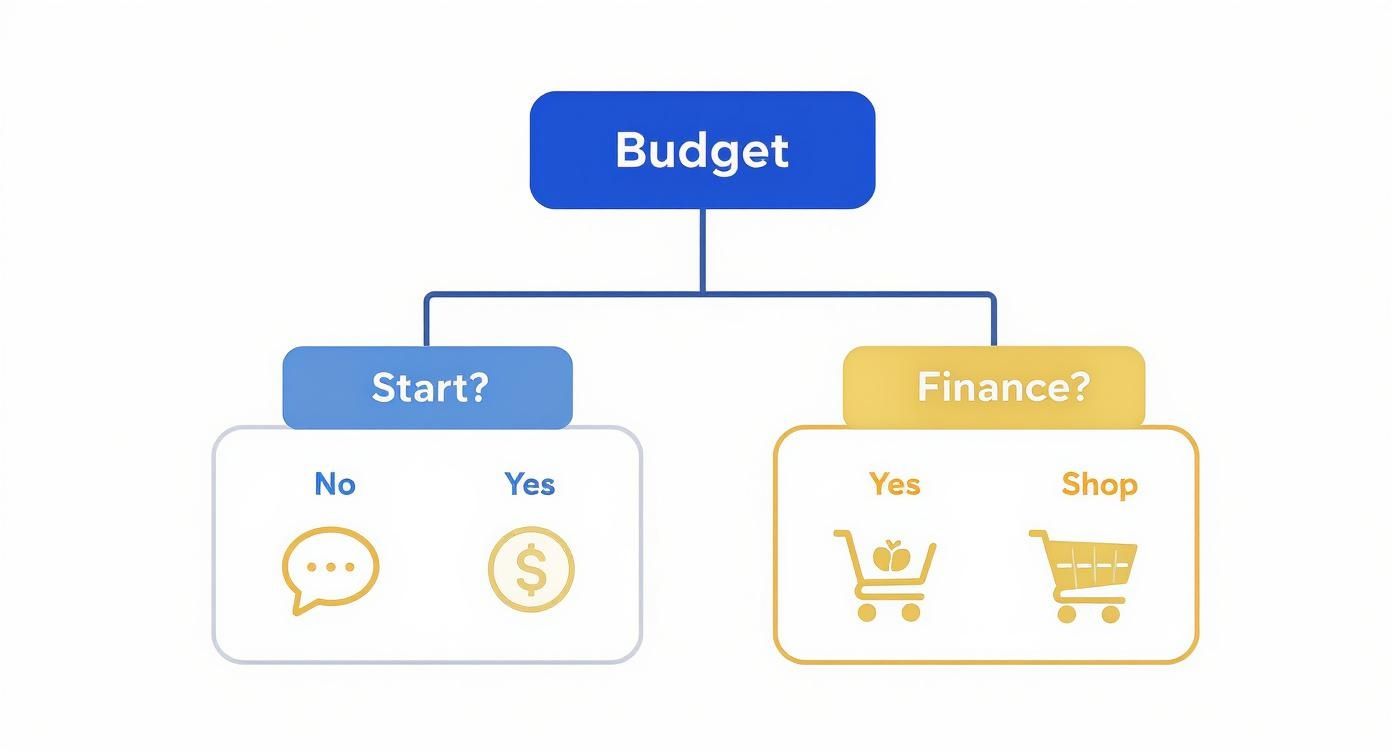
The visual flow emphasizes that a solid financial plan is the foundation for a successful and stress-free shopping experience.
Pro Tip: Casually browse online jewelry sites together. You can point out different styles and ask for their opinion under the guise of "helping" a friend or family member pick out a gift. Their gut reactions will give you invaluable feedback.
By combining your detective work with a solid understanding of ring designs, you’ll be in a great position to make a choice. Exploring a diverse collection of beautiful engagement rings is the perfect next step to see these styles in action and find the one that truly captures their essence.
Making Sense of the 4Cs Without Overpaying
The 4Cs—Cut, Color, Clarity, and Carat—are the universal language of diamonds, but getting bogged down in the technicals is a classic rookie mistake. The real secret is knowing which “C” to prioritize to get a jaw-dropping ring without blowing your budget. Think of it less like an exam and more like a strategy.
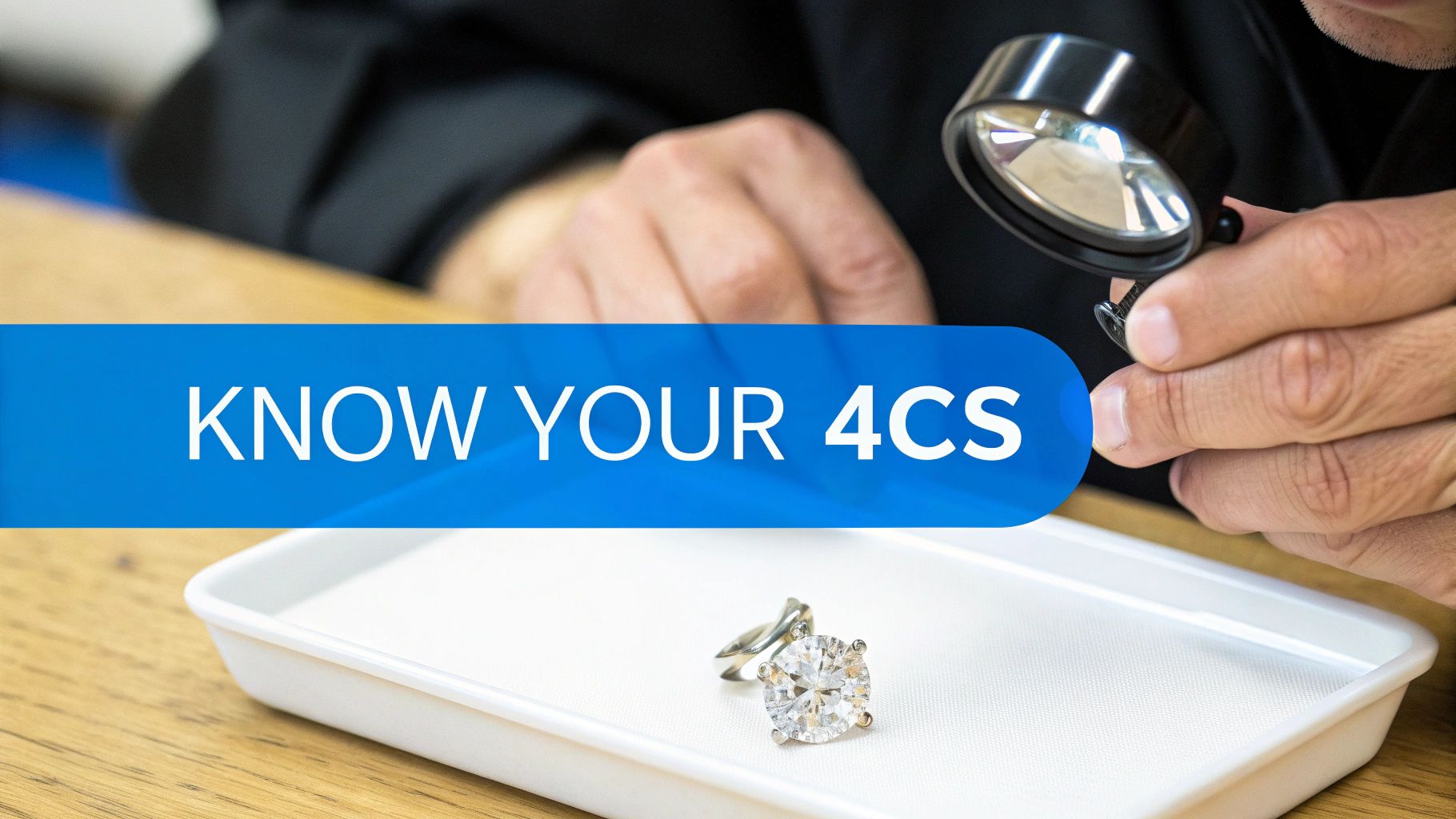
Most people instinctively think Carat (the size) is what matters most. In reality, any jeweler worth their salt will tell you to pour your budget into the Cut. A diamond's cut isn't its shape; it's all about how masterfully the facets are angled to catch and reflect light. An "Excellent" or "Very Good" cut grade is non-negotiable if you want that fiery, brilliant sparkle everyone dreams of.
This is where you get the most bang for your buck. A beautifully cut diamond can look bigger and more alive than a clunky, poorly cut stone with a higher carat weight. If there's one "C" you never, ever compromise on, it's this one.
Finding the Sweet Spot for Color and Clarity
Now, let's talk Color and Clarity. Diamond color is graded from D (completely colorless) down to Z (lightly colored). While a D-color diamond is the pinnacle on paper, you don't need to shell out a fortune for that level of perfection.
The sweet spot for nearly everyone is in the G-H range. These diamonds are officially "near-colorless," but once set in a ring, they appear stunningly white to the naked eye. Making this one small adjustment can free up a huge chunk of your budget for other things, without anyone ever noticing a difference.
Clarity is similar. It measures the tiny imperfections inside or on the surface of the stone. The scale goes from Flawless (FL) to Included (I), but your goal shouldn't be perfection. It should be finding a diamond that's "eye-clean." This just means you can't see any flaws without a jeweler's loupe.
Here's a pro tip: Many diamonds in the VS2 (Very Slightly Included) and even some SI1 (Slightly Included) grades are completely eye-clean. You get a visually perfect stone without paying a premium for a level of clarity that only a microscope can appreciate.
If you really want to get into the weeds on this stuff, our comprehensive guide to diamond education has all the charts and details you could need.
Smart Strategies for Carat Weight
Finally, we have Carat—the diamond's weight. Everyone wants a ring that makes a statement, and there are some really clever ways to get there without overspending.
One of the best industry secrets is to buy just shy of the "magic" carat weights. Prices take a noticeable jump at those milestone numbers like 0.50 ct, 1.00 ct, and 1.50 ct.
Try these tactics instead:
- Shop Shy: A 0.95-carat diamond looks identical to a 1.00-carat one on the finger, but it can cost significantly less. The visual difference is impossible to spot, but the savings are very real.
- Focus on Shape: Some shapes just look bigger. Ovals, pears, and marquise cuts have a larger top surface area than a round diamond of the exact same weight, creating a fantastic size illusion.
- Let the Setting Do the Work: A halo setting is a brilliant move. By surrounding the center stone with a ring of smaller diamonds, you dramatically increase the overall sparkle and make the main diamond look much, much larger than it is.
By balancing the 4Cs with a bit of strategy, you can find a diamond that's absolutely brilliant and perfectly in line with what you want to spend. It’s not about finding the perfect stone on a certificate; it’s about finding the one that looks perfect on their hand.
Choosing the Right Gemstone and Metal
The center stone usually gets all the attention, but the metal band and your choice of gemstone are what really bring the ring's story together. These details shape the ring's entire vibe, its toughness for everyday life, and how personal it feels. Thinking about how to choose an engagement ring means looking past just the diamond—your decisions here affect everything from how it feels on the finger to how it looks decades from now.
The metal you choose for the band is the foundation. It sets the stage for the whole design, influencing both the ring's appearance and the upkeep it'll need down the road.
Selecting the Perfect Metal Band
Every metal has its own personality and practical trade-offs. Let's dig into the most common choices you'll encounter.
- Platinum: This is the top-tier option, loved for its naturally bright white shine and serious durability. Platinum is hypoallergenic and has a satisfying heft to it, feeling more substantial on the finger than gold.
- White Gold: If you love the look of platinum but not the price tag, white gold is your answer. It's a gold alloy coated in rhodium for that crisp white finish. Just know that this plating might need a refresh every few years to stay looking its best.
- Yellow Gold: You can't go wrong with this classic. Yellow gold is warm, timeless, and looks fantastic against warmer skin tones. It's also fairly low-maintenance compared to its white gold cousin.
- Rose Gold: This trendy, romantic metal gets its signature pink hue from a copper alloy. Its unique color flatters a wide range of skin tones and hits that perfect note between vintage and modern.
Here's something most people don't realize: durability isn't just about avoiding scratches. When platinum gets scratched, the metal is just moved around, not lost. Gold, however, actually loses tiny particles with each scratch over time.
Before we get into the details, here's a quick comparison to help you weigh your options.
Comparing Popular Engagement Ring Metals
This table breaks down the key features of the most common metals used for engagement ring bands to help you make an informed decision.
| Metal | Durability | Maintenance | Typical Cost | Best For |
|---|---|---|---|---|
| Platinum | Extremely durable, dense, and strong. Scratches can be polished out. | Low. It's naturally white, so no replating is needed. Requires occasional polishing. | $$$$ | Someone with an active lifestyle or sensitive skin, looking for a premium, lifelong metal. |
| White Gold | Durable, but the rhodium plating can wear off over time. | Medium. Needs replating every 1-3 years to maintain its bright white color. | $$$ | Someone who wants the platinum look for a more moderate budget and doesn't mind occasional upkeep. |
| Yellow Gold | Softer than platinum, can scratch. Higher karats are softer. | Low. Scratches can be easily polished out by a jeweler. | $$ | The traditionalist who loves a classic, warm look and wants a low-maintenance ring. |
| Rose Gold | The copper alloy makes it quite durable, often tougher than yellow gold. | Low. Its color is stable and doesn't require plating. | $$ | The fashion-forward individual who wants a unique, romantic, and modern-yet-vintage feel. |
Ultimately, the best metal comes down to a blend of your partner's style, your budget, and how much maintenance you're willing to handle.
Exploring Diamond Alternatives and Ethical Choices
Diamonds are classic, sure, but they’re far from the only game in town. Colorful gemstones are a fantastic way to inject some personality and create a truly unique ring. Sapphires, with their deep blue tones, and emeralds, famous for their rich green, are both beautiful and durable choices.
When considering any gemstone, you absolutely need to check its hardness on the Mohs scale. For a ring that's going to be worn every day, you want a stone that ranks 7.5 or higher.
Beyond the type of stone, there’s a massive shift happening toward ethical and sustainable choices. People want to buy things that align with their values. This has led to a huge surge in the popularity of lab-grown diamonds, which are physically and optically identical to their mined counterparts.
In fact, lab-grown stones now account for nearly 20% of all diamond engagement rings sold in the U.S. That's a mind-blowing jump from just 2% back in 2016. You can find out more about these jewelry industry trends and what they mean for shoppers. This shift is great for couples, allowing them to get a bigger or better-quality stone for their budget while making a choice they can feel proud of.
Getting the Sizing and Final Details Right
You’re almost there. You've navigated the Four Cs, picked a metal, and zeroed in on a style. Now it’s time for the details that transform a beautiful ring into her perfect ring. Don’t rush this part—getting the size and personal touches right is what makes the proposal moment truly seamless.
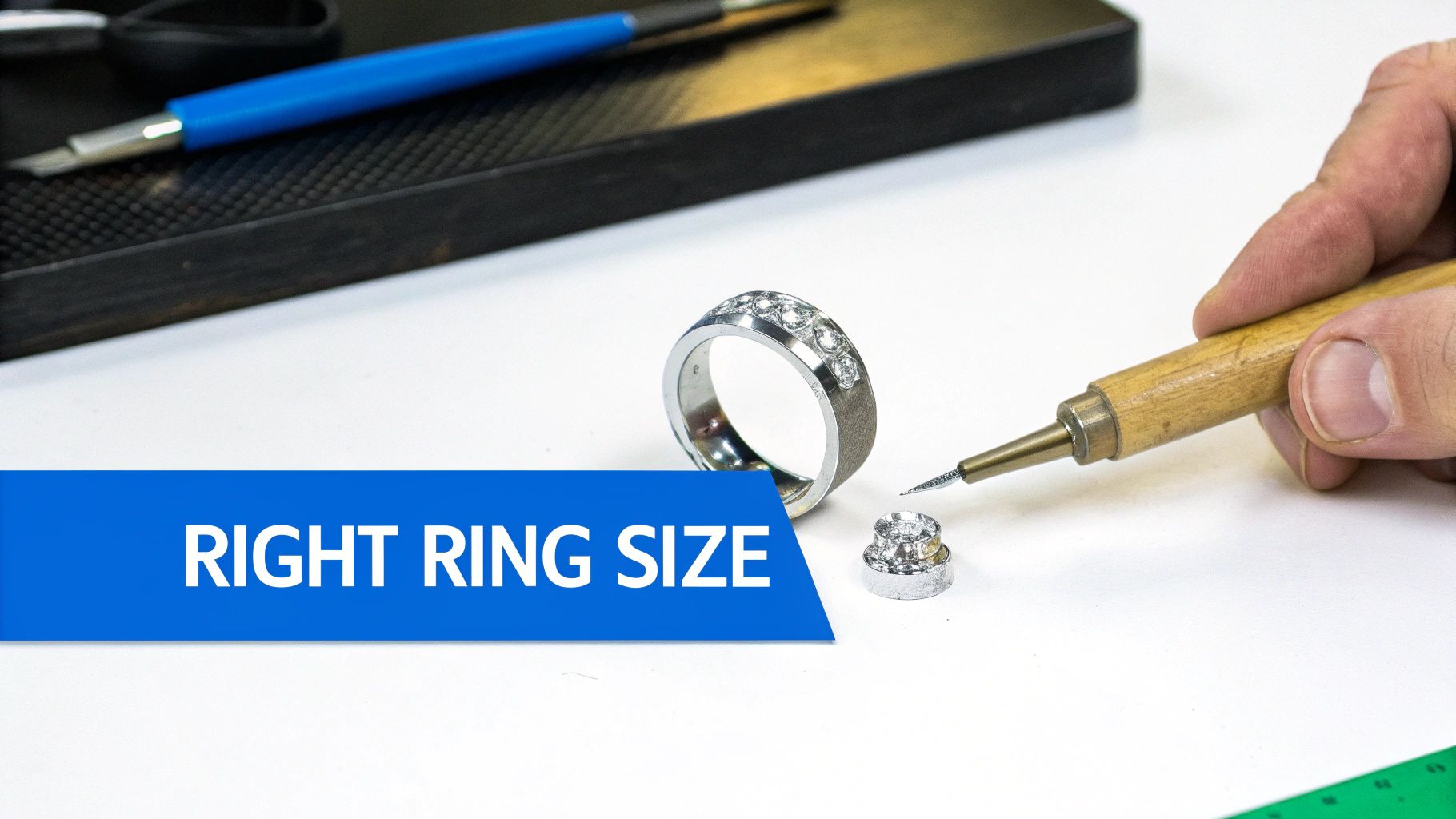
Figuring out the correct ring size for a surprise proposal is probably one of the biggest hurdles. Guessing is a massive gamble. Resizing is often possible, but some intricate designs—like pavé bands or eternity rings—can be difficult or even impossible to alter.
Luckily, you have a few sneaky ways to get it right. The best method is to "borrow" a ring she already wears on her ring finger and have a jeweler measure it. If that feels too risky, you can trace the inside of the ring on paper. Another great option is to bring a trusted friend or family member into the fold; they might already know her size or can subtly find out for you.
Partnering with a Reputable Jeweler
Your relationship with your jeweler is everything. A good one won't just sell you a ring; they'll act as your guide, explaining the nuances and helping you get the absolute best value for your budget. Look for jewelers with a solid reputation, transparent pricing, and stellar reviews.
Most importantly, never buy a diamond without its certification. A report from a respected lab like the GIA (Gemological Institute of America) or IGI (International Gemological Institute) is non-negotiable. This document is the unbiased proof of your diamond’s quality, verifying every detail from its cut to its carat weight.
Think of a diamond certificate as the stone's official passport. It provides an objective, third-party assessment that protects your investment and ensures you're getting exactly what you paid for.
Before you swipe your card, make sure you understand the jeweler's policies. Asking these questions upfront can save you a world of headaches down the road.
- Warranty: What does the warranty cover? Does it include routine maintenance like cleanings or prong inspections?
- Insurance: Most jewelers partner with insurance companies or can recommend one. Getting the ring insured immediately is a must to protect against loss, theft, or damage.
- Return Policy: What are the exact terms? Is it a full refund, or store credit only? How long is the return window?
Adding the Final Personal Touches
This is your chance to make the ring a true symbol of your relationship. Personalization elevates it from a beautiful piece of jewelry into a meaningful story you can both wear.
Engraving is a classic choice. A special date, a short phrase, or your initials inside the band adds a layer of intimacy. We’re also seeing more creative touches, like embedding a tiny "hidden" birthstone on the inner shank—a secret detail just for the two of you. It's these thoughtful additions that make a ring an irreplaceable family heirloom.
A Few Common Questions We Hear All The Time
Even after you've done all the research, a few nagging questions always seem to pop up. Getting those final answers can give you the confidence you need to pull the trigger. Let's walk through some of the most common uncertainties we see when people are learning how to choose an engagement ring.
First things first: that old "three-month salary" rule is officially dead. The right amount to spend is whatever fits comfortably within your personal finances without causing you stress or derailing your other big life goals. An engagement ring is a symbol of the future you're building together, and that future shouldn't start with unnecessary debt.
Should I Go for Quality or Size?
This is a classic dilemma: should you prioritize the diamond's size (Carat) or its overall quality (Cut, Color, Clarity)? As experts who see these stones every day, our answer is always the same: quality, especially the Cut, is far more important.
An exceptionally well-cut diamond will capture and reflect light with incredible brilliance, making it sparkle like crazy. A great cut can even make a diamond appear larger than a poorly cut stone of the same carat weight.
Think of it this way: a slightly smaller, eye-clean diamond with an excellent cut will always outshine a larger diamond that's full of visible flaws or has a dull, lifeless appearance. Your goal should be to get the most brilliant, fiery stone you can within your budget.
What’s the Deal with Lab-Grown Diamonds?
Are lab-grown diamonds a good choice? Absolutely. They are chemically and visually identical to natural diamonds—the only difference is where they came from. They've become a fantastic alternative for a couple of big reasons:
- Serious Value: Lab-grown diamonds often cost 30-40% less than their mined counterparts of similar quality. This can mean getting a larger or higher-quality stone for the exact same budget.
- Peace of Mind: For many people, the ethical and environmental benefits are a huge draw.
Ultimately, the choice between a natural and a lab-grown diamond is a personal one. It comes down to your values and priorities. There is no wrong answer here.
How Can I Secretly Find Their Ring Size?
Figuring out their ring size without ruining the proposal surprise is a challenge every proposer faces. The most reliable method is to secretly borrow a ring they often wear on their ring finger and bring it to a jeweler to be measured.
If that feels too risky, you can try carefully tracing the inside of the ring on a piece of paper. Another great tactic is to bring a close friend or family member into your circle of trust—they might already know the size or can find a clever way to ask without raising suspicion. Getting this little detail right just makes the proposal moment that much smoother.
At ECI Jewelers, our experts are here to guide you through every single question and detail. We want to make sure you find a ring that perfectly symbolizes your love story.
Explore our collection of exquisite engagement rings and let us help you make a confident choice you’ll both cherish forever.


