


You’re probably in one of two places right now. You’re either about to buy a Rolex Datejust and want to know whether you’re putting money into a lasting asset, or you already own one and you’re wondering if it’s smart to hold, sell, or trade into something else.
That question sounds simple, but it rarely is. A Datejust can be a daily watch, a milestone purchase, a family piece, or part of a broader watch portfolio. Those are different goals, and they lead to different definitions of a “good investment.”
Collectors run into this all the time. One buyer wants upside. Another wants stability. A third wants something they can wear every day without feeling like they’re exposing a speculative asset to unnecessary risk. The Datejust sits in the middle of all three categories, which is why it keeps coming up in serious buying conversations.
That middle ground is also why the model keeps its appeal outside watches. The same person who values a Datejust often values objects with history, material integrity, and enduring demand. That’s part of why resources like the Astro West meteorite guide resonate with collectors. They help explain why people assign value to objects that combine rarity, story, and permanence.

Is Rolex Datejust a Good Investment?
Yes, a Rolex Datejust can be a good investment, but usually not for the reason people first imagine. In our view, the Datejust is strongest as a long-term store of value with excellent liquidity, not as a fast-moving speculation play. Current pre-owned pricing illustrates the point: widely traded Datejust examples span from roughly entry-level vintage and smaller references to much higher-end configurations, while mainstream steel models sit in a narrower real-world band, with a steel 126200 often quoted around $8,500 to $11,500 and a fluted 126334 commonly around $11,000 to $16,500 according to WatchGuys pricing.
That makes the answer more conditional than absolute. The Datejust is a good buy when you enter at a sensible price, choose a configuration the next buyer will also want, and give the watch time to do what it has historically done well: hold value and trade consistently. It is a weaker choice if your plan depends on beating hotter Rolex sport models over a short window or buying an average example and hoping the crown alone carries the result.
From our side of the market, collectors and resellers do not define a “good investment” as the watch with the biggest chart spike. They mean something simpler: can I buy a strong example, wear it often, and still exit later without getting punished? That is where the Datejust has real credibility.
A quick decision framework
Use these six filters before you decide whether a Datejust makes sense for you:
- Entry price: Are you buying close to current market reality or paying an emotional premium?
- Configuration desirability: Steel, fluted, Jubilee, and broadly liked dials usually trade more easily than odd combinations.
- Condition: Case sharpness, dial integrity, bracelet wear, and originality set the floor and ceiling.
- Completeness: Box, papers, links, and service records reduce buyer hesitation later.
- Holding period: The Datejust generally rewards years of ownership more than quick flips.
- Exit liquidity: Ask how easy this exact watch will be to explain and sell when it is your turn to move it.
Those criteria drive the rest of this article, and they line up with the pricing and resale behavior discussed below. They also explain why two watches carrying the same family name can produce very different outcomes.
What most buyers are actually trying to solve
A Datejust usually enters the conversation when someone wants three things at once:
- Wearability: It works with a suit, knitwear, denim, and almost any setting short of dedicated sports use.
- Recognition: It has immediate Rolex identity without leaning too heavily into hype.
- Financial sanity: It tends to attract buyers who care about value retention, not just excitement.
That profile makes the Datejust different from purely speculative buying. A Daytona or GMT-Master II might dominate attention during hot periods. A Datejust tends to attract buyers who want to own something they’ll still like when the market cools.
A strong watch investment isn’t only about how high it can go. It’s also about how well it behaves when sentiment turns.
The better way to evaluate the Datejust is to ask what role it plays. For many collectors, it’s not the highest-growth piece in the box. It’s the one that keeps the box grounded.
How We Evaluate Whether a Rolex Datejust Is a Good Investment
We judge investment quality using market depth, not marketing language. That means looking at current asking ranges, historical resale behavior, configuration-specific demand, and the friction involved in selling a watch back into the market. As a baseline, recent resale guides show the Datejust acting more like a stable Rolex than a runaway one, with common steel Datejust 41s often around $8,500 to $15,500, two-tone models around $11,500 to $17,900, and precious-metal examples much higher, according to Global Watch Buyers’ 2026 resale guide.
I think this methodology matters because “good investment” means very different things in watch buying. A dealer, a collector, and a first-time buyer may all use the same phrase while judging completely different outcomes. We keep the test practical: what can you buy it for, how easy is it to own well, and how believable is the resale story when you eventually move it.
The criteria we use
-
Price discipline
A strong watch bought too high becomes a weak investment. -
Reference-specific demand
Not every Rolex Oyster Perpetual Datejust behaves the same in resale. -
Physical condition and originality
Sharp, correct watches command trust; compromised watches invite discounting. -
Completeness and documentation
Box, papers, links, receipts, and service history improve buyer confidence. -
Holding period
We give more weight to multi-year ownership than short-term price noise. -
Liquidity at exit
The best watch on paper still needs a real buyer pool when it is time to sell.
This is also why we do not treat the Datejust as one single asset. The family includes steel, Rolesor, precious metal, vintage, modern, smooth bezel, fluted bezel, Oyster bracelet, Jubilee bracelet, and a wide range of dial executions. In actual valuation conversations, those details often matter more than the broad model name.
A Decades-Long Track Record of Value
The strongest argument for the Datejust isn’t hype. It’s history.

Pre-owned Rolex Datejust models rose from an average resale value of $1,150 in 2010 to about $8,500 as of May 2025, a 639% increase over 15 years, and that growth outpaced many other Rolex models during the same period, according to Business Insider’s reporting on Bob’s Watches market data.
That number is important for two reasons. First, it confirms that the Datejust has done far more than merely “hold value.” Second, it shows that long-term performance in watches often comes from consistency, not noise.
Why that long-term record matters
A lot of watch buyers focus too much on short windows. They compare what one model did during a hot cycle and assume that tells the whole investment story. It doesn’t.
The Datejust has one major advantage over trend-driven references. It has a huge buyer base. The watch appeals to first-time Rolex buyers, seasoned collectors, people buying for everyday wear, and people buying for milestones. That broad demand base supports activity in the secondary market.
The model also benefits from a very old and very durable design language. The fluted bezel, Cyclops, Jubilee bracelet, and classic case proportions didn’t become desirable last year. They’ve remained desirable across generations.
The Datejust isn’t only a resale story
The market rewards watches that people want to own. The Datejust has always had that going for it.
Some references become valuable because they’re scarce and difficult to obtain. The Datejust often becomes valuable because people keep returning to it. That’s a different kind of strength. It creates a deeper market and usually a more forgiving one.
For a closer visual look at why the Datejust keeps attracting buyers across generations, this overview is useful:
What this performance does and doesn’t prove
A historical gain like that doesn’t guarantee every Datejust will perform equally. It doesn’t mean every buyer at every price point will win. It does prove that the collection has a documented record of appreciation across a long span of time.
That’s different from relying on forum chatter or a temporary premium.
| What the data supports | What it doesn’t support |
|---|---|
| Long-term appreciation exists | Every reference performs the same |
| The collection has broad secondary demand | Short-term flipping is always profitable |
| Datejust belongs in serious investment conversations | Configuration doesn’t matter |
Practical rule: When a watch shows durable demand across many years, it deserves to be judged as an asset class inside collecting, not just as a purchase.
That’s where the Datejust earns its place. Not as a one-season winner, but as a model with a deep record of value retention and real market memory.
Not All Datejusts Are Created Equal
The phrase “Rolex Datejust” hides a lot of variation. That’s where many buyers get sloppy.
Two Datejusts can sit side by side in a case, look broadly similar to a casual buyer, and have very different resale behavior. Material, size, bezel, bracelet, and dial all shape demand. If you’re trying to answer is Rolex Datejust a good investment, you have to stop thinking in terms of one model and start thinking in terms of specific configurations.
A good example is the stainless steel Datejust 41 Ref. 126334, which has a retail price of $11,100 and trades around $12,000 to $16,000, representing an 8% to 44% premium, according to Everest’s review of Rolex models that hold value. That spread isn’t random. It reflects buyer preference for the right setup.
The combinations that usually draw stronger demand
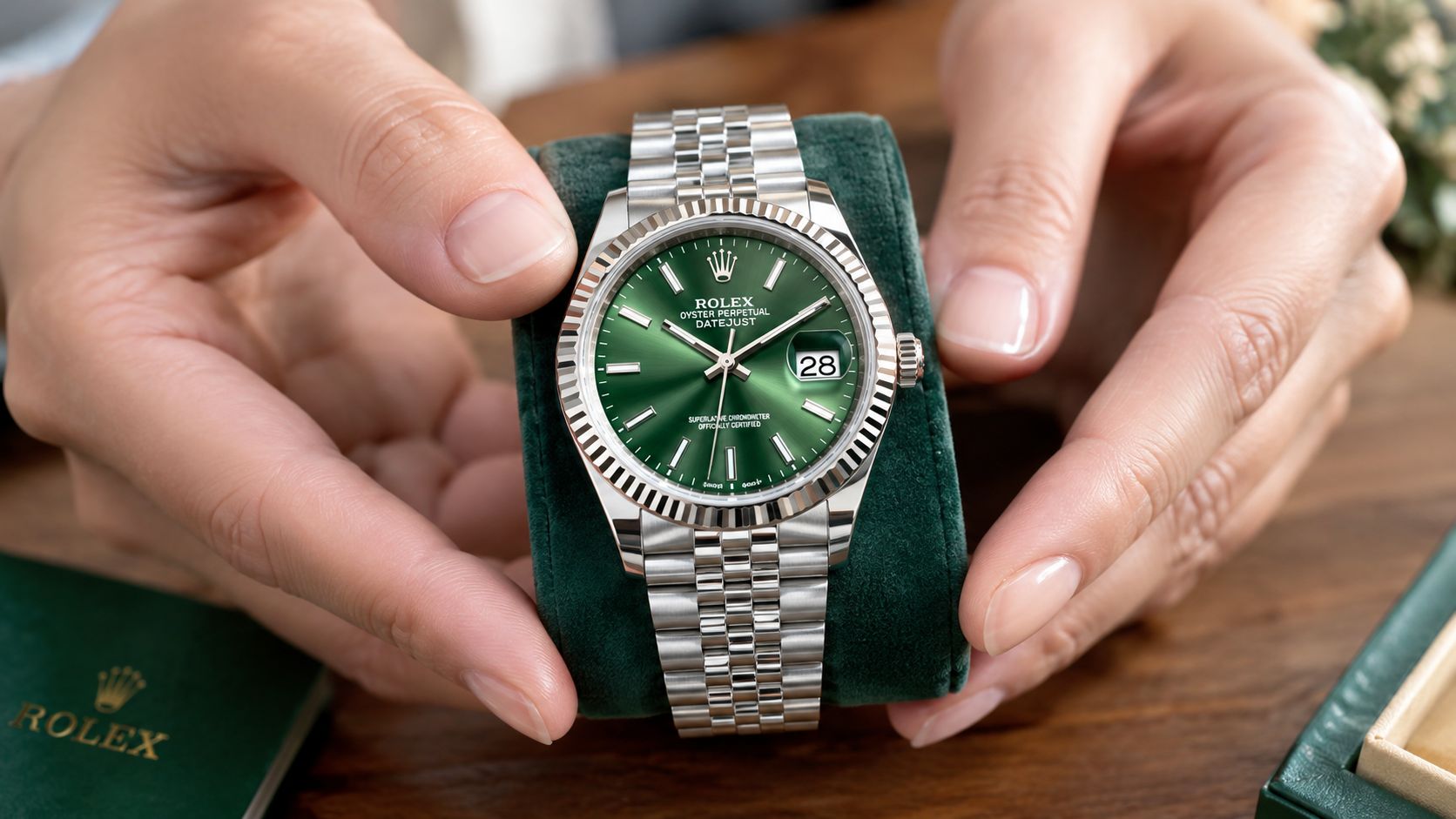
The market tends to reward the Datejust when it looks unmistakably like a Datejust. That usually means a fluted bezel, a Jubilee bracelet, and a dial buyers recognize immediately as desirable.
Here’s the practical breakdown:
- Steel over complication: Stainless steel references are often easier to move because the buyer pool is broad.
- Fluted bezel over smooth: Many buyers want the classic visual identity. Smooth-bezel models can be excellent watches, but they often don’t generate the same collector heat.
- Jubilee over Oyster: The Jubilee bracelet reinforces the model’s signature look. Oyster can be great on the wrist, but Jubilee often feels more “complete” to the market.
- The dial's importance is frequently overlooked: Conservative dials stay liquid. Standout dials can add excitement, but only if buyers agree they’re desirable.
For shoppers comparing current-generation models, this guide to the Rolex Datejust 41 helps clarify how different configurations affect desirability.
Steel, two-tone, and gold don’t behave the same way
Material changes the investment profile.
Steel references usually attract the most straightforward demand. They’re wearable, recognizable, and easier for many buyers to justify. Two-tone models can be excellent values, especially for buyers who like classic Rolex styling and don’t need the broadest possible buyer pool at resale. Full gold pieces are a different category altogether. They can be powerful long-term stores of value, but the audience is narrower and the buy-in is higher.
That means the “best” Datejust depends on your objective.
| Buyer goal | Usually stronger fit |
|---|---|
| Maximum liquidity | Steel, especially classic configurations |
| Traditional Rolex look | Two-tone with fluted bezel |
| Luxury-first ownership | Precious metal references |
What works best and what often disappoints
The strongest Datejust buys usually share a few traits. They look correct, they haven’t been over-personalized, and they make sense the moment someone sees them.
The weaker buys are often the opposite. Odd combinations, aftermarket changes, overpolished cases, replacement parts that don’t match the era, or flashy customization can all narrow the resale audience.
Buyers pay more confidently when the watch looks original, coherent, and easy to explain.
That’s why “cheap for the spec sheet” can become expensive later. If the market doesn’t like the configuration, your entry price won’t save you on exit. The right Datejust isn’t just a Rolex. It’s a Rolex the next buyer also wants.
Anatomy of a High-Value Rolex Datejust
If you want to know whether Datejust models hold value, stop looking for one magic trait. Resale strength usually comes from a checklist of small things done right. In our experience, the fastest-selling examples are rarely the most unusual; they are the easiest to trust, price, and explain.

Value-retention checklist
- Condition: Sharp lugs, even brushing, tight bracelet wear, clean dial, and no moisture history support stronger pricing.
- Reference: Some references are easier to place because buyers already know them and follow them.
- Materials: Steel generally has the broadest market; Rolesor can be strong but more taste-dependent; precious metal needs a narrower buyer.
- Bracelet and bezel combination: Fluted with Jubilee often gets the quickest recognition, while smooth with Oyster can trade at a softer level.
- Dial desirability: Classic silver, black, blue, and some green or motif dials can outperform generic-looking variants, but taste still matters.
- Age or vintage status: Older pieces can gain collector interest if they remain correct and unspoiled.
- Box and papers: Full sets reduce friction and often justify a higher ask.
- Service history: Documented service with genuine parts inspires confidence; vague repair stories do not.
- Current market demand: Even strong references move differently depending on broader Rolex sentiment.
Condition sets the ceiling
Condition is still the first filter.
Collectors will forgive normal wear. They won’t forgive heavy polishing, damaged lugs, soft case lines, moisture issues, stretched bracelets, or mismatched parts. Once the physical integrity of the watch is compromised, value usually follows.
This isn’t only cosmetic. Sharp case geometry signals restraint. It tells the next buyer the watch hasn’t been aggressively refinished into losing its original shape.
Box and papers reduce buyer hesitation
The market consistently rewards complete sets because they reduce uncertainty. According to the ECI Jewelers Rolex investment report, pristine examples with original documentation can command 10% to 15% uplifts, and servicing with genuine parts can boost resale by a further 20% to 30% over modified pieces.
That makes sense in real transactions. Original documentation doesn’t just look nice on a sales listing. It lowers perceived authentication risk, supports provenance, and helps justify a stronger asking price.
Why Rolex Oyster Perpetual Datejust configurations behave differently
The Rolex Oyster Perpetual Datejust is not one resale market. Steel references usually attract the deepest buyer pool because they combine recognizability with a more manageable entry price. Two-tone examples can hold value well, but they are more style-sensitive; when buyers are leaning classic, they move nicely, and when tastes shift casual, they can lag comparable steel pieces.
Bezel and bracelet choices also change the watch’s resale personality. Smooth-bezel Oyster models often appeal to buyers who want a cleaner, less dressy look, yet the wider market still tends to identify the “classic Datejust” with a fluted bezel and Jubilee bracelet. I see this play out constantly in buyer conversations: people may admire understated configurations, but when they are spending real money, many still choose the version that looks unmistakably like the model they had in mind.
That pattern is supported by broader resale coverage. Global Watch Buyers’ Datejust resale overview shows different pricing bands for steel, Rolesor, and precious-metal Datejusts rather than one unified curve, which is exactly how the market behaves in practice.
Originality matters more than personalization
One of the most common mistakes owners make is confusing customization with added value.
Aftermarket diamonds, dial swaps, polished bezels that shouldn’t be polished, and non-original parts usually hurt resale. They may suit personal taste, but they shrink the buyer pool. A serious collector usually pays up for authenticity, not embellishment.
That’s why educational experiences around craft can be so useful. If you want a deeper appreciation for what buyers value in untouched watchmaking detail, these bespoke Paris watchmaking workshops are a helpful example of how collectors learn to recognize originality, finishing, and mechanical integrity.
The best-performing Datejusts rarely look “improved.” They look correct.
Provenance and service history support confidence
Service is another area where owners either preserve value or erode it.
A Datejust that’s been maintained with genuine parts and competent work gives buyers confidence in both performance and future serviceability. A watch modified outside those standards raises questions immediately. If the visible parts are wrong, buyers assume the unseen work may be wrong too.
Use a simple hierarchy when you evaluate one
If you’re standing at a dealer counter or reviewing a private listing, evaluate the watch in this order:
| Priority | What to check |
|---|---|
| First | Originality of dial, case, bracelet, and parts |
| Second | Condition and signs of overpolishing or damage |
| Third | Box, papers, and service documentation |
| Fourth | Reference desirability and current buyer demand |
That order keeps you from getting distracted by surface-level appeal. A flashy dial or a good price can pull attention away from the fundamentals. In resale, fundamentals usually win.
How the Datejust Compares to Rolex Sport Models
A lot of buyers ask the wrong comparison question. They ask whether the Datejust is better than a Submariner, GMT-Master II, or Daytona as an investment. The smarter question is what kind of investment behavior you want.

Modern 36mm and 41mm Datejust models have appreciated about 30% to 45% over five years, while lagging sport model performance in the same period, according to The Luxury Playbook’s analysis of Datejust investment behavior. The same analysis notes an important nuance. The Datejust’s lower volatility can produce stronger risk-adjusted returns when sport models correct sharply.
That point gets missed all the time.
Sport models usually offer more upside and more drama
Sport Rolex references attract the most attention because they can move hard and fast. That attention can create powerful upside. It can also create unstable pricing, impatient buyers, and exaggerated expectations.
The Datejust usually trades in a more measured rhythm. It doesn’t need frenzy to stay relevant. That makes it less exciting to speculators and more useful to disciplined collectors.
The real distinction is portfolio role
Think of sport models as growth assets and the Datejust as a stabilizer.
That doesn’t mean the Datejust is boring. It means it often behaves better when the market stops rewarding hype. If a collector already owns more volatile pieces, adding a Datejust can make the overall watch portfolio more resilient.
| Model type | Typical profile |
|---|---|
| Sport Rolex | Higher upside, sharper sentiment swings |
| Datejust | Steadier appreciation, broader everyday appeal |
Why risk-adjusted returns matter in watches
In stocks, investors talk openly about volatility. In watches, people often pretend only headline appreciation matters. That’s a mistake.
A watch that rises dramatically and then corrects hard can still be the worse ownership experience if you bought at the wrong point. A watch with steadier demand can create a better long-term outcome because it gives the owner more flexibility on timing.
If you hate needing perfect timing, the Datejust usually makes more sense than the hotter sport references.
The Datejust earns respect from seasoned collectors. It may not dominate every bull phase, but it often avoids becoming a regret piece when buyers get too aggressive elsewhere.
The assumption that “sport is always better” doesn’t hold
There’s no question that some sport models have produced stronger short-term runs. But many buyers don’t need the fastest-moving Rolex. They need one that they can enter at a sensible level, wear often, and exit without depending on peak sentiment.
That’s exactly where the Datejust can shine. It’s not the highest-octane model in the Rolex lineup. It’s often the one that behaves most rationally.
Understanding the Risks and Investment Horizon
No watch is risk-free. A Datejust may be steadier than many alternatives, but it’s still a luxury asset, and luxury assets are shaped by timing, condition, buying discipline, and broader market appetite.
The first risk is overpaying for the wrong configuration. Buyers often assume the Rolex name alone will protect them. It won’t. A mediocre Datejust bought at an aggressive number can stay mediocre for a long time.
The second risk is short-term thinking. If you buy a Datejust expecting a quick flip, you’re using the model in the wrong way. The collection’s best case is usually long-term ownership with a clean, well-documented watch.
Holding period changes the outcome
The Datejust tends to reward patience more than urgency. That makes it better suited to buyers who think in years, not in the next few months.
If you’re trying to build a broader framework around luxury assets, this primer on investing in luxury watches is useful background. It helps place the Datejust in the context of acquisition discipline, maintenance, and exit planning.
The practical risks buyers overlook
A few problems come up again and again:
- Buying with your eyes only: A pretty dial can distract from a soft case, wrong bracelet, or questionable service history.
- Confusing popularity with immunity: Demand helps, but it doesn’t protect against a bad entry point.
- Ignoring paperwork: Missing documentation doesn’t always kill a deal, but it changes how easy the watch will be to resell.
- Treating maintenance as optional: Deferred service can become a valuation problem later.
A Datejust works best as a long-term store of value you can wear, not as a shortcut to quick profit.
What a realistic mindset looks like
A disciplined buyer asks different questions. Is the watch correct? Is it priced sensibly for the configuration? Will the next buyer understand why it deserves its number? Can I hold this long enough for the market to do its work?
If the answer is yes, the Datejust starts to make real sense. If the plan depends on instant upside, perfect timing, or speculative demand, the buyer is leaning on the wrong strengths.
A Practical Guide to Buying and Selling Your Datejust
Buying and selling a Datejust should be straightforward, but the details matter. Most bad outcomes come from skipping verification, underestimating condition issues, or chasing a deal that only looks good at first glance.
If you’re buying
Start with the reference, but don’t stop there. Confirm the exact configuration. Then inspect originality, bracelet condition, clasp, dial, crystal, and any service records.
Use this checklist:
-
Pick the right role for the watch
Decide whether you want stability, daily wear, or maximum collector appeal. -
Verify the full configuration
Size, material, bezel, bracelet, and dial need to match what the market wants. -
Prioritize authenticity and condition
A slightly more expensive correct watch is often cheaper than a compromised one. -
Favor complete examples when possible
Box and papers can make your future resale much easier.
If you’re selling
Sellers often focus too much on what they paid and not enough on what the watch is today. The market pays for current condition, completeness, originality, and demand.
Before listing or accepting an offer, gather everything connected to the watch. Box, papers, receipts, service records, spare links, and any original accessories all help frame the piece properly. If you’re preparing for that process, this guide on how to sell luxury watches is a practical starting point.
What usually leads to the best outcome
The most successful transactions are rarely the fastest or the loudest. They’re the most clearly documented.
| Scenario | Usually stronger result |
|---|---|
| Clean watch, complete set | More buyer confidence |
| Original parts, documented service | Smoother valuation |
| Aftermarket modifications | Smaller buyer pool |
If you own a good Datejust, treat the file as carefully as the watch. Keep the documents together. Don’t replace parts casually. Don’t polish it every time it picks up a mark. The resale market rewards restraint.
For readers comparing watches to other collectible asset classes, Wealth Collective's page offers a useful broad look at how alternative investments are weighed in 2026, especially around liquidity and exit planning.
Frequently Asked Questions
Will a Rolex Datejust hold its value?
Usually, yes. A well-bought Datejust in a desirable configuration tends to hold value better than many luxury watches because the buyer pool is deep and the model has decades of recognition. Condition, originality, and entry price still decide whether your specific watch performs well.
Is the Rolex Datejust going up in value?
Over long periods, the collection has shown real appreciation, but not every reference rises at the same pace. The broader pattern is steadier growth and dependable liquidity rather than explosive jumps, which is why many buyers view it as a conservative Rolex rather than a momentum trade.
Is the Rolex Datejust worth buying?
Yes, if you want a watch you can wear often and still treat responsibly as an asset. I would call it one of the easiest Rolex models to justify because it blends daily usability, strong brand recognition, and a resale market that is usually easier to access than niche dress watches.
Is the Datejust an entry level Rolex?
It is often described that way because it sits below many professional models in hype and, depending on the reference, sometimes in price. That label can be misleading. The Datejust is one of Rolex’s core long-term designs, and strong references are taken seriously by both first-time buyers and experienced collectors.
Which Datejust models usually retain value best?
The most resilient performers are often clean, original steel models with classic features buyers instantly recognize, especially fluted bezels and Jubilee bracelets. Full sets, attractive but not overly niche dials, and unpolished or lightly worn cases also help because they make resale easier and more credible.
The Verdict Is the Datejust a Good Investment
Yes, the Rolex Datejust is a good investment for buyers who want long-term wearable value retention, not short-term flipping upside.
Best fit: buyers who want a Rolex they can wear, maintain, and resell later with a realistic chance of preserving or improving value over time.
Worst fit: buyers chasing the fastest possible gains, relying on short holding periods, or expecting the Datejust to behave like the hottest sport-model cycle.
Whether you come out ahead usually depends on four things: buying the right reference at the right price, choosing a configuration the market already understands, preserving condition and originality, and holding long enough for steady demand to matter. In plain terms, the Datejust works best when you treat it like a durable asset with real liquidity rather than a quick speculative ticket.
If you’re buying, selling, or trading a Rolex Datejust, ECI Jewelers offers authenticated luxury watches, transparent market-based valuations, and secure concierge support for collectors who want to move carefully and confidently.


I understand about the condition and the look of the watch but to have papers and the original box sometime that’s a little ridiculous if you have to watch 10 or 15 years come on sometime you can expect a person to have the papers still but Julius this is the game that’s being played and it’s the same even if the watch is an excellent condition