


You're looking at a Calatrava because you want a Patek Philippe dress watch, but you don't want to buy on mythology alone. The line is made for collectors who care about restrained design, movement quality, provenance, and what a specific reference does on the secondary market. This guide covers the history, design language, important references, authentication, and realistic value positioning. By the end, you'll have the context to buy with confidence.
Key takeaways
- The modern Ref. 6196P uses the manual-wind 30-255 PS, with twin barrels, a 65-hour power reserve, and a slim 9.33 mm case profile, as detailed by Watches by SJX's technical review.
- The easiest entry point depends on condition and market channel. WatchCharts tracks Calatrava prices from about US$5,509 to US$131,453, with a median near US$23,532, across 59 references. See the Calatrava market overview.
- A Calatrava shouldn't be treated like a Nautilus or another steel sports watch. WatchCharts reports that Calatrava market prices fell 8.9% over the past 365 days, and several classic precious-metal references trade below retail.
The Calatrava now covers several different eras and mechanical personalities. Before choosing one, study the broader Patek Philippe Calatrava collection as a family of watches, not as one interchangeable dress-watch idea.
The Story Behind the Patek Philippe Calatrava
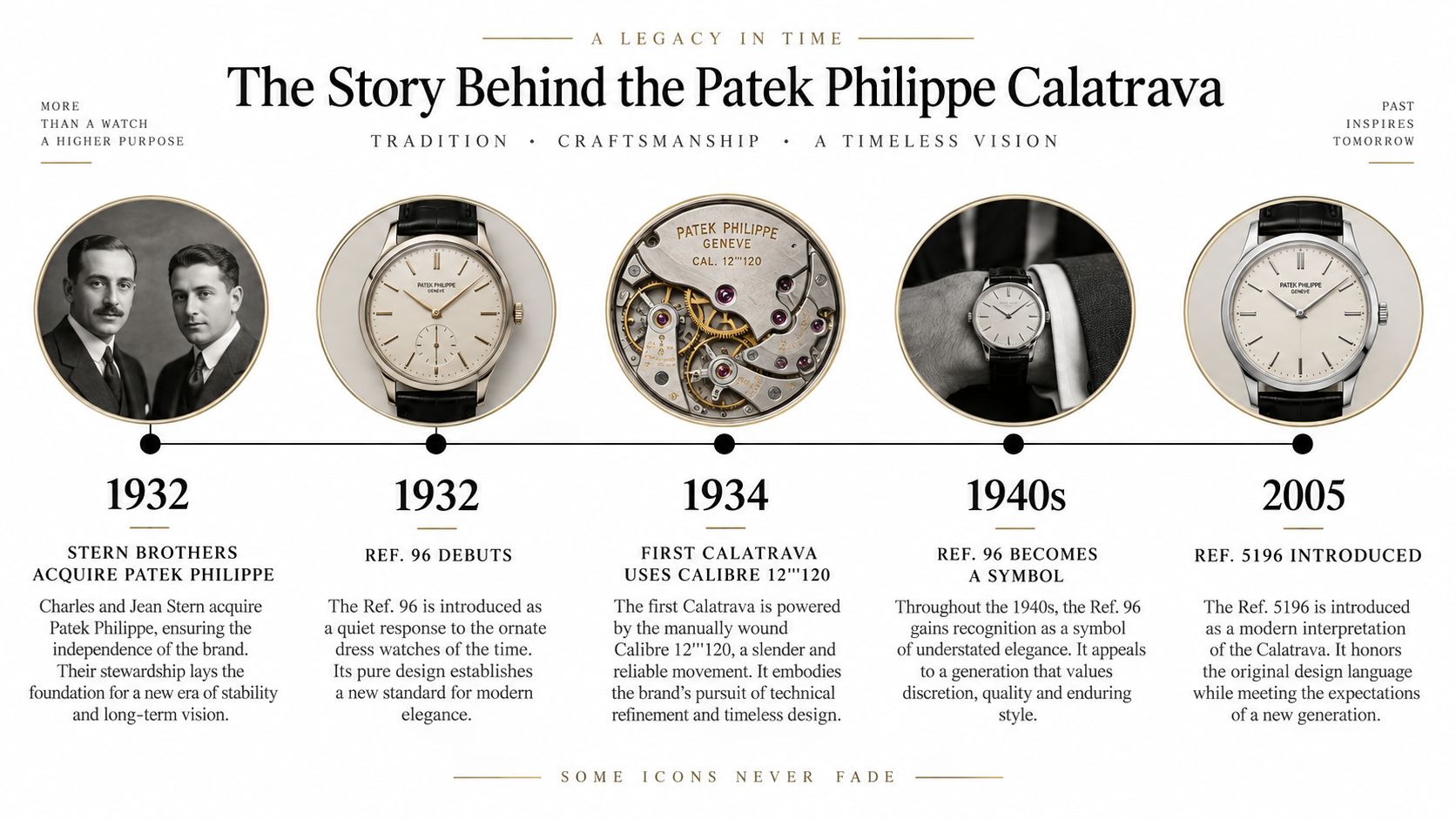
In 1932, Patek Philippe introduced the Calatrava's first reference, Ref. 96, during the Great Depression. It was a deliberately quiet watch: 31 mm, manually wound, and time-only. Its Bauhaus-influenced geometry rejected the ornate excess associated with earlier formal watches and established a clean round case, restrained dial, and purposeful proportions that would define the line for decades. The Stern family had just taken control of Patek Philippe, and Ref. 96 gave the company a formal serially produced wristwatch with a clear reference identity, according to Collectability's guide to Ref. 96.
The Calatrava cross became the collection's quiet emblem. Borrowed from the Spanish Order of Calatrava, it communicates heritage without turning the dial into a billboard. That restraint is central to the watch's appeal. A Calatrava asks the case profile, dial spacing, hands, and finishing to carry the argument.
Ref. 96 remained in production for more than 40 years, from 1932 to 1973, an unusually long run for a core Patek Philippe reference. The official Calatrava name arrived later, with sources identifying 1985 as the point when Patek Philippe formally began using it for the classic dress-watch line. Collectors had already applied the name retroactively to earlier watches.
Key milestones in the Calatrava story
- 1932: Ref. 96 launches as a 31 mm manual-wind, time-only watch, with Bauhaus-inspired simplicity.
- 1932 to 1973: Ref. 96 remains in production for more than 40 years, becoming one of Patek Philippe's longest-running core references.
- 1962: Ref. 3796 continues the compact, formal Calatrava formula while updating the reference generation.
- 1985: Patek Philippe begins using Calatrava as the official collection label for its classic dress watches.
- 1985: Ref. 3919 becomes a recognizable expression of the line, preserving the round case and formal proportions.
- 1996: Ref. 5110, the first Calatrava Travel Time, broadens the collection beyond the pure time-only dress-watch archetype.
- 2005: Ref. 5196 arrives as a modern interpretation of the earlier manual-wind Calatrava style.
The importance of Ref. 5110 is easy to underestimate. Once Patek Philippe applied the Calatrava design language to travel functionality, the name stopped describing one narrow format. It became a design vocabulary capable of supporting dates, calendars, travel watches, chronographs, and highly complicated pieces. That expansion explains why modern buyers must judge the reference, not just the name. The history of Patek Philippe's pricing and finishing is also relevant, especially for anyone asking why Patek Philippe is so expensive.
What Actually Defines Calatrava Design
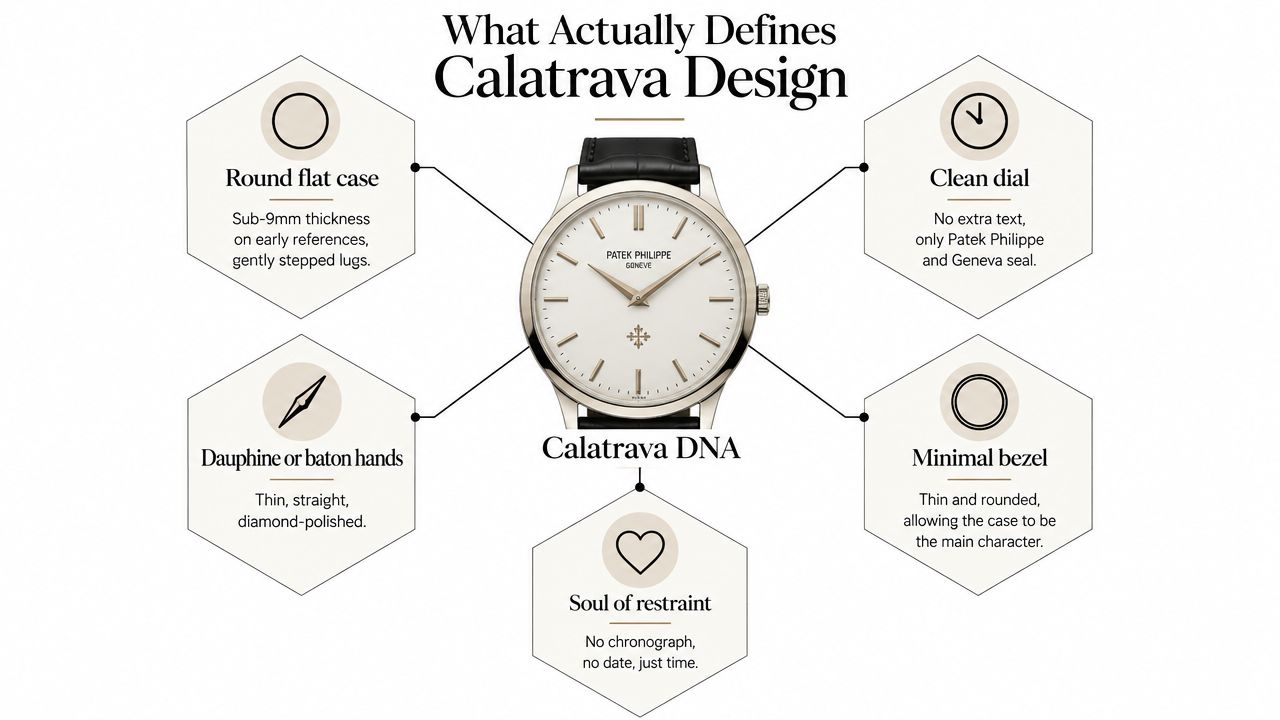
A Calatrava reads as a Calatrava from across a room because its design hierarchy is unusually disciplined. The case is round and relatively flat. The bezel is restrained. The lugs transition from straight architecture into a curve that pulls the strap under the wrist. The dial gives the hands and markers space instead of competing with them.
Early Calatravas established this formula with compact proportions and a Bauhaus preference for function over decoration. Modern examples can be larger or more complicated, but the best ones preserve the same visual order. A complicated Calatrava should still look composed before the observer notices what it does.
Case, dial, and hand vocabulary
The classic case has a thin, gently stepped bezel and a flat-to-curve lug transition. On references such as 3796, 3919, 5119, and 5227, the dial typography remains formal and legible, often using applied gold batons or carefully proportioned numerals. Railroad minute tracks reinforce the watch's instrument-like clarity.
Hands matter just as much. Patek Philippe has used baton, dauphine, leaf, and syringe forms across different references, but the common theme is precision. The hands are narrow, polished, and proportioned to the dial. They don't overwhelm a small case or disappear inside a large one.
Practical rule: If a Calatrava's dial looks busy before you've identified its complication, the design has probably lost the line's central discipline.
Modern departures are deliberate rather than random. Ref. 5370 uses an off-center sub-dial within a split-seconds chronograph layout. Ref. 6000 introduces guilloché work and a more expressive small-seconds arrangement. Ref. 5550 uses titanium in a highly technical perpetual-calendar context. These watches stretch the formula, but they don't abandon the emphasis on balance.
The 5227 demonstrates another kind of evolution. Its officer-style case back adds privacy and historical character without changing the watch's formal face. The modern Calatrava can therefore experiment with case construction, dial texture, or complication while keeping the round silhouette recognizable.
The line's visual restraint makes small errors unusually visible. A misplaced marker, incorrect font weight, over-polished lug, or poorly matched replacement dial can change the entire impression. Buyers should assess the watch as a complete composition, not as a famous name attached to any round Patek Philippe case.
For a closer look at the manual-wind format, compare the design logic of the Patek Philippe Ref. 5196. The same principles become clearer when the dial has nowhere to hide behind a date or calendar display.
Choosing Your Calatrava Reference
Choose a Calatrava by complexity tier, then judge the reference, condition, and resale profile. The line is no longer one dress-watch formula. A manual-wind Ref. 6119 represents the restrained classic. A Ref. 5227 adds automatic winding, a date, and an officer-style back. Annual calendars and high complications carry the Calatrava name, but they require a different ownership and service plan.
Modern Calatrava reference comparison
| Reference | Case size | Complication | Movement |
|---|---|---|---|
| Ref. 6119 | 39 mm | Time-only | Caliber 30-255 PS |
| Ref. 5196 | Not specified in verified data | Time-only | Manual-wind caliber, reference-specific |
| Ref. 5119 | Not specified in verified data | Time-only | Manual-wind caliber, reference-specific |
| Ref. 5227 | 37.5 mm | Date | Caliber 324 S C |
| Ref. 6000 | Not specified in verified data | Small seconds | Reference-specific |
| Ref. 4947 | Not specified in verified data | Annual calendar | Reference-specific |
| Ref. 5316 | Not specified in verified data | Perpetual calendar | Reference-specific |
| Ref. 5370 | Not specified in verified data | Split-seconds chronograph | Reference-specific |
| Ref. 5374 | Not specified in verified data | Minute repeater | Reference-specific |
| Ref. 5550 | Not specified in verified data | Perpetual calendar with advanced research movement | Reference-specific |
The strongest modern manual-wind choice is the Ref. 6119. Its 39 mm case gives the traditional design more wrist presence, while the 30-255 PS adds contemporary engineering without visual excess. According to Watches by SJX, the movement measures 31 mm by 2.55 mm, contains 164 components and 27 jewels, beats at 28,800 vibrations per hour, and stores 65 hours of power through twin barrels. For a collector who wants the pure hand-wound format, this is the reference to start with.
The Ref. 5227 suits daily wear better. Its Caliber 324 S C is self-winding, measures 27 mm in diameter and 3.3 mm in height, uses a 21K gold central rotor, and provides a 38 to 48 hour power reserve, according to Patek Philippe's Ref. 5227 technical material. The date adds practical value, while the officer-case back preserves the watch's formal character. Choose it over the 6119 if winding the watch each morning would become a nuisance.
Complications demand stricter selection. The Ref. 4947 annual calendar and Ref. 5316 perpetual calendar make sense when their functions will be used, not because the complication sounds impressive. Their service requirements and resale behavior differ from those of a simple dress watch. The Ref. 5370 split-seconds chronograph, Ref. 5374 minute repeater, and Ref. 5550 advanced-research perpetual calendar belong primarily in a collection, rather than as routine daily watches.
Discontinued references should be judged by the actual watch and complete set. A listing for this Patek Philippe Ref. 5296G Calatrava shows why reference number alone is insufficient. Metal, dial originality, polishing, papers, and presentation all affect what a buyer should pay, and those details also influence future resale.
Calatrava Pricing on the Secondary Market
The Calatrava's resale story is uneven, and buyers should stop treating Patek Philippe's reputation as a guarantee of price retention. WatchCharts reports that the Calatrava line's market prices declined 8.9% over the past 365 days, while its tracked references span approximately US$5,509 to US$131,453, with a median near US$23,532 across 59 references. Those figures show a broad family with very different levels of demand, scarcity, and liquidity.
The practical conclusion is simple. Classic gold dress references can be soft against retail, particularly when the watch has polishing, a replacement dial, incomplete papers, or weak dealer support. More complicated or distinctive references can sit closer to retail, but that doesn't make them automatically liquid. A buyer must separate collector interest from easy resale.
Calatrava reference pricing guide
The verified market data supports reference-level conclusions, not a complete MSRP table for every historical model. Don't fill in missing retail figures with auction folklore or asking prices.
| Reference or model type | Core material | Approx. retail MSRP | Approx. secondary value |
|---|---|---|---|
| Ref. 5196G | White gold | Not specified in verified data | Often about 23% below retail to around retail, depending on condition and market channel |
| Ref. 5226G | White gold | Not specified in verified data | Often about 19% below retail to around retail, depending on condition and market channel |
| Modern manual-wind Calatrava | Precious metal | Not specified in verified data | Reference-specific, commonly softer than Patek Philippe's sports models |
| Complicated Calatrava | Varies by reference | Not specified in verified data | Some examples trade closer to retail, but results vary sharply by complication and condition |
| Vintage Ref. 96 | Varies by example | Discontinued | Collector-dependent, with value driven by originality, provenance, and condition |
The Ref. 5196G and Ref. 5226G are especially useful reality checks. Recent analysis places the 5196G at roughly 23% below retail to around retail, and the 5226G at roughly 19% below retail to around retail, depending on condition and sales channel, as summarized in the verified market data. These aren't failures. They're dress watches being priced like dress watches rather than like steel sports icons.
The Ref. 5227 is more complex to assess because the market treats different metals and configurations differently. A buyer should compare the exact reference, dial, warranty status, service history, and seller terms. “Patek Philippe Calatrava” is too broad a search phrase to establish a fair price by itself.
Market discipline: Buy the watch you want at a defensible price. Don't pay a sports-watch premium for a dress reference just because the dial carries the Patek Philippe name.
Prices move with demand, condition, completeness, and market channel. Treat every figure as a working reference, not a promise of future resale. For additional context on buying used, compare current inventory and guidance on pre-owned Patek Philippe watches.
Authenticating a Pre-Owned Calatrava
A pre-owned Calatrava's value rests on finishing, original parts, movement correctness, and clean paperwork. The watch should be inspected as a system. A genuine case paired with a refinished dial or incorrect movement can still be a poor purchase.
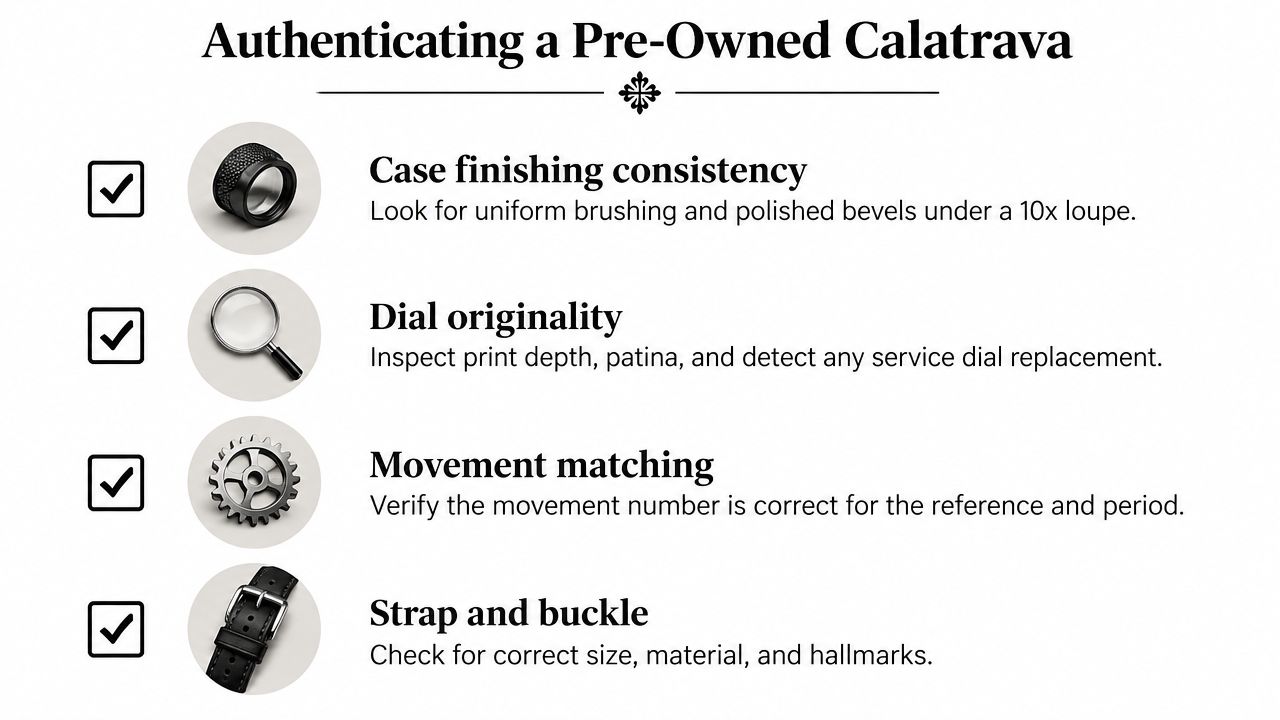
Four checks that matter
- Study the case finishing under magnification. Use a loupe to examine the transition between polished and brushed surfaces, especially around the bezel, lugs, and case edges. Rounded geometry, thin lug profiles, or bevels that have nearly disappeared indicate aggressive polishing.
- Inspect the dial as an original object. Ref. 96, Ref. 3919, and Ref. 5119 examples can appear with redials or service replacements. Check print depth, marker alignment, patina consistency, logo proportions, and whether the dial's aging makes sense across all elements.
- Match the movement to the reference and period. The caliber must be correct for the watch, and the movement number should be checked against the available Patek Philippe documentation or archive extract. A beautifully finished movement is not enough if the caliber doesn't belong in that case.
- Confirm the strap, buckle, and paperwork. Check the buckle's hallmarks, strap dimensions, leather type, box, certificate, and service records. Missing documents don't automatically invalidate a watch, but they should affect the price and the strength of the provenance.
A timegrapher reading is useful before payment, but it isn't authentication by itself. It can reveal inconsistent rate behavior or a movement that needs service. Ask for a qualified watchmaker's inspection when the seller can't provide clear movement photographs or service evidence.
Dial originality deserves particular attention because a replacement can alter both collector interest and resale value. A service dial may be legitimate Patek Philippe equipment, yet it still isn't the same as an untouched period dial. Buyers should document the distinction in the purchase agreement.
Look for mismatched fonts, incorrect crown shapes, uneven case symmetry, and a dial that appears too fresh for the case. You'll find a useful second opinion in this guide to spotting counterfeit luxury watches, but no online checklist replaces inspection by an experienced specialist.
Choosing the Right Calatrava to Buy
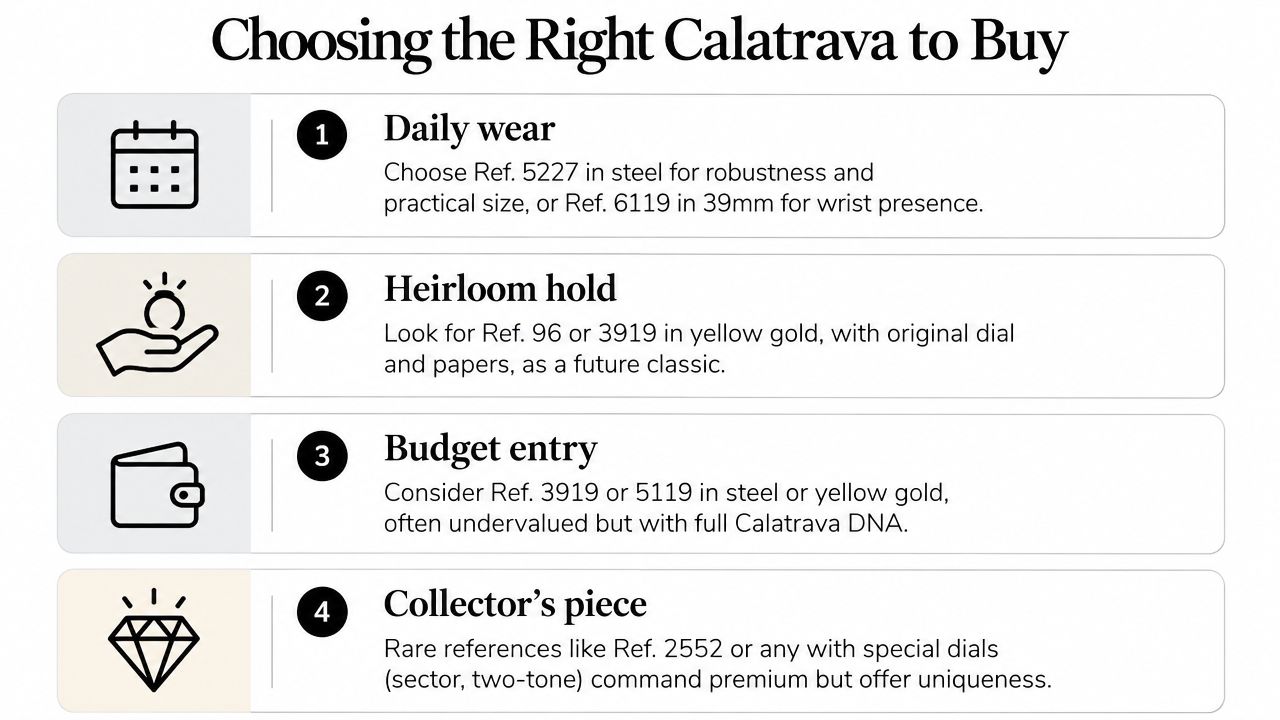
Choose the Calatrava by wear pattern, holding period, and tolerance for mechanical complexity. The collection is no longer one uniform dress-watch proposition. It ranges from compact vintage classics to technically ambitious modern pieces, and that difference should determine what you pay.
Daily wear
For regular use, I would choose the Ref. 5227 when automatic winding and a date matter. Its self-winding Caliber 324 S C and officer-style back give it more practical flexibility than a strict time-only manual-wind watch. Buyers who prefer a slimmer, more deliberate experience should choose the Ref. 6119, which has stronger visual presence and makes winding part of the ownership ritual.
The modern Patek Philippe Seal standard for the 30-255 PS specifies daily accuracy of -3/+2 seconds, and the movement includes stop-seconds for precise setting, according to Hodinkee's coverage of the Calatrava 6119. That specification makes the manual-wind format unusually usable for a traditional dress watch. It does not, however, make the 6119 a better daily choice than the 5227 for someone who wants a date and automatic winding.
Heirloom hold
An heirloom purchase should start with the dial, case condition, and provenance, not the complication list. Ref. 96 and Ref. 570 examples can carry serious collector appeal, but the case determines whether you are buying an important historical watch or an old Patek Philippe that has lost its proportions.
Originality matters more than cosmetic brightness. Honest aging and an untouched dial can be preferable to a polished case, replacement components, or a later service configuration. Those details also affect resale, because buyers pay for a coherent example rather than the name alone.
Budget entry
The Ref. 3919 and Ref. 5119 provide the clearest entry into traditional Calatrava design. Their softer secondary-market positioning compared with Patek Philippe sports models can favor the buyer, especially when the goal is formal character rather than scarcity-driven pricing.
A low asking price is not automatically value. Check the dial, crown, buckle, movement, and service history, then price the watch according to originality and condition. A cheaper reference with replaced parts can be harder to sell than a better-preserved example bought at a higher but defensible price.
Collector's piece
Collectors seeking individuality should look at special dials and less conventional complications. A reference such as Ref. 2552, or an example with a sector or two-tone dial, offers more character than a standard configuration. The trade-off is a smaller buyer pool and greater sensitivity to originality.
I would approach heavily serviced white-gold Ref. 3919 dials and oversized travel-time variants cautiously. The Calatrava earns its premium when the complication belongs to the design, not when it appears to have been added for attention. Unusual execution can protect interest, but it rarely guarantees an easy exit.
Before buying, answer four questions:
- Budget: What is the maximum price you can justify after servicing and insurance?
- Wrist size: Do you want compact vintage proportions or the presence of a larger modern case?
- Function: Will you use a date, calendar, travel display, or alarm?
- Holding period: Are you buying for daily enjoyment, an heirloom, or a collectible with a narrower exit market?
ECI Jewelers offers authenticated Patek Philippe watches, including Calatrava references, with specialist inspection and options that may include original box and papers. Visit ECI Jewelers to review available Calatrava examples, compare condition and documentation, and request a market-based valuation before committing.
Frequently Asked Questions
Does the Patek Philippe Calatrava hold its value?
Not uniformly. WatchCharts reports an 8.9% decline over the past 365 days for the Calatrava market, and the 5196G and 5226G can trade below retail depending on condition and channel. Complicated or unusually configured references may perform closer to retail, but the line doesn't offer the uniform liquidity associated with major steel sports models.
What's the story behind the Calatrava's history?
Ref. 96 launched in 1932 during the Great Depression as a 31 mm manual-wind, time-only watch shaped by Bauhaus minimalism. The Calatrava name became an official collection label in the 1980s, after collectors had already used it for earlier classic Patek Philippe dress watches.
Is a Calatrava suitable for swimming?
Treat a Calatrava as a dress watch, not a dive watch. The modern 30-255 PS Calatrava is associated with a 30 m water-resistance rating, which supports protection from incidental splashes rather than deliberate swimming or diving, as covered in Hodinkee's Ref. 6119 article.
Why does a Calatrava cost what it does?
The price reflects Patek Philippe's movement construction, hand finishing, precious-metal cases, design history, and quality-control standards. The modern 30-255 PS, for example, combines a thin architecture with twin barrels, 164 components, 27 jewels, and a 65-hour power reserve. Those qualities explain the watch's cost, but they don't guarantee resale performance.
What's the difference between a Calatrava and a Nautilus?
The Calatrava is a dress-watch family, built around round cases, restrained dials, and formal wearability. The Nautilus is a sports-watch family with a different case architecture, stronger casual positioning, and a market that generally behaves differently. Compare them by intended use and specific reference, not by brand prestige alone.


