


When you buy a Patek Philippe, you're not just getting a watch. You're acquiring a piece of history, an heirloom of incredible craftsmanship, and a genuine investment asset. Each timepiece is the culmination of hundreds of hours of meticulous handwork and a purposefully limited production run, making it less of a product and more of a functional work of art built to outlive its owner.

The True Value of a Patek Philippe Explained
To really get why Patek Philippe commands such astronomical prices, you have to look past the dial. The cost isn't arbitrary; it's a direct reflection of a complex value proposition built up over nearly two centuries. It's a careful mix of tangible quality and intangible prestige that sets the brand apart from almost every other watchmaker. You aren't just paying for a watch—you're buying into a legacy.
This value is built on three core pillars: world-class hand-finishing, an unbroken history of innovation stretching back to 1839, and its proven performance as a hard asset. Unlike so many mass-produced luxury goods, every single Patek is a testament to what human hands can achieve.
Core Pillars of Value
The company's entire philosophy is centered on creating heirlooms, not just watches. This is perfectly captured in their legendary slogan: "You never actually own a Patek Philippe. You merely look after it for the next generation." This simple phrase reframes the purchase entirely—it's not an expense, but a transfer of value through time.
To give you a better idea, here's a quick look at the factors that justify Patek's top-tier pricing.
| Factor | Brief Explanation |
|---|---|
| Generational Craftsmanship | Skills and finishing techniques are passed down through generations, ensuring a level of detail that modern machines can't replicate. |
| Strategic Scarcity | Production is intentionally limited to maintain exclusivity and quality control, keeping demand far ahead of supply. |
| Investment-Grade Asset | Certain models have a track record of outperforming traditional investments, turning them into a recognized tangible asset class. |
| In-House Manufacturing | Every component, from the movement to the case, is made in-house, giving Patek total control over quality and innovation. |
| Brand Prestige & History | An unbroken lineage since 1839 has built an unparalleled reputation for excellence and innovation in watchmaking. |
This table provides a quick snapshot, but let's dig into what makes each element so crucial.
- Generational Craftsmanship: Many of the finishing techniques used today have been handed down from one master watchmaker to the next, preserving a standard of excellence that automation simply cannot match.
- Strategic Scarcity: With an estimated annual production of only 60,000 to 70,000 watches for the entire world, Patek deliberately keeps its supply tight. This isn't just a marketing gimmick; it's essential for maintaining their uncompromising quality standards and ensuring exclusivity.
- Investment-Grade Asset: It's no secret that certain Patek models have historically crushed traditional investments at auction, with results that consistently shatter world records. This powerful track record elevates the watch from a luxury item to a tangible asset class.
At its heart, a Patek Philippe represents the intersection of art, engineering, and finance. Every single component, from the smallest screw to the most complex movement, is finished to a degree that borders on obsession, justifying its position at the absolute peak of horology.
This chart helps visualize how these three core pillars—craftsmanship, history, and investment potential—work together.
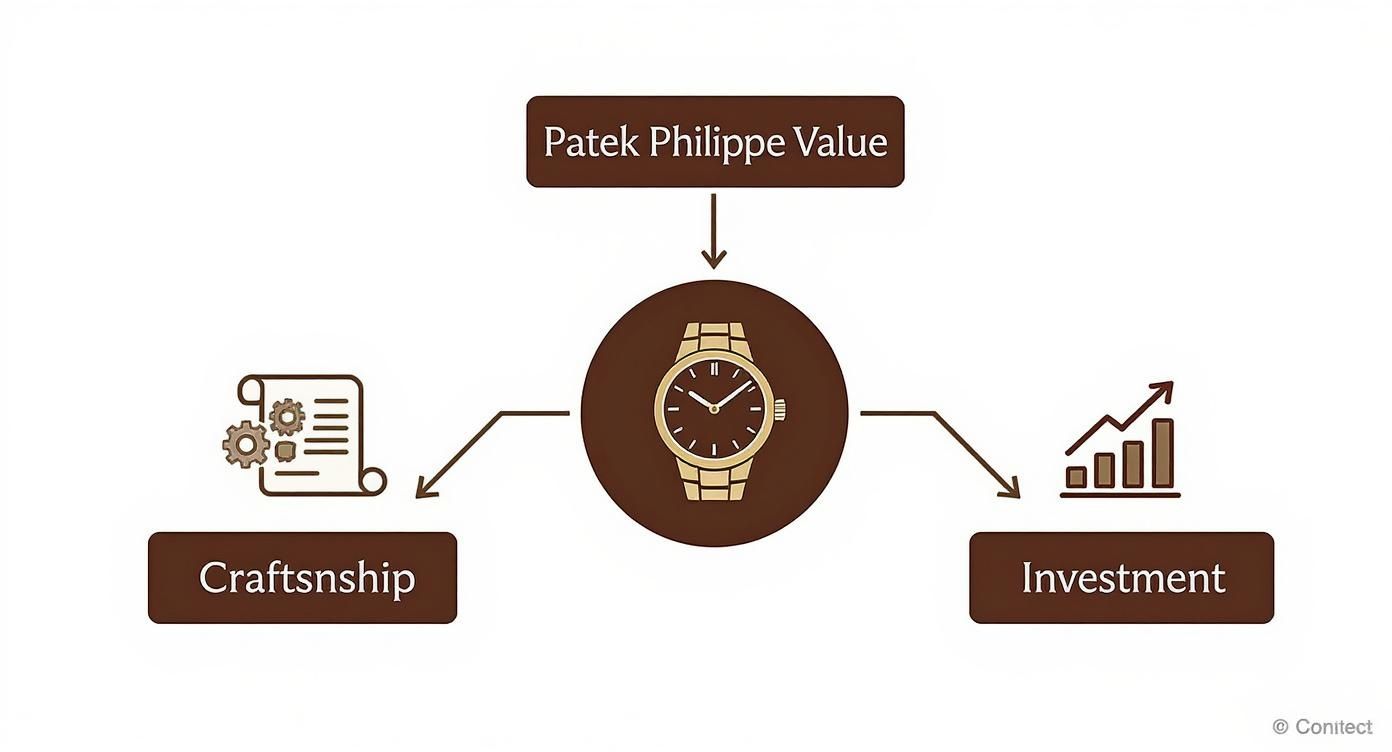
As you can see, these elements are interconnected, creating a combined value far greater than the sum of the watch's physical parts. To truly get the full picture, it helps to have a baseline for understanding luxury timepieces in the broader market. In the sections that follow, we'll break down each of these pillars in much greater detail.
A Legacy Forged in Unbroken History
When you hold a Patek Philippe, you're not just holding a watch. You're holding a direct, tangible connection to nearly two centuries of watchmaking history. The company, founded way back in 1839, has been in business ever since—without a single break in production.
This unbroken timeline is a massive piece of the puzzle when asking why Patek Philippe is so expensive. It creates a foundation of trust and permanence that very few brands can honestly claim.
Unlike so many other "historic" names that were shut down, sold off, and resurrected decades later, Patek's story is one of steady, family-owned stewardship. This has allowed them to play the long game, focusing on quality over quantity and building their reputation one masterpiece at a time. It’s a legacy of innovation, not just survival.
Think about it: back in 1845, co-founder Adrien Philippe invented and patented the keyless winding and hand-setting system. That mechanism, the one we all take for granted in almost every mechanical watch today, was a game-changer. It did away with the need for a separate key. That kind of fundamental innovation, happening so early in their history, set the tone for Patek as a leader, not a follower.
The Power of an Enduring Philosophy
This deep history is more than just a list of dates and inventions. It's the very bedrock of the brand's philosophy. It’s what gives their famous advertising slogan its incredible weight and credibility.
"You never actually own a Patek Philippe. You merely look after it for the next generation."
That's not just some slick marketing copy. It’s a mission statement. It reframes the high cost from a mere purchase into a long-term investment in a family heirloom. The message is clear: this watch is a store of value, designed to outlast you and be passed down through your family. It's a powerful idea that stands in stark contrast to the throwaway nature of so much modern luxury, positioning a Patek as something timeless.
For collectors, this completely changes the perception of the price tag. It justifies the expense by framing it as a one-time acquisition for a multi-generational asset.
Distinguishing Heritage from Hype
In the luxury world, "history" gets thrown around a lot as a marketing gimmick. But Patek's heritage is different because it's both uninterrupted and consistently innovative. Understanding this distinction is crucial to grasping its premium price.
- Unbroken Lineage: Since day one, Patek has dodged the disasters that took down other legendary watchmakers. They famously weathered the quartz crisis of the 1970s, which bankrupted countless competitors, by continuing to produce world-class mechanical movements.
- Consistent Ownership: The Stern family has owned Patek Philippe since 1932. That’s four generations of private, family ownership, which protects the brand's core values from the short-term profit demands of a corporate overlord.
- Archival Integrity: Patek keeps a complete archive of every single watch it has made since 1839. This allows any owner to get an "Extract from the Archives," confirming the watch's provenance and original sale date. This service adds immense value and security to any purchase.
When you put it all together—an innovative past, a stable present, and a guaranteed future—you get a powerful narrative. It assures a buyer that the watch on their wrist comes from a maker that has mastered its craft over generations and will be around to service that same watch for generations to come. That rock-solid assurance of permanence is a huge reason why Patek Philippe is so expensive.
The Art of Hand-Finishing in Patek Philippe Workshops
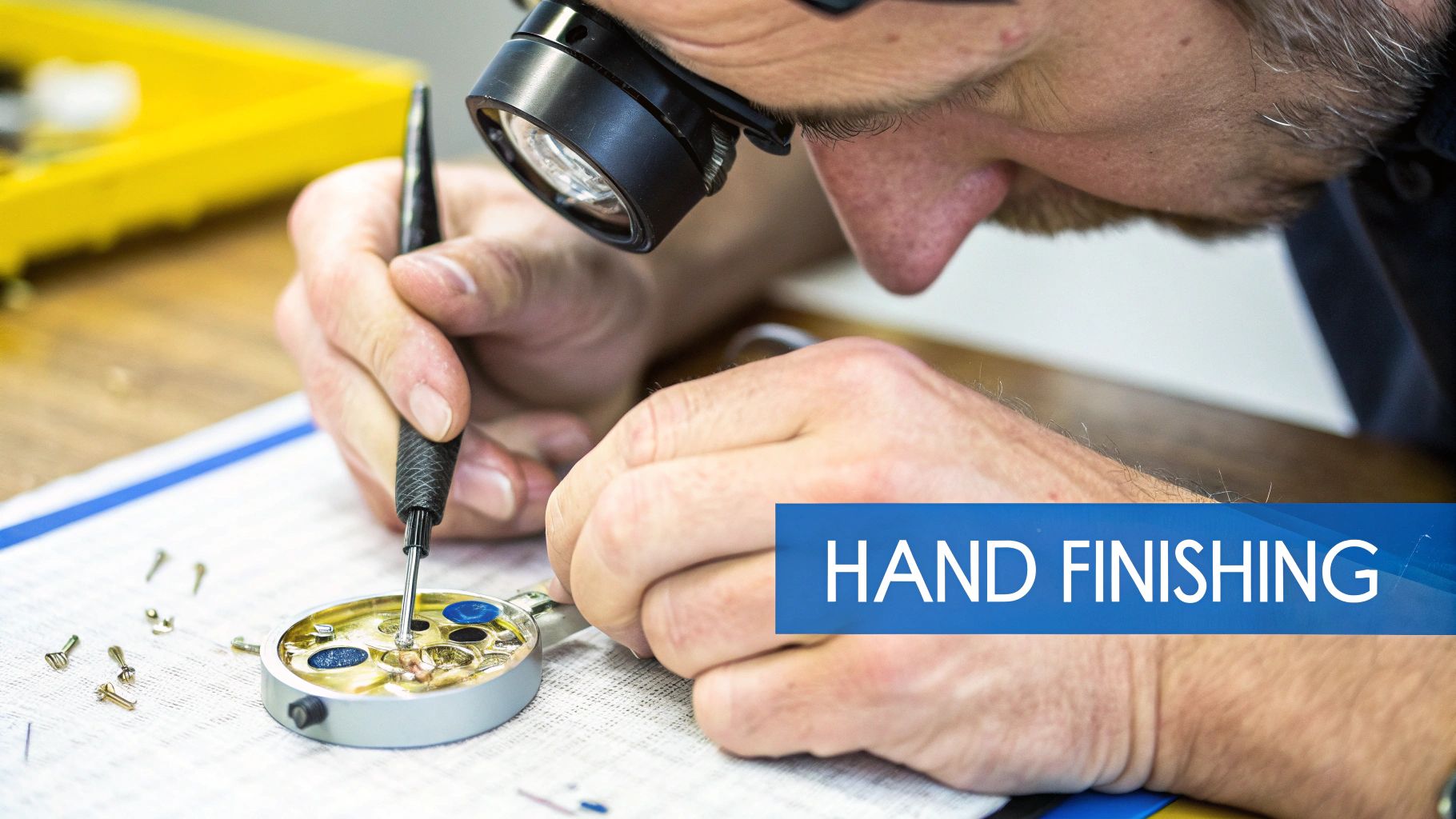
If you really want to get why Patek Philippe watches cost so much, you have to look past the brand's long history and zoom in on the sheer human effort that goes into every single timepiece. This is where a huge chunk of the cost comes from—not from robots on a sterile assembly line, but from the steady, patient hands of master artisans.
The real difference between a well-made luxury watch and a Patek Philippe is this fanatical devotion to hand-finishing.
It’s a process of meticulously decorating and polishing every single part of the movement, even the tiny pieces you’ll never see once the watch is sealed. A Patek Philippe isn't just put together; it's perfected, component by component. This can add hundreds of hours of skilled labor to a single watch.
What Is Hand-Finishing?
In the watch world, we call this finissage. It’s the art of refining the surfaces of watch parts to make them look incredible and work better. Think of it like a master jeweler cutting a diamond. A rough diamond has value, sure, but it’s the painstaking work of faceting and polishing that unlocks its true fire and worth.
Patek Philippe takes that same philosophy and applies it to every gear, bridge, and screw. The goal is two-fold: create breathtaking beauty on the inside and make sure the movement runs with flawless precision for generations. Proper finishing cuts down on friction, stops corrosion, and makes it easier for watchmakers to service down the road.
Let's break down some of the techniques that define this craft.
- Côtes de Genève: You’ve probably seen these beautiful, wave-like stripes on the bridges of high-end movements. While other brands do it, Patek’s execution is the gold standard—the depth, consistency, and alignment are just perfect.
- Perlage (Circular Graining): This is a pattern of tiny, overlapping circles, usually on the mainplate. Each little circle is applied by hand, one at a time, which takes incredible patience to create that shimmering, uniform texture.
- Anglage (Chamfering): This might be the most difficult technique of all. Artisans take hand files and special tools to bevel the sharp edges of components into a smooth, 45-degree angle. Then, they polish that bevel to a mirror shine. Flawless anglage is an undeniable sign of elite watchmaking.
These aren't just fancy decorations; they’re hallmarks of a watch built with zero compromises. This level of detail is a core reason why Patek Philippe is so expensive. It turns a mechanical engine into a piece of art in motion.
The Obsession with Invisible Perfection
Here’s what really separates Patek Philippe from the pack: they finish parts that no owner will ever see without a watchmaker taking the whole thing apart. The underside of a bridge, the inside of a gear wheel, the head of a tiny screw—every single surface is polished and perfected.
To a Patek Philippe artisan, there is no such thing as an "unimportant" component. Every piece, visible or hidden, must meet the same exacting standard of perfection. This philosophy ensures that the watch is not just beautiful on the outside but is holistically perfect all the way through.
This is a totally different mindset from many other luxury brands that might only finish the parts you can see through a display caseback. For Patek, what's hidden is just as important as what's on display. This obsession with invisible perfection requires a staggering investment in time and skill, which goes directly into the final price.
For example, a beautifully simple and classic dress watch like the Patek Philippe 6119G-001 Calatrava holds a universe of hidden finishing that justifies its place at the top of its class.
The labor involved is just immense. Polishing a single, minuscule screw head to a mirror-like "black polish" can take an artisan hours of intense focus. Now, multiply that effort across the hundreds of components inside a complex watch, and you start to get a picture of how the hours—and the cost—stack up. This isn't manufacturing; it's pure artistry. It’s the soul of the brand.
Mastering the Art of Mechanical Complications
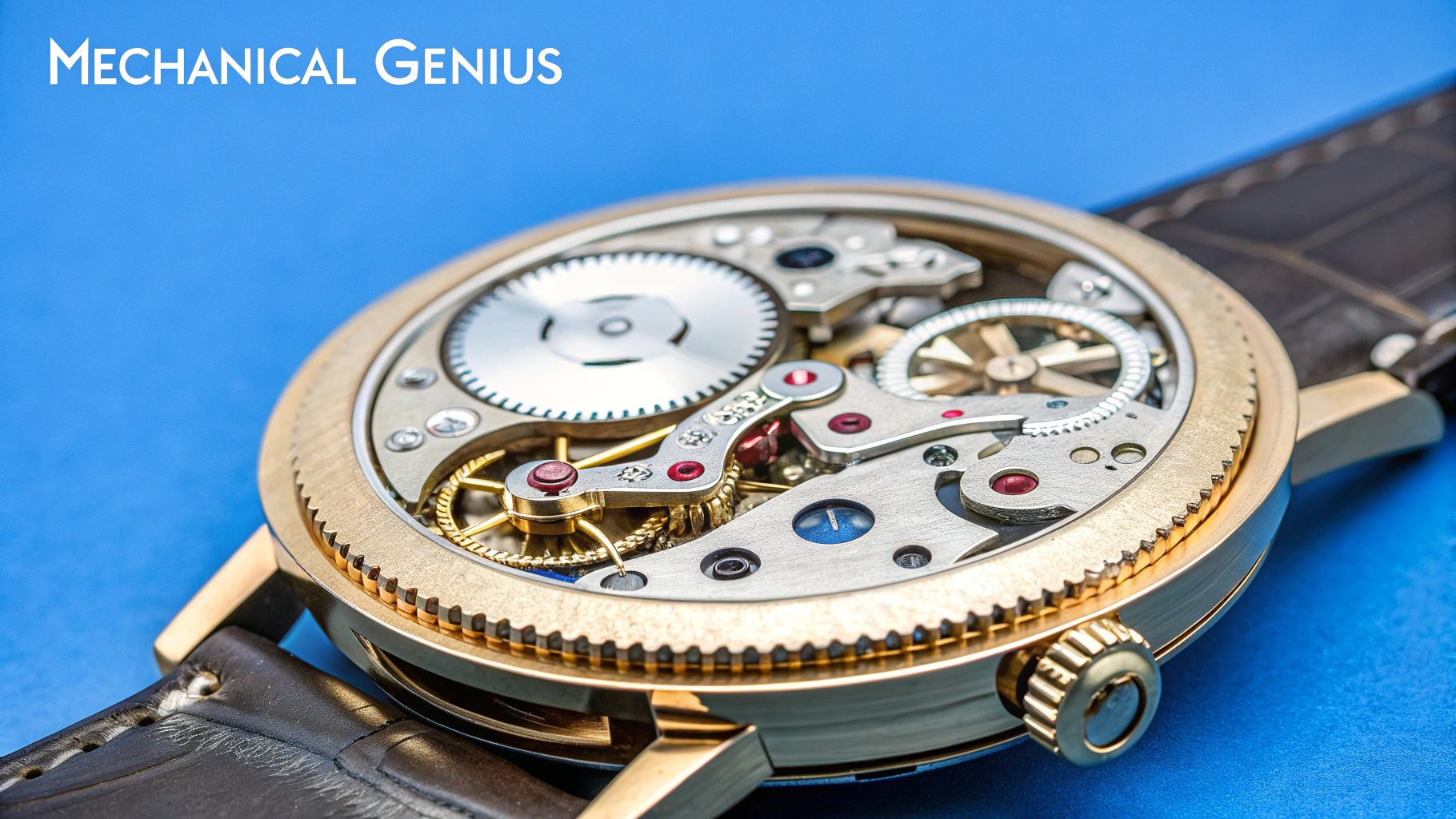
Beyond the flawless finishing and storied history, a huge part of what you're paying for in a Patek Philippe is hidden deep inside the case. It’s in the hundreds of tiny, interacting components that form the watch's mechanical brain.
In the world of high-end watches, any function that goes beyond simply telling the time is called a complication. This is where Patek Philippe really flexes its muscles. A complication can be something as straightforward as a date window or as mind-bendingly intricate as a mechanism that chimes the exact time on demand.
Each additional function requires an exponential leap in design, engineering, and assembly. This is a core reason why Patek Philippe is so expensive—their mastery over these miniature mechanical wonders is simply legendary.
Think of it like building a car engine. A basic four-cylinder gets you from A to B. But a high-performance V12 has turbochargers, advanced fuel injection, and complex cooling systems all working in harmony. In the same way, a simple watch tells time, but a Patek Philippe can track celestial cycles, function as a stopwatch, and even account for leap years, all without a battery in sight.
From Simple Functions to Grand Complications
Not all complications are created equal. Their complexity, and therefore their cost, exists on a massive spectrum. Patek produces watches that span this entire range, with each step up representing a huge jump in both technical difficulty and price.
- Useful Complications: These are the most common functions you'll see, like a date display, a second time zone (GMT), or an annual calendar that only needs to be adjusted once a year.
- High Complications: This is where things get really interesting. We're talking about intricate mechanisms like the split-seconds chronograph (for timing two separate events simultaneously) and the perpetual calendar. A perpetual calendar is an incredible little machine that automatically accounts for the different lengths of months and even leap years. You can check out our guide on what a perpetual calendar watch is to get a better sense of this mechanical marvel.
- Grand Complications: This is the absolute peak of watchmaking. A Grand Complication watch typically combines several high complications, such as a perpetual calendar, a split-seconds chronograph, and a minute repeater (a mechanism that chimes the hours, quarters, and minutes).
Assembling these mechanisms requires years and years of specialized training. A single Grand Complication can take a master watchmaker over a year to put together, with some parts so small they're barely visible to the naked eye. That intense human skill is a direct driver of the final cost.
The Grandmaster Chime: The Ultimate Expression
To understand Patek Philippe’s dominance, you only need to look at one watch: the Grandmaster Chime Ref. 6300. This is one of the most complicated wristwatches ever made, period. It boasts an incredible 20 different complications, two independent dials (front and back), and a reversible case. It is a symphony of mechanical artistry.
The Grandmaster Chime isn't just a watch; it's a statement. It proves that Patek Philippe operates on a level of technical mastery that few, if any, other brands can even dream of approaching.
The value of this mechanical supremacy is reflected dramatically in the market. While the brand’s entire range starts from around $12,500 and can go into the millions, the price skyrockets with complexity. In fact, a one-of-a-kind stainless steel Grandmaster Chime sold at a charity auction for an astounding $31 million, becoming the most expensive watch ever sold.
This sale says it all: with Patek, value is tied to mechanical ingenuity, not just the raw materials. It's a core part of the brand's DNA.
This commitment to developing and assembling every movement in-house gives Patek total control over every stage of creation, ensuring that each complication meets their impossibly high standards. It’s a costly, time-consuming process, but it’s the only way to build a legacy that lasts for generations.
How Strategic Scarcity Creates Exclusivity
While the sheer artistry inside a Patek Philippe explains a lot of its price tag, another huge factor is pure business strategy. The brand's value is supercharged by a deliberate, masterfully executed policy of scarcity. This isn't some accidental shortage; it's a core part of their identity that protects the brand's mystique and fuels an intense desire to own one.
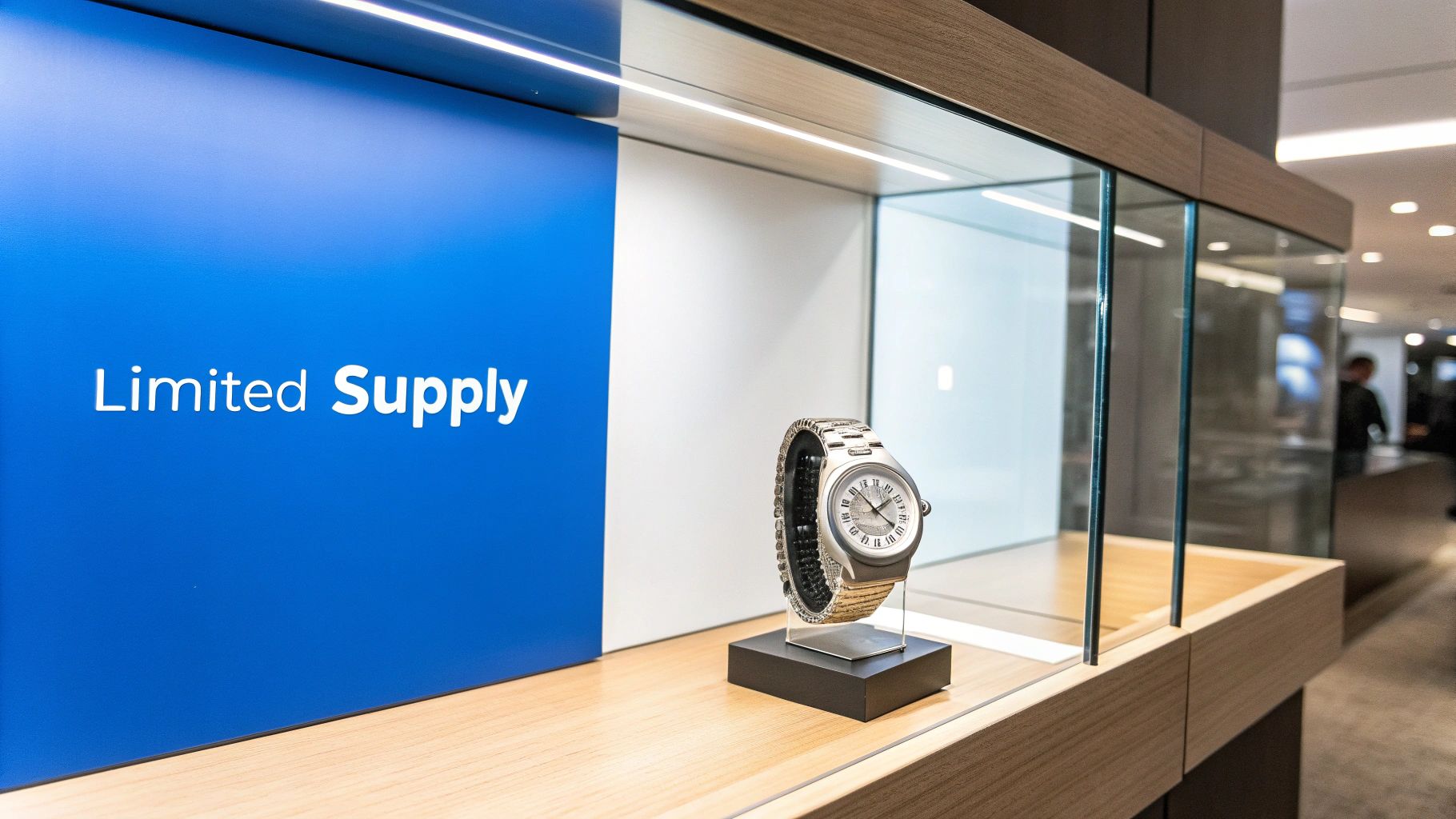
Patek Philippe produces an estimated 60,000 to 70,000 watches a year. That’s for the entire global market. To put that into perspective, some of their major luxury competitors churn out closer to a million. This is a very conscious decision to prioritize insane quality control over mass production, making sure every single timepiece that leaves the factory is perfect.
This limited output has a profound effect on the market. When you have a small, tightly controlled supply meeting overwhelming global demand, prices have nowhere to go but up. This is a massive reason why Patek Philippe is so expensive—the brand has perfected the art of making its watches incredibly difficult to get your hands on.
The Infamous Waitlist Phenomenon
Nowhere is this scarcity more obvious than with the brand’s most sought-after steel sports models, the Nautilus and the Aquanaut. The waitlists for these watches are legendary, often quoted as lasting 8 to 10 years. But let's be real: for a new client walking in off the street, getting one at retail is practically impossible. Authorized dealers hold these "allocation pieces" for their most loyal, highest-spending customers.
This creates an atmosphere of extreme exclusivity where just the opportunity to buy the watch becomes a privilege. That long wait and the tough vetting process only crank up the watch's perceived value, turning it from a simple luxury item into a genuine trophy.
This dynamic completely shapes how the market behaves.
- Retail vs. Reality: The official retail price is almost a fantasy number because so few people can actually pay it.
- Secondary Market Premiums: The true market value is set on the secondary market, where these watches often trade for three to five times their original retail price the moment they leave the store.
- Client Relationships: If you want one, you have to build a long-term relationship with a dealer, often by buying less popular models first, just to get a shot at a hot piece.
This tightly controlled system ensures that owning a new Nautilus or Aquanaut isn't just about having money; it's a symbol of status and connection.
Becoming a Veblen Good
This perfect storm of insane demand and restricted supply transforms Patek Philippe watches into a classic example of a Veblen good. This is a rare kind of luxury item where demand actually increases as the price goes up, completely defying normal economic logic.
A Veblen good's high price is a key part of its appeal. The expense itself serves as a public indicator of the owner's status, making the item more desirable precisely because it is unaffordable for most.
For collectors, this means the watch is way more than an accessory; it's a tangible asset whose value is reinforced by its own price tag. The more expensive a Patek gets on the secondary market, the more people want it. This creates a powerful feedback loop of desire and rising value, cementing the brand’s elite status and solidifying its reputation as a sound financial investment.
Patek Philippe as a Blue-Chip Investment Asset
The eye-watering price tag of a Patek Philippe is just the beginning of the story. For collectors who know the market, the real magic happens on the secondary market, where these watches often behave less like accessories and more like blue-chip stocks.
Unlike most luxury goods that lose value the second you walk out the door, certain Patek models have a long history of appreciating dramatically. Their performance at auction houses like Christie's and Sotheby's isn't just talk; it's hard proof that these watches are a legitimate asset class. Some have even outperformed traditional investments like the S&P 500.
This flips the purchase from a simple expense into a smart financial move. That initial high price starts to make sense when you view it as a down payment on years of potential growth. For many, a Patek Philippe is a tangible store of wealth that just happens to tell time.
The Discontinuation Effect
One of the biggest drivers of a Patek's value is when the brand decides to stop making a certain model. The moment Patek announces a reference is being discontinued, the supply is capped forever. This single move can send demand through the roof, causing secondary market prices to explode almost overnight.
A perfect example is the legendary Nautilus 5711/1A with the blue dial. When Patek confirmed it was being discontinued in 2021, its value on the pre-owned market went ballistic, fetching prices many times its original retail cost. This "discontinuation effect" is solid proof that the brand’s deliberate strategy creates investment windfalls for owners.
Market Performance and Hard Data
The investment power of Patek Philippe isn't just based on anecdotes; it's backed by some truly astonishing numbers. The brand’s most sought-after models have shown returns that are impossible for any serious collector to ignore.
The secondary market for Patek Philippe isn't just a marketplace; it's a financial ecosystem. The brand's calculated scarcity, combined with its unwavering reputation for quality, creates a perfect storm where demand consistently outpaces supply, driving long-term value appreciation.
Just look at the Nautilus line. Between January 2018 and February 2022, multiple Nautilus models saw their value jump by over 400%. That's not a typo. The rose gold Nautilus 5711/1R-001 saw a jaw-dropping 744% increase in that same four-year window, commanding prices roughly €330,000 higher than it was valued in 2018.
Patek Philippe Historical Price Appreciation
The data clearly illustrates how key Patek Philippe models have performed as assets over time. The following table highlights the remarkable value growth for some of the brand’s most iconic references, turning what was once a luxury purchase into a serious investment.
| Model Category | Year | Average Price | Annual Increase (%) |
|---|---|---|---|
| Nautilus Steel (5711) | 2018 | €65,000 | - |
| 2022 | €325,000 | 100% | |
| Aquanaut Steel (5167) | 2018 | €38,000 | - |
| 2022 | €115,000 | 50.5% | |
| Nautilus Rose Gold (5711/1R) | 2018 | €95,000 | - |
| 2022 | €425,000 | 87% |
This consistent appreciation shows that the high entry cost is often justified by the potential for significant long-term returns.
These principles of value growth driven by scarcity and desirability aren't unique to watches. To see how these same dynamics work with other high-end collectibles, you can explore these expert tips for building an investment collection of rare items. The core ideas often apply across different asset classes.
Ultimately, the powerful performance on the secondary market is a key reason for the brand's high prices. Collectors aren't just buying a watch; they are acquiring an asset with a proven track record. To dive deeper into this topic, check out our guide on investing in luxury watches.
Answering Your Patek Philippe Questions
Even after getting a feel for what makes Patek Philippe tick, a few practical questions always come up. Let's tackle some of the most common ones that collectors and first-time buyers ask.
Are All Patek Philippe Watches a Good Investment?
While the brand has a legendary reputation for holding its value, not every model is a rocket ship. The watches that historically see the most significant gains are the ultra-desirable sports models, like the Nautilus and Aquanaut, along with the mind-bendingly complex Grand Complications. It's a simple recipe: insane demand plus tiny supply equals soaring value.
On the other hand, a classic dress watch like a Calatrava is more likely to be a rock-solid store of wealth. It will hold its value exceptionally well, but you probably won't see the explosive growth that the rarer sports models experience. Ultimately, a watch's investment potential comes down to the specific reference, its rarity, condition, and what the market is hungry for at that moment.
Why Is a Steel Patek Philippe More Expensive Than Gold?
This is a classic head-scratcher, but it boils down to pure supply and demand. Patek Philippe makes far, far fewer watches in humble stainless steel compared to precious metals like gold or platinum. This built-in scarcity, combined with the white-hot popularity of steel luxury sports watches, creates a feeding frenzy among collectors.
For a watch like the Nautilus, its value is tied more to its iconic design and how hard it is to get than the metal it's made from. As a result, the secondary market price for a steel Nautilus often blasts past its original retail price—and frequently blows by the price of more common solid-gold models.
This phenomenon of steel models fetching more than gold is a powerful reminder that Patek Philippe creates value through design and exclusivity, completely separate from a material's intrinsic worth.
How Long Is the Waitlist for a New Patek Philippe Nautilus?
You’ll often hear people throw around numbers like 8-10 years. But let's be honest: for a new customer walking into a boutique, the waitlist is basically a myth. Authorized Dealers save these "allocation pieces" for their absolute best, long-term clients—the ones who have spent fortunes with them over the years.
This system makes getting a popular steel Patek at retail nearly impossible for the average person. That incredible difficulty is exactly why you see such massive premiums on the secondary market. It's the only place where the watch's true market value is decided by what people are actually willing to pay.
What Is the Patek Philippe Seal?
Think of the Patek Philippe Seal as the brand's own internal, obsessive-compulsive quality standard. It goes way beyond just the movement and covers the entire finished watch. It’s a guarantee of incredible technical performance, including an accuracy of -3/+2 seconds per day, which is even stricter than most official chronometer certifications.
More than that, it’s a promise. It’s a promise of aesthetic perfection in every single detail of craftsmanship and a lifetime service guarantee for any watch Patek has made since 1839. This all-encompassing seal adds huge value, both tangible and intangible, giving owners the ultimate confidence that they own the very best.
At ECI Jewelers, we understand the nuances of acquiring a masterpiece. Our experts provide transparent guidance and access to a curated collection of authenticated Patek Philippe watches, ensuring you make a confident and informed decision. Explore our collection at https://www.ecijewelers.com.


