


A perpetual calendar watch is one of the true heavyweights in high-end watchmaking. At its simplest, it's a mechanical timepiece engineered to display the correct date, day, and month—without ever needing you to adjust it. Think of it as a tiny, analog computer for your wrist, one with the built-in "knowledge" to account for the quirky lengths of our months and even the leap year cycle.
The Ultimate Smart Watch Before Smart Watches Existed
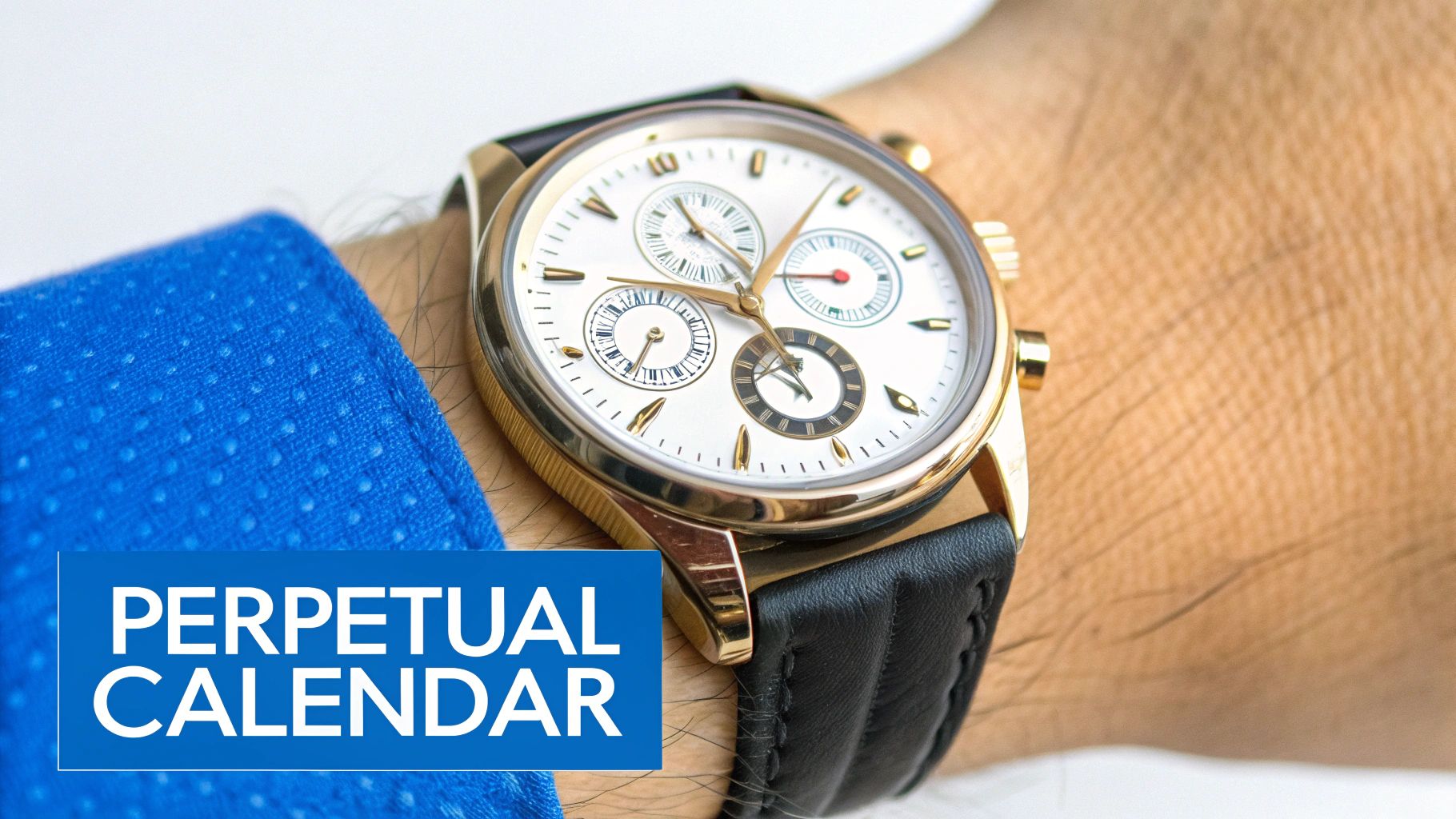
Consider your standard watch with a simple date window. You know the drill. Five times a year—at the end of April, June, September, November, and February—you have to fiddle with the crown to skip ahead. It's a minor hassle, but it shows the watch doesn't really know what month it is.
A perpetual calendar, on the other hand, operates on a whole different level of mechanical intelligence.
A Mechanical Memory
At its core, a perpetual calendar watch is a device with a mechanical memory. It’s been pre-programmed to know the exact length of all 12 months, allowing it to jump seamlessly from February 28th to March 1st in a normal year.
Even more impressive? It nails the leap year, correctly showing February 29th every four years. This is no small feat. It's accomplished through an intricate ballet of hundreds of gears, delicate levers, and precisely shaped cams all working in perfect sync. The "brain" of this whole operation is often a special component that makes just one full rotation every four years—that's 1,461 days! This slow-moving master gear is what dictates the entire calendar display, guaranteeing flawless accuracy for decades.
Perpetual Calendar Key Features at a Glance
To really get a handle on what makes this complication so special, it helps to break down its core functions. The table below gives a quick summary of what a perpetual calendar brings to the table.
| Function | Capability | User Benefit |
|---|---|---|
| Date Management | Automatically adjusts for 28, 29, 30, and 31-day months. | Forget about making manual date corrections five times a year. |
| Leap Year Logic | Correctly displays February 29th during a leap year. | Set it once and you're good to go—the watch handles the four-year cycle internally. |
| Long-Term Accuracy | Stays accurate without any adjustment until the year 2100. | Unmatched convenience that showcases true horological mastery. |
As you can see, this is a seriously sophisticated piece of engineering.
The perpetual calendar is the undisputed king of all calendar complications. Unlike an annual calendar, which still needs a small tweak once a year in February, a true perpetual calendar is built to run uninterrupted until the year 2100.
This incredible self-sufficiency is exactly why it's considered one of the "grand complications" in the watch world. It represents a pinnacle of micro-engineering and stands as a testament to the pure art of creating a machine that tracks time with near-perfect autonomy.
A Brief History of This Horological Marvel
To really get what makes a perpetual calendar watch so special, you have to look back. This isn't a story of a single lightbulb moment, but one of slow, obsessive refinement over hundreds of years. And it all started not on the wrist, but in the waistcoat pocket.
The journey kicks off in 1762 with English watchmaker Thomas Mudge, who built the first known perpetual calendar pocket watch. Think of it as the original mechanical computer for time, able to track the different lengths of months and even nail leap years. For its time, this was an insane feat of micro-engineering. Mudge's creation, now housed in The British Museum, is a pure testament to his genius. You can learn more about its incredible beginnings in this deep dive into the perpetual calendar's history.
From Mudge to Modern Mastery
After Mudge’s invention, the complication basically went dark for nearly a century. Why? It was just too difficult and expensive to produce, making it an absolute rarity. It wasn't until 1864 that the legendary watchmaking house Patek Philippe brought the idea back to life with a new perpetual calendar pocket watch.
Realizing they were sitting on horological gold, Patek Philippe moved to patent the mechanism in 1889. This move cemented the perpetual calendar's place at the very top of high watchmaking, turning it from a one-off curiosity into a reproducible, though still incredibly complex, piece of art. That patent was a huge milestone that set the stage for everything that followed.
Shrinking Genius for the Wrist
Moving this complex machine from a big pocket watch to a compact wristwatch was a whole different ballgame. Trying to miniaturize hundreds of tiny, interlocking parts while making sure the thing actually worked reliably was a massive challenge that took decades to solve.
The big breakthrough finally happened in 1925.
The world’s first perpetual calendar wristwatch wasn't a standard production model. It was a unique piece commissioned by a wealthy American collector, Thomas Emery. Made by Patek Philippe, the watch used a movement originally designed for a ladies' pendant watch, showing just how much skill it took to adapt the complication for the wrist.
This one-of-a-kind watch proved that the impossible was, in fact, possible. It opened a new chapter for watchmaking and inspired other top-tier brands to create their own versions of this "grand complication."
Key Milestones in Perpetual Calendar History
The road from Mudge’s first concept to the iconic wristwatches we see today is marked by a few critical moments.
- 1762: Thomas Mudge creates the very first perpetual calendar pocket watch.
- 1889: Patek Philippe patents its mechanism, setting an industry benchmark that still stands today.
- 1925: Patek Philippe makes the first perpetual calendar wristwatch, proving the complication could be successfully miniaturized.
- 1978: Audemars Piguet develops an ultra-thin automatic perpetual calendar movement, solving the thickness problem and making the watch far more wearable.
This history is exactly why these timepieces are held in such high regard. They aren't just watches; they're the product of centuries of relentless innovation, passion, and the human drive to master time itself. Every single one carries a piece of that incredible legacy on its dial.
How a Perpetual Calendar Mechanism Actually Works
At first glance, the dial of a perpetual calendar looks elegant and deceptively simple. But beneath that calm surface lies a microscopic city of hundreds of gears, springs, and levers working in perfect harmony. The whole mechanism is a testament to centuries of watchmaking genius—it's essentially a tiny mechanical computer programmed to understand time.
To really get it, you have to think of the movement as having a form of mechanical memory. It doesn't just tick off the days one by one; it "knows" the complex rules of our Gregorian calendar. This intelligence is physically coded into its structure, letting it navigate the irregular lengths of our months without any help from you. The complexity is just staggering, and it requires a level of precision that very few watchmakers ever truly master.
This whole system is a masterclass in controlled chaos. All those individual parts have to work together to track the date flawlessly, distinguishing between 30 and 31-day months. It also has to remember that February has 28 days most of the time, but 29 in a leap year.
The Four-Year Grand Levier
So, what's the secret to this "memory"? It all comes down to a central component often called the grand levier (or great lever), which is basically a 48-month wheel. Think of this part as the brain of the whole operation. While most components in a watch are in constant motion, this master wheel makes just one full rotation every four years—that’s 1,461 days.
This incredibly slow, deliberate rotation is what gives the watch its long-term memory. The surface of this wheel isn't smooth at all; it has a complex series of carefully shaped notches, bumps, and steps, all at varying depths. Each unique shape corresponds to the length of a specific month.
- Shallow notches signal a 31-day month.
- Deeper notches correspond to 30-day months.
- Even deeper indentations represent the 28 days of February.
- A single, unique notch is reserved just for the 29th of February during a leap year.
As this master wheel turns, a mechanical finger traces along its edge. The specific depth of the notch it falls into at the end of each month is what tells the rest of the calendar mechanism exactly how to advance the date. If you're curious about the fundamentals of how these parts interact, our guide on how a mechanical watch works breaks down the basic principles.
This diagram shows the journey from pocket watch to patented mechanism, and finally, to the modern wristwatch we know today.
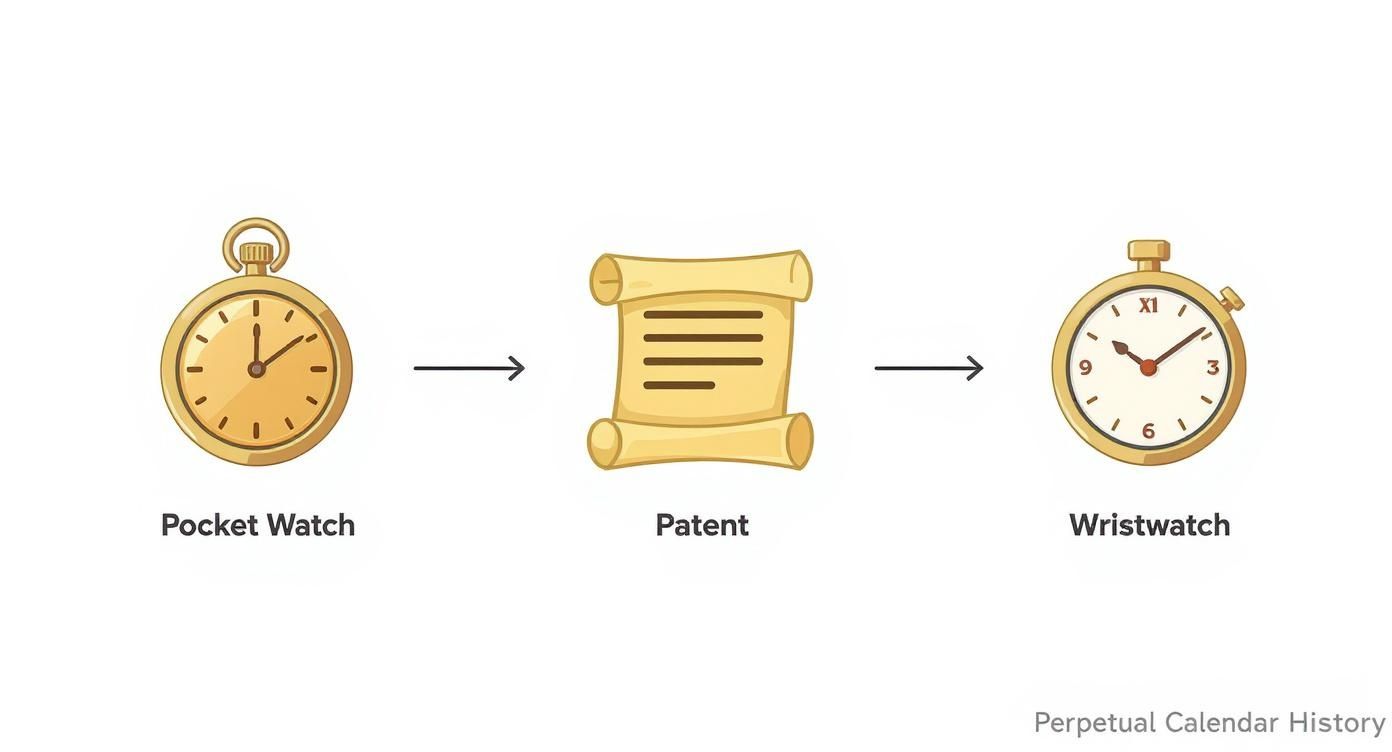
The visual highlights just how critical patenting these complex mechanisms was to standardizing and eventually shrinking them down for the wrist.
A Symphony of Levers and Cams
When that mechanical finger drops into a deep "30-day" notch, it triggers a lever that makes the date wheel skip right over the 31st and jump straight to the 1st of the next month. When it hits the even deeper "February" notch, it performs an even bigger jump. It’s an elegant system that ensures the date is always right, whether it’s April 30th or February 28th.
The perpetual calendar is basically a mechanical algorithm. Its programming isn't digital code, but physical geometry—the precise shape of a cam, the length of a lever, the number of teeth on a gear. This physical "code" is built to run flawlessly for over a century.
This entire mechanical ballet happens automatically, driven by the steady power from the watch's mainspring. It's a completely self-sufficient system that requires zero intervention from the wearer, a quality that elevates it to the prestigious status of a "grand complication."
Understanding this intricate dance helps you appreciate a perpetual calendar watch on a much deeper level. It’s not just a device that tells time; it’s a piece of kinetic art that has mastered it.
Perpetual vs Annual vs Simple Calendar Watches
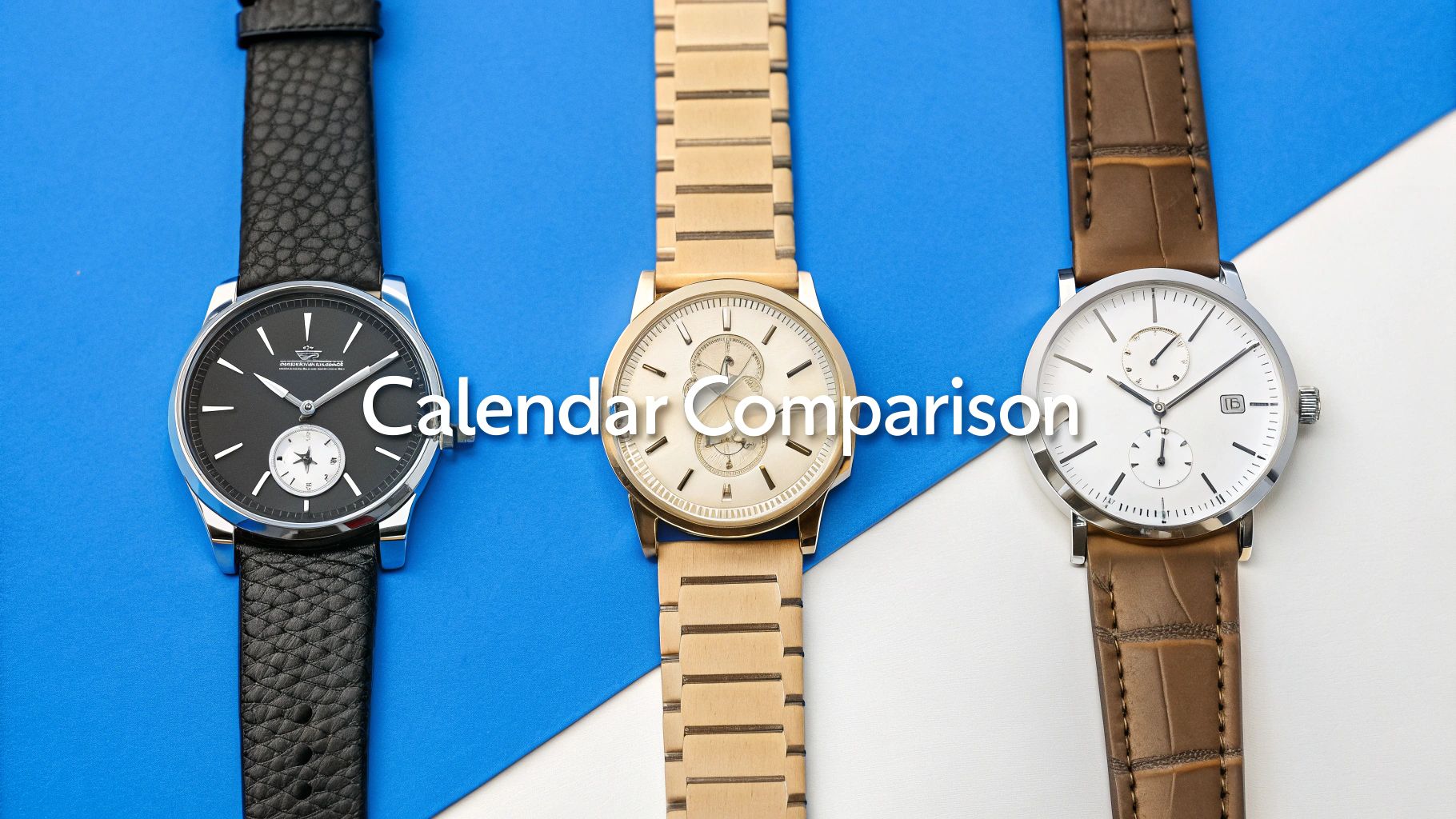
To really get what makes a perpetual calendar so special, it helps to put it up against its simpler cousins. You see, not all calendar watches are built the same, and the gap in their mechanical smarts is huge. These differences in how they function directly shape their complexity, how often you need to fiddle with them, and, naturally, their price tag.
The most basic of the bunch is the simple calendar, which most people just call a "date" complication. This is the classic date window you’ll find on tons of watches. It’s a pretty straightforward mechanism, clicking the date forward by one every 24 hours on a fixed 31-day cycle.
The catch is that it doesn’t know how many days are actually in a month. So, at the end of any month with fewer than 31 days—that’s February, April, June, September, and November—you have to step in and manually advance the date. It's a reliable system, but it needs your help five times a year.
The Annual Calendar: A Major Step Up
Climbing up the ladder, we get to the annual calendar. Patek Philippe really changed the game when they introduced this in 1996. This complication has the mechanical "brain" to tell the difference between months with 30 and 31 days, automatically adjusting itself correctly as the months roll by.
This means you can go nearly a full year without ever touching the crown. The only time it needs a hand is with February. The annual calendar mechanism isn't programmed for February's short length or for leap years, so it requires one manual correction each year on March 1st. It’s a brilliant middle ground, giving you a ton more convenience than a simple calendar without the mind-boggling complexity of a perpetual one.
The Perpetual Calendar: The Pinnacle of Horology
And that brings us to the perpetual calendar, the undisputed king of the hill. This mechanical beast does everything an annual calendar can, but it also masters the tricky business of February and the entire four-year leap year cycle. It knows to show February 29th in a leap year and to jump straight from the 28th to March 1st in all the other years.
A perpetual calendar watch is a completely self-sufficient timekeeper. Once set, it will not require any manual date correction until March 1st, 2100—the year the Gregorian calendar skips a leap day.
This level of mechanical independence is what truly sets it apart. It runs on a sophisticated "mechanical memory" that keeps track of a full 1,461-day cycle, making it a true masterpiece of micro-engineering. While both automatic and quartz movements can power a watch, this intricate calendar is a feat of pure mechanics. If you're curious about what's ticking behind the scenes, you can learn more about the differences between automatic vs. quartz watch movements in our detailed guide.
Comparing the Calendar Complications
To really put it all in perspective, a side-by-side comparison makes things crystal clear. The main differences come down to how often you need to adjust them, their mechanical complexity, and what they'll cost you. This really shows what makes each type special.
Comparison of Watch Calendar Complications
| Feature | Simple Calendar (Date) | Annual Calendar | Perpetual Calendar |
|---|---|---|---|
| Adjustment Needed | 5 times per year | Once per year (March 1st) | Once per century (Year 2100) |
| Handles 30/31 Day Months? | No | Yes | Yes |
| Handles Leap Years? | No | No | Yes |
| Mechanical Complexity | Low | Medium | Very High |
| Relative Price | $ | $$ | $$$$ |
This table lays out the step-by-step increase in capability, which goes hand-in-hand with complexity and cost. Deciding between them really boils down to what you value most: the simple utility of a date window, the everyday convenience of an annual calendar, or the horological art of a completely self-reliant perpetual calendar. Each one represents its own tier in the world of fine watchmaking.
What to Know Before Owning a Perpetual Calendar
Getting a perpetual calendar is less like buying a watch and more like adopting a complex, miniature machine. It's a seriously rewarding experience for any collector, but it also comes with a unique set of responsibilities. If you want to enjoy the watch and protect its incredibly intricate mechanism, you need to know what you're getting into.
The first and most important rule is simple: don’t let it stop. A perpetual calendar is meant to run continuously. When the power reserve dies and the movement halts, all those perfectly synchronized calendar displays fall out of whack. Resetting a simple day-date is one thing, but getting the day, date, month, and leap year indicator all lined up again is a delicate and often frustrating task.
The Power of a Watch Winder
This is exactly why a good watch winder isn't just a nice accessory; it's an essential piece of kit for anyone who owns a perpetual calendar. A winder keeps the watch gently rotating, ensuring the mainspring stays wound and the movement never stops. Honestly, it's the single best investment you can make to save the complex gearing from the stress of being reset all the time.
Not only does a winder save you a headache, but more importantly, it helps you avoid accidentally damaging the movement. For anyone new to mechanical pieces, our guide on how to wind a mechanical watch is a great place to start building good habits.
Navigating the Dreaded Danger Zone
One of the most critical things every owner must know is the concept of the “danger zone.” This is a specific window of time, usually somewhere between 9 PM and 3 AM, when you should never, ever try to manually change the calendar settings.
Why? Because during these hours, the watch's internal gears are already moving into place to automatically advance the date. If you try to force a manual change while this is happening, you can jam, bend, or even break some very tiny, very expensive parts. It’s a shortcut to a costly repair bill.
Always check the manual for your specific watch to know its exact danger zone, as it can vary a bit between movements. A solid rule of thumb is to always move the hands past 3 AM before you touch any calendar pushers, and then set the correct time afterward. It's a simple step that can save you from a mechanical nightmare.
This is a non-negotiable rule. It’s all about respecting the complication and protecting a significant investment.
Understanding Service Intervals and Costs
Just like a high-performance car, a perpetual calendar needs regular maintenance to keep its hundreds of tiny parts working in harmony. Most brands recommend a full service every five to eight years. This isn't a quick tune-up; it's a complete teardown where the movement is disassembled, cleaned, lubricated, and put back together.
You have to be prepared for the cost. Servicing a grand complication is a specialized job for a master watchmaker, and the price tag reflects that level of skill.
- Complexity: The sheer number of parts means the whole process takes far longer than servicing a standard watch.
- Expertise: Only a handful of highly trained watchmakers are qualified to even touch these movements.
- Cost: A full service can easily climb into the thousands of dollars, and that’s before factoring in any replacement parts.
The right way to think about this is not as a repair bill, but as an investment in the watch's future. Regular servicing ensures your perpetual calendar will keep ticking precisely for decades to come—a true horological masterpiece ready to be passed down to the next generation.
Frequently Asked Questions
Even after getting your head around the basics of a perpetual calendar, a few specific questions always seem to pop up. Let's tackle some of the most common ones that collectors and enthusiasts ask, helping you clear up any lingering doubts about owning one of these incredible timepieces.
What Happens to a Perpetual Calendar Watch in 2100?
Here’s a fascinating quirk: on March 1st, 2100, nearly every traditional perpetual calendar watch will need its first manual correction. It’s not a defect—it’s a feature of the Gregorian calendar system the watch is built to track.
The rule is that century years (like 1800, 1900, 2100) are only leap years if they're divisible by 400. So, while 2000 was a leap year, 2100 won't be. Your watch's mechanical "brain," however, operates on a simple four-year cycle and has no way of knowing this. It’s programmed to treat 2100 like any other leap year.
On that day, the watch will incorrectly display February 29th. The owner will need a watchmaker to advance the date to March 1st. For most of these machines, it'll be the first time they’ve ever needed human help. A few hyper-complex and extremely rare watches called "secular calendars" are actually engineered to handle this exception, but they're in a league of their own.
Is It Difficult to Set a Perpetual Calendar if It Stops?
In a word, yes. Resetting a perpetual calendar that has wound down is a delicate and potentially risky process. When the power reserve dies, all the calendar displays—date, day, month, moonphase, and leap year—fall out of sync. Getting them all aligned again takes patience.
You’ll typically use small, recessed pushers on the case to advance each display one at a time until everything is correct. It is absolutely essential to follow the manufacturer's instructions precisely. Most importantly, you can never, ever make adjustments during the movement's "danger zone."
The "danger zone" is a critical window of time, usually between 9 PM and 3 AM, when the watch’s internal gears are already engaged to change the date. Trying to set the watch during this period can snap off a gear tooth or damage other tiny components, leading to a horribly expensive repair.
This is exactly why so many owners keep their perpetual calendars on a watch winder. It’s not just for convenience; it's a practical way to protect the movement from accidental damage.
Why Are Perpetual Calendar Watches So Expensive?
The steep price tag on a perpetual calendar comes down to one thing: mind-boggling mechanical complexity. These watches are among the most challenging grand complications to design, build, and assemble in the entire world of horology.
Several factors drive up the cost:
- Part Count and Precision: A perpetual calendar movement can have hundreds of extra parts compared to a standard watch. Each tiny lever, wheel, and cam has to be manufactured to microscopic tolerances.
- Skilled Labor: Every component is hand-finished to an impeccable standard and then carefully assembled by a master watchmaker. This isn't an assembly line job; it's a process that can take weeks or even months for a single watch.
- Research and Development: The engineering investment required to create a reliable and compact perpetual calendar mechanism is massive, and that cost is baked into the price of each watch.
You're essentially buying a miniature mechanical computer built with centuries of watchmaking knowledge. It represents the absolute pinnacle of a brand's skill.
Are Perpetual Calendar Watches a Good Investment?
Like any luxury good, calling a perpetual calendar watch a guaranteed investment is a stretch, but many have proven to be fantastic assets. A watch's potential to appreciate depends on the brand's reputation, the model's rarity, its condition, and what the market wants at the moment.
Watches from powerhouse brands like Patek Philippe, Audemars Piguet, and Vacheron Constantin have a strong track record of holding their value and often appreciating over time. This is especially true for limited editions or historically significant models. The artistry involved ensures they'll always be in demand among serious collectors.
That said, it's best not to view them purely as a financial tool. Their real value is in the craftsmanship, the history, and the sheer joy of owning such a sophisticated piece of mechanical art. If you're looking to buy, focus on a watch you genuinely love from a brand you trust. Any future financial gain should be seen as a welcome bonus.
At ECI Jewelers, we understand the passion that drives collectors of grand complications. Whether you're hunting for your first perpetual calendar or adding a rare piece to your collection, our experts are here to provide a trusted and transparent experience. Explore our curated selection of authenticated luxury timepieces, backed by over 25 years of expertise, and find your next masterpiece.


