


Winding your mechanical watch is more than just a task; it’s a ritual that connects you to the intricate heart of your timepiece and centuries of horological tradition. It's the simple act that breathes life into the gears and springs.
Mechanical Watch Winding Basics

Whether you own a classic manual-wind piece or a modern automatic, understanding the basics of winding is essential. Manual watches, the old-school purist's choice, rely entirely on you. A full wind typically takes 20 to 40 turns of the crown.
Automatic watches are a bit different. They cleverly harness the energy from your wrist's movement to wind themselves, but they're not perpetual motion machines. If you haven't worn your automatic for a couple of days, it's a good idea to give it a gentle manual wind to get it going again.
A few things to keep in mind:
- Always be gentle. Grip the crown lightly to avoid putting stress on the delicate winding stem.
- Turn the crown clockwise until you feel a bit of resistance. Don't force it.
- Making it a daily habit, preferably around the same time, helps keep the timekeeping consistent.
Winding is the moment you and your watch work together. It’s a small, daily connection to the incredible craftsmanship on your wrist.
Manual vs Automatic Winding Quick Guide
Getting a feel for your specific watch is key. A vintage manual-wind Calatrava will feel very different from a modern automatic Submariner. Here’s a quick breakdown to help you get started.
| Feature | Manual-Wind Watch | Automatic Watch |
|---|---|---|
| Crown Turns | 20–40 rotations for a full wind | A few turns to start it, then let your wrist do the work |
| Power Reserve | Typically 36–72 hours | Usually 40–50 hours |
| Winding Frequency | Daily, ideally at the same time | Only when it has stopped after being unworn |
This little chart gives you the general idea, but always pay attention to your own watch's needs.
If you really want to get into the nuts and bolts of it all, check out our guide on how a mechanical watch works. It’s fascinating stuff.
The passion for these little machines is huge. The global mechanical watch market hit about USD 45.57 billion and is expected to climb to USD 67.28 billion by 2033. That’s a lot of people who appreciate the art of watchmaking.
And speaking of history, that appreciation often extends to older pieces. If you've ever wondered about the value of your vintage pocket watch, you know that these aren't just timekeepers; they're pieces of history with their own stories.
Benefits of Consistent Winding
Keeping your watch properly wound isn't just about telling time. It has real benefits for the health of the movement.
- Keeps the power reserve stable. This is crucial for maintaining the watch's accuracy, or its chronometry.
- Distributes lubricants. A regularly running watch keeps the internal oils moving, preventing them from settling and drying out.
- Connects you to your watch. You'll start to notice the little nuances of the movement, the feel of the crown, and how it performs.
A little daily attention is all it takes to keep your timepiece in peak condition.
The Hands-On Guide to Winding a Manual Watch

There’s a certain ritual to winding a manual watch, a hands-on connection that automatic movements just can't replicate. But doing it right is key to keeping your timepiece healthy.
First thing’s first: always take the watch off your wrist. Winding it while it's still on puts awkward, sideways pressure on the winding stem, which is a delicate and critical component. It’s a simple habit that can prevent a costly trip to the watchmaker.
Once it’s off, get a relaxed grip on the crown between your thumb and forefinger. No need for a death grip—just a light, controlled touch.
Getting Started: Proper Grip and Crown Position
Before you start turning, make sure the crown is in its proper winding position. For most watches, this means it's pushed all the way in against the case.
If you have a dive watch or a sport model like many Rolexes, you’ll likely have a screw-down crown. To wind it, you first need to gently rotate it counter-clockwise (towards you) until you feel it pop free from the threads. Now you're in the winding position.
- Take it off: Always remove the watch from your wrist to avoid stressing the winding stem.
- Check the crown: Confirm it’s pushed in or, for screw-down types, fully unscrewed.
- Go slow and steady: Use a smooth, clockwise motion. Don't try to rush it.
Every watch has its own feel. Winding a vintage Patek Philippe, for instance, requires a completely different touch than a modern, robust tool watch. You’ll get to know the unique character of your timepiece over time.
Feeling for Resistance
As you wind, you're tightening the mainspring. The key is to stop when it’s fully wound, but not to force it.
Most manual watches are fully wound after 20 to 40 turns, but this is just a ballpark figure. It really depends on the specific movement and its power reserve. Pay attention to the feel. You'll notice the resistance gradually increasing. Eventually, you’ll feel a distinct point where it won’t turn any further without significant force. That’s your stopping point. Don't push past it.
| Rotations | Typical Power Reserve |
|---|---|
| 20 turns | ~36 hours |
| 30 turns | ~48 hours |
| 40 turns | ~72 hours |
Again, this table is just a general guide. An experienced collector often learns to stop just a turn or two before that hard stop to avoid putting any unnecessary strain on the mechanism.
"Feeling the spring tighten is part of the connection with your watch. It tells you it's alive."
This tactile feedback is something you develop a sense for. It's how you know you’ve given the watch enough power without risking damage to the mainspring.
Building a Daily Routine
Consistency is your best friend when it comes to mechanical watches. I make it a habit to wind my manual pieces around the same time every morning. This keeps the mainspring at a consistent tension, which helps maintain better timekeeping accuracy.
A few tips I've picked up over the years:
- Keep a mental count of the turns it takes to reach a full wind.
- Avoid winding your watch right after you’ve set the date, as some movements have gear-train vulnerabilities during the date changeover period.
- Store your watch dial-up at night. This helps keep the oils distributed evenly within the movement.
Winding your watch correctly becomes a mindful, satisfying habit. Forcing the crown past its stopping point is one of the quickest ways to damage the movement. On the other hand, letting it run down completely all the time isn't ideal for accuracy either.
By mastering this simple process, you're not just powering your watch; you're participating in a tradition of horology that spans centuries. You become part of the machine's daily life, ensuring its mechanical heartbeat stays strong and true.
Properly Winding Your Automatic Watch
One of the biggest myths in watch collecting is that an automatic watch never needs your help. While its self-winding rotor is a marvel of engineering, it’s not some magical perpetual motion machine. Your daily movements keep it powered up, sure, but what happens when it’s been sitting in the watch box for a few days?
When an automatic watch's power reserve runs dry, it simply stops. Instead of giving it a frantic shake to get it going again—a common but cringe-worthy habit—the proper way is to give it a gentle manual wind. This gives the mainspring that initial burst of energy it needs, letting the movement start strong and keep better time right from the moment you put it on.
The Right Technique for Self-Winding Watches
Winding an automatic watch feels a little different than a purely manual one. You're not winding it until you feel that hard stop; in fact, you never will. Automatics are cleverly designed with a built-in slipping clutch that prevents the mainspring from ever being overwound. It’s a crucial safety feature that protects the delicate movement inside.
A good rule of thumb is to give the crown about 20 to 30 smooth, clockwise turns. That’s more than enough juice to get the balance wheel ticking and build a solid base in the power reserve. Once it’s running, your natural wrist motion will take over and keep it topped off throughout the day. If you really want to get into the nuts and bolts, our guide explains in detail what an automatic watch is and how these incredible systems work.
Think of it like starting a car that’s been sitting for a while. You don't just push it down a hill; you turn the key to give the engine the initial spark it needs to run smoothly. A manual wind does the same for your watch.
The Role of a Watch Winder
For collectors who rotate through several automatic timepieces, a watch winder quickly becomes more of a necessity than a luxury. A winder is a device that holds your watch and rotates it on a set schedule, perfectly mimicking the motion of your wrist and keeping the mainspring consistently wound.
This brings two huge benefits:
- Convenience: Your watches are always running and ready to go. No more resetting the time, date, and moonphase every time you decide to switch things up.
- Lubricant Distribution: It keeps the movement's vital oils and lubricants evenly distributed, which many believe contributes to the long-term health and performance of the watch.
The popularity of these devices has exploded right alongside the luxury watch market itself. The global watch winder market was valued at around USD 1.2 billion in 2023 and is projected to more than double by 2032, which just goes to show how many collectors rely on them. You can check out more insights on this growing market on dataintelo.com. At the end of the day, using a winder ensures every piece in your collection is primed and ready for action whenever you are.
Understanding Crown Functions And Positions
Your watch’s crown is more than just a knob—it’s the gateway to everything happening inside. Think of it like the gear lever of a classic car: each position unlocks a different feature, and shifting at the wrong moment can lead to serious trouble.
Before you dive in, take a moment to feel how smoothly (or not) that crown turns. A light touch here goes a long way toward preserving those delicate gears inside.
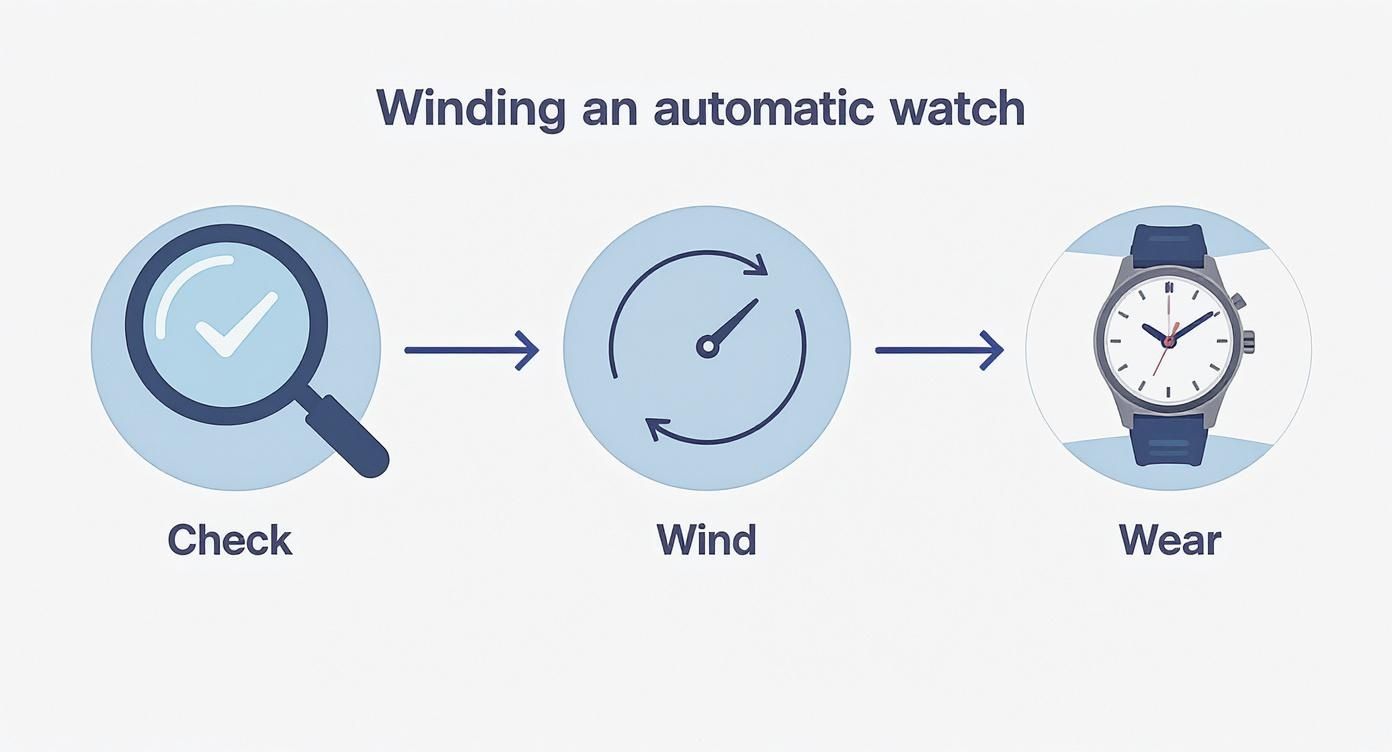
This visual walks you through the essentials: confirm the watch has stopped, give it a few turns to build up power, then let your wrist’s motion take over.
Common Crown Positions And Their Functions
Below is a quick overview of the three most common crown positions you’ll encounter on a mechanical watch. Keep this at hand the next time you’re setting or winding your piece.
| Crown Position | Function | Common Watch Types |
|---|---|---|
| Position 0 (Pushed In) | Manual winding; resting state | Manual-wind and Automatic |
| Position 1 (First Click) | Quick date adjustment on calendar-equipped models | Date and Day-Date References |
| Position 2 (Second Click) | Time setting with hacking (stops the seconds hand) | Most Mechanical Movements |
With this chart, you can quickly identify which click does what—no guesswork required.
Navigating Different Crown Positions
When your watch has a date complication, timing matters. Resist the urge to fiddle with the calendar between 9 PM and 3 AM—that’s when the gears are already engaged and vulnerable.
Pro Tip: Push the hands past midnight until the date flips, then dial back to around 6 AM before you use the quick-set. It only takes seconds and can prevent a very expensive repair.
Once you’ve cleared that window, you’re free to adjust both date and time without risking chipped teeth or misaligned wheels.
Mastering The Screw-Down Crown
High-end divers and sports pieces—think Rolex Submariner or Omega Seamaster—often rely on a screw-down crown to lock out water. Here’s how to handle it like a pro:
- Unscrew Counter-Clockwise: Turn gently toward you until you feel the threads release and the crown “pops” to Position 0.
- Pull To Desired Click: From here, select the date or time setting as needed. For brand-specific tips, see our detailed guide on how to adjust the time on a Rolex.
- Secure It Properly: When you’re done, press in lightly and turn clockwise until you feel the threads engage. Never force it. A finger-tight finish is all you need to maintain that all-important water seal.
By treating the crown with respect—smooth turns, gentle clicks, and proper resealing—you’ll keep your mechanical masterpiece humming for years to come.
Solving Common Winding Issues
Even with the best intentions, you’re bound to run into a few snags when getting the hang of your mechanical watch. Don't worry—questions and minor issues are a normal part of ownership. Learning to troubleshoot them with confidence is what separates a novice from an experienced collector.
One of the first worries for any new owner is the fear of overwinding. Can you actually break your watch by turning the crown too much?
With a manual-wind watch, the answer is yes, but it’s tough to do by accident. As you wind, you'll feel a very clear, firm stopping point when the mainspring is fully tensioned. The trick is to simply respect that signal. Don't force it further.
For automatic watches, this concern is completely unfounded. They are engineered with a brilliant slipping clutch mechanism that disengages once the mainspring is fully wound. You can keep turning the crown, but you won't do any damage; the clutch just slips to prevent any excess tension.
When The Crown Feels Stiff or Gritty
What if the crown is difficult to turn? First off, don't panic and definitely don't apply more force. A stiff crown can mean a few different things, and it’s important to figure out what's going on.
A little bit of resistance is perfectly normal, especially on a manual watch as it nears a full wind. However, if the crown feels unusually tight from the get-go, gritty like there's sand in the works, or is completely stuck, that’s a red flag.
- Check the Basics: If you have a screw-down crown, double-check that it's fully unscrewed. Sometimes the threads can create a feeling of resistance if they aren't completely disengaged.
- Don't Force It: Forcing a stuck crown is the fastest way to snap a winding stem—a delicate component that needs a watchmaker to replace.
- Seek Professional Help: A gritty or stuck crown often points to bigger issues like dried-out gaskets, debris caught in the threads, or a problem inside the movement itself. It’s time for a service.
Your watch is trying to tell you something when you feel that grit or stiffness. A stubborn crown isn't a challenge to overcome; it's a signal to stop and let a professional take a look.
Is My Watch Not Holding a Charge?
Another common head-scratcher is a watch that seems to stop well before its advertised power reserve runs out. If you've fully wound your watch but it dies after just a few hours, it's a clear sign that it needs professional attention.
This usually means the mainspring is worn out and can't store energy efficiently anymore, or there's an issue somewhere else in the gear train causing too much friction.
Getting familiar with the internal mechanics helps you appreciate these signals. To better understand the components you're interacting with when you wind the crown, it's helpful to learn about watch parts and how a watch works. This knowledge will make you a more proactive and informed owner.
Got Winding Questions? We Have Answers.
Whether you're just getting into mechanical watches or you've been collecting for years, a little clarity goes a long way. Confidence in handling your timepieces is key, so let's tackle some of the most common questions about winding.
Getting this right keeps your watch healthy, happy, and on time.
Can You Overwind a Watch?
This is probably the number one question we hear, and the answer depends on the type of movement you have.
For a modern manual-wind watch, there's a built-in safety mechanism. As you wind, you'll eventually feel a very clear, firm resistance. That's the mainspring telling you it's full. If you try to force it past that point, you risk doing some serious damage.
Automatic watches, on the other hand, are designed to prevent this. They use a brilliant little device called a slipping clutch. Once the mainspring has enough tension, the clutch simply disengages, letting the rotor (or your hand-winding) spin without adding more stress. You literally can't overwind an automatic by hand.
“Feeling that firm stop on a manual watch is your cue to pause. Think of it as the movement talking back to you.”
The Right Winding Routine
For a manual-wind watch, consistency is your friend. Winding it once a day is the best practice, and doing it at roughly the same time helps keep the power reserve in its sweet spot for optimal accuracy. Many collectors make it part of their morning coffee ritual.
Automatics are a bit different. They thrive on regular wear, as the motion of your wrist keeps them topped up. If you haven't worn a piece for a day or two and it has stopped, a quick manual wind of 20 to 30 turns is all it needs to get going again. After that, just put it on and let your daily activity do the rest.
- Manual Piece: Give it 20–40 turns once a day, until you feel that gentle stop.
- Automatic (Off the Wrist): A quick 20–30 turns is perfect to kickstart it.
- Timing is Everything: Pick a consistent time, like morning or evening, to make it a habit.
A consistent winding routine doesn't just support accuracy; it also helps maintain the even distribution of lubricants throughout the movement's tiny gears and jewels.
Troubleshooting Common Winding Issues
What if the crown feels stiff, gritty, or just… wrong? First rule: stop winding immediately. Never force it. Forcing a stubborn crown is a fast track to bending or breaking the winding stem, which is a much more involved repair.
Let's break down what might be happening.
- First, if you have a screw-down crown (common on dive watches), are you positive it's fully unscrewed before you try to wind? It's an easy mistake to make.
- If you feel resistance right from the first turn, there could be debris in the threads or a gasket that has started to deteriorate.
- A gritty sensation often points to dirt or worn-out seals inside the crown mechanism.
| The Feeling | What It Might Be | Your Next Step |
|---|---|---|
| Stiff from the start | Dirt or grime in the crown threads | Needs professional cleaning |
| Gritty or sandy | Worn seals or internal debris | Get it to a watchmaker for inspection |
| Sudden, hard stop | You've fully wound a manual watch | Perfect! Just stop winding. |
A stubborn crown is almost always a signal that your watch needs a professional service. Tackling it early will save you a headache—and money—down the line.
What Happens When an Automatic Watch Stops?
Don't panic. Letting an automatic watch run down and stop is perfectly fine and rarely harmful. Modern synthetic lubricants are incredibly stable, so a watch can sit dormant for weeks or even months without causing damage to the movement.
However, keeping the movement running has its perks:
- It prevents the oils from settling or pooling in one spot.
- It ensures all the gears and components stay loose and ready.
- It maintains consistent timekeeping, so it's ready to go when you are.
If you rotate through several watches, a watch winder can be a fantastic tool. It gently rotates your watch to mimic the motion of your wrist, ensuring each timepiece in your collection is wound and waiting for you.
Keep in mind, vintage pieces or watches with complex complications can be a bit more particular. Always stick to the manufacturer's recommendations for service intervals and handling. When in doubt, the best advice is always to consult a qualified watchmaker who knows your specific brand inside and out.
Ready to elevate your watch care routine? Explore our curated collection of authenticated luxury watches and fine jewelry at ECI Jewelers.


