


Think of an automatic watch as a tiny, intricate engine you wear on your wrist, one that’s powered entirely by you. It's a beautiful blend of old-world craftsmanship and clever engineering that turns your everyday movements into the energy it needs to keep time. No batteries needed.
The Enduring Charm of the Automatic Watch

Unlike their quartz cousins that run on a battery, automatic timepieces are marvels of self-sufficiency. They operate through a complex dance of gears, springs, and levers, all working together in perfect harmony. This is what creates that smooth, sweeping motion of the second hand—a signature trait beloved by watch lovers.
So, what exactly is an automatic watch? At its heart, it’s a self-winding mechanical watch that uses the natural motion of your wrist to power itself. The secret lies in a weighted piece called a rotor, which spins as you move. This spinning winds the mainspring, storing up the energy needed to run the watch. It’s an elegant solution that means as long as you wear it, it keeps on ticking. This innovation is a key reason the mechanical watch market continues to thrive, as noted by researchers at gminsights.com.
This direct connection between the wearer and the watch creates a unique, personal bond. An automatic watch is more than just a device for telling time; it's a piece of wearable art and a nod to sustainable technology.
An automatic watch doesn't just tell time; it tells a story of craftsmanship, precision, and the beautiful synergy between human movement and mechanical engineering.
This lasting appeal is why these pieces are often seen not just as personal statements, but as smart purchases. In fact, exploring the reasons why luxury watches are a good investment reveals a deeper value that goes far beyond simply keeping track of the hours.
How a Self-Winding Movement Actually Works
At the core of every automatic watch is a brilliant bit of micro-engineering that turns your everyday motion into the energy needed to keep time. Think of it as a tiny power plant on your wrist, harnessing the kinetic energy from simple actions like walking, typing, or just talking with your hands.
The magic starts with a semi-circular piece of metal called the rotor. As your arm moves, gravity and inertia get to work, causing the rotor to swing and spin freely. This spinning is the first critical step, kicking off a chain reaction that winds your watch without you even thinking about it.
The rotor’s whole job is to wind the mainspring, which is a tightly coiled metal ribbon that acts as the watch's battery or power reserve. Every rotation of the rotor tightens this spring just a little bit more, storing potential energy. This is what keeps the watch ticking away for 38 to 48 hours (or sometimes much longer) after you’ve taken it off for the night.
From Stored Energy to Ticking Hands
Once the mainspring is wound up, all that stored energy has to be released in a slow, controlled way. That’s where the gear train comes into play. The mainspring gradually unwinds, turning a series of tiny, interconnected gears. Each gear rotates at a very specific, calculated speed, transferring power smoothly through the movement.
This system is what ultimately moves the hour, minute, and second hands. But if left unchecked, the mainspring would unwind all at once in a flash. That's why the final, most ingenious component is so important.
The escapement is the "brain" of a mechanical watch. It's a tiny, intricate mechanism that locks and unlocks the gear train at a consistent rate, creating the characteristic ticking sound and ensuring the smooth, sweeping motion of the second hand.
The escapement releases the gear train in tiny, equal bursts, which is what allows the hands to advance with such incredible precision. This whole process—from the swinging rotor to the ticking escapement—is a beautiful mechanical symphony happening right on your wrist.
To get a better feel for the mechanics they all share, you can dive deeper into our guide on how a mechanical watch works. The self-winding mechanism is really just a clever upgrade to this timeless design.
Comparing Watch Movements: Automatic vs. Quartz vs. Manual
To really get a feel for what makes an automatic watch special, it helps to line it up against the other major players. The watch world is really run by three different kinds of "engines," or movements: automatic, quartz, and manual. Each one offers a totally different experience on the wrist, with its own quirks when it comes to performance and upkeep.
An automatic movement is a little mechanical marvel, using the motion of your own body to keep itself powered up.
A quartz movement, on the other hand, is all about the battery. It sends a tiny electrical pulse through a quartz crystal, making it vibrate at an incredibly precise frequency. That vibration is what drives the motor moving the watch's hands, usually with that familiar one-second "tick."
Then you have the manual-wind movement, which is the granddaddy of the automatic. It’s built with the same beautiful, intricate web of gears and springs, but it needs you to physically turn the crown every day or so to wind the mainspring and keep it ticking.
Watch Movement Comparison
So, how do these three stack up side-by-side? It really comes down to what you value most in a timepiece—the soul and craftsmanship of a mechanical piece or the grab-and-go convenience of quartz.
This table breaks down the core differences at a glance.
| Feature | Automatic | Quartz | Manual |
|---|---|---|---|
| Power Source | Motion of the wearer's wrist | Battery | Hand-winding the crown |
| Accuracy | Good (-10 to +20 sec/day) | Excellent (a few sec/month) | Good (-10 to +20 sec/day) |
| Maintenance | Service every 3-5 years | Battery change every 2-3 years | Service every 3-5 years |
| Second Hand | Smooth, sweeping motion | Ticking motion (once per second) | Smooth, sweeping motion |
| Craftsmanship | High; intricate mechanical parts | Lower; electronic components | High; traditional watchmaking |
| Price | Mid to very high | Low to high | Mid to very high |
Ultimately, there's no "best" movement, just the one that’s best for you. For an even deeper dive, our comparison of automatic vs. quartz movements can help you decide which is the right fit.
This infographic shows the simple, elegant process that powers every automatic watch.
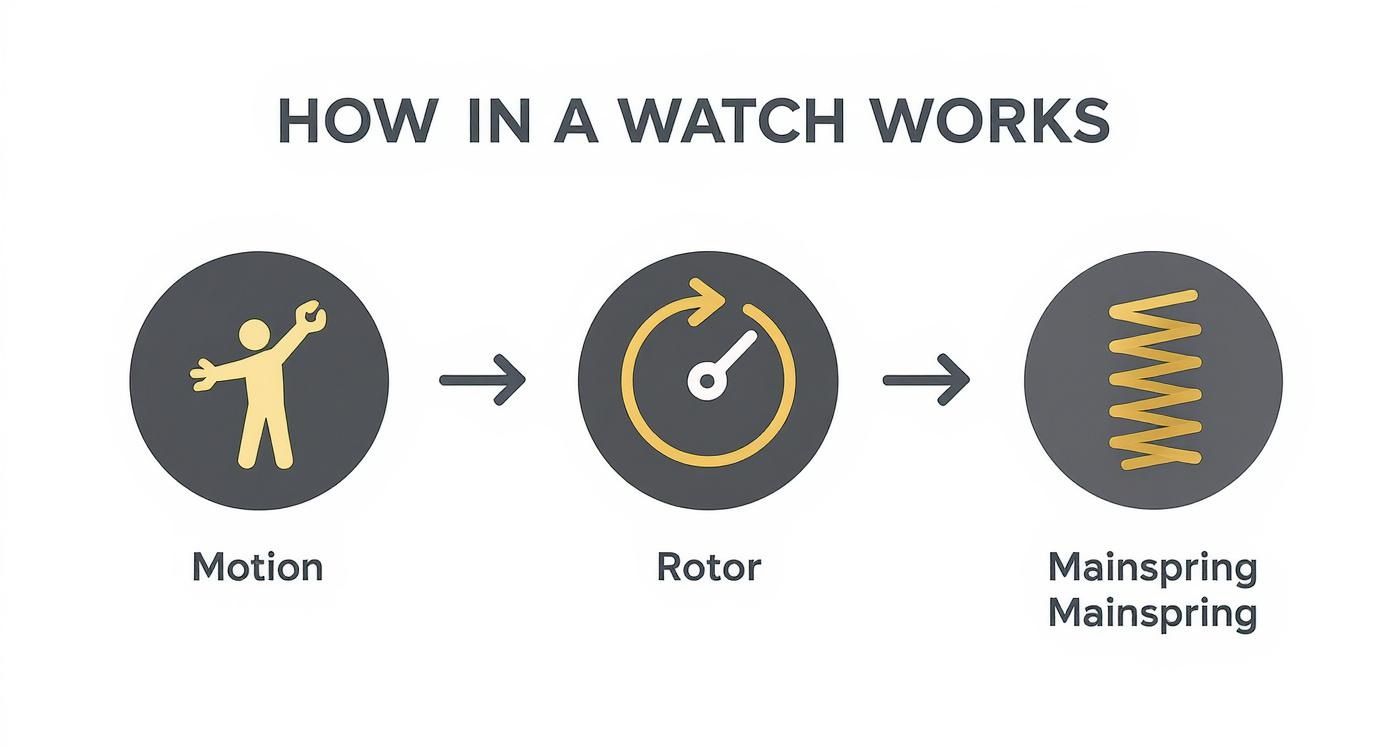
As you can see, it’s a brilliant system that turns your everyday movements into the energy that keeps time, creating a real connection between you and your watch.
While quartz offers superior accuracy and lower maintenance, automatic and manual movements provide a tangible connection to centuries of watchmaking tradition, celebrated for their complex engineering and smooth, sweeping second hands.
The Real Benefits of Owning an Automatic Watch
So, what's the big deal with automatic watches? It’s about more than just the convenience of not needing a battery. Owning one is about embracing a deeper connection to the art of traditional watchmaking.
One of the greatest joys is seeing the craftsmanship up close. Many automatic watches feature an exhibition case back—a small sapphire crystal window on the back of the watch. It gives you a front-row seat to the mesmerizing dance of the rotor, gears, and balance wheel. It’s like having a tiny, living piece of mechanical art right on your wrist.
This tangible link to history and engineering is what truly sets them apart. Unlike a quartz watch that runs on a disposable battery, an automatic movement is powered by you. This creates a personal bond, turning a simple time-telling tool into a trusted companion that shares your journey.
A Legacy on Your Wrist
Automatic watches aren't disposable gadgets; they're built to last for generations. With proper care, a quality timepiece can become a cherished family heirloom, passed down with all the stories and memories attached to it. It’s a real commitment to enduring quality.
An automatic watch is a celebration of permanence in a world of temporary gadgets. It connects you to a rich history of human ingenuity and can become a part of your own legacy.
This focus on heritage is exactly why mechanical movements continue to dominate the high-end watch world. Even with smartwatches everywhere, the mechanical segment still accounts for about 63.85% of the global luxury watch market. That number says a lot about their lasting appeal, which you can read more about in these market trends and their significance.
For true enthusiasts, it's never just been about telling time—it’s about owning a piece of history that ticks on your wrist.
Keeping Your Automatic Watch Ticking for a Lifetime

Think of your automatic watch as a high-performance engine. It's built to last for generations, but it still needs the right care to keep running with precision. The absolute best thing you can do for it? Just wear it. Regular movement on your wrist keeps all the internal lubricants properly distributed and ensures the mainspring stays wound.
If you haven't worn your watch for a while and it's stopped, it’s a good idea to give it a manual wind before strapping it on. Simply unscrew the crown and give it 20-30 clockwise turns. This builds up a solid base of power and prevents putting any unnecessary strain on the self-winding parts as they get going again.
Essential Care and Servicing
Even with daily wear, the complex machinery inside your watch needs a professional tune-up every now and then. To make sure your timepiece runs smoothly and accurately for decades to come, keep these key practices in mind:
- Schedule Regular Servicing: Just like your car needs an oil change, your watch needs a full service every 3-5 years. A professional watchmaker will carefully disassemble, clean, lubricate, and inspect the movement for any worn-out parts.
- Avoid Magnetic Fields: Be mindful of strong magnets found in speakers, laptops, and even some phone cases. They can magnetize the hairspring—a tiny, crucial component—and cause your watch to run fast, slow, or stop altogether.
- Protect from Shocks: Most modern automatic watches have some sort of shock protection, but they're not invincible. A hard drop or a high-impact sport can still knock those delicate internal parts out of alignment.
Think of regular maintenance as preventative healthcare for your watch. A small investment in servicing every few years prevents major, costly repairs down the line and ensures it remains a reliable heirloom.
Common Questions About Automatic Watches
To wrap things up, let's tackle a few of the most common questions we hear from new owners. Getting these straight will help you feel much more confident as you start enjoying your new timepiece.
Can You Overwind an Automatic Watch?
Nope, you can't. This is a common worry, but modern automatic movements are designed with a clever slipping clutch mechanism. Once the mainspring is fully wound, this little piece of engineering genius simply disengages, preventing any chance of damage from overwinding.
How Long Will My Watch Run If I Don't Wear It?
Most automatic watches have a power reserve of around 38 to 48 hours. Think of it like a full tank of gas. When fully wound, your watch will keep ticking for about two days sitting on your nightstand. Of course, some higher-end models can go for several days or even a full week.
Are Automatic Watches Waterproof?
Not necessarily. Water resistance is a totally separate feature, and you'll need to check the rating on your specific watch, which is usually marked in meters (e.g., 50m or 100m). While many automatics offer some level of protection, a basic "water-resistant" label often just means it can handle a few splashes, not a swim.
At ECI Jewelers, we offer a curated selection of the world's finest automatic timepieces, each authenticated by our experts. Whether you are a seasoned collector or buying your first luxury watch, we provide a personalized experience to help you find the perfect piece. Discover our collection of Rolex, Patek Philippe, and more by visiting us at https://www.ecijewelers.com.


