

The Rolex 116234 Datejust is a 36 mm Oystersteel Datejust with an 18-karat white-gold fluted bezel, sapphire crystal, Cyclops date lens, about 100 meters of water resistance, and Caliber 3135, made roughly from 2005 to 2018. The common advice to shop by reference number alone misses the important part: this reference identifies a production family, not one dial, bracelet, condition level, or price.
We'd start by matching the watch's configuration, then judge its condition and documentation. A familiar reference number is useful, but it isn't a substitute for examining the particular watch you're buying.
What the Rolex 116234 Is and Its Dials
The Rolex 116234 Datejust is a family of configurations, not a single dial-and-bracelet combination. Bob's Watches' discontinued Rolex overview places production broadly from approximately 2005 to 2018, before successor reference 126234, and describes the 36 mm steel case with an 18-karat white-gold fluted bezel.
That mix of metals is easy to misread. Rolex calls its combinations of steel and gold Rolesor. On the 116234, the case is steel and the fluted bezel is white gold. The two metals have similar colors, but the watch is not all steel.
Two listings can both be accurate even if one shows a silver dial on Jubilee and the other a blue Roman-numeral dial on Oyster. The reference identifies the production family; the dial and bracelet describe the individual configuration.
Why the same reference can look different
The 116234 was offered with black, blue, gray, silver, and white dials, including diamond-index and Roman-numeral treatments. Dial color describes the background. Markers describe how the hours appear on that background.
That distinction helps when comparing listings. A blue dial with plain hour markers is a different configuration from a blue dial with Roman numerals. Likewise, a silver diamond-index dial should be compared with similar diamond-dial examples, not treated as interchangeable with a plain silver dial.
- Plain index dials have a restrained look and make the time easy to read.
- Roman-numeral dials add more detail. Check how clearly the numerals read in ordinary light.
- Diamond-index dials have a different appearance and may affect the asking price. Compare the dial and its condition with similar examples.
A diamond dial alone does not tell you whether a watch is the better choice. Compare its condition and configuration with the alternatives.
Bracelet choice changes the personality
The Jubilee bracelet has five-piece links, creating a more detailed look. The Oyster bracelet has three-piece links and a simpler appearance.
Either style can appear on a 116234. Check that the bracelet, clasp, and end links suit the specific watch, then look for visible wear. A replacement strap changes the way the watch looks and feels, but it does not show whether the original bracelet is included. Ask what comes with the watch before comparing it with an example on its bracelet.
The white-gold fluted bezel is a defining part of this reference. A smooth-bezel Datejust is a different configuration, so pause if a listing describes a smooth bezel as a 116234 and ask for the details to be clarified.
For a first comparison, sort examples by dial and bracelet:
- Everyday look: A plain silver or black dial, with a bracelet style that suits your preference.
- More dial detail: A blue Roman-numeral dial.
- Diamond markers: A diamond-index dial, compared with other examples that have the same type of dial.
Production dates can be described differently across listings. Consider the warranty-card date, serial information, and configuration together rather than relying on an early- or late-production label alone. ECI Jewelers sells pre-owned watches.
Specs That Define the 116234
| Detail | Specification |
|---|---|
| Reference | 116234 |
| Case size | 36 mm |
| Case thickness | About 11.6 mm |
| Case metal | Oystersteel |
| Bezel | 18-karat white gold, fluted |
| Crystal | Sapphire with Cyclops date lens |
| Date | Aperture at 3 o'clock |
| Water resistance | About 100 m, or 10 ATM, subject to condition and testing |
| Movement | Automatic Caliber 3135 |
| Jewels | 31 |
| Frequency | 28,800 vph, or 4 Hz |
| Power reserve | About 42 to 48 hours |
| Crown and case back | Screw-down crown, solid case back |
| Bracelets | Oyster or Jubilee |
| Production window | About 2004 or 2005 to 2018 |
The Gry MRKT specification page reports the 36 mm case, approximately 11.6 mm thickness, white-gold fluted bezel, sapphire crystal, and approximately 100 m water-resistance specification. A Watches of Switzerland documented example identifies Caliber 3135, 31 jewels, 28,800 vibrations per hour, approximately 48 hours of reserve, a screw-down crown, and a solid case back.
Published reserve figures span approximately 42 to 48 hours rather than one universally presented figure. Likewise, WatchGuys' reference overview gives a production window beginning around 2004, which explains the alternative starting year in the table.
Which specifications affect your purchase?
Thickness affects clearance, particularly if you wear close-fitting shirt cuffs. Case diameter doesn't tell you everything about comfort. The bracelet's articulation, the watch's position on your wrist, and the fit around the clasp all matter.
The bezel deserves its own inspection. Look at the peaks and valleys of the fluting under magnification. Heavy polishing can make them look rounded, while polishing of the case can soften lug edges.
The crystal is scratch-resistant, not damage-proof. Inspect its edge for chips and check the Cyclops lens over the date. An attractive face-on photograph can hide damage along the crystal's perimeter.
Read movement specifications correctly
An automatic movement winds through wrist motion, but its reserve describes how long it may run after sufficient winding when left unworn. It isn't a promise that every pre-owned example will achieve its published reserve without service.
The frequency in the table describes the movement's operating rate. At that rate, the seconds hand advances in eight small steps per second, rather than moving in one continuous motion.
- Movement jewels are functional bearings, not decorative gemstones that add jewelry value.
- COSC-certified means a movement met chronometer timing standards. It doesn't establish how accurately the watch runs today.
- Bracelet type identifies a design, not its remaining condition. Stretch, clasp wear, and missing links require separate checks.
Our explanation of what a Jubilee bracelet is can help you recognize its construction before comparing listings. Use the specification sheet to catch inconsistencies, then inspect the individual watch.
How the 116234 Differs From Nearby Datejusts
| Reference | Era | Case | Movement | Power reserve |
|---|---|---|---|---|
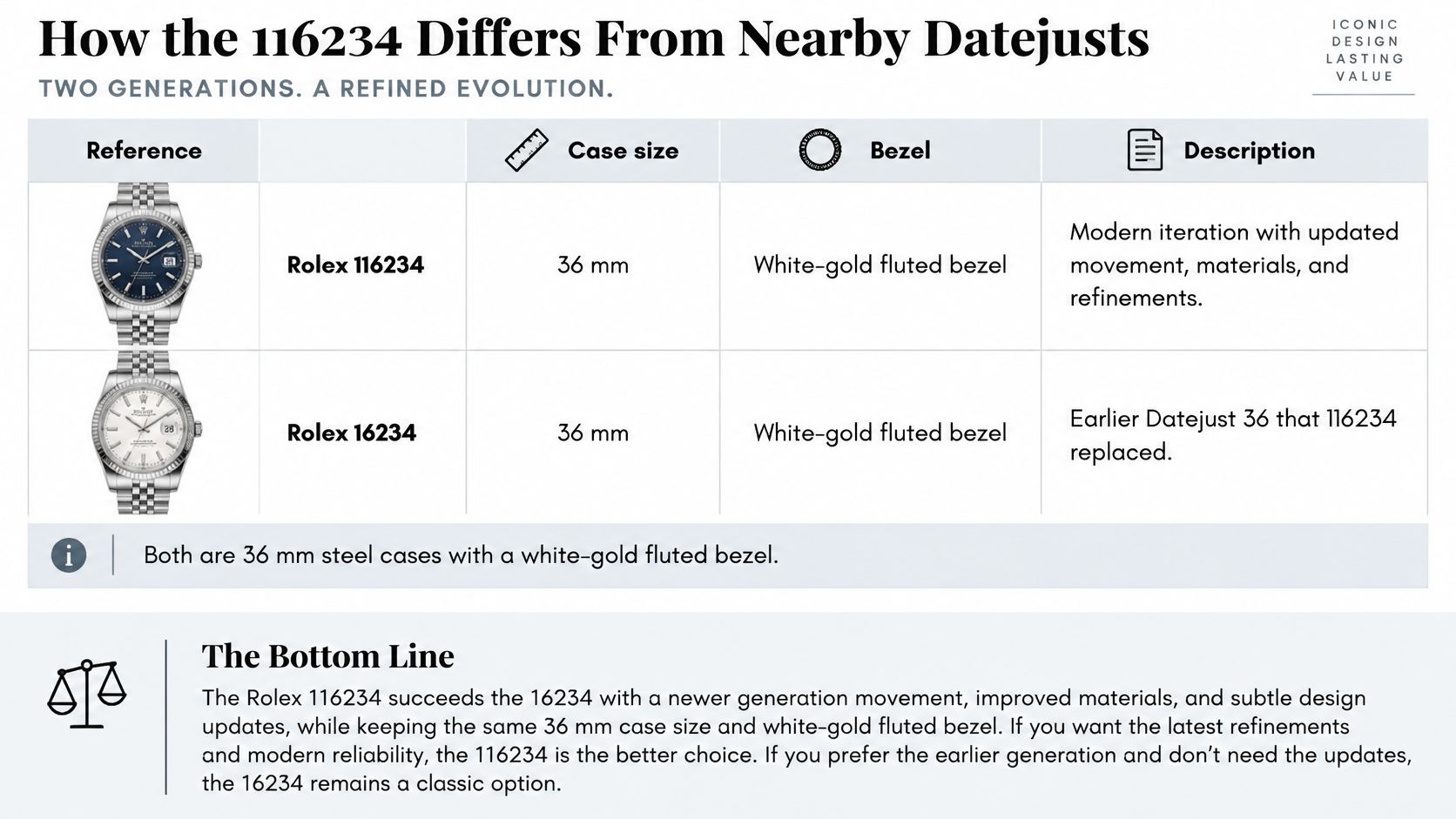
| 16234 | Earlier Datejust 36, replaced by 116234 | 36 mm steel, white-gold fluted bezel | Caliber 3135 | Not established by the cited specifications |
| 116234 | About 2004 or 2005 to 2018 | 36 mm Oystersteel, 18-karat white-gold fluted bezel | Caliber 3135, 31 jewels, 28,800 vph | About 42 to 48 hours |
| 126234 | From about 2018 | 36 mm steel and white-gold Datejust | Caliber 3235 | About 70 hours |
The EveryWatch technical description identifies the 116234's Caliber 3135, 31 jewels, and 28,800 vibrations per hour, and contrasts its approximately 42-to-48-hour reserve with the successor's Caliber 3235 and roughly 70-hour reserve.
The earlier and later references can look closely related in photographs. This visual comparison is a starting point for recognizing the family resemblance, not a substitute for checking the actual watch.
Earlier generation or longer-running successor?
The move from 16234 to 116234 wasn't a move to a larger case. Both belong to the classic Datejust size family and share the steel-and-white-gold appearance. When comparing those generations, examine the case profile, bracelet construction, clasp, and engraving details rather than expecting an obvious size difference.
Don't treat rehaut engraving as a universal shortcut to dating every example. The rehaut is the inner ring between the dial and crystal. Check what is present on the watch and whether it agrees with its documentation.
The successor changes the ownership decision more clearly through its longer reserve. If you rotate watches and leave the Datejust unworn between outings, that additional running time may be useful. If you wear your watch regularly, movement condition and service history may matter more to your daily satisfaction.
Choose the movement generation for how you'll use the watch, not because discontinued automatically means more desirable.
Keep reference and size comparisons separate
A Datejust with a different metal combination can also have a similar-looking reference number. Our explanation of the Rolex 116231 Datejust 36 helps separate that neighboring reference from the steel-and-white-gold configuration discussed here.
The same caution applies to size. Lady-Datejust and Datejust 31 listings are not smaller-looking photographs of this reference, and Datejust 41 listings belong to a larger case family. Read the reference, case dimension, and metal description together.
Our verdict is practical: choose the 116234 for its case generation, traditional proportions, and mature movement architecture, provided the particular example passes inspection. Choose the successor when its newer generation and longer reserve solve a real need. Neither choice excuses weak documentation or poor condition.
How a 36 mm Datejust Fits and Wears
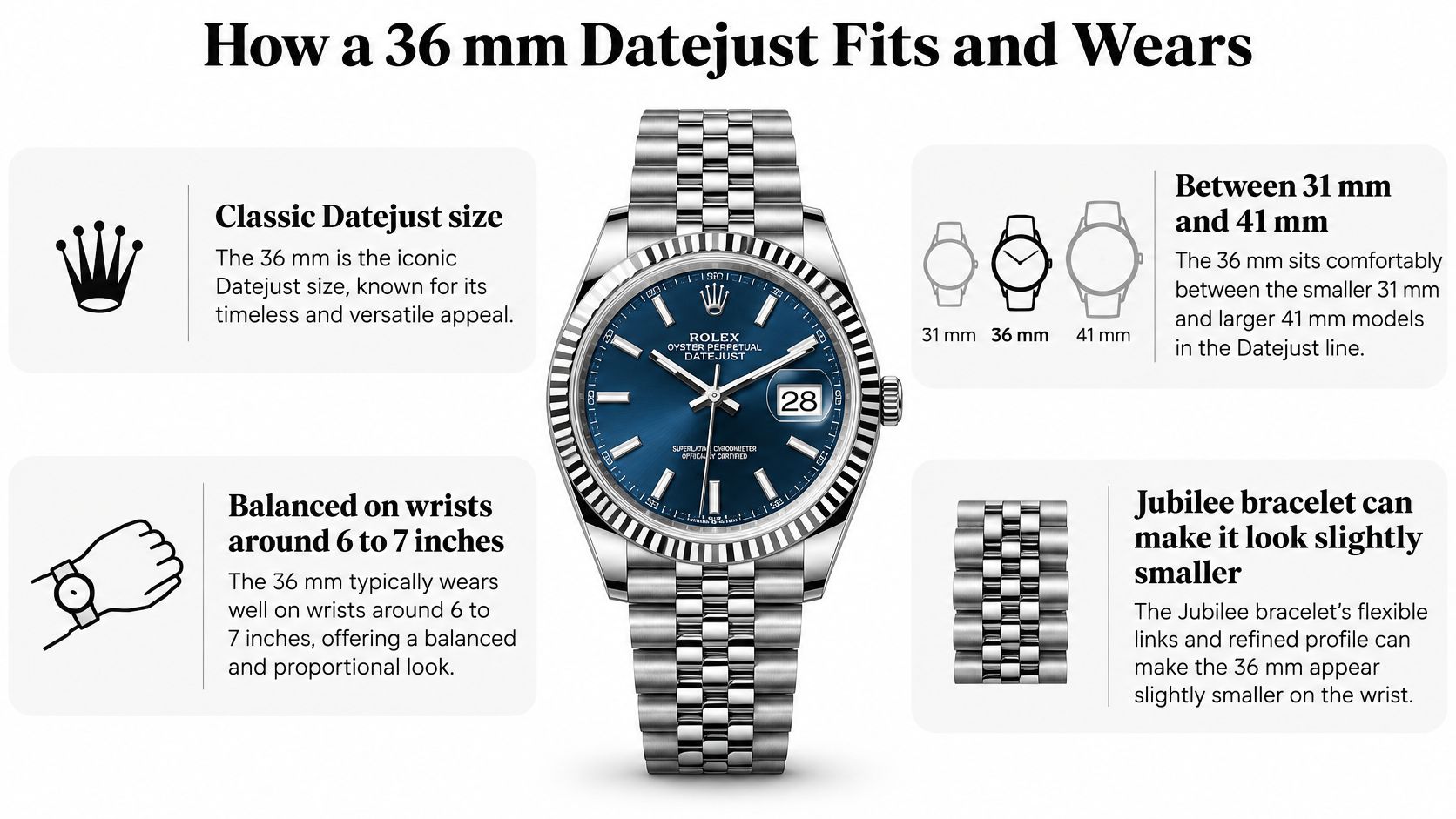
The classic Datejust size often feels less imposing on the wrist than its close-up listing photographs suggest. We'd describe it as a dress watch built for daily wear, rather than a diver or a jewelry-only piece.
Use the following illustration for visual context, but don't treat wrist circumference as a sizing formula. Wrist shape and bracelet adjustment can change the result.
Try the watch before judging its diameter
A flat wrist can support a case differently from a round wrist of the same circumference. Bracelet style also changes the visual impression, but there's no reliable rule that Jubilee always makes the watch look larger or smaller.
- Set the watch in its normal position. Place it above the wrist bone, with the crown toward the thumb side when worn on the left wrist.
- Look at the lugs from above. They shouldn't project beyond the edges of your wrist. Check a mirror as well as the close-up view.
- Compare bracelet feel. If possible, try both bracelet designs with a sensible adjustment. Notice pinching, sliding, and whether the clasp sits comfortably underneath.
Our watch case-size comparison explains why diameter alone doesn't settle the fit question. For a smaller case, use our Lady-Datejust size guide; for a ceremony purchase, our groom's Rolex wedding-watch guide addresses that choice separately.
Daily wear still requires sound seals
A published Chrono24 example lists 36 mm and 10 ATM, or 100 meters, but that rating relies on a properly maintained case, crystal, crown, and gaskets. Seals age, and opening or repairing the case can affect water resistance.
Have a pre-owned example pressure tested before water exposure. Don't operate the crown underwater, and don't assume an intact-looking case proves the seals are sound.
For another visual perspective on the watch, you can watch the video below.
What to Check Before You Buy Pre-Owned
| Example | Reported price | What it shows |
|---|---|---|
| Monaco sale | About $5,632 | Lower end of recorded 2025 results |
| United States sale | About $7,015 | US result below another US sale |
| United States sale | About $8,125 | Same country, different watch |
| Sweden sale | About $8,915 | International result in the middle |
| Higher recorded sale | About $10,847 | Upper end of the cited set |
| 2005 example | About $7,316 | Original papers, no original box |
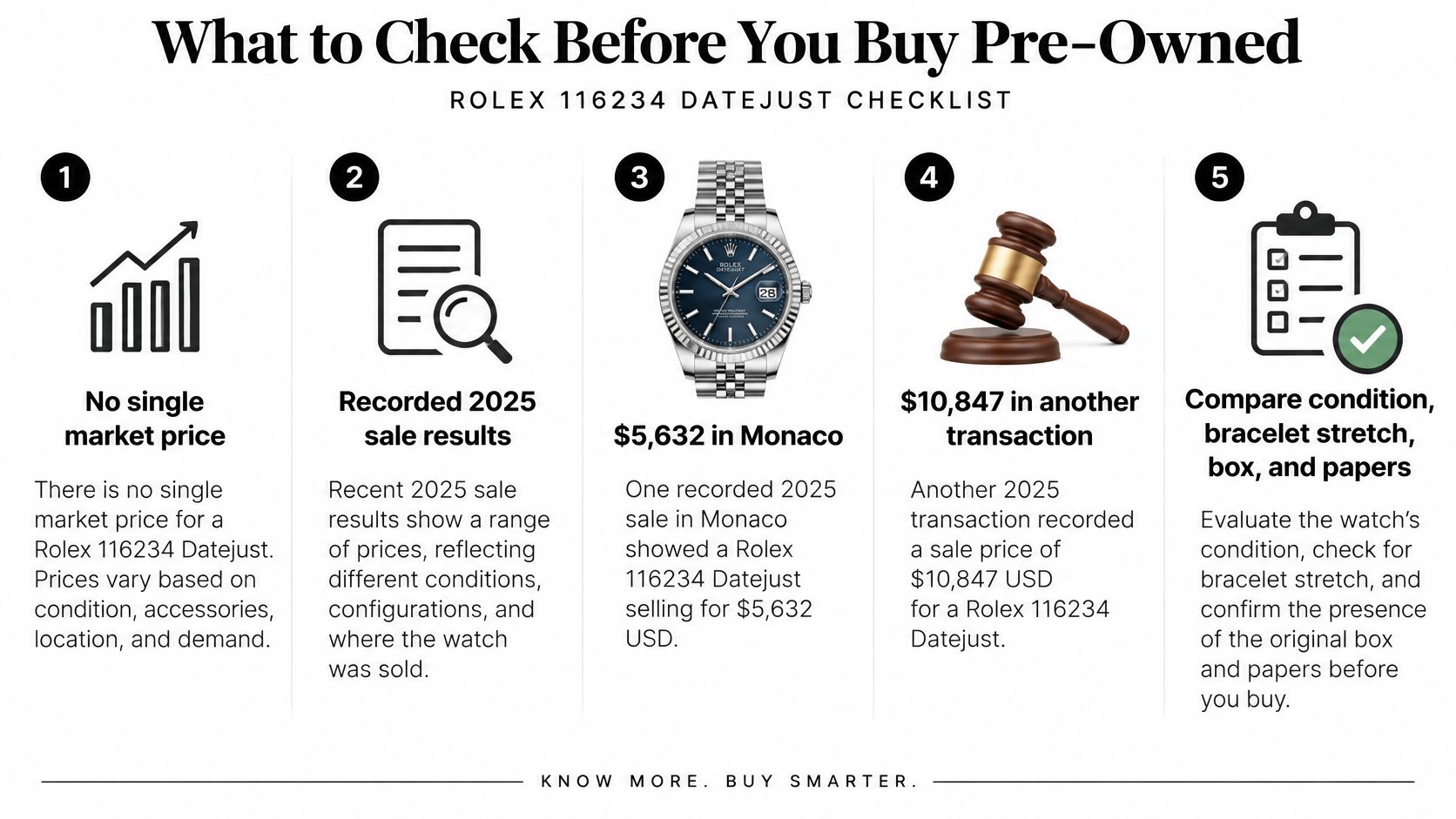
These are market transaction results, not ECI prices: EveryWatch's recorded auction results include the 2025 examples from approximately $5,632 to $10,847, as well as the 2005 example at approximately $7,316 with papers but no original box. They demonstrate why there's no single useful market price without matching the configuration and condition.
A dealer's asking price isn't a completed sale. An auction result may be presented with or without the buyer's premium, so check the reporting basis and account for applicable taxes before comparing your total cost.
Match the watch before matching the price
Start with dial, approximate age, bracelet, condition, accessories, and sales channel. A transaction in the same country can still be a poor comparison if the other watch has a different dial or needs substantial service.
The checklist illustration highlights the main comparison points.
Use this inspection order before committing:
- Match identity and paperwork. Compare reference and serial information with the warranty card and applicable case or rehaut engravings. A box by itself doesn't identify the watch.
- Inspect the face under magnification. Examine dial printing, marker placement, hand alignment, and Cyclops positioning. Resolve irregularities through qualified inspection rather than photographs alone.
- Check date operation. Have the seller or watchmaker demonstrate setting and date-change behavior. Sticking or poor alignment needs investigation.
- Examine the exterior separately. Look at bezel fluting, lug edges, bracelet articulation, clasp closure, and missing links. A clean movement doesn't repair a heavily worn bracelet.
- Request measured condition information. Ask for timekeeping results and a documented pressure test. A statement that the watch runs isn't a timing report.
- Arrange movement inspection when history is missing. A qualified watchmaker should open the case with the correct equipment and assess the movement, seals, and service needs.
Authenticity and condition are separate risks
An authentic watch can still have a replacement dial, a non-original bracelet, heavily polished lugs, or overdue service. A documented EveryWatch listing illustrates why accessory originality and service recommendations deserve close reading rather than a quick glance at the headline.
Buying caution: Papers can support identification. They don't prove that every component remains original or that the movement is healthy.
Our guide to checking whether a Rolex is real provides additional context, but a physical inspection remains important. Don't let a low price turn unresolved questions into acceptable risks.
Recognizable Datejust configurations tend to hold value because buyers understand the long-running design and can compare examples. That isn't a return forecast. Your purchase price, condition, maintenance costs, and eventual selling channel still matter.
Choose the Datejust That Fits Your Wrist
Choose a 116234 when its proportions, fluted bezel, and movement generation suit you, and the particular dial, bracelet, condition, and paperwork justify the asking price. Don't buy one merely because it sits at the lower end of an online price range.
Wait when the serial information, Cyclops, or bracelet raises an unresolved question. Missing accessories aren't automatically a reason to reject a watch, but they shouldn't be concealed or priced as though they're present. Overdue service should be evaluated as an additional cost, not dismissed as routine.
When another Datejust makes more sense
- Choose the successor if a longer reserve is important because you regularly rotate watches.
- Choose a smaller case if the lugs or bracelet feel too broad, even when the watch is adjusted properly.
- Choose a larger face if you prefer more wrist presence or find it easier to read.
We offer Datejust sizes 31, 36, and 41, with choices including steel, steel-and-gold configurations, smooth or fluted bezels, and Oyster or Jubilee bracelets. These listed alternatives illustrate how the decision changes when you move beyond the 116234.
Rolex 16233 Datejust 36 mm White Index Dial Jubilee Bracelet
About $9,700. This listed example has an 18K yellow-gold fluted bezel, white index dial, Jubilee bracelet, box, and papers, dated 1999. It's an alternative for someone who wants the familiar Datejust proportions with visible yellow-gold contrast.
Rolex 178271 Datejust 31 mm Black Diamond Dial Jubilee Bracelet
About $12,900. This listed example has an 18K rose-gold fluted bezel, black diamond dial, Jubilee bracelet, box, and papers, dated 2005. It offers a smaller case and a different metal-and-dial combination rather than a direct substitute for the 116234.
Browse the Rolex Datejust collection to view available examples and their individual details. Each pre-owned watch is one of a kind, so confirm availability and the current listing before deciding; no specific 116234 price is quoted here.
How can you pay for it?
We offer financing through Affirm, Synchrony, Acima, and Snap Finance, with approval and terms set by each provider. Our flexible financing and leasing options page explains the available paths, and our Rolex financing guide provides additional buying context. Each provider handles its own approval, so read the terms displayed during the application before agreeing, including the total cost and repayment obligations.
Customers who own a luxury watch can also explore a trade-in through our sell-your-luxury-watch page. Trade-ins are offered for watches only. Keep the purchase decision separate from the payment decision: first establish that the particular Datejust fits your wrist and condition requirements, then choose a payment arrangement you're comfortable maintaining.
Frequently asked questions
Is the 116234 the same as the 126234?
No. The 126234 is the successor and uses the newer Caliber 3235, while the 116234 uses Caliber 3135. The successor offers a longer published reserve, but similar outward styling doesn't make the references interchangeable.
How do I confirm the production year of a 116234?
Compare the warranty-card date with the serial information and applicable engravings, including the rehaut where present. The warranty date records the documented sale or warranty event, not necessarily the exact manufacturing date, so don't rely on a single advertised year without checking the watch.
Does a pre-owned 116234 need service before it is worn?
Not necessarily, but appearance alone won't establish movement or seal condition. If service history and test results are missing, have a qualified watchmaker inspect it and perform an appropriate pressure test before water exposure.
Is a diamond dial always the better purchase?
No. It may appeal to you more, but dial originality, overall condition, and the asking price still need to make sense together. A plain-dial example with clear documentation can be a better fit than a diamond-dial watch with unresolved replacement-part questions.
Should I insist on the original box and papers?
They're useful accessories, especially for identification and future resale discussions, but they don't replace inspection. Decide how important completeness is to you, then compare watches with similar documentation rather than treating every boxed watch as equivalent.
We help buyers compare pre-owned Datejust watches by case size, dial, bracelet, documentation, and condition, not reference number alone. Visit ECI Jewelers online or in our New York City Diamond District showroom to discuss which configuration fits your wrist and budget. Prices shown are as of October 2026; confirm current pricing and availability, since each pre-owned watch is one of a kind.


