

The Jacob and Co Five Time Zone watch puts your local time in the center and Paris, New York, Los Angeles, and Tokyo on four fixed subdials, each with its own quartz movement. That means it isn't one watch doing five jobs with one set of gears. It's five small clocks sharing one case.
Why does that matter if you're buying one pre-owned? Because four dials can look perfect while the fifth is dead. We think the first check isn't diamonds or case size. It's whether every display advances and sets on its own.
What the Five Time Zone Dial Shows
The dial shows five times at once, with no mode button and no digital screen. You read your own time first. Then you glance at the city you need.
Start in the middle
Your local time is the time where you are now. It sits on the main central hands. The four smaller dials around it are called subdials, which are small dials set into the main dial.
Each subdial has a fixed city name. A fixed name means the label doesn't rotate or change. Paris stays Paris. Tokyo stays Tokyo.
The Chrono24 magazine guide to Jacob & Co. describes the layout as local time in the center, with Paris, New York, Los Angeles, and Tokyo on the four subdials. Use this table as your map.
Five Time Zone dial positions
| Indication | Usual position | What it shows | Why it is there |
|---|---|---|---|
| Local time | Center | Wearer's home time on the main hands | The time you live by, set without moving the city dials |
| Paris | Around 8 o'clock | Western European time | A fixed reference for Europe |
| New York | Around 10 o'clock | US East Coast time | Business and travel on the East Coast |
| Los Angeles | Around 2 o'clock | US West Coast time | The other main US coast |
| Tokyo | Around 4 o'clock | East Asian time | A major market across the date line region |
Why the face looks crowded
The colors and close spacing confuse some buyers at first. That's normal. Each city is a working display, not a name printed on a ring for decoration.
A date window often shares the dial too. The date is useful when you travel, but it adds one more thing to read. Give yourself a few seconds in person. Point to each city out loud and say the time. If you can't do that at the counter, you won't do it faster in an airport.
A simple test: Cover the center with a fingertip. You should still be able to read all four cities without guessing which hands belong where.
This is different from a single extra hand that points to a second zone. If you want that comparison explained in plain terms, read our guide on how a GMT watch works and who it suits after you understand this dial.
The next question is the important one. How do five displays stay separate when you set only one of them?
How Five Quartz Movements Stay Independent
Say you fly from New York to Los Angeles. You land and need to move your local time back. You don't want Paris and Tokyo to move with it, because those cities didn't change.
On this watch, they don't have to. You reset the center. The other four keep their own times.
One case, five small clocks
Think of five small clocks in one case. That analogy is close enough to help you shop well.
This map shows the idea before we put names on the parts.
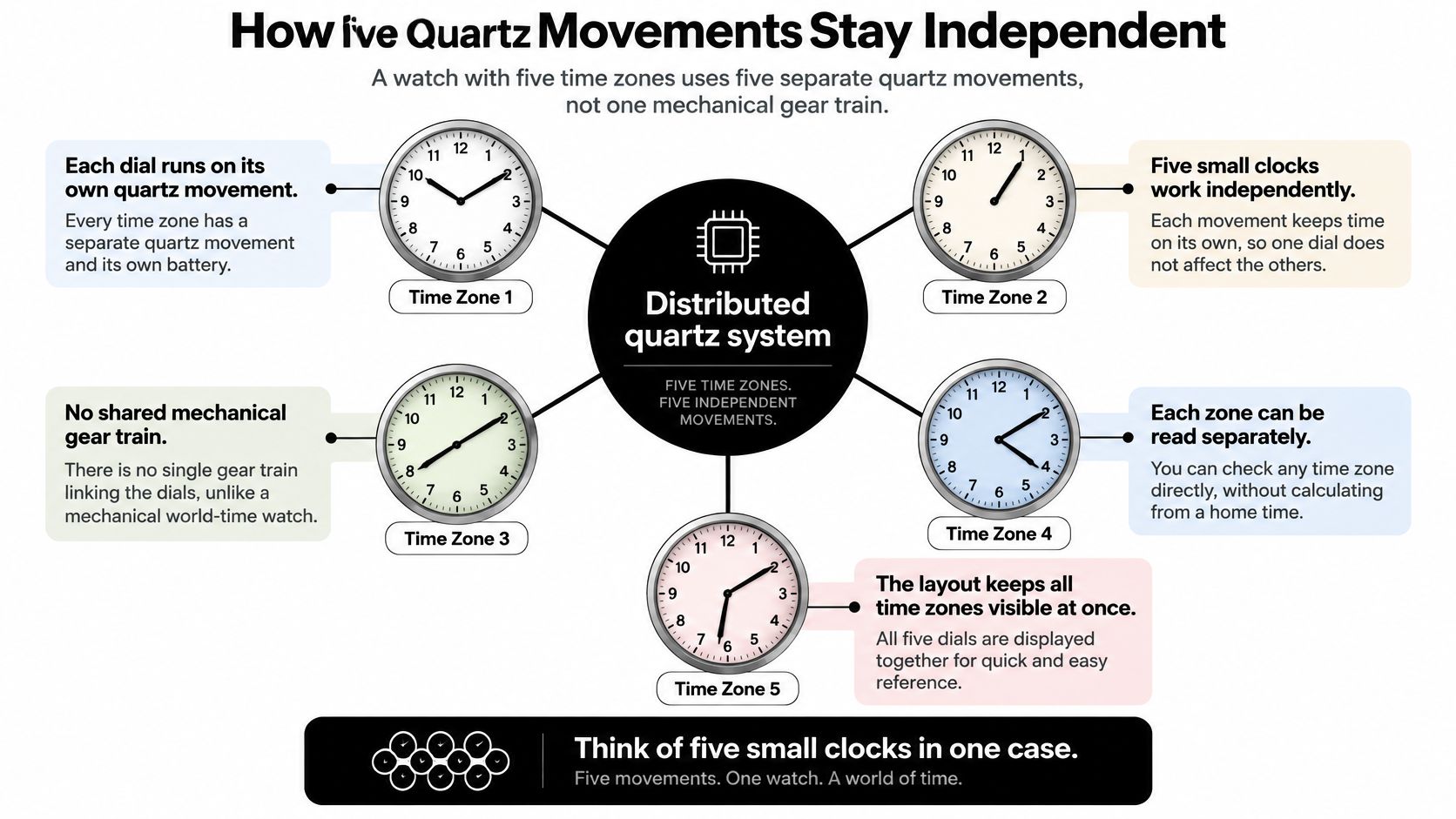
A movement is the engine that drives the hands. A quartz movement uses a battery and an electronic circuit to step the hands forward, instead of a wound spring.
The WatchGuys history of the Five Time Zone describes the original as a distributed quartz timing system with five quartz-driven indications, not a conventional single-movement world-time watch. Distributed just means the work is spread across separate units.
Each unit has its own setting path. The small controls for the city dials are often called pushers. A pusher is a button you press to set a display. When you handle one, each pusher should engage with a clear, positive feel. It shouldn't feel stuck, loose, or dead.
Why this beats a linked display for some travelers
Many travel watches link the second zone to the main hour hand with gears. Change one, and the other follows in a set pattern. That's fine if you only track home and one other place.
The Five Time Zone takes a different road. You can set the center for where you've landed and leave New York, Los Angeles, Paris, and Tokyo alone. You can also correct one city without starting over on the rest.
There's a trade-off. Five separate quartz units can fail separately. A clean crystal and a bright dial can hide a subdial that stopped months ago because its battery died or its circuit failed.
A Five Time Zone isn't checked by looking at it once. It's checked by watching all five displays advance.
If the quartz idea is new to you, our plain comparison of automatic and quartz watch movements explains the battery and spring difference without the jargon.
This short video gives you a closer look at how the displays sit together on a real dial.
Where the model came from
The model arrived early in the brand's watch story, not as a later add-on. The Hodinkee account of how the Five Time Zone shaped modern watch culture says Jacob & Co. introduced it in 2002 as the company's first watch collection, as founder Jacob Arabo expanded beyond jewelry.
That same account notes that a 2002 press release described the watch as transcending gender, so we call the design unisex, meaning it was offered for men and women rather than split into separate lines. Two sentences of history are enough here. What matters at our counter is that an early, jewelry-led brand chose five independent quartz units because the idea was clear and bold, even if the servicing is less simple than a one-movement watch.
When you test one, don't ask only if it's running. Ask which displays are running, which pushers work, and whether the batteries and service work are written down. We'll turn that into a step-by-step check after size, because a working watch still has to fit your wrist.
Which Case Size and Setting Fits
Which Five Time Zone will sit comfortably on your wrist? Case size is a useful starting point, but the watch's shape and setting matter too. A case that is too wide can extend beyond your wrist bones, shift as you move, or catch on a cuff. A flatter fit is less likely to bump into things.
The case is the metal body that holds the dial and movements. Its size is measured across the body in millimeters, or mm. For more on how that number relates to wrist fit, see our guide to choosing between 36 mm, 39 mm, and 41 mm watch cases.
Read the sizes side by side
Five Time Zone specifications vary by example. These listings document three sizes and different bezel details:
- A 1stDibs listing for a mother-of-pearl-dial Five Time Zone describes a 40 mm stainless-steel watch with quartz movement, sapphire crystal, rubber strap, and deployant buckle. It also describes a 47 mm version with a factory-set diamond bezel of approximately 3.2 carats.
- An EveryWatch auction record for a 42 mm Five Time Zone describes a stainless-steel case, quartz movement, diamond bezel, and four additional time-zone subdials.
- A separate EveryWatch auction record for a 47 mm example describes a stainless-steel case with an approximately 3.00-carat total-weight diamond bezel.
Documented Five Time Zone sizes and settings
| Example | Case | Movement and crystal | Noted details |
|---|---|---|---|
| 40 mm steel | 40 mm, rubber strap, deployant buckle | Quartz, sapphire crystal | Stainless-steel case |
| 42 mm diamond-bezel | 42 mm stainless steel | Quartz | Diamond bezel, four additional time-zone subdials |
| 47 mm diamond bezel | 47 mm stainless steel | Quartz | Approximately 3.2 carats or approximately 3.00 carats, as described in separate listings |
Crystal means the clear cover over the dial. Sapphire resists scratches better than mineral glass. A deployant buckle is a folding clasp, unlike a simple pin buckle. The bezel is the ring around the crystal. A carat measures the weight of gemstones, not their size on the case or how the watch will wear.
Plain steel or gem-set
A steel case with a rubber strap gives the watch a simpler look. A diamond bezel adds a jewelry element, so the stones and their setting become part of the comparison. Two watches with the same model name can differ in appearance and specifications. Compare the exact reference, or model code, and the case details for the specific watch.
Water resistance varies by reference. Confirm the rating for the exact watch before wearing it near water.
What to Check Before You Buy Pre-Owned
Run the checks in this order. Identity first. Function second. Fit and water next. Diamonds last.
That order protects you. A pretty bezel can't fix the wrong reference or a dead subdial.
This checklist shows the order we want you to follow at the counter.
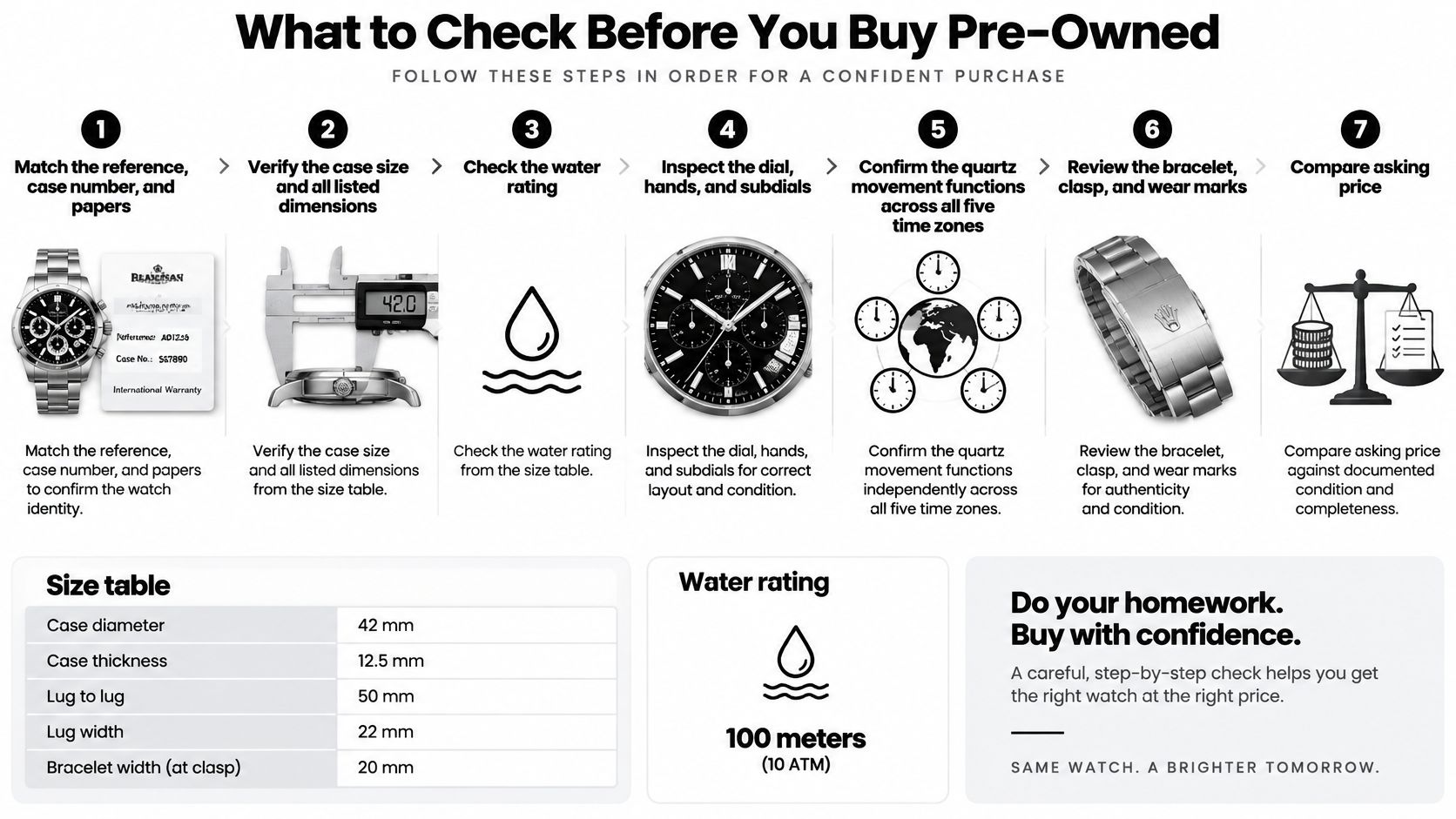
The counter check
- Match the papers to the watch. Read the reference and case number on the watch and on the papers. They should match exactly. Different sizes aren't interchangeable, and the wrong papers weaken the whole file.
- Watch all five displays advance. Leave the watch running while you talk. Every display should move as it should. One frozen subdial is enough reason to pause.
- Set each display by itself. Use each pusher or control and confirm that only its own display changes. A pusher that feels mushy or does nothing needs a written explanation and a test record.
- Ask about batteries and service. Ask whether the four city subdials have fresh batteries or a service note. A seller should be able to say what was changed and when, or say plainly that it isn't documented.
- Put it on your wrist. Look straight down. Do the lugs hang past the edges of your wrist? Bend your hand back and forward. The case shouldn't dig in or slide far toward your hand.
- Check water claims on that case. The Chrono24 listing details for a Five Time Zone notes standard examples at 47 mm in diameter, about 13 to 13.5 mm thick, about 53 mm lug to lug, and 22 mm lugs, and it warns that water resistance varies by reference. Ask for a pressure-test record tied to the specific case, and inspect the gaskets, the rubber seals that help keep water out, plus the crown.
- Confirm the diamond work. Ask whether a diamond bezel is factory-set or added later. Aftermarket means added after the watch left the factory. Aftermarket work can change service options and the value of the papers, even when the stones look good.
- Get clear photos and the full strap story. Ask for the case back, each subdial, the clasp, the box, and every strap included. Strap sets varied by version, so don't assume missing straps are a minor detail until you know what that reference came with.
Our rule at the counter: Papers, five working displays, and a test record come before sparkle. Diamonds don't make an untested watch a safer buy.
Reading small details is a learnable habit. The same patience helps with other luxury goods, and a careful guide to how to spot counterfeit perfume shows how packaging, codes, and finish can raise questions before you pay. With a watch, apply that patience to numbers, printing, pushers, and papers.
We inspect each luxury watch for authenticity using serial number verification, movement inspection, component analysis, and performance testing. If you want the broader terms explained, read our page on certified pre-owned watches and what the checks cover. Use the same questions with any seller.
You should walk away if the seller can't match the watch to its papers, won't let you test every pusher, or treats a dead subdial as normal wear. Those aren't small problems on a watch whose whole idea is five working times.
Current Five Time Zone Picks at ECI
Are you looking for a specific Five Time Zone watch today? Availability can change, so check our current Jacob & Co. listings for a piece that is in stock. We can also source a luxury watch for a customer. We'll confirm its details before discussing a price.
If you mainly want travel time
A five-city display is one way to track several local times. A mechanical travel watch offers a different setup, with fewer time zones to read at once.
- Rolex GMT-Master II: We offer this model for buyers who travel often or want multiple time zone functionality. It uses one movement and a linked extra hour hand.
- Rolex Sky-Dweller: We offer this model with a dual time zone display and an annual calendar. It suits buyers who want to track home and away time while keeping the date in view.
We sell pre-owned Rolex watches. Before comparing one with a Jacob & Co. piece, confirm its reference, condition, and papers. Those details help distinguish watches that may look similar in photos.
For buyers drawn to unusual materials, Astro West offers a distinctive gift for meteorite enthusiasts. Its meteorite dial offers a different kind of visual interest, though it does not display five city times.
As a family-owned luxury watch and fine jewelry retailer with over 25 years of experience, we focus on clear details. Check the current listing and ask us to confirm the watch's name, reference, condition, and included items before deciding.
How Can You Pay for It
You can ask us about financing through Affirm, Synchrony, Acima, and Snap Finance, with approval and terms set by each provider. We don't set the credit decision or the rate. The provider does.
Start with our page on flexible financing and leasing options at ECI Jewelers. Read the provider terms before you apply. A monthly payment only helps if the total cost and the term fit your budget.
Trading in a watch
Because this is a watch purchase, you can also ask about trading in a luxury watch toward another piece. Our page to sell or trade in your luxury watch is the place to start that conversation.
We look at the watch you're trading and the piece you want together. The numbers depend on that pair. Condition, papers, recent service, and demand for that exact reference all matter.
A recognizable Jacob & Co. piece can be easier to discuss than an unknown fashion watch because we can identify the model and test what it does. That doesn't promise a set value. It means the conversation can be specific.
If credit is your main concern, our guide to no credit check jewelry financing options explains the questions to ask before you sign. Don't let financing rush the watch checks. Test the five displays first. Then talk about payment.
Frequently asked questions
Is the Five Time Zone mechanical
No, the standard original is quartz. The center and each city subdial have separate quartz movements. That's why battery and circuit health must be checked one display at a time.
Can you change the four cities to other cities
The city names are fixed on the dial. You can set the time shown for each one, but the printed labels stay Paris, New York, Los Angeles, and Tokyo. If your regular cities are different, decide whether those four references still help you.
Is the largest size the only size
No. Documented examples include smaller and mid-size cases as well as the large standard size. Judge the exact case in front of you against your wrist, including thickness and lug-to-lug length.
Does a diamond bezel mean one standard spec
No. Diamond weight, setting, paperwork, and water resistance must be read from that exact reference. A factory-set bezel with matching papers is a different purchase from an undocumented or aftermarket bezel.
What drives the price of a pre-owned one
Condition, completeness, and the exact reference drive the discussion. Five working displays, matching papers, included straps, and documented service help because the next buyer can verify them. Recognizable early Jacob & Co. pieces tend to hold value better than unknown fashion watches, but that isn't a promise that any one piece will appreciate.
Find your Five Time Zone. Compare a current piece with us online, ask for its reference and test notes, and try the pusher checks before you pay. Prices shown are as of July 2026. Each pre-owned watch is one of a kind.
If you want a five-city quartz watch that's been matched to its papers and checked display by display, or you'd rather compare it with a mechanical travel watch in person, visit ECI Jewelers and ask us what's currently available. Bring your questions about size, batteries, diamond setting, financing, or a watch you'd like to trade, and we'll walk through the exact piece with you.


