

At its heart, a GMT watch is a traveler's best friend. It’s a specialized timepiece that elegantly displays two or more time zones simultaneously, all from your wrist. Think of it as a mechanical world clock, designed for those who live life across different longitudes.
What a GMT Watch Does for You
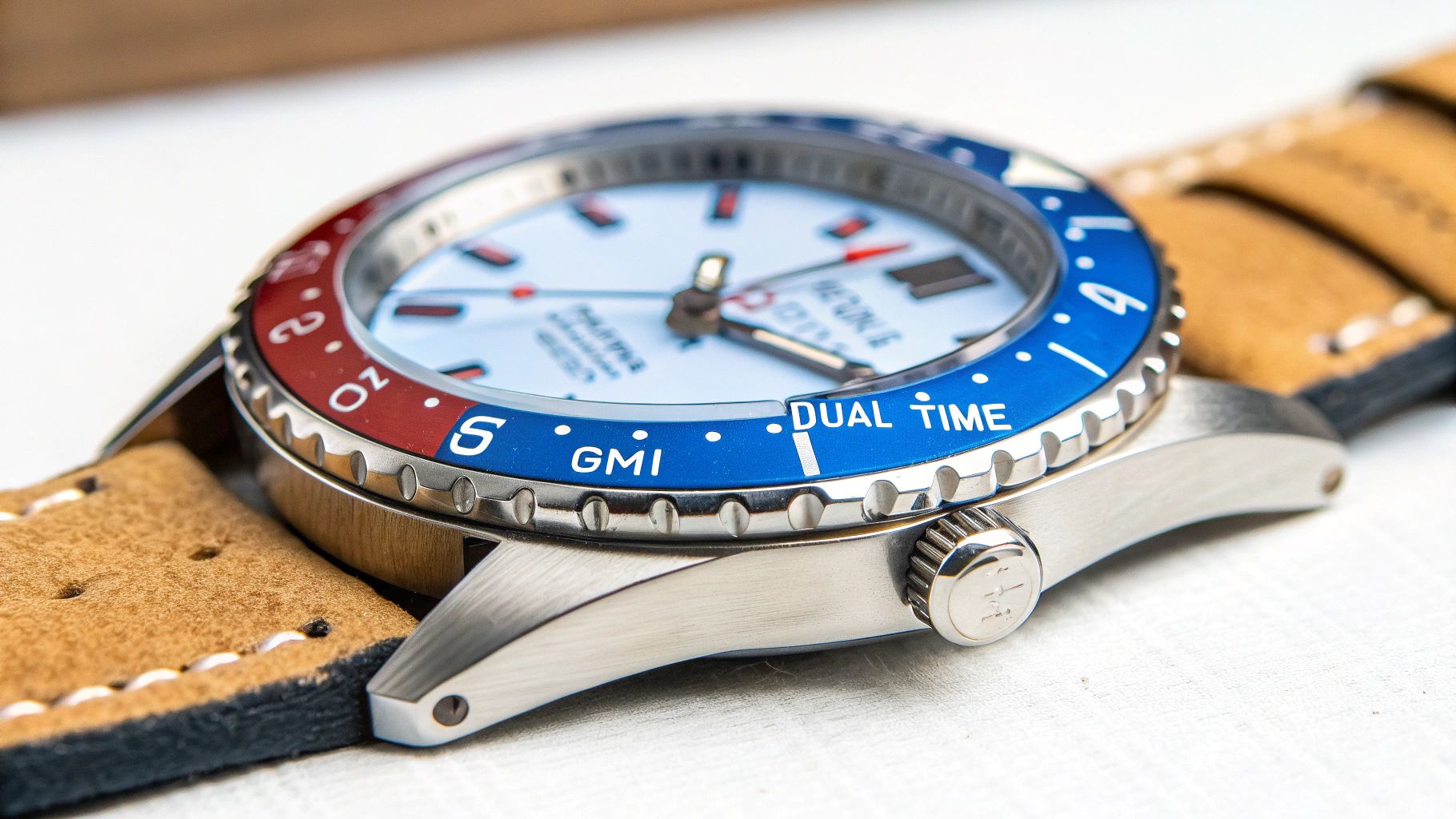
A GMT watch offers a brilliantly simple solution to a modern problem: keeping track of time across the globe. It achieves this with a few key features working in concert, making it an indispensable tool for pilots, international business professionals, and adventurers alike.
The name "GMT" comes from Greenwich Mean Time, the historic time standard that once coordinated the world's clocks. A GMT watch builds on this global principle to keep you connected to a second time zone—usually your "home" time—no matter where your travels take you.
Core Components and Their Roles
To really understand a GMT watch, you just need to know its three core parts. Each piece has a specific job that contributes to its dual-time magic.
To give you a quick overview, here's how the key components work together.
GMT Watch at a Glance
| Component | Primary Function |
|---|---|
| The Fourth Hand | An additional hour hand that circles the dial once every 24 hours. |
| The 24-Hour Bezel | A rotating outer ring marked in 24-hour increments, read by the fourth hand. |
| Main Hands | The standard hour, minute, and second hands that display the current local time. |
Let's break that down a bit more.
- The Fourth Hand: This is the most distinct feature, often tipped with an arrow and finished in a contrasting color. This is your GMT hand, and it makes one full rotation every 24 hours, not 12.
- The 24-Hour Bezel: The rotating outer ring is marked with 24-hour increments. The GMT hand points to this bezel to show you the time in your second zone.
- The Main Hands: The standard 12-hour hand, minute hand, and second hand display your current "local" time, just like on any other watch.
In essence, you read your local time on the main dial and your home time by seeing where the GMT hand points on the 24-hour bezel. It's a remarkably intuitive system once you get the hang of it.
For global adventurers, a GMT watch goes beyond just tracking time zones; it becomes a practical ally in navigating the rigors of travel. It’s a good idea to pair it with effective strategies for managing jet lag. This practical function solidifies its status as more than a luxury item—it's a purpose-built instrument.
The Jet-Age Story Behind the First GMT Watch
The GMT watch wasn’t born in a quiet design studio; it was forged right in the cockpit. Its story kicks off in the 1950s, a thrilling era when the roar of jet engines first started to shrink the globe. For the pilots of Pan American World Airways, these new long-haul flights created a problem that went way beyond navigation.
Crossing multiple time zones in a single trip caused serious mental fatigue—what we now call jet lag. Pilots needed a rock-solid tool to keep track of their local time while also keeping an eye on the time back home, which was set to the global standard, Greenwich Mean Time. This wasn't about convenience; it was critical for accurate flight logging, communication, and keeping the crew in sync.
A Partnership Forged in the Skies
To solve this, Pan Am went straight to Rolex with a challenge: create a wristwatch that could clearly display two time zones at once. The watch that came out of this collaboration became an instant icon.
In 1954, Rolex delivered the GMT-Master reference 6542, a game-changing timepiece developed hand-in-hand with Pan Am. Its name, of course, came from Greenwich Mean Time, the universal time standard since 1884.
This partnership was a landmark moment, turning a professional tool into a symbol of adventure and worldliness. The watch was an immediate hit and quickly became standard-issue gear for Pan Am pilots and navigators.
The original design had a standout red and blue bezel, earning it the legendary "Pepsi" nickname. This wasn't just for looks. The red half marked daylight hours (6 AM to 6 PM) and the blue marked nighttime, giving pilots an instant day/night read on their reference time. You can find more insights on the Rolex GMT-Master and its incredible legacy in our guide. What started as a practical tool soon became a coveted luxury watch, celebrated for its history, function, and timeless style.
How a GMT Watch Actually Works
To really get what makes a GMT watch so special, we need to pop the hood and look at the clever mechanics inside. The magic happens in the teamwork between a dedicated fourth hand—the GMT hand—and a 24-hour bezel. Together, they keep you anchored to your home time, no matter where you are.
Think of the GMT hand as your horological North Star. It’s a constant reference, making just one slow rotation around the dial every 24 hours. While your main hour hand travels with you, showing local time, the GMT hand stays put, always pointing to your home or reference time on the bezel.
This whole idea wasn't just a gimmick; it was born from a real-world problem faced by pilots in the golden age of aviation.
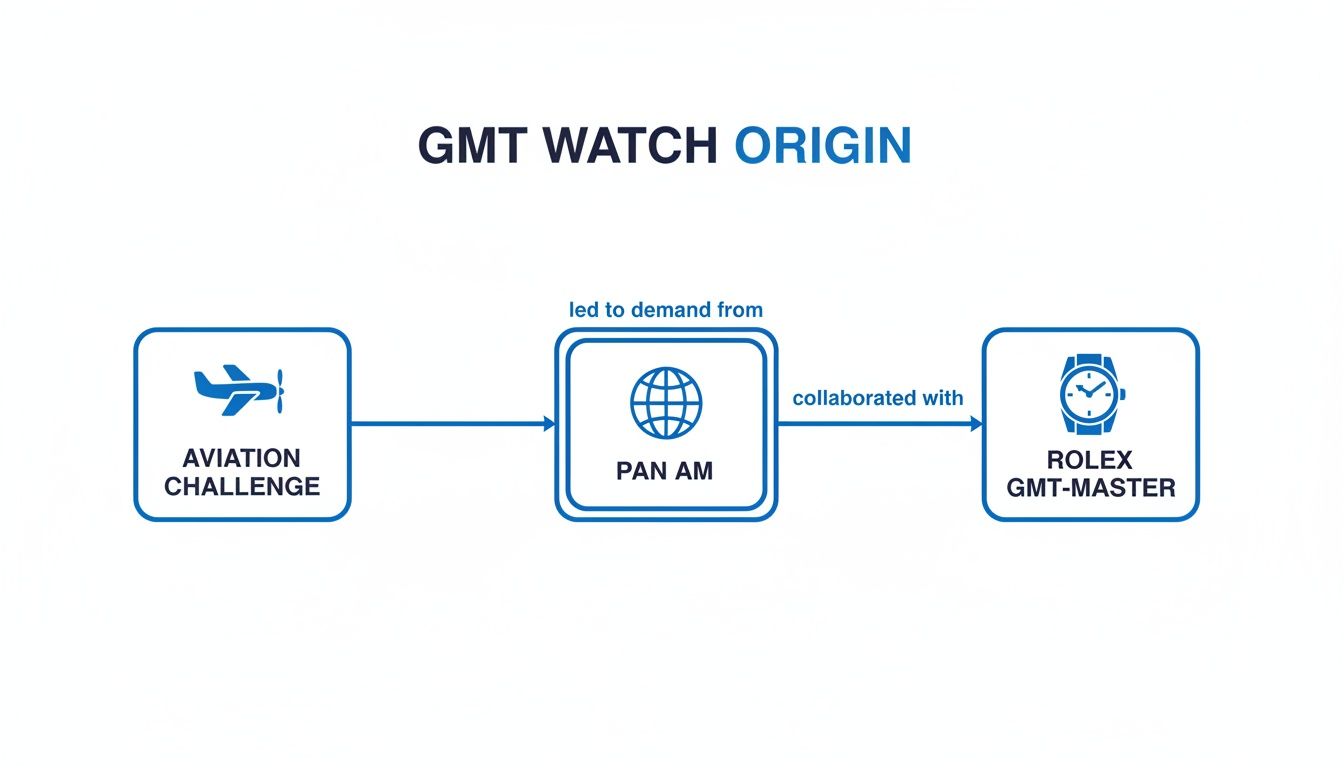
As you can see, the challenge of transcontinental flights for Pan Am pilots led directly to the creation of the legendary Rolex GMT-Master. That partnership forever cemented the GMT's place in the cockpit and in watch history.
Caller GMT vs. True GMT Movements
Now, here’s where it gets interesting for collectors: not all GMT movements are built the same. The two main flavors are "Caller" GMTs and "True" GMTs, and knowing the difference is key. Getting a handle on how a mechanical watch works in general provides a great foundation for these details.
-
Caller (or Office) GMT: On these watches, you can adjust the 24-hour GMT hand by itself. This setup is perfect for someone who stays in one place but needs to track another time zone—think of an executive in New York "calling" an office in London.
-
True (or Traveler) GMT: This is the one frequent flyers hunt for. The main 12-hour hand is the one that adjusts independently, "jumping" in one-hour clicks. When you land, you can update your local time in seconds without stopping the watch or messing up your home time.
The original 1954 Rolex GMT-Master actually had its 12-hour and 24-hour hands linked. But in 1982, Rolex changed the game with the GMT-Master II, which featured an updated movement that let the hands be set independently.
This was a huge leap forward. It allowed travelers to adjust the local hour hand on its own, setting the gold standard for what we now call a "True" GMT and defining the functionality that world travelers prize today.
Setting and Reading Your GMT Watch
Alright, now for the fun part: moving from theory to actually using your GMT. Getting the hang of it is much simpler than it looks, and once you do, you'll be tracking time zones like a seasoned pilot.
Let's walk through how to get it set up. The whole point is to anchor yourself to one time zone—your home time—so you always have a point of reference, no matter where your travels take you.
Setting Your Home and Local Time
There's a simple, two-step dance to getting your GMT watch perfectly synced up. Just follow these steps, and you'll be good to go.
-
Set Your Home Time (The GMT Hand): First, pull the crown all the way out. You're going to set the 24-hour GMT hand and the minute hand to your home time. If it’s 2 PM back home, you’ll point that GMT hand to the “14” on the bezel. Easy enough.
-
Set Your Local Time (The Main Hour Hand): Now, push the crown in one click. Adjust the main 12-hour hand to whatever the local time is where you're standing. If you've got a "True" GMT, you'll love this part—the hour hand jumps in crisp, one-hour increments without ever stopping the seconds hand.
And that's it. The main hands now show local time for your coffee meeting, while the GMT hand faithfully points to home time on the bezel. This elegant, at-a-glance display is the magic of the GMT complication.
Pro Tip for Travelers: After you land, the process is even easier. You only need to do the second step. Just give the crown a quick adjustment to jump the main hour hand forward or backward to your new time zone. The GMT hand stays put, keeping you connected to home.
How to Track a Third Time Zone
Here’s a classic move that watch collectors love. If your watch has a bidirectional rotating bezel, you can use it to keep an eye on a third time zone on the fly.
Let's say your home time is New York (GMT-4), but you need to track a colleague in Tokyo (GMT+9). That's a 13-hour difference. Just rotate the bezel forward or backward to account for that difference. Now, when you glance at your GMT hand, it’s pointing to the correct time in Tokyo on the newly adjusted bezel. Perfect for timing that international call without doing any mental math.
Iconic GMT Models Every Collector Should Know
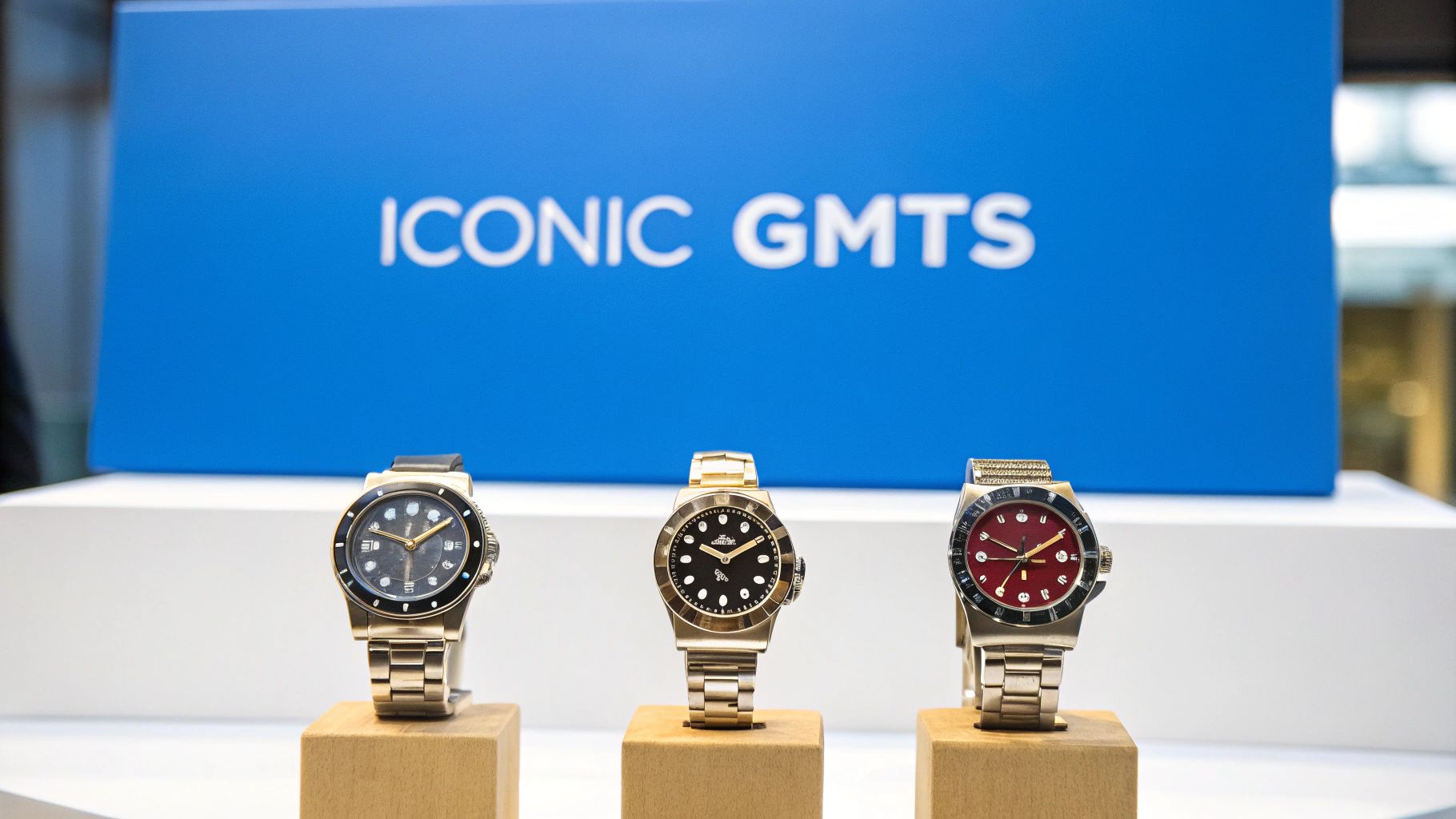
Understanding the mechanics of a GMT is one thing. But seeing that complication brought to life in legendary timepieces? That’s what really gets a collector’s heart racing. These watches are more than just tools; they're pieces of horological history, each with its own story and an undeniable presence on the wrist.
Since its debut in the 1950s, the GMT has become one of the most sought-after features in the luxury watch world. The original Rolex GMT-Master, launched in 1955, was so groundbreaking it set the standard for every dual-timezone watch that followed.
The Rolex GMT-Master II: The King of Dual Time
You can't talk about GMTs without starting with the king: the Rolex GMT-Master II. As the direct descendant of the original Pan Am pilot's watch, it has evolved into a cultural phenomenon. The model is legendary for its vibrant ceramic bezels, which have earned some very famous collector nicknames.
- The "Pepsi": The icon. Its signature red and blue bezel is the design that started it all, representing day and night hours. It's arguably the most famous GMT colorway ever created.
- The "Batman": A modern classic that took the community by storm. Introduced in 2013, its striking blue and black bezel gave the watch a sophisticated, contemporary edge that fans immediately loved.
- The "Root Beer": Known for its handsome brown and black bezel, often paired with two-tone steel and rose gold. This version has a warm, vintage-inspired look that really stands out.
For many collectors, acquiring a GMT-Master II isn't just buying a watch; it's owning a piece of aviation and watchmaking legacy. Its robust build and timeless design make it a cornerstone of any serious collection.
The Tudor Black Bay GMT: A Modern Contender
For those who love the heritage but want a different flavor, the Tudor Black Bay GMT is a fantastic choice. It has a distinct vintage tool-watch vibe, with a matte burgundy and blue bezel that offers a more subdued take on the classic "Pepsi" look. You can see how these iconic designs influence each other in our guide to the Rolex "Pepsi" GMT-Master II.
The Black Bay GMT is powered by a manufacture "True" GMT movement, delivering the traveler-focused functionality collectors demand. It packs incredible value and has quickly become one of the most popular GMTs on the market today.
Common GMT Questions
As you get deeper into the world of GMTs, a few questions always seem to pop up. Whether you're a seasoned collector or just starting out, here are the straightforward answers you need.
GMT vs. Dual Time: What's the Difference?
It’s easy to get these two mixed up, but the mechanics are quite different. A "True" GMT watch uses an independent 24-hour hand that circles the dial once a day, pointing to a 24-hour scale (usually on the bezel). This setup lets you track two time zones at a glance and often a third with a quick turn of the bezel.
A dual time watch, on the other hand, typically shows the second time zone on a smaller, separate 12-hour sub-dial. It’s still useful, but it lacks the third time zone capability and the intuitive 24-hour format of a true GMT.
Are GMT Watches a Good Investment?
Historically, yes—especially iconic models from powerhouse brands like Rolex. Certain references have not only held their value but appreciated significantly over time. A watch's investment potential really hinges on its brand reputation, reference number, overall condition, and provenance (the story and paperwork behind it).
For modern globetrotters, a GMT is more than an investment; it's an indispensable tool. If you're the type to embrace independence and see the world, a GMT makes managing time zones second nature as you plan your solo journey effortlessly.
Once built exclusively for pilots crossing continents, the GMT complication now has a massive following. It's the go-to function for anyone who travels, collaborates with international teams, or simply admires brilliant watchmaking. It’s a practical and stylish complication for today's global citizen.
Whether you're hunting for your first GMT or adding a rare reference to your collection, the experts at ECI Jewelers are here to help you find the perfect timepiece. https://www.ecijewelers.com


